


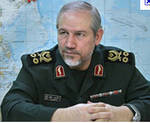
This is the life story of a person who today is the “military advisor” to Iranian Leader Ayatollah Khamenei. This has made him the most powerful military man in Iran. According to the Iranian Constitutions, the leadership post, now in the hands of Ayatollah Khamenei, is the Commander-in-Chief and can command to declare war or issue the order to ceasefire and piece. The IRCG, the Iranian military and the police force are all absolutely obedient to his commands and wishes. In a religious and dictator country like Iran where the highest rank belongs to a cleric, this means that his sayings and commands are those of God. In this regard, however, the IRGC is more religious than the military because, although the military commanders are all chosen from the IRGC, the main body consists of secular men who are less interested in getting involved in religion or politics. This distinguishes them from their IRGC counterparts who consider themselves as the “guardians’ of Ayatollah Khamenei and the protectors of the regime values.
Yahya Rahim Safavi is the military advisor to the Supreme Leader and always attends in public in his military uniform. Many journalists and analysts in Tehran believe he is the main planner of the Islamic Republic military tactics. Before he was chosen for this post, which is in spite of the title “advisor” is very important and influential, he was the Head of the IRGC for 10 years. He was preceded by Mohsen Rezaee, who, after 10 years of heading the IRGC, left the military, studied economics and challenged Ahmadinejad in the last year’s controversial elections, representing a vast range of former high-ranking IRGC officials who, although heartedly committed Ayatollah Khamenei, criticize Ahmadinejad’s various approaches and foreign adventures as an outline that, in Rezaee’s own word in his first press conference, “have placed the country on the verge of collapse”. He was succeeded by Aziz Hafari, the current head of the IRGC.
Not only has Rahim Safavi been a member of the IRGC for more than 30 years, but also his wife and brothers are members of the IRGC and the military as well and this has made the Safavis a military-political family.
His brother, Homayoun, is a member of the IRGC and Morteza, another brother, is in the military. Mehrdad, his other brother, was the commander of “Serat” engineering base when he got killed during Iran-Iraq war. However, long before these brothers joined the military and the IRGC, it was the oldest brother, Salman, who, during the Iranian imperial regime, established a group called “Tohidi Saf” with some prominent figures and started armed struggle with the imperial regime.
Mahboobeh, his sister, works at the Martyr Foundation which offers services to those whose family member got killed in Iran-Iraq war. Jalal Afshar, Mahboobeh’s husband, had a high post in Alghadir Garrison and Imam Hosein Division in Isfahan. Yahya safavi, the family’s sixth child, promoted through the Iranian military structure sooner and more easily.
Yahya was born in a family with a farmer father and a religious mother. When he was five, the family moved from the village to Isfahan, the second largest city after Tehran in Iran. After his mother died, his father remarried and the nine-member family increased to 11.
When he finished high school, he was uncertain whether or not to continue his study and go to university because in those days (Shah’s reign), Iranian universities promote western and secular values and from the viewpoint of religious families like Rahim Safavi, universities were full of immoralities.
Once in a local mosque, Rahim Safavi asks a cleric to do sortes for him, that is, to open Quran and if there comes a verse with a positive meaning on the page, he will go to university and if not, he won’t. The cleric tells him: “do whatever you have in your mind and you will definitely be successful.
Therefore, he and his friend Mahdi Yazdi (brother of Ayatollah Mohammad Yazdi, former head of Iranian Judiciary for ten years and now a key figure) started studying and when he passed the entrance exam, he went to Tabriz to major in geology.
The university was a gate for him to get into social activities and he established a student council named “Muslim Students Club of Tabriz University” with Ahmad Khoram (who later became the Minister of Transportation during Khatami presidency), Mehdi Bakeri (a well-known martyr during Iran-Iraq war whose family now is an ardent opponent to Ahmadinejad government and the IRGC) and Abolhasan Alle Es’hagh (a key economic figure and supporter of the regime). In this student council, which gathered at a dormitory called “valiahd” (Crown Prince) at eastern Tabriz but they called it “Valiasr” a title for the 12th Imam according to the Shiite, he experienced political-religious activities for the first time.
When he finished university, he was summoned for military service where his real education actually began. Wearing military uniform, he stepped in the main route of his life. In this time, he still thought about his progress and, in spite of the customary manner and regulation, was chosen as the first company commander. “I was a second company commander of a 45-50 individuals and I was surprised when I was chosen first company commander. I told the battalion commander that I was a noncommissioned officer and that according to the rules, I couldn’t be chosen in charge of a company. But the battalion commander rejected the rules and told me that i knew the military science and technology very well and that I should attend my new post the next morning”, he says.
One year before the Iranian revolution, his military service ended and he went to Qom, the religion capital of Iran, to learn religious teachings including Islamic governing in the clergymen’s classes. His secret religious and political activities left hem no choice but to leave the country. He fled Iran under alias Rahim, a name that has still stayed with him and Iranian official media call him “yahya Rahim Safavi”.
He didn’t head to Europe; instead, he went to Syria and Lebanon where he could gain guerilla trainings in Palestinian Camps. Then he went to Paris to visit Ayatollah Khomeini, leader of Iranian revolution who asked him and other students to return to the country and contribute to the preparations of the revolution more than ever.
When the revolution successfully fulfilled in Tehran, he went to him hometown, Isfahan. A day after the regime collapsed in Tehran, he and some of his friends conquered SAVAK (National Intelligence and Security Organization) and began to fight the imperial reign remaining ones. Now, he was a Guardian of the Islamic Revolution. These small groups nationwide were mobilized as the revolution guard and established the Islamic Republic Guardian Corps”, the IRGC.
A year after the Islamic revolution, Yahya Rahim Safavi was such a well-known face among the guardians that the deputy commander of Iran’s Revolutionary Guard asked him to travel to western province of Kurdistan and fight the opponent forces there. With 200 isfahani guards, Rahim Safavi departed for Sanandaj, capital of Kurdistan, and undertook the Revolutionary Guard Command there. Purging began and with his effort, “Stroke Battalion” was established. Its first head was Morteza Safavi, His brother.
After months of civil conflict, the Iraqi military launched a widespread attack on Iranian western borders. Rahim Safavi function in cracking down Kurd rebels led to his appointment as a war commander in the oil-rich and prosperous province of Khuzestan. This province is the oil resource of the country and the Iraqi Military did its best to attach this region to itself.
During the war as well as the post-war years, Rahim Safavi was among high-ranking IRGC commanders until another great change took place in the country and reformist Mohammad Khatami became president. Unlike all Islamic Republic Leaders, khatami had liberal tendencies and was an ardent opponent to religious rigors, censorship and intruding people’s personal lives. He tried to establish ties with European governments. Along with several other reasons, these made him popular among the Iranian youth who were fed up with difficult religious life.
After two decades of silence and pressure, Iranian media started to criticize various issues, from war-time management to foreign policy to the regime’s too much support for Palestine and Lebanon. They talked about freedom of media and optional Hijab and demanded for the reduction of the leader’s and the IRGC’s power. During this period, Mohsen Resaee resigned his post as the head of the IRGC and Ayatollah khamenei appointed Rahim Safavi as the new Head of the IRGC.
During the eight years of his time as the IRGC head, a half-secret half-open war took place between the conservative and religious fractions that supported Ayatollah Khamenei and the reformists who increasingly gained power. Beside the presidency, they managed to capture many parliamentary seats. Forming rural and urban councils, the reformists obtained these councils as well.
One of the reformists’ power-gaining issues was their challenge for the highly-religious regime of Iran. At this time, the IRGC openly or secretly entered the scene and launched a war ranging from economics to censorship against the reformists with the help of other pro-Khamenei institutions. The IRGC played a key role in the 7th and the 8th (current) parliamentary elections. It disqualified reformist figures, banned all their media and jailed many.
By attacking students’ dormitory in Tehran, the IRGC deprived the students and the universities of vivacity and activity. It called Khatami’s reformist government and its supporters “westernized” and “subverters”. To deal with the reformists, the IRGC demonstrated such force that it ended the last year’s controversial presidential elections with a soft coup in favor of Ahmadinejad and banished the protestors to the elections results from the streets through a violent crackdown. The election management was conducted not by Rahim Safavi, but by Aziz Jafari, the new IRGC head. Now with a more powerful post at Ayatollah Khamenei office, Rahim Safavi played a key role in this coup Khamenei’s support for the IRGC coup.