
 Member of Baha’i community arrested by security forces in Kerman . The location of Ferhad Piormahi Abadi is unknown, and his family has been unable to contact him. This is the prisoner’s fifth arrest.
Source: Iran Daily Brief
Member of Baha’i community arrested by security forces in Kerman . The location of Ferhad Piormahi Abadi is unknown, and his family has been unable to contact him. This is the prisoner’s fifth arrest.
Source: Iran Daily Brief

Masoud Bastani and Mehdi Mahmoudian, serving long prison sentences, have written to Ahmadinejad’s advisor, Ali Akbar Javanfekr, who began a six-month term this week. “We are happy that you did not have to go to Kahrizak (where protesters were abused after 2009 Presidential election).” Javanfekr, the Managing Editor of the newspaper, Iran, was convicted of insulting Islam over a special issue which investigated the history of the chador.
Source: Iran Daily Brief
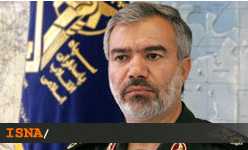
Rear Admiral Ali Fadavi said during a ceremony held to unveil the IRGC Navy’s (IRGCN) information technology systems, “Today, the enemy is ready to pay billions to get the slightest bit of information… Information security is considered the main key for the IRGC and must be considered as a priority… Today our cyber forces have easily gained access to the enemy’s most secret information, and cyber war has effectively increased its capability. We should constantly self-evaluate and compare ourselves in various fields with what we can. Then, we should improve our strong points and remove weaknesses.” Fadavi stressed the importance of security and information protection and said that if the systems lack the required security, the enemies could easily use the information provided on the Navy systems. He referred to the increased activities of “enemies” in the virtual world and the launch of satellite channels. He added, “The anti-revolution (countries) have considerably increased their Persian language (satellite) channels. Considering the process we are witnessing, we should employ our experts and enter these fields with more courage and determination.”
Source: Iran Daily Brief
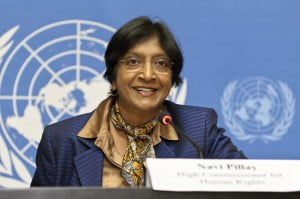
In a statement released October 2, 2012, the Office of the High Commissioner for Human Rights of the United Nations expressed its concern over “the arrest and imprisonment of several prominent human rights defenders, journalists and political activists in … Iran in the past two weeks.” The OHCHR warned of “a further severe clamp down [sic] on critical voices in the country.”
The statement references six specific cases of human rights defenders, journalists, and activists imprisoned in Iran in the last two weeks of September 2012. The OHCHR expressed concern about lawyer Mohammad Ali Dadkhah, co-founder of the Defenders of Human Rights Center, imprisoned September 29; journalist Mehdi Rahmanian, publisher of the Daily Shargh, arrested September 26; journalist Ali Akbar Javanfekr, press advisor to President Mahmoud Ahmadinejad and head of Iran’s state-run news agency (IRNA), arrested September 26; journalist Parisa Hafezi, Reuters Iran bureau chief, charged with spreading propaganda; former president Akbar Hashemi Rafsanjani’s daughter and son Faezeh Hashemi and Mehdi Hashemi Rafsanjani, arrested on September 22 and 24 for their participation in a 2011 opposition rally and the 2009 post-election protests. The statement also mentioned lawyer Nasrin Sotoudeh, an internationally prominent human rights defender and nominee for the Martin Ennals human rights award, currently serving a six-year sentence.
“The arrests and harsh sentences imposed on such figures reflect a disturbing trend apparently aimed at curbing freedom of expression, opinion and association, which are guaranteed by the International Covenant on Civil and Political Rights, to which Iran is a State party,” the OHCHR statement said.
“We urge the Government of Iran to promptly release all those who have been arrested for peacefully exercising their fundamental rights,” it concluded.
Source: Iran Human Rights

A prominent Iranian human rights lawyer has begun serving out a nine-year jail-term.
According to opposition site Kaleme, Mohammad Ali Dadkhah has been transferred to ward 350 of the notorious Evin Prison in order to serve out the lengthy prison sentence.
In May 2011, Dadkhah was tried for charges such as membership in human rights organisation, and giving interviews to foreign media. In July that year, Branch 15 of the Revolutionary Court sentenced him to nine years in prison and a ten-year ban on his legal practice and teaching.
Dadkhah has handled the cases of many political dissident and student activists arrested in the aftermath of the widely contested 2009 presidential election, including blogger Hossein Ronaghi Maleki and veteran political figure Ebrahim Yazdi.
He has also defended Youcef Naderkhani, a Christian pastor who was on death row for apostasy. Naderkhani was recently released after enduring three years of imprisonment.
Dadkhah is a member of the Defenders of Human Rights Centre (DHRC), a rights organisation headed by Nobel Laureate Shirin Ebadi. Most of the organisation’s leading figures including Mohammad Seifzadeh, Abdolfattah Soltani and Nasrin Sotoudeh are currently in prison for their activities as human rights lawyers.
Source: Iran Green Voice
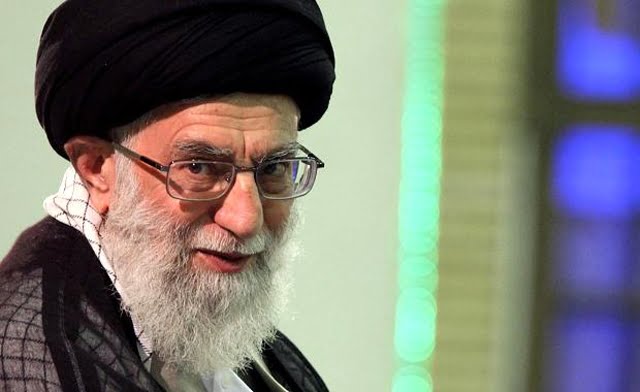
Tehran spends billions of dollars in the form of military and financial support to Damascus, causing a rift in the Iranian regime, a report published by The Times on Monday said, as fighting resumed across the war-torn country, leaving more deaths.
Citing Western intelligence reports, The Times said that the support provided by Tehran to the Syrian regime of President Bashat al-Assad has caused a split between Iran’s Supreme Leader Ayatollah Ali Khamenei and the country’s spymaster Qassem Suleimani, due to the failure of the latter to end the Syrian conflict in favor of Assad.
Iran has paid the salaries of the Syrian regime troops for months, in addition to providing Assad with weapons and logistic support, The Times reported citing members of the Syrian opposition.
The Syrian opposition has often accused Tehran of supporting the Syrian regime with weapons. The last few weeks have witnessed several statements by Iranian officials regarding means of Iranian interference in Syria.
Western members of the U.N. Security Council had blasted Iran for providing Assad with weapons to help him crush an 18-month-long uprising by rebels determined to topple his government.
“Iran’s arms exports to the murderous Assad regime in Syria are of particular concern,” U.S. Ambassador to the United Nations Susan Rice had told the 15-nation council during a meeting on the world body’s Iran sanctions regime.
Meanwhile, Iraq’s Foreign Minister Hoshyar Zebari on Sunday vowed his country would stop and search any flights from Iran over its territory suspected of carrying weapons to Syria, as requested by the United States.
Iraq plans to randomly inspect Iranian airplanes flying to Syria, the Iraqi foreign minister, Zebari told the London-based al-Hayat newspaper in an interview.
“We have informed the Iranian officials to stop these flights and to stop arming the Syrian regime or fund any side in this crisis, we have affirmed that Iraq doesn’t accept to be a path for this, or its lands, skies and water to be used for arming or funding.”
International efforts to end the 18-month conflict in Syria have failed to stop the violence as rebels continue the fight, which began in March 2011, to overthrow President Assad. The conflict has killed 30,000 people, according to estimates by the Syrian Observatory for Human Rights, an opposition group.
Fighting has been deadlocked in Aleppo since rebels pushed into the city in July. Government forces have resorted to heavy weaponry, including attack aircraft, helicopter gunships and artillery, to dislodge rebels from their positions.
The army, for its part, shelled several other districts of Aleppo and battled rebels in Aleppo’s northern district of Jandul, the Observatory said.
In Damascus province, rebels killed nine soldiers when they attacked a military checkpoint on the road linking the capital with Qatana to the southwest, the Observatory reported.
A Kurdish activist, Raad Basho, was gunned down outside his home in the Kurdish city of Hasakeh in the northeast, the Observatory said.
The northern province of Deir Ezzor, Hama in central Syria and Deraa in the south came under heavy shelling by regime forces, the Observatory said.
It reported a total of at least 114 people killed in violence across the country on Sunday, including 57 who died in Damascus province and 39 in Deir Ezzor.
Source: Alarabiya

Brigadier General Hossein Salami said, “Iran’s defensive power goes beyond its geographical borders for kilometers… A look at the new war front against Iran shows that all powers are standing against us once again, although there are some differences as well since Iran today is not dependent on (the revenues of) crude exports and, in the confrontation against oil sanctions, it is moving ahead on its path confidently and calmly.”
Source: Iran Daily Brief

Hojjatoleslam Mohammad Abedi, the Supreme Leader’s representative to Seyyed ol-Shohada provincial Guards Corps of Mashhad, said that “During the Iran-Iraq War (1980-1988), Iran was not well equipped and had to import arms. But today Iran… exports arms to 70 countries around the world…
Source: Iran Daily Brief

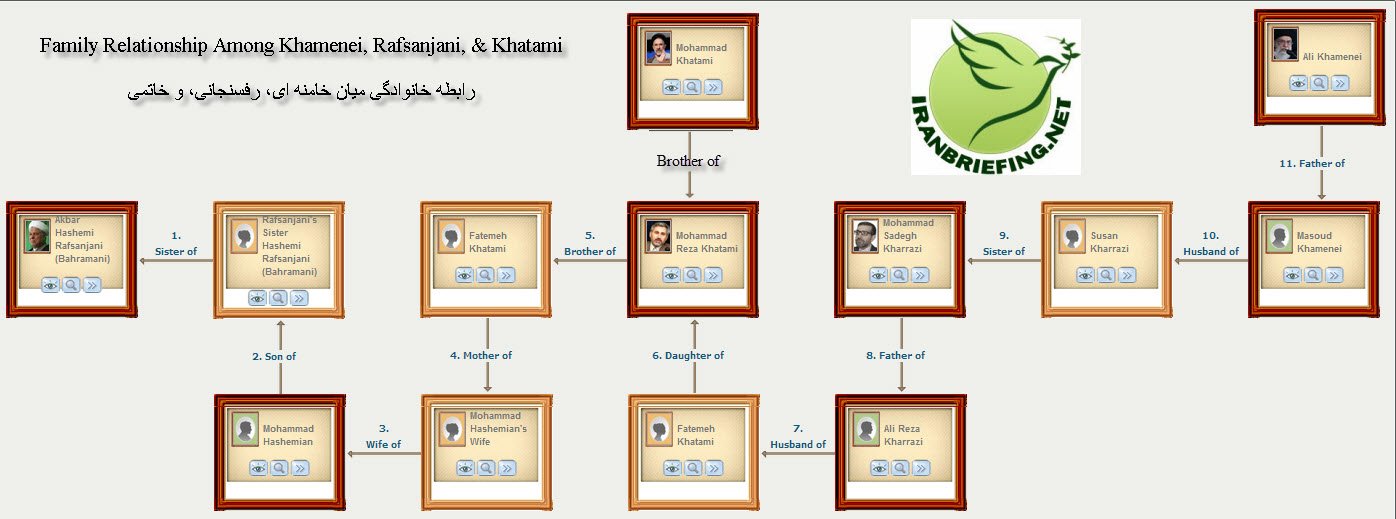
Iran’s Political Family Tree – Khomeini, Khamenei, Rafsanjani, Khatami

An Azeri court imprisoned members of an Iran-linked group that plotted to kill the head of a Jewish school in the capital, Baku.
The Baku Serious Crimes Court gave Rasim Aliyev, Ali Huseynov and Rauf Abilov, all three Azeri nationals, prison sentences ranging from eight years to 14 years, court official Amar Hasanov said by phone. The verdicts can be appealed.
The trial was held behind closed doors and Hasanov didn’t provide the name of the men’s defense lawyer.
The group, which received weapons and money from Iran, could not carry out the plan as its members were arrested by Azeri security services, Hasanov said.
The energy-rich Caspian nation’s ties to Israel and the U.S. have caused tension with Iran. Azerbaijan said in March it arrested members of an armed group that collected intelligence about foreign embassies and companies, including BP Plc (BP/), for Iran’s Revolutionary Guards Corps, or Sepah.
Source: Bloomberg Business Week