Home Blog Page 697

Political Activist’s Hunger Strike Continues and More Pressure on Him

http://www.rahesabz.net/story/20805/


Hunger_Strike(Jaras) While for 17 days “Rahim Rashi” has been on hunger strike for civil rights, he is still at the Revolutionary Guards Intelligence Office’s jail in Urumiyeh. Besides danger to his health, more new restrictions have been put in place as to apply more pressure on him.

According to a Horana report, Rahim Rashi is 57 years old from the city of Mahabad. While he has been on hunger strike for 17 days, the people in charge at the Guards’ Intelligence Office have prohibited him from seeing his family.

In expressing worry about her father’s bad physical condition and his unknown fate in the Guards Intelligence Office’s prison, his daughter Sooran Rashi in her last interview stated, “After 17 days being on hunger strike and his unknown fate in prison, my father’s physical condition is in peril.”

She also pointed out that, “No matter how many times members of my family went to the Intelligence Office in Mahabad and the Guards’ Intelligence Office in Urumiyeh in order to see my father, no permission to visit has been issued to them by the people in charge of the prison.”

Getting A Confession after Dunking Political Prisoner’s Head in the Toilet 20 Times

0

http://www.rahesabz.net/story/20723/


Free_Political_PrisonersMirhossein Mousavi said in his 11 Mordad 1389 speech with a number of followers: “Oppression and cruelty in any circumstances and at any time is reprehensible, whether it be during the Pahlavi era or in the Islamic Republic era. Oppression in the Islamic Republic is in fact worse because it is done under the name of Islam. Does Islam accept that a human being’s dignity is violated or is forced to give a confession when his head is dunked in the toilet?”

According to Jaras News Report from Tehran, as indicated by some accounts from reliable sources, the name of this prisoner is Hamzeh Kamali. He was one of the Revolutionary Guards’ commanders during the war and his job as director of the Guards’ headquarters in Tehran province was his last position with them. From 1368 to 1374 he was the chief officer at Varamin, and from 1374 to 1380 he was director of politics at the President’s Office during the Rafsanjani and Khatami administrations. Karami was chief of Rafsanjani’s media center during the Ninth Presidential Elections, and during the Tenth Presidential Elections he was director of [Mousavi’s] website; he was active in Mousavi’s campaign headquarters as well.

Hamzeh Karami got arrested in the wake of the 1388 post-election events, and stayed in solitary confinement for seventy days. On 3 Shahrivar 1388 he was tried in court without a lawyer. The 15th Branch of the Tehran Revolutionary Court condemned Karami to 16 years in prison and indefinite exemption from government service. In presenting his appeals statement, he claimed that all the confessions he made during the interrogations and in the first court were false, saying that all confessions were taken from him under intense pressure which lacked any legal value and integrity. The 36th Branch of the Tehran Appeals Court condemned Karami to 11 years in prison and indefinite exemption from government service. Hamzeh Karami has the longest sentence out of all people arrested after the (1388) presidential elections.

On 24 Ordibehesht 1389, Hamzeh Karami was temporarily released from Evin Prison with a heavy penalty of 2,000,000 tomans (approx. $2,000 U.S.), and returned to Evin five days later. Security officers wanted him to do a TV interview critical of Rafsanjani but he turned down their request. For this reason another five-day extension for him was not approved, hence he returned to prison.

During the first days of Mordad when he had another five-day release, Karami was bedridden at the critical care unit at Tehran’s Taleghani Hospital because of a heart attack. Dr. Hadi Manafi, former Minister of Health and Medicine, as representative of Hashemi Rafsanjani (Head of the Assembly of Experts) visited Karami at the hospital on the morning of Thursday, 3 Mordad. One of Karami’s relatives announced that he is half-conscious and his doctors have prohibited visits [to Karami}.
Because of a great deal of torture, Hamzeh Karami suffered from many kinds of illnesses. He said, “They put me under all kinds of torture, for example more than twenty times they dunked my head into a toilet full of feces and they wanted me to confess on their terms. Every time I screamed ‘Ya Zahra!’ they dared (to continue)! Whenever I said, ‘Ya Allah!’ they were saying ‘We are your God today and we can do whatever we want to you.”’

Rogues and Ruffians in the Country’s Top Intelligence

0

http://www.rahesabz.net/story/20440/


Rafsanjani_Hashemi(Jaras News Report from Tehran) In one of the weekly meetings between the Supreme Leader and the head of the Assembly of Experts during Spring 2010/1389, Hashemi Rafsanjani protested against the appointment of some individuals of ill-repute such as Hossein Taeb (Revolutionary Guards’ Intelligence Adviser), Mohammad Reza Naghdi (Commander of the Basij) and Heidar Moslehi (Minister of Intelligence) to executive positions in the country’s intelligence, calling them a “handful of rogues and ruffians”. Mr. Khamenei responded to this saying, “These ones are good! They can quash out the strife!”

It is necessary to note that Hossein Taeb, under Ali Fallahian at the Ministry of Intelligence was an adviser on counterintelligence affairs, was dismissed and thrown out from the Ministry of Intelligence because he presented flawed intelligence on Ali Sarkouhi’s file before the President at the time, Hashemi Rafsanjani.

Taeb then immediately acquired a job in the Office of the Leader. Taeb is one of the closest friends of Seyed Mojtaba Khamenei, the son of the Supreme Leader. During (last year’s) suppression of the Green Movement, Taeb was a Basij commander and one of the darkest points on his record was the brutal murder of Mousavi.  On the issue concerning the interrogation of political and media activists, done entirely by Revolutionary Guards interrogators, Taeb had been a key player.

Mr. Khamenei’s firm defense of Taeb in the meeting with Hashemi Rafsanjani shows that he is completely satisfied with the actions of the Basij, Revolutionary Guards, and Intelligence, and that this brutality has materialized at his direct command.

Who is Really in Charge in Iran?

0

http://www.rahesabz.net/story/20372/


For a long time, the serious question of who really runs Iran has been discussed by political authorities in Tehran. This discussion is not just limited to the Reformist and the Green Protestors—now conservative authorities are also involved. The reason for this question can’t be explained for many loyalists of the Revolution and the military, and they cannot believe that these bitter happenings materialize at the order of one cleric and/or one of the followers of the Supreme Leader of the Revolution.

In any case, to the above question there are three possible answers:

1)      The country run by Mr. Khamenei himself, and Revolutionary Guards commanders and Ahmadinejad’s Team comply with the Vali al-Amr’s orders and execute them. (If at) any time the Supreme Leader is unhappy with someone or if that someone’s date has expired, that person gets disposed of.

Good or bad, the recent events which have taken place in the country are (because of) absolute rule and the Supreme Leader is directly responsible for the country’s latest crisis.

2)      Although on the surface the Supreme Leader’s s persona is above all [affairs], it is really the Revolutionary Guards and Ahmadinejad’s Team who are running the country. The leadership of Mr. Khamenei (could be) similar to the Caliphate of the late Abbasids where the Ghaznavid sultans and Seljuq rulers were real and the Caliph did not really have power; he was just the head of his dynasty and in the country there were all sorts of military rulers.  In today’s Iran, Ahmadinejad’s Team and Major General Jafari are jockeying for a certain distribution of powers and Mr. Khamenei (in this picture) is just a decoration.

3)      None of the elements discussed above do not run the country [independent] of each other. These three elements are Mr. Khamenei and his followers, Ahmadinejad’s Team, and the Revolutionary Guards (commanders) who effectively move ahead together with their own unique way and creativity. If any one of them wants to initiate something, they cannot manage affairs alone and all three elements need each other. In (a situation) similar to relative independence they still find and get acknowledgment from each other. But the captain of this ship of crisis in the stormy sea is Mr. Khamenei and whatever the other two elements say is comparable to what he says.

The founders of velayat and those who are downright obedient to the persona of the Supreme Leader are sure about the first answer, even though their numbers are in significant decline. Those close to Ahmadinejad’s Team and the Revolutionary Guards’ commanders are leaning towards answer two. Yet the answer that most reformist and conservative authorities agree with is answer three, meaning that three (power) elements at the apex of government in the executive, judiciary, and army effectively and distressfully progress together—when Mr. Khamenei still has a high hand in government and military faculties, although he lost his former powers, and the Guards’ commanders and Ahmadinejad’s Team always get acknowledgment from him. Mr. Khamenei has very much distanced himself from moderate conservatives, and he has had a deep split with the reformists for a while. His constant companions are the most radical fundamentalist military and ignorant people such as those from Ahmadinejad’s Team.

Frequent meetings between moderate conservatives and reformists have produced one common result: apprehension about Iran’s future and Mr. Khamenei’s severe recklessness in the country’s current fifteen-month crisis.

Rahim Reshi Transferred to Urmia on Eight Day of Hunger Strike

0
28 , July , 2010
Kurdish activist Rahim Reshi was transferred to IRGC detention center in Urmia on the eight day of his hunger strike.
RAHANA- Kurdish activist Rahim Reshi was transferred to IRGC detention center in Urmia on the eight day of his hunger strike.Rahim Reshi was arrested by security agents on Monday July 19 at his house in a village near Mahabad. He was taken to Mahabad Intelligence office, where he went on hunger strike one day after his arrest.Rahim Reshi was first arrested in 2007, during which he went on hunger strike for 15 days to object his detention. In another incident, he had attempted hunger strike for 22 days after being transferred to Saghez (Saqqez) central prison, Kudristan province.

Reza Joshan Transferred to Prison Clinic in Coma on 6th Day of Hunger Strike

http://www.rhairan.us/en/?p=5927

27 , July , 2010

Reza Joshan transferred to Evin health centre on the sixth day of his hunger strike.

RAHANA- Reza Joshan went into a coma on the sixth day of his hunger strike and transferred to the health center of Gohardasht prison of Karaj.According to Human Rights and Democracy Activists in Iran, on Monday, July 26 around 10:45 AM Reza Joshan went in a coma and was transferred to the health center of prison.

Prisoners were not allowed to approach him while he was being transferred to the clinic, but according to eyewitnesses, his physical condition is very critical. Reza Joshan was on the sixth day of his hunger strike and it is not clear why he went in coma.

Reza Joshan, 25, was arrested on December 1, 2009 by intelligence agency officers at his home. He was  transferred to solitary cells of IRGC and then to ward 4 after 2 months.

Intelligence agency officers also went to his house on December 7, 2009 and arrested his mother Zahra Asadpour Gorji and transferred her to the IRGC- solitary cells. After several weeks of interrogation and physical and mental tortures she was transferred to the women section of Gohardasht prison of Karaj.

Zahra Asadpour Gorji and her daughter Fatemeh Joshan had been previously arrested for traveling to Iraq and visited another child of this family in the MKO’s camp in Ashraf, Iraq. They were both detained in Gohardasht prison in karaj for 14 months and released after their sentence was over.

On February 8, 2010, branch 1 of the Revolutionary Court sentenced Zahra Asadpour Gorji and his son Reza Joshan to 1 year of prison in exile in Zanjan prison and 4 years of exile in the village of Gheilar in Zanjan

Currently, other than Reza Joshan, Arjang Davoudi and Khaldi Hardani are in hunger strike in Gohardasht prison.

Hossein Ronaghi Banned From Phone Calls and Under Intense Pressure to Confess

http://www.rhairan.us/en/?p=5972

27 , July , 2010

Blogger and human rights activist Hossein Ronaghi Maleki is still held in prison limbo and in under extreme pressure to make false televised confessions.

RAHANA: Hossein Ronaghi Maleki is in his 8th month of detention and had gone on hunger strike from Thursday, July 15th through Thursday July 22nd in order to protest the poor food condition and the harsh conditions of his detention in Ward 2A of IRGC of the Evin Prison.Ronaghi had previously gone on hunger strike for 4 days to protest the harsh conditions of his detention. He has kidney problems and is in great need of medical attention.

His mother, Zoleikha Mousavi, told the RAHANA reporter that they have “came to Tehran to follow up on his case and have been unsuccessful again.” According to her, “Judge Mirabbas presides over the case and he is on vacation for 20 days.”

She added that they have “referred to the Prosecutor’s Office and the prison and have not received any responses from the authorities.”

His mother stated that Hossein has contacted them and told them that “the interrogators have said that he is no longer allowed to call his family or to mention anything about his case to them.”

The judicial authorities have not allowed Ronaghi’s parents to visit him in prison. He has visited his parents only 4 times in the past 8 months.

Hossein Ronaghi Maleki who blogged under the name of Babak Khorramdin, was arrested along with his brother on December 13, 2009 in the city of Malekan, located in Tabriz. He was transferred to the Evin Prison where has been under physical and psychological torture. His brother, who was detained for putting pressure on Hossein, was later released on an 80 million ($80,000) tooman bail. He was physically tortured while in detention.

Ronaghi has been transferred to the solitary confinement unit in the past 2 weeks and is under extreme pressure to make false televised confessions.

Expanding business empire of Iran’s Revolutionary Guards

0

http://www.bbc.co.uk/news/world-middle-east-10743580

26 July 2010 Last updated at 04:57 ET

By Mark Gregory BBC business reporter
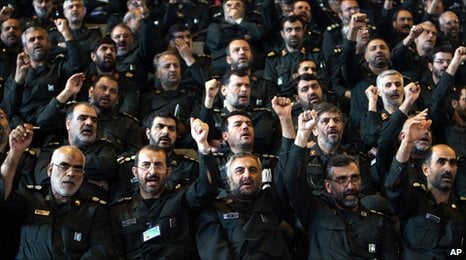
The IRGC has been building its economic influence for more than 20 years

Iran has embarked on a remarkable – many would say bizarre – experiment in business management.

Domination of a fairly sophisticated, energy-rich economy has been handed to a secretive military organisation that started out as a religious militia.

The Islamic Revolutionary Guard Corps is now believed to control a third of the Iranian economy.

Some experts put the figure much higher, although all estimates are a matter of conjecture.

The force was created by Ayatollah Khomeini 30 years ago to protect the state and defend the principles of his Islamic revolution.

Its improbable journey to becoming a powerful business network is bound up with Iran’s response to American pressure and international sanctions, which are intended to persuade Tehran to abandon alleged plans to develop nuclear weapons.

Among many other activities, the guard – often referred to by the acronym IRGC – is suspected of playing a central role in organising Iran’s nuclear programme.

‘In state of siege’

That is why the IRGC has been the prime target of four successive rounds of United Nations sanctions.

IRGC’s BUSINESS EMPIRE

  • Khatam al-Anbia construction firm: employs 20,000 workers and boasts of hundreds of government contracts
  • Iran Telecommunications Company – 50% stake bought in government privatisation scheme
  • Angouran – the largest lead and zinc mine in the Middle East
  • Bahman Automobile Manufacturing Group – (manufactures the Mazda brand) – 45% stake
  • Iran electronics industry – comprises electronic, computer and communications companies
  • Iranians’ Mehr Economic Institution – financial institution with hundreds of branches (one of the largest banking networks in Iran)

“By focussing on the Revolutionary Guards for sanctions, by making it clear to financial institutions around the world that doing business with the Revolutionary Guards puts at risk their access to the US financial system, I think they will be under significant pressure,” explains Stuart Levey, the man in charge of US policy-making on this issue.

He has an impressive job title: under-secretary for terrorism and financial intelligence at the US treasury.

But there’s no guarantee of success.

Indeed, some people argue sanctions and isolation are actually counterproductive because they create the conditions in which hardline groups, like the Revolutionary Guard, can extend their influence over politics and the economy.

“We are not in normal circumstances,” says Abbas Edalat, an Iranian anti-sanctions campaigner and maths professor at Imperial College London.

“Iran has been subjected to threats of regime change, threats of military attack. In these circumstances it is not at all strange that the military gets increasingly more economic power in the country.”

Speaking of the guard, he continues: “This is the force that the government can trust to run the economy when Iran is in a state of siege.”

That is not a view Mr Levey is ever likely to accept.

“It’s hard to argue that the Revolutionary Guard would have wanted to be singled out in UN Security Council resolutions for sanctions,” he says.

Well concealed

No doubt the debate will continue.

But there’s little dispute about the extent of the guards’ business ambitions.

“What we do know is that they are trying to infiltrate every single aspect of the economy and are trying to engage in any kind of economic activity, both legal and illegal,” explains Ali Alfoneh, an Iranian research fellow at the conservative-leaning American Enterprise Institute.

The IRGC has been building its economic influence for more than 20 years but the process has greatly accelerated since President Mahmoud Ahmadinejad – himself a former guardsman – took office in 2005.

In that period, the organisation’s construction arm, Khatam al-Anbia, has won hundreds of lucrative government contracts in areas like construction, usually without having to bid.

It has also advanced through apparently rigged privatisations and part privatisations of state enterprises that, for example, saw a company affiliated to the guards take ownership of the national telephone service.

The guard is by far the largest investor on the Tehran stock market.

From car manufacturing to mining and clothing, even online shopping, there are few industries they aren’t involved in, although often it’s hard to tell what they control because it’s well concealed.

“The Revolutionary Guard usually engages in trades [on the stock exchange] through front companies with names that vary and change all the time,” says Mr Alfoneh.

“They do not want to be perceived as an economic enterprise. They consider themselves and they want to be considered as saviours of Iran, especially from the Iran-Iraq war,” he adds.

New business

And that’s where the guard’s business empire began.

The organisation emerged from the eight-year-long conflict with Iraq in the 1980s as a formidable fighting machine, with organisational and engineering skills to match.

These skills were put to good use in post-war reconstruction, and the guard has been expanding its business activities ever since.

Much more recently, the IRGC has developed a new line of business.

Firms affiliated to the guard have been awarded multi billion-dollar contracts to open up Iran’s largest offshore gas field, South Pars.

They have filled the gap left by international energy groups like Shell, Repsol and Total, who have pulled out in response to US pressure and tensions with the government in Tehran.

In economic terms, it may seem mad to entrust the development of one of the nation’s most important assets to a military organisation that has no known expertise in energy extraction.

But the politics are easy to understand.

President Ahmadinejad wants to free strategic industries from foreign influence.

But in a clandestine way, the guard is heavily involved in the outside world.

Remarkably for an organisation that’s embedded in government, it runs a massive smuggling operation. It brings in everything from contraband to scarce consumer goods, even alcohol which is banned in Iran.

The IRGC is a complex organisation with many different layers.

Some Western analysts see it as a kind of state within a state with its own agenda. Others regard it as directly under the control of hardline elements within the government.

The reality may lie somewhere in between.

It may be both an arm of the state and a power in its own right.

One thing is clear. This is an odd way to run a modern economy.

Iranian Revolutionary Guard Chief assigned as a Trustee of a university

0

http://features.kodoom.com/

July 26, 2010

Mohammad Ali Jafari, Head of Iranian Revolutionary Guard Corp (IRGC) is assigned by the Education Ministry to the Board of Trustees of Yazd University in Iran. Other assignees are Koochakzadeh and Tabesh, two ultra-conservative pro-Ahmadinejad congressmen, and Etemadian, Advisor to Ahmadinejad.

Critics and “Green” reformist leaders like Mousavi and Karrubi, and other jailed reformists like Saharkhiz, have decried the ever increasing infiltration of pro-Ahmadinejad military forces in key economic, cultural, political and academic positions.

Ahmadreza Ahmadpour on Hunger Strike

26 , July , 2010

Seyed Ahmadreza Ahmadpour, the political prisoner who has been detained in Langroud prison in the city of Qom for 4 months, started his dry hunger strike after being on water strike for 15 days.

RAHANA- Ahmadreza Ahmadpour is a cleric, member of Qom Hezbeh Mosharekat (Participation Front), blogger (Pezhvak-e- Khamoosh), and religious scholar has been on his third round of hunger strike since July 10. He had gone on a normal hunger strike to protest inappropriate behavior with prisoners especially during physical inspection and doing unlawful acts, and started his dry hunger strike on Sunday July 25.According to JARAS, his overall condition is reported to be critical, and his family are concerned about his kidney damage and sever pressure drop.

On the twelfth day of his hunger strike, Ahmadpour wrote a letter addressing the Secretary General of United Nations,. In a part of this letter he says: “If you don’t pay enough attention to this case, this hunger strike will lead to my death, and if this happens not only will the officials of Islamic Republic be my murderers, but also I will blame you as well and you should be  accountable to my family.”

On 6 April 2010, Seyed Ahmadreza Ahmadpour was sentenced to 1 year in prison and permanent laicization on charges of propaganda against the system (for giving interviews to foreign media), publishing lies and violating the dignity of clergy. He introduced himself to the clergy special court on April 18 for his sentence’s enforcement.

http://www.rahana.org/en/?p=5906