Home Blog Page 301

Russia launches air strikes on Syria from Iranian air base, human rights groups claims civilians killed


TEHRAN, Iran – An Iranian air base was used by Russia to launch air strikes against Syrian militants for the first time on August 16 in a move indicative of Russia’s deepening involvement in the Middle East.

According to reports, Iran’s Hamadan air base was used by long-range Russian Tupolev-22M3 bombers and Sukhoi-34 fighter bombers to strike targets in Syria, marking the first time that Russia used another nation’s territory to launch strikes.

The move also marks the first time that Iran permitted a foreign power to use its territory for military operations since the Islamic Revolution in 1979.

The strikes on August 16 targeted the Islamic State as well as militants in the Aleppo, Idlib and Deir al Zour provinces, who were previously known as the Nusra Front.

The Russian Defence Ministry said, “As a result of the strikes five large arms depots were destroyed… a militant training camp… three command and control points… and a significant number of militants.”

However, the Syrian Observatory for Human Rights said that air-raids, either conducted by Russian or regime aircraft, on two rebel-held districts in Aleppo killed 19 civilians, including three children.

Ali Shamkhani, head of Iran’s National Security Council, confirmed that Tehran and Moscow were sharing facilities, and added, “Iranian-Russian cooperation in the fight against terrorism in Syria is a strategic one and we share our potential and facilities in this field.”

The countries’ cooperation has been labelled as “strategic,” as both back Syrian President Bashar Al-Assad.

Further, the gradually warming relations were also caused due to Iran’s reaching of an agreement in 2015 with global powers to curtail its nuclear programme in exchange for the lifting of U.N., EU and U.S. financial sanctions.

Russian reports have also indicated that Moscow has asked Iran and Iraq for permission to fire cruise missiles at Syrian targets across their territory from the Caspian Sea.

Apart from allowing a cut to flight time and increasing bombing payloads, the “concentrated airstrikes” from Iran has cemented Russia as a central player in the Middle East.

I am a Hostage: A letter from Political Prisoner Shirin Alam Hooli

0

I am a Hostage: A letter from Political Prisoner Shirin Alam Hooli

I am a Hostage: A letter from Political Prisoner Shirin Alam Hooli

Shirin Alam Hooli (DOB: June 3, 1981) was born in the village of Gheshlagh near the city of Maku in Iran. She was arrested in May 2008 by the Revolutionary Guards in Tehran. She spent the first 25 days of her imprisonment in an unknown location under brutal physical and psychological torture. She was later transferred to ward 209 of Evin prison where she was held in solitary confinement for six months and subjected to brutal torture. Afterwards, she was transferred to the women’s ward in Evin prison. On December 19, 2009, she was sentenced to two years imprisonment for illegally exiting Iran and sentenced to death for the charge of “Moharebeh” (enemy of God) for her alleged involvement in the Free Life Party of Kurdistan (PJAK) group. Her trial took place in branch 15 of the Revolutionary Court in Tehran, under judge Salavati. Her lawyer was informed of the decision on January 3, 2010 and has appealed it, however, there has been no judgment yet from the Appeals Court. In her first letter, Alam Hooli wrote on the brutal physical and psychological torture she was subjected to during her interrogation. As a result of the torture,  Alam Hooli is currently suffering from numerous health problems, which she points out in this letter.

In her last letter, Alam Hooli stated that the interrogators tried very hard to break her hunger strike. She wrote how the interrogators tried to force a televised confession and subjected her to additional interrogations to force her to deny her Kurdish ethnicity.

The Letter of Ms. Shirin Alam Hooli: “I Am a Hostage”

I am entering my third year of imprisonment, three years under the worst conditions behind bars in Evin prison. I spent the first two years of my imprisonment without a lawyer and in pre-trial custody. All my inquiries about my case went unanswered until I was unjustly sentenced to death.

Why have I been imprisoned and why am I going to be executed? For what crime? Is it because I am Kurdish? If that’s the case then I must say I was born a Kurd and my language is Kurdish; the language that I use to communicate with my family, friends, and community. It is also the language I grew up with. However, I am not allowed to speak my language or read it.  I am not allowed to go to school and study my own language and I am not allowed to write it. They are telling me to deny my Kurdish identity, but if I do, that means I have to deny who I am.

Read more…

I am a Hostage: A letter from Political Prisoner  I am a Hostage: A letter from Political Prisoner  I am a Hostage: A letter from Political Prisoner  I am a Hostage: A letter from Political Prisoner  I am a Hostage: A letter from Political Prisoner  I am a Hostage: A letter from Political Prisoner  I am a Hostage: A letter from Political Prisoner  I am a Hostage: A letter from Political Prisoner  I am a Hostage: A letter from Political Prisoner

Iran Arrests Dual National on Security-Related Charges

0

Iran has detained an Iranian with a second nationality over alleged links to British intelligence, a prosecutor said Tuesday, the latest in a series of arrests of dual citizens in the country.

The circumstances surrounding the detention were unclear, but hard-liners in Iran’s security forces have increasingly targeted those with foreign ties in the wake of last year’s nuclear deal with world powers.

Speaking to journalists, Tehran prosecutor Abbas Jafari Dolatabadi described the detained individual as being “active in the economic field, related to Iran,” the official IRNA news agency reported. Dolatabadi didn’t elaborate, saying only that the arrest took place last week. He did not identify the individual’s second nationality.

Iranian hard-liners have criticized a planned meeting in September called “Iran Connect 2016,” sponsored in part by Iran’s Ministry of Information and Communications Technology and the British-Iranian Chamber of Commerce. A flier for the event notes it is “strictly prohibited to Iranian individuals and entities that are sanctioned by the U.K. government and/or the EU.”

The hard-line daily newspaper Javan, which has links to Iran’s powerful Revolutionary Guard, criticized the restrictions on Tuesday. “The administration, indeed, has allowed the British Embassy to implement European sanctions in Tehran,” it said.

The British-Iranian Chamber of Commerce and those organizing the event did not immediately respond to a request for comment. Iranian officials in Tehran and Iran’s mission to the United Nations also did not immediately comment.

Britain’s Foreign Office issued a brief statement saying: “We are seeking information following the reported detention of a dual Iranian-British national in Iran.” Foreign Office officials refused to say whether they were confirming the person held was in fact a British citizen.

Iran does not recognize dual nationalities, meaning those detained cannot receive consular assistance. In previous cases involving dual nationals, like the detention of Washington Post journalist Jason Rezaian, officials initially announced indictments had been handed down without providing specifics. Later, news organizations with close ties to security services offered details of the charges.

Those detained typically face trial in Iran’s Revolutionary Court, a closed-door tribunal which handles cases involving alleged attempts to overthrow the government. Rezaian was convicted but later released in January as part of a prisoner swap between Iran and the U.S.

It’s unclear why Iran is increasingly detaining dual nationals, but analysts and others have suggested hard-liners want concessions from the West in exchange for releasing them.

Those recently detained in Iran include:

— Homa Hoodfar , an Iranian-Canadian woman who is a retired professor at Montreal’s Concordia University;

— Siamak Namazi , an Iranian-American businessman who has advocated for closer ties between the two countries and whose father is also held in Tehran;

— Baquer Namazi , a former Iranian and U.N. official in his 80s who is the father of Siamak;

— Robin Shahini , an Iranian-American detained while visiting family who previously had made online comments criticizing Iran’s human rights record;

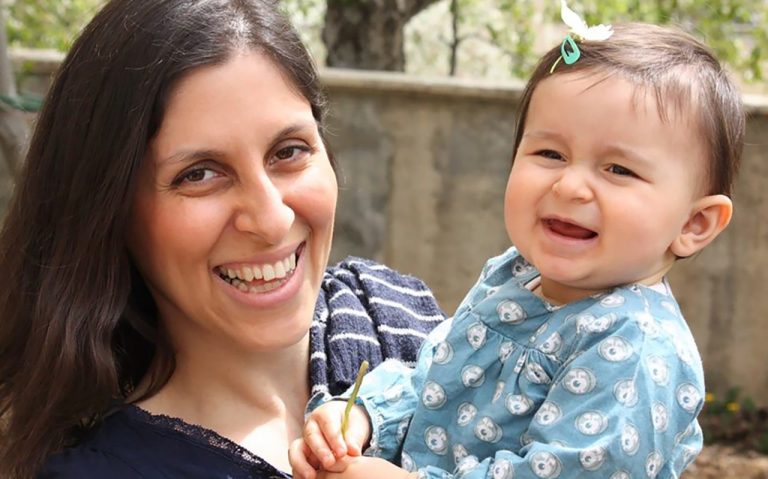
— Nazanin Zaghari-Ratcliffe , a British-Iranian woman held in Iran for months over accusations she planned the “soft toppling” of the government while visiting relatives with her young daughter; and

— Nizar Zakka, a U.S. permanent resident from Lebanon who has done work for the American government .

Still missing is former FBI agent Robert Levinson, who vanished in Iran in 2007 while on an unauthorized CIA mission.

———

Gambrell reported from Dubai, United Arab Emirates.

———

This story has been corrected to show Iranian authorities have not identified the arrested person’s second nationality.


Source

Android Phone Users in Iran Face New Threat by Hackers

Hackers posing as friends are using phone numbers based in the UK to contact civil rights and political activists in Iran to gain access to their email and social media accounts, the International Campaign for Human Rights in Iran has learned. 

When the targets don’t recognize the “old friend,” hackers ask for a face-to-face conversation and ask the target to install a malware file titled “imo.APK” to use with the IMO chat program. After it’s installed on Android phones, the malware file allows hackers to take over the victim’s device.

Since the people who have been targeted are mainly activists and journalists, it raises the strong suspicion that the hackers are state-sponsored.

This is the first time the Campaign has recorded this specific type of attack, which has been increasingly used to gain access to Iranian users’ Gmail, Facebook and Telegram accounts in recent weeks.

Meanwhile hardline security organizations in Iran remain focused on monitoring content on Telegram, an instant messaging system and Iran’s most popular social media application.

On August 9 Colonel Hossein Ramazani, the legal affairs deputy of Iran’s Cyber Police Force known as FATA, announced the arrest of three administrators of four different channels on Telegram for “publishing material insulting religion and the immaculate Imams.”

On August 6, 2016 the Chairman of Iran’s Supreme Cyberspace Council, Abolhassan Firouzabadi, repeated a claim by other Iranian officials that Telegram had agreed to move its data servers to Iran—a claim that Telegram has always denied. 

Iran’s Internet is censored and monitored by the government, and users who have posted criticism of the government online have been subjected to harsh prison sentences. Installing Telegram servers in Iran would seriously expose users’ personal information to state agencies and hackers, Iranian activists have warned.

Mohammad Hassan Entezari, a member of the Supreme Cyberspace Council, said on August 11, 2016 that over half of Iran’s Internet bandwidth is being used up by Telegram traffic. “Telegram usage has increased so much so that in our household, for instance, we have three Telegram users and we had to change our Internet subscription to unlimited,” said Entezari.

Source

Day 3 of hunger strike in Sweden to draw attention to massacre of political prisoners in Iran

0

Day 3 of hunger strike in Sweden to draw attention to massacre of political prisoners in Iran


NCRI – Iranians residing in Sweden are today on Day 3 of a three-day hunger strike in Stockholm in solidarity with the victims of the recent mass executions in Iran. They are calling on the Swedish government to make respect for human rights in Iran a key priority before upgrading ties with the mullahs’ regime.

Iran’s execution frenzy of Kurdish prisoners

0

Iran’s execution frenzy of Kurdish prisoners


Although almost four decades has passed since the rise of the Islamic Republic, the so-called Revolutionary Courts once ruled by the hanging judge,

Pentagon: Iran Has Improved Cyber Abilities and Ballistic Missiles Since Nuclear Deal

0

Pentagon: Iran Has Improved Cyber Abilities and Ballistic Missiles Since Nuclear Deal


Iran has gradually improved its cyber abilities and developed more advanced ballistic missiles since the singing of the nuclear deal with world powers in July 2015, a new report from the US Defense Department said.

Iran isn’t interested in the truth, law or decency

0

Iran isn’t interested in the truth, law or decency


Almost 40 years ago I was taken hostage with 51 of my colleagues in Iran and held for 444 days in captivity. 

Recent Executions Sparks World-Wide Condemnation for Iran

Iranian opposition leader Maryam Rajavi of the National Council of Resistance of Iran (NCRI) condemned Tehran’s mass execution of Sunni prisoners as “an appalling crime against humanity,” she said, adding,  “The mullahs’ anti-human regime carried out the mass execution of our Sunni brothers on the anniversary of the 1988 massacre of 30,000 political prisoners in Iran. They are trying in vain to contain the volatile social atmosphere and popular protests by terrorizing the public.”

The Iranian Diaspora communities across the globe are marking the 28th anniversary of the 1988 massacre of more than 30,000 political prisoners in Iran over the course of a summer. Their voices will be heard and they will raise awareness about  Iran’s human rights record.

Kia, a press spokesman for residents of Camp Liberty, Iraq, and members of the People’s Mujahedin Organization of Iran opposition group (PMOI, also known as MEK), says that, “This marks one of Iran’s most atrocious mass executions in recent times. Iranian judiciary officials claim 20 of the victims were Sunni Kurds, executed in Gohardasht (Rajaie Shahr) Prison in Karaj, west of the capital, Tehran.  The victims had denied all charges raised against them, and in video clips and text posted on the Internet revealed they had spent time in solitary confinement and placed under torture.”

Accusations of coerced confessions through torture and other banned methods is nothing new for Iran, and the number of executions continues to grow, including juveniles being sent to the gallows.

This, when according to Magdalena Mughrabi, Deputy Middle East and North Africa Program Director of Amnesty International,  says that International law, including the Convention on the Rights of the Child to which Iran is a state party, absolutely prohibits the use of death penalty for crimes committed when the defendant was under 18 years of age.

Shahram Ahmadi, amongst the recently executed, spent nearly three years in solitary confinement, and was sentenced to death after a “five-minute” trial without a lawyer present.

“United Nations High Commissioner for Human Rights Zeid Ra’ad al-Hussein issued a statement condemning this mass execution of Sunni Kurds in Iran as a “grave injustice.” The High Commissioner expressed his doubts over the fact that these individuals ever received a fair trial. Al-Hussein also referred to Ahmadi’s case, adding he was forced under pressure to sign an interrogation paper including false allegations raised against him,” according to Kia.

A series of global condemnations from international organizations, followed the execution of the Sunni prisoners in Iran.

In 2015 Iran put 977 people to death, according to Amnesty International. Iran hanged 44 convicted drug traffickers in the span of just two days in 2009. This was one of the country’s largest mass executions to date. “The recent execution of nearly three dozen Sunni Kurds in one day adds to Iran’s already dismal human rights history, especially in the past three years after the “moderate” Hassan Rouhani came to power.” says Kia.

Dr. Ahmed Shaheed, the UN Special Rapporteur on the Situation of Human Rights in Iran, told the UN Human Rights Council – Session 31- on March 14, 2016, “At least 966 persons — the highest rate in over two decades — were executed in 2015. At least 73 juvenile offenders were reportedly executed between 2005 and 2015. In the past two years alone, 16 juvenile offenders were executed.” 160 juveniles remain on death row in prisons across Iran.

Kia concludes, “The shocking stroke of irony in the recent executions lies in the fact that this incident comes as the European Union is reportedly suggesting to launch human rights negotiations with Iran. Any reasonable party figures Iran would at least consider halting executions prior to such talks. However, this proves once again that Iran takes serious only a brazen and decisive language. This should also serve as a lesson on how Iran disregards and in fact abuses any interceding measures and has refused to budge on any of its old tactics after the much boasted ‘historic’ nuclear agreement.”

At Least 400 Iranian Fighters Killed in Syria, Revolutionary Guard Reportedly Says

0

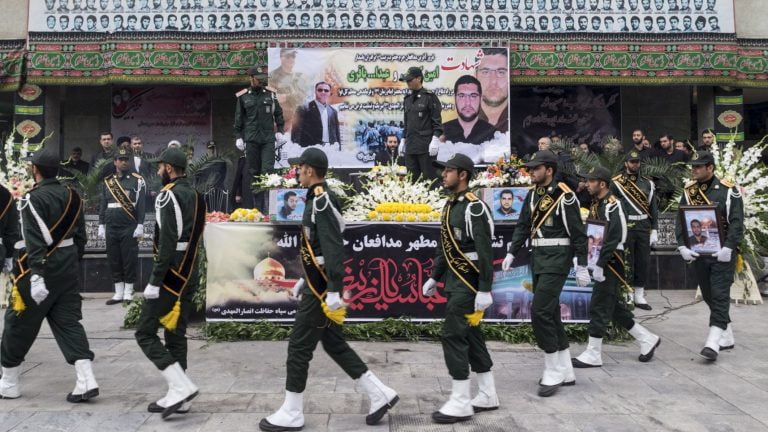
AP — Iran’s semi-official ILNA news agency reported on Saturday that the families of at least 400 people killed fighting in Iranian brigades in Syria have been referred to the Martyr Foundation, which offers financial support to the relatives of those killed fighting for Iran.
The report quotes the head of the Martyr Foundation, Mohammad Ali Shahidi, as saying that Iran’s powerful Revolutionary Guard announced the number of fighters killed, saying that around half of them were Afghan.

It is the first time that an Iranian official has indicated how many people have been killed fighting in Iranian militias in Syria.

Iran has provided military and political backing to Syrian President Bashar Assad in Syria’s civil war. Afghan Shi’ites, some of whom live in Iran, have been fighting alongside Iranian fighters in Syria.
Source