Home Blog Page 454

MPs urge Iran to free Canadian condemned to death

0

Wife plans trip to Iran to seek Hamid Ghassemi-Shall’s release in person

The wife of a Canadian man on death row in Iran is planning to travel to the country in the next couple of weeks to attempt to have him released.

Iranian officials at the embassy in Ottawa have told Antonella Mega that it would be “helpful” if she goes to Iran in person.

Mega’s husband, Hamid Ghassemi-Shall, 42, was arrested in 2008 while visiting family, and was later charged with espionage.

Ghassemi-Shall was sentenced to death in 2009 and an Iranian court rejected an appeal.

He is awaiting execution in Tehran’s notorious Evin prison, where another Canadian, photojournalist Zahra Kazemi, was beaten, raped and killed in 2003.

Iranian officials haven’t been clear whether Mega will be permitted to see her husband when she arrives in Iran, but she remains hopeful and will go as soon as her visa is approved.

MPs pass motion calling for release

Mega also says she is thankful for the Canadian government’s calls to the Iranian government to grant clemency to Ghassemi-Shall.

On Wednesday the minister in charge of consular affairs, Diane Ablonczy introduced a motion in the House of Commons.

The motion says, “That this House urgently appeals to the Government of the Islamic Republic of Iran to grant clemency to Hamid Ghassemi-Shall on compassionate and humanitarian grounds, calls for his release and return to his family and spouse in Canada, and urges Iran to reverse its current course and to adhere to its international human rights obligations.”

It was adopted unanimously by all parties in the House of Commons.

Officials in Canada, Turkey and Brazil have protested Ghassemi-Shall’s sentence.

Mega says she remains hopeful and appreciative of the help of everyone who has come forward, but adds it has been hard to help her husband remain optimistic.

The last time she spoke with her husband was nearly three weeks ago.

Source: CBC News

Radio Farda Families A Target In Iran

0

In an escalation of ongoing efforts to thwart Radio Farda, RFE/RL’s Persian-language Service, Iranian authorities are interrogating journalists’ family members in Iran.

Employees of Radio Farda believe that their journalism, which attracts over 10 million page views monthly on Radio Farda’s website, is the motive behind at least 20 incidents this year involving the interrogation and intimidation of their family members in Iran by officials of the country’s Intelligence Ministry.

In sessions that sometimes lasted for several hours, agents denounced the work of Radio Farda journalists and warned family members against having further contact with them. In several cases they instructed family members to tell their relatives to resign from their jobs and return to Iran; in one instance they demanded that a specific series of reports be discontinued. During questioning, family members were also asked about their foreign contacts and trips abroad.

The interrogations have targeted family members, who in some cases have been repeatedly summoned, in Tehran and at least six other Iranian towns and cities.

“This is a proxy war against Radio Farda. It shows the extremes to which the regime will go to prevent the exchange of information it doesn’t control,” said Steven W. Korn, RFE/RL president. “Our journalists make enormous sacrifices for the work they do and will not submit to this pressure on them and their families.”

Radio Farda, produced in and broadcast from Prague, is a leading source of uncensored information in Iran. Each month 1.5 million users inside the country defy the government by employing proxies to access Radio Farda’s website, which is blocked. Radio Farda and “Pasfarda,” its signature satire program, are active on social media, with a combined 300,000 Facebook fans. Iranians actively participate in Radio Farda’s weekly call-in shows, connect with it daily through hundreds of email and SMS messages, and despite government jamming, tune in to satellite radio and shortwave to hear its programs.

Source: Inside of Iran

Iran strengthens its backing for Assad

0

A senior Iranian military commander’s reported admission that Iranian forces are operating in Syria to stiffen the embattled regime of President Bashar Assad underlines how bad things are for Syria’s divided opposition.

This and reports that Russian and North Korean arms are reaching Damascus could propel Assad’s leading Arab foes, the monarchies of the Persian Gulf led by Saudi Arabia, to step up clandestine shipment of arms and ammunition to Syrian rebels.

The main arms pipeline to the rebels is through northern Lebanon, a region dominated by Sunnis with close ties to their co-religionists in neighboring Syria.

They’re the majority in Syria and constitute the main driving force behind the revolution that will shortly enter its 15th month with Assad’s opponents dangerously divided.

On Monday, Ismail Gha’ani, a top commander in the Islamic Revolutionary Guard Corps, the Iranian’s regime’s Praetorian Guard, was quoted as saying in an interview with Iran’s semi-official Isna news agency that, not only were Iranian forces in Syria, they were preventing Assad’s forces from slaughtering civilians.

“If the Islamic Republic was not present in Syria, the massacre of people would have happened on a much larger scale,” he said.

“Before our presence in Syria, too many people were killed by the opposition but with the physical and non-physical presence of the Islamic Republic, big massacres in Syria were prevented.”

Isna carried the interview over the weekend but abruptly withdrew the item without explanation, apparently after it was picked up by Western news outlets — or maybe because of Friday’s massacre at Houla was blamed on Assad’s regime.

The apparent admission by Gha’ani was given added weight because he’s deputy commander of the elite al-Quds Force, the IRGC’s clandestine arm which operates outside Iran.

This force has long operated in Lebanon with Tehran’s prized Arab surrogate, Hezbollah, and waged a covert campaign against the Americans in Iraq.

The number of Revolutionary Guards deployed in Syria isn’t known, although Western intelligence sources say it’s considerable.

Al-Quds Force’s long-elusive commander, Maj. Gen. Qassem Suleimani, is reported to have traveled secretly to Damascus in January to meet Assad and his senior commanders.

Suleimani, who masterminded al-Quds Force operations in Iraq and covert activities throughout the Persian Gulf and Lebanon, is a key figure in Iranian policymaking, particularly in security matters.

Syria’s a vital component of Iran’s expansionist ambitions into the Arab world, whether in the gulf or the Levant, where Tehran can carry its conflict with Israel right to its doorstep through Hezbollah in Lebanon.

Tehran seems prepared to go to almost any lengths short of all-out war with Israel or the United States to keep Syria within its orbit.

So sending someone of Suleimani’s status and reputation for covert operations to Damascus would seem to underline Tehran’s determination to keep Assad’s minority regime in power at almost any cost.

Suleimani, a combat veteran of Iran’s 1980-88 war with Iraq, took command of the al-Quds Force in the late 1990s and has become a powerful figure in the upper echelons of the Tehran regime.

Western officials say his trip to Damascus signaled an escalation in Iranian support for Assad, which for months after the revolution broke out March 15, 2011, was limited to Revolutionary Guard advisers and counterinsurgency technology.

The United States, along with its allies, would like to see regime change in Damascus and end Syria’s alliance with Iran, forged in 1980 by Assad’s late father, Hafez Assad.

He was feuding with Saddam Hussein at the time and saw an alliance with the infant Islamic Republic, then about 18 months old following the 1979 Islamic Revolution, as a strategic asset against the Baghdad regime.

The Americans, then, probably view the growing al-Quds Force profile in Syria and Suleimani’s Machiavellian hand there as an escalation of Iran’s backing for Damascus, crimping any hopes of getting rid of Assad soon.

Whether that will translate into more robust U.S. support for the Syrian rebels isn’t clear.

But the changing perceptions among Israeli leaders about what’s happening in Syria are instructive.

A couple of months ago Israeli Defense Minister Ehud Barak was confidently predicting Assad’s imminent downfall now, senior military officers and the intelligence community expect Assad to stay in power for the foreseeable future.

Source: Freedom Messenger

Kuwaiti official slams Iran criticism on spy ring rulings

0

A senior Kuwaiti official has slammed Iran for criticizing a Kuwaiti court ruling that sentenced four men to life in jail for spying for Tehran, newspapers reported on Thursday.

“Unfortunately, this is an act of disrespect for Kuwaiti court rulings that we highly appreciate and respect,” foreign ministry undersecretary, Khaled al-Jarallah, was quoted as saying by Al-Rai newspaper.

“Kuwaiti court rulings on men accused of spying were issued after lengthy and in-depth investigations … We reject the Iranian foreign ministry statements because they undermine our court verdicts,” he said.

Jarallah was responding to Tuesday remarks by Iran’s foreign ministry spokesman, Ramin Mehmanparast, in which he insisted the charges against the seven-member spy cell were false and rejected the ruling.

“From the Islamic republic’s point of view, all these charges are false and the sentences handed down are unacceptable,” Mehmanparast told a press conference in Tehran.

“We hope that the Kuwaiti government will review its position and that these people will soon be freed,” he said.

Kuwait’s court of appeals on Monday reduced a death sentence on two Iranians and a Kuwaiti to a life term and upheld a life sentence on a stateless man.

It also confirmed the acquittal of a man and a woman, both Iranians, while a Syrian who was sentenced to life by the lower court too was acquitted.

The two convicted Iranians and the Kuwaiti worked for the Kuwaiti army at the time of their arrest in May 2010.

The defendants were accused of spying for Iran and of passing information on the Kuwaiti and US military in the Gulf emirate to the Islamic republic’s Revolutionary Guards, an accusation Iran has denied.

The defendants denied the charges and insisted they had been tortured to extract confessions.

Local media has also reported that some of the men were given training on the use of explosives and had planned to bomb Kuwaiti oil pipelines.

The case strained relations between Kuwait and Iran, prompting a tit-for-tat expulsion of diplomats.

Ambassadors later returned to both capitals following a visit by Iranian Foreign Minister Ali Akbar Salehi to Kuwait City in May 2011.

The ruling is not final as the case will now go to Kuwait’s supreme court, where a final verdict will be issued.

 Source: Alarabiya

Government Assault on Academic Freedom

The following statement was issued by 17 human rights and educational groups concerned with academic freedom in Iran, including Human Rights Watch:

Abdorrahman Boroumand Foundation  *  Amnesty International  *  Arseh Sevom  *  ARTICLE 19  *  Bahá’í International Community  *  Committee of Human Rights Reporters  *  Cairo Institute for Human Rights Studies  *  Green Students for a Democratic Iran – Southern California  *  Human Rights Activists in Iran  *  Human Rights Watch  *  International Campaign for Human Rights in Iran  *  International Federation for Human Rights  *  Iran Human Rights Documentation Center  *  Iranian League for the Defence of Human Rights  *  Society to Combat Discrimination in Education  *  Iranian Democratic Student Association of George Washington University  *  United for Iran

Joint Statement on the

Right to Education and Academic Freedom in Iran

The above signatories representing 17 human rights and student organizations express deep concern about the alarming state of academic freedom in the Islamic Republic of Iran, in particular violations of the rights to freedom of expression, association, and assembly on campuses; and institutionalized procedures that allow authorities arbitrarily to expel and suspend students, and fire graduate instructors on the basis of their political views or activities. Over six hundred students, as well as some university lecturers, have been arrested since 2009, many of whom have subsequently been imprisoned, and hundreds deprived of education, as a result of their political activities.

The right to education for all persons without discrimination is explicitly guaranteed under international instruments, which Iran has accepted or to which it is party, including the Universal Declaration of Human Rights, the International Covenant on Economic Social and Cultural Rights (ICESCR), and the UNESCO Convention against Discrimination in Education. It is also guaranteed under Iran’s Constitution. The International Covenant on Civil and Political Rights (ICCPR) and the International Convention on the Elimination of Racial Discrimination (CERD) further protect the rights of individuals to freedom of opinion, expression, association, and assembly, and prohibit discrimination against any person due to their race, sex, religion or belief, ethnicity, or political or other opinion. The ICCPR also protects the right of minorities, in community with others, to enjoy their own culture, to profess and practice their own religion, and to use their own language.

In the International Covenant on Economic Social and Cultural Rights’ General Comment 13 from 1999, academic freedom is explained as including:

“the liberty of individuals to express freely opinions about the institution or system in which they work, to fulfill their functions without discrimination or fear of repression by the State or any other actor, to participate in professional or representative academic bodies, and to enjoy all the internationally recognized human rights applicable to other individuals in the same jurisdiction.”

Additionally, General Comment 13 of the ICESCR states that “the denial of academic freedom of staff and students” would be a violation of Article 13 of the ICESCR.

UNESCO’s 1997 Policy Recommendation Concerning the Status of Higher Education Teaching Personnel also provides that the right to education “can only be fully enjoyed in an atmosphere of academic freedom and autonomy for institutions of higher education.” Academic freedom is defined as:

“the right without constriction by prescribed doctrine, to freedom of teaching and discussion, freedom of carrying out research and disseminating and publishing the results thereof, freedom to express opinion[s], freedom from institutional censorship and freedom to participate in professional and representative academic bodies […] without discrimination of any kind and without fear of repression by the state or any other source.”

The UNESCO Policy further provides that professors should not be forced to instruct against their own best knowledge and conscience, to use curricula or methods contrary to international human rights standards, or be subject to dismissal for any reason without sufficient cause related to professional conduct and demonstrable before independent and impartial third party hearings. According to these standards, higher education institutions should support academic freedom and fundamental human rights, ensure students are treated fairly and justly, adopt policies that ensure equitable treatment of women and minorities, and ensure that higher education personnel are not impeded in their work by violence, intimidation, or harassment.

Yet, students and higher education personnel in Iran continue to face routine and pervasive violations of their rights on the basis of their opinions, gender, religion and ethnicity. The Network for Education and Academic Rights, an independent non-governmental organization that monitors academic freedom, documented at least 92 violations of academic rights in Iran in 2011. According to the largest independent student organization in Iran, Daftar-e Tahkim Vahdat, between March 2009 and February 2012, there were at least 396 cases of students banned from further study by the Ministry of Science, Research, and Technology as a result of their peaceful political or other dissent. Additionally, at least 634 students were arrested by security and intelligence organs and 254 students convicted for similar reasons, with the correlated impact on their ability to continue their education. The Ministry of Science, Technology, and Research declared Daftar-e Tahkim-e Vahdat an “illegal” union in 2009, on grounds that it “engaged in activities that endangered national security.”

The organizations said that they had gathered information that the Iranian authorities have threatened, suspended, arrested, prosecuted, and sentenced student activists for peaceful criticism of government policies on a regular basis. Officials also have routinely shut down hundreds of student gatherings, publications, and independent organizations. More than 30 students are currently serving long prison sentences in Iran solely for exercising their rights to freedom of expression, association, and assembly by expressing their opinions, participating in demonstrations, or membership of an independent student organization critical of government policies. Combined, these students have been sentenced to more than 130 years in prison, in some cases up to 15 years.

The organizations expressed further concern that the Iranian government also appears to vet students for admission to graduate programs as well as applicants to higher education teaching posts based on their ideological views. The Supreme Council for the Cultural Revolution sets ideological and political requirements for students seeking higher education as a strategy of deterring dissent on university campuses. These regulations require students to have faith in Islam or other state-recognized religions, and be judged “not to be hostile” to the Islamic Republic, and free from “moral corruption.” The regulations are then used by the Ministry of Intelligence, the Ministry of Science, Research and Technology and university “disciplinary committees” to arbitrarily pressure and punish students on the basis of their views, including banning them from admission and enrollment. As such they violate Article 3 of the Iranian Constitution guaranteeing the right to education for all citizens.

The organizations also highlighted that Iran’s paramilitary and intelligence apparatuses, including the Basij militia, maintain an active presence on university campuses and engage in violent confrontations with students, including repeated attacks on peaceful gatherings and dormitories leading to serious injuries and the deaths of several students. While such attacks on Iranian university campuses are not new, an increased number of instances have been carried out across the country since the 2009 disputed elections.

In addition, Iran’s minorities face systematic deprivation and discrimination in higher education. Authorities have prevented–and specifically targeted–members of the Bahá’í faith from pursuing higher education solely on the basis of their religious beliefs, as specified in regulations by the Supreme Council of the Cultural Revolution that require faith in Islam or state-recognized minority religions that exclude the Bahá’í community. The organizations said they were aware of hundreds of qualified Bahá’í students who are banned from entering public and private universities and vocational training institutes in Iran. In 2011, authorities raided the Bahá’í Institute for Higher Education (BIHE), an online correspondence university created in 1987, and arrested and jailed thirty members of the BIHE. At least nine educators have been convicted of charges relating to the peaceful exercise of their right to freedom of expression, association, and assembly, of whom up to seven are currently believed to be in prison.

Student activists that advocate for ethnic minority rights often face the harshest punishments by Iranian authorities for voicing their discontent with discrimination against them. This includes arbitrary and sometimes violent arrests, heavy sentences, and, in some instances, the death sentence. For example, in 2011, four members of the Democratic Union of Kurdish Students were arrested and several others summoned to security and intelligence offices.

Furthermore, discrimination against women has increased within Iran’s higher education system. Gender segregation introduced recently in some universities raises questions about whether women and men will continue to enjoy equal access to the same quality of higher education, subject to capacity, as is required under international law. Reports of quotas restricting women’s admission to specific university programs implemented by the Ministry of Science, Research and Technology, indicate that women are facing increasing restrictions in their ability to exercise their right to access higher education without discrimination. The quotas appear designed to reduce women’s access to specific fields of study and increase the overall proportion of male admission to Iranian universities. Such restrictions on women’s educational choices violate the prohibition on discrimination and Iran’s obligations under international law, to ensure the equal rights of men and women to education. In addition, in a recent disturbing incident at the Roudehen Branch of Islamic Azad University in April, university security personnel insulted and beat female students whom they believed were not complying with hijab [Islamic dress] standards.

The situation of higher education teaching personnel is not much better. The Iranian authorities have dismissed over one hundred academics from their posts since the 2009 election on the basis of their political views and dissent against the government contrary to their obligations under Article 13 of the ICESCR to ensure academic freedom and institutional autonomy. Several university lecturers are serving prison sentences solely for peacefully expressing opposing views from the state.

Finally, the Ministry of Science, Research, and Technology has instituted a program of “adapting” certain fields of study to Islamic ideology as defined by the government, including law, women’s studies, human rights, management, arts and cultural management, sociology, social sciences, philosophy, psychology, and political science. Such a policy amounts to a violation of academic freedom through direct censorship and ideological control of higher education.

The organizations strongly urge the Iranian authorities to fulfill Iran’s international obligations to ensure respect for the right to education and academic freedom by:

  • Releasing immediately and unconditionally all Iranian students and higher education personnel who have been jailed for peacefully exercising their rights to freedom of expression, association, and assembly, including educators at the Baha’i Institute of Higher Education, and including those who have expressed political opinions (lists provided below);
  • Ending the systemic identification and targeting of students due to their beliefs, or their religious, political or civic activities, and revising regulations for admissions and “disciplinary committees” to ensure they uphold and respect the principles of free expression, assembly, and association;
  • Removing all intelligence units and Basij paramilitary units from university campuses;
  • Allowing peaceful, independent Iranian student organizations to operate freely and without interference from government authorities and organs;
  • Abolishing discriminatory policies against women, including the quota system that restricts women’s participation in higher education, gender segregation which may lead to women experiencing discrimination in higher education, and restrictions on campuses and fields of study in which women can enroll; and ending enforcement of clothing standards that violate the rights to privacy, freedom of expression and freedom of religion or belief;
  • Abolishing all policies and practices that discriminate against or otherwise violate the rights of religious and ethnic minorities in Iran, particularly the Baha’i community, including in regard to their access to higher education and academic freedom;
  • Ending the practice of hiring, promoting or firing higher education teaching personnel based on their personal and political opinions and establishing independent university committees to review and reinstate professors that have been dismissed on ideological and politically motivated grounds; and
  • Ensuring that the governance, curricula and procedures for enrollment in universities are independent from government control and free from ideological vetting, including by the Supreme Council of the Cultural Revolution, and that they adhere to international standards of academic freedom outlined by UNESCO and the ICESCR.

Students imprisoned in Iran

Bahareh Hedayat; Zia Nabavi; Majid Dorri; Majjid Tavakoli; Ieghan Shahidi; Ali-Akbar Mohammadzadeh; Ali Malihi; Hassan Asadi Zeidabadi; Hamed Omidi; Saeed Jalalifar; Mehdi Khodaie; Milad Karimi; Babak Dashab; Hamed Rouhi-Nejad; Hossein Ronaghi-Maleki; Shahin Zeinali; Arash Sadeghi; Javad Alikhani; Omid Kokabi; Habibollah Latifi (on death row); Shabnam Madadzadeh; Atefeh Nabavi; Fereshteh Shirazi; Afshin Shahbazi; Rouzbeh Saadati; Mehrdad Karami; Ali Jamali; Mohammad Ahadi; Rouhollah Rouzi-Talab; Sama Nourani; Emad Bahavar; and Kaveh Rezaei Shiraz.

Higher education personnel imprisoned in Iran

Masoud Sepehr; Ghorbanali Behzadian Nezhad; Ghasem Sholeh-Saadi; Davoud Soleimani; Mohsen Mirdamadi; Zahra Rahnavard (house arrest); and Ahmad Miri.

BIHE educators

Mahmoud Badavam; Riaz Sobhani; Ramin Zibaie; Farhad Sedghi; Nooshin Khadem; Kamran Mortezaie; and Kamran Rahimian.

 Source: Human Right Watch

EU says alarmed by rise in death sentences in Iran

0

The European Union criticized Iran on Wednesday for an “alarming” increase in the use of the death penalty this year, calling on Tehran to introduce a moratorium on executions.

“According to the latest data, compiled from a number of sources, the rate of executions in Iran during the first 5 months of 2012 confirmed the country as one of the world’s leading users of the death penalty,” a spokesman for the EU’s foreign policy chief said.

EU foreign policy chief Catherine Ashton is “deeply concerned by the alarming increase”, the spokesman said.

Ashton is leading negotiations between six global powers and Iran over the Islamic Republic’s nuclear program, hoping to resolve a decade-long dispute over international suspicions that Tehran seeks the means to make atom bombs. Tehran denies this.

A round of talks in Baghdad last week produced scant results but the powers – United States, Russia, China, Germany, France and Britain – are due to meet Iranian negotiators again in Moscow on June 18-19.

Tehran has repeatedly faced accusations of human rights abuses related to its high rate of use of the death penalty.

“It’s not clear why this is happening now and might just be a coincidence. Whatever the reason may be, it’s a convenient time to step up executions when the rest of the world is focusing on the nuclear talks,” a Tehran-based diplomat said.

In May, Iranian media said 15 people were hanged – 14 who faced charges of drug trafficking and a man said by Tehran to be an agent of the Israeli intelligence agency Mossad.

The EU has imposed sanctions on Iranian officials who it says play a prominent role in serious human rights violations, targeting them with travel bans and asset freezes.

Such measures are in addition to a broad range of economic sanctions the EU has introduced to press the Islamic Republic to abandon its contested nuclear activity.

Source: Reteurs

Women, tie-sellers targeted in Iran clothing purge

0

Female booth attendants at an international trade fair and shops selling men’s ties have become targets in a strict crackdown by Tehran police on clothing deemed un-Islamic, Iranian media reported on Wednesday.

Women “not properly observing the hijab,” or the Islamic headscarf, as they staffed stands at an international food exhibition, prompted police to shut down 80 of the booths, Iranian deputy police chief Ahmad Reza Radan was quoted as saying in the Mardomsalari newspaper.

His boss, police chief Esmail Ahmadi Moqadam, said the female attendants had been warned, “but they did not take it seriously — that is why we shut them (the booths) down.”

It was not known if the women were fined or arrested, as often happens for such offences, nor was it known if any foreigners were among them.

The fair, which wrapped up on Wednesday, hosted exhibitions by companies from several countries, including Austria, China, France, Germany, India, Italy, South Korea, Spain and Turkey.

According to Mardomsalari and other media, police have also launched a fresh campaign to enforce an often-ignored ban on the sale of ties — apparel deemed by regime hardliners as a symbol of Western cultural influence rejected since Iran’s 1979 Islamic revolution.

“We had to remove all ties from our shop” on the orders of Tehran’s morality police, an unnamed shopkeeper told the ISNA news agency.

The ban appeared to be an effort to counter a comeback ties had been making in recent years in Iran, especially in ceremonial events such as weddings and funerals.

Tehran police have in recent weeks been zealously cracking down on clothing standards in the street, screening foot and vehicle traffic at major junctions and shopping centres.

The move is part of an annual campaign before the sweltering heat of summer, when women try to relax some of their mandatory clothing by opting for thinner, shorter coats and headscarves.

Women are required to wear a scarf covering their hair, a long coat to below the knee and to eschew heavy make-up and nail polish.

Violators are often arrested and taken to police stations, where they are typically fined and made to sign statements promising to dress properly in the future, though flogging can occur in rare cases. Relatives are usually called to collect them with clothing considered more appropriate.

Source: Freedom messenger

Zahra Khodabakhsh, daughter of Shargh investor, detained

Zahra Khodabakhsh, daughter of Shargh newspaper’s financial investor Ali Khodabakhsh, has been arrested.

According to opposition website Kalame, security forces entered the 28-year-old’s home and arrested her without providing any reasons for the move. Following her arrest, she was reportedly taken to Evin Prison.

Zahra Khodabakhsh is an architect with no history of political activism.

Her father, Ali Khodabakhsh has invested in a number of reformist publications, including Sharghnewspaper. He was arrested on 7 December 2010 and later sentenced to a year in prison plus a 3,000,000 Rial fine.

 Source: Irangreenvoice

3 students detained in Isfahan

Three students at the University of Isfahan have been arrested by the Revolutionary Guards.

According to opposition site Kaleme, Erfan Mohammad, Mohammad Moradi and Mojtaba Karimi were arrested at the University of Isfahan’s dormitory last week. The three are believed to have been detained in connection with their involvement in the distribution of Kebrit, a local student publication.

University officials claim the publication is banned and that its distribution is in violation of the law.

The IRGC recently contacted one of the families to inform them that the three were being held at Isfahan’s Dastgerd Prison.

 Source: Irangreenvoice

Syrian army being aided by Iranian forces

0
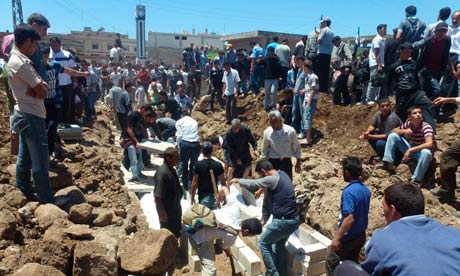
The Syrian town of Houla prepares a mass burial for the victims of an alleged artillery barrage from Assad forces. Iran disputes this claim. Photograph: Reuters

A senior commander in Iran‘s Revolutionary Guards has admitted that Iranian forces are operating in Syria in support of Bashar al-Assad‘s regime.

Ismail Gha’ani, the deputy head of Iran’s Quds force, the arm of the Revolutionary Guards tasked with overseas operations, said in an interview with the semi-official Isna news agency: “If the Islamic republic was not present in Syria, the massacre of people would have happened on a much larger scale.”

Isna published the interview at the weekend but subsequently removed it from its website.

It quoted Gha’ani as saying: “Before our presence in Syria, too many people were killed by the opposition but with the physical and non-physical presence of the Islamic republic, big massacres in Syria were prevented.”

The west has accused Iran of providing military and technical support to Assad to quell protests since the start of the uprising in Syria. Iranian officials in return played down the accusations by saying the country only supported Syria morally.

As the wave of protests swept across the Middle East, Tehran’s leaders found themselves in the peculiar situation of praising the uprisings in Tunisia, Egypt, Bahrain and Yemen but condemning them in Syria, its close ally in the region.

The Iranian opposition has tried to claim credit for the Arab spring saying it was inspired by the events in the aftermath of Iran’s disputed presidential elections in 2009, but the country’s supreme leader, Ayatollah Ali Khamenei, said the vents of the last 18 months was reminiscent of the 1979 Islamic revolution. Khamenei has since referred to the Arab spring as the “Islamic awakening”.

“This is the first time that an IRGC senior officer has admitted that the Quds force is operating in Syria,” said Meir Javedanfar, an Iranian-Israeli Middle East expert.

“This could be due to the Iranian government feeling threatened by the increasing isolation of Syria and the dangers which such isolation and possible fall of Assad could pose to its interests in Syria, and to its Hezbollah allies in Lebanon.

“By making such an admission now, Iran may very well be wishing to send the message that when it comes to Syria the gloves are off and whoever wants to confront Assad will be confronting Iran’s most experienced and potent special forces operatives.”

On Monday, Iran also blamed “foreign interference” and “terrorists” for the killing of more than 100 people, many of them children, in the Syrian town of Houla.

“We are certain that foreign interference, terrorists and suspicious measures which have targeted the resilient Syrian people are doomed to fail,” said the Iranian foreign ministry spokesman, Ramin Mehmanparast, in quotes carried by the website of Iran’s state English-language television channel, Press TV.

“The attack has been carried out in order to create chaos and instability in Syria and its perpetrators are trying to block the way to a peaceful resolution,” he said.

Iran’s Quds force has been in the spotlight in recent years mainly for its activities inside Iraq.

Part of the responsibility of the Quds force is to protect the concept of Islamic revolution which the revolutionary guards view as being closely tied up with protecting Khamenei.

Source: Freedom Messenger