Home Blog Page 460

Iran Tries to Neuter Foreign Media and International Press Freedoms

0

Iranian authorities should end their undue restrictions on and intimidation of foreign-based journalists and media outlets, the International Campaign for Human Rights in Iransaid today.

“Iranian authorities have long been repressing domestic journalists. Now it’s clear that they have turned an eye to neutering international press freedoms also,” said Campaign spokesperson Hadi Ghaemi. “We are increasingly seeing Iranian authorities using intimidation, arrests, censorship, and other methods to restrict foreign media from reporting on Iran.”

A source in the Iranian government, who spoke on condition of anonymity, told the Campaign that Iran’s drive to restrict the ability of foreign media to operate freely in Iran is due to the fears of some officials that international press coverage can undermine their political interests.

“The Intelligence Ministry, the Revolutionary Guards, and the National Security Council are pressuring the Deputy Minister of Culture who oversees the foreign press to give [these security agencies] more control over the way foreign media reports Iran’s politics and economy, as we approach the 2013 presidential election,” the government source said.

The government source also said that the Revolutionary Guards’ Intelligence Unit is more active than other intelligence agencies in curbing press freedom in Iran. “The Guards believe that the Iranian government showed negligence and ineptitude in allowing foreign journalists to cover the 2009 presidential election and post-election unrest. So, they are trying to exert more control over the presence of foreign journalists in Iran,” the government source said.

Since the June 2009 election, authorities have threatened and interrogated several journalists, contributors, and their family members, as well as Iranians appearing in foreign media, including BBC Persian, Reuters, Newsweek magazine, and The New Yorker magazine.

Sources reported that Iranian intelligence officers threatened a Reuters journalist after the release of a video report about female ninjas in Iran.

On 16 February 2012, London-based Reuters News Agency released a report profiling Iranian women practicing the Japanese martial art of Ninjutsu. The report, originally entitled Thousands of Female Ninjas Train as Iran’s Assassins, misleadingly and distastefully referred to the female athletes as “assassins.” As a result, Iran suspended the press licenses of 11 Reuters journalists in Iran.

Press TV, an English-language news network run by the Iranian government, reported that the women in the Reuters report were pursuing a defamation lawsuit against Reuters.

The Campaign has recently learned that a few days after the ninja video’s release, the Ministry of Islamic Guidance and Culture (Ministry of Culture) summoned the journalist who was responsible for the report. According to an eyewitness, when the reporter was at the Ministry of Culture’s offices in Tehran, the staff left the offices at one point, and then officers from the Revolutionary Guards’ Intelligence Unit arrived and interrogated the reporter for several hours. The eyewitness said that the reporter was extremely frightened and was shaking after the interrogation session by the Revolutionary Guards.

The aforementioned government source alleged that representatives of the Revolutionary Guards’ Intelligence Unit told the Ministry of Culture that “no word was to be said about the interrogation session.”

The Reuters reporter was also allegedly threatened and told that she should not speak about the interrogation, or else she and her family will face further difficulties. The government source claimed that authorities told the Reuters office in Tehran that if any news about the interrogation was ever published, their offices would never re-open.

“Iranian intelligence and security agencies are resorting to harassment, intimidation, censorship, and arrest of foreign media that produces stories it disapproves of in order to exert undue control over news coverage,” said Ghaemi. “The Minister of Culture himself has a responsibility to make sure security agencies don’t use his office to conduct politically-motivated intimidation campaigns against journalists.”

Laura Secor, contributor to The New Yorker magazine, described to the Campaign how Iranian officials tried to limit her ability to report on the March 2012 parliamentary elections.

“The week of the parliamentary election, visiting foreign correspondents were forced to comply, at times, with a program that confined us to buses and kept us together as a group and under watch,” Secor wrote in an email to the Campaign. “On the day of the election, we were expected to spend eleven hours on a bus, being taken to polling stations together with Iranian state television, which was filming us, and intelligence agents who were watching us. The only other option was to go back to our hotels, which we were forbidden to leave.”

“Over the course of the week, at least two of us were detained and questioned. In my case, I was questioned about my movements and my contacts, I was accused of being a spy, and some of my personal papers were confiscated,” Secor added.

Secor details her account in full in the 7 May 2012 issue of The New Yorker.

Since 2009, the number of foreign journalists allowed to enter and operate in the country has decreased notably. One Canadian journalist told the Campaign that Iranian authorities told her directly that they were rejecting her visa application because they were unhappy with her past coverage of Iranian affairs.

In practice, the Ministry of Culture keeps a file, which includes all published reports, of all foreign journalists working in Iran. This file is used when authorities decide whether or not to grant visas to applicants looking to enter Iran as journalists.

“In selecting journalists to report from Iran, a general effort was made to select reporters who had never covered Iran, or who had never published critical articles; though a few experienced reporters were also included in the list,” the government source told the Campaign.

As a result of growing restrictions on foreign journalists, only a limited number of journalists were invited to cover the Iranian Parliamentary elections this past March, the government source explained to the Campaign.

The Campaign has also previously reported the government’s obsessive attack on BBC Persian, which included satellite jamming, harassment of BBC journalists, and arrests of BBC contributors. In September 2011, authorities detained six independent documentary filmmakers because their films were licensed and aired on BBC Persian. In late January 2012, authorities seized a family member of a BBC Persian employee based in London, and then tried to pressure the family member to denounce the employee’s work with BBC Persian.

“A family member of one of the BBC Persian employees was detained and pressured to make online connections with the BBC employee,” Sadeq Saba, the head of BBC Persian, told the Campaign. “During that communication, the BBC employee was remotely interrogated to get information about BBC,” he continued.

Recently, Iran’s Press TV broadcast a report critical of BBC Persian called “Eye on the Fox.” In the report, several prisoners were shown “confessing” to working for BBC Persian, an act the government sees as a crime. The footage, reportedly provided to Press TV by the Revolutionary Guards’ Intelligence Unit, was filmed secretly in Evin Prison interrogation rooms. The government’s Islamic Republic of Iran Broadcasting (IRIB) ran a similar program for domestic audiences.

According to the Campaign’s source inside the government, this production was not solely a media operation.

“Press TV is acting as the media arm of the Revolutionary Guards’ Intelligence Unit at this time. This is why during the production of ‘Eye on the Fox,’ an IRIB program about the BBC, some of the film’s components were compiled by the Intelligence Unit. They use Press TV to put pressure on different media outlets,” the government source said.

Iranian intelligence agencies have a track record of using coercion and torture to extract false statements and confessions. At times, intelligences officers have worked closely with Press TV and other state media outlets to film and televise forced confessions, often of detainees before they have faced trial. Maziar Bahari, a former reporter for US-based Newsweek magazine, reported being made to make such a taped confession in July 2009.

According to the government source, Press TV was the government agency that turned the Reuters ninja report into a controversy. Reuters’ Tehran bureau was shut down only after Press TV complained publicly about the Reuters report. Press TV plays an important role in the Iranian government’s efforts to monitor and limit foreign media. “The channel [Press TV] has become the government’s watchdog as well as its prosecutor, judge, and jury when it comes to the foreign media,” said the Iranian government insider.

“In my opinion, Press TV, as the media arm of the Iranian government in general and the IRGC [Revolutionary Guard] in particular, tries to cut off the flow of information between Iran and the rest of the world,” Maziar Bahari told the Campaign.

“They try to do this through different means,” he continued. “First, they try to poison the environment through Press TV and to slander different individuals in the media. The second step is to try, through legal means, to prevent the activities of foreign press and media. The third step, which is a well-known and established method in Iran, is to use threats, force, and dismissal of reporters to limit and control their efforts to disseminate the news,” Bahari said.

“Foreign journalists, more than domestic journalists, need government cooperation to be able to work in the country,” Campaign spokesperson Ghaemi said.“Because of the fear that they might not get visas or might lose their ability to work in Iran, some journalists do not expose these threats and intimidation. But the government has taken advantage of this fear to prevent the international press from reporting critically on Iran.”

Source: Iran human rights

Malekpour Family Allowed Visit After Three Months

0

The family of Saeed Malekpour, an Iranian-Canadian who was sentenced to death in January 2012, was finally allowed to see him after three months of not being able to visit him. His sister, Maryam Malekpour, told the International Campaign for Human Rights in Iran that Saeed’s interrogators have prevented him from seeing his family.

“During these three months, authorities never answered any of our requests or questions, and the numerous letters I wrote were left unanswered. Only some reliable sources whose names I cannot reveal said that Saeed’s interrogators do not authorize visits for him. Even when the case judge issued a permit for visitations for Saeed, we were not allowed to see him. We guess that because they took Saeed in front of a television camera three times in order for him to make confessions and to show that he was remorseful and each time Saeed refused to give a confession, perhaps they did not allow him to have visitors to punish him,” said Maryam Malekpour.

36-year-old Saeed Malekpour, a web developer and resident of Canada, has been sentenced to death on the charge of “insulting Islamic sanctities,” for alleged “management of pornographic websites.” Malekpour’s family has maintained that he simply developed image-sharing software that was used, without his knowledge, to post pornographic photos.

Maryam Malekpour told the Campaign that authorities have not given her brother clear information about his upcoming execution: ” …  [W]e were able to see Saeed two weeks ago. Saeed’s morale was good. They had not informed him of the confirmation of his death sentence, so we didn’t tell him anything either, lest the news upsets him. His death sentence remains in the Judiciary’s Sentence Enforcement Unit. Neither he nor his lawyers have been served the confirmation, but we are really fearful that his death sentence may be carried out suddenly.”

“I heard a while back through Saeed’s cellmates that he has developed kidney stones and is in a lot of pain. His cellmates had also asked the prison guards several times to take him to a doctor, but they only transferred him to the prison infirmary. When I heard this I spoke with a specialist and got him his medicine and sent it to him,” added Maryam Malekpour, explaining that since he has begun taking the medicine, his condition has improved.

Security forces arrested Canadian resident Saeed Malekpour, 36, when he returned to Iran in 2008 to visit his ailing father. He appeared on Iranian state TV in 2009 and confessed to charges raised against him. In October 2010 he was sentenced to death on charges of “insulting Islamic sanctities” for alleged “management of pornographic websites.” The Supreme Court overturned the sentence in November 2011 because of deficiencies in investigations and insufficient evidence, and forwarded his case to the Revolutionary Court. Even so, the Supreme Court upheld his death sentence on 30 January 2012.

Source: Iran human rights

Iran: Just like Al Qaeda

0

Al Qaeda only operates in separatist regions or areas beset by tribal conflict; whilst it thrives wherever there is a sectarian atmosphere. The same applies to Iranian policy in our region, for Tehran is supporting the Baathist, secular and Alawite al-Assad, whilst at the same time supporting the extremist Sunni Al Qaeda organization, which – for its part – is coexisting with the [Shiite] Huthi movement in Yemen!

Yesterday, Asharq Al-Awsat published an astonishing report in cooperation with Britain’s The Guardian newspaper, revealing the frenetic Iranian movement to support the southern separatists in Yemen. This report clearly indicates the danger of what Iran is doing in our region, whether in Yemen, Iraq, Bahrain, Lebanon, Syria or the Gaza Strip with regards to distributing funds and arms, establishing poisonous media outlets – whether we are talking about television or newspapers or the internet – whose sole objective is to allow Iran to infiltrate our countries, including Egypt and the Arab Maghreb. The Guardian report sheds light on the manner in which the Iranians are operating, and this is similar to the way that Al Qaeda operates, as we see Tehran is active in separatist or sectarian regions. This is not to mention the Iranian’s presence amongst those who have been deceived by Tehran, sometimes in the name of “resistance”, and this is a lie that has been publically exposed, or at other times in the name of revolution. Indeed, here we see a senior member of the Iranian Revolutionary Guard Corp [IRGC] protesting against the term “Arab Spring”, saying this phenomenon should instead be called the “Islamic Awakening”, however does this then apply to what is happening in Syria and Bahrain? If this is the case, then why does Iran stand with al-Assad against the people of Syria? Why then does the Iranian-backed Shiite opposition in Bahrain call for democracy? This is truly confusing!

Therefore the importance of The Guardian report, which was also published in Asharq Al-Awsat, is that it clearly shows Iran’s relationship with the Huthis, and its desire to infiltrate southern Yemen, particularly as Iran stipulated that the southern Yemenis could only be armed via the Huthis! The importance of this report is also revealed in the information regarding the 15 Yemenis who travelled to Tehran and who, upon their arrival, were dealt with as if they were detainees; this is also what happened with the Al Qaeda elements present in Iran, and this includes some of Osama Bin Laden’s children. The Yemeni sources who travelled to Tehran also revealed that the Iranian officials they met there were using aliases. The report also revealed that the Iranians had informed the southerners that Tehran was interested in investing in infrastructure programs in southern Yemen, including building a hospital and paying the salaries of activists. The source added “most importantly, they said they would send us weapons and train people.”

This is what Iran is doing in our region, in Iraq, Lebanon and Syria, and this is what Al Qaeda did previously in Afghanistan, and indeed what it is doing today in Yemen. In addition to this, they are also providing some regions of Yemen with free water and electricity, and so the situation has reached the point where we can no longer see any difference between the behavior of Al Qaeda and that of Iran! To further clarify the picture, it is enough to consider the following…whilst the world discovered that the Saudi security apparatus was responsible for foiling the Al Qaeda terrorist plot targeting a civilian airplane travelling from Yemen, it has also been revealed that Iran today is trying to arm and train the southern Yemenis, in the same manner that it does with the Huthis, Sadrists, Hezbollah and al-Assad…so can we say that there is any difference between Al Qaeda and Iran? Of course not!

Therefore, Iran represents no less grave a threat to our region than Al Qaeda, and they both use the same methods, in a blatant manner.

 Source: insideofiran

Hizballah rushes arms to Syria, Iran sets up security cameras in Damascus

0

The shocking impact of the twin explosions which killed 55 people and injured almost 400 in Damascus Thursday, May 10, galvanized Bashar Assad’s allies, starting with Iran, into frenetic activity. Within hours, Tehran had ordered its Lebanese proxy Hizballah to open up its arms stores and run quantities of weapons and military equipment across the border to the Syrian army – a striking reversal of the routine direction of arms supplies. Thursday night, Washington quietly asked Lebanese President Michel Suleiman to put a stop to the traffic.

While the Syrian opposition and Assad regime blamed each other – or al Qaeda – for the worst attack Damascus has seen in the 14-month uprising, it was obvious to both that it must have been the work of a major and very professional undercover agency.

In Tehran, Moscow and Beirut, the scale of the bombing attacks which leveled a key Syrian security headquarters was judged a sharp escalation in the offensive for President Assad’s overthrow – more intense even than the NATO campaign which last year removed the Libyan ruler Muammar Qaddafi.
DEBKAfile’s sources in Moscow say the event has consequently cast a dark shadow over relations between the Obama administration and Vladimir Putin at the outset of his third term as Russian president.

This week, Putin pointedly declined to attend the G-8 summit of world leaders meeting next week at the US presidential retreat of Camp David. He decided to send Prime Minister Dmitry Medvedev over in his place.

The Russian president has three large bones to pick with Washington: a) He suspects American hands of stirring up opposition demonstrations against him during his election campaign; b) He is flat against the US missile shield going up in Europe and the Middle East to intercept Iran’s ballistic missiles; and c)  He is solidly behind the Assad regime which he accuses the US of seeking to overthrow.

In its message to Beirut, the US reminded the Lebanese president that the transfer of war materials by Hizballah to Syria was a violation of UN Security Council Resolution 1701 which ended the 206 Lebanon war between the Lebanese Shiite terrorist group and Israel. Arms transfers between Syria and Lebanon were banned in both directions. But his prohibition was never upheld. Regular arms consignments have been crossing into Lebanon for Hizballah from and via Syria for the past six years without any interference by the United Nations force UNIFIL stationed in South Lebanon.

Washington knows perfectly well that no one in Lebanon will stop the arms flow to Syria either. But the request to President Suleiman is intended to lay the ground for expanded international and US intervention in the Syrian conflict.
Another step Tehran took straight after the Damascus bombings to firm up the Assad regime was to start organizing a network of closed circuit security cameras to be installed in all parts of Damascus and its exits and entries for three functions:
1.  Opponents of the regime will have less freedom of movement in the capital;
2.  The army and security forces can economize on manpower for securing the city. Patrols will fan out after cameras register hostile or suspicion movements.
3.  Syrian and allied intelligence services can keep track of UN monitors’ movements. The UN mission is regarded by Syria, Iran and Russia as “the eyes and ears of the West.”

 Source: debka

Ebadi wants to enlist UN support for jailed activist

Iranian Nobel Peace laureate Shirin Ebadi is calling on the United Nations Human Rights Council to do all it can to bring about the release of Iranian activist Nargess Mohammadi.

The Centre for Human Rights Defenders website reports that Ebadi has written a letter to Navi Pillay, the High Commissioner of Human Rights, to inform her of Mohammadi’s plight.

The Iranian human rights activists was arrested last month, according to Ebadi, and the next night she was transferred to solitary confinement, where she’s been held ever since.

Mohammadi was summoned by the judiciary on April 21 to serve out her six-year prison sentence for “assembly and collusion against national security, membership in the Centre for Human Rights Defenders and propaganda activities against the Islamic republic.”

A preliminary sentence of 11 years in prison was reduced to six years in the appellate court in her letter, Ebadi expresses grave concern for Mohammadi’s health because, following her previous arrest in 2010, she had fallen victim to periodic muscular paralysis and had to be hospitalized.

Shirin Ebadi writes: “It appears that Nargess Mohammadi’s arrest and her transfer to solitary confinement is a reaction to her husband’s exit from the country and, in effect, Nargess is being held hostage.”

Ebadi urges immediate action from the High Commissioner of Human Rights in view of Mohammadi’s dire health, which she fears may lead to a permanent disability.

Ebadi’s letter has also been forwarded to Ahmad Shaheed, the UN Special Rapporteur for Iran, and UN Secretary General Ban Ki-Moon.

 Source: radiozamaneh

Lashing Sentence For Iranian Cartoonist Condemned

An unprecedented lashing sentence against Iranian cartoonist Mahmud Shokraye has been condemned by Iranian news sites and cartoonists. Shokraye was earlier this week sentenced to 25 lashes over his depiction of conservative lawmaker Ahmad Lotfi Ashtiani as a soccer player.

The cartoon was deemed insulting by the lawmaker who is among politicians criticized for interfering in sports.

In a joint statement, a dozen Iran-based new websites condemned Shokraye’s sentence and warned that it sets a dangerous precedent.

The statement noted that drawing cartoons of politicians, including of Iranian presidents and other top officials, is common in Iran.

A number of Iranian cartoonists have also protested against the sentence by drawing new cartoons of Ashtiani.

Nikahang Kowsar, a prominent Iranian cartoonist who fell foul of the Iranian regime after famously caricaturing a prominent cleric like a crocodile in a series of cartoons, said: “This verdict is a direct threat to each and every cartoonist working inside Iran. From now on, if this sentence is not set aside, any public official could sue the cartoonists for portraying him/her in a cartoon.” Kowsar, a member of the board of Cartoonists Rights Network International, has also participated in the campaign of drawing Ashtiani’s cartoon.

Speaking to RFE/RL’s Radio Farda, Paris-based cartoonist Mana Neyestani, who initiated the online cartoon protest, said the sentence was alarming.

 Source: payvand

London troubled by Iranian rights record

A nine-year prison sentence for an Iranian human rights lawyer is a sign the government is consistently repressing its people, a British official said.

Iranian lawyer Mohammad Ali Dadkhah was sentenced to nine years in prison this week by Iranian authorities. He was convicted of spreading propaganda against the government.

British Minister for the Middle East Alistair Burt said he was troubled by the sentencing of Dadkhah and the death penalty handed down in 2010 to Christian Pastor Youcef Nadarkhani.

“These cases are an all too frequent reminder that Iran continues to repress its own citizens’ rights to freedom of expression and religion,” he said in a statement.

Dadkhah had defended political and human rights activists condemned to death for their role in the 2009 uprising following the re-election of Iranian President Mahmoud Ahmadinejad.

Iran recently held parliamentary elections where opponents of the Iranian president were victorious. Members of the opposition Green Movement weren’t among the competitors because its leaders are under house arrest.

Dadkhah is the co-founder of Iran’s Center for Human Rights Defenders.

 Source: United Press International

Iran funding Yemeni separatist conference in Beirut – Yemeni official

A Yemeni official informed Asharq Al-Awsat that Yemeni authorities have banned a number of MPs and officials from travelling to Beirut to attend the Yemeni opposition summit there which is being financed by Iran under the supervision of Hezbollah and the Iranian Revolutionary Guard Corp [IRGC].

The Yemeni official, speaking to Asharq Al-Awsat on the condition of anonymity, revealed that “the Yemeni government has banned a number of MPs affiliated to the Wefaq organization from travelling to attend a conference that will also be attended by Ali Salim al-Beidh and representatives of the Huthi movement in the Lebanese capital Beirut” adding “this conference is taking place under the supervision of Hezbollah and the IRGC, and is being financed by Iran.”

The source said that the objective of this conference is to disrupt the political process in Lebanon and circumvent the Gulf Initiative.

The Yemeni official also informed Asharq Al-Awsat that “Iran has named its new ambassador to Sanaa; however the Yemeni government refused to accept his credentials because he was previously a senior officer in the IRGC.”

Iran has issued repeated calls for Tehran not to interfere in its domestic affairs, whilst Yemeni Foreign Minister Abu Bakr al-Qirbi has accused Iran of attempting to interfere in Yemeni domestic affairs in order to undermine the country’s security and stability.

Yemen’s Akhbar al-Youm newspaper reported that the Yemeni Foreign Minister received orders not to grant diplomatic passports and travel documents to a number of followers of former president Ali Abdullah Saleh to attend the Yemeni opposition summit in Beirut, as this conference intends to pervert the implementation of the Gulf Initiative and is backed by Iran. This summit was to include members of the former regime, representatives of the Huthi movement, as well as representatives of the southern separatist trend led by Ali Salim al-Beidh. The newspaper claims that this ban was due to the fact that this opposition conference is being funded and directed by the Iranian intelligence and designed to destabilize the country. Yemen’s Akhbar al-Youm newspaper also revealed that Yemen had arrested two Iranian nationals in the country with alleged ties to the IRGC.

 Source: insideofiran

Iran funding smuggling of Libyan Arms into Sinai

0

Egyptian security sources have informed Asharq Al-Awsat that the security apparatus in Cairo believe that Iran may be funding the smuggling of arms – belonging to the former Libyan arm – into the Sinai Peninsula in Egypt. The source added that the lack of security along the Egypt – Israeli border has increased the concerns that a new attack on Israel could be launched from Egypt’s Sinai.

For his part, an Egyptian government official who spoke to Asharq Al-Awsat on the condition of anonymity revealed that Cairo, over the past few weeks, has received some indications from Israel and from western countries, regarding the issue of the Sinai Peninsula. He said “the situation in Sinai is under control…the [Egyptian] Defence Minister has visited, as has the prime minister…and we are in charge of deciding what is to be done there.”

All high-level meetings between senior officials over the past few days in Cairo have discussed the grave situation in the Sinai Peninsula, which has a strategically important position, being close to the Gaza Strip, Israel, and the Suez Canal.

Egyptian Foreign Minister Mohamed Kamel Amr spoke with Director-General of the Multinational Forces and Observers David M. Satterfield on Monday. The Multinational Forces and Observers have been responsible for monitoring the Egypt – Israel borders since the signing of the Camp David Accord.

The Egyptians are also closely monitoring what is taking place on the other side of the borders, where the Israeli army is preparing to install an early-warning missile system in the city of Eliat, which has been subject to rocket attacks by hard-line groups operating from Egyptian territory.

Unidentified armed groups have also been able to thwart Egypt’s export of gas to Israel, targeting the oil pipelines 14 times over the past months. An Egyptian security source revealed that the Egyptian authorities have observed increased activities by jihadist groups that are moving across Egypt’s border with the Gaza Strip, as well as the Egyptian border with Israel, via the Sinai Peninsula. The security source claimed that weapons smuggled from Libya, including BM-21 Grad missiles and other missile systems, have increasingly appeared in the hands of extremist groups since the beginning of the year.

As for the suspicions that Iran is involved in the smuggling of arms from Libya into the Gaza Strip, the Egyptian security source informed Asharq Al-Awsat that Iran might continue its attempts to incite Egyptian – Israeli tensions by utilizing hard-line groups operating from the Sinai Peninsula. The source also revealed that Egyptian authorities had observed Iranian businessmen and nationals, carrying western passports, entering the country following the collapse of the Mubarak regime.

It is well known that Iran is facing economic sanctions and pressure by the international community due to its nuclear program, particularly as there are suspicions that Tehran would seek to transform a peaceful nuclear program into a means to produce nuclear arms.

Egyptian – Iranian relations were severed more than 30 years ago due to their different opinion regarding the issue of war and peace in the region. An official working in the Iranian Interests Office in Cairo said “we do not interfere in the affairs of Egypt, and we do not have any links to any groups in Sinai.”

Egyptian army and police forces have reinforced their presence in the Sinai Peninsula after military personnel were attacked by unknown elements that most likely belong to jihadist groups in Rafah and Sheikh Zuwayd in the Sinai Peninsula.

It is well known that the presence of the Egyptian Armed Forces in the Sinai Peninsula is restricted according to the peace treaty with Israel, which was signed following the October 1973 war. Despite the fact that Israel, when necessary, allows the Egyptian Armed Forces to deploy additional forces to the Sinai Peninsula, the Egyptians say that they require more freedom to move and act in Sinai in order to counteract the recent developments. The Egyptian presidential candidates have all pledged to amend the peace treaty with Israel in order to increase Egyptian sovereignty and control over the Sinai Peninsula.

The Egyptian authorities have become stricter regarding the movements of Egyptians and foreign nationals in the Sinai Peninsula or between Egypt and the Gaza Strip. Around 150 Arab and foreign businessmen who were on their way to Gaza to take part in an investment forum were prevented from crossing into Gaza via the Rafah Border Crossing on Monday. An Egyptian security official said that the delegation failed to obtain the necessary approvals to cross into the Gaza Strip via the Rafah Border Crossing, and this is why they were prevented from attending the forum.

Local officials in Benghazi have claimed to have no knowledge regarding whether or not Iranian businessmen are financing any arms smuggling operations from Libya into Egypt. However, some security sources in Benghazi have revealed that there are links between military battalions with ties to the Muslim Brotherhood which were formed after the collapse of the Gaddafi regime in the Cyrenaica region of eastern Libya, and Islamists in Egypt and the Gaza Strip.

Security sources in the Sinai Peninsula have claimed that the types of weapons being used by hard-liners “come from Libya”. The source also revealed that Egyptian authorities had arrested 2 jihadist elements earlier this week for photographing an Egyptian armed forces security station in the al-Ahrash district of Rafah city. The source added that it was clear that the two suspects who had been arrested subscribe to jihadist ideology, and perhaps have links to the recent attacks on the Egyptian armed forces in the Sinai Peninsula.

Source: insideofiran

Iran threatens to expel Afghan refugees if Kabul ratifies US strategic partnership

0

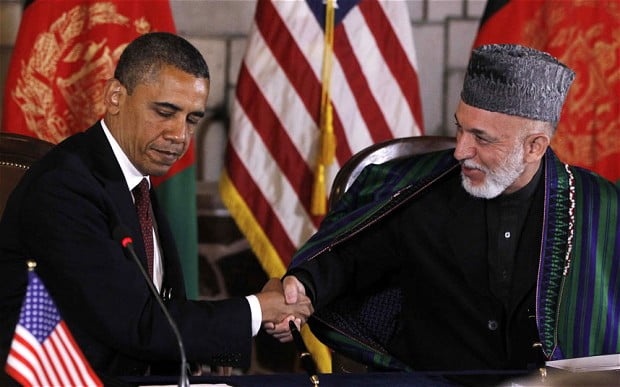
Iran has threatened to expel Afghan refugees and workers if Kabul ratifies a 10-year strategic partnership with Washington allowing US troops to remain in Afghanistan.

Fazel Hadi Muslimyar, speaker of the Afghan senate, said the Iranian ambassador had made the threat last week as he demanded senators reject the deal between Barack Obama and Hamid Karzai.

His intervention triggered a diplomatic row as senators denounced his meddling in Afghan affairs and called for his removal.

“He told me that if we signed the agreement with the Americans then they would kick out the refugees,” Mr Muslimyar said.

“We want the ambassador removed. They should send a diplomat, not a dictator.” Iran has long lobbied against the partnership, fearing it would result in American bases along its eastern border and permanent encirclement by US forces.

Afghanistan has an estimated one million refugees in Iran and an unknown, but large number of migrant workers.