Home Blog Page 475

Kurdish prisoner’s protest letter may be his last


Iranian political prisoner Habibollah Golparipour says security forces took him “to the verge of death with physical and psychological torture.”

The International Campaign for Human Rights in Iran reports that Golparipour, a Kurdish political prisoner sentenced to death in Iran, wrote a letter before his recent transfer from Oroumiyeh Prison to Semnan.

It’s not clear why the transfer has been made, and rights groups are concerned it may signal his imminent execution.

Golparipour’s father has reportedly travelled to Semnan to visit his son, but prison authorities merely confirmed the transfer of his son and told him that he will not have any visitation rights until after Norooz and the New Year celebrations.

Golparipour’s fellow inmates reported that he was beaten and insulted during the transfer from Oroumiyeh Prison.

Golparipour’s letter indicates that he has resorted to letter-writing because he has “lost all legal oaths to obtain my rights.”

He rejects the death sentence handed to him and says the Islamic Republic equates “the promotion and defence of a national identity as war against the Islamic system.”

Golparipour writes that his death sentence was issued within five minutes during his “sham” trial, which violates even the provisions of the Iranian constitution.

He goes on to say that he has made official complaints to various government bodies for the “long-term arrests and physical and psychological torture that have taken me to the verge of death” but admits that his voice has not traveled beyond the prison bars.

He adds: “Currently my national identity as a Kurd and my freedom-seeking ideas are considered as corruption on earth, and all my efforts in that direction are interpreted as enmity with God, and this is overt discrimination and open injustice.”

He ends his letter urging human rights groups to assist him in any way possible.

Habibollah Golparipour was arrested in September of 2009 on his way from Mahabad to Oroumiyeh. The Revolutionary Guards intelligence agents found that he was carrying a series of books, which prompted his arrest and the ensuing months of torture. In March of 2010, he was charged with membership in the Kurdistan Free Life Party (PJAK), the militant Kurdish group, and sentenced to death.

His appeal has been turned down, and the Supreme Court has approved his death sentence.

Golparipour has reportedly denied any involvement in armed combat, and the only evidence against him is the possession of that set of books.

Source: radiozamaneh

Letter laments prisoners’ fate for Norooz


In a message written for the Iranian New Year, Kurdish political prisoner Reza Sharifi Bukani reminds the public that hundreds of political prisoners will spend Norooz away from their families in “the dark cells” of the Islamic Republic.

In a letter that reached Zamaneh today, Sharifi Bukani writes: “As a political prisoner behind bars for over two years in Rejaishahr Prison in Karaj, I have no visitation rights. I am not allowed any furloughs or even the right to phone my family.”

Reza Sharifi Bukani was arrested in May of 2010 in an internet café in Tehran. He was primarily charged with “enmity against God” and “corruption on Earth” and was sentenced to death. His sentence was later reduced to 30 years in jail, and in a final review of the case, he was sentenced to seven and a half years in prison.

Reza Sharifi Bukani writes that the Islamic Republic has no regard for the Universal Declaration of Human Rights or human dignity. “Today, for the crime of expressing our opinions and defending liberty, democracy and human rights, together with hundreds of other political prisoners, we have to celebrate Norooz away from our families in the dark cells of the regime.”

Sharifi Bukani also speaks out against the death sentences handed to other prisoners such as Shirkouh Moarefi, Habibollah Golparipour and Shirkouh Malekpour, and urges the public to lend its support to the families of prisoners sentenced to death.

The head of Iran’s judiciary had announced that some prisoners may get a 15-day furlough on the occasion of Norooz, adding that those accused of acting against national security will not be eligible for this leave.

Source: radiozamaneh

Severe Malnutrition Of Jailed Gonabadi Dervishes In Section 350 Of Evin Prison

Majzooban Noor – Lack of medical care and poor nutrition has been led to iron deficiency, anemia and malnutrition for jailed Gonabadi Dervishes  in ward 350 of Evin prison . According to Majzooban reporter, in the last days blood test is taken of lawyers, administrators and staffs of Majzoonan Noor website who are in detention more than six months in Evin prison ward 350 and the test result shows anemia and iron deficiency.

Majzooban Noor – Lack of medical care and poor nutrition has been led to iron deficiency, anemia and malnutrition for jailed Gonabadi Dervishes  in ward 350 of Evin prison . According to Majzooban reporter, in the last days blood test is taken of lawyers, administrators and staffs of Majzoonan Noor website who are in detention more than six months in Evin prison ward 350 and the test result shows anemia and iron deficiency.

According the report, the jailed dervishes’s families were worried about their healths because of medicines which were Prescribed by special doctor of prison that was belong to pations who needs iron , vitamines and also who have anemia .

According to article No 95 of executive regulation of prison organization,  food menu should include vegetables, fruits, and meat every week, which is hardly given to them!

Our reporter added that, at about 90 percent of food rations of prisoners in section 350 Evin is inedible because these foods are not properly cooked and food are often dumped in trash .

It is mentioning that the food is prepared weekly by prisoners but in the past times, foods has been contained  meat and  large amounts of  soya but it is not now at all and prison officials say that they do not have sufficient funds.

It is noteable that the facilities and basic amenities such as the pitcher and glasses, spoon and cutlery, refrigerator, oven and etc are provided by prisoners and it is against the law.

Except the lentils which will be offered to prisoners twice a week as dinner, the only useful food which is taken by prisoners is breakfast but its quantity is too low and no-fruits were made ​​prisoners to produce fruits with personal funds and because of this, monthly average of 600 thousand rials will impose additional costs to the prisoners and their families .

Iranian government turns to Gmail and Yahoo for support in crackdown

0


The growing number of social networking media is cause for concern amongst Iranian officials, says a member of a newly formed body charged with overseeing the Internet.

Iran’s Supreme Leader Ali Khamenei recently ordered the formation of the Supreme Council of Virtual Space, which will include the president, the Intelligence and Culture ministers, and the heads of police and the Revolutionary Guards Corps.

Hamid Shahriari, who holds a seat in the Council, told the Fars news agency that the body would enhance “coordination” between various policy-making institutions with regards to cyber space. “Today, the virtual space is a cause for [great] concern; because some use this platform for transferring information and at times espionage,” he added.

“Around a year ago, the leader’s office took an active stance towards the subject. After regular weekly meetings between the [representatives] of the three branches [of government] and individuals who had had nationwide experience on the topic, we carried out an assessment of the current situation [of the Internet] which we submitted to the leader.”

Shahriari stressed that the Council would not be a “security” body; nevertheless he admitted that the expansion of social networking sites constituted a threat and was a concern for officials in Iran. He claimed that authorities had identified 650 websites that were opposing the country’s political establishment.

The setting up of the Supreme Council of Virtual Space is only the latest in a series of attempts by Iranian authorities to control users on the net.

Last week, the Paris-based media watchdog Reporters Without Borders named Iran in its “2012 list of the Enemies of the Internet.” The document, which was published on World Day Against Cyber-Censorship, said that Iran had reinforced its “technical capacity” in 2011 to tighten its grip over the free flow of information.

According to RWB, Iran has the largest number of netizens in prison after China and Vietnam. “Iranian authorities … favour extracting confessions from dissidents then broadcasting them on television.”

The group also voiced its concern over the Iranian regime’s plans to launch a “National Internet.” While little is known about the details of the new “clean” network, experts believe it could effectively cut off Iranian citizens’ access to the World Wide Web. Iran’s Telecommunications Minister Reza Taghipour recently hinted that the “National Internet” could be up and running in late May or June.

During a 12 March interview with Weblog news, a spokesperson for the Organised Crime Surveillance Centre of the Revolutionary Guards criticised email providers Yahoo and Google for their lack of cooperation with the Islamic Republic.

“Up until now, we have made numerous requests to the two [email] services most popular in Iran—Google and Yahoo—for the purpose of obtaining information on criminals and accused individuals,” Saeidi admitted. He said, however, that both companies had declined to address the concerns raised by Iranian authorities.

In September 2011, Gmail warned users in Iran that their accounts might have been compromised by the fake Secure Sockets Layer (SSL) security certificate issued by Dutch security firm DigiNotar.

“We learned … that the compromise of a Dutch company involved with verifying the authenticity of websites could have put the Internet communications of many Iranians at risk, including their Gmail,” Google said after it learned of the security breach.

Former Tehran Prosecutor, Indicted For Deaths and Torture, to Head Social Security Fund


Former Tehran Prosecutor Saeed Mortazavi has been appointed as the head of the Social Security Fund, despite impending charges against him regarding the torture and death of inmates at Kahrizak Prison.

President Mahmoud Ahmadinejad reportedly appointed Mortazavi as head of the Social Security Fund today in a ceremony attended by the Minister of Cooperatives, Employment and Social Security and other members of his administration.

In the past four years, the Social Security Organization has gone through four executive directors, which led to harsh criticism of the organization.

Workers have also protested against turning this non-governmental organization into a government institution. Retirees have also been repeatedly pressing the fund managers for an increase in benefits relative to the rate of inflation.

Mortazavi’s appointment to the head of the Social Security Fund has been severely criticized by several members of Parliament, who claim Mortazavi does not have the “necessary knowledge and competence to head this organization.

The Mothers of Laleh Park, a group of mothers who lost their children in the protests that followed the controversial 2009 presidential elections, have also denounced Mortazavi’s appointment to top government positions while he’s the main suspect in the crimes that were committed in Kahrizak.

It is widely believed that Mortazavi ordered the transfer of election protesters to Kahrizak Prison, knowing they would face abuse and torture. Mortazavi also tried to cover up the deaths of three detainees who were killed under torture by claiming they had died of meningitis.

Mortazavi was removed from his position as Tehran Prosecutor when news of the torture and deaths at Kahrizak Prison hit the media. Ahmadinejad, however, swiftly engaged him as the head of the Task Force against Smuggling and has now transferred him to his new government position.

Despite public claims by Mortazavi that he has been acquitted of the charges against him, the judiciary is apparently still pursing the charges pertaining to his role in the death of three detainees at Kahrizak Prison.

Source: payvand

Khamenei Tries to Manage Ahmadinejad’s Presence in Parliament


Iran Briefing :

Khamenei Tries to Manage Ahmadinejad’s Presence in Parliament

On March 11, 2012, Mahmoud Ahmadinejad accused his opponents of plotting against his government, aiming to interrupt the government’s economic plans and programs for what he called administration of justice in society.

He said that what happened in recent months in the currency and gold market was a preplanned plot for disrupting the Economic Development Plan and the Subsidies Reform Plan.

Such allegations are being made at the time when Ahmadinejad has been summoned by the parliament, and he must appear before the parliament to answer lawmakers’ questions on his policies and leadership abilities.

Following is an interview with Reza Alijani, political analyst and expert on Iran’s political affairs.


Mr. Alijani, what does president Ahmadinejad mean by inside opponents?

Reza Alijani: Ahmadinejad considers all critics his opponents. But I think he is specifically talking about a military-security team in the Revolutionary Guard that is loyal to the Supreme Leader. Although he is not directly addressing the Supreme Leader, he believes that other conservatives who are critical of his government, are conspiring against his government. Before, he had talked about traffickers in the Revolutionary Guard, and by that he was pointing out the certain segment of the Revolutionary Guard involved with economic activities. I think Ahmadinejad is trying to find an enemy on whom he can put the blame for his inefficiency, as he did during his campaign for the 2009 presidential election. By attacking Hashemi Rafsanjani in a TV debate at that time, he successfully deceived the lower class of the society which usually doesn’t follow the political news and issues. By creating an enemy, he tried to justify his inefficiencies for this class of the society.

  We know that Ahmadinejad is called by the lawmakers to appear before the parliament on Wednesday to answer the parliamentarians’ questions. Can his statements be regarded as a reaction to the MPs’ move?

To some extent yes. He took the same position when he was under heavy criticism because of the turbulence in the currency and gold market. If we look at those days’ news, we can see that both parties, parliament and the government, were blaming each other for being responsible for crisis in gold and currency market. From the point of view of outside observers, the entire story shows the system’s inefficiency. However, both parties inside the system are blaming one another. Ahmadinejad is trying to show that he is not going to make any compromises during the questioning motion.


Some of the members of the parliament who are surprisingly critics of the government of Ahmadinejad have put forward the idea of inviting Ahmadinejad to the parliament for a face to face dialogue with the MPs instead of questioning him. Can it be said that they have changed their position due pressure exerted on the parliament by outside sources like Khamenei or his associates?

It is less likely to have something to do with outside pressure. Unlike the MPs who have only 15 minutes to talk and pose the questions, one hour is allocated to the president to reply. So in case of face to face dialogue, the time would be equally divided between them. However, what is still unclear in the MPs’ proposal is that they have not made it clear whether the session is going to be held open or not. At the moment, the dispute is over the tactical issues. For example, the critics are worried that Ahmadinejad might politicize the economic issues or use the opportunity to reprimand his critics and refuse to accept the criticisms.

Both the government and the parliament know weak points of each other. Ahmadinejad has already lost the game to the Supreme Leader and his associates, and I think he will use the opportunity to turn the already win-lose situation to lose-lose one.

Therefore, the entire procedure has to be methodically managed somehow. My prediction is  that the Supreme Leader is trying to manage the entire process, and it is predictable that  pressure would be exerted on both side, parliament and the government, to make the session just a ceremonial one.


Source : Radio Farda

English translation of this report is exclusive to Iran Briefing

Iranian general urges Afghans to fight U.S.

0


A senior Iranian military commander urged Afghans on Saturday to use force to kick American troops out of their country, hinting that “new resistance groups” could launch attacks on U.S. interests in Afghanistan.

Brigadier General Masoud Jazayeri, a senior figure in the powerful Revolutionary Guard and the deputy head of the Joint Chiefs of Staff, said there are indications that Afghans will “soon open new fronts” against “the obsolete, worn-out American empire.”

The U.S. has accused Iran’s Revolutionary Guard of supplying powerful roadside bombs to militants in Afghanistan fighting NATO forces. Iran has denied that it is supplying arms to fighters in Afghanistan.

Anti-U.S. sentiments have grown in Afghanistan after the killing of 16 civilians, including nine children, allegedly by a U.S. soldier in southern Kandahar province, as well the accidental burning of Quran holy books by American troops. The U.S. soldier has been identified as Army Staff Sgt. Robert Bales, 38.

“Based on the existing indications, new fronts will soon be opened against invaders in order to ground the obsolete, worn-out American empire,” Jazayeri said. “Creation of resistance groups and hitting American interests are among measures that can be taken.”

He did not elaborate. The comments by Jazayeri were posted Saturday on the Guard’s website, sepahnews.com. It is the strongest comments ever by an Iranian official against American troops in Afghanistan.

“The Americans must know that the Afghan nation … is tired of the illegitimate presence of invaders … and deserve to use force and offensive operations to kick invading enemies from their soil,” he said.

Jazayeri said Afghans should make their territory unsafe for American troops.

“The United States should not be immune from the biting attacks for insulting Quran and massacring the innocent Afghan and Pakistani people. American troops must experience the bitter taste of revenge so that they won’t feel security in any part of the region,” he said.

The U.S. and Tehran are at odds over Iran’s controversial nuclear program, and some analysts fear that Iran will respond with proxy forces if the confrontation becomes violent.

Source: alarabiya

Fate uncertain for detained scholar


Concern has grown over the situation of detained scholar and sociologist Saeed Madani, after his wife revealed that she has only received one phone call from her husband during his 65 days of arrest.

The International Campaign for Human Rights in Iran reports that Mansoureh Etefagh, Madani’s wife, is concerned because he has only called his family once since his arrest in January and he is reportedly being held in solitary confinement.

Madani’s home was raided and many of his personal belongings confiscated during his arrest.

Etefagh says there has been no clear indication regarding the charges against her husband but she has found out that his arrest warrant has been extended for another month.

Madani was previously arrested in 2000, along with a group of Nationalist-Religious activists, and was charged with “membership in illegal groups, collusion to commit a crime and propaganda against the regime.” He was sentenced to four years in prison but was released on bail after five months in solitary and seven months in jail.

The other activists arrested with Madani in 2000 were handed sentences of four to 11 years and banned from social activity and stripped of their civic rights.

The appellate court, however, kept their files open. Hoda Saber, Taghi Rahmani and Alireza Rejai were arrested in 2010 and sent to Evin Prison to serve out their sentences.

Rahmani was recently released, and Hoda Saber died following a hunger strike and a lack of timely medical attention, topped with a beating in the prison infirmary.

From that original group, Alireza Rejai, Masoud Pedram and Saeed Madani are now in Evin Prison.

Source: radiozamaneh

Indian police make Iran link to New Dehli bomb and Bangkok explosions

0


Police call for extradition of Iran-linked suspects and cite connections with car bomb that wounded Israeli diplomat’s wife

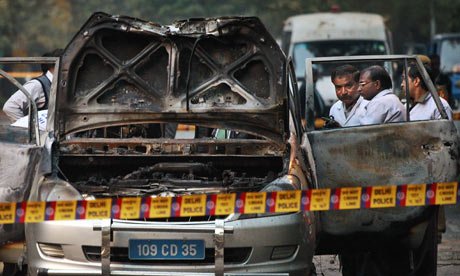
Indian police have said a bomb attack that wounded an Israeli diplomat’s wife in New Delhi last month is connected to a series of explosions in Bangkok on the same day.

Israel has accused Iran of orchestrating those plots as well as a failed bombing in the former Soviet republic of Georgia, all of which were suspected of targeting Israeli diplomats. Iran has denied any involvement.

Indian authorities had previously declined to implicate Iran in the New Delhi attack on 13 February that wounded the diplomat’s wife and three others with a bomb attached to her car by a magnet. However, they said the investigation is increasingly centering on Iranians and people with ties to Iran.

Last week, police arrested an Indian freelance journalist who reportedly worked for Iranian news organisations. Earlier this week, they issued arrest warrants for three Iranian men who had left the country.

Delhi police commissioner BK Gupta told reporters that one of those three men, Housan Afshar, had been in contact with Masoud Sedaghatzadeh, who was earlier arrested in Malaysia and accused of involvement in the Bangkok blast.

On Saturday, a Delhi court issued an arrest warrant for Sedaghatzadeh for suspected involvement in the Delhi blast. Police will seek to have him extradited from Malaysia, the Press Trust of India news agency said.

India is asking Interpol for assistance in finding and extraditing the men, according to foreign ministry spokesman Syed Akbaruddin.

“We have informed the Iranian ambassador of these developments so as to seek the co-operation of the Iranian authorities in bringing those involved in this dastardly attack to justice,” he said in a statement.

Police accused Sedaghatzadeh of being the operational head of the group that was planning the Bangkok attacks and said his arrest in Malaysia led them to Afshar. Gupta said police found that Afshar and the Indian journalist, Syed Mohammed Kazmi, had been in telephone contact.

Police said the Iranians had performed reconnaissance at the Israeli Embassy last May before returning to Delhi in January and February to plan the attack. Two of the three suspects left India before the attack and the third left shortly afterward, police said. Gupta said Kazmi was deeply involved in the reconnaissance.

“He has been arrested as a facilitator and for being a part of the conspiracy. His questioning brought to light that he has been in contact with persons of Iranian origin involved in the attack for some time,” Gupta told reporters.

He said Kazmi told police he went to Iran twice last year, promised to provide assistance to the attackers in India and was paid $5,500 (£3,470). In addition to helping with surveillance of the embassy, Kazmi booked a plane ticket for one of the Iranian suspects to leave the country, Gupta said.

A scooter used by Kazmi and Afshar for reconnaissance near the Israeli embassy was found parked at Kazmi’s home. Police were also investigating the source of nearly $45,600 in remittances from abroad in Kazmi’s and his wife’s bank accounts, a Delhi police statement said.

Source: guardian

Iran: UN Human Rights Expert Stresses Concern


The independent United Nations expert on human rights in Iran today reiterated his concern over continuing violations in the country, including the suppression of civil liberties, arbitrary arrests and detentions, lack of due process, and a significant increase in the number of executions.

Ahmed Shaheed told the UN Human Rights Council in Geneva that Tehran continues to ignore his many requests to visit the country, and had also failed to respond to the appeals by the Council and the General Assembly to cooperate.

“This apparent unwillingness to cooperate substantively only heightens concern over the human rights situation,” said Mr. Shaheed, who is the UN Special Rapporteur on the situation of human rights in Iran.

In the absence of a field visit, Mr. Shaheed said he had resorted to monitoring the situation in Iran through a variety of credible sources, including non-governmental organizations and human rights defenders.

He cited witness accounts of arrests for engaging in activities protected by international law, for which people were detained in solitary confinement, denied access to legal counsel or family members, and were held without formal charges.

“Several stated that they were subjected to prison conditions that fall well below the minimum standards defined by the UN, such as severe overcrowding, inadequate access to water, insufficient prisoner segregation practices, extremely poor quality and unhygienic facilities, hazardous ventilation conditions, insufficient access to medical services, [and] paltry nutritional provisions,” he said.

Mr. Shaheed noted with concern that the number of executions in Iran had risen from 200 in mid-September to more than 600 by the end of last year. A majority of death penalty sentences resulted from drug offences, which he said do not meet the level of serious crimes required by international standards for imposition of the death penalty.

The imposition of the death penalty without proper judicial safeguards underscored the need for the authorities to allow legal representation of accused persons at all stages of investigations and trial, he said.

He said it was frequently reported that those who attempted to defend the accused were also met with severe punitive measures. He cited the case of the winner of the Nuremberg prize for human rights, Abdolfattah Soltani, who was arrested on charges of “propaganda against the regime, co-founding the Defenders of Human Rights Centre, assembly and collusion against the regime and accepting an illegal prize.” Mr. Soltani was sentenced to 18 years in prison and banned from practicing law for 20 years.

Similarly, Nargis Mohammadi, a human rights defender and Vice President of the Defenders of Human Rights Centre, founded by Nobel Laureate Shirin Ebadi, was recently sentenced to six years in prison.

Mr. Shaheed urged the Iranian authorities to consider the release of human rights lawyer Nasrin Sotoudeh; student and women’s rights activist, Bahareh Hedayat; student activist Abdollah Momeni; and Pastor Yousef Nadarkhani, who was sentenced to death on charges of apostasy; and to consider the immediate release of opposition leaders Mir-Hossein Mousavi and Mehdi Karroubi, who have been under house arrest since February last year.

He welcomed the recent decision to release three journalists – Marzieh Rasouli, Parastoo Dokouhaki and Sahamoddin Bourghani – and urged the Government to continue to re-assess the cases of the 42 other journalists who remain detained on various charges, and to consider their immediate release.

Mr. Shaheed said he will continue to urge the Iranian Government to cooperate to address its human rights challenges in a “holistic and incremental manner, and with transparency and accountability.”


Source: freedomessenger