Home Blog Page 512

Iran provokes showdown, warns US carrier not to return to Persian Gulf

0


In another heated escalation over the strategic Strait of Hormuz, Iran Tuesday, Jan. 3, threatened to take action if the US aircraft carrier which “moved to the Sea of Oman because of our drill returns to the Persian Gulf.” Army chief Lt. Gen. Ataolla Salehi said:” Iran will not repeat this warning.”
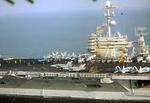
He referred to the USS Stennis as “the enemy’s carrier,” which “I recommend and emphasize… not return to the Persian Gulf.” He avoided naming the US vessel or the details of action Iran might take if it returned.
DEBKAfile’s military sources report that the Stennis transited the Strait of Hormus Wednesday, Dec. 28 and entered the Sea of Oman where Iran was staging a naval drill. Washington was demonstrating freedom of navigation in the international strait through which one-fifth of the worlds exported oil is shipped and underlining Iran’s inability to close it to merchant shipping and US warships.
Iran said that its surveillance aircraft and warships tracked and filmed the US carrier’s movements in and around Hormuz which it claims to fully control.

Saturday, Dec. 31, Iran announced a long-range missile test-fire would take place over the strait, thereby causing a five-hour stoppage of shipping traffic. Later, an Iranian general said the missile test was delayed. DEBKAfile’s Iranian and military sources reported that this was a trick to prove Iran capable of closing the Strait of Hormuz in defiance of strong warnings from Washington.

Monday, Jan. 2, the Iranian navy marked the last day of its Hormuz drill by testing shore-to-sea Qader and Nour missiles. The Qader is described by the Iranians as a cruise missile capable of destroying large American air carriers with a single hit.
Tuesday, this claim proved to be the prologue in advance of Iran’s virtual closure of the Strait of Hormuz against the return of the USS Stennis into the Persian Gulf and appropriation of its “right” to open and close the waterway at will.

It is hard to see the Obama administration caving in to Tehran’s ultimate challenge to the freedom of this vital international waterway. The Stennis or some other American naval vessel must soon be sent through the Strait of Hormuz to test Iran’s assumption of control.
Gen. Salehi said: “We are not seeking to act irrationally, but are ready to confront any threat.” Another Iranian commander said that Iran’s Revolutionary Guards are preparing another military exercise in the Persian Gulf. He did not offer a date.

Our military sources add that two more American warships, the USS Bataan and USS Makin Island, are cruising in the area. They are small Marine Corps amphibian craft carrying jets and helicopters. The big air craft carrier USS Carl Vinson, deployed in the Pacific from the third week of December, is on standby to advance to waters opposite Iran in an emergency.


Source

Iranian internet users to be cut off from World Wide Web


A member of Iran’s Corporate Computer Systems reports that Iran will be cut off from the World Wide Web once the country launches its own national internet network.

Iranian media report that Payam Karbasi, the spokesman for Corporate Computer Systems of Iran, said: “With the launch of the national internet, the internet providers can increase the speed of access to their desired websites by two megabytes… however, it will be just like a corporate network, which cannot be accessed by outsiders, and some material cannot be accessed through that network.”

Islamic Republic authorities have long been talking about separating Iranian internet users from the World Wide Web by launching a “clean” national internet network. The government has said that the national internet will be launched by next month.

The national internet network will allow service providers to decide which sites the users can access and which sites will be provided at the lowest speed.

In the past two weeks, Iranian internet users have reported an extreme reduction in internet speed. While access to government sites remains easy, using proxies to access blocked sites reduces the speed of access.

Iranian authorities heavily censor the internet and block numerous news and opposition websites. Iranian users have used proxies to overcome these obstacles.

Karbasi said: “Imagine there is a monitoring system that checks all the internet packages and then allows it to pass through or regards it unclean. Because of the high volume of internet packages, they remain in a line-up in order to be checked, and this causes the reduction in the speed of access.”

With the launch of the so-called “clean” internet network, Iranian authorities aim to separate Iran from the World Wide Web in order to block access to “immoral” content and maintain control of what Iranian users can access.

Foreign Ministry denies sanctions’ effect on currency

0


Iran’s Foreign Ministry announced today that sanctions against Iran will only hurt the countries that impose them, insisting that the steep decline in the value of Iran’s currency is in no way related to recent sanctions.

Foreign Ministry spokesman Ramin Mehmanparast commented on the U.S. sanctions against Iran’s Central Bank, saying: “These sanctions have not yet been put into force and that will take months. What is happening to Iran in the currency market has its roots elsewhere.”

Yesterday, the U.S. dollar was trading in Iran at the unprecedented rate of 1,800 toumans, which was 200 toumans higher than a day earlier. There are predictions that the U.S. dollar will soon buy 2,000 toumans.

The sudden increase came after the announcement of international sanctions against Iran’s Central Bank.

Some analysts say the increase in the rate of foreign exchange is due to worries about the international sanctions, while others say it stems from the government’s interference in the currency and gold markets.

Mehmanparast said: “Various issues might be involved in the fluctuation of the foreign exchange rates, such as the management of cash flow in the country. We’ve witnessed that, in the past, cash flow was sometimes concentrated in property and at other times in gold and foreign currencies, and Iran has come up with effective policies to control inflation and stop rising property prices.”

He added that the fluctuations in the foreign exchange market would be resolved soon and they will not be allowed to affect the country’s economic stability.

Similar promises were made today by the head of Iran’s Central Bank. Mahmoud Bahmani told ISNA that the rise in the exchange rate was a “psychological effect” and that in the coming weeks, the country will see a drop in the price of the U.S. dollar.

He added that Iran’s position as a top exporter of oil and gas cannot be eliminated from the world market without putting pressure on the very countries that might impose such sanctions.

Iran nuclear crisis: France wants ‘stricter’ sanctions

0


BBC – France is convinced Iran is developing nuclear weapons and should face “stricter sanctions”, Foreign Minister Alain Juppe has said.

He urged EU countries to follow the US in freezing Iranian central bank assets and imposing an embargo on oil exports.

Iran has dismissed the threat of sanctions. On Tuesday, it denied that a record low of its currency was linked to US punitive measures.

It also denies Western charges that it is trying to develop nuclear weapons.

Tehran says its programme is peaceful – it needs nuclear technology to generate electricity to meet growing domestic demand.

In November, the US, Canada and the UK announced new sanctions against Iran in the wake of the report from the UN nuclear watchdog, the International Atomic Energy Agency (IAEA), that said Iran had carried out tests related to “development of a nuclear device”.

But Iran was not referred to the UN Security Council because Russia and China were opposed to the move.

January deadline

“Iran is pursuing the development of its nuclear arms, I have no doubt about it,” Mr Juppe told French television I-Tele.

“The last report by the International Atomic Energy Agency is quite explicit on this point.”

Mr Juppe said France wanted the sanctions against Iran toughened further.

He said President Nicolas Sarkozy had already proposed “the freezing of Iranian central bank assets, a tough measure, and the second an embargo on Iranian oil exports”.

“We want the Europeans to take a similar step by January 30 to show our determination,” he said.

The UN Security Council has already passed four rounds of sanctions against Iran for refusing to halt uranium enrichment.

Highly enriched uranium can be processed into nuclear weapons.

The US had already sanctioned dozens of Iranian government agencies, officials and businesses over the nuclear programme.

The government in Tehran has dismissed the latest measures imposed in the wake of the IAEA report in November.

However, following a new low recorded on Sunday and Monday in the country’s national currency compared to the US dollar, the government said the dip was not linked to the latest US sanctions targeting the central bank.

Foreign Ministry spokesman Ramin Mehmanparast said the US sanctions “have yet to be put into practice”.

US President Barack Obama signed into law the US bill targeting Iran’s central bank on Saturday. It enters into force in six months’ time.

Military bluster

Iran has also been holding a series of naval exercises in the Gulf, and on Monday said it had successfully test-fired a shore-to-sea Qader cruise missile, a shorter range Nasr and later, a surface-to surface Nour missile.

A medium-range surface-to-air missile was successfully launched on Sunday, Iranian media reported.

Iran has conducted 10 days of exercises near the Strait of Hormuz, through which 20% of the world’s oil passes.

Tehran said on Monday that “mock” exercises on shutting the strait had been carried out, although there was no intention of closing it.

The BBC’s Iran correspondent James Reynolds says Iran is using the exercises to try to show that it owns the Gulf and has the military capability to defend any threat to its dominance.

But, says our correspondent, few believe Iran would carry out its threat to shut the Strait of Hormuz as to do so would be considered too economically, politically and possibly militarily damaging for Tehran.


Source

‘Regime unable to try green leaders,’ says Khamenei aide


GVF — A close aide to Iran’s Supreme Leader says that authorities are unable to put the leaders of the Green Movement on trial because of their followers.

Speaking to the Fars news agency, Ali Saeedi, the Supreme Leader’s representative to the Islamic Revolutionary Guards Corps, said that it was not possible to take 2009 presidential candidates Mir Hossein Mousavi and Mahdi Karroubi to court “because they have supporters and followers” as well as “a few turban-heads [clerics] who continue to back elements within the sedition.”

“Sedition” is a term frequently used by officials to refer to the massive protests that erupted following the June 2009 presidential race which resulted in the re-election of Mahmoud Ahmadinejad as president.

In mid-February, Karroubi and Mousavi, who spearheaded the opposition Green Movement since the rigged election, were placed under an illegal and arbitrary house arrest after calling for protests in solidarity with the Arab Spring. Thus far, no formal charges have been put forth against the two men. Human rights groups say their continued captivity and maltreatment is inconsistent not only with human rights provisions, but also with Iran’s own constitution.

Meanwhile, Mehdi Taeb, commander of the Ammar garrison of the IRGC, recently claimed that the men themselves, fearing their “safety,” had requested to be placed under house arrest!

“Some,” Saeidi continued, “ask me, ‘Why don’t they try Mousavi and Karroubi?’ The reason is that they have … supporters and I cannot mention the names of their followers.”

In what appeared to be a scathing critique directed at former president Hashemi Rafsanajani, the cleric said that some amongst Iran’s political elite “remained silent before the sedition or approved of were satisfied with it … He who is silent is just like he who approves of it.”

“A few days ago, the grey man had said that ‘I won’t distance myself from these two individuals [Karroubi and Mousavi]. These are good people.’ Now let’s see how many more turban heads we have who still support elements within the sedition.”

Saeidi’s comments come as the regime braces for parliamentary elections, which are to be held in March. Analysts predict a record-low turnout, mainly due to the fact that Iran’s major pro-reform parties, including the Islamic Iran Participation Front (IIPF) and the Mujahedin of the Islamic Revolution Organisation (MIRO), have decided to boycott the upcoming elections, calling it a “theatrical” display aimed at deceiving the population.

Candidates for the 2 March elections had until 30 December to register for the forthcoming vote. According to Interior Minister, Mostafa Najjar, 5,283 candidates signed up for the elections, close to 2,300 fewer than the same figure four years ago.

During Friday prayers, hardline cleric Ahmad Khatami spoke against the reformists’ calls for an all-out boycott, saying that people had both the “right and responsibility” to partake in elections.

“We are on the verge of an important election race, and the Supreme Leader has warned of the possibility of the elections being faced with a security challenge,” Saeidi explained.

“I do not recall the Supreme Leader ever warning about [the elections] becoming a security concern, but he has done so with regards to the upcoming elections,” Saeidi continued, suggesting Khamenei was “worried” about the “security” dimensions of the March vote.

“Remnants of the sedition might want to stir up trouble. It’s also possible that foreign [powers] will take advantage of the opportunity, as well as weaknesses in the executive and supervisory branches, in order to prepare the groundwork for [security challenges],” the IRGC official argued.

On Sunday, IRGC commander, General Muhammad Ali Jafari, told the semi-official Mehr news agency, “The enemy will use the Majlis elections as an excuse, and most certainly seeks to revive riots and social unrest in Iran [like in 2009]. It’s been plotting to do this for a while now.” He expressed hope however that the population’s participation in the elections would “neutralise” the foreign “plot.”

In mid-December, Ali Mohammad Gharibani, president of Coordination Council of the Reformist Front, announced that the country’s pro-reform factions would not participate in the March parliamentary race. He said the council had “decided not to present a unified list [of candidates] and not to support anyone [in the race].”

Months earlier, former reformist President Mohammad Khatami had set conditions for the reformists to participate in the Majlis elections, including: the release of all political prisoners; free and competitive elections; and freedom for political parties and the press.

Last week, Khatami backed the Coordination Council of the Reformist Front, saying, “My opinion is the same as the council’s, which is that the reformists cannot and must not have candidates and a unified list in the elections.”

“I don’t speak on behalf of anyone. I think that all indicators suggest that we must not take part in the elections.”

Security forces attack Church in Ahwaz one day before Christmas Eve

0


Human Rights Activists in Iran: Security forces stormed a church in Ahwaz and arrested the church priest, Farhad Sabokroh, his wife Shahnaz and all the members of the church. They were taken to an unknown location with two busses and there was no news on them for hours.

According to reports from Ahwaz, security forces who had covered their faces when entering the church even took away the very frightened children in the church.

These agents immediately confiscated the cellphones of the church members and searched all the rooms. They also confiscated a number of computers and other appliances which belonged to the church.

All the detainees except Farhad Sabokroh, his wife and two other church members are still detained and there is no news on their condition.


Source

Roghieh Hassanzadeh’s Prison Term & Lashes Upheld


HRANA News Agency – Roghieh Hassanzadeh’s prison term and lashes have been upheld by the Appeals Court in East Azerbaijan Province.Roghieh Hassanzadeh is a resident of Tabriz.

According to a report by Human Rights Activists News Agency (HRANA), the 104th branch of the criminal court in Tabriz sentenced Roghieh Hassanzadeh to 91 days in prison and 20 lashes. The 12th branch of the Appeals court in East Azerbaijan Province has upheld this ruling.

Roghieh Hassanzadeh was charged with and subsequently convicted of disturbing the peace by shouting slogans against the regime.


Source

Ailing political prisoner’s mother arrested, released few hours later

0


Fatemeh Alvandi, incarcerated political prisoner Mehdi Mahmoudian’s mother was reportedly arrested on orders of the Prosecutor’s office. According to reports by Kaleme, Mehdi Mahmoudian’s family had been gathering in front of the offices of the Tehran Prosecutor’s to protest the lack of attention to the political prisoner’s basic civil rights.

The news of Fatemeh Alvandi’s arrest was posted today on the personal web blog of Fakhri Mohtashamipour, the wife of incarcerated reformist Mostafa Tajzadeh.

Mehdi Mahmoudian, a member of the Islamic Participation Front was arrested at his house on September 16, 2009, after exposing the atrocities that had occurred at Kahrizak prison. He was behind bars for a short period at Evin prison before being transferred to Rajai Shahr ‘Gohardasht’ prison in the city of Karaj. Mahmoudian was charged with “Colluding and conspiring against the regime” and sentenced to five years in prison.

While in prison, he wrote an open letter addressed to the Supreme Leader of Iran exposing the dire conditions at Rajai Shahr prison, including the repeated rape of prisoners.

Mahmoudian was finally transferred to a hospital, in order to receive treatment for partial collapse of the lungs, an illness that was brought about because of the harsh conditions in Rajai Shahr prison.

Over the past two years Mahmoudian’s mother had repeatedly requested that the Tehran Prosecutor grant her son medical furlough. Following his operation, Mahmoudian’s family once again requested an extension to his furlough so that he may recover from his surgery, a request that was nonetheless denied by the prison authorities.

Last month, Fatemeh Alvandi conducted an interview in which she spoke of her son’s dire condition and the importance of a medical furlough to allow her son to rest and recover outside of prison. According to Alvandi, Mahmoudian’s physicians had reiterated that he needs access to fresh air in order to avoid a relapse of his condition. It goes without saying that the prison conditions are not conducive to a speedy recovery and Mahmoudian’s only hope is the support he receives from his cell mates.

It is worth mentioning that in the past couple of months, prison officials had promised Mahmoudian and his family that if the family would refrain from giving interviews on the status of his health, he would eventually be transferred to Evin prison and granted medical furlough. With the passing of each month, however, this promise was never kept.

Internet users face spotty service in Iran


Radio Zamaneh – Internet users in Iran have been faced with continuous service disruptions and a drop in internet speed in recent weeks.

ISNA reports: “In recent weeks, repeated disruptions have tried the patience of customers of telecommunications and private internet companies.”

ISNA says that, every week, reports from the Ministry of Communications indicate that it is working on improving the speed and quality of internet service and that the current problems will be overcome, but no improvement has so far been made.

Some internet providers say the repeated loss of service and reduced speeds are caused by “the testing of new filtering software.”

Iranian authorities block thousands of internet sites, describing their censorship efforts as part of the so-called “soft war.”

They claim that Iran’s enemies are constantly threatening the Islamic Republic system by trying to transform its cultural and social values through the media. A government committee, comprised of 12 senior officials including the Prosecutor General and representatives from the education, telecommunications and intelligence ministries, determines which sites need to be blocked for Iranian internet users.

Iran is considered as one of the chief “enemies of internet” by international media rights groups.


Source

Revolutionary Guards chief warns against elections protests

0


General Mohammad Ali Jafari, the head of the Iranian Revolutionary Guards Corps, has warned that the “enemy” is planning “street disturbances and social protests” around the upcoming parliamentary elections.

On Sunday Jafari said the IRGC has information showing that these disturbances have been planned for a long time.

“They want to create disturbances and resuscitate the sedition,” Jafari said. “And by showing and focusing on the confrontation of protesters with the regime, they want to distort the popular image of the regime in the Islamic world.”

The Iranian establishment refers to the elections protests of 2009, which were triggered by allegations of fraud in the re-election of Mahmoud Ahmadinejad, as “sedition.”

The IRGC has expressed concern about the possibility of protests during the parliamentary elections, fearing that this time they could spread to smaller towns. The 2009 protests were concentrated in major cities.

Iran’s Supreme Leader Ayatollah Khamenei has expressed concern that the elections could once again challenge national security. He has called on “the people, officials, the clergy and political activists to heed anti-security challenges and the efforts of the enemies” during the elections.

Iran’s parliamentary elections are set for March 2012.