Home Blog Page 511

“Police Should End Coverup And Release Recording,” Says Brother of Deceased Activist

0


The brother of Haleh Sahabi, who lost her life on 1 June 2011 following interference by security forces during her father’s funeral, told the International Campaign for Human Rights in Iran that he continues to pursue his complaint with Iranian authorities to identify those involved in the incident.

While eyewitnesses had reported assault and battery during the funeral service, official authorities and pro-government media outlets spoke of the cause of death as emotional agitation over her father’s death. A day after this incident an eyewitness who was present at the funeral told the Campaign, “The security forces were taking pictures with cameras and filming the funeral service.”

“If the court has the intention of shedding light on this case it must ask the security forces, or whatever organization, who were filming the funeral procession that day, to hand over the recordings to the court,” he said. “The court must essentially demand the recordings from the security forces. We witnessed ourselves that a few cameras were filming the funeral procession on that day. Therefore, we are certain that there are recordings of the funeral ceremony from different angles, which can be used as evidence in the court.”

According to eyewitnesses, Haleh Sahabi, 54, a religious scholar on prison furlough for a few days to attend her father’s funeral services, suffered a cardiac arrest caused by assault and battery by security forces and died in Lavasan Clinic outside Tehran. Haleh Sahabi was denied furlough while her father, prominent political activist Ezzatollah Sahabi, was still conscious in the hospital. Only after her father slipped into a coma was she allowed to be present at his bedside.

Haleh Sahabi was a women’s rights activist and a member of the Iranian Mothers for Peace group. Plainclothes forces arrested Sahabi on 5 August 2009 in a gathering in Beharestan Square. In that same year, Branch 26 of the Tehran Revolutionary Court sentenced her to two years in prison and $300 cash fine in lieu of lashes, on the charge of “propaganda against the regime” through “repeated participation in illegal gatherings and disrupting public order.”

“Our request is for clarification of the incident and an answer to the cause of tension during the burial service. Why did a funeral that could have been conducted very peacefully, especially since it was in a town far from Tehran and far from commotion, end in frenzy under such circumstances that led to Mrs. Sahabi’s death? A funeral service is a very normal occurrence and it’s every family’s right to have a service for their deceased member. We want this matter to be investigated,” Hamed Sahabi said about his family’s request from the judiciary authorities.

While the family requested an investigation into Haleh Sahabi’s death, they did not request an autopsy. “The issue of autopsy would not clarify anything in our opinion,” Hamed Sahabi explained. “Anyhow the incident happened in front of many witnesses. We preferred that an autopsy would not to be carried out, but that doesn’t mean that we did not have a request for an investigation.”

“An attorney representing us has requested an investigation into the incident of Haleh’s death,” he continued. “We requested an investigation so that the culprit who planned what happened at our father’s funeral, leading to Haleh’s death, be identified. We declared that Haleh’s death was not natural and that it was caused by the events of that day, and the court asked us for witnesses. So we introduced the witnesses to the court after coordinating with them.” Ahmad Montazeri, a prominent politician and son of Ayatollah Hossein-Ali Montazeri, is one of the witnesses in the case who has expressed in several interviews that he would testify in court.

“It was impossible for others to film the events that day. Anyone who was even recording with his cell phone was arrested immediately, or the mobile phone was taken away. Other than the police themselves who were openly filming, no one else had that possibility,” said Hamed Sahabi.

On Tuesday, 13 December, on the occasion of Student Day celebrations in the Technical College of Tehran University, Ali Motahari, a Member of the Parliament, referenced the recent explanations provided by the Minister of Intelligence about Haleh Sahabi’s death. “They did not want her to die and what happened was due to an officer’s negligence,” Motahari said. He also said that Parliament members have asked the Intelligence Minister to appear before the Commission and explain about Haleh Sahabi’s death.

“It was agreed that they give us the CD [containing the video recording of what happened at Ezzatollah Sahabi’s funeral], so that we could watch it, and if we are not satisfied, for the Minister to come to a public session and provide explanations,” Motahari said.

Reacting to Ali Motahari’s 13 December talk, Hamed Sahabi said that if an officer has been negligent, the situation should be explained to people and an apology extended. “He is right. If anyone has really done anything wrong, the country’s police force must introduce him, instead of covering up for him. Introducing the culprits won’t destroy anything and won’t harm anyone either,” Sahabi said.

A day after Motahari’s speech, a news piece indicated that security forces had failed to provide the recorded video as evidence to court. “At this time the situation with the case has not moved further,” Hamed Sahabi told the International Campaign for Human Rights in Iran. He added that nothing can deter his family’s pursuit of the case.

“Dezfool Prison Inmates Are Treated Like Animals”


A local source in Ahvaz told the International Campaign for Human Rights in Iran that Saeed Saki, a political prisoner and an Ahvaz Arab activist who was previously held in Karoon Prison of Ahvaz, was transferred to Dezfool prison two months ago. According to the source, the Dezfool Prison is in deplorable conditions due to prison overcrowding and poor hygiene, and treatment of the prisoners is abominable.

“The conduct of Dezfool Prison authorities and prison guards is extremely barbaric and inhumane, and abuse and assault of the prisoners under any excuse is a normal act in this prison. The prisoners are treated like animals,” claimed the source.

“In the last two months, Mr. Saki has … been denied the right to telephone calls and visitation…. [Once] one of the most respected and reputable political prisoners of Karoon Prison in Ahvaz, he is now housed with tens of other prisoners who are all serving time for crimes related to narcotics and robbery,” the source added.

Through information compiled from several prisons in the country, the International Campaign for Human Rights in Iran is seriously concerned about the present conditions of these prisons, which are in no way consistent with national and international standards and laws, and warns against these deplorable conditions in prisons such as Dezfool Prison and Ahvaz Karoon Prison. These prison conditions have severely damaged the physical and mental health of the prisoners. Judiciary branch authorities have repeatedly spoken about the severe overcrowding, a phenomenon that has brought other problems with it.

“Two people sleep on every bed, and on the floors of the rooms [and] of the hallways, prisoners, who are called ‘floor sleepers,’ sleep like books next to each other, in a way that there is no possibility of any kind of movement while sleeping. Even under these circumstances, some of the prisoners are forced to sleep in prison courtyards, and they are called ‘courtyard sleepers,’” the source said.

“For a few minutes of bathing, the prisoners have to wait their turns for several days. Sickness and filth has spread everywhere in the prison and surviving this prison is hardly possible,” the source told the Campaign. “Besides hygiene problems, insufficient suitable space, not even for the prisoners to sleep, [and] failure to separate prisoners according to their crimes, … drug abuse and free trade of narcotics in front of prison closed-circuit cameras have created unbearable conditions in Dezfool Prison.”

“Despite the appalling conditions of the Karoon Prison; the conditions in Dezfool Prison are far more horrific and more inhumane than Ahvaz Karoon Prison. We demand investigation of these prisons. We also want Saeed Saki, a prisoner of conscience, to be returned to the political ward of Karoon Prison, because the conditions of Dezfool Prison are not even consistent with standards of keeping animals, let alone the living standards for a human being. We do not even demand human rights organizations to come to Dezfool for inspection; any animal rights organizations are welcome to come to Dezfool Prison!  If they verify that animals can survive these conditions, we will not object anymore,” the source continued.

Desperate to Show Unity, Iran’s Regime Takes a Critic’s Daughter ‘Hostage’

0


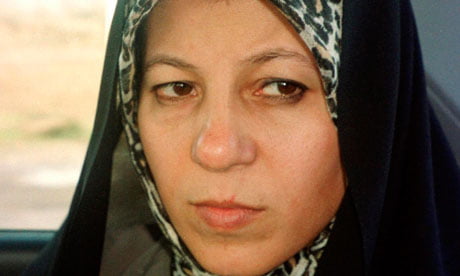
Time – Iran’s former president Akbar Hashemi Rafsanjani found himself living the old cliche about revolutions devouring their own children, Tuesday, when a court in Tehran sentenced his daughter to six months in prison for “spreading propaganda” against the regime. The verdict against a highly visible member of the influential Rafsanjani clan — longtime kingmakers within Iran’s political elite — is the latest sign of deepening political strife ahead of parliamentary elections to be held in March.

A former member of parliament-turned-political activist, Faezeh Hashemi had emerged in recent years as a sharp critic of President Mahmoud Ahmadinejad’s government. While Hashemi isn’t a political heavyweight in her own right — she is best known as an advocate for women’s sports and for flashing Chanel under her traditional black chador — she infuriates the regime by championing her father’s politics. (Former President Rafsanjani had been Ahmadinejad’s nemesis within Tehran’s clerically dominated political system; the incumbent effectively ran his reelection campaign in the controversial 2009 poll against Rafsanjani rather than against the rival candidates backed by the former president who continued to occupy important clerical positions.) The verdict against Hashemi appears to be based on a recent interview in which she said Iran “was being run by thugs and hooligans.”

Hashemi had suffered brief spells in detention in the past, and regime-aligned Basij militiamen have harassed her in public. But analysts says the harsh verdict reflects the mounting tensions between rival conservative camps ahead of the March elections, the first major vote Iran will hold since Ahmadinejad’s contested 2009 reelection. The regime fears a low turnout would erode its domestic political standing amid mounting fury over the deteriorating economy. Any street unrest would project a divided image of Iran at a sensitive moment, as the country faces a possible oil embargo and trades threats daily with the Untied States.

Iranian officials and state media have launched a “readiness” message campaign in preparation for the vote, warning supporters of the opposition Green movement to stay off the street and reminding Iranians of their “duty” to the country’s “religious democracy”. The country’s top police commander, Ismail Ahmadi Moghdam, declared this week that military and security forces were prepared to thwart “plans of the enemy” that might seek a repeat of 2009’s protests.

With anxiety running high in Tehran over the external pressures, the regime needs a show of unity ahead ahead of the election — which may be why it’s turning up the heat on Rafsanjani. Once a pillar of the revolutionary establishment, Rafsanjani’s political influence has waned in recent years, especially after he backed some of the protesters’ demands in the 2009 unrest and demanded the release of detained prisoners. In the aftermath, he lost his long-time position as head of the Assembly of Experts (an appointed clerical body that picks the Supreme Leader, and hypothetically has the right to recall the incumbent, Ayatullah Ali Khamenei). He was also barred from delivering sermons at Friday prayers at the University of Tehran, the country’s most influential political platform. Rafsanjani is also expected, later this year, to lose his position as head of the Expediency Council, another clerical body which resolves disputes between different branches of government. But even in diminished form, Rafsanjani’s clout remains considerable. As such, he represents a threat to the facade of unity the regime is trying to present, having begun questioning the fairness of the coming election. Last week the regime shut down Rafsanjani’s personal website.

By ratcheting up the pressure on the former president, analysts say, Iran’s top leadership hopes to force him to throw his influence behind the parliamentary vote. “The message being sent to Rafsanjani is very clear: criticize the Ahmadinejad government all you like, but when it comes to core issues of the system, you must be supportive,” says Alireza Haghighi, an Iran specialist at the University of Toronto. “The expectation is that he will stand behind the system when it matters.”

The March parliamentary vote is expected to be a fierce, if narrow, contest between allies of Ahmadinejad and a coalition of his opponents drawn from the Revolutionary Guard and hard-line clergy loyal to Khamenei. Both camps seek a 30 to 40 percent share of the seats in parliament that would enable them to either support or impede the Ahmadinejad government. For the anti-Ahmadinejad camp, the vote will be a key first step in marginalizing the president and shearing his ambitions to retain influence beyond the end of his term.

The country’s most prominent reformists are boycotting the vote, and Mehdi Karroubi, a leader of the now quiet Green Movement along with Mir-Hossein Moussavi, has said from his house arrest that elections will be “dictated and security driven”. With no prominent candidates to support and no unified position or leadership to follow, Iran’s opposition remains discontent but silent. Rafsanjani had garnered some credibility amongst those Iranians who protested in 2009, but would lose that favor by urging participation in an election the opposition movement considers rigged.

For Rafsanjani, says Jamshid Barzegar, senior Iran analyst at BBC Persian, “the best course is to keep silent.” If he backs the vote, he loses credibility amongst regime critics; if he undermines the election by questioning its fairness, he risks losing his standing within the system altogether. The verdict against Faezeh Hashemi leaves her 20 days to appeal, and an appeals court would likely review the case on the eve of the March 2 vote, effectively keeping his daughter’s fate hanging over Rafsanjani’s head until voting day. “The system wants to have Rafsanjani in its camp, but a quiet, passive Rafsanjani,” says Barzegar.

The provocations against Rafsanjani continue to escalate. On Tuesday, family members of his exiled son Mehdi Hashemi had their passports confiscated upon returning to Tehran after visiting with him in Dubai. Whether Rafsanjani responds remains to be seen, but it’s clear that Iran’s leadership considers him a dangerous wild card in an electoral game that matters vitally.

As Karim Sadjadpour of the Carngegie Endowment for International Peace puts it: “What remains to be seen is whether Rafsanjani will, for the sake of regime stability, take his grievances with him to his death bed, or whether he will go down fighting. It’s difficult for him to disavow a system he helped create.”

Iran’s internet cafe clampdown is an effective way to dissuade dissidents


By demanding cyber cafes take people’s details, government is free to focus on other methods of internet censorship.

The dream of dictatorships – to control communications within their borders – has got harder and harder as the internet has become more and more pervasive. Fifteen years ago, cutting off the internet was easy: internet providers used modems and you could simply seize them. Now it’s more complex: smartphones may even be able to connect to telephone data services across borders. A determined person can get a message out in all sorts of ways: one of the smartest is to hide coded data inside the pixels of what looks like a perfectly innocent photograph, a method called steganography.

The Iranian government’s latest controls, in which it is demanding that internet cafes take the personal details of anyone using them, are calculated not to stamp out anonymous use of the internet, but to dissuade the far larger body of average people from any thought of dissent. As Patrick McGuinness says in The Last Hundred Days, his semi-autobiographical novel about the last days of Ceauçescu’s communist Romania, in a society where you know that you are being watched, eventually you will watch yourself, and save the authorities the trouble.

Monitoring the free internet is too big a task for any government. But by using the threat of monitoring, Iran‘s administration can free itself to focus on words or phrases, or people, it knows to distrust.

But Iran’s government has been taking other steps too to discover dissidents and track their movements. It may be following North Korea’s lead in creating an “intranet” – an internet that works only inside its borders. Only a few thousand people in North Korea have any connectivity to the outside world.

Iran seems to be looking to protect its most valuable information from the wider internet, fearing a repeat of the Stuxnet computer virus attack of 2010 – though that was brought into the country via infected USB sticks from Russia, which were plugged into the nuclear network. An intranet wouldn’t stop that.

The government is also trying other methods to monitor dissent. Last year, an Iranian hacker broke into one of companies that issues “digital certificates” – a sort of seal indicating that a site is what it says it is. Among the false – but to a receiving computer, completely real – certificates that the hacker created was one for Google’s webmail product, Gmail. A few months later, the certificate was discovered being used in Iran to fool people who were accessing Gmail into thinking that their connection was secure; in fact any suitably equipped hacker could have monitored their emails. Significantly, a dissident would be more likely than the average Iranian citizen to use Gmail.

In response, some outside groups have tried to set up methods to let people inside Iran bypass the filtering being used on the computing and telephone networks. The so-called “internet in a suitcase” project, backed by the US government, is designed to carry systems that would let people create their own ad-hoc wireless phone networks, eventually linking out of the country to services such as satellite internet providers or mobile phone networks across borders.

Brigadier-General Bagher Afshar and his officers arrested in Qazvin while raping female students

Iran Briefing: We will establish security in Iran by sexual harassment 8  members of Iranian Law Enforcement Police arrested in Qazvin for allegedly raping dozens of female students.

According to the Azerbaijan news agency, police  officers of the 11, 12 and 13 Police Stations of Qazvin who were patrolling to enforce the Islamic dress code and moral security scheme, gang raped the female students who were deemed to be not  properly observing the Islamic dress code imposed by the Islamic Republic’s authorities on women.

While on duty, the officers stopped the cars driven by women who seemed to be not properly observing the Islamic dress code, and then transferred the cars into a parking known as Sherkat-e-Naft Parking (located in an abandoned region between Qazvin and Alborz Industrial Zone). The police officers threatened the victims , who were mostly female students, that they might get into trouble and would probably be sentenced to years in prison should the police prepare a report over the incident. Then the students started  begging  the police officers, asking them  to somehow solve the problem. The students, who were from different cities, were asked by the police officers to give their phone numbers, so that the police officers could solve the problems personally.  In following days, the police officers would call the students asking them to come to the parking lot where the cars were held, and began to rape them in the parking lot.

One day, one of the commanders of the Anti-Social Corruption Police incidentally went to the parking lot, and there he realized that a car belonging to the 12 Police Station is hidden under the parking lot’s bridge. He became suspicious and went inside the parking garage where he caught one of the officers raping a student. He then called the intelligence branch of the Qazvin’s Law Enforcement Police who subsequently  arrested the police officer. After he was arrested, he disclosed the names of seven other police officers  who were complicit in the incident. Preliminary investigation showed that 18 students were so far raped by this gang of police officers, which is being reportedly led by Brigadier General Bagher Afhshar. It was later known that the police have confiscated 2000 bottles of liquor from the house of Bagher Afshar.

Ironically, Qazvin’s Law Enforcement Police has not yet referred the case to the Qazvin Prosecutor’s  Office, and it has banned journalists from covering the news.


Political prisoner denied medical treatment after paralysis with injection


A Kurd political prisoner was paralyzed after receiving an injection in prison.

According to reports, 26 year old political prisoner Ali Chak, who is from a village in Sardasht in Western Azarbaijan Province, was transferred to the Mahabad Public Prison infirmary where he received an injection. He became paralyzed in both legs a short time after the injection.

This Kurd political prisoner was once again returned to his cell despite his critical condition and was only transferred to Orumieh Hospital after other political prisoners severely protested this issue.

No measures have reportedly been taken for Ali Chak’s treatment and his condition is deteriorating.

Ali Chak has been sentenced to seven years of prison on charges of cooperating with   a Kurd opposition group.


Source

6 Months of Human Rights Violations and Political Arrests in Iran’s Azerbaijan Provinces


During the six-month period from 21 March to 21 September 2011 more than 320 cultural, political, women’s rights, and human rights activists were arrested in Iran’s West and East Azerbaijan Provinces, according to local sources.

The International Campaign for Human Rights in Iran confirmed the names of 326 people prosecuted in these provinces. Sources told the International Campaign for Human Rights in Iran that many more detainees were released immediately or within a few days of their arrest.

Most of those arrested were protesting the drying of Orumiyeh Lake, the largest lake in the Middle East and a UNESCO Biosphere Reserve. One of the largest saltwater lakes in the world, Orumiyeh Lake is located between the Iranian provinces of East and West Azerbaijan. The demonstrations, by environmental and civil society activists, were protesting the government’s negligence regarding the quickly drying lake, which they assert will soon cause irreversible environmental and economic damage.

In addition to these arrests, sources confirm 10 executions were carried out in the prisons of Iran’s Azerbaijan provinces, which according to officials were all drug related. Of those executed, the following names have been published: Tohid Masoumi Dajin, Khaled Esmaili, Masoud Ghavi Najah, Aref Rashidpour, Esfandiar Mandahaki, Teymour (Timan) Ayoubian, Sadigh Nemani, Mehdi Kohan and Younes Aghaian. The latter was a member of the religious minority Ahl-e Haqq.

“Many of the Azerbaijan activists were tortured during and after their arrest,” local sources told the Campaign. “Among these was Faranak Fareed, women’s rights activist, poet and writer, who was arrested during the [Lake Orumiyeh] demonstrations of 3 September 2011 in Tabriz. Security forces severely beat her during her arrest and hit her repeatedly in the head and face while transferring her to prison. The beatings continued inside the Intelligence Office Detention Center, to the point that her ear and hand were seriously injured.”

Sources added, “[Lake Orumiyeh demonstrators] arrested at the Iftar ceremony on 24 August [as they were breaking the Ramadan fast in a private home] were also beaten and affronted by the security forces during their arrest and later, assaulted and beaten in front of their families in Tabriz Courts. They were also beaten in prison to such extent that broken hands, ribs, teeth, etc., were reported.”

Of the 45 individuals confirmed to have received sentences from the court, 16 were sentenced to flogging and 16 others were sentenced to cash fines ranging between $100 to $300 dollars (1 to 3 million Rials).

Three environmental activists, Saeed Siami, Ali Salimi and Jalil Alamdar Milani, who were arrested on 2 April 2011 in Tabriz, were sentenced to flogging and fines and were released after receiving 20 lashes.

The source added that 7 detainees were summoned to prison in order to start serving their sentence, and are currently in prison. Their names are as follows: Faraz Zahtab (3 months remain of his 6 month prison sentence), Sima Didar (5 months remain of her 6 month prison sentence), Alireza Farshi (3 months remain of his 6 month prison sentence), Yousef Mehr (4 month prison sentence), Abolfazl Vesali (6 month prison sentence), Moosa Saket (7 month prison sentence), Bahman Nasirzadeh (8 months remain of his 1 year prison sentence).

At least two students were expelled from their universities and two more were barred from continuing their graduate education as a result of arrests, according to information acquired by the Campaign. Siamak Koushi, a student activist who was studying mechanical engineering, was expelled from Azad University of Tabriz after his 7 June arrest. Another student activist, Amin Rezaei, was expelled from Orumiyeh University in August. Mehdi Hamidi Shafigh, a sociology student at Tabriz University, and Mohammad Azizi, a literature student at Rasht University, were banned from continuing their education at graduate level following arrests.

Comments on the table of six-month detentions in West and East Azerbaijan Provinces:

It is important to note that this list only includes individuals identified by human rights activists in the two provinces. Therefore, the total number of those arrested may exceed the number of those mentioned in this report.

The names include only of those detainees whose names have been previously published by different sites and news agencies; countless additional protesters were arrested during the street protests in the cities of Tabriz and Orumiyeh in protest of the drying of Lake Orumiyeh.

In the list, some names belong to those arrested during soccer games of the Tabriz Tiraxtor team. Azarbaijan province civil rights activists told the Campaign that usually during the matches of the team, some of their fans get arrested: “These individuals, in the most common scenario, spend one day in prison, and some are freed on bail. Even though some of these detainees’ cases were sent to the court, in the 6 months period of 21 March to 21 September 2011, the sentences of these individuals had not commenced yet, and some are therefore not mentioned in this report.”

The table, that is available in Farsi version of this article, only covers the temporary detentions, solitary confinements and imprisonments of the detainees through 21 September 2011, which means that many of these prisoners are still imprisoned or were released much later. For example, Saeed Naeemi remains imprisoned eight months after his arrest. Many of those arrested in the city of Tabriz on 24 August were scheduled to be released on bail three months after their arrest, but had only served 29 days in prison at the time this report was compiled.

The blank spaces on the table represent the lack of credible information on where the detainees were held or the dates of their release.

In this report, those arrested on 2 April 2011 in Tabriz during protests against the drying of Orumiyeh Lake were referred to as “environmental activists,” but also others with different social or political backgrounds were mentioned according to their activities.

Local sources of the Azerbaijan provinces have collected the names of 45 activists which only in the six-month period of March to August 2011, were sentenced to a total of 75 years in prison. Names made available to the Campaign and their sentences are as follows:
1-Farzin Rahimi (1 year and 4 months)
2- Habib Pourvali (3 months)
3- Hojjat Mokhtarzade (3 months)
4- Reza Abri (6 months)
5- Ali Hassan Tahamtani (6 months)
6- Ebrahim Farajzadeh (6 months)
7- Ebrahim Asemani (1 year)
8- Hadi Morteza (1 year)
9- Mousa Saket (7 months)
10- Hassan Alizadeh (91 days)
11- Hanieh Farshi Shotorban (7 years)
12- Babak Hosseini (1 year)
13- Yuroush Mehrali Beiglou (1 year prison)
14- Ebrahim Esmaili (1 year)
15- Mohammad Hossein Jafarpour (1 year and 6 months)
16- Hadi Hamidi ( 6 months)
17- Aydeen Khajei (6 months)
18- Shahram Radmehr (6 months)
19- Younes Soleimani (6 months)
20- Mahmoud Fazli (6 months)
21- Naeem Ahmadi (6 months)
22- Yashar Karimi (6 months)
23- Hamideh Farajzadeh (6 months )
24- Alireza Abdollahi ( 6 months suspended sentence)
25- Behboud Gholizade (6 months suspended sentence)
26- Akbar Azad (6 months suspended sentence)
27- Ahmad Alizadeh (20 months of suspended sentence and 4 months of prison sentence)
28- Yousef Salahshour (20 months of suspended sentence and 4 months of prison sentence)
29- Yasser Salmani Rezaei (20 months of suspended sentence and 4 months of prison sentence)
30- Abdollah Sadoughi (20 months of suspended sentence and 4 months of prison sentence)
31- Mostafa Avazpour (20 months of suspended sentence and 4 months of prison sentence)
32- Yaghoub Karimi (20 months of suspended sentence and 4 months of prison sentence)
33- Farzad Mahdavi (20 months of suspended sentence and 4 months of prison sentence)
34- Ali Sirnak (20 months of suspended sentence and 4 months of prison sentence)
35- Mehdi Mohajeri (20 months of suspended sentence and 4 months of prison sentence)
36- Mohammad Alimoradi (20 months of suspended sentence and 4 months of prison sentence)
37- Ghader Norouzi (20 months of suspended sentence and 4 months of prison sentence)
38- Akbar Hosseinpour (20 months of suspended sentence and 4 months of prison sentence)
39- Ali Imani Gharamaleki (20 months of suspended sentence and 4 months of prison sentence)
40- Mohammad Mahmoudi (20 months of suspended sentence and 4 months of prison sentence)
41- Mohammad Amiri (20 months of suspended sentence and 4 months of prison sentence)
42- Sassan Vahebivash (6 months)
43- Nima Pouryaghoub (6 years)
44- Shahrokh Zamani (11 years)
45- Mohammad Jarahi (5 years)

A more comprehensive table with a list of 326 arrested individuals is included in the Farsi version of this article. (Link)

Iran To Hold More Military Drills

0


Iranian Defense Minister Ahmad Vahidi says that Iran plans to hold more military exercises after a 10-day drill in the Persian Gulf raised tensions with the United States.

Iran’s ISNA news agency quoted Vahidi as saying that an ” Iranian Revolutionary Guards maneuver would soon be held.”

Vahidi also said that Iran “will do anything to preserve the security of the Strait of Hormuz,” a vital international oil-shipping route, and that the presence of “forces from beyond the Gulf is not needed, and is harmful.”

Vahidi’s comments were made on January 3 after Iran’s armed forces chief Ayaollah Salehi said Tehran would take action if the United States redeployed an aircraft carrier to the Persian Gulf.

The White House said the warning showed Iran was “in a position of weakness” and it maintained that it will not alter its plans for deploying of warships in the area.


Source

Daughter of former Iranian president sentenced to jail

0


Ex-MP Faezeh Hashemi, whose views are close to the Green movement’s, faces six months for ‘spreading propaganda’

The daughter of former Iranian president Akbar Hashemi Rafsanjani has been sentenced to six months in jail after being found guilty of “spreading propaganda” against the country’s regime.

Faezeh Hashemi, a political activist and former member of the Iranian parliament whose views are close to those of the reformists, was informed of the court’s verdict on Tuesday, Iran’s semi-official Ilna news agency reported.

“She has been convicted on charges of making propaganda against the ruling system and has been sentenced to six months in prison,” Hashemi’s lawyer, Gholam Ali Riahi, told Ilna.

Riahi said Tehran’s revolutionary court also banned Hashemi from belonging to any political parties and taking part in media or online activities for the next five years. She has 20 days to appeal.

She fell foul of the Iranian authorities after the disputed presidential elections in 2009 when she publicly supported opposition candidate Mir Hossein Mousavi and later participated in popular protests against the vote’s results. At the time, she was briefly arrested in two separate occasions and barred from leaving the country.

Her conviction is believed to be the result of an interview she gave to an opposition website, Roozonline, in which she blamed regime supporters for harassing her in public.

Hashemi’s criticism of the regime in recent years has led to an uproar among conservatives who believe that – as the daughter of a leading politician – she should back the official line, and not that of the opposition Green movement which the authorities now refer to as the “sedition”.

Hashemi Rafsanjani is the head of Iran’s expediency council which mediates between the parliament and the guardian council, a body that vets all parliamentary legislation.

In the past, he had a great deal of influence on Iranian politics but his authority has diminished since he lost the 2005 presidential election to Mahmoud Ahmadinejad.

Ahmadinejad played an instrumental role to undermine his rival by publicly making allegations of financial corruption against Hashemi Rafsanjani’s family. After Ahmadinejad took office for the second time in 2009, Hashemi Rafsanjani was further sidelined. In March 2011, he stepped down as the head of Iran’s expert’s council, a powerful clerical body in charge of appointing and dismissing the supreme leader.

Iranian authorities last week blocked access to Hashemi Rafsanjani’s official website in an unprecedented move against a man who was the protege of Ayatollah Khomeini, the founder of the Islamic revolution, and played a significant role in the appointment of Ayatollah Khamenei as the current supreme leader.

The spokesman for Iran’s judiciary, Gholamhossein Ejeii, said on Monday that the website was filtered according to the country’s computer crimes regulations. Other former high-ranking officials – including former reformist president Mohammad Khatami – have also seen their websites subject to censorship.

The sentencing of Hashemi Rafsanjani’s daughter comes amid growing political tension before parliamentary elections in March, the first general vote in the country since 2009.

More than 5,000 people have registered as parliamentary candidates but only those approved by the guardian council will be allowed to run. Few reformists are reported to have put their names forward, while many opposition groups have called for a boycott of the vote. Opposition leaders Mousavi and Mehdi Karroubi have been under house arrest since February.

Nervous about the turnout, Iranian authorities said any attempt to mount a boycott of the election would be viewed as a crime. They specifically warned against any online efforts to organise a boycott.

In a separate incident on New Year’s Day, the house of Iran’s first post-revolution president, Abulhassan Banisadr, in exile in France, was broken into in what appeared to be a politically motivated incident. Banisadr has been critical of the regime in recent years.

Another Gonabadi Dervish arrested in Kavar

0


Majzooban Noor – Mr. Reza Pishkar (Poshtkar) , one of the Gonabadi Dervishes , was arrested by security forces in Kavar and  transferred  to Adel Abad prison in Shiraz yesterday.

According to Majzooban Noor reporter , Security forces , yesterday , January, 01, 2012 ( Dey ,11 ,1390) assaulted on Mr Reza Pishkar’s house in  Kavar and  by illegal searches and inspections and  create fears for the family, arrested  and transferred him  to the Adel Abad prison in Shiraz.

It is reminded  that , Reza Pishkar , along with another dervish , were attacked by security forces and plainclothes in Kavar town on Nov , 17 ( Aban , 26 ) while they were going to Hosseinyeh ‘s Kavar (Worship place) faced with security forces and plain clothes that had  intention of arresting and dervishes could successfully run away then  security forces and plain clothes had gun fire to them . In this event the bullet did not hit the target and didn’t harm anyone.

Since  the last four months , detention and harassment of Gonabadi Dervishes  has continued so that , in the latest arrests by security forces  Mr Nasrollah Laleh , a Gonabadi dervish and director of Haghighat  publishing , arrested on Dec 20 2011 ( Azar 29 1390), so far no information has been obtained from his condition till now…


Source