Home Blog Page 514

Iran Regime Profiting From Currency Decline, U.S. Treasury Says

0


The Obama administration is accusing the elite of Iran’s regime and the Islamic Revolutionary Guard Corps of profiting “on the back of the average Iranian” as the nation’s currency plunges under pressure from international sanctions.

The new allegation coincides with the decline in the market value of the Iranian rial, which has dropped about 15 percent against the dollar in the past five weeks and 35 percent since March, according to Tehran’s independent Donya-e-Eqtesad newspaper. The 39 percent difference between the central bank’s official rate and market rates on Dec. 21 was the largest in almost two decades, economists in Tehran and Washington said in interviews.

U.S. Treasury Undersecretary David Cohen said the gap between the two rates has provided an arbitrage opportunity exploited by officials and businesses affiliated with the IRGC, the elite military arm that’s under international sanctions for suspected nuclear weapons work and terrorism. They are among regime elements able to obtain foreign currency at the favorable official exchange rate and sell it for a profit in exchange bureaus at the market rate, he told the Senate Foreign Relations Committee in written testimony Dec. 1.

“Ordinary Iranians are urgently seeking out foreign currency such as dollars or euros for safety, yet they are having trouble accessing hard currency, and when they can, they have to pay the unofficial market rate,” said Cohen, the Treasury undersecretary for terrorism and financial intelligence.

‘Profitable Arbitrage’

“At the same time, senior government officials and preferred businesses, including IRGC-owned and controlled operations, are able to access foreign exchange at the official rate, essentially engaging in profitable arbitrage on the back of the average Iranian,” according to Cohen.

The market value of the rial has been dropping for months. Iranians are reacting to the prospect that their government may be incapable of slowing the 19.8 percent inflation rate or improving the domestic economy, as the U.S. and Europe approved new sanctions on the banking system and discuss a possible European embargo of Iranian oil, Hossein Raghfar, an economist at Al Zahra University in Tehran, said in a telephone interview.

The official rial-to-dollar rate was 11,030 on Dec. 21, while the market rate at currency bureaus soared to 15,300 the same day. That gap narrowed yesterday to 11,100 and 15,150, a 36 percent difference, according to Donya-e-Eqtesad. The 39 percent gap last week was the widest in about 20 years and it underscores that Iranians don’t trust politicians and finance officials to stabilize the economy, said Raghfar.

Iranian Media

U.S. Treasury officials declined to provide Bloomberg News with documentation backing up Cohen’s allegation. Treasury spokesman John Sullivan did point to reports in the Iranian media citing central bank of Iran officials and a prominent researcher with Iran’s parliament warning about currency profiteering. Those reports do not explicitly refer to regime officials and the IRGC benefiting as Cohen did.

The Alef news website linked to Ahmad Tavakoli, an economist who runs the Iranian parliament’s research center, cited him as saying that the gap between the rates “will lead to massive undue incomes at the expense of the nation’s assets.”

That will result in the “emergence of a new class of people who will have reached a certain structure through the economy’s muddy waters and the blessings of the CBI,” the central bank of Iran, said Tavakoli, who has frequently criticized President Mahmoud Ahmadinejad’s economic policies.

‘Domestic Discontent’

Cohen told Congress that for a decade, until September 2010, Iran successfully supported a single, official exchange rate using hard currency earned from oil sales. He credited United Nations sanctions imposed in June, 2010, with making it hard for the central bank to access foreign currency to defend the rial. The plunging currency was “fueling serious inflation, high unemployment and domestic discontent,” he said.

Iranian Foreign Ministry spokesman Ramin Mehmanparast was not immediately available to comment when called at his office in Tehran yesterday.

The assertion that the IRGC and senior regime members are profiting from the rial’s fall raises questions about whether sanctions are having the unintended effect of enriching entities involved in nuclear and missile proliferation, said Ken Katzman of the non-partisanCongressional Research Service in Washington and author of a book on the IRGC.

“Clearly sanctions are hurting the economy, but are the sanctions putting pressure on the key institutions they are intended to pressure, or could it be making the government more powerful relative to the population than it was before?” Katzman said in an interview.

Current Sanctions

Iran is under sanctions targeting the IRGC, finance, shipping, transport, missile and nuclear procurement and energy, in a concerted effort by the United Nations, the U.S., Europe and other nations to press Iran to abandon its suspected nuclear weapons program. Iran insists its nuclear program is for peaceful use.

The UN’s International Atomic Energy Agency on Nov. 8 detailed nuclear work that inspectors said could only be for military purposes. The latest report prompted additional sanctions last month in Washington, London and Ottawa, and is driving discussions in Europe on imposing an oil embargo.

Oil is Iran’s main source of income, earning the country $73 billion in 2010 and supplying more than 50 percent of the national budget, according to the U.S. Energy Department and theInternational Monetary Fund.

Oil Revenue

The second-largest producer in the Organization of Petroleum Exporting Countries after Saudi Arabia, Iran exported an average of 2.58 million barrels a day in 2010, according to OPEC. Iran expects to earn $110 billion from crude oil production in the Iranian calendar year that ends March 19, the state-run Mehr news agency said, citing a member of the parliament’s economic committee, Gholamreza Mesbahi-Moghadam.

Ali Alfoneh, an Iran researcher and IRGC specialist at the American Enterprise Institute in Washington, said government institutions, including the IRGC, benefited from a similar currency situation during the Iran-Iraq War in the 1980s. They were given preferential access to foreign currency at an official rate, which they used both to buy weapons overseas and to sell currency on the black market, he said.

‘More Corrupt’

It would “make sense” that the IRGC now is trying to do what it did in the 1980s, Alfoneh said in an interview. “In every single profitable industry in Iran, you see the IRGC. They are becoming more and more corrupt every day.”

“The wrong people are benefiting,” while ordinary Iranians suffer inflation, feeble economic growth and a decline in the rial brought on by sanctions, he said.

Growing public anger over the falling rial and growing opportunities for corruption are also feeding divisions within Iran’s leadership. President Mahmoud Ahmadinejad’s political rivals accuse him and his loyalists of economic mismanagement. The president and the central bank governor have disavowed blame for the fall of the rial.

As state television last week showed lines of people camped out with blankets overnight in front of state banks waiting to buy gold, Ahmadinejad accused unnamed culprits of seeking to drive down the rial and portray Iran “in a state of crisis,” the business paper Donya-e-Eqtesad reported.

Losing Defense

Ahmadinejad pledged the government would bring currency and gold markets under control, and asserted on Dec. 21 that Iran has huge reserves of both and could use them “for 15 years and still have gold” to defend the rial.

A few months ago, the central bank of Iran tried to stabilize the price of gold by auctioning gold reserves, Alfoneh said. “After two weeks, they abandoned the strategy because they could no longer defend the currency. The price of gold was still going up, because there’s no public confidence in the CBI.”

Central bank Governor Mahmoud Bahmani has acknowledged the bank is struggling to restore stability to the currency, and had limited ability to defend the rial. Iran’s economy needs to be managed as if it were under siege by western countries, Bahmani said Dec. 11, according to the Mehr news agency.

Anyone with preferential access to cheaper dollars “will try to make profit out of this,” Scott Lucas, an Iran specialist at the University of Birmingham in England, said in an interview. “Whether it’s Ahmadinejad or the Guards, we’re talking about people making short term gains to the detriment of the long term.”

Ebrahim Yazdi sentenced to 8 years in jail

0


Iranian dissident Ebrahim Yazdi has been sentenced to eight years in prison and a five-year ban from civic activities for the crime of “activities against national security and publishing falsehoods.”

Aftab website quotes Yazdi’s lawyer saying he had challenged the competence of the court and declared the case should be tried in open court before a jury. Therefore, he refused to present a defence.

According to the Article 168 of the Islamic Republic Constitution, political crimes must be prosecuted in an open court in front of a jury. However, Iranian authorities have ignored that stipulation, arguing that political crimes are not defined in the constitution.

Nevertheless, Yazdi’s defence attorney said there is a good chance the appellate court would recognize the preliminary court’s lack of competence in this case.

Ebrahim Yazdi, the head of the reformist organization the Freedom Movement of Iran, was arrested after the controversial presidential elections of 2009, when waves of reformists were detained for challenging the election process.

Yazdi was released three days after his first arrest in July of 2009, only to be re-arrested in December of that year. After 60 days of solitary confinement, he was released on bail due to severe heart complications.

He was arrested once more in September of 2010 for participating in what the authorities called “an illegal Friday Mass prayer” in Esfahan. He spent three months in Evin and another three months in so-called Revolutionary Guards safe houses until the octogenarian dissident was finally released on bail to await the outcome of his trial.

U.S. prepared for military option against Iran

0


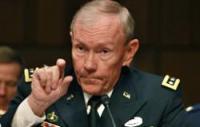
The top U.S. military commander says his forces are prepared for a mission against Iran if one proves necessary.

U.S. Chairman of the Joint Chiefs of Staff General Martin Dempsey told CNN that the military option with regard to Iran is “executable if necessary” but it would be “a tragedy for the region and the world.”

He added that the Obama administration is “examining a range of options” with regard to Iran.

The United States has repeatedly insisted that all options are on the table in its determination to stop Iran from achieving nuclear weapons capability.

Iran, however, denies having any military ambitions in its nuclear program.

General Dempsey also touched on the recent loss of a U.S. drone in Iranian territory, saying that would not put an end to U.S. efforts to collect information on what is happening in Iran.

U.S. Defense Secretary Leon Panetta recently said that Iran is one year away from developing a nuclear bomb.

There are reports that U.S. intelligence has stepped up its efforts to collect information from the Middle East using unmanned drones. In November, Iranian authorities announced the arrest of 15 suspected spies.

In the past week, Iranian national television has aired the “confessions” of a U.S. citizen of Iranian descent, who admitted to having been trained by U.S. forces in Afghanistan to carry out espionage missions in Iran.

US warns Iran over threat to block oil route

0


The US Navy has said it will not tolerate disruption to a vital oil-trade route, following an Iranian threat to close it.

Iran warned it would shut the Strait of Hormuz if the West imposed more sanctions over its nuclear programme.

The US and its allies believe Iran is trying to develop a nuclear weapon – a charge Tehran denies.

Reacting to Iran’s warning, a US Fifth Fleet spokeswoman said it was “always ready to counter malevolent actions”.

The Strait of Hormuz links the Gulf – and the oil-producing states of Bahrain, Kuwait, Qatar, Saudi Arabia and the United Arab Emirates (UAE) – to the Indian Ocean. About 40% of the world’s tanker-borne oil passes through it.

The US maintains a naval presence in the Gulf, largely to ensure the transport of oil remains open.

The strait “is not only important for security and stability in the region, but also is an economic lifeline for countries in the Gulf, including Iran”, Pentagon spokesman George Little said.

“Raising the temperature on tensions in the Gulf is unhelpful”, he said, but added that he was unaware of any hostile action directed against US vessels.

US Fifth Fleet spokeswoman Rebecca Rebarich told the BBC the navy would be ready to act if required: “The US Navy is a flexible, multi-capable force committed to regional security and stability, always ready to counter malevolent actions to ensure freedom of navigation.”

Closure ‘easy’

Western nations recently imposed new sanctions against Tehran following a UN report that said Iran had carried out tests related to “development of a nuclear device”.

Further measures being considered to target Iran’s oil and financial sectors have brought a furious response from Tehran.

Vice-President Mohammad Reza Rahimi warned that “not a drop of oil will pass through the Strait of Hormuz” if sanctions are widened and Iran’s navy chief Admiral Habibollah Sayari said that closing the strait would be “easy”.

“The enemies will only drop their plots when we put them back in their place,” Mr Rahimi was quoted as saying on Tuesday by the official news agency Irna.

Adm Sayari later told Iran’s Press TV that closing the Strait of Hormuz would be “really easy” for Iran’s armed forces “or, as Iranians say, easier than drinking a glass of water”.

“But right now, we don’t need to shut it as we have the Sea of Oman under control, and we can control the transit,” he added.

Iran’s threats to close the strait have not flustered markets and oil prices actually fell after a senior Saudi oil official said that Gulf Arab nations were ready to offset any loss of Iranian crude.

‘Non-compliance’Earlier, US State Department deputy spokesman Mark Toner said the Iranian threats were simply “another attempt… to distract attention from the real issue, which is their continued non-compliance with their international nuclear obligations”.

Map locator

Iran’s navy has been staging wargames in international waters to the east of the strait.

Adm Sayari said the manoeuvres were designed to show Gulf neighbours the power of Iran’s military over the zone.

Washington and Israel have not ruled out military action against Iran’s nuclear facilities if sanctions and diplomacy fail.

Iran has vowed to respond by attacking Israeli and US interests in the region.

An embargo on Iranian oil exports has been considered before but dismissed as it could also drive up global oil prices and harm Western economies, particularly in Europe.

It is believed the new measures could cut Tehran off from global energy markets without raising the price of fuel.


Source

IRGC and Basij have plans to correct Tehran’s political and cultural situation: Genral Jafari


IRGC chief has openly admitted that the political and cultural situation in Tehran is far from ideal which poses security threat to the regime. He has also threatened that IRGC and Basij cannot remain indifferent and they have plans to address the situation.

Following is the news article as reported by Mehr News Agency along with a couple of related news that shows the divisions among the regime.

Enemies reckoning on outbreak of unrest in Tehran: IRGC chief

Islamic Revolution Guards Corps (IRGC) Commander Mohammad Ali Jafari said on Saturday that the security issues facing the capital city of Tehran are of high importance because the enemies have counted on a possible outbreak of unrest in the metropolis.

He also said that political and cultural situation in Tehran is far from ideal due to years of negligence, adding that the Basij and the IRGC cannot remain indifferent and have plans to correct the current situation.

MPs call on president to remove his son-in-law

Forty-two lawmakers have signed a petition, which calls for the removal of President Mahmoud Ahmadinejad’s son-in-law, Mahdi Khorshidi-Azad, who was appointed as the director of the Institute of Standards and Industrial Research of Iran (ISIRI) on Monday.

MPs believe that Khorshidi-Azad does not have the professional qualifications needed for running one of the most specialized state organizations. `

I’m living proof of deviant current: Pourmohammadi

State Inspectorate Organization Director Mostafa Pourmohammadi has said that he is the living proof of the existence of the deviant current.

In an interview with the Javan newspaper published on Tuesday, the former interior minister said, “Less than 10 months after my presence in the government, I was told to leave the government.”

He also said that the matter of serious concern is that the associates of this current have been said to have links with officials at the executive branch of the government.

Iran threatens to block oil exports through Hormuz strait in sanctions row

0


Country reacts to threat of sanctions on its crude oil after UN watchdog’s report into state’s nuclear ambitions

Iran threatened on Tuesday to stop the flow of oil through the strait of Hormuz if foreign sanctions were imposed on its crude exports because of its nuclear ambitions.

Western tensions with Iran have increased since a report last month by the UN nuclear watchdog saying Tehran appeared to have been working on designing an atomic bomb and may still be pursuing research to that end. Iran strongly denies this and says it is developing nuclear energy for peaceful purposes.

Iran has defiantly expanded its nuclear activity despite four rounds of UN sanctions meted out since 2006 over its refusal to suspend sensitive uranium enrichment and open up to UN nuclear inspectors and investigators.

Many diplomats and analysts believe only sanctions targeting Iran’s lifeblood oil sector may be painful enough to make it change course, but Russia and China – big trade partners of Tehran – have blocked such a move at the UN.

Iran’s warning came three weeks after EU foreign ministers decided to tighten sanctions over the UN report and laid out plans for a possible embargo of oil from the world’s fifth biggest crude exporter.

“If they [the west] impose sanctions on Iran’s oil exports, then even one drop of oil cannot flow from the strait of Hormuz,” the official Iranian news agency IRNA quoted Iran’s first vice-president, Mohammad Reza Rahimi, as saying.

EU ministers said on 1 December that a decision on further sanctions would be taken no later than their January meeting. EU countries take 450,000 barrels a day of Iranian oil, about 18% of its exports.

China, the biggest buyer of Iranian crude, has warned against “emotionally charged actions” that might aggravate tension in the nuclear standoff with Iran.

Russia for its part has warned against “cranking up a spiral of tension”, saying this would undermine the chances of Iran co-operating with efforts to ensure it does not build atomic bombs.

About a third of all sea-borne oil was shipped through the strait of Hormuz in 2009, and US warships patrol the area to ensure safe passage.

Most of the crude exported from Saudi Arabia, Iran, the United Arab Emirates, Kuwait and Iraq must slip through the strait, a four-mile wide shipping channel between Oman and Iran.

Some analysts say Iran would think hard about sealing off the strait as it could suffer just as much economically as western crude importers.

Industry sources said Saudi Arabia and other Gulf Opec states were ready to replace Iranian oil if further sanctions halted Iranian crude exports to Europe.

The Iranian oil minister, Rostam Qasemi, had said that Saudi Arabia had promised not to replace Iranian crude if sanctions were imposed.

“No promise was made to Iran, it’s very unlikely that Saudi Arabia would not fill a demand gap if sanctions are placed,” an industry source familiar with the matter said.

Gulf delegates from Opec said an Iranian threat to close the strait would harm Tehran as well as the major regional producers that also use the world’s most vital oil export channel.

“If the sanctions take place the price of oil in Europe would increase and Saudi and other Gulf countries would start selling there to fill the gap and also benefit from the higher price,” said an industry source, who declined to be named.

Brent crude oil futures jumped nearly a dollar to over $109 a barrel after the Iranian threat, but a Gulf Opec delegate said the effect could be temporary.

“For now, any move in the oil price is short-term, as I don’t see Iran actually going ahead with the threat,” the delegate said.

From the Revolutionary Guard’s Threat to Salehi’s Denial


Hossein Alizadeh

Iran Briefing Exclusive :

Introduction
Where is the Islamic Republic’s foreign policy being set and who is leading it? This question has once again come to the forefront following September 2011 when  the Islamic Republic officials vehemently reacted against  Turkey’s move to let the NATO  install missile defense shield on its soil.
The reaction of the Islamic Republic’s officials against Turkey was so overwhelming that Ahmet Davutoglu, Turkey’s foreign minister, had to share his concern with his Iranian counterpart in a phone call. Contrary to the previous position, the Islamic Republic’s  foreign minister, Ali Akbar Salehi, dismissed statements made by Iranian high ranking officials and described them as “irresponsible” and “personal view” over the issue.
Salehi said that the Islamic Republic’s official  foreign policy is being determined and set by the Supreme Leader, the president and the foreign ministry. If it is really so, how can one interpret threatening statements made by the high ranking commanders of the Revolutionary Guard and Iranian law makers against the NATO’s decision to install missile defense shield on Turkish soil?
In other words, is the Iranian foreign policy really the one which is being set by the Supreme Leader, president and the foreign ministry?
Why Threatening Turkey?
Turkey is a member of the North Atlantic Treaty Organization (NATO). The United States has been long heightening  its military presence around Iran. At the same time, the Islamic Republic has also been intensifying  its defensive, if not offensive capabilities. A ballistic missile program, which Iran has boldly disclosed it to the international community, is among the plans that the Islamic Republic has been long seeking to develop, though the experts  believe  is limited. Israel is the prime target of the Islamic Republic’s ballistic missiles because the Islamic Republic has clearly received and digested the US message that “every  option is on the table.”
To counter the Islamic Republic’s limited but threatening ballistic capabilities, the US has proposed to install a defense shield on Turkey’s soil. The US proposal was ratified by the NATO member states on October 19th  and 20th  in a Lisbon summit, which was initially held by NATO members to reach  an agreement for installing a defense shield against what is widely believed to be the “threat of Iran’s ballistic missiles.”
In another development, Turkey agreed to host NATO’s defense shield on its soil, though it did not name the Islamic Republic being the target of missile defense shield. The Islamic Republic, which sees Turkey standing against Iran in its struggle against the west, is left with no option but to send a threatening message to Turkey warning that such policy is not going to be without cost for Turkey.
Though Tehran gave red carpet treatment to Recep Tayyip Erdogan, Turkey’s prime minister, and Lula da Silva, former Brazilian president, and despite the Islamist victory in Turkey and Turkey’s dispute with Israel over Israel flotilla raid which made Iranian officials happy, sending a threatening message to Ankara shows the extent of Tehran’s concerns over Turkey’s foreign policy.
Ankara’s pressure on the Syrian regime, which is in stark contrast with the Islamic Republic’s policy towards Syria, is adding to the Islamic Republic’s concerns. A cursory glance at analysis of the event by the Sobhe Sadegh, the Revolutionary Guard’s mouthpiece, reveals the extent of  ever increasing confrontation between Tehran and Ankara. He writes “Should the Turkish officials continue taking such policies, Iran, due to its ideological and strategic interests, will have  no choice but choose Syria between Turkey and Syria.”

Missile Defense Shield: a Threat to the Regime’s Security
A missile defense shield smartly intercepts and destroys possible ballistic missiles before they reach the target.  To install a defense shield on Turkish soil was so serious for Iran that Iran’s Deputy Police Chief, Brigadier General Ahmadi Moghaddam, reprimanded Erdogan, who has taken the toughest possible stance against Israel following the flotilla incident, said Erdogan is a “lackey of Israel” and described Turkey’s policy as “a play and disturbance to the situation of the Islamic countries.”
Having failed to convince Russian officials to deliver a S-300 defense system, which Iran had already paid for, the Islamic Republic is fully aware that Iran is defenseless against possible attacks. However, the Commander of the Revolutionary Guard’s Aerospace Forces, Brigadier General Amir Ali Hajizadeh, has explicitly threatened that the NATO’s defense shield in Turkey is incompetent against Iran’s ballistic missiles, and that “the NATO’s defense shield in Turkey would be the prime target of Iran’s ballistic missiles, should the Islamic Republic be threatened.”
The extent of Iran’s concern over the NATO’s defense shield in Turkey will be clearer when one refers to the report prepared by the Iranian Parliament’s Research Center. In the report, which was compiled at the end of July 2011, Parliament’s Research Center described NATO’s defense shield in Turkey as “a serious threat against the Islamic Republic.” At the same time, Hossein Ebrahimi, Deputy Head of the Parliament’s National Security and Foreign Policy Committee, described the NATO’ s defense shield as being merely designed to “protect Israel,” and said that should Iran be attacked, it has every right “to defend itself.”

Salehi’s Denial, Why?
It seems that the Islamic Republic has no clear understanding of Turkey’s real concern. Turkey’s problem with Iran is not Israel’s security. Erdogan is the most popular non-Arab leader who has severely criticized Israeli policy towards Palestinians. Turkey’s problem with Iran is an atomic Iran. That is a concern that all Iran’s neighbors share with Turkey. As a matter of fact, that is an atomic Iran not a service to Israel that  has made Islamists in Turkey  side with the NATO against the Islamic Republic . Turkey’s ambassador to Washington has said “we can accept an atomic Iran even if the Americans can do so.”
Christian Science Monitor has quoted Namik Tan, Turkish Ambassador to Washington, as saying  “perhaps no country other than Turkey , which has long common border with Iran, has the motivation to keep the Iranians away from the nuclear bomb.”
In spite of the fact that the Turkey’s decision to host NATO’s defense shield on its soil is a strategic one, and the Islamic Republic’s decision to confront it is a strategic one too, then how can one interpret Salehi’s intention in denying the statements made by the Islamic Republic officials?
The answer is that Tehran is fully aware of  Turkey’s weight as an Islamic country with an Islamist government and as a NATO member, and it is aware of the role Turkey can play against the Islamic Republic.
The Islamic Republic needed to send threatening message to Turkey which was sent by high ranking commanders of the Revolutionary Guards. Turkey  has clearly received the Islamic Republic’s message too. As a matter of fact, the Islamic Republic has sent its “indirect message” to Turkey. The “Deceive Strategy” was what Salehi had to apply while denying  the statements made by  Iranian officials. Salehi used the Deceive Strategy when he described the statements made by Islamic Republic’s officials as “personal views” which have nothing to do with Iran’s official foreign policy, the policy which he said would be determined only by the Supreme Leader, the president and the foreign ministry.
In fact, Salehi has properly used the “Deceive Strategy” when he says that the official position will be announced through the mentioned  channels and all other statements are no more than personal views and “informal positions” which have to be answered by those who are making them.
The storming of the British embassy, which was lamented by the foreign ministry but encouraged by Ahmad Khatami, Tehran’s Substitute Friday Prayer Leader and member of the assembly of experts who described the event as UK’s need for punishment, is another example of the Islamic Republic’s official and unofficial position. Though it is obvious that the embassy attack could not take place without permission and green light  from higher authorities, the foreign ministry, which is responsible for conveying the Islamic Republic’ s official position, expressed  regret over the incident, and at the same time the Islamic republic’s unofficial position, which was to punish the UK, was expressed by Tehran’s Substitute Friday Prayer Leader and member of the assembly of experts.

Conclusion
The Islamic Republic is a peculiar phenomenon of double standards and dichotomous politics. While Salehi regards himself as a channel through which the Islamic Republic’s foreign policy is supposed to be set,  he does not mention numerous examples in which the Islamic Republic ‘s official foreign policy has been pronounced by Saeed Jalili, head of Iran’s national security council.
There are numerous cases one can refer to that the Islamic Republic’s domestic and foreign policy, especially over Iran’s nuclear dispute, had been asserted by Saeed Jalili. Therefore, it is only the “Deceive Strategy” that Salehi is using in order to prevent further escalation of existing tension between Tehran and Ankara.
Salehi himself knows that his denial and rejection will not be trusted by either Turkey or other members of the NATO. However, his rejection can at least help water down Turkey’s already tough position against Iran, which has been fueled by the Revolutionary Guard’s threat to attack NATO’s defense shield in Turkey.  The most important point, which has not been left unnoticed, is that Turkey’s decision to let NATO install defense shield on its soil is a strategic one, and at the same time, the Islamic Republic’s decision to counterweight that system is a strategic one too. However, in contrast to Turkey, which has remained firm on it decision to carry on with its plan to let the NATO install  defense shield on its soil, the Islamic Republic has been forced to reconcile with Turkey to the extent that Salehi reminded his Turkish counterpart that he has warned “all those officials who had made such irresponsible statements.”

Military-Security Alert for Elections


Bahram Rafiei

Ahmadi Moghadam: Intelligence Ministry, IRGC and Basij are in Coordination

These days, the post-2009-election events loom large in the psyche of Iranian leaders and officials, and as the March 2012 parliamentary elections inch closer, senior regime authorities express concern about the repetition of those events.

This week again, the top police commander in the Islamic republic announced the “readiness” of the military, the police and the security forces of the country to confront possible unrest on election day for the ninth Majlis (parliament), scheduled to be held on March 2, 2012, while at the same time preaching security measures to parliamentary candidates.

Speaking at a national seminar on Provincial Police Command Operations, the country’s top cop Ismail Ahmadi Moghadam said, “It is true that the plans of the enemy and their domestic lines brought bitter experience to the public and engaged the country for a while during the 2009 elections, and even brought forth damage, the [forthcoming] the elections of the Majlis are different from those in 2009. They are more local. In any case, past experience must be utilized to provide the best possible security” for the March elections.

Drawing his attention to MP candidates, he asked that they “take domestic security and safety, and that of the nation into consideration” in their campaign activities aimed at getting public votes. “Those who register for the parliament must refrain from making promises that cannot be provided and avoid destroying each other. Instead, they should announce and describe their plans and ideas for the progress of the region and the country,” he said.

Moghadam enjoys a special position in the Islamic republic. Prior to his current position, he was the deputy commander of the Basij official vigilante force which played a key role in suppressing the widespread 2009 protests. In official photos of Iran’s leadership, he is often seen standing close or next to the country’s leader ayatollah Khamenei.

Moghadam described his expectations from the March elections in these words: “The expectation is that those get into the Majlis will be those who believe in the regime and have the trust of the public.”

The seminar where Moghadam was speaking, included the security and operational commanders of the national police force. It was organized to review the activities of these forces in those events that normally bring about public defiance of the regime and its policies. These days include the ten day period leading up to February 11 (the day when the 1979 revolution toppled the monarchy in Iran), the last Tuesday of the year (when the Iranian masses practice their ancient Zoroastrian fest of jumping over fire which the regime rejects), Nowruz (the Persian New Year which falls on March 21 which is also a pre-Islamic celebration), and the forthcoming Majlis elections on March 2, 2012.

Leaders of the Islamic regime have on numerous occasions displayed their concerns over the forthcoming Majlis elections. About three months ago Moghadam had warned the police to be vigilant in stopping individuals who may wish to disrupt the March elections on voting day. At the time, he also made a reference to the 2009 public protests that erupted around the country rejecting the official election results that returned Ahmadinejad to the presidency for the second term. He called the protests a “sedition” against the regime, adding that elections do not allow the loser to take to the streets and destroy public property. We realize that while during the presidential election the race is between two or three candidates whereas in the Majlis elections several candidates run against each other in all towns across the country. Those protests were violently and brutally suppressed by the security and militia forces of the Islamic republic, resulting in the arrest of most of the reform leaders of the country.

The supreme leader of the Islamic regime has also expressed his concerns over the forthcoming elections. On August 31 he warned, “Care must be taken that this foundation (i.e., the institution of elections) does not turn into a challenge for the security of the state.”

Following that lead, other leaders echoed the same concerns and issued their own warnings regarding the Majlis elections. During the last week of November, intelligence minister Heydar Moslehi even pronounced that the enemies of the Islamic regime had developed plans to disrupt the 2012 Majlis elections, for which he also said that the events of 2009 had thought them valuable lessons in this regard.

While the 2009 presidential race was between the incumbent hardline president and reform candidates, the forthcoming Majlis elections are expected to be between the supporters of Ahmadinejad and those of ayatollah Khameneni, as key reformers have announced that they are not participating in the elections because reform leaders such as Mir-Hossein Mousavi and Mehdi Karoubi are under house arrest while others are serving long-term prison terms on charges of sedition or plotting against the regime. Reform groups have also been outlawed by the regime.

Echoing the events of 2009, on May 29 this year, ayatollah Khamenei, speaking to Majlis deputies, warned that “no person should interfere in elections in any manner so that the process takes its legal course and the new Majlis is formed on the basis and vote of people.” The concern in this round of elections is that the system will be gamed and manipulated by supporters of Ahmadinejad who has since his last election fallen out of favor with the regime and supporters of ayatollah Khamenei. Ahmadinejad’s supporters in office have been called the “deviant current” who are accused of pursuing goals that are at odds with those of the regime leader. A number of his key allies have been arrested in recent months.

Detained opposition leader calls elections a sham


Iranian opposition leader Mehdi Karroubi says the Islamic Republic government is trying to turn the upcoming parliamentary elections into a repeat of the fraudulent 2009 election.

Karroubi has been under house arrest since last February for challenging the results of the 2009 presidential elections, which led to mass demonstrations that were violently crushed by the government.

Saham News reports that in a telephone conversation with his wife, Fatemeh Karroubi, the opposition leader said the head of the Guardian Council, Ahmad Jannati, and Intelligence Minister Heydar Moslehi are aware of the “people’s dissatisfaction and want to stage a sham election process.”

Karroubi, who according to his wife is allowed two daily newspapers and access to the state TV channel, told his wife it is clear that the government is preparing for another fraudulent election.

He notes that officials have already followed the judiciary’s order to establish the headquarters to stop election violations, and that they are demanding that reformist candidates denounce him and MirHosein Mousavi, the reformist candidates in the 2009 election, before they can run in the coming elections.

Iranian reformist organizations and figures have already announced that they are boycotting the elections because the government has refused to release political prisoners and guarantee a transparent election process.

Iran toughens cyber challenge to US, claims superior drones

0


Iranian Defense Minister Brig. Gen. Ahmad Vahidi Monday, Dec. 26, replied to Sunday’s DEBKAfile report which revealed Tehran’s plan to use its big 10-day naval drill east of the Strait of Hormuz to test its vaunted cyber intelligence prowess against US warships. He said Iran has great capabilities in “all fields of national defense, including the use of intelligence drones as well as decoding of such aircraft and countering electronic and covert warfare.” The Islamic Republic, he said, could employ aerial drones to counter any potential US-led covert war.
Vahidi’s words implied two key points: That Tehran did not expect the US to carry out a lone strike against its nuclear facilities but in conjunction with fellow NATO member and Israel. And two, that the Islamic Republic has convinced itself that by downing the US stealth drone RQ-170, it has acquired all the technology necessary for repelling penetrations and attacks by drones and warplanes with stealth capabilities.
While boasting of its ability to overcome a “US-led covert war” by means of electronic and intelligence means, Iran’s defense minister avoided making the same boast about a full-scale war offensive.

This, say DEBKAfile’s military sources, is because Tehran has reason to believe that Washington too in another strategic turnaround has stopped thinking in terms of a full-scale war against Iran and switched to a selective approach, as disclosed in an article by Matthew Kroenig he published in the latest issue of the authoritative Foreign Affairs.

According to this approach, the US could disable and demolish Iran’s known nuclear facilities by targeting select facilities, such as “the UF6 plant at Isfahan which converts yellowcake into uranium hexafluoride gas; the heavy-water reactor at Arak and various centrifuge-manufacturing sites near Natanz and Tehran, all of which are located above ground and are highly vulnerable to air strikes.”

Gen. Vahidi’s remarks aimed at warning the United States that Iran is also capable of trouncing covert strikes on those sites. He said that Iran has great capabilities in all fields of defense and will develop and maintain its accomplishments which have been achieved during the most difficult circumstances and under full, comprehensive sanctions.”

Sunday, Dec. 24, DEBKAfile reported:  Iran launched its 10-day naval drill “Velayati (Supremacy) 90” east of the strategic Strait of Hormuz Saturday, Dec. 24, to show its muscle – first of all to Washington in view of the Obama administration radically changed stance in favor of an attack to destroy the Islamic Republic’s nuclear weapons program.

It is a message that, notwithstanding the proximity of US warships in the area, Tehran can close the Persian Gulf’s Strait of Hormuz to the passage of one third of the world’s oil consumption; and if attacked, it will not just hit back at  US targets in the region and Israel; Saudi Arabia and Jordan are additionally in its sights.

Israel was informed of the US policy reversal on Iran in the one-on-one talk President Barak Obama held with Israeli Defense Minister Ehud Barak at Gaylord Hotel, Maryland on Dec. 16.

For Prime Minister Binyamin Netanyahu and Barak, the tightening of military coordination on Iran between the US and their government is a signal achievement for which neither has won kudos at home, where a sustained campaign is afoot to end their rule by raising one prickly domestic issue after another.

So far, their political foes have made no headway. The Netanyahu administration is supported by a comfortable parliamentary majority and can safely focus on pressing military and strategic decision-making.

The Iranian war game covers a 2,000-kilometer stretch of sea off the Hormuz Strait, in the northern Indian Ocean and in the Gulf of Aden up to the entrance to the Red Sea.
DEBKAfile’s military sources are waiting to see how the Iranian exercise develops in relation to the two US aircraft carriers patrolling the same waters with their strike groups, USS John C. Stennis and USS Bataan Amphibious Ready Group.

Since capturing the American RQ-170 stealth drone on Dec. 4, the Iranians appear to be spoiling to show off their cyber and intelligence feats. They claim that with the drone, they have won control of secret US cyber technology and are now capable of overpowering the advanced military and intelligence systems aboard US aircraft carriers, warships and fighter-bomber jets.

Tehran is going all out to demonstrate that the drone was downed by superior intelligence and technology, not as a result of a malfunction, as US officials have claimed. This putative prowess is expected to be tested against a US naval vessel or Air Force plane to show the Americans they are in no condition for attacking Iran’s nuclear sites.
For Tehran therefore, it is more important for Velayati 90 to test its intelligence ability against US systems than to conduct operation naval exercises, because without the former, the latter has no chance against US capabilities.

The US high command is certainly well prepared for the challenge, DEBKAfile’s military and intelligence sources report. Anyway, Iranian bragging is hard to miss.
On Dec. 19, Iranian intelligence chief Gen. Seyed Hessam Hashemi boasted: “Iran will bring down all aggressive spy drones and aircraft if the US continues espionage operations over Iran.”

Iran is playing for very high stakes: A failed performance in the face of US forces in the region will tell the West and its Arab Gulf neighbors that the Islamic extremists of Tehran talk big but can’t deliver on their threats.