Home Blog Page 515

Christian worshippers arrested in Ahvaz

0


Islamic Republic forces have arrested a group of Christians in Ahvaz just as Christmas approaches.

According to Human Rights Reporters of Iran, Islamic Republic security forces attacked a church in Ahvaz on Friday and arrested the pastor, his wife and all the congregants in attendance.

Pastor Farhad Sabokrouh, his wife and two other members of the congregation were released hours later, but the others remain in custody.

Although the Iranian government recognizes Christianity, many Christians have been arrested in recent years and charged with spreading religious propaganda. Iranian authorities do not recognize conversion from Islam; therefore, missionary efforts by other religions are not tolerated.

Close to 125,000 Christians live in Iran, mainly from the Armenian Orthodox faith. Open Doors, an international organization that reports on Christian persecution, says half of Iran’s Christians are newly converted.


Source

Gonabadi Dervish arrested in Tehran

0


Majzooban Noor – Mr. Nasrollah Laleh ,one of the Gonabadi Dervishes  who is head of Haghighat publishing, was arrested by security forces.

According to Majzooban Noor reporter ,  Mr. Nasrollah Laleh , director of Haghighat publishing   , was arrested by security force without  any legal warrant and has taken to unknown place on tuesday Dec 20 , 2011 ( Azar 29 1390).

Our reporter  added that , security forces and plain clothes  assaulted to his house  and  his office  and  also his personal  equipment   was confiscated   by them after  illegal  Searching and inspection .

It is remarkable that  after increasing pressure on Gonabadi Dervishes by security forces , he was summoned  to the office of information  by phone some times ago .

Recent actions that started on Shahrivar 11, 1390 (September 02, 2011) , have been entered to a new stage with massive detention and the persecution of dervishes in Kavar county and the other cities such as  Tehran and Shiraz  and  meanwhile  one of the dervishes was martyred and dozens of them were arrested.


Source

NY judge holds Iran, Taliban, Qaeda liable for 9/11; U.S. hunts for key Qaeda financier

0


A federal judge has signed a default judgment finding Iran, Taliban and al-Qaeda liable in the Sept. 11, 2001 terrorist attacks.

Judge George Daniels in Manhattan signed the judgment Thursday, a week after hearing testimony in the 10-year-old case. The signed ruling, which he promised last week, came in a $100 billion lawsuit brought by family members of victims of the attacks. He directed a magistrate judge to preside over remaining issues, including fixing compensatory and punitive damages.

Daniels signed findings of fact saying the plaintiffs had established that the Sept. 11 attacks in 2001 were caused by the support the defendants provided to Qaeda. It also said Iran continues to provide material support and resources to Qaeda by providing a safe haven for al-Qaeda leadership and rank-and-file Qaeda members.

Reward in millions

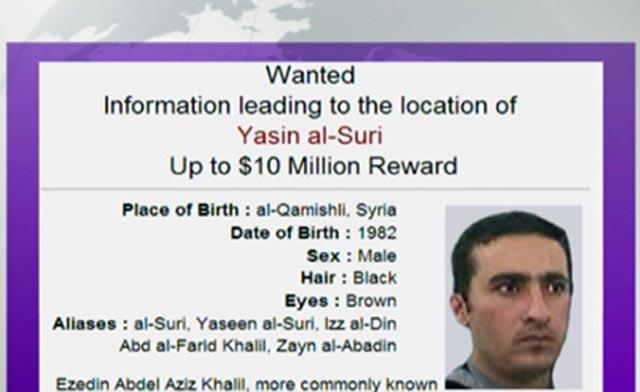
Meanwhile, the United States on Thursday offered a $10 million reward for information leading to the arrest of a key Qaeda fundraiser, who is said to be a Syrian operating from Iran.

The reward for Ezedin Abdel Aziz Khalil marks the first time that a “terrorist financier” has been targeted in such a way, said Robert Hartung, assistant director for threat investigations with the State Department.

According to U.S. officials, the man also known as Yacine al-Suri was born in Syria in 1982.

He was put on a U.S. Treasury Department blacklist in July when he was described as a high-level Qaeda “facilitator.”

The Treasury statement said then that Khalil has operated from inside Iran since 2005 “under an agreement between Qaeda and the Iranian government.”

He moves Qaeda money and recruits from across the Middle East through Iran and then to Pakistan “for the benefit of Qaeda senior leaders,” it added.

“Al-Suri is an important fundraiser for Qaeda and has collected money from donors and fundraisers throughout the Persian Gulf region,” the State Department said Thursday in a statement.

“He has funneled significant amounts of money via Iran to Qaeda’s leadership in Afghanistan and Iraq.

“Working with the Iranian government, al-Suri also arranges the release of Qaeda personnel from Iranian prisons. When Qaeda operatives are released, the Iranian government transfers them to the custody of al-Suri, who then coordinates their travel to Pakistan,” the State Department added.

“Rewards for Justice”

The $10 million was posted as part of the program “Rewards for Justice,” set up in 1984, with the aim of hunting down suspects wanted for terror acts against the United States.

Khalil is the only individual based in Iran who has been targeted under the program which according to the State Department has already handed out more than $100 million in exchange for information about wanted suspects.

However, the U.S. administration refuses to discuss the details of the information it has received or to openly identify those arrested, saying it needs to protect its informants.

Two cases have however come to light − the sons of former Iraqi dictator Saddam Hussein, Uday and Qusay, who were found in July 2003 in Mosul and killed by U.S. forces trying to arrest them.

The current head of Qaeda, Ayman al-Zawahiri, has the highest bounty on his head of $25 million.


Source

Ayatollah Boroujerdi’s Prison Cell Raided

0


HRANA News Agency – On Monday, December 19, 2011, agents sent by Iran’s Special Court of Clerics raided Ayatollah Hossein Kazemeyni Boroujerdi’s prison cell in Evin and searched through his personal belongings. This raid was coordinated and carried out with the cooperation of prison officials.

According to a report by Human Rights Activists News Agency (HRANA), security agents treated Ayatollah Boroujerdi with violence and insulted him. While calling him a spy, agents confiscated his clothing and medicine.

Since Ayatollah Boroujerdi suffers from various illnesses, the seizure of his medication will further endanger his health and life.


Source

Political prisoners: ‘Don’t give legitimacy to elections’

0


GVF — Iranians are witnessing an “undeclared martial law” in their country, according to a group of political prisoners held in the notorious Evin Prison.

In a statement published on Wednesday on Kaleme, an opposition website affiliated with Green Movement leader Mir Hossein Mousavi, the 39 political detainees said that the forthcoming parliamentary elections in March 2012 would “bear no resemblance to the elections mentioned in the country’s constitution.”

“In no place in the world is this considered to be a free and fair election [or] an indicator of national rule,” the statement added. “Today, our people are witnessing an undeclared martial law. The experience of all countries, as well as our country’s own, demonstrates that elections held under the dominance of military men and security forces, will merely constitute a rubber-stamp election whereby the fate of the [parliamentary] seats have already been pre-determined.”

On Monday, the Coordination Council of the Green Path of Hope, an influential decision-making body within the Green Movement, said in a statement that the authorities’ ongoing suppression of dissent in recent months had “left no doubt that the regime is incapable of comprehending how dire the current situation is as well as its own interests, and lacks the courage” to hold free and fair elections.

“The council … considers the forthcoming parliamentary election as illegal and unfair, and sees participation in a theatrical election as contrary to the interests of the nation and the country.”

Last week, Ali Mohammad Gharibani, president of Coordination Council of the Reformist Front, announced that the country’s pro-reform factions would not be participating in the parliamentary race in March. He said the council had “decided not to present a unified list [of candidates] and not to support anyone [in the race].”

Months earlier, former reformist President Mohammad Khatami had set conditions for the reformists to participate in the Majlis elections, including: the release of all political prisoners; free and competitive elections; and freedom for political parties and the press.

On Monday, Khatami backed the Coordination Council of the Reformist Front, saying, “My opinion is the same as the council’s, which is that the reformists cannot and must not have candidates and a unified list in the elections.”

“I don’t speak on behalf of anyone. I think that all indicators suggest that we must not take part in the elections.”

In their statement, the 39 political prisoners argued that participating in the March elections “in any form” would “only legitimise a disgraceful theatrical election and help strengthen the foundations of tyranny and authoritarianism, and goes against the democratic and anti-dictatorial ideals of the [1979] Islamic Revolution.”

The signatories to the letter, which according to Kaleme was smuggled out of Evin prison with the aid of sympathisers working there, noted that taking part in the upcoming elections would constitute a betrayal of the sacrifices made by the Iranian people and their aspiration for democracy and human rights in Iran.

The reformists’ refusal to acknowledge the legitimacy of the next Majlis elections has been met with response from Iran’s ruling elite, including former parliament speaker Gholam Ali Haddad-Adel.

A day after Khatami’s comments, Haddad Adel told the semi-official Mehr news agency, “They’re [the reformists’] participation or absence in the elections has a meaning and that should be taken into account.”

“Khatami’s recent comments show that these seditionists aren’t short of hollow claims and words, even though this group of reformists hold no position in society,” said Jafar Shajouni, a senior member of the conservative Combatant Clergy Association.

“Seditionist” (or “Fetnehgar” in Persian) is a term commonly used by Iranian authorities to refer to the opposition Green Movement formed following the rigged 2009 presidential elections.

Ali Akbar Velayati, a former Foreign Minister and current advisor to the Supreme Leader Ali Khamenei on international affairs, told state media that “all parties, and political groups and figures that seek the support of the West in the elections must be aware that this will lead to their demise.”

Some in the conservative camp accuse Iran’s pro-reform factions of being backed by the West and serving Western interests, an allegation firmly dismissed by the reformists.


Source

“Starred” student activist endures more abuse in gruesome Iranian prison


Starred student activist Zia Nabavi is illegally held in prison exile. In Iran, a starred student is banned from pursuing higher education because he or she spoke out against educational discrimination, a practice denied by Mahmoud Ahmadinejad.

On Friday, Zia Nabavi, the “starred” education advocacy activist held illegally in exile, was violently transferred along with 59 other political prisoners to another section (ward 8) of Karoun prison (in Ahvaz city) which holds people held on theft and drug-related charges.

Several months ago, Zia Nabavi had written an open letter to Mohammad Larijani, the Head of the Human Rights Council for Iran’s Judiciary, detailing the gruesome conditions in Karoun prison’s ward 1, the area reserved for political prisoners. Shortly after the publication of the letter, Zia and other political prisoners were transferred to Ahvaz Clinic, a detention center with slightly better conditions. However, sometime between July to September, Zia and numerous others were secretly transferred back to ward 1 in Karoun prison. According to the latest reports, Zia and many other political prisoners are crammed into a small space in ward 8, and the conditions are far worse- in terms of hygiene and population density- than ward 1. Additionally, 15 of the transferred political prisoners have no bed to sleep on.

Initially, the political prisoners, including Zia Nabavi, had resisted the transfer to the drug-addict ward, however, when the Iranian Special Guards forces violently invaded their cell, they were forced to move. Ward 1 is now being used to hold prisoners with tuberculosis.
The 60 political prisoners have announced that they will launch a mass indefinite hunger strike if they are not immediately transferred to a ward especially for political prisoners.

Last month when Zia Nabavi was still in Ahvaz Clinic, he wrote a letter about how the overall prison experience has changed his perspective on political concepts. In the first section of the letter, he explains how his main concern altered during imprisonment: “If my main preoccupation before my arrest and imprisonment was freedom, my largest concern inside prison is security and safety…once in prison, I found democracy valuable [only] when interpreted and defined as the “rule of law”. Throughout the different stages of my incarceration and interrogations, the most important political question I have pondered is: how can a person be bound to respect limits and boundaries, [to avoid] the infliction of harm on others?

The young education advocacy activist demonstrates how he had to replace a more complicated notion and interpretation of freedom with a more basic concept of the rule of law, once he found himself stripped of his liberty and security: “If before prison my preoccupation with complex aspects of freedom tied me to post-constructionists like Gilles Deleuze and Michel Foucault, the prison experience has made me sympathetic to John Locke and Thomas Hobbs- their main preoccupations were the law and the social contract.”
Zia Nabavi describes his conditions in Karoun prison: “At times I feel like I am living on the brink of what distinguishes a human’s life from an animal’s.”

Zia Nabavi claims that his “biggest talent in social relationships” is his ability to speak the same language as people with differing interests and tastes from him. He says: “…during my student years, I was the connecting point between people who had different, and at times opposing views.” He continues that he discovered the concept of sympathy when he was not allowed to talk or express his views during detention and interrogations. Zia believes that “when two people are involved in a conflict, they should not bring each other down to the subject of the conflict…because [a conflict] situation has the potential of exploding into violence.”

Zia Nabavi then goes on to share his take on the various political and civil activists he met in prison. He concludes with the thought: “I have developed a very critical view toward political dissidents and the opposition in the [Iranian] society…[They] are not bad people…but it does not mean that they can be considered democratic [in their conduct and their views].”
At the end of the first section of his letter Zia Nabavi offers three characteristics he believes that a democratic person must possess:

1- The ability to enter the public domain, and take responsibility to solve the common problems of [the civil society].

2- The ability to commit to critical discussion, and respect and yield to the collective wisdom in the public decision-making processes.

3- The ability to respect the privacy of individuals, and recognize and sympathize with their differences in this area.

In the second part of his letter, Zia Nabavi engages in self-criticism, and offers an analytic critique of the issues he discussed in the first part of his letter.

The full translated text of Zia Nabavi’s letter will be published shortly.


Source

Head of Iran judiciary defends widespread executions


Sadeq Larijani, the head of the Judiciary said that the international community has become a tool in the hand of America and that the Islamic Republic is not ‘afraid’ of carrying out executions.

“Execution sentences… are carried out according to the law and religion and in some case have to be in public”.

“Retribution in Iran is very rare but the law gives this right to the family of the victim and this is while in some western countries, they also accept retribution”, Sadeq Larijani claimed. (Digarban website, state-run Club of Young Reporters – Dec. 21, 201


Source

Iraq’s vice president accuses Iran of being involved in his arrest warrant

0


The Washington Times – Iraq’s vice president says that Iran is “definitely” behind Prime Minister Nouri al-Maliki’s move to jail him on terror charges, saying it is “not a coincidence” that his arrest warrant was announced the day after the last U.S. troops left Iraq.

“Definitely Iran was involved,” Tariq al-Hashemi told The Washington Times in an exclusive interview, speaking by phone late Wednesday from a Kurdish town in northern Iraq. “My dear friend, they have … staff now in the government and in the parliament. They are representing Iran.”

Mr. al-Hashemi said he has been a consistent critic of the “intervention of Iran in every respect of my country.”

“They are interfering in politics, in the economy, in social life, in education, in everything,” he said of Iran’s Shiite leadership. “They are becoming a major player in political decision-making. They are threatening our country’s sovereignty, so I was one of the major protesters against this policy.”

Mr. al-Maliki, a Shiite, issued an arrest warrant for Mr. al-Hashemi, a Sunni, on Monday, accusing the vice president of running “death squads” that assassinated Shiiite government officials during sectarian violence in 2006 and 2007.

Mr. al-Hashemi, who is staying in the autonomous Kurdish region of northern Iraq, has vehemently denied the charges, but he told The Times that he believes he could never receive a fair trial from the Iraqi judiciary.

“All Iraqis are very much aware about the nature of our judicial system,” he said. “It is not transparent, it is not neutral, it is not independent. It’s become a puppet of thegovernment and certainly al-Maliki.”

Mr. al-Hashemi said he is willing to face trial before “a neutral and more transparent and more professional, independent court, which I think is available here” in the Kurdish region.

The charges against him have threatened the fragile unity government that Mr. al-Maliki formed after the 2009 elections, which gave his State of Law bloc two fewer seats than the Sunni-dominated Iraqiya bloc to which Mr. al-Hashemi belongs.

Iraqiya, which has long complained of being sidelined in the government, has boycotted government sessions since the announcement of the arrest warrant.

The political crisis began the day after the last U.S. soldiers departed Iraq, bringing the eight-year operation to an end.

Mr. al-Hashemi said the timing is not accidental and said that it vindicated his repeated warnings to U.S. officials about leaving the country prematurely.

“We warned them that we are very much concerned about the future and you are going to leave the country with unbelievable interference from our neighbor Iran,” he said. “So what happened is not a coincidence. I’m not caught by surprise. I was expecting this.”

Officials in Iran’s Interests Section in Washington did not return phone calls seeking comment.

In Washington, Republicans have seized on the political crisis to claim that the Obama administration acted recklessly in pulling out troops.

“This crisis has been precipitated in large measure by the failure and unwillingness of the Obama administration to reach an agreement with the Iraqi government for a residual presence of U.S. forces in Iraq, thereby depriving Iraq of the stabilizing influence of the U.S. military and diminishing the ability of the United States to support Iraq,” Sens. John McCain and Lindsey Graham said in a statement Monday evening.

The U.S. had been engaged in negotiations with the Iraqi government on revising the 2008 Status of Forces Agreement to allow a few thousand troops to remain, but the talks collapsed on the U.S. demand for immunity.

President Obama welcomed Mr. al-Maliki to the White House earlier this month and hailed the “impressive progress” Iraq had made on the road to democracy.

Mr. al-Hashemi said the speech was misguided.

“Unfortunately, we are building an autocratic regime, the government is consolidating power, and our judicial system is not neutral, it’s not independent. It’s become a puppet of the government,” the Iraqi vice president said.

“Either there was an unreliable report coming from Baghdad to the White House, or Mr. Obama just overlooked all these facts on the ground in Iraq. The facts on the ground contradict his speech, so I’m really disappointed about that.”


Source

My Take: Iran must stop persecuting minority religions


CNN – In March 2009, when I was detained in Evin Prison in Iran, two evangelical Christians were arrested. I never met them but spotted them a few times through the barred window of my cell as they walked back and forth to the bathroom down the hall.

I would later learn that Maryam Rostampour and Marzieh Amirizadeh had converted from Islam to Christianity and faced charges of spreading propaganda against the Islamic Republic, insulting religious sanctities, and committing apostasy. They resisted severe pressure to renounce their faith, and in November 2009, after an international outcry, the two women went free.

News headlines are now highlighting the plight of another Iranian Christian accused of apostasy, or abandoning one’s religion. When Pastor Youcef Nadarkhani was 19, he converted from Islam to Christianity. In 2010, a provincial court sentenced him to death. This year, Iran’s Supreme Court ruled that the case should be reviewed and the sentence overturned if he recants his faith — a step Nadarkhani, 34, has so far refused to take.

Now, according to the International Campaign for Human Rights in Iran, Iran’s judiciary has ordered the verdict to be delayed, possibly for one year. But Nadarkhani’s supporters hope sustained worldwide pressure will lead to his just and immediate release.

As international criticism has mounted, an Iranian official has alleged that Nadarkhani is being prosecuted not for his faith but for crimes including rape and extortion. Nadarkhani’s attorney, however, says the only charge the pastor has faced is apostasy, and court documents support this assertion.

Although Iran’s penal code does not include a specific provision for apostasy, judges are given a fairly wide degree of latitude to issue rulings based on their own interpretation of Islamic law. In the past this has led to punishments ranging from imprisonment to death. The last person officially executed in Iran for apostasy was Hossein Soodmand, a Pentecostal minister who converted from Islam before Iran’s 1979 Islamic Revolution and was hanged in 1990.

Iranian officials often say their country’s recognized religious minorities (Christians, Jews, and adherents of the ancient Persian religion of Zoroastrianism) enjoy freedoms equal to their Muslim counterparts. Iran’s constitution gives these three religious minorities certain rights, such as five seats in the 290-member parliament and the freedom to perform their religious rituals.

The constitution’s articles, however, are all set within the boundaries of Islam, and Islamic codes grant superior legal status to male Muslims.

Many non-Shiites in Iran have also complained of limits on education, work, and exercising their faith. Critics accuse the Islamic regime of having monitored, harassed, abducted, detained, tortured, and killed citizens based upon their religion. Since 1999, the U.S. State Department has designated Iran a “country of particular concern” because of religious repression. The State Department has focused on the treatment of Sufi and Sunni Muslims, Protestant evangelical Christians, Jews, Shiites who don’t share the government’s official views, and Baha’is, whose faith is not recognized by Iran’s regime.

Christian leaders in Iran have usually blunted their criticism of the regime, in part to avoid tensions. When I attended Christmas Eve Mass in Iran four years ago, I saw a few dozen worshipers, but I also heard that they had to get government permission to hold the service and were not allowed to proselytize. They had a Christian school, but it had to have a Muslim principal. They could print Christian texts but only with the authorities’ approval.

A number of Iranian Christians who recently left Iran have told me that since the country’s 2009 disputed presidential election, pressure on their communities has intensified, prompting many more Christians to emigrate. In April, the U.S. Commission on International Religious Freedom reported a rise in Iranian authorities raiding church services and harassing worshipers.

Evangelicals and other Protestants have been particularly targeted. Unlike Iran’s traditionally recognized Christian minorities, such as Armenians, Assyrians, and Chaldeans, evangelical churches hold their services in the Farsi language. Iranian authorities accuse them of spreading Christian writings in Farsi to convert Muslims.

“They are tough on us because we educate others,” a former pastor of an underground evangelical church in Iran told me on condition of anonymity. “They call it proselytizing, but we don’t proselytize. We discuss the realities that Jesus Christ talks about in the Bible, and we never speak about the Islamic Republic.”

Shortly after their release from prison, Maryam and Marzieh, the two Christian converts detained down the corridor from me, left Iran. If they stayed, they may have shared the tragic fate of the Rev. Mehdi Dibaj.

Dibaj, a Christian convert from Islam, was jailed for a decade and released in 1994 after international appeals. Soon afterward, he went missing. The authorities reported the discovery of his corpse in a wooded area west of Tehran. Iran’s government blamed an anti-regime group for the murder.

If the Iranian regime wants to tout religious freedom, it should respect its citizens’ right to decide one of life’s most personal choices: their spiritual path. A regime that claims to observe human rights and base its actions on the peaceful nature of Islam should also explain how peace would be attained by executing a man whose only crime is his faith.

By releasing Youcef Nadarkhani before Christmas, Tehran would take an important step toward respect for human rights and would give his wife and children an unforgettable gift.

by Roxana Saberi


Source

U.S. sets bounty for Iran-based al-Qaeda financier

0


The United States Thursday announced it was establishing a reward of up to $10 million for information leading to Yasin al-Suri, who it accused of operating from Iran as a facilitator and financier for al-Qaeda.

The bounty is the first offered for an al-Qaeda financier and is aimed at disrupting a financial network that has operated from within Iran’s borders since 2005, said Eytan Fisch, a senior Treasury Department official.

Robert Hartung, a senior State Department official, said that under an agreement between al Qaeda and the government of Iran, al-Suri had helped move money and recruits through Iran to al-Qaeda leaders in neighboring countries.

Hartung said al-Suri, who is originally from Syria, also was known as Ezedin Abdel Aziz Khalil.

The U.S. Treasury Department in July blacklisted al-Suri and five other members of his network, exposing what the United States says are direct links between Tehran and the al Qaeda network.

Hartung said al-Suri’s network serves as an important conduit for channeling both money and fighters from around the Middle East to al-Qaeda leaders in Afghanistan, Pakistan and Iraq.

“He is a dedicated terrorist working in support of al-Qaeda with the support of the government of Iran,” Hartung said. “As a key fundraiser for the al-Qaeda terrorist network, he is a continuing danger to the interests of the United States.”

Since 1984 the U.S. Rewards for Justice program has paid more than $100 million to more than 70 people who provided credible information that either prevented terrorist attacks or helped bring accused terrorists to justice, the State Department’s Hartung said.