Home Blog Page 522

Unidentified People are Taken to the Gallows

0


Kaveh Ghoreishi

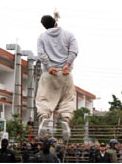
The death sentences of 11 individuals labeled “drug smugglers” by officials of the Islamic Republic of Iran were executed en-masse on Thursday at Shiraz’s Adelabad prison after the sentences were approved by the attorney general and the head of the country’s judiciary. At least 20 other individuals have been executed in prisons around the country on similar charges in the last month.

These executions come just a few days after the Third Committee of the UN General Assembly on Social, Humanitarian Cultural Affairs passed a resolution over Iran’s human rights record. The resolution strongly criticizes the Islamic Republic of Iran for practicing flogging, amputation, and a dramatic increase in executions.

On average, there were two executions per day during 2011 in Iran, which makes it the country with the highest number of executions per capita after China.

14 Executions in Four Days

According to a report by the News Center of the Islamic Republic of Iran (Vahed Markazi Khabar) the death sentences of 11 individuals were passed in the revolutionary courts of Shiraz, Abadeh, Darab and Neyriz and were executed on the orders of the public prosecutor and revolutionary prosecutor of Shiraz in the city’s Adelabad prison. The report did not mention any details of the accusations against the individuals or provide the names of those executed.

This is not the first time that such executions have taken place. In recent years many individuals have been executed on charges of being “drug smugglers” while no names or any details about them were provided, something that has been strongly protested and criticized by human rights activists.

According to Islamic law in Iran, persons sentenced on charges of drug smugglers, armed robbers and renouncing Islam are punishable by death.

According to the News Center, security and law enforcement forces in the province of Fars annually round up about 60 tons of smuggled drugs which come into the country through Afghanistan. Just three days before the execution of the eleven individuals, three other individuals were hanged on similar charges in the central prison of Sari.

According to ISNA student news agency which quoted the public and revolutionary prosecutor of Sari, “These individuals were involved in the distribution of drugs despite having been arrested repeatedly and being imprisoned.”

The identity of these individuals too has not been publicly released.

According to Amnesty International, Iran with a population of 70 million has the highest number of executions after China. Many organizations, governments and political-social personalities in recent years have expressed their concern about the rise in the number of executions in Iran. Iran’s officials persistently deny these criticisms and contend that Islamic law is being implemented in the country.


Source

Khamenei Supports the Military’s Political Activities in Politics

0


Mahshid Boroomand

As much criticism for the involvement of the Revolutionary Guards (IRGC) and the Basij para-military forces in political affairs has been going around in Iran in recent years and critics call such interference to be contrary to the constitution and contradicting the guidance of the founder of the Islamic Republic ayatollah Khomeini, the country’s current leader ayatollah Khamenei through recent remarks approved the interference of the military in politics by calling the Basij a “political” entity.

Speaking at a ceremony to mark the week that commemorates the Basij force, which operates under the IRGC, ayatollah Khamenei said, “Basij is a people’s movement that includes people from all sectors of society, the heart of the nation and it is created for the nation. It is present in all activities of defense, science, the arts, construction, politics, culture, assistance to the deprived, production, technology, sports, international accomplishments, and in any good work.” He made these remarks to senior military commanders and Basij leaders present at a commemoration gathering.

Ayatollah Khamenei listed the qualities of the Basij in these words. “The Basij is political but not politicized or partisan; it is crusading but not without discipline or extremism; it is deeply religious and committed but not dogmatic and rigid; it is insightful but not arrogant; it supports attracting the majority but is brave and does not compromise on principles; it supports science but is not mesmerized by it; it has Islamic ethics but this is not a front; it is active in developing the world but it is not material.”

This approval of Basij’s involvement in politics and political issues by ayatollah Khamenei comes at a time when two military institutions in the country, namely the IRGC and the Basij both of which operate directly under his direction, have been accused of not only taking sides in political issues but also supporting specific groups operating under the rubric of Principlists in the recent presidential and parliamentary elections.

In a 2005 letter to ayatollah Khamenei, Green Movement leader Mehdi Karoubi complained about the interference of Khamenei’s son, the IRGC and the Basij and warned about straying from the course of the revolution. Ayatollah Hashemi Rafsanjani, the current head of the powerful State Expediency Council, who was also a presidential candidate in 2009, also has aired similar criticism against the undue interference of military institutions such as the IRGC and the Basij in elections. He had also asked state officials to investigate the complaint made by Karoubi.

In the course of the controversial 2009 presidential elections, a prominent pro-reform candidate Mir-Hossein Mousavi who is also another Green Movement leader along with Karoubi, both of whom have been under house arrest for 10 months now, wrote two letters to ayatollah Khamenei complaining about the interference of members of the IRGC and the Basij in the electoral process.

Other senior leaders of the Islamic revolution too have made similar complaints about the overstepping of the IRGC and the Basij and have referenced ayatollah Khomeini’s guidance against the military’s participation in politics. The founder of the Islamic regime had on a number of occasions, including his political will, expressly stressed that the armed forces should stay away from parties, groups, factions etc and that they should not get involved with them and what he called “political games.”

The constitution of the Islamic Republic also expressly bans the armed forces from getting involved in political issues and has even outlined criminal penalties for the armed forces for such transgressions. It even specifically names the IRGC and the Basij.

It should be noted that in recent months differences among the Principlists, some of whom support Mahmoud Ahmadinejad, have been growing and are now regular fodder for the domestic media. Today, a group of IRGC and Basij commanders appointed by ayatollah Khamenei have broken ranks with some Principlists and reject Ahmadinejad and his allies completely and label them to be outside the revolutionary circle.

The head of the armed forces command recently even said that the “deviant current – a label attributed to Ahmadinejad and his allies implying that they have deviated from the true revolutionary course – is an ally of the Americans as are the seditionists – a label the regime uses for the reform movement lead by the Green Movement – and that people must exercise vigilance towards them and the events around the country.

In a recent remark the commander of the Basij force Mohammad-Reza Naghdi, the Basij also said, “The Basij shall play a guiding role in the upcoming elections so that people can make the better choices.” In another speech in September he said that the upcoming Majlis elections were a challenge for the regime and that the Basij would play a “supportive role in the ballot boxes.”


Source

“Because I Complained I Was Arrested Again,” Says Payman Aref


Almost a month after the arrest of student activist Payman Aref, his wife told the International Campaign for Human Rights in Iran that authorities are not providing any causes for his arrest and her attempts to find out about his case have been futile.

On 30 October 2011, Aref was arrested long with two other political activists while he was visiting Neda Agha Soltan’s grave to read the Fatiha prayer, an Iranian mourning tradition. They were transferred to Ward 350 of Evin Prison the next day. Aref is currently in prison for “propagating against the regime.”

“There is no one being held accountable. While the Tehran Prosecutor says his case file was referred to the Revolutionary Court, the Court says it never arrived.” Samira Jamshidi, Aref’s wife, told the Campaign. “Payman is currently in Ward 350 of Evin Prison, and we really don’t know what to do so he can be freed.”

On 9 October 2011, was released from Evin prison after completing his one-year sentence. His sentence included receiving 74 lashes on the charge of insulting the President, which authorities of Branch 26 of the Revolutionary COurt executed just before his release. Right after his release, Aref openly criticized the way in which the flogging sentence was carried out, and filed a complaint against Evin Prison Court employees.

Jamshidi also told the Campaign that Payman’s lawyer still hasn’t seen the case file but from what they can tell his charge is speaking out about his flogging sentence. “Payman himself said he only complained about getting flogged by official and unofficial Evin Prison Court authorities and didn’t propagate against the regime. Because he complained he was arrested again.”

Describing her husband’s situation, Jamshidi told the Campaign that since his arrest, she has only spoken to Aref twice and only for a few minutes, but couldn’t visit him in person. “Well, either way this situation is quite illegal and a way of seeking personal revenge. He seems unhappy and angry. The first time we spoke he said that the bail price was set at $20,000 (20 million toman) and was awaiting his release. But the second time we spoke when I told him that Evin Prison Court doesn’t have his case file yet Payman was disappointed.”


Source

Student Activist Denied Prison Leave to Take Exam


Reza Tabarzadi, father of imprisoned human rights activist and student Abdolfazl Tabarzadi, told the International Campaign for Human Rights in Iran that the Ahvaz Prosecutor denied his son permission to leave prison for a few hours last Wednesday to take a graduate admission test.

“I hope they eventually agree to a few hours’ prison leave for my son; all he wants to do is take the test,” Tabarzadi’s father told the Campaign. “I have been pursuing permission for this for a while, but so far I have only heard negative replies. He is not a criminal.”

On 19 December 2010, security forces arrested Abolfazl Tabarzadi, a 24-year-old civil engineering student. A lower court in Ahvaz sentenced him to 15 months in prison, and an appeals court reduced his sentence to nine months. On 18 October, he was transferred to Karoon Prison in Ahvaz to begin serving his sentence.

Reza Tabarzadi also told the Campaign that his son has lost a lot of weight in prison. “Naturally, it is very hard when an engineer, a merit student with a 150 IQ, has to go to prison, and to Karoon Prison of Ahvaz at that. But really, why should Abolfazl be in prison? What sin has he committed? He was just a human rights activist, he was just trying to get furlough and visitation rights and such for his uncle, Heshmatollah Tabarzadi, who is inside Rajaee Shahr Prison in Karaj.”

During his interrogation, officials asked Tabarzadi to overstate his relationship with his uncle Heshamtollah Tabarzadi, an imprisoned activist and former Secretary General of the Iran Democratic Front. Reza Tabarzadi added:

“Everyone has an opinion. ‘I am a Mousavi supporter, I love Mousavi and Karroubi,’ my son told the court. He loves his uncle, too. These are not foreigners, they are people from our own country. Mousavi was Prime Minister during the war, and Karroubi a cleric who led public prayers. Now, if a young person loves them, he must go to prison. Instead of using the power of his youth and encouraging him, he is forced to serve time at a prison like Karoon in Ahvaz, where he is wilting.”


Source

No News on the Condition of Jailed Blogger Rojin Mohammadi

0


HRANA News Agency – Although one week has passed since Rojin Mohammadi was arrested upon arriving in Iran, nothing is known about her current condition. Rojin Mohammadi is a blogger and medical student at the University of Manila (UM) in Philippines.

It has been reported that Rojin Mohammadi is currently being held in solitary confinement in Ward 2A of Evin Prison. This ward is under the control of Army of the Guardians of the Islamic Revolution (IRGC). Thus far, Rojin Mohammadi has been denied access to an attorney and also phone calls or visits with her family.

Iranian judicial and security officials refuse to disclose to her family where in Evin Prison Rojin Mohammadi is being held. Other reports indicate that the prosecutor at the 3rd branch of Evin Court has charged Rojin Mohammadi with conspiracy against national security and propaganda against the regime by the means of human rights activism.

Nine days ago, on November 14, 2011, Rojin Mohammadi flew from Istanbul to Tehran. Upon arriving at Imam Khomeini Airport, she was arrested by Iranian security agents and taken to Evin Prison. She was then released on bail after being detained for 24 hours. Five days later, on November 19, 2011, security agents raided her father’s house in Kermanshah in order to arrest her again. However, since she was not home at the time of the raid, the police failed to take her into custody.

On November 21, 2011, Rojin Mohammadi was summoned by phone to Shahid Moghadasi Court in Evin Prison, and her personal belongings including a computer were confiscated. She was interrogated for 3 consecutive days and finally arrested again on November 23, 2011 and locked up behind bars in Evin Prison.


Source

Iran: explosion in Isfahan reported

0


Widely conflicting reports emerge of apparent explosion in the north-east of Isfahan near where nuclear facilities are located.

Conflicting reports have emerged from Iran over an explosion heard in the central city of Isfahan, close to the country’s sensitive nuclear facilities.

Iran’s semi-official Isna news agency quoted a judiciary official in Isfahan, saying that an explosion had been heard.

“We heard a sound similar to that of an explosion but we have received no reports about its causes and the consequences so far,” said Gholamreza Ansari, in quotes carried by Isna. He said the explosion did not appear to be of any significance.

Iran’s semi-official Fars news agency was one of the first media organisations to report the explosion, saying it was heard at 2.40pm local time (1110 GMT). Fars quoted the deputy governor, Mehdi Ismaili, as confirming a sound that the news agency reported was loud enough to be heard across the city. The agency, however, removed the article from its website sometime later.

Ismaili then spoke to another semi-official agency, Mehr, denying his quotes as reported by Fars. “I have heard no sound whatsoever in Isfahan,” he said. Ismaili also told the Irna state news agency that he had not spoken to Fars in the first place.

Several residents of Isfahan told the Guardian that they had heard a loud blast. One said that it rattled the windows of their home.

Isfahan is home to Iran’s uranium conversion facility (UCF), which operates under IAEA surveillance. Iran’s main uranium enrichment facilities are situated in the city of Natanz to the north-east of Isfahan, where many of the country’s centrifuges are installed. In recent years, Iran’s nuclear activities at Natanz have been at the centre of an international dispute.

Earlier this month, a huge explosion at a missile base in the west of Tehran killed more than 30 members of Iran’s revolutionary guards, including Major General Hassan Tehrani Moghaddam, a senior commander described as the architect of the country’s missile programme.

In recent years, Iran’s nuclear and missile programmes have experienced a series of setbacks in what has been widely seen as a covert war against the Islamic republic.


Source

Iranian security forces welcome hackers’ skills

0


The Iranian task force for IT crimes has announced that police will enlist the aid of computer hackers.

Colonel Toraj Kazemi, the deputy head of the IT crimes task force, told ISNA that it has divided hackers into three groups: “white hats, pink hats and black hats.”

The hackers who illegally enter computer systems to damage or steal something are the black hats. Those who hack into systems to show off are referred to as pink hats, and those who do it to determine the weaknesses of security systems for marketing purposes are referred to as white hats, according to Kazemi.

He said the so-called pink and white hats are not considered criminals, adding that police welcome hackers to share their skills and add to police expertise in the field of cyber information. He added that 50 percent of Iranian hackers are under 25 years of age.

Iran has become a major player in the shadowy cyber world by hacking into opposition websites, penetrating government and private information networks and blocking user access to the web.

The Iranian Cyber Army is a well-known team of hackers widely linked to Iran’s Revolutionary Guards Corps.

U.S. intelligence reports say the Cyber Army has a budget of $76 million, with 2,400 employees and 12,000 reservists.

The Iranian Cyber Army has hacked into a number of American and Chinese websites as well as a number so-called Green Movement news websites, and the Radio Zamaneh website was compromised in February of 2010.

This past September, the Iranian Cyber Army hacked into information on 500 Dutch websites. In the wake of that incident, Iranian media reported that Iranian hackers had attacked “the internet portal of Mossad, the CIA and Israel.”

Explosion at the IRGC Base: Espionage and Anti-Espionage

0


Written by: Hossein Alizadeh

Introduction:

The recent explosion at the IRGC base in Bidgeneh, in the southwest of the capital, Tehran,  was so massive that it not only left over a dozen dead IRGC members, but it also rocked the neighboring residential areas. The explosion was massive from another angle, should we take into account the rumors spread by the media regarding the lingering espionage and anti-espionage warfare against the Revolutionary Guard.  It has to be confessed, however, that such espionage and anti-espionage warfare has been and is going to remain to the disadvantage of the Revolutionary Guard.

Though no foreign power so far has claimed responsibility for the explosion at the IRGC base, and although the Revolutionary Guard has vehemently denied the involvement of foreign powers in the explosion, a cursory review of the incident reveals very important information about the event, about which conflicting reports have been made so far, even about the true number of the casualties. The number of dead was said to be 27 in the earlier official reports. It was then changed to 17 and later to 32.

Hypothetical Probabilities:

There are only two possibilities for such a massive explosion to occur at the IRGC base. It was either a foreign- sponsored plot (US or Israel) or an accident, as claimed by the Revolutionary guard’s officials, which naturally happens in the military garrisons.

The Revolutionary Guard has vehemently ruled out possibility of foreign involvement in the blast and described the event as natural. To substantiate its claim, the Revolutionary Guard has said that the explosion occurred during transportation of explosive munitions at the IRGC depot. If it s really so, then the question is what was the necessity of having on site Brigadier-General Hasan Tehrani-Moghaddam, who is widely believed to be the mastermind of the Islamic Republic missile program? Why is the number of casualties so high? And why did Iran’s Supreme Leader, Ali Khamenei, personally take part in the funeral procession?

It might be said that Khamenei took part in the funeral procession because he wanted to honor someone who has promoted Iran’s ballistic strength to the extent that its ballistic missiles can now go far beyond Israel’s boundaries and reach Europe. Although it seems to be a valid argument.

The Brigadier General Tehrani-Moghaddam’s presence on the spot provides a very important clue on why the explosion took place at the IRGC base. What was the necessity for such a high ranking commander of the Revolutionary Guard to be present on the spot during the transportation of explosive munitions?

Doesn’t it confirm the speculation about the involvement of foreign powers in the assassinationof Hasan Tehrani-Moghaddam and strike on Iran’s ballistic capabilities?

Statements made by Mohammad Tehrani-Moghaddam, brother of Hasan Tehrani-Moghaddam, who is also a commander of the Revolutionary Guard, can provide revealing insights into the incident. In an interview with the state-run newspaper, Iran, Mohammad Tehrani -Moghaddam linked his brother’s presence at the base to the primary test of intercontinental ballistic missiles.

Though he later retracted what he had said, and although Iran newspaper omitted the report, neither his denial nor the Iran newspaper deletion can do anything to conceal the realities on the ground.

Ali Khamenei’s presence at the funeral procession was indeed an honor paid to the Revolutionary Guard’s intercontinental ballistic missile program. In the same interview, Mohammad Tehrani-Moghaddam said that his brother was the architect of Hezbollah’s missile program and had had made few trips to Lebanon.

Therefore it is likely that a foreign power has been involved in assassination of Hasan Tehrani –Moghaddam. Given the revolutionary guard’s inability to take retaliatory measures and conduct preemptive strikes against the perpetrators of the blast at the military base, the Revolutionary Guard willingly and knowingly denied foreign involvement in the incident. Had Iran  put the blame on foreign powers for the blast as it did so when Iranian nuclear scientists were assassinated,  the Revolutionary Guard would have to take retaliatory measures against them  which itself could have amounted to an all-out war which the Revolutionary Guard is not ready to carry out. After all, the Revolutionary Guard has no more than a limited defensive capability, and it does not at all see in itself the very capability to carry out a preemptive strike against the perpetrators of the blast at the IRGC base. Therefore, the best option for the Revolutionary Guard was to deny the role and involvement of the foreign powers in the incident, so that it could first keep its intercontinental ballistic missile program secret, and second not to trigger a confrontation with foreign powers.

Let’s not forget that one of the Revolutionary Guard’s commanders, Brigadier General Abbas-Khani, has clearly said that Hassan Tehrani-Moghaddam has been always target of foreign agents. Nonetheless, death of the architect of the Revolutionary Guard’s missile program, however natural as it has been  claimed by the Revolutionary Guard’s official sources, does show nothing but the extent  of the Revolutionary Guard’ s inefficiency  in conducting such program.  It shows that the security measure in the Revolutionary Guard’s missile program is so easily breakable that a massive explosion at the IRGC base can leave such high number of casualties and claim the life of the father of the Revolutionary Guard missile program.

Whatever the reason behind the explosion, be a foreign plot or not, the Revolutionary Guard is not competent enough to conduct such program. Should it be proven that the explosion was a foreign-sponsored plot, it shows that the Revolutionary Guard is weak in anti-espionage activities, and should it be considered as natural incident, the Revolutionary Guard lacks necessary competency to provide security for the architect of its missile program.

It seems that the Revolutionary Guard prefers to opt for the second option.

Iranian reformist groups barred from elections

0


Radio Zamaneh – The head of Iran’s Elections Headquarters has emphasized once again that two disbanded reformist organizations, the Islamic Iran Participation Front and the Mojahedin of the Islamic Revolution, will not be allowed to run candidates in the coming parliamentary elections.

ISNA reports that Solat Mortazavi, the head of Elections Headquarters, told a workshop for provincial elections officials that Ayatollah Khamenei has warned officials to ensure that the “enemy” does not turn the elections into a challenge.

Mortazavi added that these elections are pivotal, and widespread participation is especially vital.

He said reformists are not barred from the elections so long as the Guardian Council deems them eligible.

In past years, the reformists have repeatedly accused the Guardian Council of disqualifying candidates whose political views don’t match those of the establishment.

Mortazavi stressed that disbanded organizations such as the Participation Front and the Mujahedin of the Islamic Revolution are excluded from the elections.

The two reformist organizations were dissolved during the crackdown on protesters after the 2009 presidential election, when reformists and millions of protesters alleged the vote was rigged in favour of Mahmoud Ahmadinejad. The two parties were dissolved, and many of its members were arrested and given stiff prison sentences.

The two reformist candidates endorsed by these groups, MirHosein Mousavi and Mehdi Karroubi, have been under house arrest since last February. They have both indicated that in view of the government crackdown on the opposition and the harsh treatment of political prisoners, they have no faith in elections coming up in March, which has led reformists to consider boycotting them.


Source

U.S. Treasury to brief UAE and Israel on Iran pressure

0


The U.S. Treasury will send its top national security official to the United Arab Emirates and Israel this weekend to brief government officials on new U.S. actions to increase financial pressure on Iran.

The Treasury said David Cohen, undersecretary for terrorism and financial intelligence, will discuss the Obama administration’s decision to declare Iran a jurisdiction of “primary money laundering concern” during the Nov. 26-29 trip.

He also will discuss expanded sanctions to ban firms from aiding Iran’s oil and petrochemical industries.

The actions were announced on Monday as part of a coordinated effort with Britain and Canada to increase pressure on Tehran in response to a Nov. 8 International Atomic Energy Agency report that presented intelligence suggesting that Iran had worked on designing a nuclear bomb and may still be secretly carrying out related research.

The U.S. decision to declare Iran as an area of “primary money laundering concern” under the USA Patriot Act is a step designed to dissuade non-U.S. banks from dealing with Iran. It stopped short of blacklisting Iran’s central bank, but brands Iran’s banking sector as posing unacceptable risks of terrorist financing, weapons proliferation and money laundering.

“Our action, along with those taken by the U.K and Canada, should have a chilling effect on the willingness of foreign financial institutions to do business with Iranian banking institutions, ” Cohen said in a blog posting on the U.S. Treasury website.

“Foreign banks in jurisdictions where there may not be comprehensive sanctions on Iran are now much more likely to make the judgment that Iran is an increasingly risky place to do business, ” he added.

The United Arab Emirates, with its financial hubs in Dubai and Abu Dhabi, is one of the Middle East’s largest banking centers and has traditionally had deep trade, business and financial ties with Iran, just across the Arabian Gulf.

Previous U.S. sanctions, which effectively prohibit international firms from doing business with blacklisted Iranian institutions for fear of losing access to the U.S. financial system, have caused difficulties for UAE companies.

Treasury officials have made frequent trips to Dubai and Abu Dhabi in recent years to persuade officials and institutions to comply with U.S. sanctions and help stop Iran’s efforts to circumvent them.

In Israel, Prime Minister Benjamin Netanyahu on Wednesday called for “even tougher” sanctions than those announced by the United States, Britain and Canada. He did not elaborate on what steps should be taken.

The U.S. Treasury said Cohen also will consult with senior UAE and Israeli officials on options that the United States is exploring to boost pressure further on Iran, including possible financial measures targeting Iran’s central bank.

Cohen also will discuss efforts by Syria to circumvent U.S. and European Union sanctions aimed at halting government violence against Syrian people.


Source