Home Blog Page 552

Bahai’s educators’ lawyer arrested

0


As a number of Baha’is in Iran await trial for providing higher education to youth barred from university, the Baha’i International Community has been distressed to learn of the arrest of a lawyer who was preparing to defend them, reports the Baha’i World News Service.

Abdolfattah Soltani, a senior member of the legal team representing the prisoners, was arrested last weekend. Soltani was a co-founder of the Defenders of Human Rights Centre along with four other lawyers including Nobel Peace Prize Laureate Shirin Ebadi. The Tehran-based centre was shut down in a police raid in December 2008.

Seven Baha’is are still in prison in connection with their involvement in an informal educational programme in which Baha’i professors, debarred by the Iranian government from practicing their professions, voluntarily offer their services to teach young community members who are banned from higher education.


Source

Environmentalist Farshad Maroufi Vanished

0


HRANA News Agency – After Iranian Intelligence Agency in the city of Naghadeh summoned Farshad Maroufi several days ago, the environmentalist has vanished, and his whereabouts are unknown.

According to a report by Kurdistan Press Agency (KURDPA), Farshad Maroufi was summoned by the Intelligence Agency a few days ago. Since then, there has been no news of him. During recent demonstrations to protest against Lake Urmia drying up, he was present and active in the city of Naghadeh, West Azerbaijan Province.Farshad Maroufi is a Kurdish citizen and a member of the Society of Environmentalists, Hatva, in the city of Naghadeh.

Despite repeated inquires made by Farshad Maroufi’s family, the officials at the Intelligence Agency in the city of Naghadeh have announced to know nothing about the subject. As a result, his family’s concerns and worries have increased.


Source

Majid Dari: “Students Stand Tall Against Tyrants!”

0


HRANA News Agency – Majid Dari is an imprisoned student activist expelled from Allameh Tabatabai University (ATU) in Tehran.He studied literature at ATU and was a member of the Advocacy Council for the Right to Education. In July of 2009, Majid Dari was arrested by Iranian Intelligence Agency and locked up in Evin Prison.

Following a trial and an appeal, Majid Dari was sentenced to 6 years in prison and exiled to Khuzestan Province. In August 2010, without prior notice, prison officials placed Majid Dari in shackles and transferred him to a prison in the city of Behbahan. Since then, he has been serving his prison term in exile.

Majid Dari has written the following statement from Behbahan Prison on the occasion of the new school year in Iran:

Rain, pour in torrents
Pour and shed my falling rotten leaves
Pour till I fall into a fruitful slumber
to the gloomy melody of rain
— Mohammad Shams Langeroodi

It is difficult to talk about September, school and its reopening and hard to dig up school memories. It is naïve to talk about the resistance in universities and what effects they’ve had. It is equally gullible to mention all the scathing criticisms and trashing aimed towards universities and to remember the never-ending hollers towards the occupiers.

All of these are already known by everyone. We know that universities didn’t tolerate oppression and rejected injustice even under the most difficult circumstance. We know that universities gave blood to irrigate the tree of liberty and boasted of sacrifices made while proudly passing the baton to the fresh blood coming through the gates to repeat the cycle…

There was a time when we screamed not to concede an inch for the day would come when they could dictate what we were allowed to utter, read and wear. Although we stood alone, at the end, we prevented universities from becoming monolithic institutes devoid of diversity and stopped the second Cultural Revolution from taking place.

To our utter dismay, the tale has reportedly taken another turn without our knowledge. September begins again while these tragedies take place together all at once. Even worse, university students go along with the prevailing tide, submit to it and accept it. And the depths of the disaster widen. Thereafter, permissible thoughts are dictated and allowable beliefs are announced while the so-called brave students with their silent screams bend and capitulate.

When the time for talking, bragging and showing off had ended, and it was time for action, the on-going resistance was considered foolish. To those of us still standing, they said, “We haven’t backed off; our tactics have changed.” Thus, this change in tactics effectively buried the next generation under a pile of compromise and brought about a disaster unprecedented in the history of universities and their students.

Now, where are those who must answer? Where are those who must compare the weight of their raves and rants against their actions or at least express some remorse? Are they still adamant that their change in tactics has been effective and blame us for what has conspired?

I wanted to hail the university, but given the fact that universities have their own distinguishing characteristics, I won’t because this place resembles a high school more. I wanted to hail all college students, but these individuals liken to junior schoolchildren.

Therefore, begging your pardon, I must say, “Hey, I am talking to you! Hey, you, the ones I recognize not.I am happy for not being by your side now or during the past four years. I am pleased with not shaming myself to attend college in such a place. I am delighted for having been expelled but not humiliated in this manner. I am overjoyed with the thought of being alone instead of having friends such as you, the ones I know not.”

College students possess and universities hold within themselves certain reverence and sanctity such that they bow to no one, accept no humiliation and stand tall against tyrants. They fear not but challenge and defeat the enemy. They offer their lives while standing erect. They offer blood and remain steadfast.They dedicate their lives to bring about growth and change. To those who know who college students and what universities are, if this tree dries up and dies, we are all responsible. Yes, all of us.

College students! Universities! I miss you all, and my heart aches for you. Therefore, this time too, swallowing the knot in my throat, I shout once more:

Hail Majid Tavakoli! Hail Mahdieh Golro! Hail Zia Nabavi! Hail Abdollah Momeni! Greetings to Bahareh Hedayat!

Majid Dari
Expelled Student of Allameh


Source

Official Presence of Leader in All Affairs

0


Roozonline – While there has been some chatter questioning the need to have a presidential position in Iran’s political system ever since ayatollah Khamenei’s differences with Mahmoud Ahmadinejad went public about five months ago, resulting in splits among Principlists (politicians who proclaim to follow the ideals of the 1979 revolution and its founder ayatollah Khomeini) in some political quarters of Iran, a Principlist Majlis representative formally raised this issue in parliament two days ago.

Hamid-Reza Katouzian, the head of the parliament’s energy committee said in this regard, “Recently a theory has been advanced by political theorists that since our country enjoys the benefits of the velayate faghih(rule by a supreme cleric) and the leader of the revolution, there is in fact no need for a president in the country.”

Katouzian, who was a member of Majlis’ fact-finding committee on the massacre of Tehran University dormitory a few years ago and had then disclosed the exertion of pressure by some circles to not publish the findings of the committee said that this idea of replacing the presidency would be discussed in the Majlis.

Katouzian said that this idea was “currently under debate by members of parliament who have a greater political clout.” Speaking favorably on the subject, he added, “If representatives have greater supervisory authority on this arrangement then the idea will without doubt have a positive impact on the country.”

In May this year, news leaked that some of ayatollah Khamenei’s appointees and supporters, particularly military and security ones, had launched the idea that there was no need for the presidency in the country and that the supreme leader had the ability to manage the country through the forces under his command.

According to these reports, these individuals had argued that “In more than 20 years of leadership, the supreme leader had trusted all social groups, but one wanted to be president for life, the other wanted to create a dual administration, and if the seditionists had come to power they would have liked to change the supreme leader, and this last one to whom we ourselves voted and trusted also took the same path as the earlier ones.”

It is ironic that the talk of re-instating the office of the prime minister comes at a time when the last prime minister of Iran, Mir-Hossein Mousavi has been under house arrest since the beginning of the year. It should be recalled that after the death of ayatollah Khomeini in 1989 the constitution of the Islamic Republic of Iran was amended to remove the office of the prime minister. In the original constitution of the Islamic Republic, the prime minister was the head of the cabinet and the chief executive while the president played merely a supervisory role over the prime-minister and cabinet ministers.

The issue that seems to be mostly paid attention by Majlis representatives today on this subject is article 135 of the original constitution which provided that the prime minister would remain in office so long as he enjoyed the confidence of the Majlis, that the prime minister submitted his resignation to the president. Article 134 of that charter outlined that it was the president who introduced a person for the position of prime minister to the Majlis for its vote. So if Katouzian’s proposal is officially discussed in the Majlis, one of the key issues that will be discussed is whether the candidate for the prime minister will be proposed by the supreme leader to the Majlis, or initiated by the Majlis itself.

In a published article in Sobh Sadegh journal (belonging to the Revolutionary Guards (IRGC), the head of IRGC’s political bureau Yadollah Javani had argued that velayate faghih had the legitimacy and authority to intervene in all affairs of the state, indicating the kind of thinking that was going on in the IRGC and possibly other leadership circles.

On this note, it should be pointed out that as one of the leaders of Iran’s Green movement Mir-Hossein Mousavi had warned in communiqué number 5 that the premature announcement of the results of the 2009 presidential election were an indication of not just the imposition of an unwanted government on people, but also of a “new way of political life.” In a subsequent statement, Mousavi also said that the regime had one of two ways ahead of itself: to become democratic or to become more totalitarian. He also warned that opting for the second possibility would result in the total destruction of the regime.


Source

Hamidreza Moradi Sarvestani and Farshad Maroufi Held Incommunicado


Hamidreza Moradi Sarvestani is suffering from heart problems and his family is extremely concerned about his condition since he is in need of medical attention.

He was arrested on September 4th and endured physical and psychological pressure in order to confess to the false charge of membership in anti-regime groups.

He is one of the Gonabadi dervishes who was arrested along with several others for administering the Majzoobaneh-Nour website which publishes reliable reports on human rights violations.

Farshad Maroufi is an environmental activist in Naghdeh who has disappeared and there are no reports on his condition.

He had been summoned by the Intelligence Ministry several days ago and there have been no reports on his condition since then. It is speculated that he has been detained.

He had participated in the Lake Uromiyeh drying out protests.

He had been summoned to the Intelligence Ministry before. The authorities have stated that they are not informed of his whereabouts which has worried his family.


Source

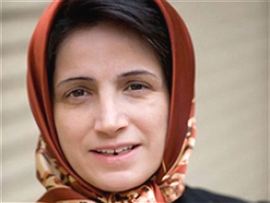
Nasrin Sotoudeh’s Disbarment Court Session Cancelled

0


In an interview with the International Campaign for Human Rights in Iran, Reza Khandan, Nasrin Sotoudeh’s husband, said that the second court session reviewing her disbarment was cancelled. “My wife’s second court session at the Tehran Bar Association was scheduled for Sunday, 18 September, but she was not transferred from prison to court, and the the court session was not held, naturally. Of course the prison authorities had previously informed the court officials that Ms. Sotoudeh would not be brought to court today, but I don’t know why. They just told me that the prison authorities have announced that Ms. Sotoudeh would not be transferred to the court session,” he said.

Following the inappropriate conduct of prison officers during Sotoudeh’s last visit with her family six weeks ago, Nasrin Sotoudeh stopped appearing at her weekly visitations to protest their mistreatment. Khandan told the Campaign that she had a short visit with her family this week. “Ms. Sotoudeh’s court session at the Bar Association was scheduled for this Sunday, which coincided with the Evin Prison visitation day. That’s why when we realized that she would not be brought to court, we went to Evin Prison quickly to see whether we could see her in the remaining visitation time. First they said she did not wish to come, but when she found out that the kids were with us and we had been to the court, she came and we were able to see her for 15 minutes after six weeks,” said Khandan. He also that in the six weeks since he last saw her, she had lost a lot of weight.

Reza Khandan told the Campaign that one of Sotoudeh’s lawyers has been arrested and another has left the country., “Unfortunately, Mr. [Abdolfattah] Soltani, the lawyer, was arrested a few days ago, and this is why we unaware of the status of Ms. Sotoudeh’s case. Ms. Parakand, her other lawyer, was under pressure and she chose to leave the country a while ago. Of course Ms. Sotoudeh has other lawyers, too, but since her case was forwarded to the Revolutionary Court, only Mr. Soltani and Ms. Parakand, and most recently only Mr. Soltani, knew about the case’s progress,” Khandan added.


Source

Baluchi Teenager Exiled & Sentenced to 5 Years in Prison

0


HRANA News Agency – Mohammad Saber Malek Raisi has been sentenced to 5 years in prison by the Revolutionary Court in Zahedan, Sistan and Baluchestan Province. He is a Baluchi teenager arrested by Iranian Intelligence Agency in order to force his oldest brother to return to Iran. Abdol Rahman, Mohammad’s brother, fled the country in 2009 fearing for his life after he refused to be the Intelligence Agency’s spy amongst Sunni scholars and Baluchi tribes.

According to a report by Human Rights Activists News Agency (HRANA), Mohammad Saber Malek Raisi was arrested when he was 17 years old and has been in prison for over a year in the Intelligence Agency’s detention center and the central prison in Zahedan. The Revolutionary Court has sentenced him to 5 years in prison. He must serve this prison term in exile.

One of Mohammad Saber Malek Raisi’s brothers has reported that Mohammad must spend 5 years in Ardabil Prison away from his family and their residence. The city of Ardabil is in northwestern Iran in Ardabil Province while Zahedan is a city in the south east part of the country. Because of the long distance between two locations, Mohammad will be practically denied visits from his family at the age of eighteen.

During the past year, Mohammad Saber Malek Raisi has also been denied the right to attend school. His only crime is being related to his brother who is outside the country. Iranian Intelligence Agency has threatened Mohammad’s family multiple times with executing him if his oldest brother doesn’t return to Iran.

Mohammad Saber Malek Raisi is one the youngest prisoners arrested for political reasons by the Islamic Republic of Iran.


Source

Security forces kill 5 Kurd tradesmen in 10 days

0


The wave of killings of Kurd carriers and tradesmen by security forces has increased in the past few days to the extent that only in the 10 past days, five Kurd carriers were killed after being directly targeted by security forces or after being chased by security forces under the suspicion of carrying smuggled goods…
On Sunday September 12, security forces chased the car of a man from Mahabad identified as Saman Kak Elahi under the suspicion that he was carrying smuggled goods. As a result, his car turned over and he passed away.
On Sunday, September 12, security forces in Marivan opened fire on a number of carriers killing a young man identified as Hamdi Khosh Namak, son of Mohammad Amin.
On the morning of September 17, security forces in Sardasht targeted a number of carriers and tradesmen killing a man identified as Shirzad Amani.
On the afternoon of Sunday, September 18, security forces in Sardasht targeted a number of cars killing a 27 year old man identified as Avat Yusefi who died on the spot. Eyewitnesses said he was not carrying any smuggled goods in his car and security forces murdered him for no reason.
On Wednesday, September 21, security forces opened fire on a number of tradesmen which led to the death of Ahmad Mam Rostam who was from Sardasht.
Local eyewitnesses have said that this person was not carrying any smuggled goods and the lack of judicial prosecution of security forces has led them to easily gun down Kurd border residents. (Human Rights Activists in Iran – Sep. 21, 2011)


Source

Social media gives women a voice in Iran

0


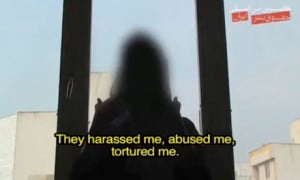
InsideofIran: Female protesters were beaten, raped and intimidated in a post-election crackdown by the Iranian authorities. Silenced by stigma and fear, these women are now using social media to bear witness to the horror

A young woman is speaking to the camera, her face obscured to prevent her being identified. Her voice heavy with emotion, and hands gesturing, she describes the rape and torture she endured at the hands of her guards while imprisoned during the post-election crackdown in Iran. “Death was my first wish,” she says after recounting the physical and sexual assaults that began when she was picked up on her way home from university and thrown into a van. “I wanted it to be over. I wanted to die.

” Bruised from her beatings, she was taken to a detention centre where her interrogator told her, before he raped her: “I will do something you will never forget. I’ll make it so you never want to leave your house again, so any time you hear my name, you will tremble.” The young student was ordered to copy a “confession”, which said she was a “rioter” and a terrorist who had endangered national security. “I didn’t even have nail clippers in my purse for them to say I had anything remotely sharp or dangerous,” the woman retorts. “All I had done was give one vote and that was to Mousavi. A vote that was never counted.”

The 22-year-old filming her statement is one of 300 women known to have been arrested in Iran since the disputed election of June 2009, when supporters of Mir Hossein Mousavi took to the streets in protest against the re-election of President Mahmoud Ahmadinejad. Some cases, such as that of film-maker Mahnaz Mohammadi and Maryam Majd, a photojournalist, have been criticised, but most, like that of the young student, are unlikely to attract international attention. “No one came to look for me. No one knew when they were raping me, or when they were burning me with cigarettes,” she says.

Few post-election detainees have spoken about about their experiences because they fear not only being re-arrested, but also the stigma of rape that exists in Iran. But social media is one way of bearing witness. The student’s 100-minute testimony is the most detailed account of the treatment of prisoners in Iran since the crackdown began, says Hadi Ghaemi, executive director of the New York based International Campaign for Human Rights in Iran. A 28-minute segment of it has had more than 75,000 views and has been shared widely on social networks including Facebook and Twitter. It has opened up discussion about abuse, torture and rape of ordinary protesters, says Ghaemi, and fuelled his campaign to get the UN to hold Ahmadinejad to account for human rights abuses ahead of his appearance before the assembly in New York.

“The regime has capitalised on not only the fear of retribution but also the social and cultural attitudes towards rape,” explains Ghaemi. “Two years after the post-election crackdown, the Iranian regime is intent on erasing any memory and documentation of the widespread violence it unleashed against protesters. This young woman’s testimony is a brave act of defiance against this trend.”

But the student is part of a younger generation of women who are more willing to challenge traditional attitudes about their position in society, says journalist and women’s rights activist Parvin Ardalan. “Rape is something that is very difficult to talk about because of the attitude that exists, not only in Iran, that victims are to blame for what happens to them,” she says. “But attitudes are slowly changing and women are starting to talk more. By going in front of a camera [the student] has challenged traditional thinking that if something happens to you, then you don’t say anything.

“Social media gave the young woman a voice, enabling her to speak out about her experience and encourage other women on the margins to follow her example, but the power of social media on its own is not enough,” says Ardalan. “We still have to challenge the fact that when people hear what happens to her they are less likely to believe her because she is a woman, or that she might still be blamed for what happened to her.”

While victim-blaming is a problem women face around the globe, the consequences for women who speak out about rape can be deadly. Rana Husseini, a Jordan-based journalist whose book Murder in the Name of Honour is an investigation of so-called “honour killings” around the world, says: “Some women who are victims of rape could face extreme punishments that could lead to death not only because of the negative societal view of women who are raped, but because of the fact that they have lost their virginity in the process.” The stigma has been such a barrier to women reporting rape in Libya that women’s rights activists have said it is unlikely that the true extent of sexual violence against women will ever be known. The risks women face were illustrated dramatically when Iman al-Obeidi went to a Tripoli hotel in March this year and told foreign journalists there that she had been gang-raped by Muammar Gaddafi’s troops. She was later denounced as a “whore” by the state TV presenter Hala Misrati who claimed a decent family would not spread news about their daughter’s rape. “With time they may even kill the girl herself,” she concluded.

In Sudan, however, one woman has come forward to claim that she was kidnapped, assaulted and gang-raped by members of Sudan’s National Intelligence and Security Services. Safiya Eshaq, a 25-year-old member of an anti-government youth group Grififna posted a video on YouTube earlier this year describing how she was attacked by secret intelligence police during protests in Khartoum. The fact that she did was brave enough – to do so with her face uncovered caught the attention of Sudan’s media, which reported her claims. But Eshaq has since been forced to flee Khartoum and so far two journalists have been imprisoned and others are awaiting trial after they were accused of publishing Eshaq’s “lies”.

In Egypt, where the power of social media was harnessed so effectively in the revolution, women are using video, blogs, Twitter and Facebook both to hold the authorities to account and to challenge attitudes that keep women silent about rape and sexual harassment. The fact that women prisoners were subjected to torture and “virginity tests” when they were arrested in Tahrir Square in March came to light because women such as Salwa-Al-Housiny Gouda were prepared to make statements in public meetings that were posted on YouTube. This determination to bring issues to light is behind Harassmap, a project that utilises open-source mapping technology to allow women to report incidents of sexual harassment by sending a text message. “It enables women to share their feelings anonymously but it also helps highlight the problem more, to bring it into the media spotlight and make the issue heard,” says Harassmap co-founder Engy Ghozan.

In partnership with Nazra, an organisation for feminist studies, Harassmap recently took part in a day of blogging and tweeting about sexual harassment, joining activists in Syria, Sudan and Lebanon. Both women and men took part, writing hundreds of blog posts in Arabic and English discussing the issue, commenting on a Facebook page and sending messages on Twitter using the hashtag #endSH in their tweet.

Prominent activist Manal Hassan wrote: “The worst thing abt sexual harrasment is it’s always looming over u.. it’s not abt something happening, it’s the constant fear of it.

” While the day of blogging helped raise awareness about the issue, some of the comments on Twitter suggesting that women are to blame and even encourage sexual harassment reveal the challenges ahead. “Perceptions need to change and we need to see an end to victim-blaming,” says Ghozan. “The whole of society needs to start to take responsibility for the problem.”


Source

U.S. says won’t ignore Iran-backed attacks in Iraq

0


Reuters – The United States will not “sit idly by” while its forces are harmed by Iranian-backed militias in Iraq, the top U.S. military officer, Admiral Mike Mullen, said on Thursday.

Mullen and U.S. Defense Secretary Leon Panetta told a Senate committee that while such attacks by groups linked to Iran had declined since the summer, the United States would not ignore it the attacks recurred.

“They (the Iranians) have been warned about continuing it … that if they keep killing our troops, that will not be something we will sit idly by and watch,” Mullen told the Senate Armed Services Committee.

“Iran needs to understand that we’re going to be around awhile here, making very clear to them that we’re not — we’re not simply going to ignore what Iran is doing in — in Iraq,” Panetta said.

Fourteen U.S. services members were killed in hostile incidents in Iraq in June. Most of the deaths were attributed by U.S. officials to rocket attacks by Shi’ite militias armed by Iran.

Mullen and Panetta said that the attacks stopped after a combination of military and diplomatic engagement with Tehran by Baghdad.

But they suggested the potential for such attacks remained. Mullen said Iran has shipped weapons to Shi’ite militias operating in Iraq, including roadside bombs called EFPs (explosively formed projectiles) and rocket-propelled munitions known as IRAMs (improvised rocket-assisted munitions).

“They’re shipping EFPs and IRAMs. And the IRAMs are getting bigger and bigger. And so, there is a great downside potential for destabilizing particularly southern Iraq, that actually I think Prime Minister Malaki and the Iraqi leadership is concerned about,” Mullen said.

The U.S. military is scheduled to fully withdraw its remaining troops — numbering about 40,000 — from Iraq by December 31, although Iraqi politicians are trying to decide whether to ask Washington to leave some troops beyond 2011 to continue to train their army and police forces.

Mullen said the Obama administration would consult with Congress about the matter once it had a decision from Baghdad. “But we’re — honestly, we’re just not there yet. We’d be having, from my perspective, circular conversations about this, because we just don’t know what’s going on in Baghdad,” he said.


Source