Home Blog Page 601

Report of systematic prison abuse in Iran

June 29, 2011

According to reports, prisoner Hassan Hosseinpour is in critical condition after 45 days in a solitary cell in the notorious Cellblock 1 in Gohardasht Prison in Karaj.
This 30 year old prisoner was attacked by a prison gang on orders of prison officials for protesting the inhumane and intolerable prison conditions. He was attacked with a sharp object on his head, both hands and back. Hosseibpour was severely wounded and suffered a broken head.
He was taken to the infirmary and received stiches but was thrown in a solitary cell in cellblock 1 before he was completely healed.
Hosseinpour requested to be taken to the infirmary after a few days of severe pain in the solitary cell but prison guards took him to the torture chamber under the kitchen in Hall 3, Cellblock 1 instead. This room does not have a security camera like other cells. He was severely beaten with batons to the extent that all of his wounds reopened and he started bleeding again. He has now been in a solitary cell for more than 45 days and his wounds have become infected. He is in critical condition.
This prisoner was arrested in 2006 and was initially detained in the Shahpour Detention Center. He has been sentenced to death and 21 years of prison. He was denied the right to a lawyer in court. (Human Rights and Democracy Activists in Iran – Jun. 27, 2011)

Source

Germany ‘outraged’ about arrested Iranian reporter

June 29, 2011

The Associated Press

BERLIN (AP) — The German government says it is “outraged” about the arrest of an Iranian female sports journalist a day before she planned to leave her home country to attend the women’s World Cup in Germany.

The government’s top official for human rights says Maryam Majd’s arrest is “a further, sad example of intimidation and persecution of women’s rights activists by the Iranian regime.”

Markus Loening demanded on Wednesday the immediate release of Majd and all other detained women’s rights activists in Iran.

Loening says Majd, who is officially accredited to cover the World Cup, was arrested by Iranian security officers the night before her trip.

Iran has no team playing in the tournament, which runs until July 17.


Source

A Plot to Prevent Farshid Fathi’s Release

0

WEDNESDAY, 29 JUNE 2011

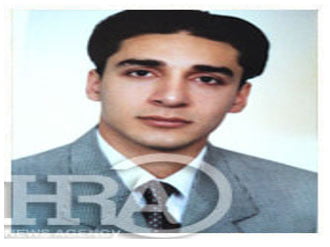
HRANA News Agency – Farshid Fathi Malayer, a Christian convert, still remains in prison despite posting the designated bail.

According to a report by Human Rights Activists News Agency (HRANA), after 183 days of temporary incarceration, Farshid Fathi Malayer is still locked up in Ward 209 in Evin Prison, and uncertainty surrounds his future.

Mr. Nasseri who is one of the interrogators working for branch 6 of the prosecutor’s office in Evin Prison has refused to release Farshid Fathi Malayer and has denied him the right to retain an attorney.

The Revolutionary Court has set bail in the amount approximately equivalent to $190,000.00 but hasn’t clearly charged Farshid Fathi Malayer with any crime.

Farshid Fathi Malayer is a 32 year old man who has a seven year old daughter and two sons aged two and five. He was arrested last Christmas together with a large number of other Christians in Tehran.


Source

14 students sentenced for Tehran University dorm attacks

Wed, 06/29/2011

Fines, floggings and prison terms are among the punishments meted out to 14 Iranian university students for events that occurred two years ago at the Tehran University dormitory.

Daneshjoo news reports that the students have received sentences that range from three to 10 months in jail, fines of various amounts and floggings.

On the evening of June 15, 2009, three days after Mahmoud Ahmadinejad’s disputed election victory which triggered mass protests, Iranian security forces and plainclothes officials attacked the university dorm, according to the opposition’s account. Hundreds of students were arrested and injured in the attack, and student new outlets report that five students were killed.

Last year, Persian BBC aired a film documenting the attack on the students.

Islamic Republic authorities have not acknowledged the role that security forces played in the attack and they deny anyone was killed.

So far, opposition demands for prosecution of the attackers have gone unheeded. However, in May, prosecutor Gholamhossein Mohseni Ejei said 40 to 50 people had been sentenced to jail terms, fines and payment of damages for their involvement in the Tehran University dorm incident.


Source


Jailed Iranian Journalist’s Health ‘Deteriorating’

June 28, 2011

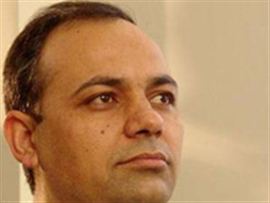
The wife of jailed Iranian journalist Ahmad Zeidabadi says his health is deteriorating and he has lost a great deal of weight, RFE/RL’s Radio Farda reports.

Mahdieh Mohammadi told Radio Farda on June 27 that Zeidabadi has lost about 10 kilos in the past month and may be seriously ill, but is not allowed to leave the prison for medical tests.

Mohammadi said she last visited her husband on June 23. She said she is worried he may have contracted a disease from other prisoners with whom he has been kept for a long time.

Zeidabadi was taken into custody in June 2009, one day after the disputed Iranian presidential election. He was sentenced to six years’ imprisonment and five years’ internal exile, and banned for life from political and civic activity.

Mohammadi said Zeidabadi has not been granted furlough “even for an hour” since his arrest two years ago.

She added that she has called the prison warden’s office and infirmary, and has written a letter to the prosecutor demanding that Zeidabadi either be taken to hospital or allowed to leave prison for treatment, but to no avail.

The winner of the 2011 UNESCO/Guillermo Cano World Press Freedom Prize, Zeidabadi is a board member of the Association of Iranian Journalists. He also heads Iran’s largest pro-reform student organization, the Iranian Alumni Association.

Zeidabadi is a former professor of political science and editor in chief of the newspaper “Azad.” He also contributed to other media, including the daily “Hamshahari,” the BBC Persian Service, and the Rooz website.


Source

End of hunger strike does not mean end of protest against human rights abuse

28 , June , 2011

Twelve political prisoners on hunger strike in ward 350 of Evin prison said in a statement that they are ending their hunger strike and added, “In response to the kind and loving messages we have received from the aforementioned, while expressing our respect and thanks, we announce that we ended our hunger strike on the evening of Sunday June 26th, 2011. Without a doubt, this will not be the end of civil protests against the human rights violations and injustices that have occurred and the protests of the Green nation of Iran will continue until we have achieved freedom and access to our full rights as individuals and as a society at large.”

In their statement they thanked the Saber and Sahabi families along with the great Ayatollahs and religious, political and national figures, political parties and groups, human rights activists and organizations, media outlets, journalists, doctors and lawyers. They added, “we give our thanks with utmost gratitude to our friends who sent us their kind messages of support, demonstrating their concern for our health and well being and requesting that we put an end to our hunger strike.”

Following is the full statement as obtained by Kalame website:

In the name of God,

To the honorable nation of Iran,

The regret and sorrow over the unexpected and surprising death of Hoda Saber was a heavy and unbearable burden for his prison mates. A hunger strike was the bare minimum act of protest towards this disastrous occurrence; something that Hoda Saber himself engaged in after the innocent martyrdom of Haleh Sahabi.

As Hoda Saber’s prison mates, the hunger strike was on the one hand a calling by our conscience and a means to fulfill our moral obligations and on the other hand our outcry and rage against the injustice towards Hoda Saber and Hale Sahabi, two responsible, Muslim citizens who were killed while upholding their ideals and aspirations.

Our hunger strike was a collective act of protest against the institutionalization of injudiciousness, lies and hypocrisy in segments of the ruling government.

We 12 political prisoners at Evin’s ward 350 announced the launch of a hunger strike on Saturday June 18th, 2011 with the hope that our cry of protest would reach the outside world, becoming an obstacle against a government intent on violating the rights of its citizens.

During the time we were on hunger strike, many of our prison mates at Evin’s ward 350 expressed their willingness to join the hunger strike; many skipped meals and fasted and in their own way demonstrated their solidarity with those of us on hunger strike. We would like to express our unwavering gratitude to our dear prison mates for their support and encouragement that further confirmed the legitimacy of our actions.

The behavior by the authorities and the fact that we were summoned to the judiciary during our hunger strike only further demonstrates the clear lack of responsibility, accountability and of course the inefficiency and weakness of our judicial system. The recent events were once again a means to test and demonstrate that the life of a prisoner is of little to no importance to the judicial and security officials.

Our dear compatriots,

This hunger strike also demonstrated the vast support from the nation of Iran and our civil society. This support was just as important as the hunger strike itself and demonstrates that the Green movement of the nation of Iran is alive and dynamic.

The wave of support and solidarity with this hunger strike showed the public consciousness and disagreement with the violation of the rights of political prisoners. It also proved that the challenges associated with the rights of political prisoners and their freedom continue to be one of the priorities and demands of our nation.

We would express our thanks and gratitude to all those who supported us during this hunger strike, particularly the families of Saber and Sahabi, the great Ayatollahs and religious, political and national figures, political parties and groups, human rights activists and organizations, media outlets, journalists, doctors and lawyers who sent us their kind messages of support, demonstrating their concern for our health and well being and requesting that we put an end to our hunger strike.

We are also forever grateful to our dear friends at Rajai Shahr prison for joining us on this hunger strike and would like to express our thanks to our suffering families and all our compatriots outside the country who patiently stood along side us showing their unwavering support.

In response to the kind and loving messages we have received from the aforementioned, while expressing our respect and thanks, we announce that we ended our hunger strike on the evening of Sunday June 26th, 2011. Without a doubt, this will not be the end of civil protests against the human rights violations and injustices that have occurred and the protests of the Green nation of Iran will continue until we have achieved freedom and access to our full rights as individuals and as a society at large.

(Our gratitude to Emadeddin Baghi and Mohammad Javad Mozafar who participated in the initial days of the hunger strike and were replaced with other prison mates when they were released from prison)

Signatories:

Bahman Ahmadi Amoui

Hassan Asadi Zeidabadi

Mohsen Aminzadeh

Emad Bahavar

Ghorban Behzadiyan Nejad

Mohammad Davari

Khosro Dalirsani

Feyzollah Arabsorkhi

Abolfazl Ghadyani

Mehdi Karimiyan Eghbal

Mohammad Reza Moghiseh

Abdollah Momeni


Source

Opposition: Iran tries to hamper democracy in Syria

0

June 28, 2011

Iran directly affects and interferes in the present events in Syria.

It supports the power of Syrian President Bashar al-Assad, thus impeding the Syrian people to build democracy in the country, head of a Syrian opposition delegation Ridwan Ziyade said.
“Iran stands against any democratic reforms in Syria,” the expert told Trend over phone from Washington.

The expert is also the head of the Syrian Center for Political and Strategic Studies.

He stressed that Iran helps the Syrian authorities to suppress demonstrations to maintain al-Assad’s power that serves the interests of Iran.
“Iran provides logistical and political support for the Syrian President,” the expert said.
The expert added that any intervention in the events in Syria to maintain al-Assad’s regime will be doomed to failure, because the Syrian people will oppose this intervention.

Commenting on a series of reforms undertaken by President al-Assad, the expert said that they are unconvincing and unfounded and do not meet the real requirements of people.
“The reforms, held by the Syrian authorities, are aimed at gaining time and staying in power,” he said.

The expert said that the talks between the opposition and the Syrian authorities are impossible. They will not give any result, as al-Assad’s power is illegitimate and there is no reason to negotiate.
“The negotiations and reforms could be effective at the beginning of the demonstrations,” he said. “It is too late to talk about any negotiations now.”

Syria is already covered by the fourth month of mass protests, which began in mid-March in Dera’a, and then spread to other parts of the country. Syrian human rights activists report that in clashes with security forces killed about 1,300 people.

The riots in Syria began in the southern city of Dera’a in mid-March.
Then they spread to other regions. Syrian human rights activists report that more than 1,100 people were killed in clashes with security forces. According to official data, more than 340 military and security forces were killed when the events of the actions of
“armed terrorist elements” began.


Source

A number of IRGC commanders resign to participate in “elections”

0

June 28, 2011

A number of IRGC high ranking officers and commanders are to resign their posts to form a united front against ‘progressive fundamentalists’ in collaboration with Ghalibaf, Haft-e Sobh, a daily newspaper close to Mashaei, reported on June 26.

Haft-e Sobh’s political service correspondent reported that after removal of IRGC commander Mojtaba Zolnour –which was presented as retirement– commanders “Hossein H.” and “Akbar B.” are to resign their posts to be considered as the number-2 and number-3 men on the military list.

Commander “H.” does not have a good relationship with conservatives close to Shariatmadari and tries to remedy his political shortcomings by getting closer to the “Ghalibaf-Rezaii-Larijani” circle. Tehran’s municipality [run by former one of IRGC commander Ghalibaf] is planned to provide the necessary support for the military list, and in return for delivering majlis [or regime’s parliament] elections, will receive support for the Presidential elections, Haft-e Sobh reported.


Source

‘Iranian prisons holding 8 times maximum capacity,’ says official

06/28/2011

GVF — Prisons in Iran are currently overcrowded as much as eight times their maximum capacity, according to a report by the reformist Shargh daily.

Describing the poor prison conditions in the country, the newspaper said that in some cases, some 800 inmates were being held a single prison whose maximum capacity was 100 detainees.

“The country’s prisons can hold up to 55,000 inmates, but there are currently more than 220,000 prisoners,” says Iran’s head of Prisons Organisation. Less than three months ago, Gholamhossein Esmaili announced that since he took over as the country’s prison chief a year and a half ago, the number of prisoners in the country had risen by 55,000.

Citing a member of the Iranian parliament’s judicial commission, the newspaper said the condition of some of the prison complexes made them “inoperative,” raising the vulnerability to diseases under poor hygienic condition.

“At the moment, the number of prisoners is four times the capacity, and in some places, the number of inmates is as much as eight times bigger. This means that in a prison that can hold up to a hundred detainees, 800 are being held. This is something we can see in smaller cities,” Yousefian told Shargh.

While acknowledging the need for more prison space, he asked “with the changing laws on a global scale, is there really a need for so many prisoners?”

According to Shargh, on 30 April, Younes Mousavi, another member of the judicial commission of the parliament, voiced similar concerns regarding overcrowded prisons, claiming that some prisoners were forced to sleep in prison corridors due to a lack of space.


Source

Health fears for Iranian political prisoners on hunger strike

0

June 28, 2011

Haleh Sahabi, a prominent Iranian activist and rights campaigner, whose death at the funeral of her father, Ezzatollah Sahabi, has prompted a hunger strike by political prisoners. Photograph: AP

Human rights activists have raised concerns about the health of almost 20 Iranian political prisoners who have been on hunger strike for more than a week.

A group of prisoners arrested in the aftermath of Iran‘s 2009 post-election unrest are refusing to eat, and some have stopped drinking water, in protest at the death of two of their fellow inmates, Hoda Saber and Haleh Sahabi.

Saber, 52, a leading journalist, died two weeks ago of a heart attack after 10 days on hunger strike in jail and Sahabi, 54, a women rights activist, died on 1 June during scuffles with security forces at the funeral of her father, Ezatollah Sahabi, a veteran activist. Saber was on hunger strike in protest at the death of Sahabi.

The hunger strikers – who include around 12 prisoners in Tehran’s notorious Evin prison and at least six prisoners in Rajaee Shahr prison in Karaj, a city 12 miles west of the capital – believe that the Iranian authorities were responsible for the death of Saber and Sahabi.

Kaleme.com, the website of opposition leader Mir Hossein Mousavi, reported on Monday that 12 prisoners had ended their hunger strike after families of political activists and senior figures, including former reformist president Mohammad Khatami, urged them to do so. Others are believed to be continuing their protest and at least five are reported to have been transferred to prison hospitals.

Last week 64 prisoners from the same block where Saber was being held wrote a letter in which they testified that the journalist was severely beaten while on hunger strike on the night before his death.

Activists are worried about the domino effect the deaths of hunger strikers might have. Protesters say they are deprived of their basic rights such as access to their lawyers, family visits, a fair trial or temporary leave after two years in jail.

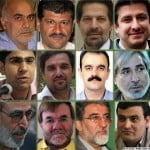
Mohsen Aminzadeh, a former deputy foreign minister, Bahman Ahmadi Amouee, a prominent journalist, Abdollah Momeni, a student leader and Keyvan Samimi, a human rights activist, were among the prisoners who began the hunger strike to highlight ongoing human rights violations in Iran.

Some of them were also among the signatories of an earlier letter complaining about the increasing use of sexual assault in Iran’s prison.

The International Campaign for Human Rights in Iran, a US-based non-government organisation, which recently published a report on the situation of political prisoners in the country, has warned Iranian authorities over the fate of hunger strikers.

“Iranian prisons are a death trap for prisoners of conscience,” said Aaron Rhodes, a spokesman for the campaign. “Officials must change the culture of unchecked impunity in Iranian prisons and give all prisoners the protections they are promised under international law.”

Seventeen political prisoners have died while in custody in Iranian prisons since 2003, according to the group.


Source