Home Blog Page 617

Warning for pro-Iranian liberation by “International Organisation to Preserve Human Rights in Iran”

SUNDAY, 05 JUNE 2011

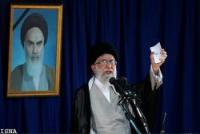
Insideofiran – The International Organisation to Preserve Human Rights in Iran, issues the following statement in response to Ali Khamenais’ announcement at commemoration for Ayatollah Khomeini, on Saturday 4th June 2011 .

Ali Khamenei, speaking on 4th of June 2011 requested for a compromise with the reformist.

Khamenei speech; “Ayatollah Khomaini acknowledged that even he could make mistakes, and by saying this he would like to declare and accept his mistakes’’. Khamenei continued: “we cannot destroy or exclude those who have different ideology or political views to us, but are faithful to the Velayat-e Faqhi and supreme leader, if we do so this would be deviating from Ayatollah Khomaini path’’

Thus from the above statement of Ayatollah Khamenei, we can gather ‘so called reformist groups’ inside and outside of Iran are gradually succeeding in winning over Khamenai’s approval regarding their involvement in Iranian government again, especially in the lead up to the parliamentary election. Khamenei hopes that by confessing to his mistakes he can reactivate his collapsed lobbies and stop international sanctions.

However, the democratic movement of Iranian’ continues to be magnificent, deep and stable against the dictatorship regime of Iran.

Therefore the increased turbulence of the financial crises and the illegitimacy of the regime, due to the extreme lack of human rights and the killing of innocent Iranian citizens, especially in the past two years, are not simple issues that can just be brushed off and healed by bringing the reformists into power or confessing the mistakes that have been made.

The International Organisation to Preserve Human Rights in Iran


Saturday 4th June 2011


Berlin, Toronto, Washington


Branch of New York – Oslo


Source

Internet should remain as open as possible – UN expert on freedom of expression

June 05, 2011

GENEVA (3 June 2011) – UN Special Rapporteur on freedom of expression Frank La Rue warned Friday that fearful Governments are increasingly restricting the flow of information on the Internet due to its potential to mobilize people to challenge the status quo.

“In recent months, we have seen a growing movement of people around the world who are advocating for change – for justice, equality, accountability of the powerful and better respect for human rights,” Mr. La Rue said while presenting his new report* on the right to freedom of opinion and expression on the Internet to the UN Human Rights Council.

“However, the unique features of the Internet, which allow individuals to spread information instantly, to organize themselves, and to inform the world about situations of injustice and inequality, have also created fear among Governments and the powerful,” the expert said.

In his report, Mr. La Rue explores key trends and challenges to the right of all individuals to exercise their right to freedom of expression, as guaranteed in article 19 of the International Covenant on Civil and Political Rights.

While noting that the Internet is a relatively new communication medium, the expert stressed the applicability of the international human rights framework when assessing whether Governments are unduly restricting the flow of information online.

“Legitimate expression continues to be criminalized in many States, illustrated by the fact that in 2010, more than 100 bloggers were imprisoned,” the Special Rapporteur warned. “Governments are using increasingly sophisticated technologies to block content, and to monitor and identify activists and critics.”

“There should be as little restriction as possible to the flow of information via the Internet, except in a few, very exceptional, and limited circumstances prescribed by international human rights law,” Mr. La Rue stressed.

“Essentially, this means that any restriction must be clearly provided by law, and proven to be necessary and the least intrusive means available for the purpose of protecting the rights of others,” added La Rue.

The Special Rapporteur also called upon Governments to develop a concrete and effective plan of action to make the Internet widely available, accessible and affordable to all segments of the population.

Frank La Rue (Guatemala) was appointed as Special Rapporteur on the promotion and protection of the right to freedom of opinion and expression in August 2008 by the United Nations Human Rights Council. As Special Rapporteur, he is independent from any government or organization and serves in his individual capacity.


Source

Haleh Sahabi was murdered, doctor says

June 5, 2011

A female political activist who was recently killed in Iran while attending her father’s funeral died as a result of a ruptured spleen, according to a doctor familiar with her injuries.

The doctor, who examined the body of Haleh Sahabi at the hospital she was transferred to, said, “Haleh Sahabi was murdered and did not die of natural causes.”

The doctor rejected the Iranian regime’s claims that she died of a “heart attack” and added, “She probably died as a result of ruptured spleen and internal bleeding.”

If she was taken to a hospital and operated on earlier, her life would have been saved, the doctor said.

The Iranian regime’s agents refused to take the body to the coroner to determine the exact cause of death and forced her family to bury the body immediately on the night of the killing.

Ms. Sahabi died earlier this week after she was reportedly beaten by Iranian regime security forces at her father’s funeral.

A number of eyewitnesses, including her uncle, have said that the regime’s forces violently attacked her and struck her in the chest and her sides, after which she fell down unconscious.


Source

Elections of 2009 was only an excuse, the goal was to overthrow the regime

0

June 5, 2011

Government-run Fars News Agency reported on June 3rd that Shariatmadari, the Spiritual Leader’s representative in Keyhan daily said: “The story of 2009 crisis has long roots and the presidential elections was just an excuse, because the plotters’ move was pre-organized and their goal was to overthrow the regime.”

Shariatmadari added: “Today, the enemies’ main arrows are pointed at the Spiritual Leader who is the focus of power, and we must have vision and be alert in facing our enemies’ conspiracy.”

In similar statements, Javad Larijani, Khamenei’s apologist said: “In the 2009 crisis, they were on surface concerned with the presidential elections, but in reality, they were against the regime itself and tried to overthrow…our regime


Source

Elderly mother of political prisoner dies after hearing situation of her son

June 5, 2011

The mother of a political prisoner in Iran has died immediately after hearing that her imprisoned son is in bad physical shape during a hunger strike.

According to Hrana news agency, Rasoul Bodaqi, a political prisoner at the Gohardasht prison, had launched a hunger strike in protest to ill treatment of political prisoners. He lost consciousness during the strike. When his mother heard the news, she had a heart attack and died.

Several other political prisoners had also launched a hunger strike and the Iranian regime’s forces in prison refuse to give tm even water and tea. Mr. Bodaqi, a teacher and member of the governing board of the Iran Teachers Association, lost consciousness after he was dehydrated and transferred to the prison clinic.

His elderly mother heard the news and when Iranian regime agents refused to allow her to meet her son, she had a heart attack and died several hours later in hospital.


Source

Iran’s Supreme Leader backs Ahmadinejad

0

Sun, 06/05/2011

Iran’s Supreme Leader has called for unity among Islamic Republic supporters, which is being interpreted as an implicit show of support for embattled President Mahmoud Ahmadinejad.

In a speech marking 22 years since the death of the system’s founder, Ayatollah Khomeini, the Supreme Leader said: “If there are criminal charges against a movement, then officials are obliged to legally confront it.” Ayatollah Khamenei continued: “However, if someone is not seeking to topple the regime or carry out the bidding of our enemies, but disagrees with our political tastes and views, we must not deprive them of justice and security or crush them under our feet.”

After the 2009 presidential election, millions of people supported opposition candidates MirHosein Mousavi and Mehdi Karroubi in their challenge of Mahmoud Ahmadinejad’s victory and protested against alleged vote fraud.

The government used extreme violence to crush the protests, which resulted in dozens of deaths and the widespread incarceration of reformists and protesters.

Even though Mousavi and Karroubi have been under house arrest since February for rallying protesters for an Arab solidarity march, Ayatollah Khamenei insisted that election protests have died down.

However, in an implicit show of support for Ahmadinejad, Ayatollah Khamenei insisted that attacks against “forces that are loyal to the foundations of the system and Islam” are a deviation from the path of the founder of the Islamic Republic.

Ahmadinejad has come under heavy attack in recent months from extreme conservatives, who claim Ahmadinejad’s chief of staff, Esfandiar Rahim Mashai, is leading a “deviant current” that threatens the foundations of the regime.

The Supreme Leader went on to laud the Ahmadinejad government, saying the “administration has been able to accomplish many great tasks, realize major infrastructure projects… the results of which will soon be evident to the people.”

This appears to be a clear indication to senior figures in the establishment to cease their attacks against the government.


Source


Syrian protesters turn on Iran and Hezbollah

June 5, 2011

Syrian opposition protesters are not just calling for the fall of President Bashar al-Assad: they have recently begun directing their anger against his regional allies, Iran and Hezbollah. Our Observer says this is a new and unexpected turn of events.


Videos of recent protests in Syria show demonstrators chanting slogans against Ayatollah Ruhollah Khomeini, the leader of Iran’s Islamic revolution, as well as the Hezbollah, an Islamist political party from Lebanon with a powerful armed wing. Even more surprising has been footage of protesters burning posters of Hassan Nasrallah, Hezbollah’s secretary-general and a widely respected figure throughout the Middle East.
Their anger is a result of Tehran’s and Hezbollah’s unwavering support for the Syrian government, even as it ruthlessly crushes its own people’s calls for more democracy. The last straw for Syrian protesters was a speechpronounced by Hassan Nasrallah on May 25, in which he assured Assad of his “everlasting friendship and support”.
The recent anti-Hezbollah protests have mainly taken place in the town of Douma, not far from the Syrian capital Damascus, and in Homs, Syria’s culture capital and third-largest city.
Nabil (not his real name) lives in the outskirts of Damascus.
Nobody in Syria was actually surprised that Iran and Hezbollah would support the Syrian regime: we all know that those three power circles have traditionally been close. But Hassan Nasrallah’s public statement of support got protesters really angry, and new anti-Hezbollah slogans began making their way into demonstrations.
This is a new and striking phenomenon: up until now, Nasrallah was worshipped in the Arab world. He was seen as a hero of anti-Israeli resistance, especially after he freed South Lebanon from Israeli occupation in 2000.
Today, Nasrallah has chosen the Syrian regime over the Syrian people. His main argument is the Assad family’s firm anti-Israeli stance and support of Hezbollah as it was branded a terrorist organization by the West. What’s more, the regime accuses protesters of being traitors manipulated by Israel and foreign powers as a way of discrediting the protest movement. By pitching Bashar al-Assad as the defender of the Arab cause, Damascus ensured itself of Nasrallah’s support.
These renewed tensions risk turning into religious divergences between Shiites and Sunnis. Just because Hezbollah is a mainly Shiite movement doesn’t mean that these news slogans are directed against Syria’s Shiite minority (about 10% of the population). The government plays on Sunni-Shiite / Arab-Kurd difference to divide the population, but we have to remain united. I think protesters understand this: one of their main slogans is ‘all together, hand in hand!” 

Source

Forces intimidate banned Iranian students

Sat, 06/04/2011

Iran’s Council for the Defence of Education Rights says Iranian security forces have threatened expelled university students to keep them from protesting against their own expulsion.

In an announcement issued today, the council writes that the so-called “starred students” [students branded as those to be denied higher education], have been summoned to police and security forces offices in advance of the release of results of the graduate student placement entrance exam. They have reportedly been threatened and intimidated to prevent them from protesting.

In the past six years, during Mahmoud Ahmadinejad’s presidency, scores of political and social activists have been banned from continuing their university studies.

The Council for the Defence of Education Rights maintains that this trend is in violation of both domestic and international laws and has called for the perpetrators of this “criminal act” to be prosecuted.

The council says “starred students” have had their report cards altered, or have been given failing grades in subjects where their performance put them at the top of the class.

“The constitution of the Islamic Republic regards the right to education as one of the primary and natural rights of all strata of the Iranian nation and has charged the government with providing for this right,” the Council writes. The statement adds that Iran is also bound by its international commitments to ensure all Iranians have access to a higher education free of all forms of discrimination.

The council calls on the government to stop banning students and denying activists their right to continue their education. The rights group also urges the government to release students who were arrested for standing up for their right to education.

In the crackdown on protests that arose against Mahmoud Ahmadinejad’s disputed election victory in 2009, several so-called “starred” students such as Zia Nabavi, Majid Dori, Majid Tavakoli and Shiva Nazar-Ahari were arrested, and some have been handed severe prison terms.

Most recently the on-line Bahai University, which provided higher education to Baha’i students banned from pursuing higher education due to religious discrimination, was shut down and several of its professors and administrators were arrested.


Source

Iran protest dispersed by force: witnesses

06/04/2011

Iranian security forces on Saturday fired in the air to disperse several hundred people protesting against the death at her father’s funeral of political and social activist Haleh Sahabi, witnesses said.

The protesters had tried to gather to gather in silent groups outside the Hosseini Ershad mosque in northern Tehran, a traditional site for reformists in the Iranian regime, the witnesses told AFP.

Security forces used batons and fired shots in the air to disperse them, and made around 15 arrests, they said.
AFP was not able to confirm the information directly, as the foreign media are forbidden from covering opposition demonstrations in Iran.

There had been calls on Facebook and several opposition websites for a protest at the mosque against the death of Sahabi, daughter of veteran opposition figure Ezatollah Sahabi.
The Iranian opposition website Kaleme.com reported that the 54-year-old died from cardiac arrest on Wednesday when she was confronted by security forces at her father’s funeral.
Washington on Thursday blamed security forces for her death.

“Eyewitness and reliable accounts of Haleh Sahabi’s death yesterday at her father’s funeral in Iran are making it clear that Ms Sahabi died as a result of reprehensible actions taken by Iranian security forces,” said Mark Toner, a State Department spokesman.

Saturday’s protest coincided with the 22nd anniversary of the death of revolutionary leader Ayatollah Ruhollah Khomeini, founder of the Islamic republic.


Source

Student Activist Sina Mehdinia Sentenced to Six Months in Prison

SATURDAY, 04 JUNE 2011

HRANA News Agency – Sina Mehdinia, a student at Babol Noshirvani University of Technology, has been sentenced by Babol’s Revolutionary Court to six months in prison.

According to a report by Daneshjoo News, local sources have stated that last March, police forces summoned Sina Mehdinia to serve his prison term. However, since his sentence was preliminary and had not been formally communicated to him, his attorney’s appeal was granted. Currently, Sina Mehdinia’s case is pending a decision by the appeals court.

Sina Mehdinia was arrested during Ashura protests organized by Babol’s Green Movement in 2009. After spending eleven days in solitary confinement, he was released on bail approximately equivalent to $30,000.


Source