Home Blog Page 619

The Editor of Andisheh Arrested

THURSDAY, 02 JUNE 2011

HRANA News Agency – Rahman Boozari, a journalist and translator, was arrested Sunday morning on May 29, 2011, after being summoned to the court in Evin Prison. Since he was detained, Rahman Boozari has not contacted his family.

According to a report by Saham News, on Saturday, May 28, 2011, security forces raided Rahman Boozari’s house and after searching the house, confiscated his laptop.

Rahman Boozari is a journalist who has worked for Hammihan, Kargozaran and a few other reformist newspapers. Recently, he has been the editor of Andisheh at Shargh Newspaper and has been translating philosophy books.


Source

Reporter’s Notebook / Ray Moseley: State sponsored murder in revolutionary Iran

0

Thursday, 02 June 2011

When I first went to Iran in December 1978 to cover the revolution for the Chicago Tribune, I carried with me a list of high-ranking sources provided by an academic friend who was an authority on Iranian politics and frequent visitor to the country.

In my first weeks there, the list proved invaluable. But later it began to shrink at an alarming rate. A lucky few of the people associated with the regime of Shah Mohammed Reza Pahlavi managed to flee abroad just before the revolutionary forces supporting Ayatollah Ruhollah Khomeini took power. Most of the others were executed by the new regime. In no other country that I covered as a foreign correspondent over more than 30 years did I lose so many sources through state-sponsored murder.

I was reminded of this after plainclothes police in Tehran attacked the funeral procession of a well-known dissident, Ezatollah Sahabi, on Wednesday, and beat his daughter Haleh Sahabi, 54. She apparently suffered a heart attack and died after being punched to the ground by the police.

It was just the latest in a long line of such incidents demonstrating the high degree of political intolerance that characterizes the Islamic republic and its security forces. In this, of course, Iran is not unique; its approach to dissent has become a model for Syria with its bloody crackdown on protestors, and other embattled Middle East dictators have not been averse to similar measures as the Arab Spring heads toward a violent summer.

But the Iranians have been more successful than most regimes in quelling popular discontent, if only because there are no apparent limits on the willingness of a professedly religious establishment to employ the most extreme forms of brutality.

That was most graphically illustrated after an apparently rigged presidential election in 2009 brought out thousands of protestors on the Iranian streets. The protest appeared to offer the best hope of political change in Iran since the revolution, but eventually the movement collapsed under the weight of official intolerance.

The key elements of suppression in Iran are the Revolutionary Guards, who played a pivotal role in helping bring Khomeini to power, and the Basij militia, a volunteer paramilitary organization of mostly younger Iranians with special responsibility for the policing of morals and the suppression of dissident gatherings.

The Iranian penchant for brutal suppression did not originate with the Islamic republic. The Shah’s secret police, SAVAK, were equally noted for their viciousness.

So is there something in the nature of Iranians that makes unrestrained political violence, and a blatant disregard for international opinion, acceptable?

There is no easy answer to that question, but the Islamic republic has over its more than 30-year existence shown that it attaches little value to human life, even the lives of its own supporters. During the Iran-Iraq war in the 1980s, young boys pressed into military service were forced to walk into minefields to help clear the way for the main fighting forces.

Today is there any prospect that political dissidence can ever change the nature of the regime, or even bring it down?

The omens are not good. Two pragmatic presidents, Mohammed Khatami and, to a lesser extent, Ali Akbar Hashemi Rafsanjani, tried without success to reform the regime and gave way to the current hardliner, Mahmoud Ahmadinejad.

The uprising against the Shah’s regime succeeded largely because of two factors: the willingness of vast numbers of Iranians to submit to martyrdom and the growing unwillingness of the Iranian military to go on killing their own people.

Throughout the revolution, I was often amazed at the courage that opponents of the Shah displayed in their willingness to die for their cause. But today’s dissidents showed during the 2009 protests a more limited willingness to sacrifice their lives, and there have been no indications of a weakening of military support for the regime. The Islamic Republic has been tactically smart in using Revolutionary Guards and the Basij, more than the military, to do its dirty work and for the time being its hold on power remains secure.

(Ray Moseley is a London-based former chief European correspondent of The Chicago Tribune. A more detailed account of his coverage of the Iranian revolution appears in his memoir, In Foreign Fields, available through lulu.com.)


Source

Forces shut down Sahabi memorial service

06/02/2011

Iranian security forces prevented today’s memorial service for Ezzatollah Sahabi from taking place.

Mizan Khabar website reports that the forces clashed with mourners at the service for the leader of the Nationalist-religious Coalition of Iran. Police and plainclothes forces descended upon the ceremony, which was set for 3:30PM at a mosque in Tehran. They blocked participants from entering the building. Some mourners were reportedly beaten and at least 12 were arrested.

Jaras reports that the families of the people arrested yesterday at Sahabi’s funeral gathered at Evin Prsion last night to get news of their loved ones.

Ezzatollah Sahabi’s daughter, Haleh Sahabi, died at her father’s funeral after mourners were attacked by security forces. Her body was reportedly given a speedy burial yesterday in Lavasan.

Some reports indicate that some mourners were also arrested at Haleh Sahabi’s funeral.

The state claims Haleh Sahabi died of a heart attack brought on by the stress of her father’s death and the heat. However, eyewitnesses have reported that Shahabi, a longtime activist who was serving a two-year prison term for taking part in the 2009 protests against the re-election of Mahmoud Ahmadinejad, died as a result of beatings from security forces at the scene.


Source


Torture at Evin Prison: Journalist’s Own Experiences and His Interviews with 19 Political Prisoners

2nd June 2011

In an interview with the International Campaign for Human Rights in Iran, journalist Saeed Pourheydar, who was arrested twice after the 2009 election and eventually sentenced to five years in prison, described his prison abuse, charges, his detention conditions inside Evin Prison, and the torture of other political prisoners.

Saeed Pourheydar is a journalist who formerly worked for several reformist newspapers. He told the Campaign that after the 2009 presidential election, he was arrested twice: once on 6 February 2010 at his home when he was arrested by Intelligence Ministry and served one month inside Ward 240 of Evin Prison, and another time on 10 October 2010, when he was detained after being summoned to Evin Prison Court and spent 52 days in prison until his appeals court issued a ruling. When the appeals court upheld his conviction, Pourheydar left Iran and currently resides abroad.

“The investigative judge raised five charges against me” ‘propagating against the regime,’ ‘assembly and collusion with the intent to overthrow,’ ‘disrupting public order,’ ‘insulting the president,’ and ‘insulting the sanctities and questioning Islamic orders.’ Judge Pirabbasi, the presiding judge of Branch 26 of the Revolutionary Court, sentenced me to five years in prison, a ten-year ban on journalistic activities and a payment of $3,000 in fines … In my case file, other than my personal blogs and my interviews with media outside the country, there were no reasons or logical evidence for arresting or sentencing me,” said Pourheydar.

“Even if a prisoner is not to suffer any compounded physical torture or abuse, solitary confinement is in itself a manifestation of psychological and mental torture. The most significant abuse I suffered in prison was my psychological and mental torture (white torture). Sometimes I was physically tortured, which included beatings during interrogations, sleep deprivation, once throwing me inside a cold water barrel, or keeping me naked outside in the cold weather. Some of the mental and psychological torture included giving me false news and information, threatening me with flogging, forcing me to accept immoral charges, threatening me with arrests of my family members or giving me false news about the arrests of my wife and my father, playing my daughter’s voice during an interrogation session and telling me that my wife and my daughter were also arrested, threatening me with a long prison sentence, and banning my visitations and contacts with my family,” he continued.

“Before prison, I used to take one pill a day for my heart condition. The ‘gift’ of my one-month solitary cell was that after I was released, I had to take three pills daily for my heart and use sedatives. Also, after four days of hunger strike, which normally lead to a prisoner’s weight loss, I lost nine kilograms in one month and once, after my interrogation session ended, I suffered a heart attack,” added Pourheydar.

“The conditions of wards containing solitary cells are different from the conditions inside the General Ward. Inside the solitary cells, the prisoner has no access to the store, sports equipment, books, etc. Some cells have a john, and some don’t, so the prisoner must go to the bathroom blindfolded and with the help of a prison guard every time… Inside General Ward 350, where political prisoners are kept, the conditions are slightly better. Ward 350 has a store, fresh air courtyard, a library, limited sports equipment, heating systems, etc., and the prisoners also has access to other amenities which they can pay for personally.”

“There were awake and sleeping hours inside Ward 350, but inside solitary cells, the prisoners were not even aware of what time of day or night it was. Inside Ward 350, wake-up time was at 7:00 a.m. and 10:00 p.m. was bedtime. Twice daily there was a roll call. Twice daily, prisoners inside the General Ward went to the courtyard where they were counted. They did the morning headcount at 7:00 a.m. and the nightly headcount at 6:00 p.m. But it wasn’t like the prisoners were forced to sleep during sleeping hours or be awake during the waking hours. Except for two times during the day when they performed the headcount and everyone had to be present, we could decide whether we wanted to be awake or asleep during other parts of the day,” said Pourheydar.

“The books in Ward 350′s library were all books that entered the prison after approval by prison authorities, and it is natural that most of these books would not be appreciated or used by the prisoners. Many of the books were old and as my friends called them “low- or no-risk” books. Though the Kayhan newspaper was delivered to ordinary wards, it was not distributed to Ward 350. After I was released, I learned from my friends that prisoners no longer have access to even those useless newspapers. There are no books or newspapers available to the prisoner inside solitary cells.”

“Many of my prisoner friends inside Evin’s Ward 350, who had prior experience in solitary cells inside Wards 209, 240, and IRGC’s Ward 2-A, had been exposed to some type of psychological, mental, or physical torture. During my time in Ward 350, I was able to talk to 19 friends who had been tortured. Most of the torture took place inside the ward affiliated with the IRGC (Islamic Revolutionary Guard Corps), and depending on what the security forces decided for the prisoner, the type and intensity of the torture differed. For example, if they were set on extracting confessions out of someone, they would force him to confess and accept his charges in whatever way they could. During the talks I had with my friends, they gave me a complete description of what they went through in solitary cells. The stories I heard about the horrible psychological and physical torture provided me with new insight about how brutally the regime treats its political prisoners,” he added.

“Beatings, urinating on the prisoner’s head and face, hanging the prisoner by his feet, flogging, using electric shockers, hitting sensitive spots on one’s body, and one case of horrible rape using glue, were parts of the physical torture my friends told me about. Fake executions, insults and degradation, arrests of family members, threats of arresting and raping the prisoner’s wife or daughter, threatening the prisoner with the death sentence, forcing the prisoner to take psychedelics, etc., were only a small part of the psychological and mental tortures used inside the Islamic Republic prisons that these 19 prisoners experienced. Though the number of prisoners who were tortured was far more than this number, when I was inside Ward 250, I was only able to talk to 19 individuals, some of whom were unfortunately executed later and some others who continue to serve their time there.”


Source


Iran human rights chief says flogging, stoning and amputation is not torture

June 2, 2011

The Secretary of the Human Rights Department in the Judiciary said that westerners take advantage of retribution [eye for an eye] sentences, amputations and stoning.

“The west interprets some of these sentences but in Iran it is interpreted based on Islam and the constitution”, he said…

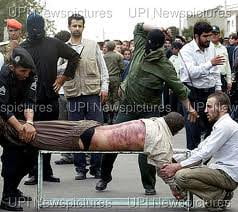
“In another example, it can be said that the west and western human rights say that flogging is torture while in our view, for a convict sentenced to this, flogging is a punishment and penalty”…


“The west says that anyone can change their religion or promote their new religion but in Iran there is freedom of religion… but Baha’is have no right to promote their religion and this is banned in Iran. Imam Khomeini was also asked [about this issue] and he said that various religions live in Iran based on citizenship laws but have no right to promote their religions”…

“Another issue that westerners have problems with is the issue of retribution. This is while retribution [eye for an eye] is very beautiful and important and in a way defends the rights of the society…”

The advisor to the head of the Judiciary said regarding charges against Iran on minor executions, “Not executing people under 18 is one of Iran’s commitments and is included in our law as well but in some cases the judge decides that for example a 17 year old who has committed three murders and knows the consequences of such an act, should be sentenced to death but in general the execution of those who are under 18 is banned and in special cases, committees have to be held”…

Larijani said, “One of the conditions for Turkey’s admittance into the European Union was to abolish stoning and its [EU] goal was only to promote adultery in an Islamic society”. (Mehr state-run News Agency – Jun. 1, 2011)


Source

Iran sentences Sunni cleric to 14 years of prison

June 2, 2011

The first branch of the Saqez Revolutionary Court sentenced Mamousta Sediq Hassani to 14 years of prison.

His lawyer Khalil Bahramian said, “Mamoustan Hassani who was arrested in Saqez some time before was sentenced to 14 years of prison on charges of cooperating with a dissident group and hiding guns”.

“We have appealed the sentence and it has been referred to the Kurdistan court of review”, he added. (Mukrian News Agency – Jun. 1, 2011)


Source

Iran releases trade union leader

06/02/2011

The International Transport Workers’ Federation (ITF) says an Iranian trade union leader was freed on parole today after spending almost four years in prison.

The ITF said in a statement that Mansur Osanloo’s release was “conditional on his “good behavior” and the payment of a bond.

Osanloo is the the head of the Vahed Syndicate, a free trade union of Tehran’s bus workers which he co-founded in 2005.

Osanloo, who the ITF says was detained and tortured after he founded the Vahed Syndicate, was re-arrested in 2007 and sentenced to five years in jail after being found guilty of “acting against national security” and “propaganda against the state.”

In 2010, his sentence was extended by one year.

The ITS said in a statement that Osanloo’s health had worsened in prison.


Source

Fereydoun Sahabi: With Total Brutality and Cowardliness, They Beat People

THURSDAY, 02 JUNE 2011

HRANA News Agency – In an interview with the opposition website JARAS, Fereydoun Sahabi, the brother of Ezzatollah Sahabi and the uncle of Haleh Sahabi, described what events took place at his brother’s funeral and how his niece was martyred.

Fereydoun Sahabi expressly emphasized that Haleh Sahabi’s death was due to a heart attack caused by the tension created during the funeral and as the result of the security forces attacking and beating the crowd. Fereydoun Sahabi who personally witnessed the events reported that a large number of plainclothes and security agents assaulted the mourners and beat people. He also stated that thirty individuals accompanying the deceased Ezzatollah Sahabi’s lifeless body were arrested.

The full text of Fereydoun Sahabi’s interview with JARAS is as follows:

What was the exact cause of Haleh Sahabi’s death?

The cause of death is the blow to her stomach and chest and heart attack.

The state media claims that no attack or beating took place. What did you see in the funeral?

Attacks and beatings took place with utmost rigor in full brutality, callousness and cowardliness. Then, they took her to hospital.

Who took her to the hospital?

Dr. Payman was with Haleh. It appears that he has been detained, but I don’t know for sure.

How did it happen?

You can’t imagine what happened. Perhaps they arrested around thirty people. The security forces, plainclothes agents and intelligence officers attacked and beat people. When they attacked, an officer struck her. Then Ms. Haleh fell to the ground.

Did one of the police officers beat her or a plainclothes agent?

An individual with the security forces did it; he has been fully identified. He beat Ms. Haleh, and in pictures taken, it is shown.

Did people take pictures?

People did take pictures of the scene when one of the intelligence agents severely beat her such that when she fell to the ground, she didn’t get up again. Of course, there were a few other ladies accompanying Ms. Haleh. They were beaten too and are currently in their homes suffering.

How many individuals were arrested?

About thirty people were arrested. All of them were detained during the attack while they were being beaten violently.

Mr. Sahabi, what was the reason for the attack by the security forces? The funeral began an hour earlier according to their request. Why did they attack?

I am ashamed to answer your question. Poor Haleh was holding a picture of her father tight to her chest.One of the security agents took the picture from her and tore it. Then he began to throw punches and kicks at her chest and sides. At that time, Haleh fell to the ground and didn’t get up any more.

Did the security forces demand for the funeral to start an hour earlier?

They were there themselves. We were busy with the last ceremonial wash for which they accompanied us. At 7:30am, we finished what we were doing and came out. It wasn’t even 8:00am when we came out.

After the attack, what did they do with the deceased Sahabi’s corpse?

The situation was extremely obscene. In front of the family’s eyes and everyone else, they throw his lifeless body into the back a pickup truck. This is how they treated him, and we don’t know what they did afterwards when we were absent. They didn’t allow us to say the last prayers. Last prayers weren’t performed at all. They didn’t permit us to go to the cemetery either. Mr. Montazeri was supposed to perform the last prayers but wasn’t allowed to do so. Nothing was permitted not even the last prayers.They treated everyone violently and savagely. For example, there was a lady who was sobbing uncontrollably. They beat my own sister so badly that she was throwing into the bushes alongside the alley. With fists and kicks, they came at people. Not one person at a time. Ten agents attacked a single person and assaulted him at once.

Under such circumstances, no one’s life could be spared easily. Everything happened so fast that everyone was stunned.

Did they use any special weapons such as brass knuckles or batons?

When ten people gang up and attack one person, there is no need for brass knuckles. It is sufficient for each one of them to lift a finger so that the victim is finished. The number of agents present far exceeded the number of the attendees. Each mourner was being watched by three agents.

Didn’t the police interfere to calm down and control the situation?

The security forces together with the police and plainclothes agents were the ones attacking the crowd.The police had a hand in it too and participated in the beating.

How many people were there in the crowd?

The funeral was crowded although people were prevented from attending. A group of people wanted to go inside the cemetery, but the doors were closed. People were being beaten and watched so that no one could enter.

Were the mourners chanting any slogans during the ceremony?

As God is my witness, only chants of hailing the Prophet and the Muslim declaration of belief in the oneness of God were uttered. No political slogans were shouted. Not even one word. I pray that those who were present will clarify exactly what happened.

Tabnak and Raja websites have reported that suspicious elements were present and have claimed that Ms. Haleh died of a heart attack.

The police force was involved in attacking people. Those who saw how Haleh was beaten stated that a police officer did it; others said that an intelligence agent was responsible. I am fifty years old but have never seen such bloody clashes. I have neither been involved in politics nor like my brother (Ezzatollah Sahabi) were in the middle of things. However, I lived during the time when SAVAK operated and also at the present time. I have never witnessed such as thing. I have not seen this type of attack, beating and clash.


Source

 

US demands Iran probe death of opposition figure’s daughter

06/02/2011

The United States on Wednesday demanded the Iranian government investigate the death of the daughter of a veteran opposition figure who died during her father’s funeral.

“We call on the Iranian government to investigate the circumstances of her death,” State Department deputy spokesman Mark Toner told reporters.

“If reports are accurate, that government security forces contributed to her death, this would demonstrate a deplorable disregard for human dignity and respect on the part of the Iranian authorities,” he added.

The Iranian opposition website Kaleme.com reported that Haleh Sahabi, 54, a political and social activist, died from cardiac arrest when she was confronted by security forces during the funeral of her father, Ezatollah Sahabi.

Kaleme.com, the website of opposition leader Mir Hossein Mousavi, quoting Haleh’s son Yahya Shamekhi said she was protesting at the security forces halting the funeral procession and taking her father’s body.

According to Haleh’s uncle quoted by Kaleme, the woman died due to “the beating given to her, (which) were severe.”

Toner added: “Both Haleh and her father suffered in life for their political activism, including imprisonment. Ms. Sahabi was, in fact, on leave from prison for her father’s funeral when she died.”


Source


Journalist Rahman Bouzari detained

06/02/2011

GVF — Journalist and translator Rahman Bouzari has been arrested.

According to opposition website Saham news, Bouzari was arrested on 29 May after referring to Evin prison.

Security forces had raided Bouzari’s home a night earlier, inspecting his residence and confiscating his laptop.

Bouzari, who currently works for the reformist Shargh daily, has also worked for other reformist publications such as Ham-Mihan and Kargozaran.