Home Blog Page 620

Daughter of Deceased Dissident Dies Following Attack During Father’s Burial

1st June 2011

Authorities Should Forbid Interference in Funerals

(1 June 2011) Interference by security and plainclothes agents in the funeral of prominent Iranian political activist Ezatollah Sahabi, including beatings of mourners, led to the death of Sahabi’s daughter Haleh, who suffered a fatal heart attack at the event today.

“The shameful actions of government thugs in this incident reveal a deep contempt for traditions that belong to all Iranians, and they have resulted in a tragedy,” said Hadi Ghaemi, spokesperson for the Campaign.

The Campaign called upon the Iranian Judiciary to investigate the incident at Ezatollah Sahabi’s funeral, and for Iran’s highest political and religious authorities to forbid security forces from any physical or psychological assaults or any other form of interference in funeral observances, regardless of the political views of the deceased and their families.

A journalist present at the funeral procession of Ezatollah Sahabi, a prominent political activist, dissident, and a member of the Freedom Movement, told the Campaign that there was a large group of plainclothes and security forces present at the ceremony who beat a number of mourners.

Haleh Sahabi was holding a photograph of her father in her hands when she was attacked by a group of plainclothes forces who tried to take the photograph away from her.  She then headed toward her father’s coffin, but she was beaten and pulled away from the coffin, which was taken away by government forces.

At this point, Haleh Sahabi’s suffered a heart attack.  She subsequently died after she was transferred to  Lavasan clinic in Tehran.

Haleh Sahabi, 54, was herself a political activist and religious scholar. TheInternational Campaign for Human Rights in Iran expresses deep regret about Haleh Sahabi’s tragic and needless death, and condemns the presence of plainclothes forces and their aggressive actions that clearly precipitated her passing.

“The grotesque interference in Eztollah Sahabi’s funeral is emblematic of the severe repression of Iranian political and civil society activists, who, even at their loved ones’ funerals, have to suffer systematic abuse by unaccountable, unidentified individuals,” Ghaemi said.

Haleh Sahabi had been arrested outside the Iranian Parliament on 6 August 2009, during Mahmoud Ahmadinejad’s inauguration.  She was sentenced to two years in prison and cash fines by Branch 26 of Tehran Revolutionary Court.


Source


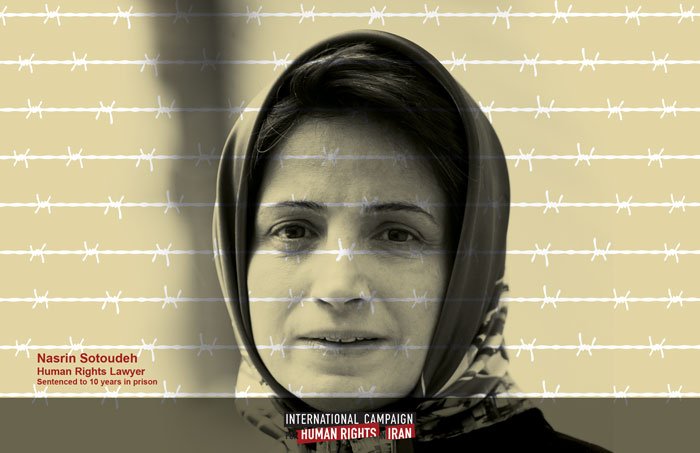
Sotoudeh’s Handcuffed Transfer To Bar Association Uncalled For, Says Husband

1st June 2011

The first court session for disbarring prominent human rights lawyer Nasrin Sotoudeh was held at the Iranian Bar Association on 29 May, though she was not allowed to review the case against her prior to the trial. Based on this reason, the court agreed to Sotoudeh’s request to postpone the session. A handcuffed Sotoudeh was transferred from the political prisoners’ ward in Evin Prison to the Iranian Bar Association, escorted by two soldiers and a female police officer. In an interview with the International Campaign for Human Rights in Iran, Reza Khandan, Sotoudeh’s husband, objected to her transfer to the Bar Association in handcuffs. “I did not expect such a treatment at all. Ms. Sotoudeh was transferred from Ward 209, a security ward, to the Revolutionary Court six times before, but during none of those times was she handcuffed. Transferring prisoners in handcuffs and foot cuffs is a normal occurrence. But today, when Nasrin was coming to the Bar Association, which is considered her home, it is the home of all lawyers, and lawyers are supposed to feel safe in their homes, she was handcuffed,” he told the Campaign.

“The meeting was held at 11:00 inside a room at the Bar Association. But because Ms. Sotoudeh and her lawyer, Mr. Soltani, were not prepared to defend, because they had not had not been able to read the case file and the indictment, they asked for a rescheduling of the court session. Ms. Sotoudeh said at this court that ‘I don’t even know whether the Prosecutor has asked for the suspension or revocation of my lawyer’s permit, so I don’t know how to defend myself.’  The meeting did not last more than ten minutes,” said Khandan.

Criticizing Sotoudeh’s transfer, Khandan said: “She was well, but she was very upset about being transferred in handcuffs. I think we were more upset than she was, because she is in prison and it must be normal for her to see handcuffs. They brought her to court an hour earlier. During this hour, she was sitting inside one of the Bar Association rooms. They didn’t even remove the handcuffs for one minute to drink a glass of water or write something. As a lawyer, she did not deserve this treatment. It was also disrespectful of the Bar Association to bring one of its lawyers there in handcuffs.”

Judicial authorities asked for the suspension of Sotoudeh’s lawyer’s permit, but the Bar Association has taken over the file by assuming responsibility for it. Sotoudeh has been in prison since September 2010 on charges of “acting against national security,” “collusion and propagating against the Islamic Republic of Iran,” and “membership in the Defenders of Human Rights Center.” She was sentenced to 11 years in prison, a 20 year ban on her legal practice, and a 20 year ban on foreign travel.


Source


Kurdish Cleric Sentenced to 14 Years in Prison

0

WEDNESDAY, 01 JUNE 2011

HRANA News Agency – Mamosta Sedigh Hasani has been sentenced to 14 years in prison by the first branch of the Revolutionary Court in Saghez, Kurdistan Province.

In an interview with Mukrian News Agency, Khalil Bahramian, Mamosta Sedigh Hasani’s attorney, reported the news of the verdict and stated, “Mamosta Hasani was arrested a while ago in Saghez and has been sentenced by this city’sRevolutionary Court to 14 years in prison on charges of collaborating with the opposition parties and concealing a weapon.”

Khalil Bahramian added, “As the attorney handling this case, I have objected to the court’s ruling, and the case has been referred to the Kurdistan’s Appeals Court. In the briefing submitted to the appeals court, I have stated that facts of this case together with legal reasoning don’t support the verdict. The truth is that Mamosta Sedigh Hasani was easily deceived by another individual whose party affiliations were not known by my client. This person placed a gun with two rounds of clips in my client’s barn in the village where Mamosta Sedigh Hasani lives. This weapon has neither been fired nor are any bullets missing from either clip.”

At the end, Khalil Bahramian mentioned, “The second reason for the appeal is that my client has no connections or party affiliations with the opposition groups. He is merely a farmer and a cleric. Perhaps the only charge against him could be the concealment of a weapon. For this crime, the punishment is light and doesn’t exceed one year in prison.”

Mamosta Sedigh Hasani is currently being held in Saghez’s central prison.


Source

Nasrin Sotoudeh’s appeal hearing postponed

May 31, 2011

Prominent human rights lawyer Nasrin Sotoudeh’s court hearing concerning the suspension of her legal license was postponed Sunday by the Iran Bar Assn.

According to Sotoudeh’s husband, Reza Khandan, the court hearing, which was expected to end the lawyer’s formal legal career, was rescheduled indefinitely.

Sotoudeh was able to briefly embrace her husband during her court appearance Sunday, a rare opportunity. According to Khandan, she is allowed to talk to him and a handful of family members for only 20 minutes a week.

“We are six or seven, my children, me, her brother and sister and my parents who live with us since my wife was sent to jail. Her mom is too old and sick to walk to jail,” he said.

He said his young son cannot understand why he is not allowed to stay with his mother, and when their jail visits end, he “screams and cries for hours.”

“You can imagine [how difficult it is] to lead our daily life without my wife,” he said.

Before her arrest, the legal activist was known for helping imprisoned high-profile Iranian opposition activists and politicians, especially those arrested following the disputed 2009 presidential elections.

Sotoudeh is also an advocate for juvenile offenders on death row. In a letter to her daughter, she said her children inspired her to represent other youth.

The lawyer and activist saw her home raided in August and was arrested a month later, charged with spreading propaganda against the regime and conspiring to harm state security.

In January, the Revolutionary Court sentenced Sotoudeh to 11 years in prison and banned her from practicing law and leaving the country for 20 years.

In an effort to challenge the conditions of her imprisonment, Sotoudeh staged two hunger strikes.

In an interview with Babylon & Beyond, Khandan shared a recent letter his wife wrote to him from prison, in which she defiantly declared, “You do not need a license to uphold people’s rights and justice.”

“Whether or not I have a license to work as attorney at law, I will keep on defending people whose rights have been violated,” she wrote. “As a lawyer, I have taken an oath to defend the rights of oppressed people.”

Amnesty International and several other human rights organizations have condemned Sotoudeh’s arrest, calling her a “prisoner of conscience” vulnerable to torture and inhumane treatment.

In an interview with the International Campaign for Human Rights in Iran, Khandan said Sotoudeh was being pressured to confess her crimes in the months preceding her court hearing.

“I don’t know why they asked that, because my wife would not give in under any amount of hardship,” he said. “Even if they keep her in there for a hundred years, she would not do it.”

Many of Sotoudeh’s visitors are surprised that she does not wear a head scarf in her office, an offense in Iran that she has also been charged with.

“This is my office and my private sphere and I do not obey the official code of dress,” she told Babylon & Beyond in an interview before she was arrested.

Sotoudeh was recently moved from solitary confinement to a ward with nearly three dozen other inmates, according to her daughter. Monday is her birthday; she turns 48.


Source

300 prisoners condemned to death; dossier of 250 prisoners sent for execution and life sentences: Tehran’s prosecutor

May 31, 2011

Jaffari Dolatabadi, Tehran’s criminal prosecutor of the clerical regime, announced yesterday that 300 prisoners have been condemned to death and the dossier of 250 prisoners condemned to death or life imprisonment have been sent to the judicial system. Thus, the clerical regime that has already admitted almost 200 executions been carried out since the beginning of this year is promising further executions and repression.

The state news agency IRNA wrote, “Tehran’s revolution and general prosecutor stated that: We have 300 smugglers of narcotics that are condemned to death… and we, in Tehran’s Public Prosecutor’s Office have prepared 250 dossiers of those mostly condemned to death or life sentences which have been sent to the judicial system to carry out their sentences.” This criminal promised further executions saying, “We have not given grave writs on narcotics. In the last two months, we have had dossiers with heavy sentenced in this regard.”

In a fresh criminal act, Dolatabadi announced building of new camps for the addicts saying, “The transfer of addicts to these locations will rid the cities of their presence and it is our hope that the building of these camps and contributions from people would gather speed.” He also paved the way for plundering people’s properties under the pretext of “undertakings in regard of smugglers’ properties” saying: “More serious measures should be adopted regarding the property of smugglers.”

Statements by Tehran’s atrocious prosecutor, is a reflection of a trembling clerical regime as it faces its downfall and demise encountering deadlier crises with each passing day. In fear of the increasing wrath and loathe of Iran’s populace, and incapable of controlling the unbridled power struggle among its internal gangs that promise the demise of Velayat-e faqih regime, mullahs have found no other avenue but to increase the executions and to intensify an open suppression to create fear and terror in the society.


Source


Two people publicly hanged in Kermanshah

May 31, 2011

Two more people have been hanged in public in the city of Kermanshah amid a growing wave of executions by the Iranian regime, state-run Jahan News reported this week.

The source identified the two by their first initial and last names as P. Mohammadi Poshteh Rizeh and A. Namakchi. They were hanged on Sunday morning in one of the city’s public squares.

The clerical regime has increased the number of executions recently to instill fear and terror among people in a bid to prevent growing social dissent and protests against it.


Source

For Baha’i educators, a lesson in power from Iran

May 31, 2011

The three Iranian security officers rang the doorbell, politely informed the man of his arrest, thoroughly searched the house, confiscated high-tech gear and books, and whisked him away to the nation’s notorious Evin Prison.

The early Sunday morning raid took three hours. Now, every second seems like an eternity for the man’s anguished family members, praying for his physical safety, hoping for his release, and getting their heads around the prospect of a long stint in prison, his relatives told CNN.


His family says the reason for his arrest is his religion.

The man is one of 16 Baha’is swept away in raids on or after May 21 targeting educators dedicated to teaching members of their community who are denied entry to universities in the Islamic Republic of Iran. Of those 16, nine have since been released. But this educator remains in prison, a Baha’i official told CNN.

The crackdown is the latest example of the Shiite Muslim regime’s relentless persecution of those who adhere to a faith deemed heretical by the ruling ayatollahs.

The Baha’i faith, founded during the 19th century in Iran and now with 5 million to 6 million adherents worldwide, is a monotheistic religion that focuses on the spiritual unity of humanity.

The clerics who hold sway in Iran regard the Baha’i faith as blasphemous because its founder, Bahá’u’lláh, declared himself to be a prophet of God. Muslims believe the Prophet Mohammed was the last prophet of God.

Iranian security officials in Tehran, Karaj, Isfahan and Shiraz raided as many as 30 homes of Baha’is who were part of the Baha’i Institute of Higher Education, or BIHE, established in 1987 to help their co-religionists get undergraduate and graduate degrees. More than a dozen people were arrested in the raids, the most sweeping against the education initiative since 1998.

“The BIHE university was a cover for the propagation of the Baha’i faith and was used to trap citizens in the Baha’i spy network and to gather information from within the county,” the Iran Daily, an official government newspaper reported.

“Authorities have discovered Baha’i propaganda, CDs and books in the possession of those who have been arrested,” according to the newspaper.

The raids have drawn condemnation from the Baha’is and other voices, including the U.S. Commission on International Religious Freedom, an American government agency that monitors religious discrimination across the globe.

“The Iranian government will stop at nothing in its shameless persecution of the Baha’is in Iran,” said the commission’s chairman, Leonard Leo, in a written statement. “It’s not enough that authorities already have a policy in place preventing Baha’is from attending Iranian universities — the government is now systematically trying to dismantle the Baha’i community’s internal initiative to ensure that its youth have the opportunity to get an education beyond high school.”

The 300,000-person Iranian Baha’i community has endured intensified persecution since the shah of Iran was toppled in 1979.

Since the Islamic regime took power decades ago, the U.S. commission says, 200 Baha’i leaders in Iran have been killed, more than 10,000 have been dismissed from government and university jobs, and followers are forbidden to “establish places of worship, schools, or any independent religious associations in Iran.”

They are “denied government jobs and pensions as well as the right to inherit property. Their marriages and divorces also are not recognized, and they have difficulty obtaining death certificates. Baha’i cemeteries, holy places, and community properties are often seized or desecrated,” the commission says.

Baha’i spokesman Farhad Sabetan, who teaches economics at California State University, East Bay, said that while Baha’is are not allowed to serve as military officers, they were recruited to serve as low-level privates in the Iran-Iraq war.

And since 2005, around 400 Baha’is have been jailed arbitrarily, the U.S. commission said, including seven of the community leaders seized three years ago.

“It reminds one of what Hitler wanted to do prior to the extermination,” Sabetan said. That is a reference to the persecution and genocide of Jews under Adolf Hitler’s Nazi regime in Germany in the 20th century.

As Baha’is were systemically banned from higher education, they developed the underground-style institute.

Sabetan said that the thinking had been, “Why can’t we just start something ourselves?”

At first the classes were correspondence courses. Others were held in private homes, where dental students stood over kitchen sinks in denture-making lessons.

“It became a grass-roots homegrown development.”

No one bothered the students and teachers at first as the group amassed volunteers, equipment and willing students. Its faculty comprised volunteer professionals who once taught in Iran but lost their jobs after the revolution because they are Baha’is.

But about 10 years later, the crackdowns started.

The power plays made no sense to Baha’is and seemed like oppression for oppression’s sake. Sabetan said one teacher told him that security officers “destroyed everything” in a raid and didn’t even have the good sense to confiscate the material for their own use.

With the help of funding from foreign Baha’i organizations, the system grew and is now a virtual online college.

The effort is a serious initiative to help Iranian Baha’is gain the right qualifications for trades and professions and the bachelor’s degrees issued by the school have been accepted by some Western colleges, the Baha’is say on their website.

The Baha’i educational network offers over 20 associate, undergraduate and graduate degrees in a range of subjects from literature and law to math and pharmacy, the website says.

Sabetan said he doesn’t know what compelled the authorities to carry out the latest raids, but at least one of the people has been charged with acts against the security of the regime.

“It’s not clear to us how the study of physics, chemistry and science endanger the Iranian government,” Sabetan said.

The professor seized in the Sunday, May 22 raid typified the faculty, according to his wife and daughter in Iran.

They did not want to be named for security reasons.

His relatives said he was unpaid for his labors teaching math and economics to fellow Baha’is. The security officers told the teacher and his wife he would be held in Evin Prison’s Ward 209. That’s a section of the penitentiary said to be for political prisoners and run by intelligence officers.

“He was not paid or reimbursed for this work,” his daughter told CNN. “He did it out of love, love for teaching and love for his students. He wanted to give young people an education so they can have a good life and make something of themselves. It was his passion in life to educate others.”

After the three security officers, armed with a warrant, walked in the Baha’i man’s house, and the man quickly told his wife that the police had arrived.

“Please put your veil on, your brothers have come,” a phrase meant to show respect to the police of the Shiite regime, which expect women cover their heads.

The officers explained that they would be looking through the family’s personal belongings. While the wife accepted that, she insisted that she accompany them; the officials let her.

“I couldn’t just sit down and let men sort through my home. I told them, ‘This is my house.’ I couldn’t just stand to the side,” she told CNN.

The men were respectful, she said. They didn’t destroy material or ransack the house. But they seized memory cards from cameras, mobile phones, computer hard drives and books on the faith and university.

Before the father was taken away, he told his wife not to worry, saying the authorities will realize he didn’t do anything wrong.

But his relatives and the Baha’i community are worried that interrogators attempting wider clampdowns will try to pry names of other teachers and students out of the arrested teachers.

Before one unsuccessful effort to visit him at the prison last week, his wife said, “God willing, I will be able to see him tomorrow and he will be released. I am positive about this because he did not do anything wrong and he is a good person.”


Source

Mohammad Seyfzadeh Transferred to Evin Prison

TUESDAY, 31 MAY 2011

HRANA News Agency – Mohammad Seyfzadeh, an attorney and the co-founder of the Center for Human Rights Defenders, has been transferred from Urmia Prison to ward 209 in Evin.

According to a report by the Campaign for the Independence of Iranian Bar Association, Mohammad Seyfzadeh was arrested two months ago in Urmia and charged with acting against national security by attempting to leave the country illegally. This report also indicates that Mohammad Seyfzadeh was held captive for one month in a solitary confinement in Evin Prison, ward 209 but now has been transferred out of isolation units into prison cells housing multiple inmates. Mohammad Seyfzadeh remains in temporary custody for the time being while his case is pending review by the fourth branch of Evin Prison’s court system.

It has been reported that Mohammad Seyfzadeh’s physical and psychological condition isn’t good, and his family has been allowed to visit him only twice during his detention.


Source


Mousavi supporter Mohsen Borozvan behind bars

05/30/2011

GVF — Mohsen Borazvan, a supporter of 2009 presidential candidate Mir Hossein Mousavi, has been arrested, according to reports.

Mousavi’s official website Kaleme has reported that Mohsen Borazvan who headed an important campaign centre in the province of Kerman has been detained. The Setade 88 campaign, with branches across the country, supported Mir Hossein Mousavi in the 2009 race.

“More than ten days after his arrest, there is still no news regarding his condition,” Kaleme said.


Source

No Information on the Condition of College Professor Reza Sefri

May 30, 2011

RAHANA : Reza Sefri is held in solitary confinement in the Isfahan Dastgerd Prison and his family has not been informed of his condition.

According to the Human Rights House of Iran, his charges include organizing Quran meetings and ignoring the suggestions and pressures by the security forces.

The security forces who entered his house insulted him and his wife.

He had followed up on the conditions of detained teachers in Isfahan and had assisted their families.

He has been deprived of the basic rights of a prisoner and has not been able to contact his family.


Source