Home Blog Page 692

Hossein Ronaghi-Maleki Still in Prison Limbo after 10 Months of Detention

0

http://www.rahana.org/en/?p=7225

Rahana – Sept 27, 2010

Hossein Ronaghi- Maleki is still held in prison limbo in Ward 2A of the Evin Prison after 10 months of detention.

RAHANA: Hossein Ronaghi- Maleki, a blogger who has been imprisoned since December of last year is still awaiting the court’s verdict. He has been held in Ward 2A of Evin Prison and has not had prison visits with his family for the past 2 months.According to the RAHANA reporter, a $300,000 bail was set for him last month. However, the Cyber Intelligence Unit of IRGC prevented his release after his family posted the bail.

His lawyer, Mohammad Ali Dadkhah told RAHANA that “based on what we are told, he will be sentenced in the upcoming days but there has been no information regarding his release.”

The follow-ups by his lawyers have not had any results and he is still in detention. He has spent most of his 10 month detention in solitary confinement and has endured psychological and physical torture.

Hossein Ronaghi- Maleki was arrested along with his brother at his father’s house which is located in the city of Malekan near Tabriz on December 13, 2009.

Families of commanders who died in war barred from visiting opposition leaders

0

Iranian security forces persisted today in their restrictions against visitor of the opposition leaders, Mir Hossein Mousavi and Mehdi Karroubi.

Kaleme website reports that families of two military commanders who died in the Iran-Iraq War tried to visit Mir Hossein Mousavi, Iran’s prime minister during the war, but the Bakeri and Hemmat families were prevented from meeting with the opposition leader by Iranian security forces.

The two families had visited the other opposition leader, Mehdi Karroubi, yesterday.

After being impeded from visiting Mir Hossein Mousavi today, the two families tried to see Mehdi Karroubi again but were reportedly forced away by tear gas bombs. In addition, Ehsan Bakeri, son of the deceased commander, was briefly arrested by the police.

In the past weeks, the Islamic Republic establishment has stepped up pressure on Mir Hossein Mousavi and Mehdi Karroubi who challenge the legitimacy of Mahmoud Ahmadinejad’s government.

While numerous reformists along with scores of election protesters have been arrested by the Islamic Republic in order to silence the allegations of vote fraud in the 2009 presidential elections, Mousavi and Karroubi, the two disputing candidates of the elections have so far not been arrested.

However, the establishment has used every tactic ranging from dismissing them from government positions, to attacking their homes, offices and even their person on the streets in order to isolate them from the public.

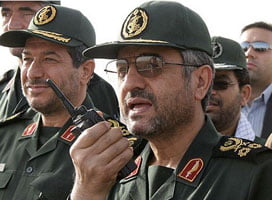
Widow Of Renowned Iran Commander Accuses IRGC Head Of Treason

The widow of a renowned Iranian Revolutionary Guard Corps (IRGC) commander has accused its current head of treason.

Fateme Amirani’s accusation came in an open letter to commander Mohammad Ali Jafari published on September 20.

Amirani is the widow of Revolutionary Guard division commander Hamid Bakeri, who is regarded as a war hero for his role in the Iran-Iraq War of the 1980s.

In her letter, Amirani describes the contested presidential election of June 2009 as a coup d’etat, and accuses Jafari of treason for the IRGC’s role in engineering the election’s outcome and in the ensuing crackdown on opposition protesters.

Bakeri’s family supported opposition candidates Mir Hossein Musavi and Mehdi Karrubi in the election and condemned the regime’s postelection crackdown.

Amirani criticizes the regime for trying to control everything and leave people without any power.

“Why should one side [the government] have all the means of power and the other side [the people] be without any power? I never remember such disasters in the shah’s time,” she writes.

She says in her letter that her children were beaten by members of the hard-line Basiji militia and Revolutionary Guard and warns Jafari that such suppression will only end in the regime losing all legitimacy.

Amirani also says in her letter that the Basijis who are suppressing people in the street are different from the Basijis during the war.

Bakeri’s family has criticized the regime on several occasions in the wake of the 2009 election.

His daughter told students at Tehran University that the Basijis and Revolutionary Guards who beat people in the streets are different from her father and uncle, who died in the war.

The Iranian government considers Bakeri and his brother Ebrahim symbols of war and martyrdom.

Source: RFE/RL’s Radio Farda

Iran’s Revolutionary Guard gets new missile

0

TEHRAN, Iran — Iran’s defense minister says the country’s powerful Revolutionary Guard has received its first batch of new missiles with enhanced guidance systems to hit ground targets.

Gen. Ahmad Vahidi says the Defense Ministry supplied the Guard with the upgraded surface-to-surface Fateh-110 missile, which was successfully test-fired last month. The weapon was developed by Iran’s Aerospace Industries Organization.

Iran has been pushing to upgrade its missile arsenal, which is already capable of hitting Israel and other parts of the region.

Vahidi says Iran will further develop the Fateh-110. He gave no details of the missile’s capabilities but earlier versions had ranges of up to 120 miles (193 kilometers).

Vahidi’s remarks were published Tuesday on the website of state TV.

Iranian Political Prisoners Denied Phone Calls, Told To Recant

0

http://www.rferl.org

September 07, 2010

Kouhyar_Goudarzi
A few hundred inmates at Tehran’s Evin prison are reported to have been denied phone calls since 17 of them launched a hunger strike in late July, RFE/RL’s Radio Farda reports.There are an estimated 200 political prisoners in Evin prison’s Ward 350, many of them journalists, students, and civil activists who were arrested during the crackdown following the controversial June 2009 presidential election.Seventeen of them went on a hunger strike in late July to protest what they called mistreatment by prison guards and the violation of their rights. Although the strike is over, the prisoners are still deprived of making phone calls to their families, the mother of one prisoner told RFE/RL.

Parvin Mokhtare, mother of hunger-striking human rights activist and journalist Kouhyar Goudarzi, told RFE/RL that the prisoners’ families have no news about their children, even those who did not participate in the hunger strike.

She said prisoners have been told they will be allowed to make phone calls only if they write a letter of recantation.

It’s unclear if the apparent ban on phone calls applies to all prisoners held in Ward 350 or political prisoners only.

According to the opposition Kalemeh website, the authorities have ordered prisoners to write a letter expressing remorse for protesting against mistreatment by prison guards and for launching the hunger strike. Prisoners have also been told to ask for forgiveness from prison authorities.

Hossein Derakhshan May Face Death Penalty

0

http://www.rahana.org/en/?p=7152

20 , September , 2010
The Prosecutor is seeking the death penalty for Hossein Derakhshan in the 15th branch of the Revolutionary Court.
RAHANA: Yesterday, there were rumors that either  the Prosecutor is seeking a death penalty for Hossein Derakhshan or that there is a possibility that the court will sentence him to execution. The RAHANA reporter has confirmed the reports and he has been threatened to receiving a death sentence and may in fact receive the sentence.According to RAHANA, the psychological and physical condition of Hossein Derakhshan who is currently held in the IRGC-run Ward 2A is extremely poor.    His first court hearing was held on June 23, 2009 and he was charged with anti-regime propaganda, blasphemy and administrating obscene websites.There have been no further details of the case. The Kamtarin website which published the report in regards to the possibility of death sentence for Derakhshan has stated that “punishment for Derakhshan and deterrence of similar crimes” are the reasons behind the death penalty request.

Derakhshan was arrested on November 1, 2008 when he had recently returned to Iran. He has been held in temporary detention and solitary confinement for the past 2 years.

Islamic Participation Front Letter to IRGC Commander Ali Jafari: Safaee Farahani’s Life is in Your Hands

(Jaras): The Islamic Participation Front published an open letter addressed to Head IRGC
Commander Ali Jafari, urging him—as the one in command of armed forces which played the
most considerable and fundamental role in the post-election events—to take the necessary
measures to provide medical care especially for Mohsen Safaee Farahani, member of the
Central Council of the IPF.

The following is the full text of the IPF’s letter, courtesy of Norouz:

In the Name of God
To Brigadier General Ali Jafari, Head IRGC Commander

Greetings, we are writing this letter to you since the military organization under your command
played a considerable and fundamental role in the post-election events. It is also the decision-
maker [for the fate of] the green prisoners who complained against orchestrators of the coup
d’etat.

Judiciary officials have implicitly and somewhat vigorously approved this recognition of
responsibility, and they in talking with the families of these dear ones [in prison] deny any
responsibility. This flow of affairs—whether in the illegal arrests, the contemptible show
trials on TV, in the sentencing, in the temporary releases, and the repeated imprisonment of
these brave and truth-seeking men—very well backs up this situation. In fact, during the past
few months, the Ministry of Information along with high-level figures directly linked to Mr.
Ahmadinejad has outrun you in this wicked race.

The subject of this letter pertains to the critical and precarious situation of Mr. Safaee Farahani,
who according to some reports on hand is suffering from severe heart complications and thus
has fallen unconscious on a number of occasions. Unfortunately due to the circumstances in
prison, he is forbidden to receive the most prime and essential medical attention.

Certainly you know Mr. Safaee Farahani very well. He is a unique person and a manager
beyond compare whose record of service to the country, especially during the imposed war,
is renowned. He as someone with the highest merit and brilliant sense of managing mobilized
all the country’s industrial resources to defend the homeland. He also had a big interest in
supporting the holy defense troops.

His valuable service after the war is not inconspicuous. Safaee was present in the economic
and industrial sectors, as well as in the political and social domains—even in national sports
management—and exerted an encouraging and dynamic push. How much he has to pay for
all those unmerited ill will which have been unfairly leveled against him, a manager full of
potential.

Commander!

Safaee enjoyed the best of physical and mental health. He was the shelter and patron of all
needy people. It is not yet apparent how your prison has transformed such a strong and athletic
human being into someone who is ill and suffering from heart disease.

He still has not been relieved of this scourge which has persisted since the beginning of his
detention last year, since your prison’s unlawful and unbearable conditions have taken a toll on
his life and health. Yet with head held high, he has stood up against your spiteful intelligence
friends who have targeted him outside prison. His spirit flies high in the sky despite the fact his
body is worn out and sick.

Sir!

Now that the most essential medical care is denied to an honorable person such as Safaee
Farahani—just know that you are a man of authority and therefore responsible for the first
steps of all this suppression and calamity. Sooner or later you have to answer for all of that. It
is not surprising that the judiciary has denied any responsibility for the [actions] of its executive
officers and your interrogators—even though it is undeniable that they are accountable for
all that happens in their name. Yet in the specific situation of continuous lawlessness and
lawbreaking of security and military organizations who have power at their disposal, naturally
any event would be attributed to you and your name.

Islamic Participation Front

September 12, 2010

Reformist Iranian Party Criticizes Revolutionary Guard Chief

0

http://www.rferl.org/

September 14, 2010
Iran’s largest reform party has written an open letter to Islamic Revolutionary Guard Corps (IRGC) Commander Mohammad Ali Jafari accusing him of responsibility “for the oppression and catastrophes” following the disputed 2009 presidential election, RFE/RL’s Radio Farda reports.The Islamic Iran Participation Front published the letter on the Norooz website on September 12 after a worsening in the condition of jailed top member Mohsen Safaie Farahani.

Safaei Farahani was arrested shortly after the June 2009 presidential election and released on bail after spending several months in jail. He was recalled to Evin prison after filing a complaint with six other reformists against the (IRGC) for its alleged “interference” in the presidential election.

Safaei Farahani’s wife, Efat Khatibi, told RFE/RL on September 11 that her husband had a heart attack in Ward 350 of Tehran’s notorious Evin prison but has been denied medical care.

Addressing the IRGC commander, the letter states that “now that Safaei Farahani has been deprived of even the most basic medical treatment, you should know that you are the first-rank authority responsible for all these oppressions and catastrophes and should be held accountable sooner or later.”

The Islamic Iran Participation Front said the letter was addressed to Jafari because the military institution he commands has not only had the foremost role in Iran’s postelection events, but is also currently the final decision maker about the prisoners detained in the course of Iran’s Green Movement.

The Islamic Iran Participation Front is the dominant member of the 2nd of Khordad Movement, the reformist coalition in parliament that is made up of several progressive political parties.

IRGC Devouring All of the Country’s Wealth

0

By Farahmand Alipour

The IRGC (“Sepah Pasdaran” in Persian) was established to preserve the newly-formed Islamic Republic which emerged from the 1979 Iranian Revolution. During the Iran-Iraq war, it played an important role in driving out the invading forces. Today, the IRGC has transformed into an economic behemoth which is quickly devouring Iran’s economy.

In the past few months, the IRGC has made a number of huge business contracts, including the purchase of a 50% stake in Iran Telecommunications. Hamid Behbahani, Minister of Transportation, said that the Khatam al-Anbiya (the engineering arm of the IRGC) has been awarded $2.5 billion to build a railway route linking the southeastern port of Chabahar to the Iranian rail network.

Khatam al-Anbiya: The Engineering Arm of the IRGC

The engineering firm Khatam al-Anbiya, winner of this $2.5 billion project, has more than 800 registered companies. This giant holding firm has worked on more than 1500 projects in Iran. It formed in 1990 at the order of Ayatollah Khamenei, the Supreme Leader of the Islamic Republic, and with authorization from Hashemi Rafsanjani, the president at the time. It was founded so that the IRGC, then under the direction of Mohsen Rezaee, could acquire funds and take part in the country’s construction projects. Since then many of the freeway, tunnel, and dam constructions, as well as oil and gas projects, have been granted to the IRGC. The Gharb-e-Noh, Hara Institute, Rahab Institute, Sahel Institute, Omran Institute, and Makin Institute are subsidiary companies either owned or controlled by Khatam al-Anbiya.

From Water and Electricity to Oil and Gas

As the years passed, the IRGC became increasingly dominant in Iran’s national economic [and political scene]. When Khatami’s reformist administration entered negotiations with the Turks in order to finish part of the Imam Khomeini International Airport, a direct confrontation within government ensued, escalating to the extent that three IRGC fighter jets performed military maneuvers over the airport. Due to the efforts of hard-line MPs in the conservative-dominated 7th Majlis, Khatami’s reformist minister was sacked.

Meanwhile, Mahmoud Ahmadinejad, then mayor of Tehran, was signing contracts with the IRGC. In 2009, Ahmadinejad became President through “a complicated process,” according to Commander Zolghadr. Hashemi Rafsanjani wrote a letter to God against the perceived election fraud and went into silent protest, but Mehdi Karroubi wrote an open letter to the Supreme Leader and without hesitation described the roles the IRGC and Basij had played in Iranian business. After the Ahmadinejad administration was established, huge contracts were awarded to the IRGC and the Khatam al-Anbiya firm,in some cases without following the recognized bidding process. Notwithstanding the IRGC’s influence throughout levels of the ministries and their affiliations, more than 100 projects were allocated to the IRGC during the first year of the Ninth Government. Some of the deals the IRGC acquired in the oil and gas areas included receiving a $2.2 billion contract for the oil pipeline from the Sistan province to Pakistan, developing part of the South Pars gas field for $2.5 billion, developing the Chabahar railroad and a number of huge oil projects valued at more than $7 billion. Over and above its control of road construction and the distribution of water and electricity, the IRGC has officially seized control over oil and gas, the heart of Iran’s wealth.

Telecommunications in the IRGC’s Clutches

It was late September 2009 when news of a financial bombshell broke out: the purchase of 50% stake in the Telecommunications Company of Iran in an $8 billion contract. The winner was Mobin Trust Consortium, formed from three companies. The Mobin Trust and Shahriyar Mahestan investment firms are IRGC controlled firms under the Setad Ejraee Farman Emam. The two companies were formed during a merger in 2006 and 2007 and have no substantial background. The Mobin Trust Consortium started its own activities in 2004. It is interesting that Mobin Trust’s rival Mehr Eghtesad Iranian is active in the stock exchange which is under the Basij’s control. The purchase of the 50% share in Iran Telecommunications was the biggest business deal in Tehran’s 41-year history of stockholding. It was all done in half an hour, minutes after Telecommunications was privatized.

Sepah’s Banks

Only days after news of the $8 billion contract broke out, Bahmani, head of the Central Bank, announced the transformation of one of the IRGC’s known satellite economic institutes, the Ansar Institute of Finance and Credit into a bank. He also announced that the Mehr Institute of Finance and Credit, known to be under Basij control, was on the threshold of becoming the IRGC’s second bank. [This news in the banking industry] appears to be following the same trajectory as Ghavamin Gharz al-Hasane which has been linked to the police. In addition to these institutions, the IRGC conducts a wide range of of economic activity through a number of subsidiaries and trusts.

Karroubi’s Revelation

Everything said up to this point has only related to the known and reported projects of the IRGC. On the other side of the coin, the IRGC as the biggest undercover mafia also controls a vast shadow economy of illicit enterprises. Mehdi Karrubi, as Speaker of the Sixth Majlis under President Khatami, officially announced that the IRGC was operating 60 illegal jetties in the country without government supervision. Until that point, because of censorship and fear of the IRGC, only one or two brave reformist newspapers had reported on the 60 illegal jetties. Ali Ghanbari, another Sixth Majlis member, followed suit, arguing that one-third of imported goods are delivered through the black market, underground economy and illegal jetties.

Mirhossein Mousavi: IRGC Economic Activities Dangerous for the Country

In early September 2010, Mirhossein Mousavi, one of the Green Movement leaders, in his first full interview after the post-election events, pointed out the IRGC’s presence in the economy and said, “One thing the Imam was really sensitive about was the financial issue. At one point in the country, this debate began about the financial needs of the armed forces, and thus the need to have [the armed forces] participate in economic activities. I opposed such action, and I believed that this national issue would confront other various issues. [The proponents] were saying that the police wanted to do some construction activities. I said that the police’s occupation with the cost [of such endeavors] would hinder their ability to perform their duties and would instead spread corruption. I totally believe that awarding billion dollar contracts to the IRGC is not in our country’s financial interest, and certainly not to the IRGC’s or the entire military’s advantage. Such action would only place our country in danger.”

Ahmadinejad: IRGC Presence is Trustworthy

In November 2008, President Ahmadinejad attended the opening ceremony of an operation to transfer water from the Dez River in western Iran to the city of Qom. At the ceremony he said, “In order to develop our country, it is necessary to have a jihadist, hezbollahi, and religious mindset. The presence of the [Khatam al-Anbiya] sincerely reminds people that it is possible to do big things in this country—but some people express wrong opinions without having any information and say that the presence of the [Khatam al-Anbiya] in the country’s projects gives little space for other [firms]. But instead such erroneous language results from ignorance.”

Brutal Torture of Saeed Malekpour in Sepah’s 2-Alef Detention Center

0

Saeed Malekpour is a prisoner who was detained on September 2008 by Sepah’s Cyber Squad (Gerdab), and since has been in detention for interrogation in Evin Prison since his arrest.

Mr. Malekpour was born in May of 1975, and graduated with a degree in Metallurgy from Sharif Industrial University before working at the Iran Khodro Company, the Razi Research Center, and as an inspector for Garma Felez Company.  Last year, Mr. Malekpour was accepted to Victoria University in Canada to work on his master’s degree.  Mr. Malekpour was detained in September 2008 upon his return to Iran.  Since 2005, Mr. Malekpour has been designing web sites in Canada.

This prisoner was detained in connection with a case known as “Mozlin 2”(Decivers 2) , which is related to Internet crimes.  Last year, the news of their arrest was reported by a group  identifying themselves as affiliates Of Sepah (Islamic Republic Guardian Corps or IRGC).  The content of the report dealt with people who had been charged in connection with an Internet Immorality network.

Two more arrests were made by this group, one was after the election unrest where they claimed to have rooted out some of the leading cyber attackers and several web designers and webmasters of opposition websites were arrested

A similar arrest was again done in March 20010 by a wide arrest of Human right activist claiming that they were part of a group to “shake the foundation” of Islamic republic  and that they were part of the “Cybernetic war Network of United States”

The letter below was written by Saeed Malekpour 5 month ago. He has been in Evin prison for the past 25 month :

My name is Saeed Malekpour. I was arrested on October 4th, 2008, around Vanak Square by
some plainclothes agents who did not present an arrest warrant or any [proof of] identification.
The arrest actually looked like a kidnapping. I was handcuffed, blindfolded and placed at the
back of a Sedan. A heavy-set agent leaned his weight on me by pressing his elbow on my neck,
and forcing my head down throughout the ride. They brought me to an undisclosed location
[outside the prison] which they called the “tech office.” A few agents greeted me with some
beatings and foul language. While I was still handcuffed and blindfolded, they forced me to sign
some forms, but I was not able to read the contents. As a result of the physical assault, my neck
ached for several days and my face was swollen from all the punches, slaps, and kicks. That
very night, I was transferred to ward 2-A of Evin prison. I was placed in a solitary cell whose
dimensions were 2m X 1.7m. I could only leave my cell twice a day at specified times for a break
of fresh air. However, whenever I left the cell, I had to be blindfolded. I could only remove the
blindfold in my cell.

I spent a total of 320 days (from October 4, 2008 to August 16, 2009) in solitary confinement
without any access to books, newspapers, or any contact with the outside world. In the
cell, there was only a prayer stone, copy of the Qur’an, a water bottle, three blankets. Until
December 21, 2009, I spent 124 days in the general ward 2-A. I was never granted weekly visits
with my family throughout my entire detention. During the 444 days of detention in ward 2-
A, I was allowed a few restricted visits with my family—with an IRGC officer listening in. Agents
were always present during the visits. They never permitted me to make weekly calls. Prison
staff and interrogators listened in on any call I was able to make. Anytime I talked to my family

about my case, the line would get disconnected. During the 444 days I spent in ward 2-A, I
always felt that I was under constant threat, so I never felt safe.

On December 21, 2009, I was transferred once again to solitary confinement, this time in ward
240 of Evin prison. I spent another 48 days (until February 8, 2010) in solitude and without
any access the outside world. Since February 8th, I have been detained in the general wards
of Evin, first in ward 7 and then in ward 350. So far, I spent 12 months of the total 17 months
of detention in solitary confinement, and could not see a lawyer even once. During this time,
especially in the first months, I was subject to various forms of physical and psychological
torture by the “IRGC Cyber Counterattack” team. Some of the torture was performed in the
presence of Mr. Mousavi, the chief inspector of [my] case. A large part of my confession came
out of pressure, physical and psychological torture, threats to me and my family, and false
promises of immediate release upon giving a false confession on the interrogators’ terms.

I must add that the confession in front of the chief inspector was forced out in the presence
of interrogators. To prevent me from informing him that my confession was received under
[intense] pressure, the interrogators threatened to intensify the torture. Sometimes they
threatened that they would arrest my wife and torture her in front of me. In the first few
months following my arrest, I would be interrogated at various hours, day and night. The
interrogations also came with severe beatings. The tortures were carried out either in the “tech
office” outside the prison or in the interrogation room in ward 2-A.

Most of the time, a group would carry out the tortures. While I remained blindfolded and
handcuffed, several individuals armed with cables and batons, would cuff and punch me
with their fists. At times, they would flog my head and neck. All this abuse was to push me
to write what the interrogators were dictating, and to compel me to [confess] on camera
to their scenarios. Sometimes, they utilized awfully painful electrical shock that would
temporarily paralyze me. Once in October 2008, the interrogators stripped me naked while I
was blindfolded and threatened to rape me with a bottle of water.

On one of those very days, as a result of being kicked, punched, and lashed with cables on my
head and face, my face became extremely swollen. I passed out several times, but each time
they splashed water on my face to wake me up and then continue the torture. That night, they
returned me to my cell. Later that night, I realized my ear was bleeding. I banged on the door of
my cell, but nobody came. The next day, while half of my body was paralyzed, and I could not
move, they took me to Evin prison’s clinic. After seeing my condition, the doctor stressed that I
be transferred to a hospital. However, I was taken back to my cell instead, and left on my own
until 9:00pm. Three guards eventually transferred me to Baghiatollah hospital. On our way to
the hospital, the guards told me I was not allowed to give my real name, and instructed me to
use the alias Mohammad Saeedi. They threatened to torture me if I did not follow their orders.

Before I was able to be examined by the doctor, one of the guards met with the doctor on duty
in the emergency room. I entered a few minutes later. Without performing any examinations,
radiography, or tests, the doctor just said that my problem was “stress related”. He wrote his
diagnosis on the medical report and prescribed a few medications. When I asked him to at least
wash my ear, the doctor said it was not necessary. I returned to the detention center with the
blood clot remaining in my ear. For 20 days, the left side of my body was paralyzed, and I had

little control over my left arm and leg muscles. I also had difficulty walking.

On January 24, 2009, after being subject to severe beatings, one of the interrogators
threatened to pull out my tooth with a pair of tongs. One of my teeth broke, and my jaw was
displaced after he kicked my face. However, the physical tortures were nothing compared to
the psychological tortures. I had to endure lengthy solitary confinement time (totaling to more
than one year) without any phone calls or the possibility of seeing my loved ones, as well as
constant threats to kill me. They always threatened to arrest and torture my wife and family if
I did not cooperate. They also gave me false news of my wife’s arrest. My mental health was
severely threatened. I had virtually no access to any books or journals in the solitary cells. I
could not speak to any human being for days.

Restrictions and psychological pressures on me and my family intensified—so much that after
my father’s passing on March 16, 2009, and despite the fact that the officials were aware of his
death, I did not know for approximately 40 days. When I had a five minute (tapped) phone call
with home, I learned of my father’s death.

Masoud, one of the interrogators, burst into laughter and made fun of me when he saw
me crying about the news of my father’s death. Despite my pleas, they did not permit me
to attend my father’s memorial service. In addition to the psychological tortures, the IRGC
interrogation team illegally—contrary to religious values—withdrew some funds from my
credit card account. They also have my Paypal account, and I am not sure what they did with it.

Another example of psychological torture involved forcing me to do some role play before
the camera as dictated by the Revolutionary Guards interrogators. Although the interrogation
team had promised me these films would never be broadcasted on TV, they would be shown
to regime officials to receive a larger budget for the “Gerdaab” project. However, I found out
later that state television aired those films numerous times during the seventh day funeral
service for my father. This caused severe emotional pain for my family. My mother suffered
from a heart attack after seeing my picture and me making false confessions on television.
Some of those forced false confessions were so ridiculous that they could not even be possible.

For example, they asked me to confess to purchasing software from the UK and then posting
them on my website for sale. I was forced to add that whenever somebody visited my website,
the software would be (without his/her knowledge) installed on their computer and would take
control of their webcam, even when their webcam is turned off. Although I told them that what
they were suggesting was impossible from a technological point of view, they responded that I
should not fret about [such technicalities].

I was promised, with the chief inspector assigned to the case present, that if I participate in
their false televised confession, they would release me conditionally or on bail until the court
date. They also promised that I would receive the maximum leniency in the prosecution case,
getting a maximum of two years in prison. They repeated these promises so many times, and
reneged when these filming sessions finished.

Based on the above information, I have been subject to various forms of psychological and
physical torture in violation of sections 1-9, 14-17 and article 1 of the “Torture Ban Act.”
[The act] was passed by the Majlis (Parliament) in 2004. According to article 4 of the act, the

confessions I made are not admissible, and I made the majority of the confessions to mitigate
the pressure on my family and friends.

After 17 months of “temporary” detention, I am still [in a state of] limbo. I have not been
allowed to meet with my lawyer. Given the size of the case, and the nature of the accusations
against me, I need a computer expert trusted by the judiciary [to prove those false and forced
confessions wrong] and access to my lawyer. I also need a place equipped with technical
facilities (such as Internet) to prepare my defense. Therefore, I would like to ask that my
request regarding release on bail or bond be granted, and that I will be provided with the
suggested facilities.

Saeed Malekpour

March 13, 2010