
Various state news resources in Iran report on a new plan by the IRGC known as
the “Resistance Movement” which aims at gaining preparation to  confront ultra-crisis
situations. According to this plan, a collection of forces will be chosen and staffed from
the Basij bases all over the country so that in case the current situation arises from
tension to crisis and the country fails to correctly manage the crisis with the regime
at the risk of collapse, a network of highly-committed individuals to the regime will be
available and can be summoned under any circumstances.
The purpose of establishing these networks is announced as “regaining the control
over the situation in any possible way”. According to this plan, in case the Basij bases
collapse, the selected individuals will be summoned by the commanders of each district
in a place called “Emergency Operation Center” while they are prepared to carry out the
instructions.
An individual attending a Basij Base describes the purpose to this plan:
“Resistance Movement” plan aims at collecting a network of those who are most
committed to the regime and can be available and summoned under any circumstances
to regain the control over the situation in case the situation changes from stabile to
elevated tension, from tension to high and eventually to crisis and if the crisis management fails
with the risk of the regime collapse.
The source underlined that in the Emergency Operation Center, the commander of each
district is obliged to set up a new seat outside the bases which enjoys the qualifications
of an emergency operation center, is adjacent to the most important entrances and
exits of the district, enjoys the parameters of the unbreakable defense with the capacity
to keep arms and ammunition.
Therefore, based on its logistics, every distinct is obliged to inform its sub-bases to
secretly select five individuals among the members and introduce them to the superiors.
Some of the Green Movement pro websites such as Jaras believe that choosing five
individuals among the all members of each Basij Base indicates that since these
members have arisen from the public, the IRGC fear that in case of a crisis, 90 percent
of their forces would refuse to cooperate. Therefore, they are content with this limited
numbers under restricted conditions.
Considering the fact that some of the IRGC commanders and security officials confessed
to and warned about a social riot resulting from the upcoming economic pressures
based on the estimates by their informational bodies, it’s safe to say that the fear of
a serious and uncontrollable crisis arising from public riot made them get prepared to
confront a critical situation.
Basij and the plain-clothes militia played a key role in the bloody crackdown in the wake
of the last year’s controversial presidential elections.
confront ultra-crisis
situations. According to this plan, a collection of forces will be chosen and staffed from
the Basij bases all over the country so that in case the current situation arises from
tension to crisis and the country fails to correctly manage the crisis with the regime
at the risk of collapse, a network of highly-committed individuals to the regime will be
available and can be summoned under any circumstances.
The purpose of establishing these networks is announced as “regaining the control
over the situation in any possible way”. According to this plan, in case the Basij bases
collapse, the selected individuals will be summoned by the commanders of each district
in a place called “Emergency Operation Center” while they are prepared to carry out the
instructions.
An individual attending a Basij Base describes the purpose to this plan:
“Resistance Movement” plan aims at collecting a network of those who are most
committed to the regime and can be available and summoned under any circumstances
to regain the control over the situation in case the situation changes from stabile to
elevated tension, from tension to high and eventually to crisis and if the crisis management fails
with the risk of the regime collapse.
The source underlined that in the Emergency Operation Center, the commander of each
district is obliged to set up a new seat outside the bases which enjoys the qualifications
of an emergency operation center, is adjacent to the most important entrances and
exits of the district, enjoys the parameters of the unbreakable defense with the capacity
to keep arms and ammunition.
Therefore, based on its logistics, every distinct is obliged to inform its sub-bases to
secretly select five individuals among the members and introduce them to the superiors.
Some of the Green Movement pro websites such as Jaras believe that choosing five
individuals among the all members of each Basij Base indicates that since these
members have arisen from the public, the IRGC fear that in case of a crisis, 90 percent
of their forces would refuse to cooperate. Therefore, they are content with this limited
numbers under restricted conditions.
Considering the fact that some of the IRGC commanders and security officials confessed
to and warned about a social riot resulting from the upcoming economic pressures
based on the estimates by their informational bodies, it’s safe to say that the fear of
a serious and uncontrollable crisis arising from public riot made them get prepared to
confront a critical situation.
Basij and the plain-clothes militia played a key role in the bloody crackdown in the wake
of the last year’s controversial presidential elections.
IRGC’s New Plan to Confront Crisis
Iran’s biggest highway contract handed to Revolutionary Guards
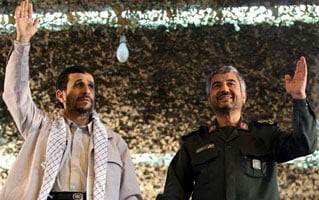
A company controlled by Iran’s Revolutionary Guards(IRGC) has been given a contract to build a major highway, a newspaper reported on Sunday, the latest example of the elite military unit expanding its economic influence.
On Saturday, President Mahmoud Ahmadinejad marked the start of construction of the highway, which will connect two of Iran’s holy cities, calling it “the biggest project in the history of Iran and the region,” the budget for this project is estimated at between 13 to 15 billion Dollars.
The paper said Khatam al-Anbia, an engineering and construction arm of the Guards, would build the 1,100-kilometre (684 miles) road between Qom in central Iran and Mashhad in the northeast.
The Guards, a military force that has been directly targeted by international sanctions, have played a growing economic role in the Islamic Republic since hardline President Mahmoud Ahmadinejad first took office in 2005.
Iran handed the development of several phases of the giant South Pars gas field to Khatam al-Anbia worth at 21 billion dollars. But on July 19 this year, after the U.N. Security Council passed a resolution blacklisting 15 firms belonging to the Guards including Khatam al-Anbia, Iran announced that the company had pulled out of developing all phases of South Pars.
No reason was given for the pull-out.
Mousavi called IRGC comander’s speech “a historic evidence to last years Coup”

In interview with the Kaleme website Mir Hossein Mousavi one of the green movement leaders called one of the top intelligence Commanders of IRGC speeches in Mashhad an undeniable evidence of a coup in last years election, he also spoke once more, about the movement’s characteristics and said that it was the outcome of the “unattended demands of the past one hundred years.” He described pro-democracy Green Movement in Iran as “alive, freedom-seeking, liberating and modern with a look towards tradition and the past.” He said that movement’s roots were becoming deeper every day.
Addressing Iran’s hardliners currently in control of the country, Mousavi said, “[let’s] assume that we are all either ‘enemies’ or ‘tricked by the enemy’, by returning to the people, the law and avoiding tyranny, you yourselves [can] pick up the green flag.” He asked Iran’s illegitimate statesmen, “who has given you the right to make us confront the rest of the world and to create such critical conditions for the country’s economic and political situation with your adventurism and despotism?”
When asked about the current status of the Green Movement and its future, Mousavi said, “The Green Movement is alive and its roots are deepening. The Green Movement is a green word that has risen from the loving hearts of the people and it is the outcome of unattended demands of the [Iranian people] throughout the past hundred years, especially the demands that had resulted from the Islamic Revolution [in 1979]. Most importantly, it is a modern movement and compatible with the characteristics and necessities of the today’s word. If you pay heed, the slogans and demands [raised] by the movement are such that the hardliners’ open [public] opposition towards them is made difficult.”
“Who can publicly stand against the desire for freedom, justice and free elections without vetting [of candidates]? Or who can dismiss the reliance on the values of diverse ethnic cultures or simply and loudly declare that he does not accept human dignity or that he does wish for the people to be in control of their own destiny?”
Mousavi continued, “who can say that the regeneration of [religious] tyranny … is something desirable?” “We know that with the exception of a few sick [individuals] dependent on power who benefit from the exploitation of national resources, in the conscience of no one, not even the security forces, military and dark-clothed Basij [militia], there is no pleasure in killings, clampdowns and imprisonment of intellectuals, teachers, workers, women and men.”
“This is the reason why those opposed to the [Green] Movement [begin to] create enemies when they cannot face the movement’s demands,” said Mousavi, while referring once more to the voice recording of Revolutionary Guards commander Moshfegh who had recently admitted the IRGC’s role in the engineering June 2009 presidential elections and its aftermath. Mousavi called Moshfegh’s comments an “important historic document.”
The former Iranian prime minister added that the comments made by Moshfegh, also demonstrated the “degenerate thought of the people’s enemies.” “This is the reason behind the hardliners’ fury over the lawsuit [launched by seven reformist figures] which was based on this so-called speech.”
“But in the face of this anger we can say, ‘assume we are all either enemies or deceived by the enemy. [Forget about us] and [simply] comply with the covenant between you and the people which is respect for the people’s rights and preserving liberties and fully implementing the constitution and the people’s right to have control over their own destiny, without having any regard for us’. By returning to the people and the law and avoiding tyranny, you yourselves [can] pick up the green flag. Who has given you the right to make us confront the rest of the world and to create such critical conditions for the country’s economic and political situation with your adventurism and despotism? Do not cheer yourselves on! Hold a referendum and see if the people accept such devastating policies or not.”
The 2009 presidential candidate once more described the Green Movement as a “freedom-seeking”, “liberating”, and “completely modern.” He argued that the Green Movement’s views regarding “tradition and the past” had not limited it and that the movement’s hopes had not resulted in hallucinations about the future. Mousavi also claimed that the government’s “destructive” policies had played an essential role in drawing the people’s attention towards the Green Movement’s slogans and presenting the movement as the “only alternative” for the current situation.
Responding to a question regarding the Iranian authorities’ claims about having put an end to the Green Movement, Mousavi said, “It’s very easy to test this claim.”
“Without filling the streets with military forces during celebrations such as the ones on 16 Azar [7 December 2009] and 15 June, let the people express their opinions based on article 27 of the constitution [which guarantees the right to assembly],” said Mousavi, while reiterating that Iran’s problems would not be solved by means of “engineered” and “guided” pro-government rallies.
“The spontaneous Takbir [chants of Allah-O-Akbar on rooftops] on Monday 20 September was by itself, a response to all those engineered [pro-government] assemblies,” said Mousavi. On the mentioned date, many Iranians took to their rooftops and in another show of unity, voiced their support for the leaders of their Green Movement, Mir Hossein Mousavi and Mahdi Karroubi who had been facing nonstop government attacks. The opposition leader said that the “effects of the Green Movement until now, cannot be reversed. You can look at the cracks that have appeared in a body poisoned with corruption and oppression. These cracks have in some instances, turned into irreparable cracks. They are regularly forced to lie in order to cover these splits.”
Mousavi continued, “today, the reputation of the regime rests upon fulfilling its promises and implementing the law in cases such as the Kahrizak [Prison] scandals, the letters of the harassed political prisoners and the crimes [that occurred] during the [nightly] attack against the dormitory of the [Tehran] University. It is absolutely clear that the authorities do not have a solution in this regard and this is why the lies are increasing every day. Every day, they are further exposed in the eyes of the Iranian people and the world.”
“Let us remember, that in the absence of the [Green] Movement, this corruption and structured tyranny and despotism could have remained hidden for a long time and [could have] positioned the country in irreversible danger.”
Referring to Ahmadinejad’s recent claims at the United Nations headquarters in New York, Mousavi added, “In short, when someone goes in front of billions of humans at the headquarters of the United Nations and says that there are no political prisoners in Iran and that those in prison had [actually] wanted to kill police officers, and [at the same time] is not able to hide his fear of green wristbands worn by athletes and artists, shows that the Green Movement is always present and everywhere, both in Iran and the rest of the world and will not leave them in peace and has put them in a position of desperation to such an extent that acknowledging the very obvious is the same as letting go of power. For this reason, raising [the] awareness [of the people] will play a vital role for the future of the country and the movement. The military forces that were brought onto the streets for scaring the population on Jerusalem Day showed that the hardliners are fully aware of how lively the movement is.”
On the question of UN sanctions against Iran, Mousavi argued that the sanctions that resulted from the government’s “adventurism” and “posturing” in its foreign policy, were “avoidable.” He also called on professors, experts and even experienced Foreign Ministry personnel to assess whether Ahmadinejad’s recent comments in New York were in line with national interests. “Of course, it is possible that we might hear a few applauds in the cafés of certain Arab countries, but the real effects of these positions are felt more every day, on the tables of the impoverished and weak of society, Bazaar and the national economy.”
During the interview with Kaleme, the popular reformist warned about the exclusion of “competent forces for the management of political and economic crises” in the country. “The establishment is experiencing dangerous illusions and is busy destroying all bridges—big and small—behind it. Otherwise, it wouldn’t [even] have considered omitting the Dialogue Among Civilisations Day from the national calendar. This seemingly trivial action shows very well, the short-sighted and partisan approach that the country is facing.”
“Should Aminzadeh be in prison today, or at the Foreign Ministry? Should Safaei Farahani be in prison and the hospital or instead at the Ministry of Economy?” Mousavi asked, referring to the imprisonment of the two reformist figures. “Whether the hardliners like it or not, most of the forces that could have played a role in [solving] this crisis, are members of the Islamic Iran Participation Front, The Mujahidin of the Islamic Revolution Organisation, the Executives of Construction Party, the National Trust Party and other similar factions. And in the middle of all this, the main issue for the country’s Chief Prosecutor, the Judiciary’s spokesperson and in effect, the spokesperson for the whole regime, is the illegality of the these factions and arresting their members.”
“I am saddened when I see the country’s best executives in prisons or in isolation instead of solving problems and reversing the effects of the destructive actions of the gentlemen [authorities] … Out of concern, I would recommend that during these difficult times—which will become more difficult—more attention is given to the thousands of experts and competent forces who have been filtered out of the systems [of government] and that their experiences should be utilised.” Nevertheless, Mousavi expressed doubts that Iranian authorities would actually heed to his calls. He accused Iran’s officials of confusing the management of the country and its international affairs with how thugs and hoodlums would achieve their aims.
Mir Hossein Mousavi, whose premiership coincided with Iran’s difficult years during the Iran-Iraq war, mentioned that acknowledging the country’s problems was an “inseparable” part of escaping the current crises. “By concealing the issues and posturing, we will not have any oil to place on the people’s dinner tables and we will not be able to guarantee Iran’s security. Deceit and misrepresenting the realities must stop, in order for us to have the whole population behind the establishment. We must know that in the long-run, for the people, more important than [preserving] a name for the state is securing their rights and respecting their human dignity. If you want to preserve Islam, you must show that in practice, Islam is not incapable of securing the rights of the people, their right to control their own destiny and solving the country’s problems and that [Islam] is against oppression, corruption, [resorting] to force, [rewarding people based on] family ties and suppression.”
He continued, “no government or political system can defend itself in the face danger by any means other than creating unity among the nation. The solution to attracting the people is to give them the assurance that their votes will not be stolen and it is they who must decide how their representative will speak at the United Nations and which countries they will befriend and which ones they will consider as enemies. It will be their representatives [Members of Parliament] who will decide when to support statesmen and when to impeach them.”
In the end, Mousavi was asked whether the proposed strategy to separate the Iranian people from the leaders of the Green Movement would work or not. “I think it is a wise strategy,” Mousavi acknowledged. “But people are attracted to groups that will not categorise them as ‘insiders’ and ‘outsiders’ for their own interests and will defend the rights of the people.”
He called on the ultraconservative parties to take a stance regarding the letters written by imprisoned politicians such as Abdollah Momeni, Hamzeh Karami and Aria Aram Nejad and to openly announce their objection to torture, forced confessions and the recent imprisonment of senior members of the Freedom Movement of Iran.
“The problems will be resolved when we close our eyes to the differences that create ‘us’ and ‘them’ and [begin to] defend what is right, even if it is against our own interests.”
Blogger falls victim to Iran’s in-fighting

By Omid Memarian
A week after Iranian President Mahmud Ahmadinejad told heads of state gathered for the United Nations General Assembly in New York that his government did not jail its citizens for expressing their opinions, Iran’s Revolutionary Court sentenced Hossein Derakhshan, an internationally known Iranian-Canadian blogger, to nineteen-and-a-half years in prison.
On Monday, the conservative website Mashreq announced the verdict issued by Branch 15 of the Revolutionary Courts.
Derakhshan, 35, was arrested in 2008 by IRGC and charged with “cooperation with hostile states” and “propagating against the regime”, among other counts, the site said. In addition to the lengthy prison term, he was fined and banned from membership in political parties and work in the media for a period of five years.
“We are shocked,” one of Derakhshan’s relatives told Inter Press Service (IPS) on condition of anonymity due to the sensitivity of the case and fears of a backlash by security forces. “We never expected this to happen. Even according to Iranian laws, he has not done anything to deserve such a harsh sentence.”
Neither the family nor Derakhshan’s lawyer was aware of the sentence until it appeared on Mashreq’s website. His relative told IPS that Derakhshan did say that after two years in prison, “My state of uncertainty has finally ended,” referring to his long detention without any progress in his case.
Mohammad Ali Mahdavi, Derakhshan’s lawyer, told IPS that the verdict still had not been announced even to him. “I’m waiting for the official announcement to start working on the defense bill for the appeals court,” he said, adding, “I prefer to defend my client rather than bringing the case to the media as it might endanger the fate of the case at this phase.”
The judge in the case called Derakhshan’s family to confirm the verdict and sentence, according to the Paris-based Reporters Without Borders, which cited Derakhshan’s partner, Sandrine Murcia.
The Canadian government called Derakhshan’s sentencing “unacceptable and unjustifiable”.
“No one should be punished anywhere for simply exercising one’s inherent right to freedom of expression,” Lawrence Cannon, the foreign affairs minister, said in a statement. “Iran must release him”.
Judge Abolqasem Salavati is among three judges who are well known for issuing long and harsh sentences for political prisoners, particularly detainees from the post-election protests of mid-2009. His rulings have included the death sentence and numerous long-term prison sentences.
“I believe that first of all, the charges are totally unfounded, and the verdict demonstrates the injustice that many people have been talking about all these years,” Nikahang Kowsar, an award-winning Iranian cartoonist and blogger based in Toronto, where Derakhshan used to live, told IPS.
“Hossein wasn’t a very nice guy to many of us,” Kowsar said. “He criticized many journalists, bloggers and activists for being critical of the Iranian regime and ridiculing Iran’s leaders. He called us ‘agents of neo-liberalism’ or ‘enemies of Iran’ and tried to portray us as the ones willing to sell our nation to the West, but he was absolutely entitled to express his mind.”
Derakhshan, also known as Hoder, has been dubbed Iran’s “Blogfather” for his role in promoting blogging among Iranians via his popular website, hoder.com and his role in making it technically possible to blog in Persian.
Immediately following the reform era in 1999, Derakhshan was a technology and Internet columnist for one of the reformist newspapers in Tehran. In 2000, he moved to Canada and continued his work as a full-time blogger in Toronto.
In 2006, Derakhshan traveled to Israel as a Canadian citizen, a trip that caused a huge controversy in Iran and abroad, as Iranian law forbids Iranian citizens from traveling to Israel. “We have a saying in Iran: ‘There is freedom of speech in Iran, but there is no freedom after speech in Iran’,” said Kowsar. “His captors are willing to make an example of him for others,” he added.
After years of criticizing the Iranian government, a few years ago, Derakhshan started supporting Ahmadinejad. He launched a fierce attack against the government’s critics, including human-rights activists, politicians, and journalists.
A source close to Derakhshan told IPS that his friends and colleagues warned him that traveling to Iran could be dangerous for him. “But he was positive that his support for Ahmadinejad and his government would protect him from being arrested,” said the source.
According the source, Derakhshan received the green light from a ranking official within the Ahmadinejad administration that his November 2008 trip to Iran would be tolerated. But a few days after his arrival in Tehran, he was arrested and sent to jail.
“Hossein had had some conversations with Press TV about working in their Tehran office,” Derakhshan’s mother, Ozra Kiarashpour, told the Kamtarin website on why he decided to come to Iran.
“Before his return to Iran, the High Council of Iranian Affairs Abroad promised Hossein that his trip would be without problems,” she said. “He had cleared his trip with this council, which is governmental and which is in contact with the intelligence service. That’s why even though Hossein knew that they would call him to be questioned, he did not expect to be arrested like this and hadn’t told us what to do in case he was arrested.”
“A representative from the council told us that they pursued his case on behalf of the council but that unfortunately they couldn’t do anything further. Why are there such splits in the country’s security apparatus?” she asked.
Some believe that Derakhshan is being used as a pawn by certain political and security factions to justify the post-election crackdown and attempt to incriminate opposition political figures.
Mohammad Mostafie, a human-rights lawyer who recently fled to Norway under pressure from the Iranian judiciary, told IPS, “Several judges have gathered in a place they call the Revolutionary Courts, where they issue unfair, illegal and inhumane rulings based on orders from security and intelligence forces.”
“Some of these judges, like Judge Salavati, obey the intelligence forces rather than the law and issue whatever they want, whether it’s a long-time prison sentence or a death sentence,” he said.
(Inter Press Service)
Doctor Soudbakhsh: A Medical Examiner’s Office Expert Who Resisted Mortazavi’s Orders

(Jaras) According to the latest news received related to Dr. Abdolreza Soudbakhsh, Associate Professor at the University of Tehran and target of an armed assassination attempt last week and lost his life, Dr. Soudbakhsh was a Medical Examiner’s Office (MEO) expert who also treated and examined abused prisoners at the Kahrizak Detention Center. Although the MEO had ordered him to announce that the prisoners died from “meningitis,” Dr. Soudbakhsh was not ready to violate his Hippocratic Oath and mirrored the reality in official reports.
It is said that last year, during the post-election events and the uproar over the Kahrizak Detention Center, the MEO noted that the prisoners died not due to “meningitis” but from “severe beating and injury to the body”—contrary to the claims and emphasis made by Saeed Mortazavi, the Tehran Public Prosecutor at the time.
Ramin Pourandarjani, a young doctor on duty at the Kahrizak Detention Center, mysteriously died around November 2009, and superiors immediately announced his death as a “suicide.”
Based on reports from Jaras News sources, Ahmad Shojaei became head of the MEO, his job being to survey medical reports in tandem with the IRGC’s head commanders and security circles. The head of the MEO is appointed by the head of the judiciary.
It is said that Iran’s Chief of Security Forces, Commander Ahmadi Moghadam, was the first person to announce that the Kahrizak prisoners died due to “meningitis,” and in his latest statement, he announced that the murder of Dr. Soudbakhsh is in no way connected to the Kahrizak tragedy.
Ahmadi Moghadam, along with General Radan and Judge Mortazavi, the masterminds and culprits behind the Kahrizak tragedy, had a role in last year’s replacement of the Behesht Zahra Cemetary Organization’s president. In the time leading up to the government’s operation to torture and bury a group comprised mostly of political prisoners, his [Moghadam’s] role was not known.
In recent days, a Jaras News source pointed out that, “Soudbakhsh recently felt mounting pressure from security forces and saw his life in danger. Days before his murder, he purchased a September 22 ticket for abroad to see his child in college. One day before leaving the country, he was fatally shot and killed by an assassin’s bullet outside his clinic in Kesharvarz Boulevard in Tehran.”
Arya Aramnejad’s Heroic Defense

Arya Aramnejad is Iranian song writer and singer who wrote and sang “Rise Oh Ali” for the event’s of Ashura Protest(27th December 2009) in which at least 37 people were killed. Ashura is a day of justice, a day that any kind of violence is forbidden. His song was widely reciveed and loved. a month later he was arrested and is since is in prison. what is written below is his defense in his first court hearing :
I am standing before you in this court so that the Almighty will be a witness before you and I. A witness to what is happening today to our beloved Iran and to its brave sons and daughters. So that upon the judgment day when we are held accountable, those of us who stand proud and those of us who hold our heads down will remember that such is destiny. The final reward and punishment is only by God.
If justice was the benchmark, instead of me standing trial today, it should have been those who have disgraced Iran and Islam who should have been standing trial. The very people who want to plunder Iran’s wealth and use Islam to cover up their foray and despotism.
I was arrested on 15th February when the intelligence ministry agents broke into my house. They smashed up our furniture and rummaged through our belongings just to maximize their intimidation. This was all because of a song I had written that according to the gentlemen had ‘endangered the national security’. After that, I spent 44 days in solitary confinement where I was put under a series of emotional, mental and physical tortures. Allow me to describe just a small part of what I was put through:
– Hurling insults and profanities to belittle me, even ridiculing the way I looked
– Intimidating me by threatening to arrest my wife, even though she has had no political activities or played a role in anything I have done
– Insulting my war veteran brother and threatening to arrest him as well if I did not co-operate
– Intelligence agent threatening me with death (He said to me I can easily kill you outside here with a single bullet and no one can question me)
– Prison officials threatening me with execution
– Keeping me in a 2 meter by 1.5 meter cell without any hygiene facilities that led to infected boils all over my body
– Deliberate negligence in giving me my medication related to my heart problem
– Putting me in a cell next to an inmate with AIDS and making me walk with bare feet on his blood after he had committed suicide by slashing his wrists
– Giving me insinuating offensive information about my wife
– Stripping me naked in front of an agent who was holding a camera in his hand, who kept laughing and asking me ‘are you scared?’ every time I protested at his immoral behavior
– Severe physical beating when I asked to see the prison doctor, beatings so bad that the marks were visible all over me for a long time
– Chaining my hands and feet for long periods of time
And these were just a small glimpse of what I went through during my detention.
After the Ashura uprising which resulted in so many of my compatriots being killed, I felt it was my duty to condemn this inhumanity and use my musical talents in doing so. I wrote and composed a song, which became known as ‘Ali, Rise up’. The content of this song is to do with the exploitation of God, the Koran and the Imams by a bunch of impostors to achieve their demonic goals. In this song, I asked the Imams for help in uprooting lies and hypocrisy. Is it not strange that in these days to ask the Imams for help in battling against evil is considered a crime in our country?
Imam Hussein was martyred for good to triumph against evil, so should we not expect the same from his followers? Or are we just supposed to ceremoniously beat our heads and beat up our chests and pretend we despise tyrants and despots?
I do not recognize this man as our president! Am I then not a Muslim? On the day of Ashura, I chanted ‘God is Great’ and I am proud of calling His name. Surely whoever jails me for chanting ‘God is Great’ is a non-believer and an infidel himself.
Those who make out they are Muslims these days, themselves disregard the most basic teachings. They easily lie to nation of seventy million and make false promises, and feign that they want to glorify Iran and Islam. Iran and Islam are both much grander than having the need for such claimants.
The constitution has to be made clear. It gives me the right to criticize. It gives me the right to take part in gatherings without carrying weapons, it gives me the right to free speech and free thought. And because of this constitution that our fathers voted for, I am free not to be indifferent to the destiny of my country. Interestingly instead of being commended, I have to stand trial today for this.
Sadly in the report made by the intelligence ministry, it is stated that I have written an insulting song against Mu‘āwiya and posted it on my blog. Has the intelligence ministry now become defenders of Mu‘āwiya and Yazid? In another section of the report it says, I made up this song against the Supreme Leader, which is the most comical part of the report. The song is clearly against those who desecrated the sanctity of Ashura, but it seems the intelligence ministry is insistent that someone else is responsible for all this. Such is the illusion of power by those who seek the temporary reigns of power.
These policies of mass oppression and intimidation are dictated by which eternal power that justifies silence. Which divine laws allow such invasions of privacy into people’s homes and into the privacy of people’s private beliefs? and not tolerate the slightest of criticisms? These self interest seeking persons who claim to be kinder child minders than our own mothers, not only think they own this land but consider any non-conformity a crime and trample on the basic rights of our citizens. I recommend, in a brotherly way, some reality check and some insight than just having your eyes fixated on the seats of power; for rectifying your mistakes in the future will be much harder.
Respected judge, I am worried today about your judgment, for my interrogators said you are their puppet and will do whatever they tell you to do. I hope God will reveal you the truth, so that God forbid, you will not be held accountable for what others have asked you do for them in another world.
In the end, I reject all charges against me and ask you to find me not guilty.
Supreme Leader’s Inner Circle

http://www.roozonline.com/…/supreme-leaders-inner-circle.html
January 16, 2010
Based on documents that confirm that Mohammad Reza Madhi held a 12-year position of responsibility in a committee at the powerful Majlis Khobregan (Assembly of Experts on Leadership) and that he was a member in the intelligence division of the Islamic Passdaran Revolutionary Guards Corps, one cannot ignore the revelations that he makes about what is going on behind the scenes in the Islamic Republic. Here are the excerpts of an interview we had with him.
Rooz: A conservative lawmaker in the Majlis, Mr. Ali Motahari once said in an interview that the recent controversies and murders would not have taken place had Mr. Hossein Taeb not been the official person in charge of managing the post-election crisis. What is do you think?
Mohammad Reza Madhi (Madhi): When people such as Mr. Taeb are in charge of any situation the results couldn’t be any better. When Taeb worked at the intelligence ministry, the-then minister Mr. Fallahian fired him and ordered that he be never allowed to return to the ministry. But he returned to the IRGC. For a while he was at the seminary too. But basically, he had not place to go.
Rooz: What was your position at that time?
Madhi: I was officially in charge of the case/dossiser that is commonly known as the chain murders case from April of 1379 through August of 1383, but unfortunately the internal settling of scores, which hurt people who also paid a price for this prevented real work in that area.
Rooz: According to your own statements you served in an official capacity through February 1386. In that same year, you left Iran. From what sources do you obtain your current information?
Madhi: I am still in contacts with Iran. I am not someone who once had some information and who is now out of touch. We receive information from various channels.
Rooz: Who are these people?
Madhi: These are people inside the regime who care about the regime and serve in intelligence, security or judicial posts. There are even clerics who trust me and believe in the ideals of the revolution and the Imam – against which they carried out a velvet coup but accused people of doing that. They help me in understanding what is going on.
Rooz: What issues do they discuss with you, for example?
Madhi: Some of these people told me that there were orders for the arrest of reformist leaders before the elections.
Rooz: One issue that was very surprising was the imposition of unprecedented violence against protesters and civil society activists after the election. Many ask who is behind these events? What is your opinion?
Madhi: Look, Mr. Mesbah Yazdi has played the biggest role in Mr. Ahmadinejad’s growth as a way for his own growth. In order to be successful they had to deal with the reform movement once and for all, and for that purpose they even took up arms against someone like Mir-Hossein Mousavi, who was a priceless resource for saving the regime. They could not tolerate even Mousavi.
Rooz: How so?
Madhi: A plan was prepared before the election not to allow reformists to win under any circumstances. It was a strong plan.
Rooz: Is the supreme leader aware of these issues?
Madhi: In my opinion the supreme leader was played with in this incident.
Internal Security of Iran is in the hands of IRGC

 Green Voice of Freedom, or Jaras, as one of the leading news organizations of the Green Movement in Iran, said in a report that “All the responsibilities related to Internal security of Iran have been given to IRGC (Islamic Republic Guard Corp).”
An informed source told Jaras that this decision came from the High Counsel of National Security, Iran’s highest security office, and that with this decision, the IRGC will be able to control even the Iranian Ministry of Intelligence. For many years IRGC has been running shadowy and parallel intelligence and covert operations to the Ministry of Intelligence, a situation that was objected to many times during the Presidency of Mr. Khatami by him, his government and newspapers supporting the reformist.
IRGC unlawfully listened in on opposition parties and writers and took down the websites owned by dissidents of the Islamic Republic. There were talks of encounters and arguments between the Intelligence Ministry and IRGC on several occasions.
The supporters of the Green Movement and its leaders, Mir Hussein Mousavi and Mehdi Karoubi, believe that IRGC and the covert operations of this military establishment were the means by which Mr. Ahamadinejad achieved his coup-like victory in the June election of 2009.
Jaras writes that, according to this bill, the sole responsibilities of the Ministry of Intelligence are in regard to external security, espionage and counter espionage. The responsibilities of suppressing demonstrators; controlling the parties; putting pressure on political activists; breaking of labor and student strikes; confronting any activities by women, minorities and religious activists; and controlling prisons and interrogations are the duties of IRGC.
The Jaras website adds that this a great victory for Aziz Jafari, the head of IRGC, and other high ranking officials of Sepah in gaining more power during the past year and a half. With this bill, internal security is out of the hands of government and Parliament and is given to the hands of a military group under the supervision of the supreme leader. This amounts to yet another step in concentrating Mr. Khamenei’s absolute power.
According to the Constitution, Parliament can ask about the activities of the Ministry of Intelligence and have it under its review. Iranian Parliament is now closer to a more moderate political party than the Iranian government.
Former Secretary of Tehran University Guild of Students Ayoub Nemati Still in Ward 2A of Evin Prison

Ayoub Nemati, the former secretary of the Tehran University Guild of Students, is still held in the solitary confinement unit of the notorious Ward 2A, which is under the control of IRGC.

RAHANA: According to Bamdad Khabar, Nemati has been able to contact his family once and has also had a prison visit with his brother once.Many students of the Tehran University have been summoned to the Prosecutor’s Office and threatened. The pressure has intensified in order to force them to make false confessions.
Since September, 30 Tehran University students have been summoned under the pretext of investigating the case in regards to the post- election raid on the dormitory which lead to loss of lives and financial losses. The families of the students summoned had been threatened by the authorities in order to scare them.
There have also been reports that the students have been threatened, summoned and detained since the beginning of the school year in order to intensify the pressure.
Intelligence Services; from attracting foreign funds to suppressing dissidents
 30 September 2010 Morteza Rasooli
This whole project, a means to put down the Greens, was the brainchild of Ahmad Jannati who had first brought this up at a meeting at Jamkaran near Qom. He had claimed he had come across a document that showed that the Americans, with a little Saudi assistance, had paid a billion dollars to the “leaders of sedition” with a promise of another fifty billion for toppling the present regime. Reacting to this groundless statement, protests arose from all around, even from unlikely quarters such as even the fundamentalist Majles delegate Ali Motahari. Green movement leaders denied and ridiculed the allegations and demanded to see the documents. In response to this, in turn, Kadkhodai, spokesman of the Council of Guardians, without mentioning any documents, spoke of disclosing “evidence” in “court” and then Yadollah Javani, one of the political authorities in the Revolutionary Guard, threatened these leaders with action by the regime.
Haydar Moslehi, the Intelligence Minister, claimed that the amount of money paid to the “leaders of sedition” was considerably more than a billion dollars, the amount claimed by Jannati. He then produced a list of all the educational, propaganda, cultural, research and even sporting activities undertaken by all countries with Iran and declared that the precise amount of funds discovered by the Intelligence Ministry was actually 17 billion 700 million dollars. He added that certain other funds for international awards, secret intelligence missions, assistance given to terrorist guerrillas, such as Rigi or the PJAK groups, research institution scholarships and similar beneficiaries had not even been included in the figures.
Incidentally, the above figure, after adding only a small amount, will just about match the 18 and a half billion dollars which was, in a very insensible way, taken out of the country by operatives of the regime and allowed to fall into the hands of the Turkish government as easy money. (As an interesting side-note, following the elections, financial matters were the only thing not mentioned among the charge against those arrested.) Yet even a closer examination of certain types of aid given by some European governments, claimed by the Iranian government to be given under the pretext of international extra-curricular activities such as defending human rights and supporting victims of violence and other causes, reveals that one of the most important undercover NGOs of the Intelligence Ministry, namely, the Organization for Defending Victims of Violence,” presided over by one Ali Reza Taheri, has been one of the main recipients of these funds.
A few years ago, it was announced that a 55-million-dollar bill countering Iran had been passed by the US government. The lion’s share of the proceedings mainly went towards bolstering Voice of America and its Persian section’s television programming as well as Radio Farda and some research programs and on programs for defending human rights by the US Department of State. The Islamic Republic, on various pretexts, accused as criminals any human rights activist or any participant in international conferences as being indirect recipients of financial aid from the above-mentioned budget. At that time, one of the high-ranking insiders of the Revolutionary Guard openly declared that the Iranian regime was not worried at all over this budget because a considerable amount of it would, in fact, be absorbed by supporters of the Iranian government establishment. Perhaps at that time many people ignored these remarks or considered them, as usual, as habitual psychological warfare or empty words on the part of the Revolutionary Guard but in 2007, that is two years after Ahmadinejad seized power, all civil and non-governmental organizations campaigning in areas of human rights, women and children’s rights, the environment and health (fight against AIDS and addiction and so on) were dissolved and were pronounced illegal and their managers and core staff were arrested or exiled or sentenced to long imprisonments. These include figures such as Emadeddin Baghi, the Alai brothers and others. In their place, tens of quasi-governmental organizations, dubbed by the opposition as G-NGOs or governmental non-government organizations, were created, one after another by the movaazi (parallel) intelligence service. The Ahmadinejad administration tried to take advantage of the void created from the lack of civil organizations, even absorbing and spending the common funds of international communities for its own security and intelligence purposes.
A concrete example of this policy adopted by the Iranian Republic is an organization called the Organization for Defending Victims of Violence, which was founded in 1988 by a former staff member of the Intelligence Ministry named Alireza Taheri. This organization received under that cover, millions of dollars of aid from different organizations while accusing the opposition of the same acts. After a while, it had learned different ways to infiltrate these international communities and organizations and thus gradually paved the way for other Iranian governmental organizations, such as Iran’s Judiciary Center for Training and Research and some other organs so that they could benefit from such million-dollar aid too, in such a way that over a four year period in Ahmadinejad’s term in office, that is from 2005 to 2009, over two and a half billion dollars were obtained from foreign governments through the office in Iran for the UN Development Program by organizations affiliated with judicial, security and intelligence organs of Iran.
Complete details of these funds and the names of governments who provided assistance can be viewed in both English and Persian at the website . The crucial point is that many Iranian civil society non-governmental organizations have been closed down over these same years and by these same judiciary and intelligence organs – because they themselves were participating in such propagandist and civil projects – on charges of treason and their activists were imprisoned and suppressed. In this case, too, the Iranian government, using its deceitful double standards in its one-way media propaganda, set out to suppress the civil society at large.
Of course, spending foreign funds for the purpose of training a country’s judges through participation in training courses on judicial systems and becoming familiar with advanced judicial systems in other countries is also a good thing. Indeed, it is necessary and will definitely be of great help in setting up democracy and freedom in Iran. Still, it is unfortunate that under the name of NGO, security and intelligence organizations abuse these facilities for the opposite purposes, hence the need for ever more awareness on the part of international organizations outside Iran and independent civil organs.
The Organization for Defending Victims of Violence presided over by Ali Reza Taheri – who can be seen in the picture accompanying this article, while taking part in the UN Human Rights Council session in Geneva – is only one of the known examples of such blatant abuses of absorbing foreign aid and internal government resources, which have been used to continue the blatant and organized violation of human rights in Iran. The undercover security organization, Defending Victims of Violence, by adopting affiliations that can only be used for non-governmental international organs such as membership in the network of non-governmental organizations for the formation of the International Criminal Court, the national coordinator for demonstration against child labor, International Action Network on Small Arms, the Conference of NGOs in Consultative Relationship with the United Nations (CONGO), International Movement for a Just World (JUST), Center for Victims of Torture and Asian Youths Services, can all be seen on the website of the Organization for Defending Victims of Violence.
By taking part in various international conferences and by delivering false reports and materials, they are attempting to fortify the government’s web of lies concerning complete freedom and observation of human rights in Iran. With these ploys, they are attempting to neutralize the voice of a nation which they say is speaking through independent members of organizations and the Iranian civil society and human rights activists at such conferences in defense of the oppressed.
An outrageous example is the organized attendance at the UN Human Rights Council session of this organization in Geneva. Ali Reza Taheri along with Mohammad Javad Larijani, the secretary of the Human Rights Office of the Judiciary, and the Iranian delegation, who, in the examination of Iran’s thick file attempted to justify the ruthless killing of people following the presidential elections last year, the ambiguities of the rigged election of Mahmoud Ahmadinejad, and also the imprisonment of thousands of people from different castes and classes of the country on grounds of their beliefs and political and social charges. They also tried to gloss over stoning and other methods of execution that do not have any legal backing.These people intended to occupy seats in the Human Rights Supreme Council, an act which was foiled thanks to the awareness of Iranian civil society activists and international organs. Of course, the story of utilizing double standards in order to take advantage of non-Iranian funds as a tool to suppress Iranian activists opposed to policies of suppression is still going on. Just as in the recent news of the deputy of the National Prosecutor as to the filing of the lawsuit against some of the leaders of the opposition and in the speech made by the secretary and spokesman of the Council of Guardians and the Intelligence Minister, the way is being paved in various ways, such as false charges of using foreign financial aid, so that the story of relations with other countries and foreign organizations remains the most important propagandist project of the regime

Ali Reza Taheri and Monireh Amedi-e Qomi, two of the undercover agents of the Intelligence Ministry, in the February 2010 session of the Human Rights Commission in Geneva, Switzerland.