

In a message released on Saturday, Brigadier General Esmaeil Qaani lashed out at the “global arrogance, Zionism, and the states creating and fostering terrorism” for killing the Iranian scientist “with American bullets”.
Swedish-Iranian scientist faces ‘imminent risk of execution’ in Iran
Swedish-Iranian scientist faces ‘imminent risk of execution’ in Iran
Swedish-Iranian scientist faces ‘imminent risk of execution’ in Iran
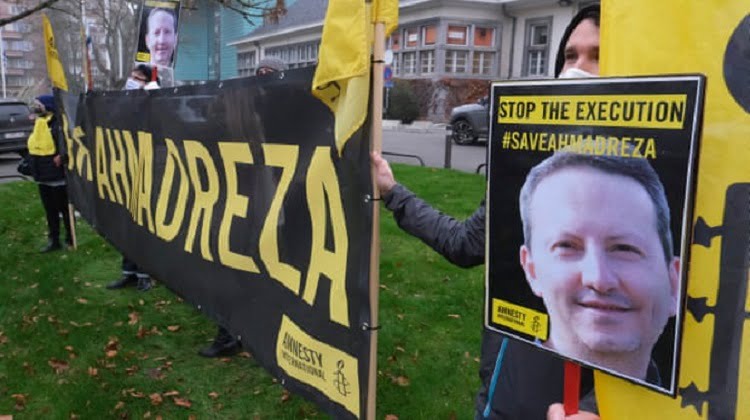
A Swedish-Iranian scientist sentenced to death in Iran on espionage charges may face execution as early as Wednesday, human rights groups and his wife have warned.
Chief Iranian nuclear scientist Mohsen Fakhrizadeh assassinated near Tehran
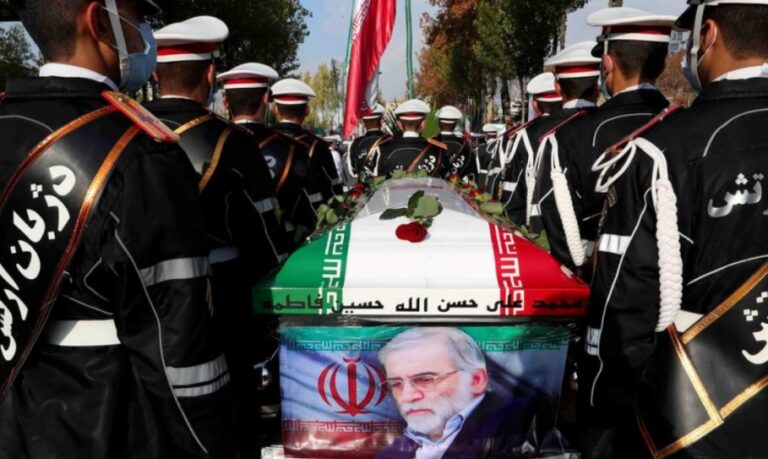

Mohsen Fakhrizadeh commonly referred to as the ‘father of Iran’s nuclear bomb’ was assassinated outside of Tehran Friday in what is being described by Iranian officials as an act of terrorism perpetrated by Israel and the United States.
Fakhrizadeh, a Brigadier General in the Islamic Revolutionary Guard Corps (IRGC) and a professor of physics was the chief scientist behind Iran’s secret program to build a nuclear bomb.
Fakhrizadeh’s convoy came under attack Friday afternoon as it entered the city of Absurd, east of Tehran.
The attackers reportedly detonated a car bomb and fired automatic weapons against the vehicles ultimately killing Fakhrizadeh.
After the assassination, Iran’s Foreign Minister Mohammad Jarad Zarif went to Twitter to accuse Israel of possibly having a role in the assassination.
“Terrorists murdered an eminent Iranian scientist today. This cowardice—with serious indications of Israeli role—shows desperate warmongering of perpetrators,” Zarif stated.
Iranian President Hassan Rouhani also accused Israel of having a role.
“Once again, the evil hands of global arrogance and the Zionist mercenaries were stained with the blood of an Iranian son,” Rouhani stated.
Read the Complete Article at NewsNow.Com
Also Read: Airstrike kills IRGC commander at Iraq-Syria border, Iraqi officials say
Since the assassination, Iran’s semi-official Fars News Agency has reported different versions of the story. In one report, Fars claimed the assassination was done via a remote-controlled machine gun attached to a vehicle contradicting its original story of a car bomb and men firing at the convoy. Who is behind Fakhrizadeh’s assassination? As previously covered on FDD’s Long War Journal, Israel’s Mossad has been attributed to numerous assassinations of Iranian scientists over the past decade in a bid to thwart Iran’s nuclear project. Fakhrizadeh was reportedly marked for assassination several times by Israel. Former Prime Minister of Israel, Ehud Olmert, hinted in a 2018 Israeli news broadcast that Israel knew of Fakhrizadeh’s activity and had no ‘immunity’ to Israeli action against him.
Air strike kills IRGC commander at Iraq-Syria border, Iraqi officials say
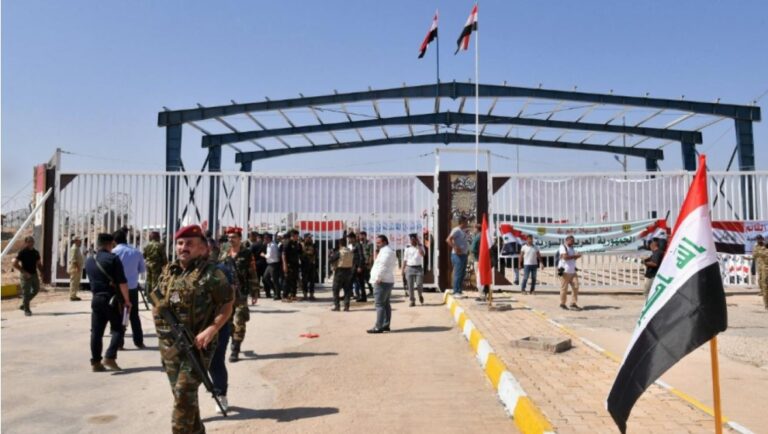

An airstrike killed a commander of Iran’s Revolutionary Guard at the Iraq-Syria border sometime over the weekend, Iraqi security and local militia officials said on Monday.
Officials could not confirm the identity of the commander, who they said was killed alongside three other men traveling in a vehicle with him.
The vehicle was carrying weapons across the Iraqi border and was hit after it had entered Syrian territory, two Iraqi security officials separately told Reuters.
Read the Complete Article at NewsNow.Com
Also Read: Report: Iranian Revolutionary Guard commander eliminated in Syria
Iran-backed Iraqi paramilitary groups helped retrieve the bodies, the two officials said, without elaborating or giving the exact time of the incident. The Lebanon-based Al-Mayadeen TV channel, which is close to the Syrian government and Lebanese Hezbollah, said that trusted sources have denied the assassination of an Iranian commander and three of his bodyguards. Several Arab media reports have identified the commander as Muslim Shahdan. The reported incident comes just days after Iranian nuclear scientist Mohsen Fakhrizadeh was assassinated in Tehran in an operation that Iran has blamed on Israel. Israel launched air raids against what it called a wide range of Syrian government and Iranian targets in Syria last week, signaling that it will pursue its policy of striking Iranian targets in the region as US President Donald Trump prepares to leave the office. Dozens of Iran-backed fighters have been killed in Israeli strikes in Syria over the past month, according to the Syrian Observatory for Human Rights. Israel has carried out hundreds of air and missile strikes on Syria since the civil war broke out in 2011, targeting Iranian and Hezbollah forces as well as Syrian government troops. The killing of Fakhrizadeh and attacks on Iranian-backed groups are seen by analysts as an attempt by Israel.
Report: Iranian Revolutionary Guard commander eliminated in Syria
Report: Iranian Revolutionary Guard commander eliminated in Syria
Report: Iranian Revolutionary Guard commander eliminated in Syria
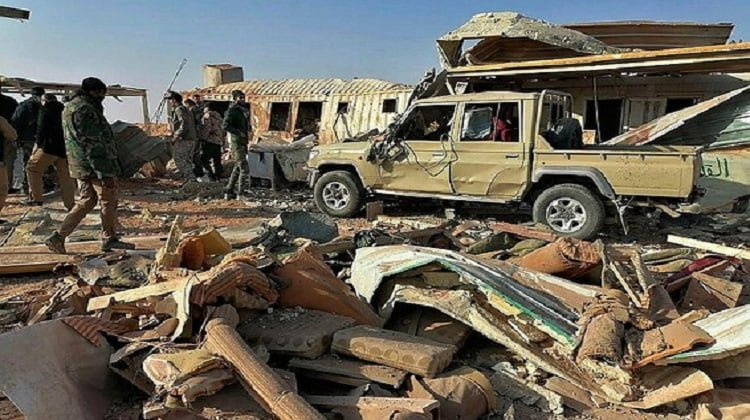
A senior member of Iran’s Revolutionary Guard Corps was assassinated in the Syrian town of Al Qaim near that country’s northeastern border with Iraq on Sunday, Syrian media outlets have reported.
Iran accuses Israel at funeral for slain military nuclear scientist
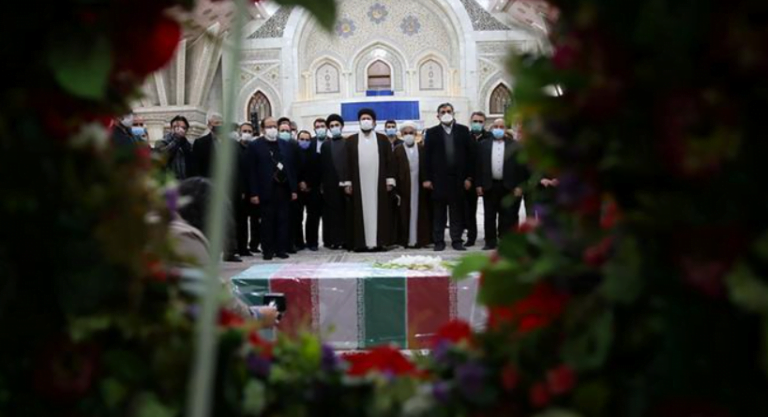
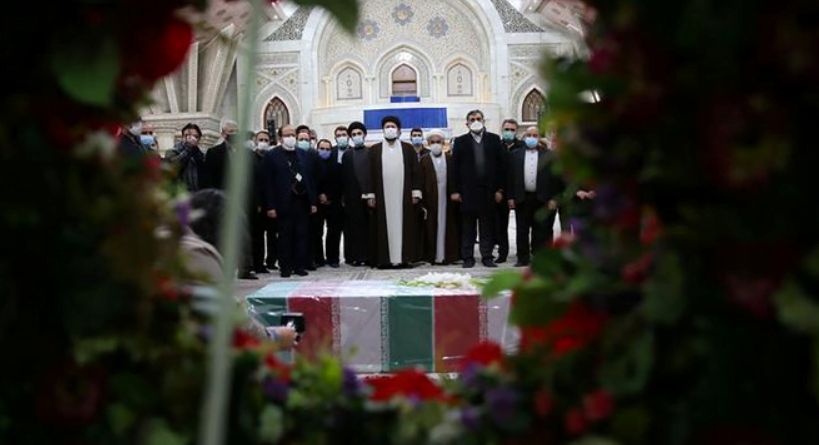
Iran has marked the death of nuclear scientist Mohsen Fakhrizadeh, a member of the Islamic Revolutionary Guards, with a high-profile funeral ceremony.
The physicist was killed in an attack that Iran has blamed on Israel.
The secretary of the country’s Supreme National Security Council, Ali Shamkhani, used the event to claim that Israel had used “electronic devices” to remotely kill military physicist Mohsen Fakhrizadeh.
Meanwhile, the defense minister said Iran would continue Fakhrizadeh’s work “with more speed and more power.” Hatami referred to the killing as a “heinous assassination.”
Read the complete article at NewsNow.com
Also Read: The fallout of assassinating Mohsen Fakhrizadeh
The funeral began with a religious singer praising Fakhrizadeh, whose coffin was covered with the Iranian flag. An honor guard carried the coffin containing his body. State television showed high-ranking Iranian officials, including Defense Minister Amir Hatami and Revolutionary Guards chief Hossein Salami, who were present for the funeral. The socially-distanced funeral was held in an outdoor part of the Iranian Defense Ministry in Tehran and was closed to the public. Israel, which is alleged to have killed several Iranian nuclear scientists over the past decade, has declined to comment on the attack. According to the defense ministry, Fakhrizadeh died after assailants targeted his car and engaged in a gunfight with his bodyguards outside Tehran. Iranian officials debate response to the killingFakhrizadeh, who was a member of Iran’s Islamic Revolutionary Guard, is believed to have led Iran’s nuclear program, which Israel and the West have claimed was a veiled military operation to construct a nuclear weapon. Iran has long maintained that its nuclear program is peaceful.
The fallout of assassinating Mohsen Fakhrizadeh

Political assassinations require considerable preparation and planning. It is almost certain the killing last week of Mohsen Fakhrizadeh, head of the Iranian nuclear program, was timed to avoid cancellation of the hostage exchange involving Australian-British academic Kylie Moore-Gilbert.
The nuclear program is under the control of the Iranian Revolutionary Guards Corps, and the Iranian terrorists released from Thailand had gone there to carry out an attack on the Israeli embassy following an earlier Israeli assassination of another Iranian nuclear scientist.
Australia would almost certainly have consulted Israel about the plan to exchange the prisoners for Kylie Moore-Gilbert.
However, there is no reason to believe Australia would have had prior knowledge of the Israeli intention to carry out the assassination if that is indeed the country behind the attack.
There are several possible reasons for the timing of the assassination. One obvious explanation is an intention to remind the IRGC that Israel will continue to extract a price from the IRGC for any attacks on Israel or Israelis, either directly or through surrogates including Hezbollah.
Read the complete article at NewsNow.com
Also Read: Iran’s Quds Force Calls Scientist’s Assassination Handiwork ‘of Arrogant International Thieves’
The risks of witnessing a spiral of military responses are not all that great, despite the rhetoric which flowed from Tehran after the attack. Another perhaps secondary but still possible explanation is that the Israelis (with US President Donald Trump’s blessing) want to take every opportunity to damage the prospects of president-elect Joe Biden reaching an agreement with the Iranians (in effect, the Supreme Leader and the IRGC) to resume US participation in the Joint Comprehensive Plan of Action (JCPOA), which is anathema to Israel, Saudi Arabia, and Trump. The IRGC was never keen on the JCPOA in the first place.
Iran’s Quds Force Calls Scientist’s Assassination Handiwork ‘of Arrogant International Thieves’

Mohsen Fakhrizadeh, a senior Iranian nuclear scientist, died of injuries sustained in a brazen daylight gun and bomb attack on his vehicle on Friday afternoon in a small town east of Tehran. The assassination caused a surge in regional tensions, with Iranian officials almost immediately blaming Israel for the attack. Tel Aviv remains silent.
The Revolutionary Guards’ Quds Force will ally itself with other “guardians of the Islamic homeland” to exact revenge on the “terrorists and their masters” for the murder of Mohsen Fakhrizadeh, Commander Brig. Gen. Esmail Ghana has announced.
“The enemy does not dare to wage war against Iran like men. The end of Israel is approaching…This assassination is one of the desperate attempts of the arrogant and international thieves,” Ghani said, his comments cited by local media.
Read the complete article at NewsNow.com
Also Read: IRGC Quds Force Commander Vows Revenge for Fakhrizadeh Killing
Characterizing Fakhrizadeh as the “pride of the school of Islam” and its efforts to break global monopolies on science and technology, Ghana suggested that the “scientific growth, independence and self-sufficiency of Iran and the Muslim and freedom-loving nations” is what “hinders the realization” of the “nefarious goals” of the Islamic Republic’s enemies. Ghaani, who was appointed chief of the Quds Force, Iran’s elite extraterritorial fighting force, in early January after the US assassination of Gen. Qasem Soleimani, did not specify how the Revolutionary Guard would exact “revenge” for Fakhrizadeh’s killing. On 8 January, five days after Soleimani’s 3 January killing, the Revolutionary Guard lobbed over a dozen ballistic missiles at a pair of US bases in Iraq, leaving over 100 US military personnel with traumatic brain injuries. The Quds Force has also been known to provide training and arms assistance to Baghdad-allied Iraqi militias, which have been accused of carrying out a spate of rocket attacks against American military facilities in Iraq in recent months in a bid to force the US to pull out of the country.
IRGC Quds Force Commander Vows Revenge for Fakhrizadeh Killing
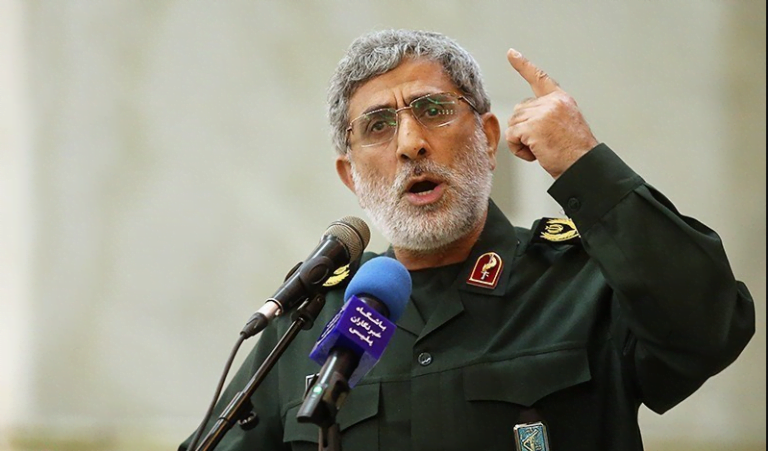

The commander of the Islamic Revolution Guards Corps Quds Force pledged that his forces will work with the other “guardians” of Iran to take revenge for the assassination of top Iranian scientist Mohsen Fakhrizadehs.
Read the complete article at NewsNow.com
Also Read: Bloody and brutal: Killing of IRGC Iran nuke chief symbolic – analysis
The commander said the IRGC Quds Force would ally itself with all other “guardians of the Islamic homeland” to take revenge on the terrorists and their masters for the blood of Fakhrizadeh and all other martyrs. The commander further paid tribute to the late scientist for battling with the “hegemonic system’s scientific monopolists”, saying his martyrdom discredited the fake advocates of human rights, democracy, and freedom. Qadiani also stressed that the loss of assets like Fakhrizadeh would not only not hinder Iran’s progress, but also accelerate the country’s movement forward. Fakhrizadeh, a senior nuclear and defense scientist, was assassinated by unknown gunmen in a small city east of Tehran on Friday evening. After sustaining injuries from a car explosion and bullets, Fakhrizadeh was taken to the hospital with a helicopter but succumbed to injuries a few hours later. Qadiani also stressed that the loss of assets like Fakhrizadeh would not only not hinder Iran’s progress, but also accelerate the country’s movement forward. Fakhrizadeh, a senior nuclear and defense scientist, was assassinated by unknown gunmen in a small city east of Tehran on Friday evening. After sustaining injuries from a car explosion and bullets, Fakhrizadeh was taken to the hospital with a helicopter but succumbed to injuries a few hours later.
Bloody and brutal: Killing of IRGC Iran nuke chief symbolic – analysis
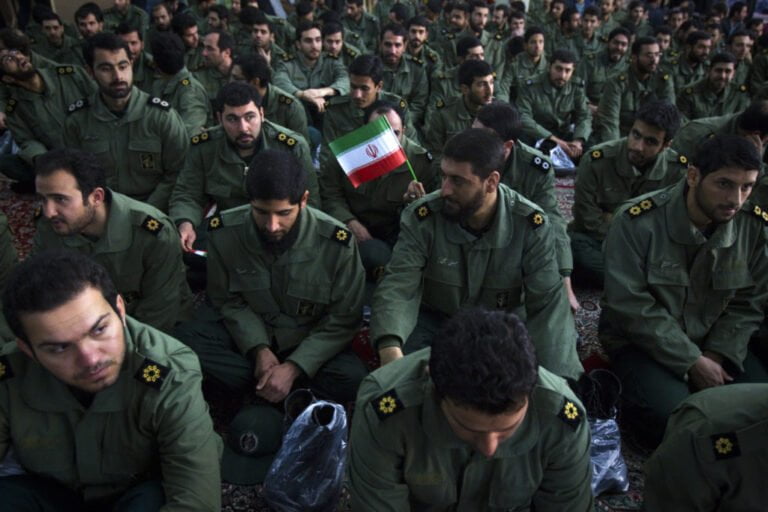

The killing of Mohsen Fakhrizadeh in Iran, a key nuclear engineer behind Iran’s clandestine nuke program, was not just a hit, it was a bloody and symbolic killing.
According to the photos posted online, he wasn’t just killed, one of the cars in his entourage was eviscerated and the other peppered with bullet holes.
This was a hit like the killing of Gambino crime boss Paul Castellano in New York in 1985, a serious assassination that shows the power of those responsible and shows that any Iranian linked to the nuclear program can be found and killed.
He was shot down on a road in broad daylight. This was not a clandestine hit, but a brutal clear killing, the destruction of a major and well-known Iranian figure.
He was not well known like Iran’s foreign minister, not a glad-hander who sucks up to western politicians and is known for nice suits and “moderation,” but a man well known in intelligence circles, among the kinds of people who follow Iran.
Read the Complete Article at NewsNow.Com
Also Read: Iran’s IRGC chief vows to avenge slain nuclear scientist Fakhrizadeh, accuses Israel