
Another Mysterious Airstrike Hits Iran-Backed Militia In Iraq
Another Mysterious Airstrike Hits Iran-Backed Militia In Iraq

Another Mysterious Airstrike Hits Iran-Backed Militia In Iraq
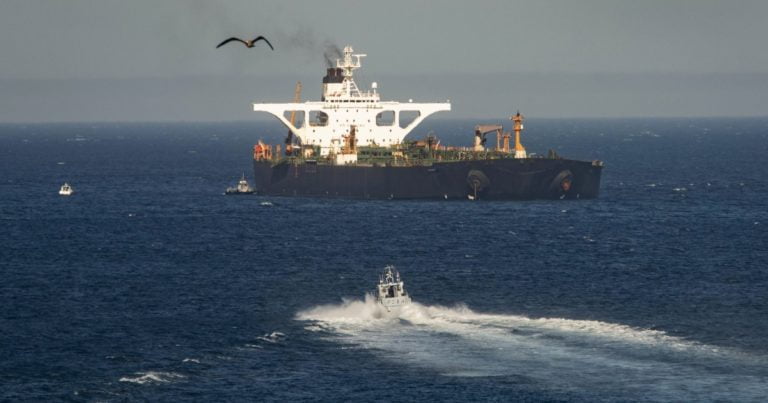
Gibraltar rejected on Sunday a U.S. effort to seize an Iranian supertanker held in the British territory’s port, despite allegations from the United States that the ship helped the Islamic Revolutionary Guard Corps transport oil from Iran to Syria.
In an unusual move, the Justice Department unsealed a seizure warrant and forfeiture complaint on Friday for the Grace 1 supertanker, which the U.S. says is controlled by the Revolutionary Guard, and the Justice Department sent a mutual legal assistance request to British-controlled Gibraltar.
The Justice Department alleged that the oil tanker was part of a “scheme” to “unlawfully access the U.S. financial system to support illicit shipments to Syria from Iran” by the Revolutionary Guard and that this plot was aided by multiple parties as well as a “network of front companies” that laundered millions of dollars connected to the “deceptive voyages” of the ship. Therefore, the U.S. asked for the tanker, all of its 2.1 million barrels of crude oil, and $999,950 in allegedly illicit bank funds be turned over.
A court in Gibraltar said no earlier today.
The supertanker, which originally deceptively flew a Panamanian flag before being captured, has been sitting in a Gibraltar port since July 4, when the British navy seized it on suspicion that it was violating sanctions put in place by the European Union, which do not allow the transport of oil to Syrian dictator Bashar Assad. But the British gave the green light for the ship to be released last week after Iran said the oil would not be brought to Syria. The ship has been renamed the Adrian Darya 1 and is now flying an Iranian flag.
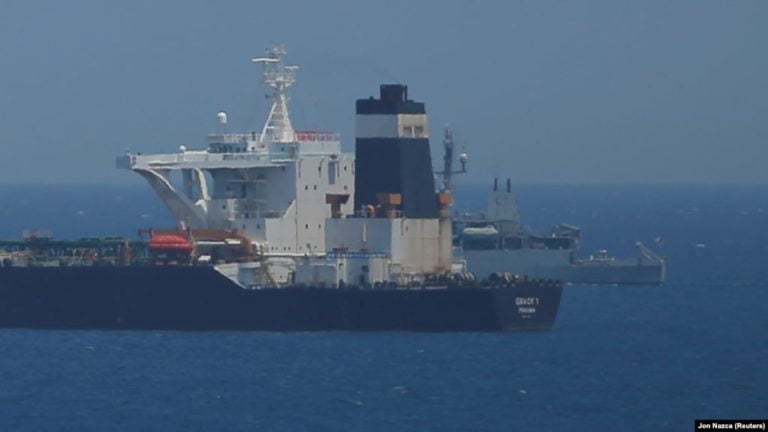
The Iranian tanker seized by British royal marines near Gibraltar in July on suspicion of carrying oil to Syria has left port.
Shipping data showed the Grace 1, renamed the Adrian Darya 1, leaving Gibraltar around 11pm on Sunday, and is believed to be heading to Kalamata in Greece.
Authorities in Gibraltar released the tanker last week but on Friday a federal court in Washington issued a warrant for its seizure, along with its cargo of 2.1 million barrels of light crude oil, and nearly $1m (£824,000).
However, on Sunday Gibraltar said it could not comply with that request because it was bound by EU law.
Washington had attempted to detain the ship on the grounds it had links to Iran’s Islamic Revolutionary Guards Corps (IRGC), which it has designated a terrorist organisation.
The release comes amid a growing row between Iran and the west after Donald Trump pulled Washington out of Tehran’s nuclear deal with world powers more than a year ago.
Shortly after the tanker was detained in early July near Gibraltar, a British overseas territory, Iran seized the British-flagged oil tanker Stena Impero in the Strait of Hormuz, which remains in the Islamic Republic.
Iran has warned the US against any new attempt to seize its tanker in open seas after it left Gibraltar.
Asked whether the US could renew its seizure request, Abbas Mousavi, a spokesperson for the Iranian Ministry of Foreign Affairs, said: “Such an action … would endanger shipping safety in open seas. We have issued a warning through official channels, especially the Swiss embassy.”
Switzerland represents American interests in Iran, which has no diplomatic relations with the US.

Yemen Shiite Rebels Appoint an Ambassador to Iran for First Time

Germany charges army staffer with spying for Iran
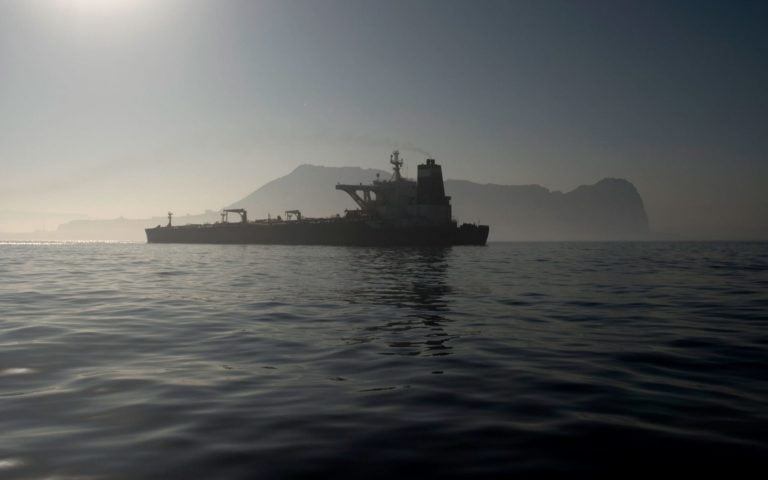
An Iranian tanker detained in Gibraltar for breaching EU sanctions could be allowed to leave on Friday, though a last minute US legal bid to halt it could yet end up back in court, the territory’s chief minister said.
Gibraltar decided on Thursday to free the tanker, but did not immediately indicate when or if the ship would set sail after the United States launched a last-minute legal bid to hold it.
“She is able to leave as soon as she organises the logistics necessary in order to sail a ship of that size wherever it’s going next,” Fabian Picardo told BBC Radio. “Could be today, could be tomorrow.”
Asked about the US request, he said: “Those will be determinations made purely objectively and independently by those authorities and then subject to once again the jurisdiction of the Supreme Court of Gibraltar. It could go back to the court absolutely.”
The US State Department said Friday that the ship was “assisting the Islamic Revolutionary Guard Corps (IRGC) by transporting oil from Iran to Syria” and threatened to sanction its crew members by revoking any US visas they held.
Iran’s state television reported on Friday that the Grace I was being reflagged and preparing to set sail.
“Based on the owner’s request, the oil tanker Grace 1 will depart for the Mediterranean after being reflagged under the Iranian flag and renamed Adrian Darya after preparing for the journey,” the television quoted Jalil Eslami, deputy head of Iran’s Ports and Maritime Organisation, as saying.
“The 25-member crew will start their journey after preparations, including refuelling,” Mr Eslami said.
The television report did not identify the tanker’s owner.

In the spring of 2011, watching the groundswell of dissent that eventually came to be known as the Arab Spring, commentators of various political stripes and nationalities expressed hope that the region would move toward democracy. Iran had experienced a similar moment two years earlier, when millions of citizens protested what they saw as the fraudulent reelection of hard-line President Mahmoud Ahmadinejad. But by 2011, Tehran had effectively crushed that movement. As a result, many Iranians watched the Arab Spring unfold with envy.
Syria, in particular, captured their imagination. Under the Assad family’s rule, Syria had been a crucial ally to the Islamic Republic and the country’s only real Arab partner. For that reason, many Iranians who opposed their own government cheered the anti-Assad protests that broke out in early 2011 and welcomed the prospect of Bashar al-Assad’s downfall. Officials in Tehran, by contrast, observed the situation in Syria with deep unease. Fearful that the friendly regime in Damascus would collapse, they committed significant resources to shoring up Assad, deepening Iran’s involvement as the uprising in Syria morphed into a vicious civil war.
To date, Tehran has spent an estimated $15 billion propping up Assad—even as the Iranian economy has crumbled under sanctions for the better part of the war. Additionally, the Islamic Republic is thought to have sent some 10,000 operatives, including combat troops, to Syria between 2011 and 2014. This number omits non-Iranian forces backed by Tehran, which The Wall Street Journal put at 130,000 in 2014. And by Tehran’s own admission, at least 2,100 Iranians had died in the conflict by 2017, including a number of high-ranking military commanders. Today, even as the war winds down, Iranian body bags continue to return home.

U.S. Arranges Secret Talks Between Israel, U.A.E. Over Iran
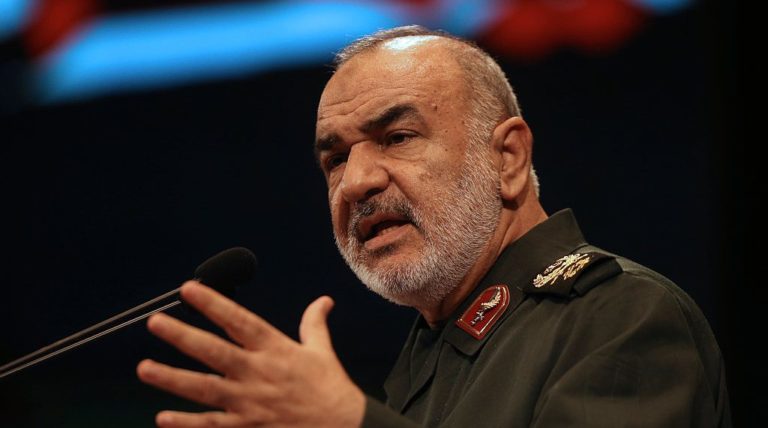
Iranian Revolutionary Guards Commander Hossein Salami declared on Wednesday that Lebanese terrorist group “Hezbollah has acquired capabilities in Syria that allow it to destroy Israel alone.”
The warring comments seem to affirm Israel’s concerns over Iranian-backed activity in war-torn Syria, where the Jewish state has admitted to conducting “hundreds of strikes” on Iranian-linked targets.
The comments come after a Lebanese lawmaker affiliated with Hezbollah warned at the beginning of the week that Israel was preparing to wage war against the Iran-backed group and was ready to “confront it.”
Prime Minister Benjamin Netanyahu hinted that the Israeli military was responsible for carrying out a missile strike on Hezbollah targets in Syria earlier this month.
Salami also addressed the escalating tensions with the United States that were following the seizures of tankers in the Strait of Hormuz and the further breach of the nuclear deal’s terms.
“The Iranian people forgot about talking to the United States and removed it from its thought,” he said in reference to suggestions in recent weeks of possible talks between nations following international calls to reduce tensions.
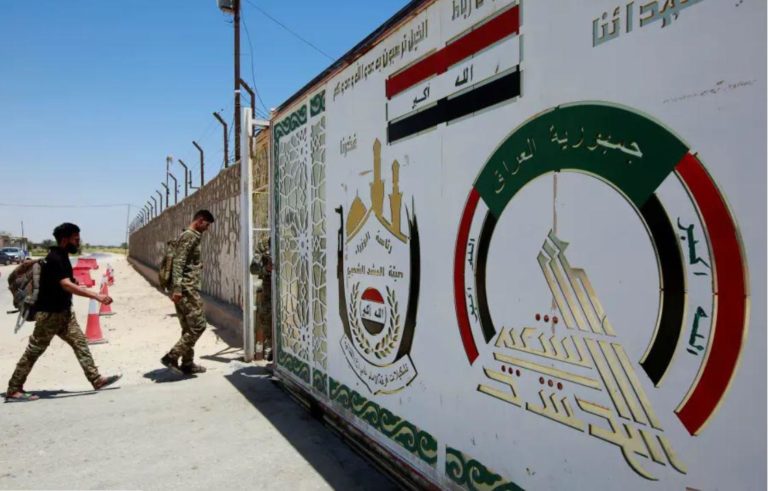
An airstrike was likely behind the explosions in a weapons depot belonging to an Iranian-backed Shiite militia south of Baghdad on Monday, an assessment by ImageSat International (ISI) found on Wednesday.
According to ISI, the warehouse which measured 140x180m belonged to the Hashd al-Shabi (Popular Mobilization) militia and was located within the Iraqi Al-Saqr military base.
On Tuesday, Prime Minister Adil Abdul-Mahdi visited a weapons depot belonging to an Iranian-backed Shiite militia south of Baghdad where an explosion and fire occurred on Monday as conflicting reports emerged about the cause of the incident, according to the international Arabic London-based newspaper A-Sharq Al-Awsat.
One person was killed and 29 others were injured in the explosion, according to Sky News Arabia.
Shortly afterward, shells fell in the Green Zone of Baghdad where the American Embassy in Iraq is located.
Earlier on Monday, the Iraqi Ministry of Health said 13 people were injured in the explosion, according to the Iranian IRNA news agency.
Sources in Iraq issued conflicting statements as to the cause of the attack. Some claimed that it was an accident caused by improper storage, while others claimed that Israel and the US attacked the depot.
Reuters reported that the explosions were caused by a large fire at the weapons depot, which injured 14 people when rockets stored there went off and hit neighborhoods in the area.
A police source said the fire was probably caused by negligence leading to poor storage conditions and high temperatures, according to Reuters.