Home Blog Page 199

1 killed, 29 injured after explosions reported at Iraqi Shia milita base

0

One person was killed and 29 others were injured after explosions were reported at a base of Iranian-backed Shia militias south of Baghdad, Iraq, according to Sky News Arabia. Shortly after, shells fell in the Green Zone of Baghdad where the American Embassy in Iraq is located, according to Sky News Arabia.

The Iraqi Ministry of Health earlier said 13 people were injured in the explosion, according to the Iranian IRNA news agency.

An Al Mayadeen correspondent reported that the explosions were caused by shells hitting the base held by al-Hashd ash-Sha’abi or Popular Mobilization Units (PMU) located in the Abu Dshir area, according to preliminary information.

Al-Ain news reported that an unidentified aircraft carried out the attack on the base to which the PMU recently transferred heavy weapons and missiles.

Reuters reported that the explosions were caused by a large fire at the weapons depot and injured 14 people when rockets stored in the depot went off and hit neighborhoods in the area.

A police source said the fire was probably caused by negligence leading to poor storage conditions and high temperatures, according to Reuters.

Two attacks have hit bases held by Iranian-backed Shia militias in Iraq since the beginning of July.

The first attack happened on July 19 at a base in Amerli in the Saladin province north of Baghdad. Iraqi and Iranian sources blamed Israel at the time, and Asharq Al-Awsat reported that “diplomatic sources” confirmed the attack, specifying that it was carried out by an Israeli F-35.

Read More

1 killed, 29 injured after explosions reported at Iraqi Shia milita base 1 killed, 29 injured after explosions reported at Iraqi Shia milita base 1 killed, 29 injured after explosions reported at Iraqi Shia milita base 1 killed, 29 injured after explosions reported at Iraqi Shia milita base 1 killed, 29 injured after explosions reported at Iraqi Shia milita base iran

Houthis Threaten to Use New Defense System

0

Iran-backed Houthi militias have threatened to use a new air defense system, enhancing their military capabilities to counter the legitimate government.

The newly obtained system is most likely Iranian-made.

The threats came after Houthis’ so-called spokesman Yahya al-Saree and foreign minister Mohammad Abdel Salam Felita met in Tehran with commanders of the Iranian Revolutionary Guards Corps (IRGC) and Foreign Minister Mohammad Javad Zarif.

Sources believe Felita’s visit to Tehran may be linked to efforts to acquire new weapons which Iran smuggles into Yemen using its terrorist arms to reach Hodeidah port. The group still refuses to withdraw from Hodeidah according to the Swedish agreement.

The militias admitted to Felita’s meeting with FM Zarif, however, they did not disclose his meeting with IRGC commanders.

Houthi media claimed that during the meeting, they discussed means to strengthen bilateral and diplomatic relations with Tehran and joint cooperation to support the political solution in Yemen, as well as regional developments.

Observers believe the Iranian regime has summoned Felita to assign the group new terrorist missions in the Red Sea in order to ease international pressure in Hormuz Strait.

The Spokesman indicated that soon there will be discussions on the group’s air defense forces, especially with the recent developments in the system, boosting its performance to carry out operational tasks in various areas.

He indicated that the group’s military militias will soon unveil their new developments of the air defense.

Houthis rely on Iranian missiles and drones they receive to carry out terrorist acts and attacks against the Yemeni army and Saudi civilian areas. However, they claim in media reports that the missiles are manufactured in Yemen.

Read More

Houthis Threaten to Use New Defense System Houthis Threaten to Use New Defense System iran briefing

Iran’s navy chief warns any Israeli presence in Gulf could ‘spark war’

0

The commander of the Iranian Revolutionary Guard’s navy, Alireza Tangsiri, warned Sunday that “any illegitimate presence by the Zionists in the waters of the Persian Gulf could spark a war.”

His remark followed reports on Israel potentially taking part in a US-led international mission to secure Western vessels crossing the Strait of Hormuz, after Iran seized several oil tankers, amid escalating tensions over US sanctions on the Islamic Republic.

In an interview to the Hezbollah-affiliated Al-Mayadeen television station in Lebanon, Tangsiri warned that “whenever our commanders wish so, they are able to detain any ship, even if it is accompanied by American and British forces.”

Last week, the Ynet news site reported that Foreign Minister Israel Katz had told a closed session of the Knesset Foreign Affairs and Defense Committee that Israel was involved in US-led efforts to provide maritime security in the Strait of Hormuz.

Katz said Israel was assisting the mission to secure the crucial waterway with intelligence and in other unspecified fields. He stressed the mission was in Israel’s strategic interest of countering Iran and boosting ties with Gulf countries.

Responding to Katz’s comments, Iran’s defense minister on Thursday said that the formation of a US-led flotilla would “increase insecurity” and any Israeli involvement would have “disastrous consequences” for the region.

Tehran and Washington have been locked in a battle of nerves since US President Donald Trump withdrew from a landmark 2015 nuclear deal with Iran last year and reimposed sanctions.

Tensions have soared in the region, with drones downed and tankers mysteriously attacked in Gulf waters.

Read More

Iran’s navy chief warns any Israeli presence in Gulf could ‘spark war’ Iran’s navy chief warns any Israeli presence in Gulf could ‘spark war’ Iran’s navy chief warns any Israeli presence in Gulf could ‘spark war’ iran briefing iran

Campaign Pressuring Tehran to Release 8 Environmentalists

0

Social media users have interacted regarding the issue of eight environmentalists facing security charges in Iran, one week after they started a hunger strike. Two hashtags were launched to pressure Iran to release the activists.

Kaveh Madani, water management expert, tweeted that 564 days have passed since arresting the activists, and eight days since the hunger strike. He stressed that their only demand is to work based on justice.

Human Rights Watch said last week that the authorities should immediately release all eight environmentalist experts detained for over 18 months without being provided with the evidence concerning their alleged crimes.

“Members of the Persian Wildlife Heritage Foundation have languished behind bars for over 550 days while Iranian authorities have blatantly failed to provide a shred of evidence about their alleged crime,” said Michael Page, deputy Middle East director at Human Rights Watch.

“The authorities should take the long-overdue step of releasing these defenders of Iran’s endangered wildlife and end this injustice against them,” Page added.

HRW quoted a reliable source as saying that the environmentalists on hunger strike are demanding that authorities end their legal limbo and either release them on bail until a verdict is issued against them or transfer them to the public ward of Evin prison.

They are inward 2-Alef of Evin prison, which is under the supervision of the IRGC’s Intelligence Organization, the source added.

Their trial in Branch 15 of Tehran’s revolutionary court was halted before March, then resumed at the beginning of August. The court reportedly did not allow lawyers to review the evidence before the trial opened on January 30.

Article 48 of Iran’s 2014 criminal procedure law says that detainees charged with various offenses, including national or international security crimes, political, and media crimes, must select their lawyer from a pre-approved pool selected by Iran’s judiciary during the investigation.


Read More

Iranian parliamentarian: Authorities should explain confessions of the defendants to the assassination of nuclear scientists

0

Iranian parliamentarian Mahmoud Sadeghi has called on Islamic Republic officials to comment on the “false or true of the confession of the defendants to the assassination of nuclear scientists”.

Mr. Sadeghi described the reason of his request as “bizarre allegations” recently published about the false confessions of the defendants.

The BBC Persian recently reported on the fate of a case known as the “Assassination of Nuclear Scientists”.

In this report, Maziar Ebrahimi, one of the defendants, calls on the Ministry of Intelligence to press fictitious confessions as well as judiciary system file case against him.

He also has claimed that under pressure of the Ministry of Intelligence’s interrogators, he provided false intelligence about the blast of IRGC missile base, Malard, to the IRGC intelligence agents.

Seven years ago, Maziar Ebrahimi, along with twelve others, in a documentary called the “Terror Club” confessed that he went to Israel, trained there and then returned to Iran to assassinate Iranian nuclear scientists.

Iranian security officials claim that in the years between 2009 to 2011, four of the Iranian nuclear scientists have been killed and one survived an assassination.

After hearing this case, Majid Jamali Fashi, one of the defendants in the case, was executed in May 2012 on charges of “assassinating Massoud Ali Mohammadi”, a professor of physics at the University of Tehran.

Maziar Ebrahimi’s remarks have now raised doubts as to the validity of the accusations and confessions of Majid Jamali Fashi.

According to the documentary, all of the defendants have now been released, with the exception of Majid Jamali Fashi, who was executed before the release of this documentary.

It is worth remembering that the Persian and English sections of the Iran Briefing on January 17, 2011, found dozens of reasons for Majid Jamali Fashi’s innocence, some of which are also reflected in the now BBC Persian documentary. In 2011, the Iran Briefing report was noticed by international media including Foreign Policy and was published there.

Now, based on Maziar Ebrahimi’s statements, the Iranian security apparatus has pressured the defendants during their temporary detention and a fair hearing has not been conducted.

Mr. Ebrahimi says the film aired on Islamic Republic national TV was made by the Ministry of Intelligence and recorded in the Evin prison in the presence of the interrogators.

He says after being forced to confess to killing Iranian nuclear scientists, he was tortured for seven months in an unspecified location outside Evin Prison.

In the interview with the BBC, he acknowledged that “what ultimately led to him miraculously being freed was the competition between the Ministry of Intelligence and IRGC Intelligence, and the Ministry of Intelligence’s attempt to make him confess more.”

At that time, Haidar Moslehi was the Minister of Intelligence.

After releasing the film of the confessions to the assassination of nuclear scientists, it was revealed to Iranian government security and intelligence officials that Maziar and other defendants were innocent. But they remained in jail for another twenty six months.

They spent a total of three and a half years in prison.

Maziar Ebrahimi’s current remarks can now show dark corners of the divide between Mahmoud Ahmadinejad and Heydar Moslehi. At the same time that Maziar Ebrahimi says IRGC interrogators found out that the confessions made under Ministry of Intelligence interrogations were false, Mahmoud Ahmadinejad dismissed Heidar Moslehi. But Khamenei did not approve his dismissal, and in a letter to Haider Moslehi asked him to stay in the Ministry of Intelligence.

The incident led to Ahmadinejad’s leaving duty for a few days and the beginning of the disagreement between the leader of the Islamic Republic and Mahmoud Ahmadinejad.

Although margins have been circulating in the domestic media since the BBC documentary broadcast, Iranian parliamentarian Mahmoud Sadeghi is the first official to respond.

Iran’s Spies Are at War With Each Other

Iran’s Spies Are at War With Each Other

Iran’s Spies Are at War With Each Other

Political rivalry among Iran’s various factions is nothing new. Ever since the 1979 revolution and particularly after former President Mohammad Khatami’s unexpected electoral victory in 1997, moderate officials—including reformists and centrists now associated with Hassan Rouhani’s administration—have been vying with hard-liners and traditional conservatives known as “principalists” for a greater share of clout and resources in Iran’s labyrinthine system of governance.

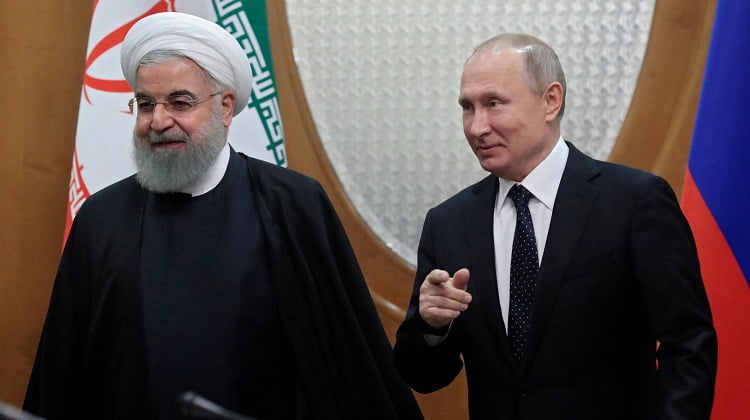
How Russia is deepening military ties with Iran to counter the US

0

How Russia is deepening military ties with Iran to counter the US

How Russia is deepening military ties with Iran to counter the US

Russia and Iran are deepening their military ties in a joint challenge to perceived US hegemony in the Middle East. The Russian Defense Ministry and the General Staff of the Iranian Armed Forces signed a memorandum of understanding that seeks to expand military ties between the two countries on Monday during Iranian Navy Commander Hossein Khanzadi’s three-day visit to St. Petersburg.

Iran is reportedly jamming ship GPS navigation systems to get them to wander into Iranian waters

0

Ships passing through the Strait of Hormuz and the Persian Gulf have reported unusual GPS interference, among other problems, and the US believes Iran is to blame.

The Department of Transportation’s Maritime Administration issued a warning on Wednesday highlighting threats to commercial vessels posed by Iran. The warning revealed that ships have had a variety of issues when operating in the region, including “spoofed bridge-to-bridge communications from unknown entities falsely claiming to be US or coalition warships.”

“Due to the heightened regional tensions, the potential for miscalculation or misidentification could lead to aggressive actions against vessels belonging to US, allied and coalition partners operating in the Arabian Gulf, Strait of Hormuz, and Gulf of Oman,” US Central Command (CENTCOM) explained in an emailed statement, adding that ships have reported experiencing “GPS interference, bridge-to-bridge communications spoofing, and/or other communications jamming with little to no warning.”

In some cases, a US official told CNN, Iranian Navy and Islamic Revolutionary Guard Corps vessels have spoofed merchant ship automatic identification systems to make themselves look like commercial shipping vessels.

At least two incidents allegedly involved GPS interference.

A US defense official told CNN that Iran has GPS jammers operating on Abu Musa Island, an island in the Persian Gulf located near the Strait of Hormuz, adding that the aim is apparently to cause ships and aircraft to inadvertently wander into Iranian waters or airspace, thus justifying a seizure.

Following a string of suspected limpet mine attacks on commercial shipping vessels, actions the US military has attributed to Iran, Iranian forces began seizing tankers. Following the seizure of an Iranian tanker believe to be in violation of sanctions by British forces, the Iranians tried unsuccessfully to capture the BP oil tanker British Heritage.


Read More

Iran is reportedly jamming ship GPS navigation systems to get

U.S. warns of GPS interference, communications spoofing in Persian Gulf

0

The US Department of Transportation warned commercial shipping companies on Wednesday about a list of Iranian threats in the Strait of Hormuz and the Persian Gulf, including GPS interference and communications jamming, CNN reported.

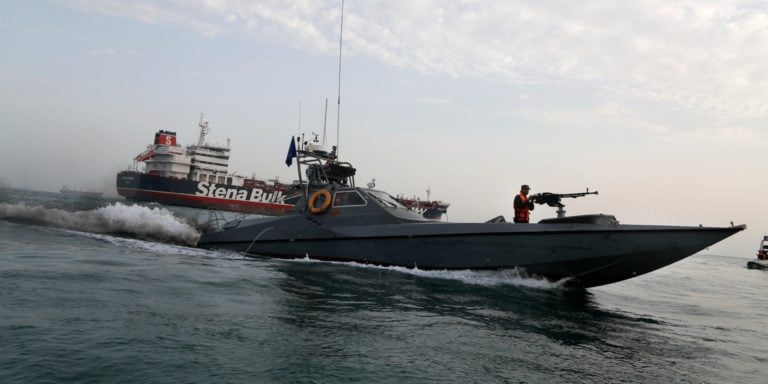
The warning listed a series of incidents that have occurred involving the Islamic republic since May, including the detention of the British-flagged M/V Stena Impero and the detention and release of the Liberian-flagged M/V Mesdar.

During “at least two” of the recent encounters with Iranian military forces, “vessels reported GPS interference. One vessel reportedly shut off its Automatic Identification System before it was seized, complicating response efforts.”

The Stena Impero “turned off its tracker and ignored several warnings by the [Iranian Revolutionary] Guards before being captured,” an unnamed military source told Iran’s state news agency IRNA, according to Reuters.

Ships in the area have also reported spoofed communications from “unknown entities falsely claiming to be US or coalition warships,” according to the warning.

Iran has placed GPS jammers on its Abu Musa Island, located in the Persian Gulf near the entrance to the Strait of Hormuz, a US defense official told CNN.

The jammers were placed at that location in order to disrupt civilian aircraft and ship navigation systems. Iran hoped that ships or planes would mistakenly wander into Iranian waters or airspace due to the GPS malfunctions, which would give Iranian forces the pretext needed to seize them.

According to the official, the jammers have no effect on US military warships and aircraft.
In July, British media reported that the British intelligence services MI6 and GCHQ were concerned that Iran had used Russian GPS spoofing technology to send the Stena Impero off course into Iranian waters.
U.S. warns of GPS interference, communications spoofing in Persian Gulf  U.S. warns of GPS interference, communications spoofing

Iran to Send $30 Million per Month to Hamas in Exchange for Intelligence

Iran to Send $30 Million per Month to Hamas in Exchange for Intelligence

Iran to Send $30 Million per Month to Hamas in Exchange for Intelligence

Iran has reportedly recently agreed to increase its funding to the Hamas terrorist group by $30 million a month, according to Israel’s Channel 12 news agency.