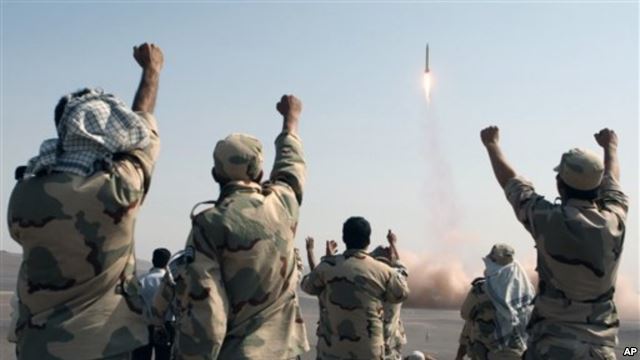
TEHRAN – Commander of Islamic Revolution Guards Corps Ground Force Brigadier General Mohammad Pakpour underlined the IRGC’s firm resolve to act decisively against terrorist and armed groups along the country’s borders and beyond.Terrorists’ Positions
According to Tasnim News agency, General Pakpour on Sunday stressed that the IRGC will rigorously confront terrorists’ moves in the country’s border areas and target their positions anywhere they are.
He referred to recent clashes between the forces of IRGC’s Hamze Sayyid al-Shohada Base and terrorist teams affiliated with anti-revolutionary groups in a northwestern region of the country and said the militants have been provoked by “reactionary countries” to make the aggression.
He added that the IRGC warriors are watchful of every move by infiltrating terrorists and will give an immediate and crushing response to any wicked act.
The senior commander further noted that the terrorists’ main base is in northern Iraq and warned that if their anti-security moves and measures are not prevented, they will be targeted wherever they are.
On Friday, IRGC forces killed a number of terrorists in armed clashes in Sarvabad and Mahabad regions in the northwestern province of West Azarbaijan.
According to the public relations department of the IRGC’s Hamze Sayyid al-Shohada Base, a number of terrorists were killed in the encounters.
Members of the group had entered the village to carry out terrorist attacks and spread propaganda, an IRGC member said.
The militants had on June 15 clashed with the IRGC in the Oshnavieh County, also in West Azarbaijan Province.
Two days earlier, IRGC Ground Force troops killed five members of the Party for Free Life in Kurdistan (PJAK) terrorist group in an ambush in Sardasht region in West Azarbaijan.
On the same day, Iranian police forces killed five members of the Jaish ul-Adl terrorist group in an exchange of fire in the southeastern province of Sistan and Balouchestan, while a trooper was also martyred. Terrorists’ Positions Terrorists’ Positions Terrorists’ Positions Terrorists’ Positions Terrorists’ Positions Terrorists’ Positions Terrorists’ Positions Terrorists’ Positions Terrorists’ Positions
One of the world’s most wanted terrorists met a fiery death last month. The mystery over who killed him is now an international guessing game—with the prime suspects in Washington.
Plenty of people wanted Mustafa Badreddine dead.
There were the Saudis, who blamed him for terror attacks in the kingdom and against its allies abroad.
The Israelis had already once tried to assassinate Badreddine, the military commander of Hezbollah and one of the most important and powerful figures in the organization.
Even Badreddine’s own Hezbollah brethren were said to have their knives out, feuding with the storied militant over where the group should devote its resources: Towards attacks against its longstanding enemy, Israel, or on the battlefields of Syria, where Badreddine had been commanding around 6,000 men in an all-out effort to prop up the regime of Bashar al-Assad. Some Hezbollah figures had also chastised Badreddine as an easily distracted womanizer who had developed a taste for the high-life, dining in fine restaurants and tooling around Lebanon in a Mercedes.
But of all Badreddine’s many enemies, one had a special place for him on its most-wanted list–the United States. And that has officials in several countries speculating that Washington finally took him out in a massive explosion in Damascus last month.
Badreddine had put himself in America’s crosshairs at a young age. In 1983, the 22-year old budding terrorist helped to plan the suicide bombing of the U.S. Marines barracks in Beirut, Lebanon. Even then, Badreddine was a genius with explosives and devised a means for increasing the force of the bomb by the insertion of compressed gas. Loaded onto a flatbed truck, his device ripped the hulking barracks building off its foundations and collapsed it inward, killing 241 men inside, most of them probably in their sleep. It was the deadliest day for the Marines since they stormed the beaches at Iwo Jima.
Badreddine would go on to help plan and execute a string of bombings that year, including on the U.S. and French embassies in Kuwait. But there, he was captured, tried, and imprisoned. The cunning killer seemed to have been put away.
Badreddine’s cousin, however, had other plans. He made it his mission to free his brother-in-arms, and he directed a slew of kidnappings and attacks all aimed at achieving that end. In one notorious airline hijacking in June 1985, in which the assailants demanded Badreddine’s release in exchange for the passengers, the cousin and his henchmen beat to death Navy diver Robert Stethem and dumped his body on the tarmac of the Beirut airport in front of rolling TV cameras.
There were other violent efforts to free Badreddine and 16 of his fellow prisoners, including at least two hijackings, which claimed the lives of four passengers, and a kidnapping spree of Americans in Beirut in the 1980s. That led President Ronald Reagan to sell arms to Iran–Hezbollah’s main patron–in exchange for the Americans’ release.
But then, a stroke of luck for Hezbollah: Badreddine escaped prison in 1990 amid the chaos of Iraq’s invasion of Kuwait. For the next quarter century, he was practically a ghost, using aliases and multiple cell phones to avoid detection.
Until one day last month.
On May 10, in a building near the Damascus airport, Badreddine met the same fiery end as so many of his victims. News ACCOUNTS are sketchy but all described a huge explosion that killed Badreddine and possibly others present for a meeting of Hezbollah’s forces in Syria. What was left of him was placed in a box and buried in Beirut. Thousands turned out for the funeral, and Iran’s government sent messages of condolence praising the vanquished commander.
Mustafa Badreddine’s funeral ceremony
Badreddine’s death was a body blow to Hezbollah, which has been losing more men in its efforts to prop up the Assad regime than it has in armed conflict with its longtime enemy Israel, according to U.S. and Israeli intelligence officials. But it was also a moment of celebration for American spies, soldiers, and diplomats. Badreddine was one of the founding fathers of the modern era of terrorism, kicked off by the barracks bombing in 1983 and an attack on the U.S. embassy in Beirut that killed 63 people and wiped out most of the CIA station in the country. It was the deadliest strike on the agency until an al Qaeda suicide bomber detonated himself at a remote outpost in Khost, Afghanistan, in 2009.
Almost immediately after the explosion that killed Badreddine in Damascus, Hezbollah pinned the blame on Israel. That was no surprise. Accusing Israeli intelligence for all manner of attacks is practically a reflex for Hezbollah. And sometimes with good reason. In fact, the U.S. and Israel had been credited with killing Badreddine’s cousin, Imad Mughniyah, in 2008. Until his death, Mughniyah, who was also married to Badreddine’s sister, had been Hezbollah’s military chief. He was killed after a months-long operation–also in Damascus–with a bespoke bomb hidden inside a car. It detonated as Mughniyah passed, ripping him limb-from-limb and sending his torso flying through a window 50 feet away, Newsweek reported.
But almost as soon as the word went out that Israel had killed Badreddine, Hezbollah made a new claim–that he was assassinated by “takfiri” terrorists, a pejorative for Syrian rebel forces and Sunni militants, including ISIS and al Qaeda, whom Shiite Hezbollah considers apostates.
That may have been the official line. But in the U.S. and Israel, no one seemed to buy it. What’s more, in the corridors of power in Tehran, senior government officials were pointing the finger somewhere else: Washington.
***
The U.S. certainly had the motive, and the opportunity, considering that the military’s Central Command is conducting a daily barrage of airstrikes in Syria. If American spies did finally track Badreddine to that building near the airport in Damascus, it must have been the result of painstaking work by U.S. and Israeli intelligence agencies.
Badreddine was famous not just for his lethal genius, but for being practically untraceable. “Since the year 2000, there has been no mention of his name in any registry or record in Lebanon, there are no bank ACCOUNTS, social security or internal revenue documentation and no property in his name,” Ronen Bergman, the journalist who is perhaps most well-sourced in Israel’s intelligence community, wrote shortly after Badreddine died.
Mustafa Badreddine’s funeral ceremony
But Badreddine didn’t exactly live a quiet life. Under another identity, Sami Issa–or alternatively Sami Samino–he struck the pose of an international man of mystery. He dined in expensive restaurants. Personal bodyguards attended his moves. He even owned a jewelry shop, boldly named “Samino,” Bergman reports.
On his various cell phones Badreddine kept in touch with his various mistresses. He risked detection by some of his oldest enemies. But not even the threat of imminent death could slake his mortal appetites, it seems.
Being hunted also didn’t blunt Badreddine terrorist ambitions, and in 2005, he proved that while he might be off the radar, he was not out of the picture. Working with top Hezbollah commanders, Badreddine orchestrated the assassination of Rafic Hariri, the ex-prime minister of Lebanon and one of the country’s most well known politicians and business leaders. Hariri’s convoy was hit by a massive bomb hidden inside a parked car near the St. George HOTEL IN Beirut. It was a classic Badreddine operation.
“Hariri was one of the best-guarded people in the world, with his security protocol formulated by experts from Germany and the United States,” Bergman writes. “Badreddine’s success in killing Hariri (together with 21 other people) had once again proven that apart from Mughniyah [his cousin and brother-in-law], he was the best operative in the organization.”
But within three years, Mughniyah was dead, killed in that joint U.S.-Israeli operation. Badreddine stepped into his relative’s role, and now, the hunt was on for him.
In January 2015, Israel thought they’d found their man, traveling in a convoy in Syria. An Israeli helicopter reportedly fired two missiles at the vehicles, but Badreddine wasn’t there. Mughniyah’s son, however, was among the dead.
Badreddine would have gotten the message that his trail was no longer cold. Israeli officials were onto him, which meant the Americans almost certainly were, too. The fact that Israel had tried so recently to kill Badreddine is another reason why U.S. and Israeli officials I spoke to are deeply skeptical of the theory that ISIS or al Qaeda fighters finally took him to his grave.
***
There has been no public claim from Hezbollah that the U.S. killed Badreddine. But at the highest levels of the Iranian regime, leaders have concluded that he was taken out in a precision U.S. airstrike, an Iranian official with knowledge of information sent to top leaders told The Daily Beast.
Radar that Iran had installed in Lebanon and Syria picked up signals showing a missile that was fired by what Tehran’s intelligence analysts have concluded was either a U.S. drone or a manned aircraft, said the Iranian official, who spoke on condition that he not be identified by name.
This bold allegation hasn’t been officially leveled. But, the official said, Iran’s supreme leader, Ali Khamenei, was so incensed by the American attack on a Hezbollah icon that he ordered Gen. Qassem Soleimani, the head of Iran’s Quds Force, to begin retaliatory strikes at U.S-backed rebels in Syria. It’s not clear if those orders were carried out. But a U.S. counterterrorism source told The Daily Beast that there had been “chatter” since Badreddine’s death that Iran had put out orders to exact some revenge.
The fog of suspicion only thickens. Speaking privately, two U.S. defense officials said they’re aware of allegations in Iran that the U.S. was behind the attack. But they offered no claim about who was really responsible, other than to speculate that the explosion may have been caused by an errant artillery strike by the Syrian regime, a kind of friendly fire incident that was also a “lucky” event for the U.S., as one official put it.
A U.S. intelligence official said he was also aware that Hezbollah has publicly blamed “takfiri” terrorists. But no one in the U.S. national security community, nor in Israel, was persuaded that ISIS or al Qaeda’s branch in Syria had the sophistication or the firepower to pull off the attack that killed Badreddine.
Hezbollah said in an official statement that an “artillery bombardment” caused the explosion that killed their commander. But that would seem to rule out an attack by Sunni terrorists since they’re not known to possess those kinds of weapons. Syrian opposition forces, for their part, have also rejected claims that they may have been responsible.
At the same time, some Lebanese journalists with sources in Hezbollah have claimed that Badreddine “was killed by a missile possessed only by advanced countries,” according to the Times of Israel. That would support Tehran’s contention that Washington is to blame. Lebanese papers have also quoted Hezbollah parliamentarians alleging that Israel provided the technology to kill Badreddine, the Times of Israel reported, which leaves open the possibility that Israel tracked Badreddine to his location and then tipped off forces on the ground.
But Tehran has dismissed the notion that Sunni fighters, Israel, or anyone besides the U.S. military or the CIA were to blame, the Iranian official said. He also downplayed speculation, which has surfaced in various press ACCOUNTS, that Hezbollah may have killed Badreddine as part of an internal power struggle. Hezbollah’s true believers “do not kill their own people–period,” the official said.
If the U.S. did kill Badreddine, it might want to keep that quiet so as not to divulge the intelligence sources used to find him. Iran may also have calculated that it’s not worth antagonizing the U.S. to publicly assign the blame for Badreddine’s killing, particularly now that Iran is enjoying sanctions relief following a landmark agreement with Western powers to suspend production of nuclear materials.
The lack of precise details on the nature of the explosion–was it really a missile, or could it have been a powerful bomb, maybe even of the kind that Badreddine knew how to build?–also has helped fan the flames of speculation about who’s to blame. But in recent conversations, Israeli journalists and intelligence officers repeatedly said that Israel wasn’t behind the assassination.
One Israeli intelligence official, speaking privately, likewise concluded that Israel was not the culprit. What’s more, the official added, it was notable that Hezbollah quickly walked back initial claims that Israel was responsible. The reason? The last thing that Hezbollah’s leaders want now is another fight with Israel; their forces are too stretched, having evolved from a militant group focused primarily on its home base of Lebanon to an expeditionary force that is spilling blood and treasure in Syria, this official said.
So who did it? The Israeli official smiled. “I think maybe it was you,” he said, meaning the United States.
In the end, it may not matter who gets credit for killing Badreddine. The fact that he was taken down after a lifetime spent in the shadows has sent a message to Hezbollah and its patrons in Tehran, the Iranian official said: Your forces aren’t as strong as you think they are.
Iran Briefing: Javad Mansouri, one of the first commanders of the Iranian Revolutionary Guards and Iranian senior diplomat, in an interview with the weekly “Ramz-e Obour” has claimed that Abbas Araghchi, an Iranian diplomat and the Deputy Minister for Legal and International Affairs, is also a member of the terrorist Quds Force.Abbas Araghchi
According to Tasnim (the Iranian diplomat), Araghchi, the Chief of Staff to pursue the implementation of Joint Comprehensive Plan Of Action (JCPOA) and a senior member of Iran’s nuclear negotiating team, in an interview with the weekly “Panjereh” claimed: “He had formally quit the Iranian Revolutionary Guards since entering the Ministry of Foreign Affairs in 1989, but he has not been satisfied with this separation and so he has kept all his clothes during his time in the Corps.”
Javad Mansouri, the former commander of IRGC also said: “In addition to Abbas Araghchi, other Iranian diplomats are also members of the Quds Force and this selection procedure of diplomats has so far been continued at the inception of the Quds Force.”
Javad Mansouri continued: “Quds Force is one of the special formed forces and a subdivision of the Iranian Revolutionary Guards in cross-border activities. The corps was called “Nehzat-e Azadi Bakhsh” (liberation Movement), founded in 1979 and was initially chaired by Mohsen Rafiq Doost; however, after “Mehdi Hashemi” (Ayatollah Montazeri’s relative) joined, it was known and named as an independent organization. In 1985, Nehzat-e Azadi Bakhsh was transferred to the Foreign Ministry on the order of Ayatollah Khomeini and the Ministry was responsible for its management. After a while, it was known as a subdivision of the IRGC named “Shakhe-ye Quds” (Quds Subdivision). The institute was established during the Iran and Iraq war but during the war, and up to this day, it still continues its activities throughout the world. Currently, Qusem Soleimani is the commander in chief of the Quds Force.”
Javad Mansouri believes that Abbas Araghchi and some other Iranian diplomats have been introduced to the Foreign Ministry by the Quds Force and are still members of the force. He also acknowledges the Iranian ambassadors in Iraq, Lebanon and Syria as the Force members saying: “The Ministry of Foreign Affairs and the Quds Force has close relations with each other and they coordinate in the selection of ambassadors and diplomats.”
Releasing the interview, the governmental news agencies has quoted informed sources denying Abbas Araghchi’s membership in the Quds Force and mentioning Mansouri’s interview with weekly “Ramz-e Obour” , far from reality; he also stated that his remarks shocked him cold. Ramz-e Obour is one of the publications close to “Mahmoud Ahmadinejad” opposing with the government.
The presence of Quds Force members as ambassadors, members of embassies and diplomats, has a long history after Iran’s Islamic Revolution. In 1982, Commander Ahmad Motevaselian and three other members of the Quds Force were taken as hostages by Israelis militants in Beirut. Since Iran’s pursuit for their release, they have been introduced as diplomats. The destiny of these four members of the Quds Force, 35 years after being taken as hostages and transferring to Israeli territory, is still shrouded in mystery.
It is worth mentioning that “Ghazanfar Rokn Abadi”, the former Iranian ambassador in Lebanon who was killed during the Mena accident last year, was also a member of the Quds Force.
Iranian Paper Shut After Criticizing Revolutionary Guards as Crackdown on Freedoms Continues
Iranian Paper Shut After Criticizing Revolutionary Guards as Crackdown on Freedoms Continues – The publication, Ghanoon, had run afoul of the IRGC for …
An independent Iranian newspaper said it was shut down by authorities after criticizing the country’s powerful Islamic Revolutionary Guard Corps.
Canadian professor Homa Hoodfar, imprisoned in Iran, still not allowed contact with family, lawyer
Canadian professor Homa Hoodfar, imprisoned in Iran, still not allowed contact with family, lawyer – Homa Hoodfar, the Concordia University professor …
Homa Hoodfar, the Concordia University professor seized in Iran, has disappeared into Evin prison. Her family and her lawyer have been refused all contact in the two weeks since she was suddenly arrested in Tehran.
Iran Briefing: By an Act of Parliament in previous years, a plan called “jihad camps” is running each year which Basij is in charge of its organizing and deployments. In this project which is implemented across the country through participating students and Basij, the volunteer students each year are sent to deprived areas to get involve in civil works. Jihadi camps
During the project, which is directly run by Basij and under the Iranian Revolutionary Guards’ supervision, student volunteers in a seven-day camp are being sent to help deprived areas; however the main purpose of the plan is “culture and beliefs strengthening of young people in their leisure time”. According to a Corps’ Commander, the plan is focused on “serving” and it is prepared based on the slogan of the year made by the leader of the Islamic Republic.
The Corps’ commander of Zarandieh, Mohammad Mahjoori, introduced the main purpose of the plan” the system’s future staffing and helping the government to achieve the goals of economy resistance”. Naming the year as “Economy Resistance, Acting and Action” assumes that the country urgently needs workforces to participate in the economy field; and using the teenagers and youths either as the workforces or to be prepared to participate in ideological courses provides the required force for the future plans.”
Considering the youth acclamation of the plan, the corps commander mentioned the plan as the best opportunity to expand the spiritual motivation and prepare the necessary requirements to gain a jihadi view.
Mentioning that holding the “jihad camps” is the perfect place to guide the younger generation, Semnan governor also stated that attending these camps is ten times more effective than listening to speeches to guide the youth. He also believes that in order to improve the economy of resistance, attending the deprived area which reduces the expectations and also acting in the field of work and effort is very crucial.
Other projects such as “Hejrat Plan” and “Rahian-e Noor” are the other projects for youth, held by various security and army institutes such as Basij and Corps which the purpose of these projects is mostly to prepare youth for future contributions in the issues beyond the economy.
In fact, the Corps intends to provide its required future staff through arrangement and selection of these adolescents. Therefore, before starting the project in the summer, all the agencies affiliated to the IRGC and Basij start wide advertising and publicity about the plan in order to encourage the students to join the plan. The provincial authorities are also required to utilize the institutes under their management in order to promote and run a sensational plan.
Hashem Ghiasi, the IRGC commander of “Ansar al-Reza” also contends that the activities of these groups should not be limited to the spring and summer as the Basij Sazandegi (Reconstruction Basij) can remove the burden from the government’s shoulders through these projects. Another IRGC commander considered the presence of Basij in these camps as strengthening the relationships between people and Basij.
Considering the institutes involved in the “Jihadi Camps”, helping the deprived is perhaps the last concern or cover for its real purpose of implementation; it is particularly intended for governmental staffing, educating and identifying efficient people for the future and consolidating long-term mobilization activities.
The annual implementation of a plan such as Rahian-e Noor has caused many fatalities among innocent youth during the deployments and its activities; these victims are named Jihadi Martyrs. Jihadi camps Jihadi camps Jihadi camps Jihadi camps Jihadi camps Jihadi camps Jihadi camps Jihadi camps
The bio of elected IRGC’s military representatives in 10th Islamic Parliament; A Basij Commander and member of the Halghe-ye Salehin (Righteous Ring)
Hajar Chenarani
Iran Briefing: The end of the first and second round of the parliamentary elections finally determined the left parliamentary seats of the cities across the country. Accreditations of all the elected representatives of the parliament were approved without any objection and the representatives started choosing the members of specialized committees.Hajar Chenarani
Among them, Hajar chenarani, an elected woman from Neyshabour constituency has hit the headlines of the tenth parliament news. Chenarani has made herself as a controversial member in National Security Commission and Foreign Policy.
Mentioning she is still a particular commander of Corps of Salehin (Righteous), the representative of Neyshabour in Tenth Parliament said: “None of the Tenth Parliament women has had a background and security activity as I do.” Her remarks were denied by the users of Neyshabour on social networks.
The Neyshabouri users of social networks wrote that she has demanded for the Commission of Budget during her election campaign, however she brought excuses saying: “ Surly the disputes on my presence in the National Security Commission and Foreign Policy of the Parliament will be resolved in a few days. From the first day being elected as a representative of Neyshabour in the Tenth parliament, all my effort and interest was attending the National Security Commission and the Foreign Policy of the Parliament; of course I was prepared to attend other commission and work there if the conditions were not prepared.”
Neyshabour city has two representatives in the Parliament. In the Tenth parliamentary elections, doctor “Garmabi” a reformist candidate and Chenarani, a conservative candidate who was introduced as an independent candidate won the election. Before starting the parliament, Hajar Chenarani was seen in the courtyard of the Parliament consulting and requesting the representatives to participate in the Plan and Budget Commission.
Making a political bluff to the reformist representatives of the parliament, she said that in case of cooperation, she will vote Aref for the presidency of the parliament. As long as the Omid coalition had introduced only one candidate for Neyshabour, people tried to vote for an individual independent that had fewer disputes in order to prevent the right wing extremists to be elected for the parliament.
Indeed people voted for Chenarani to prevent some candidates from being elected; such as Sobhani Nia -the board member of Ninth Parliament- Marvi and Hosseini who all of them were the past extremists representatives of the parliament and from conservative wing. In this regards Chenarani says: “ I might not be the best of the candidates of Neyshabour for the Tenth Parliament, but people voted for me and relied on me and here is the meaning of democracy.”
Chenarani, the representative of Neyshabour who is now “the only female representative” of the National Security Commission and Foreign Policy of the Tenth Parliament, mentioned the disputes on her being elected as a member of the Commission, saying that it is not fair to elect just those who studied courses such as “Political Science” and “International Affairs” for the Foreign Policy and National Security Commission of Parliament: “ We cannot limit the presence of the representatives in various commissions only based on their education as there might be another representative with different educational levels, especially in those particular fields, having admirable and elegant attitudes.”
She pointed out her expertise in Middle East Pathology and also her PhD in Sociology, saying:” I am not supposed to represent my resume to the all individuals but the person who has decided about my presence in the National Security Commission and Foreign Policy had known all the required points and also during the one minute I had to defend myself, I said all the necessary points and the representatives voted for me to be at the National Security Commission and Foreign Policy.”
20 years of being a Mobilization Commander
Chenarani was born on April 21, 1978; she is one of a martyr’s daughters of the Iran-Iraq war and she gained her master degree in Sociology from “Al Zahra” University. In her work experience she has mentioned that coincide with studying at the university, she has worked as a “staff expert of Martyrs and Veterans Affairs at Al-Zahra University”.
Following the criticisms about her membership in the National Security and Foreign Policy Commission Chenarani mentioned in an interview with reporters about her “20-year history of Mobilization Commander” saying: “We have 15 million female Basiji across the country and as you know the Mobilization ( Basij) has a great importance in terms of security.”
Pointing out that the beginning and the end of the world is not decided in a Commission, she added: “The view that suggests the National Security and Foreign Policy Commission is the most important and influential parliamentary commission and other commissions are useless is a wrong and misguided point of view; as the representatives can achieve their defined purposes in any commissions if they define their goals.”
“I am not a feminist”
The “expert staff of presidential trips” said in another part of her interview: “I’m not a feminist woman and I value the women until they keep the foundation of the family.” “I believe in family bonds, not just validity of the women.” She continued.
She pointed out conflicting news about the decision of Fraction of Women and Families about some issues such as the presence of women in stadiums and said:” I believe as long as the presence of women in the stadiums has not been cultured we cannot raise these issues; I have not seen such situation in Fraction of Women and Families in the tenth parliament so far but if the members have such views certainly I would not be a fan of that.”
Previous to this, there has not been any news or more information about Hajar Chenarani as an independent candidate of Neyshabour constituency engaging in the election except a few posters and some short promotional videos, however after the election held on February 25, and winning the election, her personal weblog and Wikipedia page has been activated publishing her activities.
During the election, Hajar Chenarani earned 75,384 votes out of 238,711 votes of Nishabour and Takht-e Jolgeh people and was elected for the tenth Parliament through deceiving public opinion and announcing herself as an independent candidate.
It seems that a part of the Tenth Parliament’s controversial challenges will form about the Independent candidates who claimed independency and entered the election but now in the Majlis their political positions and factional affiliation is revealing one by one.
After illegal elimination of Minoo Khaleghi, a member of Omid Coalition who faced many controversies and eventually was stopped from entering the parliament through the Khamanei’s views conveyed to the Parliament, among those women who won the election Hajar Chenarani has hit the news.
The representative of Neyshabour in Tenth Parliament emphasized: “Along with Mr. Larijani, we were seeking to create an independent fraction named Velayat.in very first days of raising the idea the number of members of the fraction was above 150 people and now this number is increasing.” Hajar Chenarani Hajar Chenarani Hajar Chenarani Hajar Chenarani Hajar Chenarani
Ray Takeyh is a senior fellow for Middle Eastern studies at the Council on Foreign Relations. His areas of specialization are Iran, political reform in the Middle East, and Islamist movements and parties Revolutionary Guards
The Guards, particularly the Quds Brigade, now numbering about 15,000, are in the forefront of projecting Iranian influence.
Iran’s Revolutionary Guards have been much in the news in the past few years. They are at various times presented by Western media as a paramilitary force rampaging in a disorderly Middle East, entrepreneurial businessmen who may be useful allies of President Hassan Rouhani as he attempts to open up the economy, and a zealous ideological force helping Supreme Leader Ali Khamenei in his quest to sustain the Islamic Republic. A look at the Guards from their inception reveals that all of these descriptions bear a measure of truth and that the context of Iranian politics and the regional order have done much to condition the Guards’ mission.
Revolutionary Guards
The Guards made their first appearance during the latter stages of the 1979 revolution that deposed the shah. Ayatollah Ruhollah Khomeini, the leader of the revolution, did not trust Iran’s military and needed his own force as various factions and militias battled for influence in those chaotic days.
The unit was drawn from pious young men, mostly from working-class backgrounds. They were attracted by Khomeini’s mission of salvation and his quest to ensure God’s rule on earth. From the very beginning a strong ideological bent permeated the organization and sanctioned its view that violence was a justifiable response to the Islamic Republic’s detractors, both domestic and foreign.
Spear of the Islamic Republic
The Guards would likely have remained a small internal security force operating on the edges of the regime had it not been for the Iran-Iraq war. As often in history, wars make careers. And Saddam Hussein’s impetuous invasion of Iran in 1980 ultimately brought the Guards to a new height of power and prestige. The Guards proved daring if largely incompetent, especially early in the war. Their operating principle was that faith and commitment could overcome Iraq’s technological superiority. They oversaw mass attacks on Iraqi lines, whereby young men, some as young as twelve years old, were dispatched to walk across minefields and clear a path for the military. These suicide missions endeared the Guards to the clerical oligarchs who appreciated their zeal and tenacity at a time when the regular military was often cautious and deliberate. It was at this point that the Guards began their expansion in terms of numbers, funds, and weaponry.
The individual most responsible for the Guards’ emergence as current status was a pragmatist, President Hashemi Rafsanjani. He encouraged them to participate in postwar reconstruction after the conflict ended in 1988. Despite their struggles in the war, the Guards had developed engineering skills viewed as vital for rebuilding. They learned they could profit from this new role and soon front-companies—typically smaller firms not subject to outside sanctions—and other businesses directly responsive to the Guards started appearing.
While Rafsanjani was mainly a supporter of the Guards’ role in rebuilding, the Supreme Leader backed their effort to assemble a potent security apparatus (see figure below). It was at this point that the famed Quds Brigade was created to forge the revolution beyond Iran’s borders. And the Guards began to develop their domestic surveillance arm and pay close attention to dissent within Iran. These efforts would make the Revolutionary Guards the most important single organization within the Islamic Republic, with their own corporate identity and corporate interests. Today, they number about 125,000.
Iranian-Regime-Structure
Pushing Back Reforms
The regime’s investments in the Guards came in handy once the reformist Mohammad Khatami assumed the presidency in 1997. The new president was genuinely interested in liberalizing the Islamic Republic and resting its legitimacy on a popular mandate. He spoke of expanding civil society and critical media. His popularity concerned the guardians of the theocracy as they fully appreciated that their constituents were more interested in freedom than religious orthodoxy. The specter of Mikhail Gorbachev’s failed attempt at reforming the Soviet Union hung over the Islamic Republic, and many feared that reform would lead to the regime’s extinction.
The student riots of July 1999 confirmed to the hardliners that Khatami’s experiment had gone too far. The institutions of the Islamic Republic now arrayed against him. Backed by hardline clerics, the Guards repressed the students; the courts closed newspapers and convicted reformers on trumped up charges, and the intelligence ministry assassinated dissidents. The Guards’ warnings that they were willing to shed blood for the Islamist regime helped undermine Khatami.
Hardliners, reacting to Khatami’s presidency, established a redline: they would no longer tolerate a reformist presence in the government. This was reinforced in the summer of 2009 when the fraudulent reelection of President Mahmoud Ahmadinejad caused massive demonstrations. The Green Movement that led those protests was the direct descendent of the reformers and shared its aspiration to create a more tolerant republic. The Guards were instrumental in the suppression of the movement, once more preserving the regime.
Regional Opportunities?
The Guards’ domestic preoccupations should not obscure their all-important internationalist mission. The Middle East today presents unique opportunities for Iran to project its power from the Persian Gulf to the Mediterranean. The Islamic Republic views the developments since the Arab awakenings as some of the most important turning points in the region’s history. The essential collapse of the Arab state system and the creation of the many power vacuums in the region have offered tantalizing opportunities for a state that has always harbored imperial dreams. Iran seeks to become the most important player in Iraq and Syria and a commanding voice in the Gulf. The Guards, particularly the Quds Brigade, now numbering about fifteen thousand, are in the forefront of projecting Iranian influence. Among other tasks, they help train and provide intelligence for forces fighting on behalf of Bashar al-Assad’s regime in Syria and assisting Shia militias arrayed against Islamic State forces in Iraq.
The Guards have been in the forefront of insisting that the United States is a spent power in the Middle East and celebrated their January capture and brief detention of ten U.S. sailors who sailed into Iranian territorial waters. “The U.S. is aware that it cannot launch an offensive against the Islamic [Republic] and is sure that the Iranians enjoy very high power and capability to confront it,” said the commander of the Guard’s navy, Admiral Ali Fadavi, in April.
The message to both Rouhani and the region’s Sunni Gulf monarchies is that the United States is too feeble to stop Iran’s provocations.
In the coming years, the Guards are likely to be a force in both Iranian as well as regional politics. The Guards and the hardline clerics have a relationship of mutual dependence. As deeply pious men, the Guards need the approbation of the priestly class. And as politicians seeking power and regional preeminence, the clerics need the reliable muscle of the Guards. The region’s future may yet be defined by the compact between these two forces. Revolutionary Guards Revolutionary Guards Revolutionary Guards Revolutionary Guards Revolutionary Revolutionary GuardsRevolutionary GuRevolutionary Guardsards
British-Iranian woman accused of bid to ‘overthrow regime’
British-Iranian woman accused of bid to ‘overthrow regime’ – rights Iran on Wednesday accused a British-Iranian woman arrested in April of seeking to …
rights Iran on Wednesday accused a British-Iranian woman arrested in April of seeking to overthrow the Tehran government, an allegation dismissed by her husband as “complete nonsense”.
Kurdish Forces Clash with Iran Troops on Iraqi Border
Kurdish Forces Clash with Iran Troops on Iraqi Border – Kurdish rebels on Friday clashed with Iran’s Revolutionary Guards for a second consecutive …
Kurdish rebels on Friday clashed with Iran’s Revolutionary Guards for a second consecutive day in a border area between Iraq and Iran, Kurdish officials and Iranian state media said.