Home Blog Page 326

Human Rights Activist Arash Sadeghi Must Be Released

0
The Gulf Center for Human Rights (GCHR) calls for the immediate and unconditional release of human rights defender and student activist Arash Sadeghi, detained in Iran for over a month. Arash Sadeghi has been the victim of routine arrests and brutal treatment in prison since 2009, when he was a postgraduate student at Allameh Tabataba’i University. He was first arrested in July 2009 for his involvement in pro-democracy protests that followed the 2009 re-election of President Mahmoud Ahmadinejad.


From that point on, Arash Sadeghi’s story goes downhill. He was accused of organizing a student protest at Allameh Tabataba’i University and of having contact with families of political prisoners. He was charged with “gathering and colluding against national security” and “spreading propaganda against the system” eight months after his arrest in 2009. He denies all charges. From 2009 until today, Arash Sadeghi has been repeatedly tortured and mistreated in detention, including being held in incommunicado detention for long periods of time. As a result, he lost around 20 kilos (he weighed 50 kilos in October 2013 after his release.) He also had been banned from resuming his studies in Allameh Tabataba’i University.

Human Rights Activist Arash Sadeghi Must Be Released, Arash Sadeghi, Human Rights, Iran Human Rights, Iran, Lawyer,
Human Rights Activist Arash Sadeghi Must Be Released

Today marks the 48th day of his latest arbitrary arrest. On 6 September 2014, Arash Sadeghi was arrested at his workplace in Tehran. The men who arrested him took him to his house, searched his possessions and seized laptops, CDs and other personal items. He has since been held in solitary confinement in Section 2A of Tehran’s Evin Prison, without access to a lawyer. He has only been allowed to make brief phone calls to his father. Until now, Arash faces no charge and is still denied the presence of his lawyer.

The GCHR is very concerned about Arash Sadeghi especially given his previous experiences in Evin prison. He has reported high levels of torture such as being hung from the ceiling by one leg and left hanging for up to five hours at a time, being beaten so severely that his shoulder was dislocated twice and his teeth were broken, and being forced to lick a soiled toilet bowl. He said interrogators had kicked him and punched him in the face while he was blindfolded, harming his eyes and causing him temporary loss of vision.

We also are concerned that he was arrested this time in connection with his critical posts on Facebook about the authorities, and due to interviews he had given to the media about his experience in detention. Arash Sadeghi may require medical attention for injuries he says he has sustained from torture and other mistreatment throughout the years, including his dislocated shoulder.

The GCHR is alarmed that the arrest of Arash Sadeghi might be part of an ongoing trend of harassment against human rights defenders in Iran. This detention silences human rights defenders and violates their right to freedom of expression, especially the ones who are standing up for national issues that are based on international human rights standards.

Based on the above, the GCHR strongly believes that Arash Sadeghi’s ongoing detention is directly related to his human rights activities in Iran, and as such, calls on the Iranian Judiciary and Iranian authorities:


  1. To release Arash Sadeghi immediately and unconditionally, as he appears to be detained solely for peacefully exercising his rights to freedom of expression, association and assembly,
  2. To ensure that he is no longer held in solitary confinement and that he is allowed regular family visits and access to a lawyer of his choosing,
  3. To ensure the physical and psychological integrity and security of Arash Sadeghi, which includes providing any necessary medical attention he might need,
  4. To guarantee in all circumstances that human rights defenders in Iran are able to carry out their legitimate human rights activities without fear of reprisals and free of all restrictions including judicial harassment.


The GCHR respectfully reminds the Iranian government that the United Nations Declaration on the Right and Responsibility of Individuals, Groups and Organs of Society to Promote and Protect Universally Recognized Human Rights and Fundamental Freedoms, adopted by consensus by the UN General Assembly on 9 December 1998, recognizes the legitimacy of the activities of human rights defenders, their right to freedom of association and to carry out their activities without fear of reprisals. We would particularly draw your attention to Article 6 (b and c): “Everyone has the right, individually and in association with others: (b) As provided for in human rights and other applicable international instruments, to freely publish, impart or disseminate to others views, information and knowledge on all human rights and fundamental freedoms; (c) To study, discuss, form and hold opinions on the observance, both in law and in practice, of all human rights and fundamental freedoms and, through these and other appropriate means, to draw public attention to those matters”, and to Article 12 (1 and 2): “(1) Everyone has the right, individually and in association with others, to participate in peaceful activities against violations of human rights and fundamental freedoms. (2) The State shall take all necessary measures to ensure the protection by the competent authorities of everyone, individually and in association with others, against any violence, threats, retaliation, de facto or de jure adverse discrimination, pressure or any other arbitrary action as a consequence of his or her legitimate exercise of the rights referred to in the present Declaration.”


Also we remind the Iranian government of the following:

The Universal Declaration of Human Rights states under:
Article 5: 
No one shall be subjected to torture or to cruel, inhuman or degrading treatment or punishment.
Article 9: No one shall be subjected to arbitrary arrest, detention or exile.
Article 10: Everyone is entitled in full equality to a fair and public hearing by an independent and impartial tribunal, in the determination of his rights and obligations and of any criminal charge against him.
Article 19: Everyone has the right to freedom of opinion and expression; this right includes freedom to hold opinions without interference and to seek, receive and impart information and ideas through any media and regardless of frontiers. 


Legal Reference:

Under Article 48 of Iran’s amended Code of Criminal Procedures, which came into law in April 2014, “an accused [person] can request the presence of a lawyer at the onset of detention.” However, according to the Note to the Article, if the accused has been detained on suspicion of committing certain offences including organized crime, crimes against national security, theft and drug-related offences, he or she will not be allowed access to a lawyer until up to a week after arrest.


Source: Gulf Center – Arash Sadeghi Must Be Released

The Islamic Republic and Islamic State

0
The Islamic Republic and Islamic State – The Western world is uniting in its justified fight against the oppressive rule of Islamic State in large parts of Syria and Iraq.


The pictures of Western journalists being beheaded by these radical Islamic extremists have been seared into our consciousness; IS must be defeated.

The Islamic Republic and Islamic State, Iran, ISIS,Journalists, Executions, Muslim, Islamic Republic of Iran,  Iraq, Syria
The Islamic Republic and Islamic State

Some have considered the idea of creating an alliance with the Islamic Republic of Iran in the fight against the IS. There has even been talk of loosening the Western world’s opposition to Iran’s nuclear weapons program in order to encourage cooperation.

Such of a move would be a mistake of historical proportions.

Iran is no different than Islamic State. This is true with respect to Iran’s ultimate ambitions as well as with respect to Iran’s attitude to human rights.

Both groups apply the strictest and most literal interpretation of the Koran to the territories they govern. While the pictures coming out of Syria and Iraq today are truly horrifying, one need not look very far into the past to see similar images from Iran. In August, Amnesty International reported a new wave of attacks against independent journalists in the Islamic Republic. In Iran, people are often stoned to death for being homosexual or for the “crime” of being raped. Anyone who opposes the ruling party is threated with death, in a way reminiscent to the mass executions committed by IS in areas it has conquered.

The ambition of both Iran and the IS is wide territorial expansion. While with IS this can be clearly seen, as the organization is openly fighting in Syria and Iraq to expand the territory under its control, the ayatollahs in Iran fund schools and terrorist movements (such as Hezbollah) which spread their worldview, thus expanding their influence.

Both groups apply the strictest versions of their respective interpretations of Islam to the territories they rule, with complete disregard for human rights, while constantly attempting to enlarge their territory. Both also have great disdain for the Western world.

The only difference between the Islamic Republic and Islamic State is that one fights in the name of the Shi’ite Muslims while the other fights in the name of the Sunni Muslims.

However, in every aspect that actually matters to the West, these two groups are identical.

Making an alliance with Iran to fight Islamic State would be a serious mistake. More so, making concessions to Iran on the nuclear issue would be no different than giving Islamic State a nuclear bomb. Would anyone reasonable allow for such a scenario? The fight against Islamic State should be a fight between good and evil, a distinction only rarely as evident as it is today.

By considering an alliance with the Islamic Republic of Iran, the West is blurring this distinction and joining hands with an evil regime that oppresses its own people and calls for the genocide of others.

If this alliance comes to be, the very justification for the fight against IS would be lost.

The rise of the IS should not turn the world’s attention away from Iran. Rather, it should highlight to the world how dangerous radical Islam would be if armed with nuclear weapons, and encourage the world to unite against the common threat of radical Islam, whether it comes from Sunnis or from Shi’ites.


Source: jpost – The Islamic Republic and Islamic State

US-Led Anti-ISIS Coalition Emboldens Iran and Alienates Allies

0
When Israeli Prime Minister Benjamin Netanyahu spoke at the United Nations on September 29, he had a number of concerns on his mind, but one stood out above the rest. He feared that President Obama was downgrading the struggle against the Iranian nuclear program. “To defeat [the Islamic State] and leave Iran as a threshold nuclear power,” Netanyahu said in the most quotable line of his speech, “is to win the battle and lose the war.”


Netanyahu had good reason to sound the alarm. An examination of Obama’s recent moves in the Middle East reveals that he has exploited the U.S.-led military campaign against the Islamic State (IS) in order to increase cooperation with Iran in matters of regional security. Of course, administration officials dismiss any suggestion that they are “coordinating” with the Iranians militarily. In their next breath, however, they grudgingly concede otherwise—acknowledging, for example, that we provided advance notice to Iran of the anti-IS coalition’s bombing plans in Syria. They also acknowledge opening “a quiet backchannel” to Iran in order to “de-conflict” Iranian and American operations in Iraq.

US-Led Anti-ISIS Coalition Emboldens Iran and Alienates Allies, Iran, U.S., Israel, Iraq, ISIS, Barack Obama, Benjamin Netanyahu , Ayatollah Khamenei, National Security Council, Bashar Assad, Middle East, Turkey, Nuclear Negotiations,
President Obama was downgrading the struggle against the Iranian nuclear program

Indeed, “de-conflict” is the favored euphemism of the moment. “No, we’re not going to coordinate,” Secretary of State Kerry said in reference to Iran’s client Bashar Assad and the military campaign against IS. “We will certainly want to de-conflict, . . . but we’re not going to coordinate.”

Too clever by half, this distinction is hardly lost on America’s traditional allies in the region, all of whom regard the Iranian alliance system, which includes Syria and Hizballah, as their primary enemy. Middle East media are replete with stories of backroom deals between Washington and Iran. Given the enormous gap between what the Americans are claiming in public about Iran and what they are seen to be doing in private, even the false reports carry an air of plausibility.


Khamenei the Silent Partner

No less a personage than Ali Khamenei, Iran’s supreme leader, recently joked about the hypocrisy. Emerging from a hospital stay for surgery, he said he’d amused himself during his convalescence by keeping track of the lies of American officials who, while disclaiming any appeals for Iranian assistance, were privately begging for help. Even John Kerry, he delighted in adding, had approached the Iranian foreign minister with cap in hand—the very same Kerry who had piously announced “in front of the whole world, ‘We will not request help from Iran.’”

According to Khamenei, Iran has rejected all of the American requests. But Iran has indeed permitted operational coordination—sorry, “de-confliction”—with the United States. In effect, Khamenei has set Iran up as America’s silent partner in the Middle East, and Kerry himself, at a recent hearing of the Senate Foreign Relations committee, testified to the value the administration places on this partnership. Grilled by Senator Marco Rubio about glaring deficiencies in the American strategy against IS, Kerry offered a stunning defense. “[Y]ou’re presuming that Iran and Syria don’t have any capacity to take on [IS],” he lectured Rubio. “If we are failing and failing miserably, who knows what choice they might make.”

Iran, in the administration’s view, should thus be seen as a force multiplier for the United States. This line of reasoning has a long history, as one can detect by reading between the lines of Leon Panetta’s new memoir, Worthy Fights. Panetta, who served Obama both as secretary of defense and director of the CIA, recounts how he and his colleagues on the National Security Council (NSC) fought with the president over the American endgame in Iraq. Urged by the NSC to reach an agreement with Iraqi Prime Minister Nouri al-Maliki for American troops to remain in the country, the president refused. Why? Obama, Panetta explained in a recent interview, nursed “the hope that perhaps others in the world could step up to the plate and take on” the role of stabilizing Iraq.

Which others? Panetta did not specify, but Obama undoubtedly assumed that Iran, the obvious candidate, would see Iraqi stability as in its own self-interest. It was a severe miscalculation. The precipitous departure of the American forces, Panetta argues in his book, removed the United States as a bulwark against Shiite sectarianism and led ineluctably to the alienation of Iraq’s Sunnis—developments that (as Panetta omits to point out) took place under the sheltering umbrella of Iranian power.


Obama Alienating Regional Allies

Later, when civil war broke out in Syria, Obama’s policy was similarly deferential to Iran, and with similar consequences. In 2012, he rejected another unanimous recommendation of the NSC: this time, to aid the Syrian rebels. It was the same advice he’d received from America’s allies in the Middle East, who grew ever more insistent as it became clear that Iranian intervention was giving Bashar Assad the upper hand. But Obama held his ground and, in doing so, effectively recognized Syria as an Iranian sphere of interest and hence inviolate.

Of course, Obama has never described his calculus in such terms. But he has hinted at it—by, for example, expressing his opposition to American participation in a Sunni-Shiite “proxy war,” which is nothing if not a synonym for a war against Iran.

Impolitic recent statements by Vice President Joseph Biden testify further to the astounding bias in the Obama administration against America’s traditional friends in the Middle East. Discussing the Syrian civil war, Biden developed at length the theme that “our biggest problem is our allies”—even as, on the ground in Syria, coalition military operations against IS are indirectly strengthening those allies’ enemies, starting with Assad. In the words of an American official quoted in the New York Times, “It would be silly for [Assad’s forces] not to take advantage of the U.S. doing airstrikes. . . . Essentially, we’ve allowed them to perform an economy of force. They don’t have to be focused all over the country, just on those who threaten their population centers.”

In the past, to assuage America’s allies who were angry at the pro-Iranian bias in U.S. policy, Obama pledged to build up the anti-Assad rebels in the Free Syrian Army (FSA). But he never really followed through on his pledge. Now he is playing the same tattered card in order to enhance the coalition against IS. But General John Allen, the commander of the coalition, has made the insincerity transparent by stating that training and equipping the FSA “could take years”—in other words, until after Obama has left office.

What would it take for Obama to change course? Here, Turkey has assumed the lead. If the American leader wants Turkey as a full-fledged ally, President Recep Tayyip Erdogan has insisted, then he must agree to oust Syria’s Assad. This demand places Obama in a difficult bind. If he fails to gain Turkey as a true partner, the coalition against IS will be hollow at its core. But he has explicitly dedicated himself to avoiding the kind of large-scale war that Turkey requires of him.

More to the point, meeting Turkey’s demand would also entail scuttling the administration’s silent partnership with Iran in Syria—a move that Iran, for its part, would not take sitting down and might counter by, for instance, bringing Israel under attack. Indeed, as Iran’s deputy foreign minister recently revealed, Iran has directly warned that efforts by the U.S. or its allies to topple Bashar Assad would place Israel at risk. Hizballah’s October 7 attack on Israeli forces, its first declared such operation since 2006, proves the seriousness of the threat.


Nuclear Negotiations

And Iran has other means of retaliation as well, for instance by adopting an even more recalcitrant position in the current negotiations over its nuclear program. By all accounts, those negotiations are failing. With no agreement expected before November 24, the expiration date of last year’s interim deal, Iran Super Leader Ali Khamenei can contemplate several possible courses of action. He might, for example, extend the interim deal in return for a reward in the form of further relief from sanctions. That would at least allow Obama to buy time. But what if Khamenei were instead to demand an even more exorbitant reward, or threaten to abandon negotiations altogether?

Either of those choices would deeply complicate Obama’s life, precisely at the moment when the war against IS grows ever more burdensome. Whatever Iran chooses, it is he, not Obama, who now holds the initiative.

In brief, our silent partnership with Iran has simultaneously emboldened Iran and other enemies and alienated our allies: the very same allies who are vital to subduing IS. In the meantime, that silent partnership not only has done nothing for us, it has considerably weakened our hand—and that of its main proponent, Barack Obama. Yet he shows no sign of considering alternative strategies. No wonder Netanyahu sounded the alarm in New York.


Source: US-Led Anti-ISIS Coalition Emboldens Iran and Alienates Allies

IRGC proposal waits for Lebanon’s OK

0
IRGC proposal waits for Lebanon’s OK – Marzieh Afkham the Spokeswomen of Iran’s Foreign Ministry told Lebanese Al-Ahed news portal that Iran is ready to reinforce Lebanon army which stands against terrorism and waits for this country’s response to send army aids to Lebanon, IRNA reported on Oct.23.


On Sept. 30, Iran’s Supreme National Security Council (SNSC) Ali Shamkhani said in Beirut that he discussed military cooperation with the Lebanese officials.
Shamkhani said that Iran will gift the Lebanese army military equipment and weapons. The issue of supplying the Lebanese army with military equipment, as requested by the Lebanese side, will also be discussed.

Iran v Lebanon
IRGC proposal waits for Lebanon’s OK

He went on to add that seeking ways for cooperation in confrontation with common threats against Iran and Lebanon is also among the main objectives of the visit.

After Skahkhani’s visit to Beirut, Lebanese Minister of Defense Samir Mokbel arrived in Iran on Oct. 18. Mokbel, who serves also as Lebanon’s deputy prime minister discussed boosting of bilateral military ties, as well as the latest regional and international developments with Iranian officials, IRNA reported.

It should be noted that the Islamic State (IS) group has declared war against the Lebanese army, which they claim has assisted the Shiite Iranian-backed Hezbollah group that has de facto control over the government of Lebanon.

Saudi Arabia last year announced it would give the Lebanese army $3 billion to purchase weapons and equipment from France, but that deal has yet to be fully implemented.

In August, the kingdom offered another $1 billion in funds to allow the army to purchase supplies immediately.

Washington has also sought to bolster Lebanon’s military, and this month announced it had delivered a new shipment of Hellfire missiles and would also supply light aircraft.

Responding to a question about Saudi Arabia and the United States’ military aids to Lebanon, Afkham said that “Some countries proposed their offers in past, but they haven’t been realized”.


Source: IRGC proposal waits for Lebanon’s OK

Shirin Ebadi’s letter to the International Bar Association Regarding Nasrin Sotoudeh

0
Shirin Ebadi‘s letter to the International Bar Association Regarding Nasrin Sotoudeh


Shirin Ebadi's letter to the International Bar Association Regarding Nasrin Sotoudeh, Iran, Human Rights, Iran Human Rights, Nasrin Sotoudeh, Shirin Ebadi, Letter, International Bar Association’s Human Rights Institute, Ahmad Shaheed, UN
Shirin Ebadi’s letter to the International Bar Association Regarding Nasrin Sotoudeh


The International Bar Association’s Human Rights Institute (IBAHRI)

Following previous reports, it is with much regret to inform you that Lawyers Disciplinary Tribunal of Iran suspended Ms. Nasrin Sotoudeh’s licence. She is barred from practicing law for three years. Nasrin Sotoudeh was previously convicted to six years imprisonment due to her work in defending political defendants and prisoners of conscience. She has received the Sakharov Prize in 2012. Due to the pressure from international community and human rights activists, Iran’s Supreme Leader granted her and few other political prisoners pardon ahead of President Rouhani’s visit to the UN. She was released from prison after three years.
You may already be aware that under Iran’s legislations, lawyers are not free to choose the board of directors of their Bar Association, as a result the board is not the real representative of the members. Due to this fact the Bar Association fails to support its members against the security forces.
Based on above I urge you to support our Iranian colleague Nasrin Sotoudeh.
I look forward to receiving your comments.


Sincerely
Shirin Ebadi
Nobel Peace Prize Laureate 2003
20/10/2014


Cc:
Dr. Ahmad Shaheed, the UN Special Rapporteur on the Human Rights Situation in Iran
The Special Rapporteur on the Situation of Human Rights Defenders
The Special Rapporteur on the Independence of Judges and Lawyers
Office of the UN Secretary General
Office of the UN High Commissioner for Human Rights


Source: Shirin Ebadi’s letter

Three Christians sentenced to 18 years

0
Three Christians sentenced to 18 years – Three Christians, Pastors Behnam Irani and Matthias Haghnejad, and Deacon Silas Rabbani, have been each given a six-year sentences by a court in Iran.


Pastor Behnam Irani has received an additional sentence of six years imprisonment. He was initially arrested in 2006 and sentenced to six years in 2011.

Three ChristHassan Rouhaniians sentenced to 18 years, Iran, Christian, Human Rights, Iran Human Rights, Iran Christian, Pastor Behnam Irani, Hassan Rouhani, Dr. Ahmed Shaheed, Iranian regime
Three Christians sentenced to 18 years

According to the ruling, the three must serve their sentences in remote prisons far away from their families.

Pastor Irani must serve his sentence in a prison in the northern city of Zabol, Pastor Haghnejad and Deacon Rabbani will be sent to a remote prison in Minab.

The Iranian regime sends prisoners to exile in remote prions far away from their family members to torture their family members and put financial pressure on them.

Violations of human rights is continuing under Hassan Rouhani in Iran.

The October 2014 report by Dr. Ahmed Shaheed, the Special Rapporteur on the situation of human rights stated that “At least 49 Protestant Christians are currently detained, many for involvement in informal house churches.”

“During the past two to three years, the authorities have increasingly closed officially licensed churches and arrested their pastors,” the report said.

According to the report, Christians are subject of “physical and intense psychological abuse, including threats of execution, while in detention.”

Also the authorities regularly block Christian community websites.


Source: NCR-Iran – Three Christians sentenced to 18 years

Several spies arrested in Bushehr

0
Several spies arrested in Bushehr – Iranian security forces have arrested several spies in the Southern province of Bushehr, Intelligence Minister Seyyed Mahmoud Alawi announced on Tuesday, IRNA reported.


Alawi Who was addressing a number of local officials in Bushehr City said that thanks to the vigilance of the Intelligence Ministry officers who monitor the moves of the foreign intelligence services, some agents who were gathering intelligence data for the foreigners in Bushehr province were identified, arrested and sent to concerned judiciary offices.

Several spies arrested in Bushehr, Iran, Spies, Arrests, Bushehr, Nuclear, IRGC, Iran Foreign Minister, Intelligence Ministry, Iranian security forces, Ali Akbar Salehi, Natanz Nuclear
Several spies arrested in Bushehr

The minister further reminded the decisive role of the Bushehr province for the country, and stressed, ‘This province as the economic, industrial, military, trade and nuclear hub of the country has a special position at the national level.’

Late in August, the Islamic Revolution Guard Corps (IRGC) announced that it had shot down an Israeli drone near the highly sensitive nuclear enrichment facility in Natanz in Central Iran.

The IRGC Public Relations Department said in the statement that the Israeli drone was a radar-evading, stealth type and downed while trying to spy on Iran’s Natanz nuclear enrichment plant.

The IRGC also pointed out in its statement that the Israeli hostile aircraft had been targeted by a surface-to-air missile.

The IRGC then warned that it ‘reserves the right of response and retaliation for itself’.

In August, Head of the AEOI Ali Akbar Salehi said not only the western, but also some developing states have been trying to sabotage Iran’s nuclear installations through selling malfunctioning parts to the country.

‘Unfortunately, different European and western countries and famous world industries with special positions (in this industry) have collaborated with the Zionist regime and the US efforts to sabotage Iran’s nuclear industry, and if one day we reveal the names of these industries and companies to the world, all people will understand the importance of this issue,’ Salehi told reporters at the time.


Source: Several spies arrested in Bushehr

Iranian Top Commander Warns Enemies of Islam to Prepare for Harsh Punishment

0
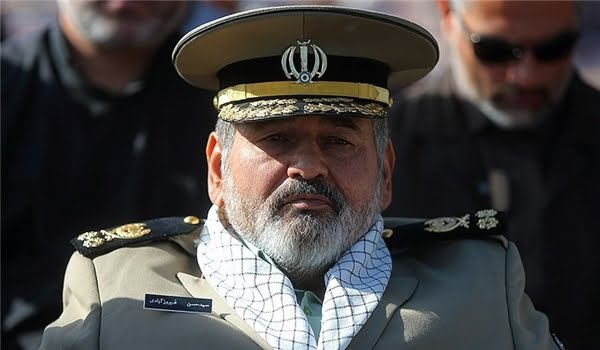
Iranian Top Commander Warns Enemies of Islam to Prepare for Harsh Punishment – Chief of Staff of the Iranian Armed Forces Major General Hassan Firouzabadi warned those countries which support terrorist groups under the name of Islam to prepare for a harsh punishment.


“Today the Zionists and their hirelings are acting against Islam and Muslims and some of their allies who have hidden behind the name of the anti-ISIL coalition are practically strengthening the ISIL,” Firouzabadi said in Tehran on Tuesday.

Iranian Top Commander Warns Enemies of Islam to Prepare for Harsh Punishment, Iran, IRGC, IRGC Commander, General Hassan Firouzabadi, Iranian Armed Forces, Iranian Deputy Foreign Minister, Hossein Amir Abdollahian, U.S., NATO, Enemy,  United Kingdom, France, Germany, Canada, Australia, Turkey, Italy, Poland, Denmark, ISIL, Iraq, Syria,
General Hassan Firouzabadi warns Enemies of Islam to Prepare for Harsh Punishment

“The enemies of Islam have started a harsh game and they should prepare themselves for harsher punishments,” he added.

In relevant remarks on Monday, Iranian Deputy Foreign Minister Hossein Amir Abdollahian voiced suspicion over the real intentions of the US-led coalition in its fight against the ISIL.

Speaking in a meeting with Dutch Deputy Foreign Minister Jeir Tess, Amir Abdollahian said that Iran is suspicious at the US determination in fighting the ISIL.

He further said that the measures adopted by the US-led coalition have left no impacts on the ISIL’s stand and have further aggravated extremism.

If the US and other western governments had prevented their citizens from joining the ISIL terrorist group and asked neighbors of Iraq and Syria not to allow terrorists to use their borders, the ISIL would have been destroyed and there was no need for the coalition and such theatrical moves.

NATO heads of state convened in the Welsh city of Newport on 4-5 September and US Secretary of State John Kerry and Defense Secretary Chuck Hagel told foreign and defense ministers participating in the NATO summit that the US was forming a broad international coalition against the ISIL.

Ministers from the United States, the United Kingdom, France, Germany, Canada, Australia, Turkey, Italy, Poland and Denmark met in Wales to hammer out a strategy for battling the ISIL, but the policy was questioned by many regional officials and political leaders.

After the so-called US-led coalition against the ISIL declared its creation, Iran lashed out at the western states for pursuing a double-standard policy towards campaign against terrorism in various countries.


Source: Iranian Top Commander Warns Enemies of Islam to Prepare for Harsh Punishment

If Al-Nimr is executed we shall turn the life of Al-Saud into hell

0
If Al-Nimr is executed we shall turn the life of Al-Saud into hell – The head of the Iranian Organisation for the Mobilisation of the Oppressed, known in Persian as the Basij, General Muhammad Reza Naqdi, warned the Saudi authorities on Saturday that there would be repercussions for executing the opposition Shi’ite religious scholar, Baqir Al-Nimr, stressing that once the Saudi rulers have perpetrated this crime, it will not pass without a response.


General Mohammad Reza Naqdi said that: “If Al-Saud commits such a crime against Sheikh Al-Nimr, its move will not remain unanswered and Muslims will change this world to a hell for them.”

If Al-Nimr is executed we shall turn the life of Al-Saud into hell, Iran, IRGC, IRGC Commander, Basij, General Mohammad Reza Naqdi, Al-Saud , Al-Nimr, Execution, Saudi Arabia
General Mohammad Reza Naqdi: If Al-Nimr is executed we shall turn the life of Al-Saud into hell

He added that “the death sentence should be seen as a verdict issued by a blasphemous and sinister regime,” rather than as an act by “a Sunni government against a top Shiite cleric”.

The Iranian news agency said that Sheikh Al-Nimr “is accused of delivering anti-government speeches and defending political prisoners”.

The Guardian newspaper reported that the senior Shiite cleric led protests in Qatif at the height of the Arab uprisings in 2011. He was convicted last Wednesday of sedition and other charges in a case that has been followed closely by Shiites in the kingdom and in neighbouring Bahrain.

“State prosecutors [have] reportedly asked for Al-Nimr to be crucified,” the newspaper said, noting that the court’s verdict has sparked an international outcry.

“Saudi Arabia’s harsh treatment of a prominent Shiite cleric is only adding to existing sectarian discord and unrest,” said Joe Stork, deputy Middle East director at Human Rights Watch. “Saudi Arabia’s path to stability in the eastern province lies in ending systematic discrimination against Shiite citizens, not in death sentences.”


Source: If Al-Nimr is executed we shall turn the life of Al-Saud into hell

IDM: Israel and ISIS pursuing same goals in Mideast

0
Israel and ISIS pursuing same goals in Mideast – Brig. Gen. Hossein Dehqan says that ISIS and Israel are two sides of the same coin, seeking to weaken the anti-Zionism resistance movements in Palestine, Syria, Lebanon and Iraq.


Iran’s defense minister said Israel and the Islamic State are both carrying out the same mission in the Middle East by killing innocent people and demolishing economic infrastructures, the semi-official Fars News Agency reported Sunday.

Israel and ISIS pursuing same goals in Middle East, Iran, ISIS, Iranian Defense Minister, Middle East, anti-Zionism, Gen. Hossein Dehqan, Israel, Terrorist, Kurdish, Barack Obama, Iraq, NATO
Iran Defense Minister: Israel and ISIS pursuing same goals in Middle East

Speaking during a meeting with his Lebanese counterpart in Tehran on Saturday, Brig.-Gen. Hossein Dehqan said ISIS and Israel are two sides of the same coin, seeking to weaken the anti-Zionism resistance movements in Palestine, Syria, Lebanon and Iraq.

Dehqan was speaking with Lebanese Defense Minister Samir Moqbel about increased military cooperation between Tehran and Beirut.

According to Fars, “Several reports, photos and footage have shown that Israeli hospitals are treating the injured ISIL militants fighting in Syria.”

The report further claimed that Kurdish forces had found Israeli supplies and equipment at Islamic State terrorist hideouts in the Iraqi cities of Mosul and Kirkuk.

The fiercest fighting in days shook the Syrian border town of Kobani overnight when Islamic State fighters attacked Kurdish forces with mortars and car bombs, sources in the town and a monitoring group said on Sunday.

Islamic State, which controls much of Syria and Iraq, fired 44 mortars at Kurdish parts of the town on Saturday, some of which fell inside nearby Turkey, according to the British-based Syrian Observatory for Human Rights. It said four more were fired on Sunday.

The month-long battle for Kobani has ebbed and flowed. A week ago, Kurds warned the town would fall imminently and the US-led coalition stepped up air strikes on Islamic State, which wants to take Kobani to consolidate its position in northern Syria.

The coalition has been bombing Islamic State targets in Iraq since August and extended the campaign to Syria in September after Islamic State, a group that espouses a rigid interpretation of Islam and initially focused on fighting Syrian President Bashar Assad’s forces, made huge territorial gains.

Raids on Islamic State around Kobani have been stepped up, with the fate of the town seen as an important test for US President Barack Obama’s campaign against the Islamists.

NATO member Turkey, whose forces are ranged along the border overlooking Kobani, is a reluctant member of the coalition, insisting the allies should also confront Assad to end a civil war that has killed close to 200,000 people since March 2011.

“We had the most intense clashes of days, perhaps a week last night. [Islamic State] attacked from three different sides including the municipality building side and the market place,” said Abdulrahman Gok, a journalist in Kobani.

“Clashes did not stop until the morning. We have had an early morning walk inside the city and have seen lots of damaged cars on the streets and unexploded mortar shells,” he said.


Source: Israel and ISIS pursuing same goals in Mideast