A pastor in Iran has been arrested and imprisoned after security forces raided his home and confiscated Christian paraphernalia, and now he’s Facing Death for ‘Crimes against God’
Iran Pastor Facing Death for ‘Crimes against God’
According to Christian Solidarity Worldwide, Pastor Matthias Haghnejad was arrested on July 5 for “Moharebeh,” or “crimes against God,” and faces the punishment of death.
“These charges constitute a worrying escalation of Iran’s campaign against Christians, adding a sinister new component to the regime’s appalling litany of religious freedom violations,” CSW’s Chief Executive Mervyn Thomas said.
“The fact that Iran continues to commit severe human rights violations, including executions without due process and on vague charges, while simultaneously seeking improved relations with other nations, is a matter of utmost concern,” Thomas continued.
“The international community must insist on discernible and consistent improvements in human rights, and on the upholding of rights stipulated in international covenants to which Iran is party, as benchmarks for improving bilateral and multilateral relations,” he said.
The 2013 Islamic Penal Code prohibits the death sentence for Moharabeh.
However, under President Hassan Rouhani’s administration eight men have already been executed for “Moharebeh” this year, including cultural rights activists Hashem Shaabani and Hadi Rashedi.
Others accused of this crime report they were tortured to force false confessions, denied legal help, and given unfair trials without any witnesses.
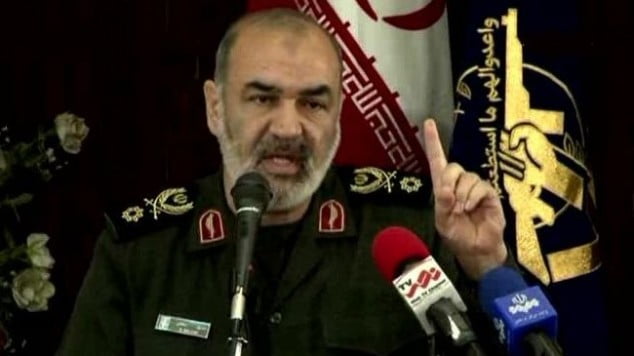
IRGC Lieutenant Commander Brigadier General Hossein Salami said given the biased ceasefire plan proposed by Egypt, continued resistance and war against Israel is now the best possible option for the Palestinians, adding that Hamas enjoys hidden war equipment and capabilities which will be used in later stages of the war.
“The plan proposed by Egypt meets the Zionist regime’s interests and is not acceptable as it seeks to disarm the resistance, but we know that the damage inflicted on the Palestinians by a ceasefire is more than war,” Salami said in a live interview with Iran’s state-run TV on Saturday night.
Hossein Salami, IRGC Commende
Stressing that the Zionist regime has been defeated in close-range and street war against Hamas and other Palestinian resistance groups, he said the Zionist army cannot move on the ground no matter Palestinian tunnels are there or not.
“Their fighter jets can just bomb the Palestinians, and these bombardments are responded by the resistance’s missile attacks,” he added.
He also referred to the Israeli “iron dome” missile shield built to intercept and destroy the Palestinian missiles, and said the shield has proved efficient in only 20% of cases.
Salami underlined that the resistance missiles now have a range of 160km which means that the entire occupied territories can be covered by the resistance missiles and the Zionist regime is not able to stand against the flood of Palestinian missiles.
The Iranian commander said that the Zionist regime has misused the Muslim world’s negligence and attacked Gaza in a bid to clear the world public opinion of its previous failures against the Palestinians.
A senior Iranian military commander threatened that the country’s Lebanon based surrogate Hezbollah was prepared to open a second front of rocket fire against Israel as negotiators worked to bring quiet to the Jewish state’s southern border after more than a month of fighting with Gaza based terror group Hamas.
IRGC Commender: Hezbollah Ready to Open Second Front Against Israel
Lieutenant Commander General Hossein Salami of Iran’s Revolutionary Guard Corps’ claimed on Saturday that Hezbollah is prepared to “storm the Zionist regime by its high-precision missiles.”
“Today, all the residents in the occupied territories feel insecure and the security of the occupied territories is in an equation that on one side the powerful Hezbollah exists which is ready to storm the occupied territories and everyone knows the destruction power and preciseness of its weapons, and the other variable in this equation is the Palestinian resistance which has destroyed 11 tanks of the regime and damaged 48 others using good tactics, techniques, technologies, missiles, rockets and new weapons,” Salami said in a live interview with Iran’s state-run TV, according to semi-official state news agency Fars.
Salami also criticized more moderate Arab states for allegedly opposing the “Palestinian resistance.” He claimed that Egypt, Saudi Arabia and Jordan are three Middle Eastern allies of the U.S. who regulate their own policies based on U.S. and Israeli policies, according to Fars.
“The reason that the Zionist regime has chosen this opportunity for attacking Gaza is that they felt that the policies of the Arab regional states is more coordinated with the Zionist regime than the resistance,” he said.
The general also claimed that that the U.S. has attempted to replace the “Zionist threat” in the region by highlighting the threat posed by Iran.
Despite the forthright rhetoric, it is widely believed that Hezbollah is far too heavily engaged in its battle on behalf of Syrian strongman Assad against rebels to instigate a foe as formidable as Israel.
In August 2013, twenty-four years after serving as the representative of the Supreme Leader in the mullahs’ highest security organization, the Supreme Security Council, Hassan Rouhani took office as the President of the Iranian regime.
HUMAN RIGHTS IN IRAN DURING FIRST YEAR OF HASSAN ROUHANI’S PRESIDENCY
His foremost motto as the new man in office was “moderation.” Those who advocate for change from within the religious dictatorship fell head over heels for the new president, hoping for an overture with Iran while keeping the regime in power. They hope for an end to the era of extremism marked by Mohmoud Ahmadinejad, which promises to open the doors to economic trade and political cohesion with the regime.
One year later, the residents of cities and villages in Iran feel no change at best in the economic and social realms. Ali Tayebnia, Hassan Rouhani’s Minister of Economy, said on August 2: “During its history, the economy of Iran has never faced such complex conditions as today.” He added: “Right now, the government has a 250 thousand billion Toman debt… while government’s budget is somewhere from 10 to 20 thousand billion.”
The regime’s nuclear project is at a standstill and its meddling in Iraq and Syria has deepened. However, the foremost indicator for Rouhani’s record is human rights.
The situation of human rights in Iran
793 executions,during Hassan Rouhani’s presidency
During Hassan Rouhani’s first year in office, there have been at least 793 executions, a number which is unprecedented in the past 25 years of Iranian history.
The executions include at least 31 women, 38 political prisoners, and 12 persons who were juveniles at the time of crime. At least 46 of these executions were carried out in public.
The number of executions in the second half of the Persian year 1392 (i.e. October 2013 to March 2014), at which point Hassan Rouhani has assumed office, doubled the figure of the first six months.
The UN Secretary-General Ban Ki-moon, said in Geneva on 11 March 2014: “Despite pledges made by the president during his campaign and after his swearing in…The new government has not changed its approach regarding the application of the death penalty and seems to have followed the practice of previous administrations, which relied heavily on the death penalty to combat crime.”
On June 5, a group of UN human rights experts announced that the execution of political prisoner Gholamreza Khosravi Savadjani on June 1 had been unfair. Amnesty International issued several calls to prevent his execution and on the final day warned of the imminent execution of this active supporter of the People’s Mojahedin Organization of Iran (PMOI/MEK).
Mr. Khosravi was arrested in 2008 and initially condemned to six years in prison. While he was spending his time, he was tried once again in 2011 and was condemned to death on the charge of Mohareb (enmity against God) for allegedly collecting information and giving monetary assistance to a satellite television station, the body of Mr. Khosravi was not even returned to his family and was instead secretly buried.
The trend of intensification of violation of human rights in the past year is evident in all realms:
Human rights under Rouhani: Attacking the organized opposition
On September 1, 2013, in an attack planned by and conducted at the behest of the Iranian regime, the forces of Tehran’s proxy government in Iraq collectively executed 52 members of PMOI/MEK in Camp Ashraf, which was the residence of refugees opposing the Iranian regime in Iraq. Six women and a man were also taken hostage.
Then, on December 26, a rocket attack targeted this same group of exiles in their new, ostensibly temporary home at Camp Liberty, killing four and leaving dozens injured. Such attacks require Rouhani’s permission, as he is not only president but also remains the head of the Supreme Security Council.
Cleric Mahmoud Alawi, Rouhani’s Minister of Intelligence, commented on the attacks by telling Etemad Daily News: “We congratulate the Iraqi nation, as well as the suffering Iranian nation, for this heroic act.”
Human rights under Rouhani: Ethnic minorities
In a 10-point declaration on 30 May 2013, Hassan Rouhani promised to look into the demands of ethnic minorities. This promise not only was not kept by Rouhani, but repression and discrimination against minorities increased.
Of the 38 political prisoners hanged in the first year of Rouhani’s Presidency, twenty-four were Baluchi activists, eight were Ahvazi Arabs, and five were Kurds. Additionally, Gholamreza Kosravi Savadjani was hanged for his support for the PMOI.
In one case alone, 15 Baluchi prisoners were hanged together; and in a revenge execution, eight Baluchi prisoners were collectively hanged in Zahedan Prison after the assassination of city of Zabol’s General Prosecutor.
Four prisoners were among prisoners executed for supporting Kurdish political parties. Ahvazi Arab prisoners were among political prisoners executed during this period.
Human rights under Rouhani: Religious minorities
On 24 August 2013, a Baha’i citizen by the name of Ata’ollah Rezvani was assassinated in the city of Bandar Abbas, capital of the coastal province of Hormozgan. He was one of the active members of the Baha’i community in this city.
In his March 2014 report, Ahmed Shaheed, the Special Rapporteur on the situation of human rights in the Islamic Republic, stated that 110 Baha’is are currently in prison in Iran because of practicing their religion.
Meanwhile, at least 1500 students are deprived of university studies because of their belief in the Baha’i faith.
On 26 August 2013, Saeed Abedini, a Christian Iranian–American pastor was sentenced to eight years of hard labor in prison. Prior to that, Abedini had revealed in a letter that he had been beaten and denied medical treatment.
On the verge of Christmas, the Islamic Revolutionary Court of Tehran sentenced Vervir Avanessian, a retired pastor of the AOG Church, to three and a half years imprisonment.
On January 6, Hossein Saketi Aramsary, a newly converted Christian, was sentenced to one-year hard labor in prison on charges of evangelism.
In the first week of January 2014, the international Open Doors Organization declared that in terms of the harassment of Christians, Iran is amongst the top ten countries in the world.
Human rights under Rouhani: Suppression of Women
Based on a directive ratified by Tehran’s council of mayors and their deputies on 17 May 2014, the suppressive ‘gender separation’ plan has been secretly implemented in Tehran’s municipalities by Mohammad Bagher Qalibaf, mayor of Tehran.
Based on this plan, “all senior or median directors should use only male employees for posts such as chief of bureau, secretary, phone operator, typist, and in charge of follow-ups, etc. from those employed in their office,” according to state-run news agency ISNA. In the course of implementation of this directive, some posts and jobs in the municipalities were banned for women, and a number of women lost their jobs in the municipality.
The implementation of this plan met with public abhorrence, especially by women. The regime’s authorities steadfastly defended it. The head of Administrative Court of Justice, Ali Akbar Bakhtiari, described this plan as ‘securing integrity of women’s working environment’ and said this move does not mean ‘a gender discrimination or separation.’ Mostafa Pour-Mohammadi, Rouhani’s Justice Minister, regarded this plan as being “in conformity with the regime’s values that would increase the revenue.” More than 183 members of the regime’s parliament called this misogynistic plan “special attention and tribute to women.”
This plan has now extended to the regime’s other organizations such as the Administrative Court of Justice and state -controlled Tasnim News Agency, affiliated to the terrorist Quds Force.
In line with this policy Tehran municipality is planning to separate benches used by boys and girls in parks. The Science and Technology University of Tehran has issued a repressive plan titled as “Moral Charter” based on which ‘no social intercourse of male and female students is allowed on the campus.’ Rules of this charter ban using perfume or after-shave.
Human rights under Rouhani: Repression in Universities
Amnesty International announced in a report on 30 May 2011,“Student activists, reformists and academics perceived as secular are hounded by authorities…. Despite initial welcome steps by President Hassan Rouhani’s administration to allow the return of a number of banned students and academics to universities, the situation remains dire. Hundreds of students continue to be barred from higher education and many remain in prison, with some fresh arrests since President Hassan Rouhani’s election. As the first academic year under his administration comes to an end, many restrictions remain in place.”
Human rights under Rouhani: Suppression of Press
Reporters Without Borders in its annual report on December 18, 2013 announced that 42 reporters or journalists have been arrested since the election of Rouhani and 12 publications have been shut down.
According to Reporters Without Borders, there are currently 65 reporters behind bars in Iran. To this effect, Iran is among the top five regime’s that have imprisoned the journalists.
It also has the highest number of women journalists imprisoned and has been described by the Committee to Protect Journalists as one of the worst overall suppressors of journalists.
TEHRAN (FNA)- IRGC Lieutenant Commander Brigadier General Hossein Salami said given the biased ceasefire plan proposed by Egypt, continued resistance and war against Israel is now the best possible option for the Palestinians, adding that Hamas enjoys hidden war equipment and capabilities which will be used in later stages of the war.
“The plan proposed by Egypt meets the Zionist regime’s interests and is not acceptable as it seeks to disarm the resistance, but we know that the damage inflicted on the Palestinians by a ceasefire is more than war,” Salami said in a live interview with Iran’s state-run TV on Saturday night.
IRGC Commander: Continued War Better Option for Palestinians
Stressing that the Zionist regime has been defeated in close-range and street war against Hamas and other Palestinian resistance groups, he said the Zionist army cannot move on the ground no matter Palestinian tunnels are there or not.
“Their fighter jets can just bomb the Palestinians, and these bombardments are responded by the resistance’s missile attacks,” he added.
He also referred to the Israeli “iron dome” missile shield built to intercept and destroy the Palestinian missiles, and said the shield has proved efficient in only 20% of cases.
Salami underlined that the resistance missiles now have a range of 160km which means that the entire occupied territories can be covered by the resistance missiles and the Zionist regime is not able to stand against the flood of Palestinian missiles.
He said that despite the advanced technologies and equipment that the Zionist regime enjoys and its extensive intelligence operations, the Palestinians have been able to dig hundreds of kilometers of tunnels and the resistance’s key leaders have escaped assassination which shows the Palestinian resistance’s intelligence maturity and superiority.
Salami referred to the situation in the West Bank, and said, “Certainly, the West Bank will move on the same track paved by the Gaza Strip and will certainly be armed and turned into a battle ground, of course, they are now fighting with stone but Gaza also fought with stone and now has acquired missiles and drones and this will also happen there.”
He also pointed to the opposition of certain Arab states with the resistance, and said the resistance questions the legitimacy of the Arab regimes which want Palestine, Lebanon and Syria to be killed by the Zionist regime so that they can be a regional actor and retain their legitimacy.
Salami said that the Zionist regime has misused the Muslim world’s negligence and attacked Gaza in a bid to clear the world public opinion of its previous failures against the Palestinians.
An Iranian policeman has been sentenced to three years in jail, 74 lashes and two years’ internal exile for the unpremeditated killing of a blogger in 2012.
Sattar Beheshti, was found dead in his cell at Iran’s notorious Kahrizak prison
Sattar Beheshti, 35, arrested on October 12 that year for criticizing Iran’s regime on the Internet, was found dead in his cell at Iran’s notorious Kahrizak prison on November 3.
Opposition groups alleged at the time that he had been tortured to death.
The Tehran prosecutor ruled that Beheshti’s death was “probably caused by shock after several blows to sensitive parts of his body, or by extreme psychological pressure”, the media reports said.
The court decided that his killing was “not premeditated“, a ruling which the lawyer for the blogger’s family contested.
“When journalists are jailed for six years, a sentence of three years for murder is surprising,” Giti Pourfazl was reported as saying.
The convicted officer from the police cyber-crime unit was not identified.
Premeditated murder is among the crimes punishable by death in Iran, based on its interpretation of sharia law in force since the 1979 Islamic revolution.
After Beheshti’s death, influential MP Aladin Borujerdi took issue with claims by pathologists that he had died of shock and fear, saying he had “very clearly” been beaten in custody.
Beheshti’s death also led to the dismissal of the head of Iran’s cyber-crime unit, launched in January 2011 to confront anti-regime activity on the Internet.
Reports said the cyber-crime chief was fired for “negligence, weakness and not controlling his staff properly”.
A number of investigations were launched after U.N. experts and some Western states condemned Beheshti’s death and demanded that Iran investigate it, with Amnesty International saying the blogger may have died from torture.
Hundreds of opposition figures — politicians, journalists, bloggers, lawyers, rights activists, union figures and media workers — are in Iranian prisons, according to international human rights groups.
IranBriefing – The new Representative of the Valiyy–i–Faqih to the Army of Tharullah in the Kerman Province has declared that while defense against physical aggression of the enemy is a religious obligation, we should not only counteract cultural aggression of the enemy, but also attack the enemy’s cyber hotspots.
The Representative, Hojjatol Islam Ali Arabpour, taking part in his introduction ceremony held in the morning of August 6 at the IRGC’s headquarters in the Babak City, said: The Revolutionary Guards, and the Volunteers, are among the soldiers of the Valiyy–i–Faqih who have consistently supported the Supreme Leader and the Islamic society throughout the Islamic Revolution, and shall continue to do so.
Stating that the secret of the defeat of the enemy lies in the unity of the Muslims, he added: In view of recent developments and happenings in the region, the situation demands that we must be fully prepared on all fronts, and preserve the Islamic regime with all our might. The Leader’s Representative characterized the Islamic Revolution as a revolution of transformed values, and said: Today, the enemy, desiring to strike a blow to the sublime values of our revolution, has adopted cultural aggression and soft weapons instead of physical aggression and hard weapons.
Declaring that the satellites and the internet are the weapons of soft war and cultural aggression by the enemy, he explained: While defense against physical aggression of the enemy is a religious obligation, we should counteract, not only cultural aggression, but attack the cyber hotspots of the enemy.
He said: Today, whatever is happening in our vicinity, whether from the side of the DA’ISH [“the Islamic State”] or the extremists or Israel attacking Gaza, all these moves are directed at taking revenge from Islam, the Islamic revolution and the religion of God.
Pointing out the recent crimes committed by the usurper regime of Israel, the Representative said: Israel is an artificial regime and is like a breakable house of glass. It is bound to vanish soon by the grace of God.
Hojjatol Islam Arabpour further stated: Right always triumphs. It is the righteous and pious conduct of our society which comes into action in times of danger and aggression from the enemy.
He attributed the support of the Arab countries to the Zionist regime to their dependence upon the West, and emphasized: The world view, and the philosophy of Da’ish, is a world view and philosophy of debauchery and blood shedding. This is a false and fake tendency which has no place in the Islamic society, and its days are numbered.
During this ceremony, Hojjatol Islam Hussain Karimi was introduced as the Representative of the Valiyy–i–Faqih in the IRGC of the Babak City, and the services of the outgoing Representative Hojjatol Islam Hussain Dahqani were appreciated.
Hitherto Hojjatol Islam Karimi had served as the Political Representative of the Valiyy–i–Faqih to the IRGC at Rafsanjan.
TEHRAN (FNA)- Senior Iranian parliamentary officials vowed that the country would not allow its ballistic missile program to become an agenda of the nuclear talks between Tehran and the Group 5+1 (the US, Russia, China, Britain and France plus Germany).
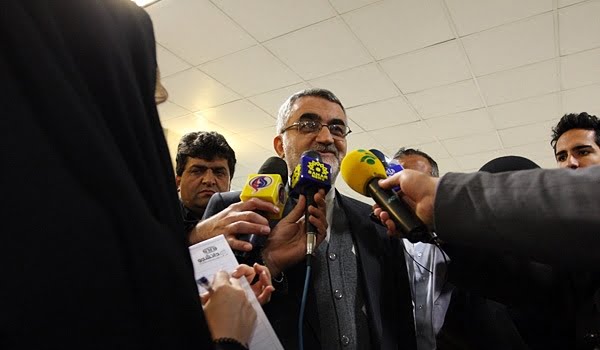
“The US should know that the issue of Iran’s missiles will never be put on the agenda of the negotiations with the G5+1,” Chairman of the parliament’s National Security and Foreign Policy Commission Alaeddin Boroujerdi said on Saturday.
The missile issue is one of Iran’s inalienable rights and is in no way related to the US or any other country,” reiterated the influential lawmaker.
Boroujerdi referred to the 8-year Iraqi-imposed war on Iran (1980-1988) when the US and other western states rendered massive arms and military aids to Saddam Hussein’s regime, and said, “This (missile) capability will be further developed as a strategic and defensive policy to prevent imposition of another war on the Iranian nation.”
Chairman of the parliament’s National Security and Foreign Policy Commission Alaeddin Boroujerdi
US officials have stated several times that they intend to include Iran’s ballistic missile technology in the nuclear talks, while Tehran has repeatedly stressed that it would not allow inclusion of any other topic in the negotiations but those related to its nuclear program.
Iranian Foreign Minister Mohammad Javad Zarif had also stressed earlier that Iran’s defensive missiles is no topic for the ongoing negotiations between Tehran and the sextet of powers.
It will be wrong to assume that the only application of Iran’s defensive missiles that have not and will not be the subject of any negotiations is carrying unconventional weapons,” Zarif said in a joint press conference with his Austrian counterpart Sebastian Kurz in Tehran earlier this year and in response to a question by an Austrian reporter who asked if Iran did not have a nuclear weapons program then why it produced ballistic missiles which have Europe within their range.
The Iranian foreign minister underlined that such wrong assumptions were based on certain media hypes.
Zarif reiterated that the Iran-world powers talks would never deal with subjects other than the nuclear issue.
Iran’s nuclear program will always remain peaceful and in this case no one can claim that Iran’s missiles will carry nuclear weapons, because Iran does not produce nuclear weapons to be carried by missiles or any other delivery system,” the Iranian foreign minister said.
In February, Zarif dismissed media reports that Tehran and the Group 5+1 would discuss Iran’s missile program in their talks in Vienna, and said the country’s nuclear program has no military dimensions.
Iran’s nuclear program is not related to the military issues and our military program is not related to the current negotiations,” Zarif told reporters after meeting EU foreign policy chief Catherine Ashton – who presided the G5+1 delegations in talks with Iran – in Vienna for a working dinner on February 17.
Tehran launched an arms development program during the 1980-88 Iraqi imposed war on Iran to compensate for a US weapons embargo. Since 1992, Iran has produced its own tanks, armored personnel carriers, missiles and fighter planes.
Yet, Iranian officials have always stressed that the country’s military and arms programs serve defensive purposes and should not be perceived as a threat to any other country.
TEHRAN (FNA)- Commander of Iran’s Basij (volunteer) Force Brigadier General Mohammad Reza Naqdi expressed regret about Arab states’ silence on the massacre of their Muslim brothers in Palestine, and said they are afraid of the Zionist regime’s power because they are overestimating its power.
“The Arab states have made miscalculations in understanding the regime which has occupied (the holy) Quds and they cannot understand that the Zionist enemy is a hollow and fake power and its ground force has been pushed to stop in its confrontation against a number of Palestinian snipers,” Naqdi said, addressing a gathering of Basij officials in Tehran on Saturday.
Commander of Iran’s Basij (volunteer) Force Brigadier General Mohammad Reza Naqdi
He condemned the Zionist regime’s crimes against civilian Palestinians, and said, “The innocent and defenseless Gaza children who have awakened the world with their blood, became an indelible document revealing the scandalous face of the world arrogance and displaying the true nature of European and American-type of human rights to the world.”
Israeli warplanes have been pounding numerous sites in the Gaza Strip since July 8, demolishing houses and burying families under the rubble. Israeli forces also began a ground offensive against the impoverished Palestinian land on July 17.
The Palestinian death toll in Israel’s onslaught on Gaza has now reached nearly 1,650, with 9,000 people injured. Most of the casualties have been civilians, including a large number of women and children.
Meantime, over 400,000 of Gazans, nearly one out of four, have been displaced as a result of the recent aggressions of Tel Aviv’s forces against the besieged enclave.
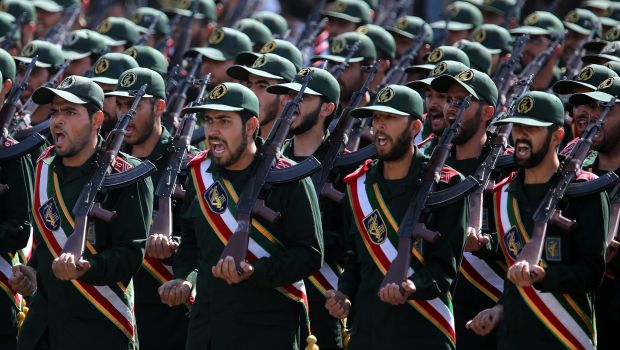
Erbil, Asharq Al-Awsat—A heavily armed Iranian military force landed at Sulaymaniyah International Airport this week, deploying to Kirkuk to defend Shi’a shrines from radical Sunni militants, an Iraqi Kurdish security source told Asharq Al-Awsat.
A senior Kurdish security official, speaking to Asharq Al-Awsat on the condition of anonymity because he was not authorized to brief the media, said that a 200-strong elite Iranian military force tasked with protecting Shi’a shrines has been granted access to Kirkuk province by the Patriotic Union of Kurdistan (PUK). Last month Kurdish military forces, called the Peshmerga, were able to take control of Kirkuk with the aid of PUK-led Kurdish Asayiş security forces, driving Islamic State of Iraq and Syria (ISIS) fighters out of the oil-rich northern province.
According to the security source, the PUK facilitated the Iranian force’s movement through Kirkuk.
He said: “[Iranian] elite forces trained in guerilla warfare and armed with sophisticated weapons have come [to Iraq] to fight ISIS, protect Shi’a shrines and lift the siege imposed by ISIS on the Shi’ites and Turkmen communities.”
In comments to Asharq Al-Awsat, senior PUK member Arez Abdullah denied the claims that his party had facilitated the Iranian military intervention. He described the news as being a “pack of lies,” maintaining that the PUK “does not interfere in the affairs of the [Iraqi] government.”
Although the PUK enjoys extensive relations with all parties in the region, we emphasize that no country has the right to interfere in the domestic affairs of either the Iraqi Kurdistan Region or Iraq as a whole without the approval of the Erbil and Baghdad governments,” he said.
Although a number of local and international media outlets have published reports that forces affiliated with the Iranian Revolutionary Guards Corp (IRGC) are present in Iraqi territory, this is the first report of Iranian military access being facilitated via Kurdistan.