The women’s committee of the National Council of Resistance of Iran published its yearly report on the execution of women in Iran under Hassan Rouhani as part of the gross violation of human rights under the “moderate” president of the clerical regime.
The report published by the NCRI, contains details of 22 women who have been executed during the past year, many with their name, date and place of execution.
Based on this report Hassan Rouhani’s government has publicly announced the execution of six of these women and the other 16 have been secretly executed in various cities in Iran.
Under Hassan Rouhani the suppression of women in Iran has further intensified and in much larger scales by imposing gender segregation in workplaces, concerts, and universities.
Recently a group of 183 members of the regime’s parliament ‘have supported a plan by Tehran Mayor Mohammad Baqer Qalibaf to segregate female and male employees in Tehran Municipality.’ They said the measure provides “special attention and respect to women”.
An example of such plan is the directive ratified in the council of mayors and their deputies on 17 May 2014 says: “all senior or median directors should use only male employees for posts such as chief of bureau, secretary, phone operator, typist, and in charge of follow-ups…”
In the course of implementation of this directive, women were banned from holding some posts in the municipalities and lost their jobs.
In line with this policy of gender apartheid, Tehran municipality is planning to designate separate benches to be used by boys and girls in public parks. Also some universities are imposing new measures to prevent social interactions of male and female students in campuses.
The security and intelligence forces have arrested some Arab activists at Kouy-e-Alavai (Hay al Sour) and transferred them to an unknown location, on Sunday August 10, at 5 am in Ahvaz.
A group of Arab activists were arrested in Ahvaz
According to the report of Human Rights Activists News Agency, following attendance in Eid-e-Fitr ceremony and congratulation to the families of Arab political prisoners, some of the Arab activists were arrested. The same as past years, Arab activists visited the families of political prisoners, with the aim of showing solidarity with political prisoners’ families, and went to dominated Arab territories like, Malasliyah, Kout Abdullah, Kouy e Alavi and other Arab territories of Ahvaz.
After this ceremony and after 13 days after Eid-e-Fitr, some of these Arab activists were arrested at their houses and were transferred to unknown location by security forces on Sunday, August 10. The identities of five arrestees are already known, though reports are stating the number of arrestees is more than that.
Mohammad Batrani along with two of his brothers, and Abbas Savari and Mohammad Siyahi are the arrestees. Among them, Mr Siyahi has multiple arrests in his record.
Previously, Mr Asad Salehi was arrested during the group visit of Arab political prisoners’ families in Eid-e-Fitr day, on July 19, and was recently transferred to Sepicar prison in Ahvaz.
IRGC Commander Lists His 5 Favorite Palestinian Terror Groups
The Daily Beast reported yesterday that two weeks ago, when he pledged his support the Palestinians fighting Israel, Qassem Suleimani, the commander of the Qods Force of Iran’s Revolutionary Guard Corps (IRGC), singled out five groups for special mention: Hamas’ Qassam Brigades, the Islamic Jihad’s Al-Quds Brigades, the Abu Ali Mustapha Brigades, the al-Aqsa Martyrs and the Nasser Salahuddin Brigades.
The Qassam Brigades is the active terrorist branch of Hamas and “the largest and best-equipped group operating in Gaza today.” It is led by Mohammad Deif, who is sometimes referred to as the defense minister of Hamas. The Daily Beast notes that Deif reportedy lives in the Shuja’iya neighborhood which, the IDF noted, was the site of much of the terror infrastructure that was threatening Israel.
The Al-Quds Brigades, is part of Palestinian Islamic Jihad (PIJ) and has mostly been firing rockets and mortars into Israel. PIJ has maintained strong ties with Iran even when Hamas’ ties with the Islamic Republic were strained due to its support of the anti-government rebels in Syria.
Theasser Salahuddin Brigades is, according to its spokesman the third largest armed group in Gaza. The al-Aqsa Martyr’s Brigades is affiliated with Fatah, the party of Palestinian Authority President Mahmoud Abbas. The Abu Ali Mustapha Brigades is a division of the Marxist Popular Front for the Liberation of Palestine (PFLP).
The Times of Israel reported yesterday that the Palestinian Liberation Organization’s (PLO) ambassador to Iran, Salah al-Zawawi, said, “Israel’s annihilation has begun and the new generation in Iran will certainly witness our victory over Israel,” at a gathering in Tehran in support of Hamas ruled Gaza.
In the past few weeks other Iranian leaders vocally supported Palestinian terror and boasted of providing terrorists with military aid against Israel. Last month a United Nations report charged Iran with being behind Hamas’ arms buildup in the run up to Operation Protective Edge.
Suleimani coordinated Iran’s support of Syria in that country’s bloody civil war.
Terror organizations that failed to make Suleimani’s list have not yet issued public statements in response.
Two journalists to be flogged for insulting regime official
Two Iranian photojournalists have been sentenced to 75 lashes for making ‘insulting remarks’ about a book by a local official in the regime’s province of Qazvin.
The Voice of Qazvin reported on August 13: “Based on a ruling by the Branch 102 of the General Court of Qazvin, one defendant was sentenced to 25 lashes and another photographer to 50 lashes.”
The report added: “It seems that the sentence was issued because of remarks made by these photographers about a book written by the cultural advisor to the province’s governor. The remarks prompted the cultural advisor to file a complaint against these photographers in Qazvin.”
Human rights group Amnesty International said in a recent statement that the sharp increase in the number of arrests, prosecutions and imprisonment of independent journalists in Iran shows that the mullahs ‘have widened the circle of repression in a bid to crumple any aspirations for change’.
Hassiba Hadj Sahraoui, Deputy Middle East and North Africa Program Director at Amnesty International, added: “The way journalists are being treated puts everything journalism should stand for at risk in Iran.
“Anyone deemed critical of the authorities has been at increased risk of arrest and prosecution in recent months, creating an intense climate of fear where voicing any criticism has become a direct road to prison.”
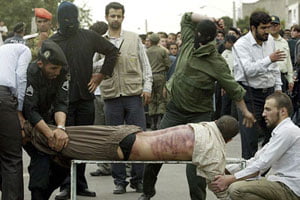
Since Hassan Rouhani became the regime’s president a year ago, human rights violations including execution, public hanging and the carrying out inhumane punishments such as flogging have intensified.
According to official statistics published by the regime’s judiciary during the holy month of Ramadan, at least 200 people were lashed in Qazvin province alone.
Two men also were also flogged in public on Wednesday in a city near the country’s capital Tehran for ‘disrupting public order.’
Reza Makeian AKA Reza Malek is a former deputy of Research and Investigation in Iran’s Ministry of Intelligence and Security (MOIS). He spent years in prison and in solitary confinement for disclosing the ministry’s 30 year involvement in the chain murder of dozens of Iranian intellectuals. He was arrested on July 3, 2001 and was sentenced to 4 years in prison. However, his sentence was increased to an additional 6 years, for secretly releasing a tape where he addressed UN Secretary General, Mr. Ban Ki-moon, on Iran’s secret mass graves of prisoners during 1988 and other crimes the regime was involved in. He was released on April 15, 2012 after enduring 11 years in prison and solitary confinement. However, he had to sustain 70 lashes right before his release for “Spreading Lies and Disturbing the Public Opinion”. While enduring his 70 lashes, he uttered “Death to Khamenei”, a crime that landed him back in prison for an additional 2 years. He was finally released in April 2014 after spending 13 years in prison and is suffering from paralysis of his right leg. His torturer one day told him, “I am going to have your wife get divorced and then I will marry her”, and this has since come to pass.
(Below is a translation of Reza Malik’s letter by Iran Briefing, published in Gooya News)
Qizil Hisar Prison, 2008:
In the name of God
To: His Excellency Ban Ki Moon Secretary-General, UN
Her Excellency Navi Pillai
UN High Commissioner for Human Rights
Subject: Detection of a giant microbiological-chemical weapons research complex and an underground prison disguised as a zoological park in Karaj, Iran.
In addition to a variety of open and secret prisons and detention centers, the tyrants of Iran have created a most dreaded underground prison within a giant biological weapons research complex in the city of Karaj near Tehran for testing lethal material on the bodies of prisoners!
According to the latest information, the blackguard regime is maintaining a vast and inhuman prison establishment in the southwest of Karaj. This underground complex is one of the many research centers dedicated to the development of microbial and chemical warheads for Iranian missiles. During the last two decades, the regime has been engaged in developing long-range and intercontinental missiles with technology transferred by North Korea, Russia and China.
It is a complex where prisoners are being used as test animals for carrying out the most heinous and reprehensible trials on living beings.
Reza Khandan – Reza Malek – Nasrin Sotoudeh
This killer site is maintained and run by the Protection Division of the General Command of the Armed Forces. Specifically, each unit of this complex is controlled and maintained by a separate concerned division of the related bodies under the supervision and control of the General Command of the Armed Forces.
This complex is divided into three separate and self-contained parts that are unrelated to each other. The area occupied by this complex is spread over more than two thousand hectares.
This area extends from Mehr Shahr and Kakh-e-Shams in the north to the trisection of the Malard Road and Buvain Zahra Road in the south. It is coterminous with the Payam Airport in the west. Nobody knows how many organizations, with their ramifications, are operational underneath this forest area placed under the control and protection of the soldiers of the Yazidi regime! According to my information, this complex has at least three covered access passages in addition to a number of other secret passages. One access point is from the abandoned edible oil refining factory in the direction of the Payam Airport. The other is from the arrival square of the trisection of Buvain Zahra-Malard Roads in the direction of the Mehr Shahr. The third access is from a place which is apparently a police club.
In the underground, there is a personnel section—management and public facilities—which is equipped with all paraphernalia of modern living, such as apartments, enclaves, and several hostels, to separately accommodate the interrogators and the staff and workers of different sections. The arrangements are such that the functionaries are at home and are to stay and work underground for months at a time without the need to go out. All the access passages are connected with the research centers, the prison and the residential units, by well-built tunnels. The whole complex is ventilated by more than 50 pairs of jet fans.
Your Excellencies!
One of the important parts of this complex is a multi-phase prison which is named as the prison of the zoological park. The first part of this prison is divided into two sections. One section is reserved for the foreign prisoners and the other for the Iranian prisoners. The inmates of this black hole belong to the category of non-repatriable foreign and internal prisoners. In other words, they are persons who were abducted from different places and brought here. They are the persons who are declared as missing persons, whose destiny is sealed here. For instance, persons missing from the university hostels complex, persons missing during the disturbances of 2009, and other unfortunate political activists and dissidents who were abducted from the neighbouring and non-neighbouring countries, members of groups such as Al-Qaeda, Ra’d, PKK, Pazhak, and the Arabs, Europeans, Americans, Turks, Afghans and captives of many other nationalities who were abducted from abroad and being non-Iranian and declared as non-repatriable, are lodged in the foreigners’ section of this prison and are subjected to the harshest forms of interrogation. Fuladvand, of the Anjuman-i-Padshahi, and hundreds and thousands of other helpless persons, are lodged in this prison. Hizbullahi interrogators of different nationalities, acting under the direction of senior interrogators of the Yazidi army, are engaged in continuous interrogation of these prisoners. This vast prison has hundreds of cells with their different stages. Foreign nationals, who are abducted outside the country and from centers which the regime’s intelligence networks maintain in other countries, particularly the neighbouring countries, are smuggled out in the guise of “consignments” and with other pretenses and transferred to Iran in flagrant misuse of diplomatic immunity. “Ayat-us-Shaitan” Ali . . . of the Iranian judiciary has also been seen visiting this prison!
Your Excellencies!
In the other part of the prison, there exists a big cold store for keeping dead human bodies. Beside it, there exists a crematorium for the burning of human bodies. Some other halls of this eerie complex have been reserved as a zoo where many types of animal species are kept. As a matter of fact, monkeys imported into this zoo are merely a cover for carrying out underground and secret biological tests upon human beings. By virtue of this actual zoo, the whole complex has been given the name of a zoo by the informed functionaries of the regime.
Two other units of this black hole are related to the microbial and chemical labs of the complex. These two units are completely separate from each other in so far as their personnel, buildings or the captives under custody are concerned. The length and breadth of these two units are physically separated by a covered passage of a few hundred meters in length.
Your Excellencies!
These laboratories employ a large number of scientists and technicians who do not come out for weeks and months.
Your Excellencies!
In these laboratories, many types of lethal material and toxins are tested on human bodies. These humans, with their black and blue and worn out bodies, undergo such testing and trials.
The last part of this prison consists of death cells for individual prisoners. As soon as the interrogators of Hizbullah and of other nationalities, along with the agents of the obscurantist regime, have extracted the required information from a prisoner in the main ward, he is transferred to the functionaries of the laboratory section who keep their own cells and operation rooms.
Your Excellencies!
To conclude, may I remind you that the authoritarian regime ruling over the Iranian nation is creating a new problem, making a fresh arrest and finding a new enemy every day for the Iranian nation. The story of terroristic activities abroad, and later of the nuclear program, has not come to an end when it comes to light that the regime is absolutely determined to produce warheads of mass destruction in secret centers.
Your Excellencies!
Of course, the Europeans’ concern about Iran’s access to weapons of mass destruction, and allocation of huge military budgets toward this end, is not without reason!
For me it is quite clear, like the bright sun, that in the not too distant future, in addition to the Europeans, the Americans will also come within the range of Iranian microbial, chemical and nuclear warheads.
Your Excellencies!
Let the heads of government in Europe, like the Russians and Chinese, be the spectators of Iran’s getting access to destructive technologies of all types. Then ultimately, they will realize that small short term interests of Western companies have led to bigger losses for the European nations!
With esteemed regards for all defenders of human rights from Navi Pillai to Shirin Ibadi.
Iran is still rife with suppression of human rights, abuses of individual freedom and summary executions a year after the election of so-called ‘moderate’ President Hassan Rouhani a year ago, Britain’s Lord Carlile has said in a article published in PoliticsHome.
Iran is still rife with suppression of human rights
The Liberal Democrat peer said the West would be ‘naive’ to assume there had been any change for the better in the theocratic regime, whose oppressive policies have not changed in 35 year.
Lord Carlile said: “A range of politicians and analysts have recently argued for close cooperation between the United States and Iran on issues such as the sectarian conflict in Iraq. The view is irresponsibly neglectful of the dangers still posed by the Iranian regime.
“But with Rouhani having held the position of president for one year as of this week, it is time for that narrative to be abandoned.
“It is time that it be recognized for what it was: wishful thinking based on Western hopes for a popular upsurge of democracy in the Middle East.
“It was naïve to think that the regime of the mullahs would stand aside and hand over the presidency to someone who would contravene their interests by embracing even a portion of the people’s desire for change.
“Supreme Leader Ayatollah Khamenei and the Council of Experts would not do this, and they did not. The first year of Rouhani’s presidency has proven that. The repressive policies that have defined the last 35 years of the Islamic Republic continue as does the disappointment of the Iranian people, who have seen none of Rouhani’s charmingly moderate campaign promises fulfilled.”
There had also been a marked increase in the number of executions since Rouhani came to power, Lord Carlile said.
He added: “Many of these executions have had recognizably political motivations, as with the hasty and secretive execution on June 1 of Gholamreza Khosravi, a 47-year-old activist charged with “enmity against God” because of his support for the People Mojahedin Organization of Iran (MEK), the principal Iranian resistance group.
“The same group has been attacked outside of Iran’s borders in incidents that testify to the persistent Iranian desire for regional hegemony. The Rouhani government has strongly influenced Nouri al-Maliki’s exclusionary Shiite government in Iraq, especially in light of the sectarian crisis that precipitated Maliki’s consolidation of power. That influence has allowed Iran to launch proxy attacks against the MEK community living in exile at Baghdad’s Camp Liberty.
“Increased press freedom was perhaps one of the most common expectations of change after Rouhani’s presidential campaign, but the situation has, if anything, grown worse.
“The high-profile arrest of Washington Post correspondent Jason Rezaian ought to leave no room for doubt among Western observers that Iran under Rouhani is still a dangerously repressive landscape.
“In July eight Facebook users were sentenced to prison terms of up to 20 years for purportedly insulting Islam and state officials.
“All of this paints a rather clear picture of a ‘new’ Iran that is largely characterized by business-as-usual.
“What Iran and Rouhani do at home is relevant to what they do abroad. Iran’s continued support for Bashar al-Assad and Nouri al-Maliki, and its advocacy for an expansion of the fighting in Palestine might be more surprising if the Rouhani administration was defined by the moderation that so many people assumed it would be.
“As it is, these foreign policies are perfectly predictable. They are the same sorts of policies that the Islamic Republic would have pursued under Ahmedinejad and earlier. Other Iranian actions, including their follow-through on the nuclear issue, could be equally predictable. But to draw sound conclusions on these topics, we have to recognize what Rouhani’s Iran looks like from the inside, and judge his presidency accordingly.”
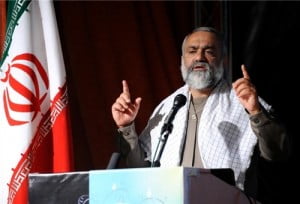
Commander of the Basij (volunteer) Force Brigadier General Mohammad Reza Naqdi described the British embassy in Iran as a “spy den” due to its role in the 2009 post-election unrests, and said the British are desperately seeking to bring back Iran under their reign, although to no avail.
Naqdi referred to the British embassy’s role in the 2009 post-election unrests in Iran, and said, “The people (in Iran) are entitled to know about the role of the British spy den in those bitter events.”
Basij Commander Calls Britain’s Iran Embassy as “Spy Den”
“The filthy monarchical British regime still feels pitty for the black era of colonialism and it wishes to find new Khans to follow the footsteps of its former servants like Reza Khan (the father of Mohammad Reza Pahlavi, the last king of the Pahlavi dynasty in Iran who was toppled in the 1979 Islamic Revolution in the country) and rule the Iranian people and it wishes to return to the black era of colonialism by sowing discord and creating distance between the Iranian people and the pivot of Islam and unity, but it will take this wish to the grave,” he said, addressing Iranian war veterans in Tehran on Wednesday.
Relations between Iran and Britain hit an all-time low in November 2011, when the two countries shut down their diplomatic missions around Britain’s key role in the imposition of a new set of Western sanctions against Iran and its repeated meddling with Iran’s domestic affairs.
On November 27, 2011, Iranian lawmakers voted by a large majority to downgrade diplomatic ties with the United Kingdom, in response to Britain’s decision to impose sanctions on the Central Bank of Iran over the allegation that Iran is pursuing non-civilian objectives in its nuclear energy program.
Two days after the decision by the Iranian parliament, hundreds of Iranian students staged a protest outside the British Embassy in Tehran and pulled down the UK flag.
On November 30, 2011, London cut off its ties with Tehran, withdrew its diplomatic staff from Iran and the Iranian Embassy in London was closed.
Iran recalled all its staff and closed its embassy in London the same day Britain recalled its diplomatic mission in Tehran due to massive protests in front of the British embassy complex by thousands of Iranian students who demanded a cut of ties with London.
The Iranian students’ November 2011 protests at the British mission came after the Iranian legislators in an open session of the parliament the same month approved the bill of a law on downgrading relations with Britain. After the parliament approval, Iran expelled the British ambassador from Tehran.
The parliament approval came a week after the US and Britain targeted Iranian financial sectors with new punitive measures, including sanctions on Iran’s Central Bank and petrochemical industry.
The sanction against CBI and Iran’s petrochemical industry was adopted in a unilateral move by the US, Canada and Britain outside the UN Security Council as other council members, specially Russia and China, had earlier warned against any fresh punitive measure, including sanctions, against Iran.
The British government has also embarked on delisting the anti-Iran terrorist Mojahedin-e Khalq Organization (MKO) from its list of terrorist groups.
The Iranian lawmakers initially started drafting a bill to downgrade ties with London after Britain’s direct involvement in stirring post-election unrests in Iran in 2009, but they intensified and accelerated the move after Simon Gass, the then British ambassador to Tehran, criticized the human rights situation in Iran.
“Today, International Human Rights Day is highlighting the cases of those people around the world who stand up for the rights of others – the lawyers, journalists and NGO workers who place themselves at risk to defend their countrymen,” Gass said in a memo published by the British Embassy in Tehran on December 9, 2010.
“Nowhere are they under greater threat than in Iran. Since last year human rights defenders have been harassed and imprisoned,” Gass added.
Following Britain’s support for a group of wild demonstrators who disrespected Islamic sanctities and damaged private and public amenities and properties in Tehran on December 27, 2009, members of the parliament’s National Security and Foreign Policy Commission drafted bill of a law requiring the country’s Foreign Ministry to cut relations with Britain completely.
The British government’s blatant stance and repeated remarks in support of the unrests inside Iran and London’s espionage operations and financial and media support for the opposition groups are among the reasons mentioned in the bill for cutting ties with Britain.
Then in a meeting at the UN Headquarters in New York City on September 23, last year Iranian Foreign Minister Mohammad Javad Zarif and his British counterpart discussed improvement of Tehran-London relations, Iran’s nuclear energy program as well as regional developments.
Following a set of talks between the two sides, Tehran and London eventually agreed to resume diplomatic relations and announced the names of their non-resident charges d’affaires in October 2013.
In June all the talk was about ISIS’s impending march south on Shiites in Baghdad. Here we are in August, and ISIS has moved due North and East, attacking Christians, Kurds and Yazidis! How did that happen?
IRGC in Iraq push ISIS North instead of South
The Yazidis, Christians and Kurds in Iraq’s North-East have all been aligned with U.S. and Israel for decades. In fact, Israel has not only provided arms, but also substantial training to Kurdish fighters. And for decades, the US imposed a no-fly zone in Northern Iraq o Saddam Hussein to protect the Kurds. With the Kurds being Sunni, and the Yazidis being Zoroastrians, along with a small Christian minority in Mosul – they appeared to pose no direct threat to ISIS. ISIS, after-all had declared war primarily on the Shiites in Baghdad (and Syria [Assad is an Alawite, which is a Shiite derived faith]).
So when ISIS cut off roads to Baghdad and targeted Iraq’s military and central government, it appeared that they were well on their way to fulfilling their backer’s goals. And right after ISIS’s conquest of Mosul, the Kurds declared their independence from Baghdad. And Israel was the first country to formally acknowledge and recognize the Kurdish state. ISIS clearly was doing the job for its backers. ISIS had clearly become a key element in US/Israel’s regional strategy. The U.S. was happy to sit back (send 200 troops to protect their embassy in Baghdad, delay delivery of weapons to the Iraqi army) and let ISIS overrun Iraq. ISIS had taken on Assad for them in Syria, cut off Iranian linkage through Iraq to Syria, and completely undermined Iraq’s central government indirectly controlled by Iran.
Both U.S. and Israel, and several key regional allies such as Saudi Arabia and Qatar too have been funding and providing arms to ISIS! ISIS for years had been deeply entrenched against Assad and marching to Baghdad to topple the Maliki regime too. And to make matters worse, US was weakening the Iraqi military’s defense with delays in supplying critical weapons and aircraft to fend of ISIS. US wanted Maliki’s government to collapse. It was Maliki after all who engineered US withdrawal without any significant long-term plan for US presence in Iraq.
This was all a simple – irrefutable fact. But then everything changed.
ISIS Killing the Yazidis, Christians and Kurds
Ironically, here we are: ISIS is attacking US/Israeli allies: the Yazidis, the Christians and Kurds! It seems they’ve blown back on their backers! In fact, ISIS is not just taking on the Kurdish army and Yazidi fighters, but burying their women alive; cutting off young Christian boys and soldiers’ heads in public squares, grabbing all the loot – including US arms from military barracks and cash from bank vaults – from towns and cities in the North and Eastern part of Iraq. And, they have stopped heading south.
This is the complete opposite of what U.S. and its allies had in mind. It’s completely blown back.
And finally the U.S. military has gotten involved. Under the pretext of stopping genocide and protecting the Yazidis, Christians and Kurds, the US is finally engaged. US bombers and fighter jets are all over ISIS strongholds – destroying their very proxy allies, ISIS.
Yesterday’s allies have become today’s enemy. It’s laughable. It’s actually incredible. How did this happen?
You have to hand it to the IRGC. They are simply amazing. They have turned the tables on US, Israel, Europeans, Saudis and Qataris with incredible skill. And fighting ISIS by default using non-Iranian resources. Brilliant, absolutely brilliant.
According to a major report today, US military are working shoulder to shoulder with their Iranian counterparts to defeat ISIS. Iran, the enemy, is suddenly America’s best friend!
Obama has been cornered. Obama had absolutely no choice but to turn on ISIS – when they moved North and East to fight long-time US allies (Kurds, Christians and Yazidis).
In one of my prior blogs, I had mentioned that in order to stop an ISIS attack on Iran, the IRGC should herd ISIS warriors towards Saudi Arabia as a blowback strategy. But I had completely forgotten about other US allies nearer to ISIS positions. Instead the IRGC herded them to the Kurds, Yazidis and simply made sure there was ample footage of ISIS fighters cutting heads off in the region on the Internet. IRGC quickly realized that ISIS warriors have turned into savage, psychopathic animals that could be easily herded in any direction. And indeed the IRGC figured out how to push them precisely in the direction of where they could cause the greatest harm to their backers.
Hand it to the IRGC Quds Force (IRGC-QF) to know precisely how to manipulate the situation.
As a major component of Iran’s foreign policy, Syrian regime leader Bashar al-Assad was supported via Iranian orchestration and the intervention of Iran’s longtime protégé Hizballah to fight alongside strapped Syrian forces.
Now, in Iraq, Lebanese Hizballah fighters provide critical training and support and have helped develop a large pool of Shiite manpower willing and able to stiffen the faltering Iraqi Security Forces (ISF). This pool of manpower consists of Shi’a militias that the IRGC-QF played a major role in forming and still, to a large extent, funds and controls. Most of the militias ended their armed activity when US forces withdrew at the end of 2011. But, as the ISIS-led offensive drew closer to Baghdad, all of the Shi’a militias took their weapons out of storage and began to reorganize. Members of the Iraqi Shiite militias have been fighting in Syria on behalf of Assad, in part to protect Shi’a holy sites such as the Sayida Zaynab mosque, but have returned home to Iraq to help blunt the ISIS-led offensive. The militia ranks are further swelled by Shi’a youth answering the call from the senior religious figure in Iraq, Grand Ayatollah Ali al-Sistani, to mobilize to defend against the ISIS-led offensive.
The militias have wide popularity in the Iraqi Shi’a community but also a record of Iran-supported violence. Several of the militias were responsible for attacks on US personnel and for killings and disappearances of Sunni civilians during the height of sectarian conflict in Iraq between 2006 and 2008. The revival of the armed militias gives the ISF access to desperately needed manpower. The Badr Organization, the militia arm of the Islamic Supreme Council of Iraq, was formed and trained by the IRGC during the 1980-88 Iran-Iraq war. It later evolved into a political party and was part of Maliki’s “State of Law” coalition in the April 2014 elections. Another militia, the “Mahdi Army,” was formed in 2004 by Shi’a cleric Muqtada Al-Sadr to combat the US military in Iraq and was widely involved in sectarian killings of Sunnis in Baghdad. The Mahdi Army disbanded in 2008 to form a social charity organization, but press reports indicate that it is reconstituting its armed wing to assist the ISF. Several militias are Mahdi Army offshoots. One of them, Asa’ib Ahl Al Haq (League of the Family of the Righteous), reportedly was responsible for killing several US soldiers at Karbala in January 2007. It competed as a separate political entity in the April elections. Another, Kata’ib Hizballah (Hizballah Battalions), was named by the US as a Foreign Terrorist Organization for past acts against US personnel in Iraq.
Yet, interestingly these same IRGC backed fighters (along with the IRGC-Quds Force and Hizballah fighters) are aligned with the U.S. to fight the very enemy that the U.S. armed and funded by proxy through Saudi Arabia and Qatar.
Oh how incredibly the tables have turned. And indeed the IRGC-QF have played their cards brilliantly. In effect, ISIS’s march South has been blunted. And ISIS have been forced to look elsewhere for loot! And in the process, ISIS has in effect committed suicide. By attacking US/Israeli allies, they have forced the US into the game. And once again the victors are the Iranians. Years of calculated US backed proxy war against the Assad regime, and then the Maliki regime have totally backfired. US is killing the very child they have given birth to.
It’s weird, ironic, strange maybe even stupid. When will these idiots inside the beltway learn that you cannot and should not deal with fanatics? Did they NOT learn anything from supporting the Taliban for so long? The ‘cheapest’ proxy war option has once again turned out to the most expensive route. How much has the U.S. spent in Afghanistan so far, to rout out the Taliban that they themselves put in power? How much will the US spend now to pull itself (and its allies) out of this mess? ISIS’s bloody brutality is the direct result of a failed US regional policy. Who, in America, is going to take responsibility for this stupidity? Does the American electorate know or even care?
And once again, the IRGC has played out its hand beautifully. The tragedy of all this, is, that in the end US failure is translating into the rise of Shiite clerics in the region. US allies have all been weakened by this, and the Shiites are more dominant than ever. And we, Iranians, can forget about democracy, freedom, separation of Church & State … all the good things a modern and prosperous Iran truly needs. US has lost out, Iranians have lost out, and the IRGC reigns supreme.
Commander of Basij (volunteer) Force Brigadier General Mohammad Reza Naqdi said enemies are striving hard to impair Iran’s Islamic Revolution through different means, but to no avail.
Basij Commander: Enemies Unable to Harm Islamic Revolution
“Using the culture (promoted) by satellite (channels) and other soft war tactics along with economic war are among the enemy means to defeat the Iranian nation,” Naqdi said in the Northern city of Babol on Wednesday.
“The enemy seeks to strike and damage the objectives of the Islamic Revolution of Iran through all these means, but it has been defeated so far,” he added.
Elsewhere, Naqdi pointed to enemies’ attempts to break the Palestinian people’s resistance, and said, “The enemy is seeking to kill the people in Gaza by western missiles, while these people are still standing firm and fighting the enemy with their faith and belief.”
In relevant remarks in June, Naqdi also underlined the full preparedness of the Islamic Republic’s Armed Forces, saying that Iran’s defensive capabilities and readiness have pushed the enemy to resort to soft war.
“The enemy which couldn’t wage a hot war against the Iranian nation grew disappointed after it found that the deployment (of its forces) around the Islamic Republic has proved ineffective, and it has now focused on the cultural front,” Naqdi said, addressing a forum in Tehran at the time.
“Since 7 years ago, they have focused mainly on the soft war and the cultural front,” he added.
Naqdi further pointed to the wave of psychological propaganda against the Islamic Republic as part of the same soft war efforts made by the enemies, saying over 160 Persian-language satellite channels are now working outside Iran to affect and change the thoughts and system of values of the Iranian youth and families.
A deputy chief of staff of the Iranian Armed Forces had also warned in early January that enemies have devised different plots to implement various soft war scenarios, and called for taking the necessary precautionary measures by Iranian officials.
“It is necessary to devise the needed retaliatory measures in proportion with the enemy’s determination, which is unfortunately growing more serious every day, and to implement them with firmness and confidence,” Deputy Chief of Staff of the Iranian Armed Forces for Cultural Affairs and Defense Publicity Brigadier General Massoud Jazzayeri said, addressing a group of Armed Forces’ cultural officials.
He underlined that the Armed Forces as flag-bearers of fight against enemies’ soft war scenarios can make the society active and remove the existing concerns in this regard by activating potentials and creating effective and timely capacities.
Todays Zaman:A politically motivated witch hunt against police investigators who uncovered a highly secretive Iran-backed terrorist network that has ties to senior government officials has reversed direction and hit the government by revealing to the public damaging details from the prosecutors’ confidential investigation files.
The publication of leaked details on the Tawhid-Salam case file in independent media outlets indicate that embattled Prime Minister Recep Tayyip Erdoğan’s government’s attempts to cover up the investigation have backfired.
Last week, the Bugün and Yurt dailies ran stories detailing the structure of terrorist Tawhid-Salam — also known as the Jerusalem Army — which has killed leading intellectuals and attacked Western, Israeli, Arab and other diplomatic targets in Turkey. The names of a number of Turkish and Iranian suspects, some of whom hold high positions in Erdoğan’s government, have been revealed in recent media reports and put the government in a difficult position.
An unidentified Turkish soldier passes by the damaged car of Ahmet Taner Kışlalı following the expolsion in Ankara on Oct. 21, 1999.(Photo: AP) August 09, 2014, Saturday/ 17:00:00/ SUNDAY’S ZAMAN / ANKARA
A propaganda campaign on the part of pro-government media outlets aims to discredit the probe by publishing fabricated information, such as stating that up to 7,000 people with no connection to one another were wiretapped in an investigation of what was supposedly a fake terrorist organization, but with the release of new information, the campaign has effectively collapsed. Police chiefs who worked on the case file and prosecutors who secured court-authorized wiretaps on the suspects have been detained. Many of them have testified that the actual number of people put under surveillance was 234. Some 70 Iranian nationals with connections to the terror group were also wiretapped.
Main opposition Republican People’s Party (CHP) deputy Mahmut Tanal claimed that Erdoğan’s government is closely involved with the Tawhid-Salam organization. “The government is part of it [Tawhid-Salam],” he said. He filed an objection against the dismissal of the Tawhid-Salam investigation that was dropped by the İstanbul Prosecutor’s Office under political pressure.
Ali Fuat Yılmazer, the former chief of the İstanbul Police Department’s intelligence unit, said Tawhid-Salam has penetrated deep into the government, in what amounts to international espionage. He has been detained by the government so that he and others involved in the investigation will keep their mouths shut.
The government has tried to downplay the significance of the serious breach of national security and has scrambled to contain the fallout. Erdoğan called the terror group “fake” and “imaginary” even though the Supreme Court of Appeals has accepted the group as a terrorist network and upheld the convictions of many of its members.
According to a report compiled from a three-year-long probe conducted by police investigators, Tawhid-Salam has allegedly been operating through four independent cells, all of which are directed by Iranian intelligence operatives who report directly to the Iranian Revolutionary Guard Corps (IRGC).
First cell focuses on ‘sensitive targets’
The first cell is allegedly headed by Naser Ghafari, one of the commanders that the IRGC assigned to Turkey, who operates under the cover of a diplomatic passport attached to the Iranian Consulate in Istanbul.
Hüseyin Avcı Yazıcıoğlu, a Turkish citizen who was wiretapped by Iranian intelligence a long time ago, is a key operative in this cell. In 2011, his wife Kamile Yazıcıoğlu reported his activities with Iranian agents to the police; she provided the police investigators with valuable documents as well as sensitive information that her husband had been holding.
Yazıcıoğlu, the director of Sincan Municipality’s education and culture department in the late 1990s, was involved in profiling activities and aiding and abetting Tawhid-Salam. He fled to Iran in the late 1990s, when he organized a meeting with senior Iranian diplomats called “Quds Night” that started the process of a post-modern coup that forced the Islamic led-coalition government to resign in 1997. He provided valuable information to his superiors, according to the investigation. For example, Aziz Babuşçu, head of the ruling Justice and Development Party (AK Party) İstanbul branch, and several other several AK Party members were among the list of profiled political figures.
The investigation also discovered that the terrorist cell had carried out reconnaissance on the US Consulate General in İstanbul in 2010, seemingly in preparation for an attack on the building. Yazıcıoğlu and his accomplices had produced a detailed surveillance report that indicated empty shops and flats that could be rented to monitor the consulate. The various rental prices of the flats overlooking the entrances to the building were also listed.
During the reconnaissance activity, Selçuk Çetin and Engin Bilgin, both of whom were allegedly working for Yazıcıoğlu, used rented and municipal vehicles to scout the neighborhood. In the next phase of the investigation into the Tawhid-Salam network, police verified that the suspects’ cell phone activity had been recorded on Oct. 5-6, 2010, in the neighborhood of the US Consulate General. As part of their surveillance activity around the consulate, members of the cell suggested using a minaret near the consulate building as well as renting a flat for TL 800 a month from which one of them would be able to spy on the building.
Yazıcıoğlu, his son and other members in the cell had drawn plans of the Nuclear Research Institute in İstanbul’s Halkalı neighborhood and delivered the details to Iranian intelligence.
Second cell taps key operatives
The second cell in the Tawhid-Salam terror network is run by IRGC Gen. Sayed Ali Akber Mir Vakili, who maintained two safe houses in İstanbul’s Ataköy neighborhood and reported directly to Iranian Supreme Leader Ali Khamenei. Its suspected members include National Intelligence Organization (MİT) head Hakan Fidan, former AK Party deputy Faruk Koca, media distributer Abdülhamit Çelik and one of Tawhid-Salam’s founders, Hakkı Selçuk Şanlı.
Çelik is on record as a member of the terrorist network. He was convicted of killing two opponents of the Iranian regime in Turkey and given a prison sentence of 12 years, six months, but he was released in 2004 following an amnesty agreement by Erdoğan’s government. During his testimony in May 2000 as part of the Tawhid-Salam probe, Çelik admitted that he had been trained in Iran to stage attacks in Turkey and conduct intelligence operations on behalf of Iran for over two months. He also acknowledged that the Iran-based Quds Force, a special unit of the IRGC, had obtained bombs from him and had staged attacks in Georgia and Thailand.
Police investigators discovered the footprints of Çelik, who is also the owner of the Sena dental firm, at the site of a bomb attack that targeted the Israeli Consulate General in İstanbul’s Etiler neighborhood in 2011, which led to Ayten Bal losing her leg and injured seven others. Initial investigations suggested that the bombing was an act of terrorism committed by the Kurdistan Workers’ Party (PKK) due to the proximity of the blast to a police academy building, but further investigation clarified that Tawhid-Salam had carried out the attack. Using street camera recordings, police were able to trace a bomb-laden bike to a storage unit in İstanbul’s Fatih district that had been rented by an Iranian with the Quds Force, Rezazadeh Metin, using a false identity. The bomb was supplied by Çelik.
Şanlı, another member in the second cell, allegedly helped set up the Quds Force operation in Turkey on orders from then-IRGC commander Nasir Takipur in the 1990s. While working for Takipur, Şanlı was involved in terror attacks targeting US interests in Turkey. Şanlı was arrested on May 13, 2000 in police raids against the Tawhid-Salam terrorist network; meanwhile, Takipur fled to Iran. Şanlı was tried and sentenced to 12 years in prison, but like Çelik, was freed in 2004 when the Erdoğan government passed an amnesty bill in Parliament reducing the sentences of a number of convicts.
Şanlı kept a low profile for a while after his release — until he was re-engaged by Iranian agents. Police discovered that Şanlı regularly delivers Iranian “hush money” to the families of the murderers of Turkish intellectual Uğur Mumcu and others killed in the 1990s; every month, on orders from Sayed Ali Akber Mir Vekili, he visits convicts Ferhan Özmen and others.
In the 1990s, Şanlı and Mumcu’s killer Özmen met regularly at a car dealership in Ankara that is owned by Koca, another member of the cell. Fidan, a non-commissioned officer (NCO) in the Turkish military at the time, regularly attended the meetings. Koca, one of the founders of the ruling AK Party who later on became a deputy, was described as being pro-Iran and even named his son after Iranian religious leader Ayatollah Rouhollah Mousavi Khomeini. He was also the landlord of a house that Erdoğan rented in the early 2000s. A wiretap was later found there.
He has become wealthy under the Erdoğan government, while he has apparently kept in close contact with Mir Vekili. Koca owns S’LO Cafe, a prestigious establishment in Ankara’s Çukurambar district that is patronized by the new elite in Ankara. The investigation discovered that the top floor of S’LO Cafe is reserved for special guests and that Fidan had Turkish intelligence secure this location against possible eavesdropping. These special guests — including Fidan, Koca, Mir Vekili and Şanlı, according to the leaks — use the back door to access the top floor for meetings.
The police determined that Koca works as a liaison between Fidan and Mir Vekili. A wiretap record from Dec. 1, 2013 reveals that Koca, on instructions from Fidan, set up an emergency contact with Mir Vekili to secure permission for a plane carrying Energy Minister Taner Yıldız to land in the northern Iraqi city of Arbil. Mir Vekili says he will talk to his contacts at Tehran to convince the Iraqi leadership to allow Yıldız to visit Arbil after stopping in Baghdad.
With the help of an informant, the police also discovered that Mir Vekili had learned of a high-profile argument within Erdoğan’s government two days before media outlets published it. According to a leak reported by Twitter user @ACEMUSAKLARI, Fidan had been sharing confidential information about Cabinet meetings with Mir Vekili. Media outlets reported that Deputy Prime Minister Bülent Arınç had tendered his resignation and stormed out of a Cabinet meeting after a fight with Erdoğan, but was later convinced to withdraw his resignation.
It was alleged that Fidan was recruited by Iran in the 1990s through Shiite study meetings in Ankara and that Koca was the point person in facilitating the meetings. The most alarming document against Fidan was discovered on Jan. 17, 2000, when a huge archive was seized by the police during a raid on a safe house operated by Hezbollah in İstanbul. The document revealed the names of public employees who were working for Iran.
Fidan, an NCO at the time, was listed by the code name “Emin.” Police notified military intelligence about Fidan, who later quit the military service. During the surveillance, police discovered that the same code name for Fidan was used in conversations among suspects in the Tawhid-Salam network as well.
Fidan also has links to the first cell. Yazıcıoğlu maintained close contact with Fidan and met him several times, according to Kamile. She said her son and Fidan’s son were friends from school and that her husband had used their son to set up meetings with Fidan.
Third cell plants agents of influence for Iran
The third cell in the Tawhid-Salam network is operated by Ghafari and included people used as spies by Iranian intelligence, according to the police. This cell was entrusted with infiltrating the Turkish government, promoting a positive public opinion towards Iran and collecting valuable information to pass to Iran. Burhan Kavuncu was alleged to be one member of the cell. He maintained secret ties with Iran for 30 years. Court-authorized police wiretapping records revealed that Kavuncu frequently talked to Iranian agent Ghafari, who used payphones in Ankara and İstanbul to set up meetings. On several occasions police surveillance photographed both men when they met.
Kavuncu is alleged to have a wide network in the Turkish government, including the then-prime minister’s undersecretary and current interior minister, Efkan Ala, who was described as being sympathetic to the Iranian revolution and Shiite ideology. During Erdoğan’s visit to Tehran, where he met with Supreme Leader Ali Hosseini Khamenei in 2013, Ala was reportedly given Khamenei’s prayer stone. Furkan Torlak, Kavuncu’s son-in-law, is alleged to be among those who organized the planting of Iranian sympathizers in the Turkish government.
A wiretap audio file recorded on Jan. 4 reveals Kavuncu asking Ala to speed up security clearance for his son-in-law, Torlak, to start working as the prime minister’s advisor. Torlak is now working at the ruling AK Party’s headquarters for Deputy Chairman Numan Kurtulmuş. Torlak was accused of coordinating the planting of pro-Iranian sympathizers in government institutions including the state-run Anadolu news agency, the Turkish Radio and Television Corporation (TRT) and the Undersecretariat for Public Security. The investigation also reveals how Ghafari used the pro-Iranian Yeni Akit daily to signal to other operatives to flee Turkey when he was alerted by pro-Iranian officials in the government that he was under surveillance.
The leak by @ACEMUSAKLARI alleges that Deputy Prime Minister Beşir Atalay has been a long-time Iranian sympathizer as the police investigation into his background revealed, which was added to the Tawhid-Salam investigation case file. The leak claims that Atalay’s family originates from Iran, even though his family settled in the Keskin district of Kırıkkale province, an hour’s drive to the east of Ankara. His family has been very active in the Shiite Bab-ı Ali (Ehl-i Beyt) İlim Vakfı foundation in the province. The contact address for this foundation is listed as the Çile Bookstore, whose owner Bahattin Atalay is the brother of Beşir Atalay.
The investigation file claims that Atalay was exposed to Iranian propaganda throughout his youth. He even went to Iran to attend annual celebrations of the Iranian revolution. A confidential police document dated Feb. 26, 1982, reveals that Atalay, a research assistant in the department of sociology at the Faculty of Management and Economy of Erzurum Atatürk University, went to Tehran to attend the third annual celebrations for the Iranian revolution. He was arrested on April 27, 1983, in Erzurum when police raided different cells as part of an investigation into an Iranian-linked network in the eastern province. Police found Iranian revolutionary documents and materials in Atalay’s house. He told the police he had spent 12 days in Iran.
In 1984, police sent a confidential memo on Beşir Atalay to the rector’s office at Erzurum University, detailing his activities, which included seminars in student houses praising the Iranian revolution and recruiting for an Iranian group in the university. He reportedly taught a doctrine that Turkey could also be saved with a similar revolution. The police also exposed Atalay’s links to then-Iranian consul M. Tahari at the Iranian consulate in Erzurum. Atalay also served as the rector of Kırıkkale University between 1992 and 1997 and appointed pro-Iranian sympathizers to key positions at the university. The investigation file claims that he also established the Fifth Way group at Kırıkkale University, which was officially organized under the Fifth Season Association. Its members subscribe to radical Shiite doctrine and praise Shiite ideology as the fifth true school of thought in Islamic law that generally accepts the Maliki, Hanafi, Shafii and Hanbali schools as the leading Sunni schools of thought of Islamic jurisprudence.
Atalay was also believed to be the architect of Turkey’s tilt towards Iran during AK Party rule. He was identified as the key pro-Iranian official in helping Iran sympathizers move to senior positions in the Turkish government. Fidan and Interior Minister Efkan Ala are among many of his protégés, according to Twitter user @ACEMUSAKLARI. He publicly admitted in 2012 that he was the one who helped Fidan make a name himself in the government.
Fourth cell fifth column group
The fourth cell of the Tawhid-Salam terror group is operated by Iranian intelligence operatives and includes names like Hussain Muktediri, Ali Kıasat Far, and Hasan Şabani. The aim of this cell is to conduct fifth column activities and undermine Turkey’s national security.
The terror group staged bloody attacks on Turkey in the 1990s, including the murder of investigative journalist Mumcu, Professor Bahriye Üçok, intellectual and commentator Ahmet Taner Kışlalı and several other Kemalist-secularist intellectuals in Turkey as well as foreign diplomats such as Abdul Ghani Bedawi, a Saudi diplomat working as the second secretary at the Saudi Arabian Embassy, Ehud Sadan, the Israeli Embassy’s top security officer in Ankara, and Victor Marwick, who worked for a Turkish-US logistics group. The group also orchestrated attacks targeting Yash Palkumar, second secretary at the Indian Embassy, Abdullah Huseyin Kurabi, a member of staff at Egyptian Embassy, Hüseyin Osman, an employee at the British Embassy, and Zivarov Simiç, an employee at the Yugoslavian Consulate in İstanbul.