TEHRAN (FNA)- Iran’s police chief Brigadier General Esmayeel Ahmadi Moqaddam underlined preparedness of the Law Enforcement Force to thwart any threat to the country, and said his forces are in stable conditions.
Today, the Law Enforcement Force enjoys proper structure and forces and it is in a stable status under the conditions that the region surrounding the country is insecure,” Ahamadi Moqaddam said in Tehran on Sunday.
Iran’s police chief Brigadier General Esmayeel Ahmadi Moqaddam
In relevant remarks earlier this month, Ahmadi Moqaddam stressed the readiness of the country’s military, security and intelligence forces to defuse any destabilizing threat to Iran’s borders, particularly in the West.
Some people linked to the Islamic State of Iraq and the Levant (ISIL) may be arrested at Western borders, but no command from the ISIL has entered the country (Iran),” he said.
The police chief reiterated that the country’s borders are closed to terrorists, and there is no concern about terrorism.
Hopefully, we are observing all activities and movements in terms of intelligence across the borders of Islamic Republic, and there is no concern,” General Ahmadi Moqaddam underlined.
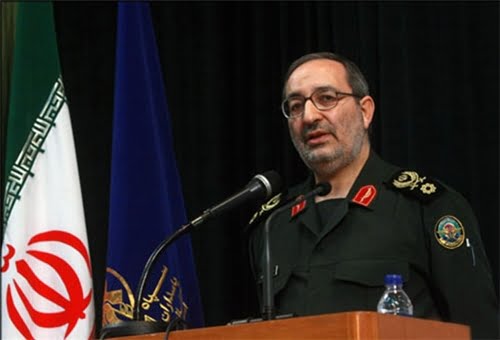
TEHRAN (FNA)- Deputy Chief of Staff of the Iranian Armed Forces for Cultural Affairs and Defense Publicity Brigadier General Massoud Jazayeri blasted the US for waging a proxy war in the regional states, and said the terrorists’ command center in Iraq is controlled by Washington.
“Formation, organization and leading of the terrorist groups’ actions and waging proxy wars instead of direct interference are among the US strategies in the region,” Jazayeri said in Tehran on Sunday.
The US is after fundamental changes (in the region), weakening the regional powers and breaking the regional resistance,” he added.
Jazayeri warned that the Americans are trying to open a new front in Iraq to increase pressure on the resistance front, but stressed that resistance won’t allow the enemy to cross its redlines.
Deputy Chief of Staff of the Iranian Armed Forces for Cultural Affairs and Defense Publicity Brigadier General Massoud Jazayeri
In relevant remarks earlier this month, Iranian Parliament Vice-Speaker Mohammad Hassan Aboutorabi Fard extended Tehran’s full support for Iraq’s territorial integrity, and called on the country’s people from all walks of life to be watchful of the divisive plots hatched by the enemies who don’t want a powerful and united Iraq.
Aboutorabi Fard underlined that Muslims are really concerned about sovereignty of Iraq, and urged the crisis-hit country’s nation to grow more united to thwart the arrogant powersˈ divisive plots.
He further added that the Islamic State of Iraq and the Levant (ISIL) has been created by arrogant powers to provoke division among Muslims.
The ISIL is a Takfiri organization affiliated to al-Qaeda, which was founded in Iraq in 2004.
Also last month, Iranian Ambassador to Beirut Mohammad Fath-Ali voiced opposition to Washington’s interference in Iraq, and said the US is attempting to change the results of the recent elections in Iraq using terrorist groups like the ISIL.
Many other regional and Iranian officials have also warned of enemies’ plots against the Muslim nations, specially Iraq.
TEHRAN (FNA)- Secretary of Iran’s Human Rights Council Mohammad Javad Larijani in a letter to UN High Commissionaire for Human Rights Navi Pillay blasted the UN Special Rapporteur on Human Rights in Iran, Ahmed Shaheed, for his baseless allegations against Tehran, and said his method of compiling reports runs counter to the principles of being a neutral rapporteur.
“Stressing the Islamic Republic of Iran’s interaction strategy in different issues and its logical and constructive talks, I underline that the path chosen by the special rapporteur completely contradicts his responsibility as a neutral, professional and independent rapporteur,” Larijani said in his letter to Pillay on Saturday.
Pillay had on Thursday in a press conference on the sidelines of the Vienna nuclear negotiations between Iran and the Group 5+1 (the five permanent UN Security Council members plus Germany) requested the western negotiating delegations to include human rights issue in Iran in their nuclear negotiations with Tehran in full details.
Secretary of Iran’s Human Rights Council Mohammad Javad Larijani
Larijani underscored that Iran expects Pillay to adopt the necessary measures to correct and review this “destructive and unconstructive” process.
Also on Friday, senior Iranian nuclear negotiator Seyed Abbas Araqchi rejected Pillay’s demands, and cautioned the six world powers and international bodies not to try to include new issues in the negotiations.
The human rights issue is fully unrelated to the nuclear talks, as everyone is well aware, and such a request will lead to nowhere,” Araqchi stressed.
Araqchi added that he had only seen a headline about the UN High commissionaire for human rights (UNHCHR) comment on the matter and that he was not even fully aware whether she had said so or not, reiterating, “All I can say is that Pillay is a much respected personality on the international scene.”
She is an internationally renowned, experienced personality and I seriously doubt it that she would have been incapable of comprehending such a simple fact,” the Iranian official added.
All the sides of these negotiations, too, are fully aware of the fact that the human rights issue is totally unrelated to the matter of discussions in our ongoing nuclear talks,” he pointed out.
In relevant remarks in March, Larijani lashed out at Ahmed Shaheed for his baseless allegations against Tehran, and said he could never verify hundreds of claims against Iran just during a three-day visit to the country.
Ahmed Shaheed regularly complains why we do not allow him to come to Iran, while he has raised about 3,000 accusations against Iran from outside the country (without visiting Iran),” Larijani said in a press conference in Tehran at the time.
His visit to Iran is not meant to be for verification purposes, but it is for propaganda; how does he want to study 3,000 allegations in just three days (of a trip),” he asked.
Also in January, Larijani blasted Shaheed for his support for the terrorist groups acting against Tehran, and said the UN rapporteur has turned into an actor providing service for the opposition media.
“Unfortunately, Ahmed Shaheed has become a media actor who acts for those media which air propaganda against the Islamic Republic, while this is against the approved protocols,” Larijani told FNA at the time.
“Ahmed Shaheed supports terrorism extensively,” he said, explaining that he has provided Iran with the name of four people claiming that they are due to be executed for their human rights activities.
“This is while these four individuals have been sentenced to death or other penalties for their membership in PJAK (Party for a Free Life in Kurdistan), they have killed people and their houses had turned into place for storing weapons,” Larijani said.
“It is a shame for the human rights rapporteur to label terrorists as human rights advocates,” he underlined.
PJAK, a militant Kurdish separatist group with bases in the mountainous regions of Northern Iraq, has been carrying out numerous attacks in Western Iran, Southern Turkey and the Northeastern parts of Syria where Kurdish populations live.
The separatist group has been fighting to establish an autonomous state, or possibly a new world country, in the area after separating Kurdish regions from Iran, Iraq, Turkey and Syria.
Iranian intelligence and security officials have repeatedly complained that Washington provides military support and logistical aids for such anti-Iran terrorist groups.
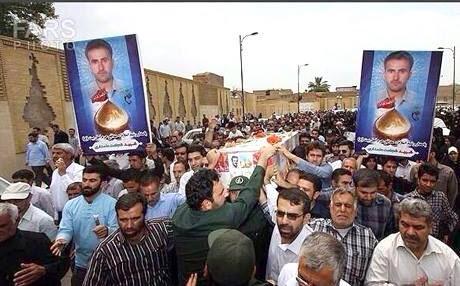
An Iranian pilot has been killed in Iraq, state-run IRNA news agency reported on Saturday. This is the first report by state-run media on military casualty of the Iranian regime during fighting militants in Iraq.
The report said Colonel Shoja’at Alamdari Mourjani was killed last week in Iraqi city of Samera.
IRGC Col. Shoja’at Alamdari Mourjani
His death comes after reports emerged that fighter planes from the Iranian regime have arrived in Iraq to provide air support for Iraq’s fight against Sunni militants.
The International Institute for Strategic Studies, based in London, said in a report that a number of Su-25 fighter jets from Iran have arrived in Iraq.
IISS analysts said serial numbers on the Russian-built aircraft from Iran, seen on a video produced by the Iraqi Ministry of Defense, correspond with numbers known to be part of the Iranian regime’s air force.
The commander of the IRGC in Fars province attended the funeral service held for IRGC Col. Alamdari on Friday in southern city of Shiraz.
HRANA News Agency – 4 men who were arrested because of their Facebook activities have been released on the bail.
According to the report of Human Rights Activists News Agency (HRANA), Bahman Tafazzolinasab, Afshin Zemanati, Reza Tejare and Davoud Afrouz had been arrested by the IRGC intelligence forces in May. They were transferred to the prison of Gachsaran after 2 days of custody in IRGC detention center.
The 4 men had been under arrest for 40 days and released on the bail afterwards.” Said an informed source to HRANA reporter
Afshin Zemanati, Reza Tejare and Davoud Afrouz have been charged with insulting the Supreme Leader, blasphemy and spreading propaganda against the government. They will be tried at the second branch of the revolutionary court of Dehdasht soon.” He said
LONDON , (UPI) –Fighter planes from Iran have arrived in Iraq to provide air support in Iraq’s fight against Sunni militants who have overtaken much of the country.
After Russia supplied Su-25 jets and the United States provided helicopters, drones and missiles, three Su-25s from Iran have arrived as well, said the International Institute for Strategic Studies, based in London.
It indicates the U.S. and Iran, enemies on most geopolitical fronts, are working toward the same goal.
An example of a Su-25 fighter plane (CC/ merlion86)
IISS analysts said serial numbers on the Russian-built aircraft from Iran, seen on a video produced by the Iraqi Ministry of Defense, correspond with numbers known to be part of Iran’s air force.
Joseph Dempsey of the IISS noted “evidence of key positions (identifying marks) being painted over. This includes the location of Iranian roundels on the side of the air intakes along with a large proportion of the tail fin normally occupied by a full serial number, the Iranian flag and the IRGC (Iran Revolutionary Guard Corps) insignia. Imagery analysis makes this the most logical conclusion. The markings, serial numbers and camouflage all fit with what we know of the Iranian fleet.”
Dempsey suggested the planes are being flown by non-Iraqi pilots, noting Iraq has not used this type of aircraft since the first Gulf War.
HRANA News Agency – Negar Haeri, Mashallah Haeri’s doughter, has been arrested and transferred to Shahr Rey Prison.
According to the report of Human Rights Activists News Agency (HRANA), Mrs. Haeri was sentenced to 1 year in prison by the branch 26 of the revolutionary court of Tehran and has been arrested to serve the sentence.
She is Mashallah Haeri’s daughter who is imprisoned in the Rajai Shahr Prison of Karaj.
She had been arrested in April 2011 and released on the bail in July 2012.
NICOSIA-(AFP): For a man widely reported to be playing a key role in helping Iraq’s routed military recover lost ground, Qassem Suleimani, the commander of Iran’s feared Quds Force, remains invisible.
It is not a new strategy for Suleimani – the 57-year-old is rarely pictured, a trait that chimes with his apparent, although officially denied, presence in Baghdad in the past fortnight.
Having already helped Syrian President Bashar al-Assad reverse the gains of Sunni-led rebels in that country’s civil war, just when it looked like Assad was finished, Suleimani has cultivated a reputation as perhaps the most formidable security operative in the Middle East.
With multiple media outlets stating that the enigmatic general is now in Iraq, where Prime Minister Nuri al-Maliki’s forces have as yet failed to repel a Sunni militant offensive, the political parallels are striking.
The jihadists laying siege to Maliki declared a “caliphate” – an Islamic system of government not seen since Ottoman times – on Monday.
Despite their limited numbers, they have led the occupation of Iraq’s second largest city Mosul and are fighting to hold Tikrit after a northern sweep shocking in both its speed and simplicity, with Iraqi troops melting away when confronted.
With the Iraqi military’s collapse all too visible, the presence of Sunni militants – now known as the Islamic State (IS) – near Iran’s border invokes fear in Tehran.
Bonded by Shiite Islam, Iran and Iraq have grown closer in the realms of government and security since the overthrow of Sunni leader Saddam Hussein in the US-led invasion of 2003.
Qassem Suleimani, the commander of Iran’s feared Quds Force
Short in stature but feared on a grand scale, Suleimani joined Iran’s forces during the war Saddam launched against them in 1980, an eight-year conflict that left more than a million people dead.
Afterwards, he was sent to Iran’s eastern border to fight drug traffickers coming in from Afghanistan.
He was named Quds commander in 1998 and in May 2005 was described by Iran’s ultimate authority, supreme leader Ayatollah Ali Khamanei, as “a living martyr.”
The Quds Force, a branch of the Revolutionary Guard, is highly secretive and conducts sensitive security functions abroad, such as intelligence, special operations and political action deemed necessary to protect the Islamic republic.
On the rare occasions he has spoken publicly, Suleimani’s obvious zeal has lived up to the air of mystique that has built up around his persona.
The few pictures of him show a face whose intense stare and focus sits within a closely cropped and greying beard.
His words have confirmed Iran’s regional reach
Iran has a presence in southern Lebanon and Iraq. In fact, those areas are in a way influenced by the Islamic Republic of Iran’s ideology and conduct,” he said in a speech carried by Iranian media in January 2012.
Two years later, he went further: “No force or country except for Iran is capable of leading the Muslim world today… due to Iran’s support for revolutionary and Islamic movements and fighters as well as its defence of Muslims against aggressors.”
A diplomatic source told AFP: “He knows Syria like he was born there and has very good knowledge of Iraq.
“He is utterly respected by the Quds Force members, thanks to his career.”
A similar mission to the one he carried out in Syria would explain Suleimani’s presence in Baghdad, which has been denied by the foreign ministry in Tehran.
Moreover, Suleimani has history with Maliki.
Amid the political deadlock of Iraq’s inconclusive 2010 general election, the Iranian general allegedly organised a meeting in the shrine city of Qom, a two-hour drive south of Tehran.
It was at that meeting that Shiite cleric Moqtada al-Sadr – the one-time head of Iraq’s Mahdi Army militia turned political leader based in self-imposed exile in Iran at the time – agreed to support Maliki’s bid for the premiership.
The deal effectively completed Baghdad’s political power shift from Washington to Tehran, and was followed a year later by a complete exit of US troops from Iraq.
All of the important people in Iraq go to see him,” Iraqi deputy PM Saleh al-Mutlaq said of Suleimani in 2011.
The dark side of the Quds Force’s activities is never far from foreign headlines. Suleimani was accused by the US military in 2008 of training Iraqi hit squads. And Israel said he orchestrated attacks on Israeli tourists in the summer of 2012.
He is indeed like Keyser Soze,” a senior US official told the Guardian newspaper in 2011, referring to the seemingly invisible character portrayed by Kevin Spacey in “The Usual Suspects.”
Nobody knew who he was and this guy’s the same,” the official said of the Quds commander. “He is everywhere, but nowhere.”–AFP
KHAAMA PRESS– :The Afghan Intelligence – National Directorate of Security (NDS) Chief, Rahmatulllah Nabil, said Wednesday that the Iranian Revolutionary Guard Corps (IRGC) and Pakistan’s Inter-service Intelligence (ISI) are involved behind the deadly clashes in Helmand province.
NDS Chief told Afghan lawmakers that the IRGC and ISI are seeking their interests in Helmand clashes.
Nabil said ISI is looking to provoke war in Helmand province and turn the area into a war zone.
The Afghan Intelligence – National Directorate of Security (NDS) Chief, Rahmatulllah Nabil
He also added that the IRGC and ISI are currently working to implement their plans by taking advantage from the current political issues due to elections.
According to Nabil, Pakistan is directly involved in instability and continued violence in eastern, northeastern and western provinces where the militia men have been deployed to fight the Afghan forces.
The senior security officials were summoned in Afghan parliament on Wednesday to brief the lawmakers regrding the deadly clashes in Helmand province.
Dozens of Afghan civilians and security forces were killed or injured during the clashes which continued for almost one week.
Around 800 Taliban militants launched the offensive in Sangin district and the clashes soon spread in other districts Kajaki, Nawzad and Mosa Qala.