TORONTO, Canada-RUDAW—A female Kurdish prisoner in Iran who has reportedly been tortured and is now going blind is being denied proper healthcare, activists say.
Zeinab Jalalian’s eyesight has been deteriorating over the past several months and her physical and psychological health is deteriorating, human rights activists say. Jalalian, 32, is serving a life sentence in Kermanshah prison for enmity against God for belonging to the armed rebel Party of Free Life of Kurdistan (PJAK), a charge she denies.
Prisoners have access to healthcare under Iranian law, but activists say prison officials are refusing to let her see an eye specialist outside of the prison. She has suffered torture, serious intestinal issues and eye problems since being imprisoned, “possibly as a result of blows to her head” Amnesty International reported.
Iranian and international human rights groups are calling for Jalalian to receive immediate medical treatment and for a new trial to be held. Amnesty reported that her trial in 2009 lasted only a few minutes and that she did not have a lawyer.
Jalalian was originally given the death penalty, but her sentence was reduced to life imprisonment in 2011. She has frequently gone on hunger strikes and has not been allowed family visits for over a year, according to Amnesty International.
Jalalian is from Maku, a town in the West Azerbaijan province of Iran. Human rights activists including the World Organization Against Torture have called for Jalalian’s release, noting that she did not have the right to cross-examine witnesses or have witnesses testify on her behalf.
US-based Kurdish activist Soraya Falah has called on Nobel Peace Prize winner and prominent Iranian lawyer Shirin Ebadi to advocate on Jalalian’s behalf.
Though vaguely worded, enmity against God, is no small crime in Iran. Kurdish prisoners including Farzad Kamangar, 32, Ehsan Fattahian, 28, and Fasih Yasmani, 28, were among those hanged for the crime, which human rights activists say is often politically motivated.
Other Kurdish political prisoners are living under dire conditions in Iranian prisons including Muhammad Sediq Kaboudvand, a Kurdish journalist who was convicted in 2007 of breaking numerous laws including “acting against national security” and “widespread propagation against the system.” He is serving a 10-year sentence.
LAINFO-Iran has tightened security of its borders by the constant terrorist attacks suffered by neighboring Iraq by the group the Islamic State of Iraq and the Levant (EIIL), so the head of the Iranian police, Brigadier General Esmail Ahmadi Moqadam , highlighted the strong presence and full control of the intelligence of the police forces, the Army and the Corps Guardians of the Islamic Revolution of Iran (IRGC) in Iran’s borders.
The head of the Iranian Police, Brigadier General Esmail AhmadiMoqadam
Ahmadi Moqadam Monday dismissed rumors of a possible input elements belonging to EIIL in Persian territory or any other terrorist group.
Faced with this threat, the Persian police commander, stressed the capacity and ordered the Iranian police efforts in the promotion of safety in all parts of the country and borders.
Recall that since 10 June EIIL elements have carried out attacks in different parts of Iraq (Mosul and Tikrit) and caused the deaths of more than a thousand citizens, a large number of wounded, besides a large number of displaced.
In response to these attacks, the security forces of Iraq, with Sunni, Shia and Christian volunteers, among others, have launched operations to drive terrorists busy cities.
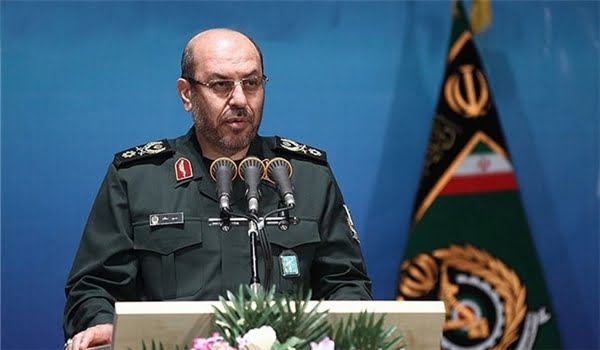
TEHRAN (FNA)- Iranian Defense Minister Brigadier General Hossein Dehqan said members of the Islamic State of Iraq and the Levant (ISIL) terrorist group and their supporters should be tried in a war tribunal.
“The terrorist grouplet of the ISIL and its supporters should be punished as war criminals,” Dehqan said, addressing a meeting with the Defense Industries Organization’s elites and managers in Tehran on Monday.
Iranian Defense Minister Brigadier General Hossein Dehqan
He said massacre, aggression, destruction, mass execution and displacement of thousands of people in Iraq and Syria is a clear evidence of the war crimes, which have undermined the regional security in light of the silence shown by the international community and the so-called advocates of human rights.
Dehqan underlined the necessity for maintaining national integrity and solidarity by the Iraqi people to overcome the crisis and the terrorist groups.
He also stressed the Islamic Republic’s support for the territorial integrity of Iraq, and said, “The Islamic Iran seeks an integrated, united, secure and advanced Iraq and supports any measure to this end.”
The ISIL is operating in Northern and Northwestern Iraq near the country’s borders with Turkey and Syria.
Earlier this month, Iranian President Hassan Rouhani rejected alleged reports on the deployment of Iranian troops in Iraq, but said Tehran is ready to help its Western neighbor in its war on terrorists based on the international laws if requested by Baghdad.
“We, as the Islamic Republic, are Iraq’s friend and neighbor and have good relations with the Iraqi government and nation,” Rouhani told reporters in a press conference in Tehran.
“If the Iraqi government wants help, we will study it; of course no demand has yet been raised until today but we are ready for help within the framework of the international laws and at the request of the Iraqi nation,” he added.
“Of course, we should know that help and assistance is one issue, and interference and entrance (into the battlefield) is another. If the Iraqi government demands us we will help them, but the entrance of the Iranian troops (onto the scene of battles in Iraq) has never been considered,” the president said.
IRAN NEWS UPDATE-(NCRI) – The Iranian regime is ready to help the government of Nouri al-Maliki to fight Sunni militants and tribes using the same methods it has deployed against those opposing Syrian dictator Bashar al-Assad, a senior commander of Iranian regime’s Revolutionary Guards (IRGC) said.
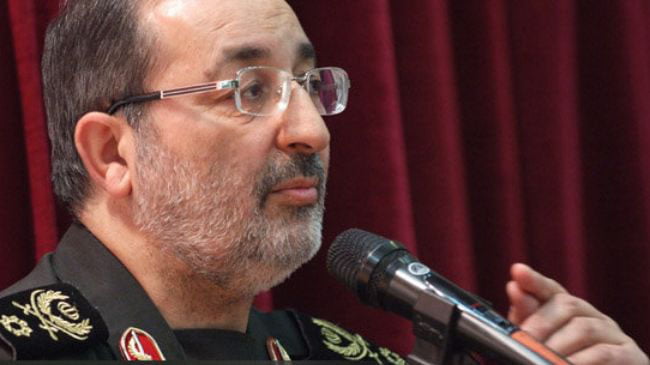
Brigadier General Massoud Jazayeri, deputy joint chief of staff of the armed forces told the Iranian regime’s Arabic language TV channel, al Alam television, that regime’s response to Iraqi militants would be “certain and serious.”
Brigadier General Massoud Jazayeri, deputy joint chief of staff of the armed forces
Jazayeri’s remarks late on Saturday did not provide details on the assistance that mullahs’ regime could give Nouri al-Maliki regime.
“Iran has told Iraqi officials it is ready to provide them with our successful experiments in popular all-around defense, the same winning strategy used in Syria to put the terrorists on the defensive … This same strategy is now taking shape in Iraq – mobilizing masses of all ethnic groups,” he told the television station.
“A response is certain and serious,” he said. “With Syria, too, we announced we would not allow terrorists in the hire of foreign intelligence services to rule and dictate to Syrian people. We will certainly have the same approach with Iraq.”
The Iranian regime has spent billions of dollars propping up its ally, the Syrian dictator Bashar al-Assad.
The help for Bashar al-Assad has included hundreds of military specialists, including senior commanders from the elite Quds Force, the external and secretive arm of the IRGC, according to Iranian sources familiar with deployments of military personnel, Syrian opposition sources and security experts.
Meanwhile, a former senior commander of the Revolutionary Guards Corps (IRGC) said on Thursday that now third Basij force which he described as third child of the Iranian regime in the regime is being born in Iraq.
Major General Hossein Hamedani, said on May 4: “Today, 130,000 trained Basij forces [repressive paramilitary forces] are waiting to enter Syria. Today we fight in Syria for interests such as the Islamic Revolution. Our defense in Syria is to the extent of the Sacred Defense (term used by the regime officials to refer to the Iran-Iraq war of 1980’s).”
Mahabad, West Azarbaijan, IRNA – Commander in chief of Islamic Republic Guard Corps said Saturday that the brave residents of Iranˈs Sardasht border city with their exemplary resistance and challenging attitude taught everyone the lesson of gallantry and resilience.
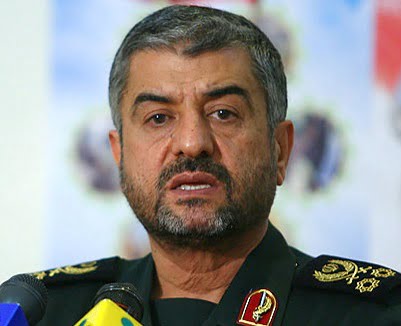
Brigadier General Mohammad Ali Jaˈfari made the comment in a message on the 27th anniversary of the chemical bombardment of Iranian border city of Sardasht by the Baˈathist regime of the ousted Iraqi dictator, Saddam Hussain, in an auditorium of that township in the presence of some country and army officials.
ˈBeyond doubt the chemical bombardment of Sardasht in the year 1978 by the wretched Baˈathist enemy regime is a document for having been oppressed of the noble and revolutionary Iranian nation, and particularly the residents of Sardasht City,ˈ said the IRGC commander,
ˈSardasht catastrophe is so painful that the sound of its oppressed victims will echo in the ears of the world nations till the end of the history of mankind so that maybe one day the liar standard bearers of the human rights would heed a small bit of their natural duties; the standard bearers who saw the catastrophes of Sardasht and Halabcha, but due to the ruling censorship in world media, the horrendous dimensions of that horrible crime remained hidden from world nationsˈ public opinion,ˈ said Brigadier General Jaˈfari.
Commander in chief of Islamic Republic Guard Corps Brigadier General Mohammad Ali
ˈThis year, on the 27th anniversary of the chemical bombardment of Sardasht City by the bloodthirsty Baˈathi butchers, we commemorate the memories of over 800 martyrs and 2000 injured victims of that war crime, hoping that this commemoration service would serve as a pretext and an opportunity for echoing the sound of oppression of the civilian people and innocent children, and even the future generations of the brave Sardasht, in the ears of the world nations,ˈ said the IRGC commander.
He meanwhile encouraged the world public opinion and the freedom seekers around the globe to make more serious moves aimed at blocking the path for the production, stockpiling and use of the chemical weapons, as well as all other types of the weapons of mass destruction (WMD) by the hegemonic powers, especially the criminal US and Zionist regimes.
Also present in the commemoration service there were the minister of health, a number of parliament members from the regionˈs various cities, officials from the Martyrs and War Disabled Veterans, Friday prayers imams of the region, IRGC commanders and a large number of Sardasht residents and chemical victims.
It was about 4 p.m. on June 28, 1987 when Iraqi warplanes began circling the city of Sardasht in northwestern Iran and dropped bombs containing chemical weapons on four parts of the city.
The poison gas attack continued on the next day, and the neighboring villages were also not spared.
Over 130 people were killed in the attacks on Sardasht at the time, but the real death toll is much higher since some died of their injuries later.
About 5000 people were injured in the chemical weapons attack and suffered lifelong health problems as a result. Some victims spent the rest of their lives in hospital, suffering from respiratory problems.
The world did not take notice of this tragedy until former Iraqi dictator Saddam Hussein gassed the Kurdish town of Halabja in northern Iraq on March 16, 1988, killing 5000 men, women, and children.
Professor Philip G. Kreyenbroek, the director of the Iranian Studies Department at the University of Gottingen in Germany, says the attack on Halabja is better known because of the much greater number of victims, and also because it highlighted Saddam’s willingness to murder his own people.
“An attack on enemy territory did not shock the Western public as much as near-genocide in one’s own territory,” Kreyenbroek said.
Arshin Adib-Moghaddam, the chair of the Centre for Iranian Studies of the London Middle East Institute of the University of London’s School of Oriental and African Studies, said Western companies helped Saddam commit atrocities against Iranians and Iraqi Kurds.
“Halabja and Sardasht were atrocities that were only possible due to the dual-use equipment made available to Saddam Hussein by Western companies,” he stated.
Some human rights campaigners believe that Sardasht should be registered in world history, just like Hiroshima, as a city that was a victim of weapons of mass destruction.
Western firms that sold component materials for the production of chemical weapons to Saddam’s Baˈathist regime must be held accountable.
There has been no justice for the people of Sardasht. It has been 27 years since a formal complaint about the attack was submitted to the International Court of Justice in The Hague, but the case is still open.
Tehran, IRNA – Representative of the Supreme Leader to the Islamic Revolution Guards Corps (IRGC) Ali Saeedi, on Saturday cautioned against US divisive plots in the Muslim World.
He made the remarks in a ceremony to mark anniversary of Haft-e Tir terror bombing against the statesmen of the Islamic Republic of Iran who had attended a meeting at the Islamic Republic of Iran Party.
Representative of the Supreme Leader to the Islamic Revolution Guards Corps (IRGC) Ali Saeedi
On June 28, 1981 (the 7th of Tir 1360) a powerful bomb went off at the headquarters of the Iranˈs Islamic Republic Party in Tehran, while a meeting of party leaders was in progress.
Seventy-three leading officials of the Islamic Republic were killed, including Chief Justice Ayatollah Mohammad Beheshti.
Referring to the ongoing civil war in Iraq, Syria and Afghanistan, he noted that US regional plots is doomed to failure.
Saeedi said that the Muslims should exercise vigilance against the divisive plots of the US and its allies.
He noted that before Iranˈs 1979 Islamic Revolution, the occupying regime of Tel Aviv had conquered all wars but it couldn’t win any war after 1979.
TEHRAN (FNA)- The drug combat squads of Iran’s police, Basij (Voluntary), and Islamic Revolution Guards Corps (IRGC) have seized more than 9,000 kilograms of illicit drugs in Isfahan province in the first three months of the current Iranian year (March 21-June 21, 2014), a senior provincial official announced on Saturday.
“Over 9 tons of various kinds of narcotics have been seized from drug traffickers by the Iranian Law Enforcement, Basij Force and IRGC in the first three months of the current year,” Representative of the Coordination Council of the Drug Combat Directorate in Isfahan province Nabiollah Shahmohammadi said.
Iran lies on a major drug route between Afghanistan and Europe, as well as the Persian Gulf states.
According to official estimates, Iran’s battle against drugs cost the country around $1 billion annually. Strategies pursued by Tehran include digging canals, building barriers and installing barbed wire to seal the country’s borders, specially in the East.
Iran has long complained that the global community, specially the western nations, do not contribute their role in the campaign against drugs, saying that Iran is making lone efforts to block the transit of narcotics from Afghanistan to Europe and the US. Meantime, the Iranian police officials maintain that drug production in Afghanistan has undergone a 40-fold increase since the US-led invasion of the country in 2001.
While Afghanistan produced only 185 tons of opium per year under the Taliban, according to the UN statistics, since the US-led invasion, drug production has surged to 3,400 tons annually. In 2007, the opium trade reached an estimated all-time production high of 8,200 tons.
TEHRAN (FNA)- Deputy Chief of Staff of the Iranian Armed Forces for Cultural Affairs and Defense Publicity Brigadier General Massoud Jazayeri blasted the US and its regional allies for igniting proxy wars in the region, and warned that Iran will give a crushing response to terrorists and even their supporters in case they dare to approach its borders.
“Certainly the terrorist groups and even their supporters will be confronted seriously (if they threaten the Iranian borders),” Jazayeri said in an interview with the Iran-based Arabic-language Al-Alam in Tehran on Saturday.
Deputy Chief of Staff of the Iranian Armed Forces for Cultural Affairs and Defense Publicity Brigadier General Massoud Jazayeri
“Our confrontation (with the terrorists) is certain and serious; we don’t have any little ambiguity and uncertainty in this regard and we certainly won’t allow them to approach our borders or enter them,” he added.
Asked if Iran has decided to help Iraq in confronting the terrorists, Jazayeri said, “If the Iraqi government and people feel any need (to Iran’s assistance) in such conditions, the Islamic Republic of Iran will certainly help them.”
He lambasted the US and its regional allies, specially Saudi Arabia, for supporting the terrorist groups, and said, “We think that the Americans are seeking new advantages in Iraq.”
Referring to the US officials’ remarks on Washington’s readiness to help Iraq, Jazayeri said that the most important assistance that the Americans can give is stopping support for the terrorists and their regional advocates.
In relevant remarks on Wednesday, Iranian border guards commander said the Islamic State of Iraq and the Levant (ISIL) terrorist group – which has caused chaos in Northern and Northwestern Iraq in the last two weeks – has not approached Iran’s borders in the West.
“Security is in place along the Northwestern borders and no aggression has been made by the ISIL Takfiri terrorist group,” General Hossein Zolfaqari told his troops in Iran’s Northwestern Province of West Azarbaijan.
He said Iran is boosting border checkpoints in the Northwest and Southeastern country as a main agenda and also plans to improve equipment of border units.
ISIL is operating in Northern and Northwestern Iraq near the country’s borders with Turkey and Syria. A few hundred kilometers to their East is the border with Iran’s western and Northwestern provinces.
His remarks came as senior Iranian Army officials said divisions in the South and Southeast have gone on alert due to the unrests in Iraq.
“We are on the alert in the South and Southeast,” Deputy Chief Liaison of the Iranian Army’s Ground Force troops General Ali Arasteh said addressing a gathering of Ground Force Athletes Wednesday morning.
The senior Army official said Ground Force Commander General Ahmad Reza Pourdastan and a number of his deputies are also in the same region supervising defensive measures.
On Monday Iranian Interior Ministry Spokesman Hossein Ali Amiri once again reiterated that the country’s borders are fully secure.
“We are closely monitoring the situation across the region,” Amiri said.
He noted that there is no security lapse along Iran’s borders with the neighboring countries, and said, “Border guards are doing their duties in the best way.”
Amiri pointed to the importance of maintenance of security along the borders, and said, “Whenever there is insecurity in a neighboring country, Iran’s National Security Council discusses the case in an urgent meeting.”
Last Sunday, Lieutenant Commander of the Islamic Revolution Guards Corps (IRGC) Ground Force Brigadier General Abdollah Araqi also stressed that the country’s borders are fully secure, adding that Iranian borders have been reinforced in terms of manpower and military equipment.
Also last Saturday, Iranian Deputy Interior Minister Ali Abdollahi informed that security forces have intensified measures along the country’s Western border with Iraq in a bid prepare for any unexpected incident.
“Given the circumstances in certain neighboring countries and efforts by enemies of the Islamic Revolution to organize terrorist groups, it is all the more necessary to pay attention to borders,” Abdollahi told reporters.
Earlier this week, Amiri announced that the country’s security and intelligence forces have full control over the Western borders with Iraq and are ready to foil any unexpected threat.
“There is no notable problem along our common border with Iraq,” Amiri said.
“However, the necessary measures have been adopted by the Interior Ministry and border police,” he added.
The official further added that Iran’s Supreme National Security Council will discuss this issue in a forthcoming session.
Earlier this month, Lieutenant Commander of the Iranian Ground Force Brigadier General Kioumars Heidari reiterated full control over the country’s borders, and said the terrorists active in Iraq don’t dare to pose a threat to Iran.
“We don’t assume any threat posed to our borders since the Iranian nation and the country are awake and they enjoy full vigilance under the guardianship of Velayat (Supreme Leader of the Islamic Revolution Ayatollah Seyed Ali Khamenei) and we also act upon our responsibility,” Heidari told reporters in Tehran in mid June.
He, meantime, said Iran always monitors its borders vigilantly and has recently tightened border controls to give a crushing response to any possible threats.
Heidari referred to the recent events in Iraq and the terrorist attacks in the neighboring country, and said what is happening in the regional states is a part of the plots hatched by the arrogant powers and the Zionist regime.
Commander of the Iranian Border Guards Units General Hossein Zolfaqari had also earlier announced that his forces have intensified security measures along the country’s Western borders with Iraq in a bid to prepare for any unexpected conditions.
“All the possible outcomes for any type of activity along the country’s Western borders have been studied and we are prepared for confronting any possible conditions,” General Zolfaqari said.
He noted that some Iraqi citizens may look for a safe haven in Iran due to inclement conditions in their country, “and we have offered some proposals to the officials in this regard”.
BASNEWS_Iranian Special Forces, known as the “Quds Force,” has opened a private center in Iran to register those soldiers who have been sent to Iraq to help combat the ISIS incursion.
Iran has reportedly started sending troops in to Iraq earlier this week after extremist group Islamic State in Iraq and Sham (ISIS) took over much of the area of Northern Iraq, including the Nineveh and Salahaddin Provinces. These provinces are centers of Iraqi Sunni resistant against Iraqi Shiite-led government.
Iranian Quds Force to send Soldiers to Iraq
The Iranian force was deployed to fight as ISIS militants crept ever closer to the Iraqi capital of Baghdad.
The head of the registration center, Muhammad Reza Zumurdy, revealed that the center is called ‘People’s Organization for Shiites Protection’; he says that the fight against ISIS militants in Iraq can be named the ‘fight against expansion’ operation, based on the desire to prevent ISIS forces from taking control of even more Sunni areas in Iraq.
According to local Iranian media, the Commander of the Iranian Quds Force, Qassem Suleimani, visited Iraq recently along with 76 other military officials. He also met with Zumurdy, who supervises the Iraqi army.
WASHINGTON-( worldtribune)— The Islamic Revolutionary Guard Corps has taken over Iranian policy in neighboring Iraq, a report said.
The American Enterprise Institute asserted that IRGC’s Quds Force was now responsible for Teheran’s interests in Iraq.
In a report, the institute identified Quds Force commander Brig. Gen. Qassem Suleimani as the organizer of the defense of Shi’ite communities in Iraq, including Baghdad, from an invasion by Al Qaida’s Islamic State of Iraq and the Levant.
Quds Force commander Brig. Gen. Qassem Suleimani
“His first priority will be to coordinate with the other elements of the IRGC and the regular Iranian Army to prevent the Iraqi conflict from spilling into the Iranian homeland,” the report, titled “The Non-negotiables: What Iran and Qassem Suleimani Have to Do in Iraq,” said.
“The establishment of a 100 kilometer ‘do not cross’ line illustrates that the Iranians are ready to take pre-emptive operations to defend their border from any outside threat.”
Authors Matthew McInnis and Ashton Gilmore said Suleimani has shifted into “full crisis mode” as ISIL fighters advanced toward Baghdad. They said Suleimani’s priority was to defend Shi’ite communities and holy sites throughout Iraq, with the stress on Baghdad, Karbala, Najaf and Samara.
The report, dated June 16, said Suleimani was trying to mobilize Shi’ites to fight ISIL as well as maintain the friendly Baghdad government of Prime Minister Nouri Al Maliki. Gilmore and McInnis dismissed the
prospect that Iran would tolerate ISIL control over any part of Iraq.
Another goal for Suleimani was said to maintain the war against Sunni rebels in Syria. The report said this could include an offensive against ISIL in northern Syria.
“Like in Syria, Teheran, under Suleimani’s direction, will go to almost any length in Iraq to protect its vital national and revolutionary interests, which includes ensuring the U.S. does not come out of this crisis in a stronger position, either in Baghdad or the region,” the report said.