Home Blog Page 360

Khamenei controls massive financial empire built on property seizures


Part 1: A Reuters investigation details a key to the supreme leader’s power: a little-known organization created to help the poor that morphed into a business juggernaut worth tens of billions of dollars.Khamenei_Dictator
The 82-year-old Iranian woman keeps the documents that upended her life in an old suitcase near her bed. She removes them carefully and peers at the tiny Persian script.

There’s the court order authorizing the takeover of her children’s three Tehran apartments in a multi-story building the family had owned for years. There’s the letter announcing the sale of one of the units. And there’s the notice demanding she pay rent on her own apartment on the top floor.

Pari Vahdat-e-Hagh ultimately lost her property. It was taken by an organization that is controlled by the most powerful man in Iran: Supreme LeaderAyatollah Ali Khamenei. She now lives alone in a cramped, three-room apartment in Europe, thousands of miles from Tehran.

The Persian name of the organization that hounded her for years is “Setad Ejraiye Farmane Hazrate Emam” – Headquarters for Executing the Order of the Imam. The name refers to an edict signed by the Islamic Republic’s first leader, Ayatollah Ruhollah Khomeini, shortly before his death in 1989. His order spawned a new entity to manage and sell properties abandoned in the chaotic years after the 1979 Islamic Revolution.

Setad has become one of the most powerful organizations in Iran, though many Iranians, and the wider world, know very little about it. In the past six years, it has morphed into a business juggernaut that now holds stakes in nearly every sector of Iranian industry, including finance, oil, telecommunications, the production of birth-control pills and even ostrich farming.

The organization’s total worth is difficult to pinpoint because of the secrecy of its accounts. But Setad’s holdings of real estate, corporate stakes and other assets total about $95 billion, Reuters has calculated. That estimate is based on an analysis of statements by Setad officials, data from the Tehran Stock Exchange and company websites, and information from the U.S. Treasury Department.

Just one person controls that economic empire – Khamenei. As Iran’s top cleric, he has the final say on all governmental matters. His purview includes his nation’s controversial nuclear program, which was the subject of intense negotiations between Iranian and international diplomats in Geneva that ended Sunday without an agreement. It is Khamenei who will set Iran’s course in the nuclear talks and other recent efforts by the new president, Hassan Rouhani, to improve relations with Washington.

The supreme leader’s acolytes praise his spartan lifestyle, and point to his modest wardrobe and a threadbare carpet in his Tehran home. Reuters found no evidence that Khamenei is tapping Setad to enrich himself.

But Setad has empowered him. Through Setad,Khamenei has at his disposal financial resources whose value rivals the holdings of the shah, the Western-backed monarch who was overthrown in 1979.

How Setad came into those assets also mirrors how the deposed monarchy obtained much of its fortune – by confiscating real estate. A six-month Reuters investigation has found that Setad built its empire on the systematic seizure of thousands of properties belonging to ordinary Iranians: members of religious minorities like Vahdat-e-Hagh, who is Baha’i, as well as Shi’ite Muslims, business people and Iranians living abroad.

Setad has amassed a giant portfolio of real estate by claiming in Iranian courts, sometimes falsely, that the properties are abandoned. The organization now holds a court-ordered monopoly on taking property in the name of the supreme leader, and regularly sells the seized properties at auction or seeks to extract payments from the original owners.

The supreme leader also oversaw the creation of a body of legal rulings and executive orders that enabled and safeguarded Setad’s asset acquisitions. “No supervisory organization can question its property,” said Naghi Mahmoudi, an Iranian lawyer who left Iran in 2010 and now lives in Germany.

Khamenei’s grip on Iran’s politics and its military forces has been apparent for years. The investigation into Setad shows that there is a third dimension to his power: economic might. The revenue stream generated by Setad helps explain why Khamenei has not only held on for 24 years but also in some ways has more control than even his revered predecessor. Setad gives him the financial means to operate independently of parliament and the national budget, insulating him from Iran’s messy factional infighting.

Washington has acknowledged Setad’s importance. In June, the Treasury Department imposed sanctions on Setad and some of its corporate holdings, calling the organization “a massive network of front companies hiding assets on behalf of … Iran’s leadership.” The companies generate billions of dollars in revenue a year, the department stated, but it did not offer a detailed accounting.

The Iranian president’s office and the foreign ministry didn’t respond to requests for comment. Iran’s embassy in the United Arab Emirates issued a statement calling Reuters’ findings “scattered and disparate” and said that “none has any basis.” It didn’t elaborate.

Setad’s director general of public relations, Hamid Vaezi, said by email in response to a detailed description of this series that the information presented is “far from realities and is not correct.” He didn’t go into specifics.

In a subsequent message, he said Setad disputes the Treasury’s allegations and is “in the process of retaining U.S. counsel to address this matter.” He added: “This communication puts you on notice that any action by your organization could prejudice our dispute in the United States and harm our position for which we hold you responsible.”

When Khomeini, the first supreme leader, set in motion the creation of Setad, it was only supposed to manage and sell properties “without owners” and direct much of the proceeds to charity. Setad was to use the funds to assist war veterans, war widows “and the downtrodden.” According to one of its co-founders, Setad was to operate for no more than two years.

Setad has built schools, roads and health clinics, and provided electricity and water in rural and impoverished areas. It has assisted entrepreneurs in development projects. But philanthropy is just a small part of Setad’s overall operations.

Under Khamenei’s control, Setad began acquiring property for itself, and kept much of the funds rather than simply redistributing them. With those revenues, the organization also helps to fund the ultimate seat of power in Iran, the Beite Rahbar, or Leader’s House, according to a former Setad employee and other people familiar with the matter. The first supreme leader, Khomeini, had a small staff. To run the country today, Khamenei employs about 500 people in his administrative offices, many recruited from the military and security services.

A complete picture of Setad’s spending and income isn’t possible. Its books are off limits even to Iran’s legislative branch. In 2008, the Iranian Parliament voted to prohibit itself from monitoring organizations that the supreme leader controls, except with his permission.

But Reuters has put together the fullest account yet of the organization’s holdings. They include:

EXPLORE REAL ESTATE
AUCTIONED BY SETAD

Reuters identified 286 properties Setad listed for sale in May. The 242 that included price and type of property are shown below.

Hover over a circle for details, including location and excerpts from the original ads.

Setad regularly conducts large auctions of its real estate – at least 59 to date, according to a review of Iranian newspaper advertisements and auction websites. One recent auction took place in May, when nearly 300 properties went on the block – including houses, stores, tracts of farmland and even a spa-and-pool complex in Tehran. The required opening bids totaled about $88 million, based on the official exchange rate that month.

* An investment unit worth tens of billions of dollars

In June, the U.S. Treasury Department sanctionedSetad and 37 companies it controls over the organization’s alleged role in “assisting the Iranian Government’s circumvention of U.S. and international sanctions.” The Treasury also said Setad played a role in “generating revenue for the Iranian leadership,” and that one of its investment companies alone was worth about $40 billion in late 2010.

But the June action covered just part of Setad’s corporate holdings. According to a Treasury spokesman, sanctions only apply to subsidiaries if the targeted entity “owns 50 percent or more of a company.”

In practice, Setad controls many businesses in which it holds very small stakes. Reuters identified at least 24 public companies in which Setad – or a company it invested in – held less than 50 percent. Those holdings that are publicly traded are worth more than $3.4 billion, Reuters calculated. That figure includes about $3 billion Setad paid in 2009 for a stake in Iran’s largest telecommunications firm.

Reuters also identified 14 companies Setad has invested in – directly or through other companies – that couldn’t be valued because they are not publicly traded.

All told, Reuters was able to identify about $95 billion in property and corporate assets controlled by Setad. That amount is roughly 40 percent bigger than the country’s total oil exports last year. It also surpasses independent historians’ estimates of the late shah’s wealth.

After toppling the monarchy, the Islamic Republic filed suit in the United States against the shah and his wife, Farah Pahlavi, claiming they had stolen $35 billion in Iranian funds, according to court records. In today’s dollars, that sum would be worth about $79 billion. The suit was dismissed.

Abbas Milani, director of the Iranian Studies program at Stanford University who wrote a biography of the shah published in 2011, told Reuters he believes the estimate of the shah’s fortune was “extremely exaggerated.” He said the monarch led a truly opulent lifestyle – including owning an automobile collection that may have included 120 fancy vehicles. But, he wrote in the biography: “Those most likely to know estimate the Shah’s fortune to be close to a billion dollars.” With inflation, that would equal about $3 billion in today’s money, a fraction of the worth of Setad’s holdings.

PROTECTION FEES

Setad officials have offered two justifications for their property activities: that the assets were acquired legitimately, and part of the profits go to charity.

In an interview in April with the Iranian reformist newspaper Shargh, Ali Ashraf Afkhami, who was identified as the head of Tadbir Economic Development Group – the main unit that handles Setad’s financial investments – called the organization a “custodian” of “property without owners,” and suggested that none had been confiscated. He also described the way Setad had accumulated its real estate as nothing unusual.

“Imagine that a property or piece of land has been left behind by someone after their death without any heirs or, for example, property that has been freed by customs but remains without an owner,” he said. “These properties must be managed somehow. If the lack of ownership is confirmed through the order of the court, then the property is given to Setad.”

“Like I said,” he added, “everywhere in the world systems have been created to take control of property or pieces of land that have no owners and the profits are put toward activities for the public good.”

Charities have played an important role in the Islamic Republic. Setad controls a charity. Other charitable trusts, known as “bonyads,” served as a vital safety net during and after the 1980-1988 Iran-Iraq War, assisting disabled veterans, widows and orphans, and the poor.

According to the son of one slain soldier, Bonyad Shahid (Martyrs Foundation) provided his and other families’ accommodation, wages and household items. A list of current veteran services on its website includes discount airplane tickets, technical training and the installation of wheelchair lifts on vehicles.

Setad, however, is a much broader operation than these foundations. It’s unclear how much of its revenue goes to philanthropy. Iranians whose properties have been seized by Setad, as well as lawyers who have handled such cases, dispute the argument that the organization is acting in the public interest. They described to Reuters what amounts to a methodical moneymaking scheme in which Setad obtains court orders under false pretenses to seize properties, and later pressures owners to buy them back or pay huge fees to recover them.

“The people who request the confiscation … introduce themselves as on the side of the Islamic Republic, and try to portray the person whose property they want confiscated as a bad person, someone who is against the revolution, someone who was tied to the old regime,” said Hossein Raeesi, a human-rights attorney who practiced in Iran for 20 years and handled some property confiscation cases. “The atmosphere there is not fair.”

Ross K. Reghabi, an Iranian lawyer in Beverly Hills, California, said the only hope to recover anything is to pay off well-connected agents in Iran. “By the time you pay off everybody, it comes to 50 percent” of the property’s value, said Reghabi, who says he has handled 11 property confiscation cases involving Setad.

An Iranian Shi’ite Muslim businessman now living abroad, who asked to remain anonymous because he still travels to Iran, said he attempted two years ago to sell a piece of land near Tehran that his family had long owned. Local authorities informed him that he needed a “no objection letter” from Setad.

The businessman said he visited Setad’s local office and was required to pay a bribe of several hundred dollars to the clerks to locate his file and expedite the process. He said he then was told he had to pay a fee, because Setad had “protected” his family’s land from squatters for decades. He would be assessed between 2 percent and 2.5 percent of the property’s value for every year.

Setad sent an appraiser to determine the property’s current worth. The appraisal came in at $90,000. The protection fee, he said, totaled $50,000.

The businessman said he balked, arguing there was no evidence Setad had done anything to protect the land. He said the Setad representatives wouldn’t budge on the amount but offered to facilitate the transaction by selling the land itself to recover its fee. He said he hired a lawyer who advised him to pay the fee, which he reluctantly did last year.

This was not the only encounter the businessman’s family has had with Setad. He said his sister, who lives in Tehran, recently told him that Setad representatives had gone door-to-door at her apartment complex, demanding occupants show the deeds for their units.

Several other Iranians whose family properties were taken over by Setad described in interviews how men showed up and threatened to use violence if the owners didn’t leave the premises at once. One man said he had been told how an elderly family member had stood by distraught as workmen carried out all of the furniture from her home.

According to this account, she sat down on a carpet, refused to move and pleaded, “What can I do? Where can I go?”

“Then they reached down, lifted her up on the carpet and took her out.”

“BEHIND THE DOORS”

Several Iranian foundations, such as Bonyad Mostazafan (The Foundation of the Oppressed), also have been granted legal authority to confiscate certain properties. Those organizations generally are open about the practice, listing their names and logos in real-estate advertisements. Setad’s role in confiscations is more hidden.

Neither Setad’s logo nor its full name appear in newspaper advertisements listing upcoming auctions. Instead, the organization uses a vague title that doesn’t make clear the seller is connected to Setad. A call by a reporter to one of the phone numbers listed in an advertisement in May for property in the northeastern city of Mashhad was greeted by a recording that said: “You have reached Setad Ejraiye Farmane Hazrate Emam.”

Many of the newspaper ads found by Reuters also referred readers to a website for further information. That site doesn’t contain Setad’s proper name either. Internet website ownership records show that the site, which lists auctions for many types of confiscated goods – including boats, motorcycles, flat-screen televisions, automobiles and even fertilizer – is registered to an office in Tehran. When a reporter called it, the person who answered confirmed it was Setad’s office.

Some of the properties under Setad’s control were confiscated from religious minorities, including members of the Baha’i faith, a religion founded in Iran that is seen as heretical by the Islamic Republic. Baha’is are a persecuted religious group in Iran, with some followers blocked from jobs and universities. Baha’i shops and cemeteries also have been vandalized.

Figures compiled by the United Nations office of the Baha’i International Community, a non-governmental organization, show that Setad was occupying 73 properties seized from its members as of 2003, the most recent data available. The real estate was then worth about $11 million.

That figure captured only a fraction of the value of Baha’i properties taken by Setad. Not on the list were several that belonged to a Baha’i named Aminullah Katirai. According to his daughter, Heideh Katirai, who now lives in Toronto, Setad has been pursuing her family’s property for more than two decades.

Her father owned a house and land around the city of Hamedan in northwest Iran, she said. In the early 1990s, Setad confiscated about 750 hectares (1,853 acres) – the family’s entire land holdings in the area. Court records documenting the property seizures that were reviewed by Reuters claim Katirai had collaborated with the prior government of the shah. Katirai’s daughter says her father never had any ties to the shah’s government.

He tried to appeal to government authorities: He wrote a letter to a parliamentary commission in 1993 stating he was being targeted solely because of his religion. In a response seen by Reuters, a commission representative cited Article 13 of Iran’s constitution, which says that only Zoroastrians, Jews and Christians are recognized as religious minorities and have the right to practice their religion within the limits of the law. “The Baha’i faith is not among religion minorities,” a translation of the letter stated. The commission refused to consider his case.

Setad did not stop there. According to his daughter, Setad representatives showed up several years later at a three-story building her family had owned in central Tehran for 44 years. At the time, Katirai lived on the ground floor, and the upper floors were rented out.

According to his daughter, the Setad representatives claimed the building’s owner had left the country and had abandoned it. Katirai told the Setad representatives repeatedly that he owned the building. They left, but Setad soon began court proceedings to take it over.

In 2008, Katirai died. For the past five years, Setad has been trying to evict the tenants, including Katirai’s son, producing court notices and threatening fines. “Each corner of that house is a memory for us,” said Katirai’s daughter. “I took my kids there every Friday to see the family.”

“What has my family done to deserve this kind of treatment?” she asked. “We know that Islam is a religion of peace. But how can a government that claims to be an Islamic government allow this to happen?”

Mohammad Nayyeri, a lawyer who worked in Iran until 2010 and now lives in Britain, said he handled a case involving Setad in which a Muslim man’s house had been confiscated in part based on rumors that he had converted to the Baha’i faith and had ties with the monarchy.

The man – Nayyeri declined to name him because he still has family in Iran – relocated to the United States soon after the 1979 revolution. The new government seized the man’s home, in a wealthy Tehran neighborhood.

“The Baha’i rumor was one of the triggers of this,” Nayyeri said. “They found that this house is empty and the owner had left the country so they came and seized the place.” Around 1990, the property was given to Setad, which sold it at auction.

NEW HEIGHTS: A builder at work on a high rise in north Tehran in 2010. Property prices have soared in Iran’s capital in recent years. REUTERS/Stringer

Nayyeri said that in 2008, the owner’s son contacted him. By then, the man had died. The son – who told the lawyer his father had never converted to the Baha’i faith and had no ties to the monarchy – wanted to clear his name and try to recover the house.

Nayyeri said he lodged a complaint against Setad and the current owner and successfully challenged the original confiscation. He ultimately obtained a judicial order that the property be returned to the son.

But Setad refused to give it back unless the son offered a “khoms,” a religious payment mandated under Islamic law, Nayyeri said. It totaled $50,000 – 20 percent of the property’s assessed value. According to the lawyer, the son had no choice, and paid it.

Reghabi, the Iranian lawyer based in California, said he, too, won a number of property seizure cases involving Setad. But he said no case was simple – the hurdles involved not only untangling a property’s ownership and challenging decades-old court decrees, but also identifying and paying off people with connections to the key decision maker.

“The real stuff is what goes on behind the doors,” he said. “You have to find the right person.”

Reghabi said his clients were responsible for paying the various fees, which were all “subject to negotiation” and could reach millions of dollars.

He added that he always advised clients whose properties had been sold by Setad to try to recover some of the sale proceeds in cash. “That is my advice to them – don’t try and be stupid and get your property back.”

“COME AND KILL ME”


“This was my property and my family’s property that was built with the blood of myself and my husband.”Pari Vahdat-e-Hagh, 82, whose Tehran apartment building was seized

The case of Vahdat-e-Hagh, who is Baha’i, involved several Iranian organizations over the years, but none was more relentless than Setad, she said.

She said her troubles began in 1981 when her husband, Hussein, began working for a company called Asan Gas that had been set up in part to assist unemployed members of the faith.

In September 1981, he was arrested and imprisoned in Tehran. According to Vahdat-e-Hagh, after five months, a cleric from a court sentenced him to death, with no chance to appeal. He was executed in February 1982.

“He was shot with nine bullets,” she said, her voice cracking.

To protest her husband’s execution, she began writing letters to senior government officials, including Khamenei, then Iran’s president. In 1985, she said, she was jailed for three months.

Her protests continued, including a call to Khamenei’s office. “I kept begging them to tape my voice, to take my message to Khamenei,” she said. Instead, she said, the clerk recorded the conversation and turned the tape over to the intelligence ministry.

The widow’s account of what happened next is supported by legal notices andofficial correspondence seen by Reuters.

A court later ordered the confiscation of her family’s apartments in an affluent area of north Tehran. Her children were out of the country at the time and the court order accused them of proselytizing the Baha’i faith abroad, she said.

Two Iranian foundations pressed Vahdat-e-Hagh to turn over her properties to them. She refused, and both eventually dropped the matter, she said.

Then, in November 1991, Setad entered the picture. Another court authorized it to confiscate the family’s properties in Tehran and the southern city of Shiraz.

According to Vahdat-e-Hagh, Setad representatives came to her apartment and threatened to beat her if she did not leave. “One even had his fist balled up one time to punch me,” she said. “I told them, ‘You can come and kill me.'”

CAPITAL VIEW: Setad has sold or managed hundreds of seized properties in Tehran, seen here in 2010. REUTERS/Stringer

In January 1992, Setad wrote to the property registry office requesting that the names of Vahdat-e-Hagh’s children be removed from the deeds to their apartments. A year later, Setad sent a letter to Vahdat-e-Hagh offering to sell her one of the units.

Setad ultimately sold the apartment to an official from Tehran’s revolutionary court, she said, who flipped it within a month for a quick profit. Setad later sold three more apartments that belonged to her two other children and late husband.

In the fall of 1993, Vahdat-e-Hagh quietly left Iran, telling only a few friends and relatives. It took six years before Setad authorities realized she was no longer living in her apartment, which she had been renting out.

In a letter in November 1999, Setad offered to sell her own apartment to her at a discount. She refused. It then demanded she pay rent on the unit. She refused again. The organization eventually sold it.

Vahdat-e-Hagh said she later telephoned the new buyer. “This was my property and my family’s property that was built with the blood of myself and my husband,” she said she told the man. She said he offered her some money, which out of principle she refused.

Today, the building appears to be vacant, except for a business on a lower level. Merchants in the neighborhood said the property’s present ownership isn’t clear and the building may be under the control of an Islamic organization.

On the top floor, where Vahdat-e-Hagh once lived, most of the windows are broken.

(Additional reporting by Humeyra Pamuk in Ankara)

reuters
Revolutionary Pragmatists Why Iran’s Military Won’t Spoil Détente with the U.S.

0


Akbar Ganji

It is fair to assume that any deal between Iran and the United States to freeze Iran’snuclear program will be greeted by the Iranian Revolutionary Guard Corps with cries of “Death to America!” Hassan Rouhani was elected president earlier this year with a mandate to seek just such a deal. But he still has to reckon with the fact that Iran’s most powerful military force has traditionally been a bastion for ideological hard-liners uninterested in building closer relations with the United States.Khamenei-IRGC

At the same time, any hope that the Revolutionary Guards have of playing the spoiler in a U.S.-Iranian rapprochement will be undermined by the fact that the force is implacably divided against itself, between those who are dead set against closer relations with the United States and those who are likely to support a deal.

This is not to suggest that the Revolutionary Guards don’t pose a threat to détente; its most hard-line factions certainly do. And those tend to be the most vocal — or at least the most visible. On September 30, just a few days after Rouhani’s breakthrough telephone conversation with U.S. President Barack Obama, the chief of the Guards, Mohammad Ali Jafari, labeled the move a “tactical error,” adding that his forces would be monitoring the issue in the future so that it could issue “necessary warnings.” Two weeks later, on October 13, Jafari declared that “the people have figured out what [the reformists] are up to and will not be duped by their provocations in the interests of the enemy.” That same day, Yahya Rahim Safavi, a general in the Guards, expressed the Islamic Republic’s standard ideological line against relations with Washington when he said that the United States had proved repeatedly that it could not be trusted.

Around the same time, however, other prominent Guardsmen were offering a strikingly different message, by way of a revisionist interpretation of recent Iranian history. In early October, the former president Ali Akbar Hashemi Rafsanjani, who served as commander in chief of the Guards during the Iran-Iraq War, published an article recounting that Ayatollah Ruhollah Khomeini, the founder of the Islamic Republic, had repeatedly made clear in the early 1980s that he wanted the Iranian government to stop needlessly taunting the United States with the slogan “Death to America.” Rafsanjani also pointed out that, in April 1980, Khomeini said that “Should our awakened and noble nation permit, it will establish a very normal relationship with the United States, just as with other countries.” A founding member of the Guards, Mohsen Rafighdoost, gave an interview on October 21 concurring with Rafsanjani’s assessment of Khomeini’s views, pointing out that Khomeini dissuaded him from setting up the Guards’ headquarters at the former U.S. Embassy in Tehran. “Why do you want to go there?” Rafighdoost recounts Khomeini asking him. “Are our disputes with the U.S. supposed to last a thousand years? Do not go there.”

This emphasis on Khomeini’s overlooked pragmatism is entirely consistent with the preferred self-image of an increasing number of Guardsmen. Although the Guards were founded as an ideological organization, they have become vastly more pragmatic as they’ve acquired more power in the Iranian establishment. The Revolutionary Guards are no longer simply a military institution. They are among the country’s most important economic actors, controlling an estimated ten percent of the economy, directly and through various subsidiaries. And those economic interests increasingly trump other concerns. And, although the force can corner a greater share of the domestic market under the sanctions regime imposed by the United States because the private sector has a chronic shortage of funds, many Guardsmen are aware that they stand to gain much more if Iran strengthens its ties to the rest of the world. Companies controlled by the Guards would likely win a lion’s share of new foreign investment. But that would require, of course, reaching some sort of accommodation with the United States on the nuclear program.

The Guards have also always shown signs of pragmatism when it comes to military strategy. They are aware that if talks between Tehran and Washington break down, the United States could begin to seriously consider a military intervention. Few leading Guardsmen are eager for that; unlike the clerical establishment that preaches resistance to the West, the Guards are very capable of calculating the material and strategic costs of escalation. On June 3, Brigadier General Hossein Alaei, a veteran of the Iran-Iraq War and a highly respected IRGC commander, declared in a public speech that war in the region has only ever resulted in “increased killing of the Muslim people, particularly the Shiites.”

Commanders are increasingly framing their military tactics and political goals to avoid direct confrontation. After the Israeli prime minister Benjamin Netanyahu’s declaration that Iran was building “intercontinental ballistic missiles” capable of striking Washington, the IRGC quickly responded that “the range of even our long-range missiles is only two thousand kilometers” and suggested that it had no intention of building missiles with a longer range.

Further, there is no shortage of high-ranking Guards offering explicit support for the idea of rapprochement with the United States. Often, this support is framed as calls for cooperation on Washington and Tehran’s mutual interests in the region. In a speech on October 16, Major Hassan Firouzabadi, chief of staff of the armed forces, was even more explicit. He called on the United States to take advantage of the “historic opportunity” to cooperate with the Islamic Republic in combatting extremist groups such as al Qaeda and in providing stability in the Middle East. “Obama’s domestic opponents are trying to scuttle these negotiations, because they do not want this winning card to belong to Obama,” he said. “Obama must save himself by resisting them.”

To be sure, it would make no difference if the entire Revolutionary Guards wanted rapprochement if Supreme Leader Ali Khamenei was opposed. But even he seems to have given his quiet backing to pragmatism. Rear Admiral Ali Shamkhani, a commander of the Guards who was personally appointed by Khamenei to become the secretary-general of the Islamic Republic’s National Security Council, has endorsed Rouhani and Obama’s approach. On October 14, he commended both for their “commitment to diplomacy to solve and eliminate the differences” between the two countries, and for creating “a positive basis for managing their differences.” Clearly, there are members of the IRGC who would vehemently disagree with any kind words for the U.S. president, but Khamenei’s tacit endorsement would not be taken lightly.

Of course, the only members of the Guards who are on the record on this issue — on either side — are officers at or near the top of the organization’s hierarchy. Just as important will be what the group’s rank and file make of the idea of better relations with the United States. And on that question, there are grounds for even greater optimism. The younger members at the middle or toward the bottom of the IRGC organization are largely drawn from the lower strata of society, which has been hardest hit by the international sanctions regime. They have no memories of the Islamic Revolution, or of the searing experience of the Iran-Iraq War. If they do share the older generation’s ideological framework, it is only in an attenuated form. Indeed, what informal polling exists on the matter suggests that when members of the Revolutionary Guards have been given the chance to freely vote in presidential elections, they have been most likely to vote for moderates, and even reformists. (In the 1997 presidential election, 70 percent of the Guards are estimated to have voted for the reformist candidate Mohammad Khatami.) The rank and file can be manipulated (and forced) by their superiors into calling for the United States’ downfall. But like their colleagues in the upper echelons of the Guards, they are likely hoping for a new era with fewer tensions and greater mutual respect.

So long as the Guards are divided between themselves, the decisive factor will be the group’s sworn loyalty to the country’s highest clerics. That explains why Khomeini’s views on the United States have now become such contested terrain for people like Rafighdoost and Rafsanjani. Hard-liners may have resisted accepting détente when it is advocated by reformists. But one should not be surprised if they accept such a policy when there is evidence of its backing from Khomeini and Khamenei.

Foreıgn Polıcy

Stop fabricating and publicizing these pro-regime opinion polls

0


Once again, on the eve of negotiations over Iran’s nuclear program, a new Gallup’s poll has been published in the US that claims the majority of Iranians support the regime’s nuclear program and prefer sanctions and hardship rather that suspending the program. The Crude-oil_10-150x150majority of Iranians allegedly put the blame  on the US for the sanctions and the hardships that affect them.

During the past several years, numerous opinion polls of Iranians have been released that claim Iranians support a program that remains unknown to the Iranian public and has caused the total collapse of economy and brought misery to the majority of people.

Some of these polls are done over the phone and therefore, are entirely unreliable because the majority of Iranians would not divulge their opinions over the phone with unknown people, notably sensitive issues such as nuclear program and responsibility of the regime in ruining the country and putting the people in such a disastrous conditions.

But many of these polls are intentionally fabricated by pro-appeasement circles in Washington that  seek the removal of sanctions and pressure against the Iranian regime.

Watch this video to see how the organization that makes most of these polls, the World Public Opinion and the Program on International Policy Attitudes at the University of Maryland (PIPA) is run by someone who works with the regime and makes speeches at the rallies organized by Bassijis in Iran. Bassijis are the Para-military repressive forces under the direct control of the Revolutionary Guards.


İranian Americans Forum

Iran Revolutionary Guard Commits to Motto, “Death to America”


While Obama, Biden, and Kerry grovel at their feet, the Iranian Revolutionary Guards have committed themselves to the motto, “Death to America.”  It’s our own fault sepahGforelecting a possum as president.  The possum has razor-sharp teeth (or the best military in the world) but when confronted, prefers to play dead.  Israel tried to warn Obama that the Iranians were just playing for time, while they complete a nuclear bomb.  And while his minions sung his praises, claiming a major diplomatic victory, Iran has continued to insult and degrade the United States, while Obama plays dead.

Moderate groups in Iran wanted them to soften their rhetoric, while there are ongoing negotiations.  That plea was rejected just as the Revolutionary Guards are preparing tocelebrate the 34th anniversary of the taking of American hostages.  The Guard defends its use of “Death to America” on their official website:

“The slogan Death to America is the symbol of strength and determination of the Iranian nation against the dominance of the United States which is an oppressive and untrustworthy country.”

There has been an ongoing debate into whether it was proper to continue the “Death to America” chant that has made regular appearances at official functions.  But the Guard asserts, “Telephone espionage by the United States government against thepeople of other countries are proof that you can not trust the leadership of the White House.”  (Hey, we do have some common ground) 

The Revolutionary Guards were formed in 1979, when the Shah of Iran was removed by Jimmy Carter and the radical Islamists took control of the country.  Their direct allegianceis to the Supreme leader Ali Khamenei and not to the president.  They are coup insurance.  It has a total force of 200,000 soldiers.

Hardliners have added two new “Death to America” songs for the upcoming celebration to be held at the former US embassy.  They are “Burn, America, Burn” and “Barack Obama mmm, mmm, mmm”.

Imam  Ayatollah Ahmad Khatami, said on Friday during prayers that Iran will continue to chant, “Death to America” even as negotiations continued.  The US response?  Biden and Kerry are pleading for no new sanctions on Iran.  That should show them.  Obama did not comment, he was too busy playing dead.

During the revolution, Iranian students seized 52 hostages and held them for 444 days.

dcclothesline

Iran Forecast: Tehran Says Nuke Deal “Possible Within a Week”; US Says Not So Fast


LATEST: Trouble in Syria? Qods Force Heads Buries General Killed in Conflict

Foreign Minister Mohammad Javad Zarif, speaking to France 24, has set out Iran’s PR line on the eve of nuclear talks with the 5+1 Powers.sepah

Zarif began with the upbeat, “I believe it is even possible to reach that agreement this week.”

Then the Foreign Minister injected caution, “But I can only talk for our side. I cannot talk for the other side.”

Tehran is thus taking the lead on optimism while protecting itself before domestic and international opinion — if there is no advance at Geneva, the reason will be the lack of willingness of the 5+1, particularly the US, to engage in genuine two-way negotiations.

It looks like Washington will play into the latter strategy.

A “senior administration official” has fed journalists the line that Tehran must make the initial concession at Geneva:

What we’re looking for is a first phase, a first step, an initial understanding that stops Iran’s nuclear programfrom moving forward and rolls it back for first time in decades.

This phase must involve Iran’s enrichment of 20% uranium, its stock of 20% fuel, and international monitoring.

And what will the US offer in return?

“Very limited, temporary, reversible sanctions relief.”


Trouble in Syria? Qods Force Heads Buries General Killed in Conflict

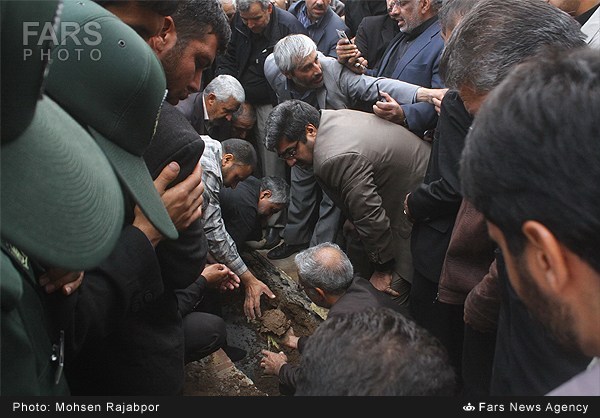
The commander of the elite Quds Force, Qassem Suleimani, helps bury RevolutIonary Guards Brigadier General Mohammad Jamali Zadeh, killed in the Syrian conflict this week.

IRGC Zadeh funeral

As is the case with Iranians slain in Syria, the Islamic Republic’s media said that Jamali Zadeh was slain by “Wahhabi terrorists” near the Sayyida Zeinab shrine near Damascus.

Revolutionary Guards Continue Fight With Rouhani

Fars News, the outlet of the Revolutionary Guards, threw another punch at the Rouhani Government on Tuesday: it declared that recent appointments of officials in key Ministries are the return of the “supporters of extremists”.

The outlet specifically claimed that former MPs from 2000-2004, during the years of President Khatami, had been put into the Labor Ministry.

Fars News also highlighted the criticism of MP Mehdi Bazrpash who accused “some recent appointments” to senior ministry posts of “individuals possessing two allegiances.” Bazrpash alluded to those “who were at least active in [2009] sedition-creation, active in the famous resignation of the Sixth Parliament [2000-2004 when Reformists held majority] or the resignees of that time.”

The Guards are in a running battle with Hassan Rouhani over foreign policy and economic issues, seeking to limit the President’s authority.

An effective was struck in September after the Supreme Leader backed Rouhani: the President would not act against the Guards’ major economic interests, while the elite force would not block the nuclear talks with the US and the 5+1 Powers.

However, that deal does not halt all criticism, especially with the Government maneuvring for space on domestic as well as international issues.

Look for the Thursday-Friday talks with the 5+1 Powers in Geneva to be an important marker in the contest. If they go well, Rouhani will maintain momentum at home. If they do not bring signs of an advance, then the Guards will have more ammunition for their next assault on the President.

Prominent Writer Considers Return to Iran After “the Ahmadinejad Winter”

In the wake of President Rouhani’s election in June and the change in atmosphere inside Iran that accompanied the end of the Ahmadinejad administration some members of the large Iranian diaspora have considered returning to their homeland.

One such person looking to return is the writer and satirist Ebrahim Nabavi, who has outlined his reasons for doing so in a piece for the Guardian.

A writer’s life in Iran is like taking a romantic stroll through a minefield. You might get lucky and make it through unscathed, or you might lose your legs in that first hour.

If you really want to know why this writer wishes to return to a prison where the warden has swallowed the key, to a minefield which may blow up at any moment, the answer is quite simple. My vocation is writing in Persian and I have to work in Iran to be my most useful and effective.

The further away Tehran gets from the Ahmadinejad winter, the longer the days get and the brighter the skies. I am certain that in the next two or three months, the space for free expression will be wider than it is today. I am certain that we will be able to publish our work and create an active cultural, publishing, and media space. But I am not returning with the wish that everything will get better, I am returning to help make sure that it does.

Nabavi’s comments coincide with a move by the Rouhani administration to limit restrictions on internet access, a key factor in maintaining a civil society based on freedom of information and expression.

Rouhani Government Pushes Once More to Open Internet

The Rouhani Government made another push on Tuesday to open up the Internet in Iran.

Culture Minister Ali Jannati declared that “not just Facebook but all social networking websites” should be accessible: “We must reduce the filtering of Internet websites to the minimum and [only based on] necessary positions.”

Jannati’s statement follows reports of a meeting of a regime committee at the weekend to ease restrictions on Facebook pages.

In the summer, the Government followed up President Rouhani’s campaign promise to act on censorship, with all Ministers opening Facebook pages. Both Foreign Minister Mohammad Javad Zarif and Rouhani are prominent on Twitter, and Zarif’s Facebook entries have been a notable front for Iranian public diplomacy and interaction with members of the public.

The Government may have tried briefly to open up the social networking sites in September, only for restrictions to be imposed within 24 hours and declarations that the moment was only a “technical glitch”. Some websites, however, have been opened to access for the first time in years.

Death of a “Moderate Conservative”

A notable loss in Iranian politics on Tuesday, as Habibollah Asgaroladi, the Secretary-General of the Islamic Coalition Party, died at the age of 82.

Asgaroladi was a leading figure in the party, notable for its influence in Iranian business and the bazaar, and in the Islamic Republic since 1979. He was the head of the Imam Khomeini Relief Foundation, the largest charitable organization in Iran; head of the Followers of Imam and Leadership Front; and a member of the Expediency Council.

Earlier this year, Asgaroladi publicly challenged the repression after the disputed 2009 Presidential election. He called for a review of the strict house arrests, imposed in February 2011, of Presidential candidates and opposition leaders Mir Hussein Mousavi and Mehdi Karroubi.

Asgaroladi was close to both the merchant class and the Society for Combatant Clergy. Before the revolution, he spent nearly 13 years in prison for aiding in the assassination of late Prime Minister Hassan Ali Mansur under the Shah.

About the Author

 Scott Lucas is a professor of American Studies at the University of Birmingham and editor-in-chief of EA WorldView. He is a specialist in US and British foreign policy and international relations, especially the Middle East and Iran. Formerly he worked as a journalist in the US, writing for newspapers including the Guardian and The Independent and was an essayist for The New Statesman before he founded EA WorldView in 2009.

eaworldview

Shirku Maarefi, the Kurdish political prisoner is executed

0


Shirku Maarefi, the Kurdish political prisoner has been executed in Saghez prison this morning.sherko-moaarefi

According to the report of Human Rights Activists News Agency (HRANA), Shirku Maarefi the political prisoner who was sentenced to death by the revolutionary court of Saghez has been executed this morning.

He had been transferred to the solitary some hours before and was executed in the meeting hall of Saghez central prison.

One of his relatives confirmed the reports about his execution and told to HRANA’s reporter: “We were in front of the door of Saghez central prison but the authorities did not give us his body. One the authorities told us that they will give us the body if go in the evening. We hope they are honest and will let us have funeral.”

Shirku Maarefi, born in Baneh, had been arrested in 2007 and was sentenced to death on charge of cooperation with Kurdish opposition parties.

His case was sent to branch 4 of the appeal court of Kurdistan province which confirmed the death verdict as well as the Supreme Court.

There had been 10 political prisoners executed in Zahedan, Uremia and Salmas prisons last week.

Rouhani’s Speech to the IRGC Convention: Handing Over More Power to IRGC Than Ahmadinejad (Part II)

IranBriefing Exclusive; by [email protected]

Rouhani-Talking out of both side of his mouth
Iranian President Hassan Rouhani Master of Duplicity

President Rouhani’s Speech During IRGC Annual Convention:
Continued from a Part I:

The President emphasized: The IRGC is not an army or an armed force as it exists in all other countries. The IRGC which was created for the protection and defence of the Islamic Revolution has two special types of capital which are seldom seen with the other armed forces. Although the IRGC possesses human capital and military hardware and software like other armies, but from the very beginning they have had the most important spiritual and social capital.

Continuing his address, Rowhani pointed out: Their spiritual capital was that the night of their operations, before looking on the plan of action, they looked at the map of the routes for pilgrimage to Karbala and before learning the code of operations they shouted “Ya Hussein” and “Ya Zahra” and kept chanting those words. The spiritual capital of the IRGC is not in the sense of the ideological armies of the East, but it is in the sense spiritual and religious motives which are rooted in the history of 140 of 0 years ago and to the meeting place of the Prophet and his companions and to the desert Nainava of Hussein Ibn Ali, who camped there with his supporters.

Rowhani stated that the spiritual capital of the IRGC is deeply rooted in the banks of Euphrates and the loyalty of the Qamar Bani Hashem (AS). It is the spiritual capital of the Guards which has led to their endurance. If this spiritual capital erodes and some people begin to doubt the dedication of this most loyal force of the Revolution then it will no longer remain the same Guards about whom the late Imam had said that ‘I wish that I too were a Revolutionary Guard’.

He added: The IRGC with its spiritual capital which has been preserved up to this day, and shall be preserved till the end, enjoys a distinction and superiority over other armed forces.

The President asserted: What caused the enemy to fear the IRGC is not its jet fighters, missiles, submarines, frigates, tanks and other equipment as these are also possessed by other armies. However, what makes the enemy afraid of the IRGC is its morale, spiritualism, sincerity and devotion to the household of the Prophet and the bonds of the troops of IRGC with fighters such as Badr and Karbala.

Pointing out that he is not against the high aspirations of the IRGC, he said: This is a great distinction for the IRGC and they have preserved it, but they have to promote it further because they have acquired great experience from the ups and downs of the developments of the past thirty plus years.

Adding that the other capital of the IRGC is its social capital, the President expressed: I mean that the IRGC is in the hearts of the people and operates beside them. The IRGC ought to be the strong gate and the refuge of the masses; whether Muslims or non-Muslims, Shi’as or non-Shi’as, city-dwellers or country-folk. All people, when they see the IRGC or even a single Guard, must get a feeling of peace and security. That is, all citizens must see that the existence of their civil rights and the recognized rights of their Islamic society depend on the armed forces, particularly the IRGC. Declaring that the IRGC is the jewel of the system he emphasized: Security is ensured through the IRGC and the IRGC provides the social capital of 20 million Revolutionary Guards and some 10 million Baseej [Volunteers].

Pointing out that the late Imam [Khomeini] had directed that the armed forces should not engage in political activities, Rowhani said: This means that the IRGC is above politics and should not be involved in it, neither on the sidelines nor in direct participation. The estate of the IRGC belongs to everyone and this point was made clear by the late Imam, who during the war and from the very first day, declared that the IRGC should not engage in political activities, since the IRGC has to belong to the whole Iranian nation. And if someday the need for mobilizing the whole population arises, it is the IRGC which can bring them as volunteers under the banner of Islam and the entire country.

He continued: If God forbid some danger arises someday which calls for the mobilization of the religious and sectarian minorities to become volunteers, then all those who are interested in defending the country will join together. The volunteers [Baseej] belong to the people. We should not confine them to narrow groups which would land us into a narrow alley. We have to confront the enemy in an open field.

Relationship Between Sanctions, Human Rights, & Economy in Iran in the Coming Years

The President declared: The present time is of great sensitivity for the region and Iran; and the force that is in the frontline and which stands and ought to stand in the first rank against all the conspiracies, is the Islamic Revolutionary Guards. This is a declaration from my heart.

He added:  Our first priority should be to identify the threats. Such threats emanate every day in one form or another. On 31 Shahrivar 1359 HS [22 September 1980] when the enemy invaded our country, the threat was primarily a military threat. Therefore, at that time the IRGC got converted from a security and police force into a paramilitary force.

He continued: Behind each military threat exists a political threat.  In those days they were after changing the system itself. Thereafter, when Saddam wanted to invade and occupy Kuwait, the threat was of another type. Saddam thought that by capturing the oil in Kuwait he would become the biggest power in the region. It was in this context that, before invading Kuwait, Saddam had written to Iran that they both have 800 kilometres of common borders.

The President emphasized: At that time, we discussed this subject in the Supreme National Security Council. Different interpretations were presented; one of which was that Iraq wanted to expand up to the border of Oman. This indicated that the threat had come in a different form. Likewise, when America invaded Afghanistan and Iraq the threat was of a different type and is still so, even up to this day  when invasion of Syria is being debated.

Rowhani said:  It will be greatly dangerous if we commit a mistake in assessing and identifying the threat. We have to identify the threat clearly and determine what the first and foremost threat is. After that, we should map out the correct plan and strategy to face it. In the end, we should also formulate our ultimate objectives taking into account the existing possibilities, because we have seen that the Americans made a mistake by invading Afghanistan and Iraq and the same is the case of Syria.

Opining that Syria was an important problem for the whole region and may perhaps have global repercussions, the President said:  Syria is located in a volatile region. The matter is not about one individual continuing as a president or one sect. The problem transcends that. It is clear to all of us that the West has a design for the whole of our region and it does not like our region in its present form. It is the same design that the British and French have had for years, to come back to our region.

He pointed out that an analysis of the conditions in Libya, Egypt, Lebanon, Palestine, Iraq and Syria indicates that the West counts them as links of the same chain and wants to strengthen Israel and weaken their resistance. The problem of Syria is a problem of the future of a great region and it may contribute to the reshaping of the future of the world as well.

Referring to the chemical weapons of Syria as a pretext for America, he said:  The position of the Islamic Republic has always been very clear. We are opposed to all weapons of mass destruction. However, the West mistakenly believes that the Islamic Republic is seeking an opportunity to impose its military domination over the region. But we are not seeking that. Our power is the authority of our word in the whole region.

He added: The IRGC is not a fighting force in the region. This is a force meant for maintenance of peace and security [within the country]. If the military threats of world arrogance are removed from the region, the IRGC would never wish to seek military authority in the region. Our policy is a policy of maintaining popular sovereignty, stability, brotherhood and of combating terrorism in the whole region.

Indicating that the Islamic Republic itself has been a victim of terrorism and weapons of mass destruction including chemical weapons, the President said: Our armed forces are the armed forces for the peace, stability, and tranquillity in the whole region. It would be best if the uninvited guests leave this region now and desist from threatening Iran and transgressing against her. Our call is a call for popular sovereignty. If the people of Egypt want popular sovereignty, the West need not feel discomfort about it. This is to be decided by the will of the Egyptians themselves.

Rowhani continued: In Syria, Iraq and all countries including Palestine; the will of the people should be supreme. Our Leader’s assertion that all displaced Palestinians should be allowed to return to their country and cast their votes, indicate that our policy is in favour of popular sovereignty.

The President emphasized: Anybody who uses chemical weapons anywhere is damned and condemned by us. We also condemn civil wars and massacres. Syria ought to return to stability. Thereafter, whosoever is voted by the people is acceptable to us.

Referring to the military threats from America and Europe to Syria he said: The Americans and Europeans while beating the drums of war feel that a war in this region shall have undesirable consequences. Therefore, they have said that this will be a limited war and they even asked others to pay for the expenses of this war. All this indicates where the Achilles heel of the enemy lies.

Rowhani clarified: We do not want the break out of any war; and the Islamic Republic with all its power shall prevent a war in this region. But Syria is important to us and the states and nations of the region shall not remain indifferent to the Syrian problem. Likewise, the Islamic Republic is not and cannot be indifferent towards this decisive issue. We shall do our duty and God will also grant success to the countries of the region in the face of the conspiracies of others.

In another part of his speech, referring to the point that the enemy has targeted the livelihood of the people, Rowhani said: All sanctions imposed which are unjust, illegal and supported by false reasons are directed towards this end. They know very well that Iran is not after nuclear weapons and when the Leader of the Revolution has himself unequivocally proscribed the nuclear weapons, Iran will never go for them.

He added: Sanctions against the sale of crude oil and banking transactions are aimed at putting pressure on the life and livelihood of the people. We ought to defeat the conspiracies of the enemy because, behind the economic pressure of the enemy, lies political pressure so that people are diverted from the Revolution. But our nation understood it well and gave a befitting reply to them in the election. This was one of the best elections which did not face any objections or protests and was the first strike against the enemy.

Rowhani continued: The second strike which has to be launched against the enemy is in the economic struggle which has to be carried on with the participation and alertness of the people and the IRGC may prove itself very effective in this field.

The President said: The IRGC has great potential in human resources and in the economic and cultural fields and whenever the system is subjected to pressure the IRGC complements and supports efforts to meet the situation.

Rowhani emphasized: I do not believe in the rumours spread about the IRGC’s activities in the economic sphere. The IRGC is not a competitor with the people or the private sector and is not like ordinary contractors. The IRGC needs to take up various projects which the private sector does not have the resources to finance and manage.

The President said: I have spoken with the Commander-in-Chief of the IRGC to take the burden of a few national projects on its shoulders to maintain its reputation. In view of sanctions, the IRGC needs to become active and take up three or four big national projects. The IRGC is fully conversant with the situation of the country and the government. The country which exported 2.5 million barrels of crude oil is now selling less than one million barrels.  On the other hand, it has to import 7.5 tons of wheat. This indicates the general economic condition of the country.

He continued: We want the IRGC to take part of the burden of not only the government, but also the system, on its shoulders. Another problem is that of the smuggling of goods into the country which is another calamity for the country’s economy. The IRGC may help in combating this menace so that the smuggling of goods may be prevented.

Rowhani appealed: As the President of the Republic, I want the IRGC to give a helping hand and swing into action in the two sectors in which the government is facing difficulties so that the people may be witness to the sincerity and selflessness of the IRGC in defeating the enemy in the area of people’s livelihood and production.

Towards the end, referring to the difficulties of the government and the condition of stagnation he said: In this situation, we are hopeful that with divine help and cooperation of the IRGC we will be able to defeat the conspiracies of the enemy.

A listing of IRGC’s Involvements in Iran’s Economy, Politics, Military, and Everything Else

Conclusion:
If IRGC is not removed totally from Iran’s politics and economy and its military domination and expansion is not restricted and its top 100 commanders were dismissed or retired as soon as possible and like the United States, if Iran’s military was not run by civilian officers, the whole world including the Iranian people are going to pay a heavy price for its destructive and hegemonic power.  IRGC might make some heavy concession to the West in order to survive in the short term, but sooner or later its brutal ambition will cost many lives all over the world.  Iranian people inside Iran will suffer the most sooner the the Western society.

An alternative to regime change in Iran, if we are seeking peace in the Middle East and the world, might be to install a civilian body to oversee and appoint IRGC commanders, as is done in the United States military, in Turkey, and in other democratic nations.  And to ensure a permanent solution, the concept of Velayat Faqih (Leadership of Jurist) must be abolished from the Iranian constitution.

Read Part 1 here

Rouhani’s Speech to the IRGC Convention: Handing Over More Power to IRGC Than Ahmadinejad.

IranBriefing Exclusive; by [email protected]

Rouhani-Talking out of both side of his mouth
Iranian President Hassan Rouhani Master of Duplicity

During the IRGC’s annual convention held in September 2013 in Tehran, the Iranian President gave a speech about IRGC involvement in Iran’s economic sector.  His lecture had two parts, one part for the Western world and the other part for the IRGC commanders.  During his speech he said: “I do not believe in the rumors spread about the IRGC’s activities in the economic sphere” and later on during the same lecture he emphasized and invited IRGC to take up even more major projects.  He added that, “The IRGC needs to take up various major national projects which the private sector does not have the resources to finance and manage”.
In reality wherever there is money, there is IRGC.  Below we bring you the full translation of Mr. Rouhani’s lecture during IRGC convention and a listing of IRGC activities in various sector of the Iranian economy and politics without any full explanation since it would take hundreds of pages.  An alternative to regime change in Iran, if we are seeking peace in the Middle East and the world, might be to install a civilian body to oversee and appoint IRGC commanders, as is done in the United States military, in Turkey, and in other democratic nations.

President Rouhani’s Speech During IRGC Annual Convention:
Iranian President Hasan Rowhani, referring to the commemoration of “31 Shahrivar” [22 September 1980] said: The IRGC had played an influential role during the holy war of defence along with the Baseej [the Volunteers].  On this sacred front, the dearest friends of the Revolution laid down their lives for the sake of the prestige, honor and independence of this country.

He added: The Revolutionary Guards are the repository of great honor as they guarded not only the borders of the country, but were also the protectors of the limits of God Almighty. The IRGC is a child of the Revolution and had no great time distance from the triumph of the Revolution.

Rowhani continued: It was from the first hours of victory after the Revolution that safeguarding, steadfastness and struggle for preservation of the Islamic Revolution took shape, and later the assumption of the name ‘Islamic Revolutionary Guards’. The Guards put their lives at stake for the sake of the continuity of the Revolution and wherever any danger arose, the Guards were present in the frontline in defence of the Revolution.  Continue to the rest of the translation…

A listing of IRGC’s Involvements in Iran’s Economy, Politics, and Military

A. Economy
More than 85% of Iran’s economy is fully controlled  by the IRGC. Some of the main sectors are:
1. Economic Sector: Khatam al-Anbia, the IRGC’s Economic Wing, gets ‘no-bid’ contracts worth billions of dollars, and is the main company responsible for hijacking Iran’s economy. It has nearly 900 subsidiaries and employs over 50,000 Iranians and over 10,000 foreign nationals, mainly from Lebanon. As of today, it has undertaken over 1,836 major projects and over 19,000 small projects. It is included in the U.S. OFAC list,

Relationship Between Sanctions, Human Rights, & Economy in Iran in the Coming Years

http://khatam.com
2. Banking Sector: The IRGC controls many banks including Mellat, Melli, Saderta, Refah Kargaran, Sepah, Tejarat, and Parsian Bank. The IRGC also controls many financial institutions including Ansar, Arian and KarGoshaee. The IRGC has formed hundreds of major foundations such as the Mostazafan Foundation, as well as many holding companies and investment institutions.
3. Stocks, Money Exchange and Money Laundering: The IRGC has managed to cause the closing down of most money exchange shops and offices, and replaced them with its own personal shops.
4. Oil and Gas Sectors: The IRGC has a major stake in the petrochemical industry, including oil refineries, drilling companies, the National Iranian Oil Company (aka ‘NIOC’), Arvandan Oil & Gas Company, and the National Iranian Tanker Company. It has almost full control over the oil ministry and oil trading, and most aspects of the wider oil industry. Khamenei’s immediate family members own a major portion of this sector.
5. Communication Sector: The IRGC owns the Telecommunications Company of Iran (‘TCI’) which provides a major part of Iran’s cellular phone services, domestic landline phone services and internet services, as well as controlling Iran Electronics Industries (‘IEI’). The Guards are also a main shareholder in MTN Irancell (South African telecom giant MTN owns a minority share), the second largest mobile phone network operator in Iran.
6. Ports, Customs Offices, Aviation: The IRGC assets include Mahan Air, part of Iran Air, and Pars Aviation, in addition to shipping assets such as the Islamic Republic of Iran Shipping Lines, which operates 115 ocean-going vessels (and is also on the U.S. OFAC list http://www.irisl.net)
7. Various Industries including: Maritime industries such as Sadra; missile development and construction industries, auto industries such as Iran Khodro, Pars, Saipa, and other companies that have license to build Peugeot, Renault, Suzuki, Daimler-Benz, and Hyundai models; metal industries including steel and copper, and other heavy machinery industries; the helicopter industry; and even whole industrial towns with hundreds of factories and companies.
8. Pharmaceutical & Medical Industries: Every year the IRGC imports medicine from countries such as India and Europe worth hundreds of millions of dollars, and sells it on the black market in order to inflate prices. They store tons of rare drugs, often keeping them beyond their expiry date, and sell them knowing they will be used in hospitals and make sick patients even sicker. There have been many fatal cases of surgery where the anesthetics or other drugs used were not effective for this reason.
9. Drug Trafficking, Human Trafficking: Iran is the main route for heroin and opium cultivated in Afghanistan. IRGC has been trafficking drugs from Afghanistan into Iran and then on to Europe, Azerbaijan, and Turkey, making billions of dollars through this trade as well as creating many drug addicts inside and outside Iran. Currently, there are more than ten million drug addicts in Iran.
10. Trade and Investment in other countries: IRGC has been investing in many neighboring countries to bypass sanctions. It has investments on all five continents, the details of which are described below in the “Overseas Operation” section.

B. Politics
The IRGC controls between 40-65% of the executive, legislative, and judicial branches of Iran’s government. Some of the details are listed below:
1. Leader’s Office: Khamenei himself is a former IRGC member. His son Mujtaba is the main link between his office and the IRGC, as well as dozens of Khamenei’s advisors and office staff.
2. Expediency Council: A body whose 39 members are appointed by the Supreme Leader to resolve conflicts between the Parliament (Majlis) and the Guardian Council as well as advising the Supreme Leader. More than 55%of the members are IRGC members.
3. Assembly of Experts: The Assembly’s six committees are responsible for overseeing the Supreme Leader, Ayatollah Khamenei. However, their role has been neutered and they have become devout followers of Khamenei, and politely receive a formal lecture from him once each year. More than 32% of the 86 members of the Assembly of Experts are members of IRGC, Basij, and Intelligence. In fact, in order to be chosen for this assembly candidates must be approved by the Guardian Council, Supreme Leader, and IRGC.
4. Guardian Council: The Council is a twelve member body of clerics, judges and lawyers, which supervises elections to, and approves candidates standing for, the Assembly of Experts, the President and the Majlis. 45% of the members of this Council are members of Intelligence and the Basij.

IRGC-in-Irans-Parliament
IRGC Members in Iran’s Parliament

5. Parliament: According to recent research by IranBriefing, more than 56% of the parliament (Majlis) members are members of the IRGC (Pasdaran, Basij, Intelligence, Qods Force) https://iranbriefing.net/irgc-members-in-irans-parliament/
6. Judicial Ministry: Judicial branches across the country are dominated by IRGC appointees. It is estimated that more than 60% of them are IRGC members.
7. Presidential Cabinet: There are now more former IRGC and Intelligence members in Rouhani’s presidential cabinet than there were during Ahmadinejad’s presidency.
8. Foreign Ministry: Even though there is a parallel body under Ayatollah Khamenei in charge of foreign policy and decision making, all being taken in accordance with IRGC policy and objectives, the IRGC also has at least two officials in every embassy. More than 70% of Iran’s foreign ministry staff are members of IRGC.
9. Governors: More than 80% of governors are IRGC members. (Basij, Intelligence, and IRGC.)
10. Mayors: More than 65% of mayors are IRGC members (Basij, Intelligence, and IRGC.)
11. Today every single government agency, office, and institution has an office called “Daftar Hefazat” or “Security Office,” a section of the IRGC which keeps an eye on every single employee. Officers of that agency have a file on every person working there. This section of the IRGC reports directly to IRGC’s intelligence office.

C. Military
The IRGC has its own military force in addition to the country’s existing military, which was established decades before the Islamic Revolution. All three branches of the traditional military are controlled and dominated by officials and military personnel from the IRGC, who are all the Supreme Leader’s appointees. The Supreme Leader’s representatives have the final say in choosing or replacing officers, and exert strong influence on decisions by military officials. In addition to the three traditional branches of the military;

1. Air Force
2. Navy
3. Army;
the IRGC has added a few new ones to the list:
4. Basij (Militia)
5. Aerospace Sector, Airports
6. Army Joint Command Center (IRGC & Regular Army)
7. Quds Force
8. Cyber Technology & Cyber Warfare
9. Nuclear Industry
10. Chemical & Biological Industry
11. The Ansar-Ul-Mehdi Corps which is responsible for the protection of top government officials and members of parliament.

D. Media
The IRGC has full control of all media in Iran. No one would dare criticize or write anything against the IRGC. Some of the top news sites that belong to the IRGC, or have IRGC officials as their managing directors, are as follows:
1. TV: All TV stations are controlled by the IRGC, and the current head of the Islamic Republic of Iran Broadcasting is a former IRGC member.
2. Radio: Inside Iran there are hundreds of radio stations broadcasting programs which brainwash even the best educated members of the public.
3. Satellites: IRGC has invested millions of dollars in satellite technologies and satellite programs in Iran and the Arab world.
4. Websites: The IRGC pays thousands of Basijis to manage and post news on websites, all of which are registered under various names belonging to the IRGC.
5. Social Media (Facebook, Twitter, YouTube, etc.): There are thousands of Basij members active in social media, each having dozens of fake accounts.
6. Newspapers: The vast majority of Iranian newspaper chief editors and management are IRGC members.
7. Books: All books published in Iran have to be endorsed by Iran’s Guidance Ministry which is under the control of IRGC or is affiliated with the IRGC. Iran’s Supreme Leader and the IRGC have the final say on who should be in charge of this ministry.
8. Publishing companies: All publishing companies in Iran must follow IRGC, Intelligence, and Guidance Ministry’s frequent guidelines, restrictions, and red lines, otherwise they will be subject to huge fines and shutdown.
9. Reporters: More than 90% of reporters around the world are members of IRGC or Iran’s Intelligence office.
10. Commentators/ anchors: Other than clerics who have proved to be loyal to the system, only former IRGC members or IRGC endorsed commentators and anchors have the privilege of appearing on live programs relating to social and political issues.

E. Education & Universities
1. Universities: The 
IRGC has established several universities of its own focusing  on military industrial projects, information technology, intelligence gathering, and management. These include the Imam Hossein University, Malek Ashtar University and Imam Mohammad Baqir University.
2. Academic & Scientific Projects: 
The IRGC has full control over major projects in some of the top universities such as Sharif University of Technology, Isfahan University of Technology, and various universities related to technology and research, and directs them towards military and related information technology applications.
3. Recruiting Top Scientists Inside Iran: The IRGC also recruits top scientists from various sectors and universities to work and teach part-time in its own universities.
4. Recruiting Top Scientists Outside Iran: The IRGC spends millions of dollars every year to hire and recruit scientists from Russia and Eastern Europe to carry out research in the fields of military and technology and to train its graduate students.
5. Academic Take Over: Every year the IRGC ensures a set portion of its Basij members enter top universities and various departments, even if they are not qualified. In this way Basij members are always present in meetings and activities by other students who are not loyal to the regime.

F. Religion
The IRGC began controlling religious activities over ten years ago. Below are some of its activities:
1. Religious Seminaries: IRGC has been establishing its own religious seminaries and training future Ayatollahs and religious figures for the last fifteen years.
2. Friday Prayer Sermons: Every Friday, there is a Friday prayer in every city and town in Iran and all Friday prayer Imams (religious figures appointed by Ayatollah Khamenei, Iran’s Supreme Leader) deliver sermons related to politics and religion. The leader’s office faxes and emails these sermons every week to the Imams, and the IRGC ensures that its representatives in the Supreme Leader’s office oversees the content of these sermons. Even Ayatollah Khamenei’s sermons on most occasions have to be endorsed by the IRGC.
3. Occupying Mosques (Masjids): Every Mosque in Iran must have some Basij members who are in charge of the running of the building. They work with religious clerics to ensure they are effective in shaping people’s religious ideology, and prevent any lecture or program that is critical of the regime. In most cases those who are killed in IRGC prisons are not even allowed to have funerals and religious ceremonies in Mosques.
4. Religious Tourism: The IRGC has worked with other government offices to heavily subsidize travel, and has facilitated lodging in cities where religious figures or saints are buried. Mashad is one of these cities, where one of the descendants of prophet Mohammad is buried, and every year millions of people go to Mashad for religious pilgrimage. This work ensures that the IRGC penetrates deep into the minds and religious beliefs of the Iranians, inculcating the view that IRGC is not just a regular army but an ideology working alongside religion, and therefore whatever it does or forbids has a religious base to it and people must obey them. Outside Iran, members of IRGC are always present as under cover pilgrims accompanying Iranian pilgrims going to religious cities in Saudi Arabia, Iraq, and Syria.
5. Religious Fatwas (Verdicts): The IRGC has used religion to extract confessions, and commits torture, arrests, and thousands of executions in the name of religion. In fact, as part of their training, IRGC interrogators are trained to torture to obtain a confession, and in some cases even rape prisoners, believing that their act is indeed a religious practice, and would take them to Heaven, and that having any pity or leniency during torture is considered to be the act of a person who is not sufficiently devout. In other arenas, the IRGC pressures Ayatollahs to move closer to the regime in order to isolate and discredit those religious authorities who are not in line with the Islamic Republic.
6. Religious Donations: Setting up religious Donation Boxes all around the country, in the corner of every city and village, and using clerics and religious leaders to encourage people to donate daily, thereby earning millions of dollars every year. At the same time they brainwash people on a daily basis to believe that their prosperity and success in life depends on their donation. In the past people’s donation would go to their favorite religious authorities, however since the takeover of the IRGC within the religious field, only those religious authorities who are approved by the regime are entitled to public religious donations. Religious figures opposing the regime are either under house arrest or deprived of any government appointments, and in the worst cases they end up in prison or losing their authority to act as religious figures.

G. Overseas Operation
The IRGC has major operations in various countries which it conducts through diverse means:
1. Quds Force
2. Full control and influence on Hizbullah
3. Influence among both Shia and Sunni factions in Iraq
4. Influence within the Syrian regime and its officials
5. Strong influence among Iraqi officials
6. Influence among Kurdish factions
7. Influence among Afghan factions
8. Investment in real estate and the religious sector of Azerbaijan, funding private Shia religious schools
9. Tourism, trade, real estate, and shipping in Turkey
10. Tourism, trade, real estate, and shipping in Canada
11. Tourism, trade, real estate, and shipping in Africa
12. Tourism, trade, real estate, and shipping in Central and South America
13. Intelligence gathering and terrorist activities as well as murder and the disappearance of dissidents

H. Food Industry
IRGC has gained control over the trade, price, storage, distribution, and quality of the food and daily living of the Iranians. In the last five years for instance, IRGC has been importing very cheap and on some occasions harmful food products from India, and as a result Iran’s own rice and tea farmers have been out of work, and people have been made sick by consuming below-standard food products. Iran subsidizes food products. In most cases this involves selling them to IRGC or Basij members wholesale, and they then distribute them among the public, pocketing huge sums of money. Some of the main products IRGC has been profiting from are:
1. Rice
2. Tea
3. Oil
4. Sugar
6. Fisheries products
7. Mineral Water
8. Fruit
9. Vegetables
10. Meat and other high protein foods.

I. Mining & Construction
The IRGC earns billions of dollars from mining natural resources and is involved heavily in importing and exporting various minerals. Below are some of the major relevant mining resources in Iran:
1. Gold: Only the government – under IRGC control – has the authority to explore and work mines extracting precious metals.
2. Coal
4. Copper
5. Building Dams: All projects related to dams are undertaken by the IRGC, and are undertaken without any planning consent or consideration of the environment. Recently Iran’s largest lake, Urmia in the northwest of the country, has been drying up due to dozens of dams constructed around it. This has caused salt laden winds spreading salt across hundreds of kilometers as well as causing drought.

J. Miscellaneous Sectors
The IRGC’s activities are not limited to the above industries or sectors; wherever there is money, the IRGC will be there.
1. Prison System: The IRGC has been building dozens of prisons following the fraudulent election, and all prisoners have to pay – sometimes up to ten times the regular price – for their basic needs inside prison. This has put tremendous pressure on prisoners’ families.
2. Tourism Industry: The IRGC is active in the tourism industry both inside and outside Iran. It collects travelers’ information, especially through agents and agencies outside of Iran.
3. Utilities Recently it was revealed that Iran’s Telecommunication industry, which is under the control of the IRGC, has been overcharging people by millions of dollars.
4. Wholesale & Retail Trades:  Former IRGC and Basij members are given priority to be chosen to work in the wholesale and retail sectors, and in the import and export arena. Every month, hundreds of IRGC and Basij members travel to Asia and specifically to China to conduct business. They bypass sanctions by working with natives in those countries to bring home products ranging from technology to food, and other items unavailable to the Iranian public. This is a means by which the regime rewards Basij members. The IRGC allow them to conduct business and get rich, in return for Basij help protecting the interests of the regime when required. This can include anything from interfering in the way people dress, to beating up protestors.
5. Kidnapping & Prostitution: IRGC and Basij members have been making money by ransoming kidnap victims, and from kidnapping girls and selling them for prostitution to neighboring countries. In other cases, the IRGC uses prostitution for espionage inside and outside Iran, as well as trapping people inside Iran during demonstration.
6. Use of Orphans.  The IRGC and Iranian Intelligence (MOIS) uses orphans in various overt and covert operations, taking advantage of the fact that these agents have no known identities that might be identified by enemies. They are trained to be extremely brutal and ruthless in some cases.
7. Importing, Sale, and Distribution of Luxury Cars.  

Conclusion:
If the IRGC is not removed totally from Iran’s politics and economy, and its military domination and expansion is not restricted, and if its top 100 commanders are not  dismissed or retired as soon as possible, the whole world including the Iranian people will inevitably pay a heavy price for the destructive authority it wields.
The IRGC might make some substantial concessions to the West in order to survive in the short term, but sooner or later its brutal ambition will cost many lives across the world. People within Iran will be the first to suffer, but so too will Western societies.

An alternative to regime change in Iran, if we are seeking peace in the Middle East and the world, might be to install a civilian body to oversee and appoint IRGC commanders, as is done in the United States military, in Turkey, and in other democratic nations.  A final thought for those who believe Rouhani’s election will bring real change.

And to ensure a permanent solution, the concept of Velayat Faqih (Leadership of Jurist) must be abolished from the Iranian constitution.

Read Part 2 here

‘Iran paramilitary forces holding maneuver’


 Iranian state television is reporting that the country’s paramilitary forces are holding a two-day maneuver.

Mohammad Reza Naqdi, commander of Iran's Basij force (screen capture: Youtube/PresTVGlobalNews)
Mohammad Reza Naqdi, commander of Iran’s Basij force (screen capture: Youtube/PresTVGlobalNews)

The report Thursday said the forces of the Basij, affiliated with the elite Revolutionary Guards, began their exercise in five central and northern provinces.

The nationwide paramilitary network also serves as a powerful propaganda tool in local politics.

Over the past years, Iranian forces routinely held military exercises on its mainland and in areas in the strategic Strait of Hormuz, the body of water that one-fifth of the world’s oil supply passes through. More military maneuvers are expected in coming months.

Copyright 2013 The Associated Press.

Trial of Masoud and Khosrow Kurdpoor Ended Today

0


The Islamic Revolutionary Court trial against the two brothers Khosrow and Masoud Kurdpoor ended today, 28 of October 2013. The brothers are Kurdish journalists and were arrested in March and May of 2013, respectively, in Mahabad.kordpur

The Kurdpoor brothers are charged with “Moharebeh” (Enmity against the God), “insulting the Supreme Leader of Iran”, “threatening the territorial integrity of Iran”, “being members of Kurdish opposition parties” and “spreading lies”. The Kurdpoor brothers wrote mostly for the Mukriyan News Agency and openly spoke about human rights violations in Iranian Kurdistan.

The judge declared that because the state has deemed the trial as a “matter of national security,” no bail was going to be set for the brothers. The Islamic Revolutionary Court in Mahabad is expected to issue the final verdict of the trial in two weeks

PDKİ