Home Blog Page 363

Revolutionary Guard warns against Iran-US talks

0


Reuters, DUBAI

Iran’s elite Revolutionary Guard has warned the country’s diplomats about the dangers of dealing with US officials, according to a statement issued on Saturday, the weekend ahead of expected diplomatic contacts between the US and Iran.

IRGC: Rape, Sex, Drug, Terrorism, and Moral Decay

“Historical experiences make it necessary for the diplomatic apparatus of our country to carefully and skeptically monitor the behavior of White House officials so that the righteous demands of our nation are recognized and respected by those who favor interaction,” a statement from Iran’s Army of the Guardians of the Islamic Revolution (IRGC) said.

The statement was published by Iran’s Tasnim news agency on Saturday evening and said that the IRGC would support initiatives that were in line with national interests and strategies set forth by Iran’s theocratic leader and highest authority, Ayatollah Ali Khamenei.

The IRGC, an elite force that was established to protect Iran’s revolution in 1979, has been under pressure in the past week not to involve itself in politics and to support the new Iranian government’s goals of better diplomatic ties and improving the economy.

On Tuesday, Khamenei appeared to give his strongest endorsement yet to new Iranian President Hassan Rouhani’s attempts to initiate talks with the US, saying he agreed with “heroic flexibility.”

Khamenei echoed a statement by Rouhani a day earlier that there was no need for the IRGC to be active in the political arena, but that it should be familiar with it.

The US and its allies suspect Iran’s nuclear program is aimed at developing a nuclear weapons capability and has imposed tough economic sanctions on Tehran. Iran says the program is purely peaceful.

Rouhani will pursue a comprehensive charm offensive this week while in New York for the UN General Assembly to set the right tone for further nuclear talks with world powers which he hopes will bring relief from sanctions, analysts said.

US President Barack Obama and his aides have made clear that they are ready to test Rouhani’s intentions to seek a diplomatic solution to Iran’s nuclear dispute.

The White House has left open the possibility that Obama and Rouhani could meet on the sidelines of the UN meeting. A US official has privately acknowledged the administration’s desire to engineer a handshake between the two leaders, which would be the highest-level US-Iranian contact since the 1979 Islamic Revolution.

Saturday’s statement was published on the eve of Iran’s annual “Sacred Defense Week” to commemorate Tehran’s 1980 to 1988 war with Iraq.

The IRGC and conventional armed forces marked the occasion yesterday with a parade to showcase their latest military advances.

Will Iran’s Revolutionary Guard Reduce Economic Role?

0


Kourosh Avaei-Al Monitor

In preparation for the celebration of “Sacred Defense Day” on Sept. 22 (the date Iraq invaded Iranian territory in 1980), Iranian leaders have been meeting the commanders of the Islamic Revolutionary Guards Corps (IRGC). On Sept. 16, President Rouhani gave a sepahGcarefully worded speech that was designed not to antagonize the elite force, while pointing to a potential strategic shift.

About This Article


Rouhani praised the IRGC’s economic activities, but at the same time, he urged the IRGC only to engage in large projects so that it does not compete with the private sector. Rouhani underlined this point: “Today, in conditions in which our economy is a target [of sanctions], the IRGC must enter into action and take on three or four large national projects … The IRGC is not a rival to the people and the private sector … The IRGC today must take on important projects that the private sector is unable to take on.”

It was clear from the onset of the Rouhani government that the new administration will try to push the IRGC back into a more strategic position rather than allowing the continued penetration of economic sectors by the military entity. For example, Rouhani’s choice for minister of information and communication technology, Mahmoud Vaezi, was a rebuff to the IRGC, which had controlled this sector for eight years. Furthermore, the return of Bijan Namdar Zanganeh and Mohammadreza Nematzadeh to the ministries of Petroleum and Industry, Mining and Trade were all signs that these sectors would be pushed back to the pre-President MahmoudAhmadinejad era.

Even the Reformist media started highlighting the tensions emerging from the IRGC’s expanded role in the Iranian economy. The daily Shargh published on July 22 a challenging interview with the IRGC’s spokesperson, Commander Ramezan Sharif, in which he was asked to explain the logic of the IRGC’s presence in economic activities. Sharif outlined that the main motivation for IRGC’s role was “national security” and that the IRGC saw itself as a “protector of Iranian interests,” including economic ones.

Now, the central question will be whether the IRGC will oblige, especially considering the fact that the IRGC command does not report to the president but rather to Supreme Leader Ayatollah Khamenei. Interestingly, Khamenei himself gave a speech to the IRGC commanders on Sept. 17 stating, “The IRGC has to guard the revolution. I don’t want to say that this guardianship has to stretch to all spheres — scientific, intellectual, cultural and economic spheres — I don’t mean this. I mean that the IRGC has to be alive and has to know what it is guarding. What is the revolution? There is no need for the IRGC to guard the political sphere; it only needs to be aware of its developments.”

The above statement could be interpreted as a plea from the supreme leader for the IRGC to reposition itself in Iranian society and its economy. The intended repositioning could be along the lines indicated by Rouhani, i.e. the IRGC helping the government in national projects, but withdrawing from those activities in which the corps is competing against Iran’s private sector (such as telecommunications, construction, small industry, car manufacturing and trading). In any case, Khamenei’s statement offers a clearer interpretation of the objective that has been manifested in the IRGC statutes by the entity is asked to “protect the Islamic Revolution and its achievements.”

However, it is not clear how such a transformation in the economic sphere will actually take place. Does Rouhani intend to insist that the IRGC and its affiliated companies sell off all businesses that clash with the above vision? That would mean the transfer of ownership of hundreds of existing companies that are directly or indirectly owned by the IRGC network. Furthermore, the larger IRGC network goes far beyond the military organization and includes various foundations, cooperatives and entities owned by former IRGC commanders. It is obvious that these businesses cannot be easily redefined and restructured. The country’s private sector is mainly concerned about the unjust competitive advantages that the IRGC network enjoys in the Iranian market. The corps has easy access to funds (thanks to various banks and financial institutions owned by its network) and also political muscle that can secure projects and licenses that are not easily accessible to the genuine private sector.

Therefore, at best, the government can hope to achieve two objectives:

  • Stop awarding government projects to IRGC firms and focus on offering those projects to the IRGC-affiliated companies only when the private sector is not interested (such as large industrial projects). In this sphere, the IRGC would have to compete with revolutionary and religious foundations such as the Mostazafan Foundation, but there is sufficient cross-interest between these entities that project awards would be distributed without fierce competition.
  • Improve the business environment, especially the competition in the market so that companies from the IRGC network would actually compete fairly with private-sector entities. This objective can only be achieved in the medium term, as it would require a number of structural reforms including easier access to financing as well as a more transparent tendering process in government projects.

What Iran is witnessing today is very similar to the process that was initiated under the President Mohammad Khatami administration in the late 1990s. Back then, the Reformist government put pressure on the revolutionary foundations to become more transparent, pay taxes and also to stop competing with the private sector. The result was that the main foundations (the Mostazafan, Martyrs and 15 Khordad Foundations) obliged, but their interests were pushed into a host of smaller and less visible foundations, cooperatives and regional companies. The government could claim victory by pointing to the reforms that took place in the main foundations, but the private sector was left with the same degree of uncertainty in business competitiveness.

It can be expected that Rouhani’s initiative will go similarly. The more obvious IRGC companies (such as Khatam-ol-Anbia or the Bahman Group) will adjust their strategies and engage in large projects to assist the government. However, the wider network of IRGC-affiliated firms will continue operating in various business sectors. They may make their affiliations and ownership structures less transparent by selling some of the company shares to newly founded cooperatives and foundations, but their principal approach to the market would be the same. They would utilize their vast IRGC alumni network to secure projects, funds and human resources. The net effect on the Iranian private sector would be minimal as long as other structural reforms do not take place.
Read more: http://www.al-monitor.com/pulse/originals/2013/09/rouhani-asks-revolutionary-guard-scale-back.html#ixzz2fNJfImCz

Nasrin Sotoudeh ‘among freed political prisoners’

0


Iran is reported to have freed at least 11 political prisoners, including noted human rights lawyer Nasrin Sotoudeh.Nasrin_Sotoudeh

The eight women and three men are said to also include the reformist politician Mohsen Aminzadeh.

The move comes just days before Iran’s new President Hassan Rouhani visits New York for the UN General Assembly.

In another development, Mr Rouhani described a recent letter sent to him by US President Barack Obama as “positive and constructive”.

In an interview with US broadcaster NBC, he said he had full authority to negotiate a deal over Tehran’s controversial uranium enrichment programme with the West.

He also reiterated Iran’s position that it would never develop nuclear weapons.

The BBC’s Iran correspondent James Reynolds says Mr Rouhani’s decision to speak to a major US news organisation shows the importance to his government of reconciliation with Washington.

In his election campaign, Mr Rouhani promised to free political prisoners.

Release ‘a surprise’

Ms Sotoudeh was arrested in 2010 and jailed for six years on charges of acting against national security.

Her husband, Reza Khandan, said she had been dropped off at their home by prison officials on Wednesday evening.

Continue reading the main story

Analysis

Rana RahimpourBBC Persian Service

A day after Iran’s supreme leader Ali Khamenei backed diplomatic flexibility, the release of a number of political prisoners can be seen as a promising development. On Tuesday, Ayatollah Khamenei told the commanders of the revolutionary guards that it was not necessary for them to “guard politics”.

The Iranian opposition accuses the revolutionary guards of playing a role in the disputed presidential election of 2009 and the arrests that followed it. Ahead of President Rouhani’s trip to New York and nuclear talks, it seems that the supreme leader is trying to portray a better image of the regime to the world. A goal that might be difficult to achieve as long as the leaders of the opposition are under house arrest.

He said she had been unaware that she was about to be released.

“I am happy that she joined us, particularly as our younger child is starting school for the first time,” he told AP news agency.

“We are very happy but we will be happier if other prisoners are freed.”

There has been no official comment on Ms Sotoudeh’s release or on the other prisoners reported to have been freed.

Ms Sotoudeh – winner of the European Parliament’s 2012 Sakharov Prize for Freedom of Thought – is a well-respected and outspoken human rights lawyer known for taking on high-profile political cases.

During her captivity in Tehran’s Evin jail, she went on hunger strike to protest against her prison conditions as well as sanctions imposed on her family.

Mohsen Aminzadeh, a former deputy foreign minister under President Mohammed Khatami, was jailed in 2010 for organising protests and spreading propaganda against the system.

He was a prominent supporter of the defeated presidential candidate Mir Hossein Mousavi.

Analysts say that since President Rouhani’s election, there have been growing calls for the release of political prisoners.

According to an investigation by the UK’s Guardian newspaper, there are close to 800 political prisoners and prisoners of conscience in Iran.

They include journalists, lawyers, human rights activists, bloggers, feminists, Christian priests, Sunni clerics, the entire leadership of the Bahai faith in Iran, and others.

The releases come a day after Iran’s Supreme Leader, Ayatollah Ali Khamenei, gave the strongest sign yet of Iran’s potential flexibility in future talks with the West.

Iran is subject to sanctions by the UN, the US and the European Union over its controversial nuclear programme.

In a meeting with Revolutionary Guards he said: “I don’t oppose diplomacy. I am in favour of showing a champion’s leniency. A wrestler may give way for tactical reasons, but should remember who is its opponent and enemy.”

The head of Iran’s nuclear agency told reporters in Tehran on Wednesday that he expected “a breakthrough” this year in settling the nuclear issue with the West.

“We are very optimistic about the process that has started to resolve the nuclear issue,” said Ali Akbar Salehi.

BBC

First TV video of Iranian Revolutionary Guard soldiers in Syria

BBC Persian TV and Holland TV first video of Iranian Revolutionary Guard soldiers in Syria

A video produced by BBC Persian TV filmed by documentary maker of Iranian TV who was killed by opposition groups in Syria and his video confiscated and sent to the Dutch news network


Iran’s assets in Canada include more than $2.6-million

0

Iran’s assets in Canada include more than $2.6-million held in 13 different bank accounts, Ottawa reveals

The federal government has identified millions of dollars worth of Iranian state assets in Canada, ranging from bank accounts to a parking spot, that may now be claimed by victims of terrorist groups sponsored by the Islamic republic.

The Embassy of Iran on Metcalfe St. in Ottawa after Foreign Minister John Baird announced, diplomatic relations between Canada and Iran have been suspended.

The list of Iran’s 22 Canadian assets was to be released by the Department of Foreign Affairs on Tuesday to help victims who want to collect damages from Iran due to the regime’s support for terrorist groups such as Hezbollah and Hamas.

A copy of the list obtained in advance by the National Post includes the Iranian Cultural Centre in Ottawa, a parking spot in the capital, 13 bank accounts containing more than $2.6-million, a VISA account and $325,000 currently frozen under United Nations sanctions.

In addition to those “non-diplomatic assets,” the list also includes Iran’s five diplomatic properties: the Iranian chancery, ambassador’s official residence and staff headquarters in Ottawa, as well as two embassy bank accounts.

The federal government says Iran’s non-diplomatic assets can be awarded to terror victims, while diplomatic assets are protected under the Vienna Convention on Diplomatic Relations and therefore cannot be awarded. But the matter is still before the Ontario courts.

The release of the highly unusual list was portrayed by officials as an attempt to help victims hold Iran to account for arming and bankrolling an array of terrorists. It comes more than a year after Parliament enacted the Justice for Victims of Terrorism Act, which allows Canadian victims of terrorism to seek redress through the courts.

The law applies to victims of attacks committed anywhere in the world as far back as Jan. 1, 1985. Under the legislation, nations designated by Canada as state sponsors of terrorism lose their state immunity. On Sept. 7, 2012, the government listed Iran and Syria, opening both governments up to lawsuits. Canadian terror victims are now preparing suits but none has yet been filed. Two cases involving U.S. victims trying to collect damages are currently being heard in Ontario courts.

news.nationalpost

Revolutionary Guard commander Salami: MKO Masoud Rajavi is killed in attack on Camp Ashraf?

0


Sardar Hossein Salami commander general of Revolutionary Guard corp , tell his account of attack on MKO camp Ashraf and possibility of of Mujahedin Khalgh leader Massoud Rajavi death in the attack .

Report: U.S. Intercepts Message From Iran’s Revolutionary Guard Chief Ordering Iraqi Shia Militants To Attack U.S. Targets If Syria Is Bombed…


WASHINGTON (WSJ) — The U.S. has intercepted an order from Iran to militants in Iraq to attack the U.S. Embassy and other American interests in Baghdad in the event of a Sepah_Oil_Projectstrike on Syria, officials said, amid an expanding array of reprisal threats across the region.

Military officials have been trying to predict the range of possible responses from Syria, Iran and their allies. U.S. officials said they are on alert for Iran’s fleet of small, fast boats in the Persian Gulf, where American warships are positioned. U.S. officials also fear Hezbollah could attack the U.S. Embassy in Beirut.

While the U.S. has moved military resources in the region for a possible strike, it has other assets in the area that would be ready to respond to any reprisals by Syria, Iran or its allies. […]

The Iranian message, intercepted in recent days, came from Qasem Soleimani, the head of Revolutionary Guards’ Qods Force, and went to Iranian-supported Shiite militia groups in Iraq, according to U.S. officials.

In it, Mr. Soleimani said Shiite groups must be prepared to respond with force after a U.S. strike on Syria. Iranian officials didn’t respond to requests for comment.

Iraqi Shiites have been sympathetic to the Alawite-dominated government of Syria and oppose U.S. strikes against the regime of President Bashar al-Assad.

U.S. officials said the U.S. Embassy in Baghdad was one likely target. The officials didn’t describe the range of potential targets indicated by the intelligence.

weaselzippers

Commander of Iran’s Revolutionary Guards warns US over attack against Syria


TEHRAN, Iran –  A senior commander of Iran’s powerful Revolutionary Guards is warning the United States against attacking Syria, saying such a move would be a “dangerous mistake.”Sardar_Jafari

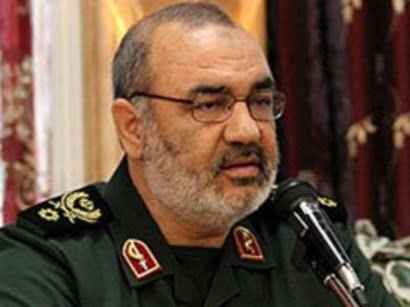
Gen. Hossein Salami, acting commander of the Guards told a group of students on Tuesday that an attack against the regime of Bashar al-Assad would spread the “spirit of jihad” among Muslims and encourage animosity toward the West.

Gen. Salami said Syria is not “alone.” Assad is Iran’s main Middle East ally who supports Tehran and its proxy forces, Hezbollah in Lebanon and Hamas in the Gaza Strip. Iran does not recognize Israel.

FOX NEWS

Read more: http://www.foxnews.com/us/2013/09/03/commander-iran-revolutionary-guards-warns-us-over-attack-against-syria/#ixzzg98fqum00

Top 5 reasons why the United States must attack Syria decisively.

0

1- Syrian regime so far has massacred more than 140,000 of its own people, this means more than a million people are mourning for their loved one. This all started with a protest in a small village and Assad’s army responded with tanks killing most of the villagers. Asad’s father did similar massacre in 1982, killing more between 30,000 to 40,000 people. http://en.wikipedia.org/wiki/Hama_massacre. This need to be stopped as soon as possible with a minimum casualties possible.

Syrian Chemical Bomb Victims

2- Iranian regime is also behind these massacres, Iran has been supplying billions of dollars to the Syrian economy to stop the value of its currency from falling while its own economy and currency is in shamble. Iran has a vested interest in the totalitarian regime of Bashar Al-Assad and is determined to control the regime and have a major influence in the Syrian politics in order to continue its terrorist activities through Hezbollah and Syrian territory, this needs to be cut off ASAP.

3- The Iranian Revolutionary Guard Corps (IRGC) and its Quds Forces as well as Hizbollah are in Syrian with their ground forces fighting alongside Syrian army and its intelligence to suppress and kill all opposition to the regime, they have participated in direct killings of the innocent civilians.  Their goal is to support the continuation of a dictator regime in Syria and create instability in the region as they have been doing it for more than 30 years now.

4- The United States should do anything necessary to show the Iranian regime that Syria is an independent country and its people deserve to choose their own government and system in a democratic way, Syria’s majority Sunni population of more than 20 million deserve and must have a government that represent them, not a minority Alawite of less than 3 million who have been dominating and controlling the Syrian government for almost a half century at the expense of massacre of hundreds of thousands of innocent civilians.

5- If the United States does not react decisively, chemical and biological attacks will continue in the near future and by other dictator regimes in the region. Furthermore, Iran will further increase and boost its terrorist activities and interference in the region especially in Afghanistan, Iraq, Lebanon, and in other countries in the region. The Iranian regime must learn to stop the export of terrorism and instead focus on its own ruined economy and image and welfare of its own people. What we see in Syrian is a coalition of top three ruthless terrorist and dictator systems in the world; Iran, Hizbollah, and Syria, very few people would cry if they cease to exist.

Iranian Revolutionary Guard chief: US Syria strike will have regional consequences


The head of Iran’s Revolutionary Guard warned Saturday that a US attack against Syria would have wider regional consequences.


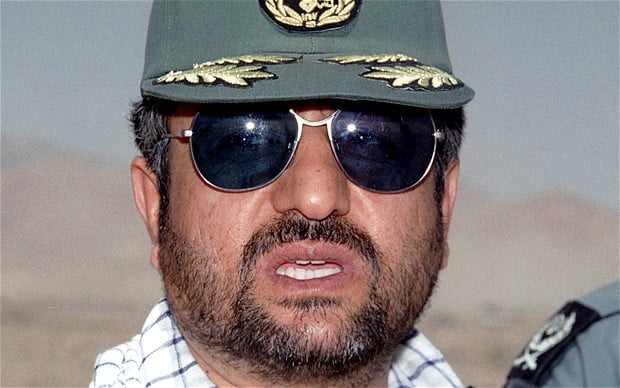
Mohammad Ali Jafari Commander of IRGC

“The US opinion about its ability to limit a military intervention to Syria is nothing more than an illusion. The reactions will go beyond Syrian borders,” Iran’s Press TV quoted Major General Mohammad Ali Jafari as saying.

“Just as US meddling in the Muslim world has led to the spread of extremism, violence and terrorism, attacking Syria will intensify the spread of extremism,” Jafari added.

Crisis in Syria – full JPost.com coverage

A delegation of Iranian parliamentarians left Tehran for Syria and Lebanon on Saturday to inspect the situation first hand and “condemn the use of chemical weapons by terrorist groups,” AFP quoted an official as saying.

Both Iran and Syria have warned that a US strike against Syria would be answered with retaliation against Israel.

The IDF has taken precautionary measures against potential Syrian retaliation, but officials in Jerusalem believe their is a low possibility of strikes against the Jewish state.

JP