Home Blog Page 389

Evin Prison is no “hotel” says jailed reformist

Jailed reformist Mohsen Mirdamadi has issued an open letter from Evin Prison to challenge the recent favourable reports of a parliamentary delegation that visited there. Astara MP Safar Naimi has said that Evin should be referred to as Hotel Evin for the high-quality services that it offers to prisoners.

The delegation visited Evin Prison on January 21 after numerous reports of the mistreatment of prisoners, a lack of space and inadequate services at Iranian prison facilities circulated through the media in recent years.

The delegation reportedly visited ward 350 of Evin Prison, which is known as the section for political prisoners.

In a letter issued on January 24, Mirdamadi says that the Astara MP has quoted false statements on his behalf and on behalf of his cellmate, Alireza Beheshti.

Mirdamadi claims that in an interview with the visiting MPs, he referred to “widespread unwarranted arrests after the 2009 election, and after arrest, the depriving of detainees of their legal rights, issuing sentences without adequate evidence and the pivotal role of interrogators in passing those sentences.”

The head of the reformist organization known as the Islamic Iran Participation Front goes on to add that, in section 350 of Evin, “there are many prisoners that have been subjected to physical and mental pressure during interrogations, and those that have been held in solitary for long stretches without legal justification.”

Mirdamadi says political prisoners are especially denied the minimum services rightfully accorded to any prisoner.

Many top reformist figures were arrested in the election protests of 2009, after reformist candidates MirHosein Mousavi and Mehdi Karroubi challenged the election results. The two reformist candidates are under house arrest and, although no formal charges have been laid against them, the establishment claims that they had “seditious” intentions.

MP Safar Naimi has reportedly quoted Mirdamadi and Beheshti as trying to convince him of their innocence.

Mirdamadi emphasizes that if Naimi feels Evin is like a hotel, then he should live in it for a while to “become fully familiar with all of its hidden aspects.”

Mirdamadi accused the MPs of failing in their duties and closing their eyes to the violations of the rights of the people they represent.

Source: Radiozamaneh

UN group decries opposition house arrests

0

The house arrest of three Iranian opposition leaders has been challenged by the United Nations Working Group on Arbitrary Detention (WGAD), which has called on the Islamic Republic government to release MirHosein Mousavi, Mehdi Karroubi and Zahra Rahnavard.

The International Campaign for Human Rights in Iran reports that the UN Working Group has described the house arrest of the Iranian opposition leaders as “arbitrary” and in violation ofinternational human rights law as well as Iranian law.

The opposition leaders have been under house arrest since February 2011 without being formally charged or put on trial.

The Campaign welcomes that the WGAD has added its voice of “grave concern” in requesting that the Iranian government and its leader Ayatollah Khamenei “immediately release Mousavi, Karroubi and Rahnavard.”

Hadi Ghaemi, a spokesman for the Campaign, says: “There are no justifications for these illegal arrests; in the past two years, no charges have been laid, no law has been referred to and no judicial process has taken place.”

“So long as the two candidates of the 2009 elections remain under house arrest,” Ghaemi added, “the coming elections in June 2013 can have no trace of legitimacy.”

The head of Iran’s Security forces, Esmail Ahmadi Moghaddam, confirmed in a previous interview with Keyhan that Ayatollah Khamenei is directly responsible for the opposition leaders’ situation under house arrest.

Former President Mohammad Khatami has also referred to the plight of these leaders on several occasions, saying: “The continued house arrest of MirHosein Mousavi, Rahnavard and Karroubi in not in the interests of the country.”

Source: Radiozamaneh

Iran’s morality police crack down on coffee shops

0

Popular hangout for Tehrani intellectuals closes after refusing to install surveillance cameras to monitor customers.

As the June presidential election in Iran draws near, authorities have
stepped up political surveillance by ordering coffee shop owners to install cameras on their premises and turn over the recordings on demand.

Cameras have proliferated in Tehran coffee shops since last summer. “Most people thought they were part of the security systems installed by owners to protect against theft,” one Tehrani said. However the cameras are now required to be on during work hours and police have demanded access to the tapes, according to several business owners.

The practice became public when Café Prague, one of the most popular coffee houses in Tehran, closed down last week after its owners refused authorities’ orders to install a video system. Café Prague, a stone’s throw from Tehran University in the heart of the capital, has been a sanctuary for students, activists and young intellectuals since its opening in 2009.

A few weeks ago, Tehran’s morality police and security authorities told the café’s proprietors to install a minimum of four surveillance cameras on the premises as part of state efforts to tighten civic monitoring and security. The owners decided they would not do so. Recognising that this would result in further harassment and eventual closure, they shut down the cafe themselves to protest against the new surveillance measures.

“We always knew this day would come and, in the midst of Tehran’s grimy winter, our end has finally arrived in spite of our many attempts to stay afloat,” read a statement posted on the Café Prague Facebook page.

“But as much as it pains us and as much as we will miss our friends and all of you who stood by our side in the past four years, we take comfort in knowing that we at least didn’t let Big Brother’s glass eyes scan and record our every step, minute and memory from dawn till dusk.”

The café’s closure is a significant loss for Tehran’s academic and cultural life. During its short existence, Café Prague offered much more than just coffee and free wi-fi; it played host to a number of social and political events, from photo exhibitions supporting local artists to music performances and vibrant left-leaning discussions on workers’ rights.

“I have four years’ worth of memories in that café,” said Amir Hossein, a photographer. “I am sad that I didn’t spend more time there. Café Prague wasn’t just a café; it was like home, a safe haven for us to forget all our daily troubles and burden.”

From the ninth century, the Iranian coffeehouse was a place that poets, artists and dervishes could gather without fear of harassment by royal deputies or local authorities. In the modern era, dissident café culture in Tehran stretches back some 85 years to the time when the celebrated Café Naderi – much like Café de Flore and Les Deux Magots in Paris – became a magnet for the intellectual elite. For decades it was frequented by prominent literary figures such as Sadegh Hedayat, Jalal al-Ahmad, Simin Daneshvar and Nima Yooshij.

After the 1979 revolution, the government closed many coffee shops, declaring them part of the “western cultural onslaught”. Harking back to those early days of the Islamic Republic, some conservative political and religious leaders have taken a stricter line against “foreign culture” in recent years, promoting plans to “Islamicise” universities’ liberal arts curricula and once again shutter venues that facilitate socialising and the exchange of ideas unbound from customary constraints. Last July, more than 87 cafés and restaurants in a single district of the capital were reportedly raided for defying “Islamic values.”

The crowds at coffee shops in Iran tend to be young. They are the site of many couples’ first dates, a place where they can be free of the inhibitions imposed by the morality police or parental supervision. Groups of young people gather as well, for everything from discussions after class at university to birthday celebrations.

“The decision to force this or that place to follow the rules or shut down also signals another trend at Tehran’s coffee shops,” an observer told Tehran Bureau. “An increasing number of their patrons use coffee shops to discuss politics – something the government does not appreciate.”

Source: Guardian

Halt the Execution of Five Ahwazi Arabs

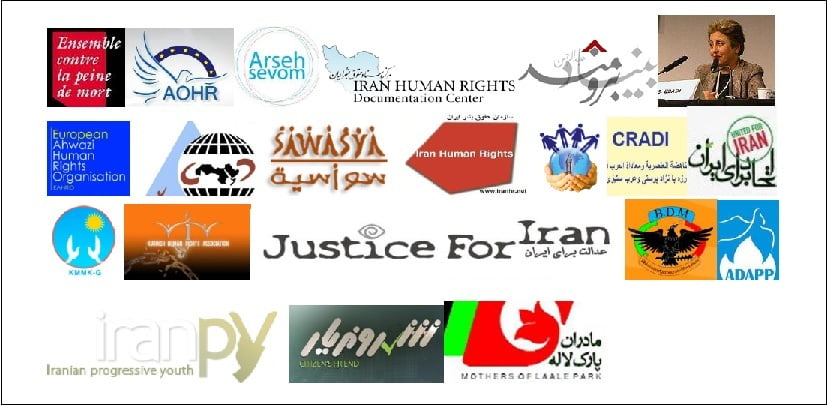
The undersigned human rights organizations strongly oppose the death sentences issued by the Islamic Republic of Iran (IRI) against five civil and cultural activists who are members of the Ahwazi Arab ethnic minority in Iran.  We urge the IRI authorities to halt the implementation of the death sentences against these five men pending further review of their cases in accordance with due process standards.

On Friday, January 18, five Ahwazi Arabs from Khalafieh (Ramshir), Iran were transferred by security forces from Karoun prison to an undisclosed location.  Their families fear that the removal of the five men from Karoun prison indicates that they will soon be executed.

These five Ahwazi Arab cultural activists were sentenced to death in June. The execution sentences were upheld by the Supreme Court, and the families of the men were subsequently notified on Wednesday, January 9, 2013.

The five men in question are: Jaber Alboshoka (holds an associate degree in computer sciences and is a private in the military) 28 y/o, Mokhtar Alboshoka (works at a stone mining company) 26 y/o, Hadi Rashedi (holds a masters degree in applied chemistry and is a chemistry teacher) 39 y/o, Hashem Shabaninejad (an Arabic literature teacher and a masters student of political science at Ahwaz University) 32 y/o, and Mohammad Ali Amourinejad (a Fisheries engineer and school teacher) 34 y/o.  In addition to their professional vocations, these five men are founders and active members of the Al-Hiwar scientific-cultural institute (Al-Hiwar means “dialogue” in the Arabic language)—a group which experienced mass arrests of its members in February 2011.  Mohammad Ali Amourinejad was imprisoned in Basra, Iraq at the time. He was transferred directly to Iranian custody at the Shalamcheh border between Iraq and Iran in February 2011. After being held at a detention center run by the Ministry of Intelligence and Security (MOIS) in Ahwaz and tortured for months, they were accused of moharebeh (waging war on God) and terrorism, however the defendants maintain that the confessions obtained from them are false confessions obtained under torture.

Among ethnic minorities in Iran, Ahwazi Arabs are subjected to some of the most severe repression from the central government. In June of last year, four Ahwazi Arabs, three of whom were brothers, were executed on similar charges.

In addition to these five men, whose execution is imminent, there are more than 30 prisoners on death row who are members of ethnic and religious minorities in Iran.

The Iranian judiciary and security apparatus recently carried out the execution of six Sunni prisoners in secret—which has prompted fears among prisoners on death row and their families that more executions of ethnic and religious minority prisoners are on the way.

The undersigned organizations wish to express their deep concern about the imminent execution of these five Ahwazi Arab cultural activists. We urge the international community and human rights organizations to take immediate action to halt the execution of these five men.

1. Shirin Ebadi, Nobel Prize Laureate

2. Arab Organization for Human Rights in UK

3. Arseh Sevom (Third Sphere)

4. Association for Defence of Azerbaijani Political Prisoners in Iran (ADAPP)

5. Balochistan Human Rights Organisation

6. Centre for Combating Racism and Discrimination against Arabs in Iran” (CCRDAI)

7. Committee of Human Rights Reporters (CHRR)

8. Together against the Death Penalty/ Ensemble contre la peine de mort (ECPM)

9. European Ahwazi Human Rights Organization (EAHRO)

10. Iran Human Rights

11. Iran Human Rights Documentation Center

12. Iranian Cultural Society, Switzerland

13. Iranian Progressive Youth (IPY)

14. Iraqi Coalition Against the Death Penalty

15. Justice for Iran NGO

16. Kurdish Human Rights Association

17. Kurdish Human Rights Network

18. Mothers of Laleh Park/ Dortmund

19. Mothers of Laleh Park/ Hamburg

20. Mothers of Laleh Park/ Los Angeles – Valley

21. Mothers of Laleh Park/Köln

22. Mourning Mothers of Iran – London

23. National Centre of Justice Iraq-UK

24. Shahrvand Yar (Citizen’s Friends)

25. Society for the Defense of Human Rights in Iran – Austria

26. The Abdorrahman Boroumand Foundation

27. The Arabic Network for Human Rights Information (ANHRI)

28. The Association for Human Rights in Kurdistan of Iran-Geneva

29. The Mothers for Peace, Montreal

30. United4Iran

Source: Iran Human Rights

Anvar Hossein Panahi’s family summoned & portion of their assets confiscated

The parents and younger brother of political prisoner Anvar Hossein Panahi were summoned on January 21, 2013, to the office of the Qorveh Ministry of Intelligence in Kurdistan province. The intense bullying and pressure tactics against this family continues as judicial authorities impounded 10 million tomans from their bank account, money Panahi’s brother had deposited to help his family.

The family of incarcerated Kurdish activist Anvar Hossein Panahi, who is the eldest son, has endured intense torment and harassment by security agents during the past 5 years. They have reported that their family is under constant surveillance and their residences are routinely searched.

Anvar Hossein Panahi is a Kurdish activist and a Dehgolan province dignitary who was arrested in 2007 and severely tortured while in detention. In 2008 he was sentenced to death on charges of “acting against national security,” “collaborating with a Kurdish political party” and “moharebeh” (enmity with God). After tireless efforts and protests on the part of human rights activists, his death sentence was later commuted to 6 years in prison.

On January 4, 2013 a nephew, Sirvan Hossein Panahi was violently detained at his home and transferred to an undisclosed location by plainclothes officials from the Ministry of Intelligence. Witnesses reported that his arm looked like it was broken during the arrest. There is still no news of Sirvan’s condition or whereabouts.

In the past 6 years since the incarceration of Kurdish activist Anvar Hossein Panahi, his family has endured constant harassment and more than 33 members of his family have been arbitrarily arrested.

Source: CHRR

Cultural activist and teacher arrested

0

Iran Daily Brief: Cultural activist and member of the teachers association in Kermanshah, Mohammad Tavakoli, was summoned for questioning by the IRGC Intelligence Headquarters in the city, where he was arrested.

Accused prosecutor keeps controversial job

0

Saeed Mortazavi, the notorious former Tehran Prosecutor accused of causing the deaths of detainees at Kahrizak Prison in 2009, is staying at the head of the Social Security Fund by order of the Ahmadinejad administration.

The controversial appointment of Saeed Mortazavi as the executive director of the Social Security Fund organization was rejected twice by the Supreme Court of Justice; however, the administration now claims that Mortazavi is serving there in a supervisory role.

Labour and Social Security Minister Abdolreza Shekoleslami was threatened with impeachment over Mortazavi’s appointment on the grounds that the latter is the prime suspect in the case of the Kahrizak deaths. The impeachment motion was suspended, however, as Parliament reached the end of its mandate and a new group of MPs was voted in.

Saeed Mortazavi, a staunch Ahmadinejad supporter, was removed from his position as Tehran Prosecutor after it came to light that detainees had died there under torture. The administration immediately put Mortazavi at the helm of the Task Force to Fight Smuggling and Drug Trafficking, and last year he was appointed to head the Social Security Fund.

The appointment has been challenged by many lawmakers and other political figures.

Mahmoud Ahmadinejad’s presidency has been fraught with disputes with Parliament, and in several cases the escalation of disputes has forced the Supreme Leader to step in and mediate a truce, with calls for unity amongst the branches of government.

Source: Radiozamaneh

Continuing the prevention of Mousavi and Rahnavard to contact their children

0

Total prevention of call contact between Mousavi and Rahnavard with their daughters is still continuing and these two besieged are not allowed to be informed about anything related to their children.

According to a report quoted from Kalemeh website, Zahra Rahnavard confirmed on the call with her mother on last Tuesday that they are not allowed to have any contact with their daughters.

Mrs. Rahnavard who her father passed away recently and was not able to be present in funeral ceremony, has been able to talk with her alone mother during a phone call on Tuesday.

Kokab, Zahra and Narges are Mir Hossain Mousavi’s daughters but they are not allowed yet to visit or have phone call with their parents, then lack of information about their parent’s situation is still continuing.

During the last two months, Mir Hossain Mousavi’s children expressed some of what happened to their parents in the last few months in interviews, Also released a joint statement with Sheikh Mehdi Karoubi’s children. While they were silent for months
to not stop the Mousavi’s medical treatment by pertinacity of regime leaders while the treatment process took place very late.

Security agents of regime threatened that if their children will release any news, they won’t have permission anymore to visit their parents. Now the security forces insistence on this illegal and inhuman threat and do not allow any contact between Mousavi’s children and their parents who are in house arrest.

While the house arrest of Mousavi, Rahnavard and Karoubi will be two years in one month and there is not any justification or even regime leaders preventing their public and transparent trialed.

Source: HRANA

Iran’s Revolutionary Guard The story of a long war between Iran and US

For more than 30 years the Islamic Republic in Iran has been waging a low intensity war against the United States and its allies in the Middle East. This undeclared war has claimed the lives of hundreds of Americans, including many Marines and GI’s killed by roadside explosives in Iraq and Afghanistan.

Iran’s principal arm in this war has been the Islamic Revolutionary Guard Corps (IRGC), a paramilitary organization created in 1979 with the help of Palestinian guerrilla groups. Since then the IRGC has developed into an alternative army with its own navy, air force and special units. Charged by the late Ayatollah Khomeini with the task of “exporting” revolution, the IRGC has created a special unit, known as the Quds (Jerusalem) Division to conduct asymmetric operations against the Khomeinist regime’s enemies across the globe.

Steven O’Hern’s new book is dedicated to a study of the IRGC and the Quds Division with special focus on their operations against US forces in Iraq and Afghanistan. A retired military intelligence officer, O’Hern, is able to write this subject with some authority if only because he had personal experience of trying to the IRGC in Iraq.

O’Hern makes three important assertions.

The first is that the threat from the IRGC, though debatable as to its extent and effectiveness, is a fact that the outside world would ignore at its peril. Determined to de-stabilize and, when possible, help overthrow pro-West regimes, Iran’s current leaders have no qualms about using the IRGC in an increasingly aggressive manner.

Next, O’Hern asserts that the United States, the principal though by no means the only, target of the Iranian campaign is unable or unwilling to appreciate the extent of the threat. In fact, O’Hern’s book has this as subtitle: The Threat that Grows While America Sleeps.

The subtitle recalls a slim book written by President John F Kennedy about the rise of the Nazi threat while Europe slept before the Second World War.

O’Hern’s third assertion is equally interesting. He rejects the conventional wisdom’s belief that classical Shi’ite-Sunni divisions in Islam prevent the Khomeinist regime from forming alliances against their common foes.

He then proceeds to suggest that Iran has been helping Al Qaeda with training, tactics and supply of weapons for a number of years and may well have been indirectly involved in the attacks against New York and Washington on 9 September 2001.

According to O’Hern, Iran used the Lebanese branch of Hezbollah to establish a link with Al Qaeda.

He writes: “Hezbollah opened classrooms to Al Qaeda operatives who traveled to Lebanon for training. Al Qaeda purchased a guesthouse in the Bekaa Valley where its members lived while being trained by Hezbollah experts in using explosives used to bring down large structures.”

That Shi’ite Hezbollah should help train Sunni Jihadists may seem surprising. However, the IRGC itself had been partly trained by Palestinian groups that were Sunni, Christian or Marxist-Leninist. Because of their common hatred of the United States, they had little difficulty ignoring religious and/or ideological divisions.

According to O’Hern, Imad Mughniyah, a senior military commander of the Lebanese branch of Hezbollah visited Al Qaeda’s founder Osama bin Laden while the latter lived in Sudan. Mughniyah’s brother-in-law, one Mustafa Bad red-Din also played a role. A captured Al Qaeda fighter who had been in Sudan at the time witnessed the fateful meetings, O’Hern reports.

According to O’Hern, the Lebanese branches of Hezbollah, like its branches in other countries, is an integral part of the Iranian government’s military-security structure. Mughniyah was recruited by the Iranian intelligence service in 1982 and remained on its payroll until his death in Damascus more than a quarter of a century later. Lebanese Hezbollah leader Hassan Nasrallah is also an Iranian government employee and directly controlled by the IRGC.

While O’Hern hints at the ideological roots of the IRGC he does not study them in detail. Had he done so he would have paid greater attention to reasons that could bring together people from a widely different religious, ethnic and political background in a common fight against the American “Great Satan.” In fact, among the 11 men that O’Hern names as the original founders of the IRGC at least six were US-educated and at least four, including Mostafa Chamran and Ibrahim Yazdi were naturalized US citizens.

Tehran’s anti-American message has also won it a number of allies in Latin America where a number of new left-leaning regimes have helped the IRGC establish bridgeheads in what used to be Washington’s backyard. The IRGC now has “operational assets” in Venezuela, Ecuador, Nicaragua, and Bolivia, and maintains a political presence in Argentina and Venezuela and Cuba. In most cases, the IRGC has used ethnic Lebanese and Syrian groups in those countries as a cat’s paw.

As far as the US position is in this low intensity war, O’Hern’s tone remains pessimistic. However, at the end of the book he devotes a chapter to how the US could prevail. The first step in that direction, according to O’Hern, is to explain to the American public the threat that the Khomeinist regime in Tehran poses to the US. O’Hern rules out outright war against the Islamic Republic and questions the effectiveness of economic and other sanctions to change Tehran’s behavior.

What he suggests, in effect, is for the US to give Iran a taste of its own medicine, that is to say low intensity war against it. In other words, this may prove a long struggle that would not, indeed could not, end without regime change in Tehran.

Source: Inside of Iran

Russia lifts nationals out of Syria. Moscow, Iran arm Assad for major armored push

0

The Russian emergency ministry said Monday, Jan. 21 that it is sending two planes to Beirut to evacuate 100 Russians from Syria – the first such effort since the uprising against Bashar Assad began in March 2011. Moscow also announced contingency plans to lift 30,000 Russian nationals from the embattled country.

This evacuation of Russian nationals starting Tuesday was decided after the Syrian high command received orders from President Assad to organize mobile armored strike groups with massive fire power for a big push to run the rebel forces out of the towns, villages and areas they have captured, mostly in the north and southeast.

DEBKAfile’s military sources report that, because they are in a hurry, the Syrian army chiefs decided to use only seasoned officers and men with experience in active service against the rebels, rather than new recruits who would need weeks of combat training. The divisions or brigades holding the line in such trouble spots as Aleppo, Homs and Deraa, are being depleted, some of their units detached for service in the new armored strike groups.
Our sources report that Iranian Revolutionary Guards Corps officers are supervising the effort for what Assad sees as his biggest assault yet to finally crush the revolt against his regime.
Its timing marks two fundamental developments in Syria’s bloody civil war:

1. The self-confidence of Assad and his top military staff is gaining in direct contrast to the weakening of the insurgency. It was therefore decided in Damascus that the time was ripe for a major offensive to push the rebels out of the strategic areas from which they could threaten central government.
2. Western-Arab arms supplies to the rebels have slowed down steeply because the funding from Saudi Arabia, Qatar and the UAR has dried up. The high-grade weapons still in rebel hands were mostly looted from Syrian army bases and stores.
3.  According to DEBKAfile’s military sources, Russian officials up to the level of President Vladimir Putin examined the Iranian-Syrian armored strike group tactics and approved.
These developments, according to Western intelligence sources familiar with the Syrian situation, explain the recently intensified coordination between Moscow, Tehran and Damascus and the resulting accelerated flow of Russian and Iranian weapons to the Syrian army.

Russian arms ships are lining up at the Syrian port of Tartus to unload their freights, while Iranian air transports are touching down and taking off at speed from Damascus and Aleppo military airports.
Arms deliveries are coming in aboard large Russian naval vessels, including the Azov andAklexander Shabalin landing craft, the amphibious Kaliningrad and others.

To camouflage heir rapid movements in and out of Tartus, the Russian navy Sunday, Jan. 20, announced a large-scale sea maneuver would take place in the Mediterranean up until Jan. 29. None of the ships taking part in the drill were identified except to say that they came from Russia’s Baltic, North and Black Sea fleets.
Our military sources report that the Russian deliveries consist mainly of armored vehicles, self-propelling recoilless guns, all-purpose vehicles for rough terrain and a variety of missiles and rockets for combat in built-up areas – all items clearly designed to outfit Assad’s new armored strike units.
Tehran, for its part, is sending ammo, spare parts for Syrian tanks and artillery and missiles.
According to those sources, the Syrian army plans to kick off its new offensive at Daraya, a small town near Damascus which is held by the Free Syrian Army.

Source: DEBKA