Home Blog Page 458

Iranian MP accuses Revolutionary Guards of interfering in election

0

By NAJAH MOHAMED ALI

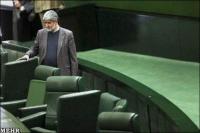
Iranian veteran conservative MP Ali Motahari accused the Iranian Revolutionary Guards Corps (IRGC) of interfering in the results of the latest parliamentary elections amid retaliation threats by IRGC senior officials.

IRGC General Ramadan Sharif, was quoted in a statement posted on the IRGC-affiliated Fars News Agency as saying the military body is, and will always be, committed to the teachings of the leader of the 1979 Islamic Revolution Ayatollah Khomeini and will therefore never interfere in legislative elections.

The IRGC, the statement added, did not influence in any way the results of the March 2 elections, which witnessed a major victory for the supporters of Supreme Leader Ayatollah Khamenei, some of whom are IRGC members.

IRGC members were infuriated by the accusations Motahari, one of Iran’s most daring and independent MPs, hurled at them in the parliament session held Sunday and threatened to take the MP to court if he does not withdraw his “allegations.”

Motahari, who called for the questioning and possible impeachment of the president, also accused Iranian President Mahmoud Ahmadinejad and his brother-in-law and chief of staff Esfandiar Rahim Mashaei of spreading vice among the youth and creating the suitable environment for indecent behavior.

“I suggest that you open nightclubs to satisfy the sexual desires of the youth,” he once said, addressing Ahmadinejad.

Al Arabiya News Channel and AlArabiya.net ran on March 3 reports stressing that the ninth parliamentary elections since the 1979 revolution have witnessed a wide range of violations such as rigging and vote buying in the capital Tehran and other Iranian cities.

Those violations, reports explained, were committed by various political powers but especially by the IRGC and the IRGC-affiliated volunteer militia the Basij.

According to an Al Arabiya report, IRGC and Basij members toured the streets on their bikes, paid money to pedestrians, and told them to vote for the IRGC list.

Large numbers of villagers were also transferred to big cities to give the impression that the turnout was high in the elections described by several opposition figures inside and outside Iran as a “farce.”

Several of those involved in paying money were arrested in several cities only to be released later after IRGC interfered.

Source: Alarabiya

Iranian economist to serve out prison sentence

Iranian economist Fariborz Rais Dana was arrested today in Tehran to serve out a one-year sentence.

The Workers’ Rights Defenders website reports that Rais Dana was arrested and transferred to Evin Prison. He sentence relates to a media interview in which he criticized the government’s plans for restructuring subsidies.

In an interview with Persian BBC, only a few hours after Mahmoud Ahmadinejad announced his subsidy plans on Iranian state television, Rasi Dana accused the Ahmadinejad administration of “illusion therapy” and emphasized that the government’s actions would wreak havoc on the economy.

His statement led to his immediate arrest in December of 2010, and he was released after a month on bail.

The Middle East Economic Association spoke out against his arrest, calling for his immediate release.

Later, Rais Dana was sentenced to one year in prison for a series of charges including “membership in the Writer’s Association, preparing seditious announcements against the regime, giving interviews to BBC and VOA, and accusing the Islamic Republic of abusing prisoners and holding show trials.”

 Source: Radiozamaneh

The case of Kurdish Iranian death row prisoner Behruz Alakhani

The Iran Human Rights Documentation Center (IHRDC) has learned from an informed source close to the case of Kurdish Iranian death row prisoner Behruz Alakhani that Alakhani’s arrest, prosecution and sentencing leave numerous evidentiary questions unanswered. The source has also expressed concern for Alakhani’s psychological state. Alakhani endured 19 months of solitary confinement without access to visitation in the detention centers of several local Intelligence Ministry offices prior to his transfer to Orumiyeh Prison, where he is currently held. IHRDC has also obtained an exclusive copy of the judgment rendered against Alakhani.Behruz Alakhani was arrested 28 months ago and taken to the Ministry of Intelligence detention center in Salmas. Thereafter his family had no knowledge of his whereabouts. However suspicions that Alakhani had been arrested were raised when several plainclothes agents from the local branch of the Intelligence Ministry along with uniformed members of the Islamic Revolutionary Guards Corps (IRGC), and the local police raided the Alakhani family home without a search warrant three days after his disappearance, on January 30, 2010. At that point, a member of Alakhani’s family asked why he had been arrested, to which one agent replied that he had not been arrested. Other agents involved in the raid confirmed his arrest, but stated that the charges were theft or the possession of alcohol.

Only after Behruz Alakhani’s transfer to the drug offenders’ ward of Orumiyeh Central Prison after 19 months in the custody of the Ministry of Intelligence were charges brought against him. He was charged with muharibih [waging war against God] and ifsad-i fil arz [sowing corruption on earth]. These charges were made on the grounds that Alakhani had collaborated with PJAK (Partiya Jiyana Azad a Kurdistanê)—an armed Kurdish group—by procuring and transporting illegal firearms and a bomb, and that he had also participated in the assassination of the prosecutor of the county of Khoy, Valiollah Hajj Gholizadeh.

The day after the shooting, a local official, Fakhrali Nikbakht, alleged that PJAK was behind the assassination of Hajj Gholizadeh. Mehr News Agency later claimed that PJAK had claimed responsibility for the attack. This was never confirmed, and no public record of an acceptance of responsibility for the assassination by PJAK exists. Until its declaration of a unilateral ceasefire in September 2011, PJAK regularly claimed responsibility for the deaths of IRGC members.

At the time of his death, the Iranian government stated that Valiollah Hajj Gholizadeh died of two gunshot wounds sustained on the front doorstep of his home at 8PM on January 18, 2010. The next day, on January 19, 2010, the local governor stated that two “suspicious” automobiles had been found and the semi-official Mehr News Agency announced that four suspects had been arrested, though the news article did not provide names. Further, IHRDC’s source confirms that Behruz Alakhani was arrested the day after the assassination of Hajj Gholizadeh.

On the same day Mehr News Agency also quoted Ebrahim Mohammadlou, the governor of Western Azerbaijan province as claiming no suspects had yet been arrested, but that agents were on the case. Whether this belies miscommunication between the local Intelligence Office that was already detaining Alakhani and the governor’s office, or whether Alakhani was indeed not charged with any crime related to the assassination of Hajj Gholizadeh at the time of his arrest and early detention as the agents searching his house also stated is unclear at this time.

IHRDC’s source also avers that Alakhani’s codefendants, Kamel Shablouee, Bashir Chartagh and Akbar Ali Akbarlou, were all his paternal relatives and that he had no connection with PJAK.

In the court opinion rendered in Alakhani’s case, Judge Chabak of Branch 1 of the Revolutionary Court of Orumiyeh sentenced Alakhani to 10 years’ imprisonment including time served and subsequent execution.

According to the opinion, Alakhani’s alleged guilt is based in part on a claim that his phone lines were deactivated for one week after the assassination—purportedly he then received a call from an alleged PJAK agent designated only as ‘Khalil’, who congratulated Alakhani on assassinating Mr. Hajj Gholizadeh. However if Alakhani was arrested the day after the assassination of Mr. Hajj Gholizadeh, as IHRDC’s source has stated and the January 19, 2010 Mehr News article seems to confirm, then the evidence about the congratulatory telephone call does not accord with that narrative. Further evidence mentioned in the judgment base Alakhani’s guilt on a codefendant’s claim that he did not eat very much on the night of the assassination, allegedly indicating a nervous mental state. Alakhani’s verdict is also based in part on what is designated a ‘speedy confession’ on his part and testimony from local agents of the Ministry Intelligence and IRGC.

IHRDC’s source states that Alakhani has suffered greatly as a result of his 19 months of solitary confinement. The source further indicates that Alakhani’s psychological state has deteriorated, adding “he does not speak with you anymore. He is like a mentally ill person now.”

Source: Iranhrdc

Accused in fraud case attends government meetings

0

Iranian news websites report that the former deputy head of the Central Bank, who is accused of playing a part in Iran’s $3-billion bank fraud and is currently out on bail, is attending important meetings of the Ahmadinejad administration.

Hamid PourMohammadi, who was the deputy head of the Central Bank of the Islamic Republic of Iran until last November, was arrested in connection with the $3-billion bank fraud and dismissed from his position. He was later released on bail.

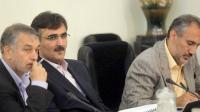
The Mehr News Agency reported today, Sunday, that PourMohammadi is attending top government meetings, and the agency published a photo of the former bank deputy head at the recent meeting of the Petrochemical Industry Development Committee together with the vice president, Mohammadreza Rahimi.

Mehr writes: “He was immediately dismissed from his position at the Central Bank after his arrest, so it is not clear in what capacity he is attending government meetings.”

PourMohammadi’s presence at government meetings has also been challenged by Ahmad Tavakoli, the head of Parliament’s research centre, on his website Aleph.

Previously, Tavakoli had challenged the authenticity of PourMohammadi’s credentials as deputy head of the Central Bank and accused President Mahmoud Ahmadinejad of using unqualified people in his administration.

Ahmadinejad denounced PourMohammadi’s arrest in November. The judiciary has not announced a trial date for PourMohammadi.

The $3-billion bank fraud centres on Amir Mansour Arya Financial Group, headed by MahAfarid Amir Khosravi, who is accused of acquiring $3-billion through the sale of fraudulent letters of credit to banks. Several bank managers and officials are also charged with receiving exorbitant bribes to facilitate the fraud process.

 Source: Radiozamaneh

Protests In Sunni-Majority Iranian Province Turn Deadly

0

Tensions are running high in a southeastern Iranian province with a majority Sunni population after a protest against the recent arrest of local religious figures ended in bloodshed.

At least one person was killed and two injured after police forces opened fire on the protesters, who had gathered in the city of Rask in Iran’s Sistan-Baluchistan province on May 14. According to reports, they were demonstrating against the recent arrests of the son of the city’s Friday Prayers leader and other Sunni clerics.

Sunni Muslims make the majority of the population in Sistan-Baluchistan but make up only about 10 percent of the population in Shi’a-dominated Iran overall.

Iran’s officials and state media have not reported on the unrest. But SunniOnline, a website that covers news about Iran’s Sunni minority, wrote that police opened fire on protesters, resulting in the death of a man identified as Jan Mohammad Dehghani. His funeral was reportedly held on May 15.

Quoting unidentified citizens of Rask, the daily “Etemad” reported that at least two people were killed in the shooting, without providing further details.

Deutsche Welle’s Farsi Service quoted a source in Rask as saying that a number of protesters were rounded up and suggesting that more arrests could follow after authorities traveled from the provincial capital to investigate.

“Protesters were filmed, today security forces came from Zahedan to identify [those who took part in the protest] and arrest them,” the unidentified source reportedly told the German news agency.

The recent arrest of Abdolghafar Naghshbandi, the son of Rask Friday Prayers leader Molavi Fathi Naghshbandi, was apparently the most immediate cause of the protests. He was reportedly arrested upon returning from nearby Zahedan, where he had traveled to learn about the fate of his father, who was imprisoned along with a number of other Sunni scholars in mid-April.

SunniOnline wrote that women initiated the protest in Rask and were later joined by other citizens angry over the arrests of Sunni figures.

Some reports say Friday Prayers leader Fathi Naghshbandi and a dozen others were arrested in connection with the January assassination of pro-government Sunni cleric Molavi Mostafa Jang Zehi. Jang Zehi was killed by unknown assailants on a road in Sistan-Baluchistan.

Iran’s Intelligence Ministry said in April that it had arrested “15 terrorists” involved in the assassination of Jang Zehi, who has been described as a Basij commander and cleric loyal to the establishment. Iranian hard-line websites reported that Jang Zehi had received death threats from the Sunni militant group Jundullah, which is believed to be behind a number of attacks in the region in the past few years. The group, whose leader was executed in Iran in 2010, has been labeled as a terrorist organization by Iran and the United States.

The ministry claimed that the opposition Mujahedin Khalq Organization (MKO) was involved in planning the attack, while “elements affiliated with Wahhabi groups” carried out the assassination. The ministry didn’t provide the names of those arrested. SunniOnline later reported that Fathi Naghshbandi and Molavi Abdollah Molazadeh, the Friday Prayers leader of the city of Paroud, are among those arrested on terrorism charges.

Members of Iran’s Sunni minority often complain of discrimination and neglect by the government.

Although Iran’s constitution guarantees the rights of the country’s minorities, Sunnis are in practice not allowed to build their own mosques in major cities. Sunni clerics critical of the Iranian establishment face pressure and they are sometimes denounced as “Wahhabis.”

SunniOnline reports that there have also been protests over the arrest of Sunni scholars in Jagikour, located in Sistan-Baluchistan’s Sarbaz district, of which Rask is the capital.

Prince Mojtaba Khamenei, son of the false Pharaoh

What Stalin and Hitler began, fascist zealots want to accomplish on behalf of the Islamic revolution in Iran and the rest of the planet.

Since 33 years, the so-called Islamic revolution in Iran has more and more been showing its ugly face. What in 1979 for many Iranians began as the greatest adventure of political freedom and participation, has increasingly grown in always tighter stages to a real fascist dictatorship. The dream of the just system of velayat-e-faghi (rule of the supreme religious leader, who is connected to God and acts as an intermediary for the “people”), which should serve as a model for the whole world, turned out  as a bitter disillusionment even for those followers who dedicated their life to this cause.

The false pharao

Khamenei and his son

When the revolutionary leader Khomeini died in 1987, the question of his Velayat-e-faghi system was a problematic weak point that still to date hasn’t offered a satisfactory solution. In benefit of Ali Khamenei, the constitution was even simply changed so that he could be installed as Supreme Leader. His religious sanctifications were and are meager. He hasn’t been maintaining his power for more than 20 years with an impressive performance but with money, positions, intimidation tactics and brutal coercion and violence. The nearness to God is slyly staged and can only convince little even devout Muslims. In ancient Egypt the Pharaohs also claimed a closeness to God in order to legitimize their rule and to demand obedience. Khamenei seems to emulate them. He is a Pharaoh with poor legitimacy.

The only thing that we have to admit is the fact that men of the revolution like Rafsanjani offered him the throne to preserve the system. Now Khamenei holds to his Pharaoh turban at any cost. He is in both senses of the word a false Pharaoh. Ayatollah Montazeri was originally intended to be the successor of Khomeini, however was forced in time to the sidelines. Montazeri spoke out against the massacre of political opponents in the 80’s and Khamenei came into the office. His lack of qualifications for this office, that premised the highest spiritual, moral and character requirements, represents the second meaning of false.

The fox in the shadow

Akbar Hashemi Rafsanjani was a man of the early days of the Islamic Republic of Iran and a close confidant of Ayatollah Khomeini, the charismatic revolutionary leader. In the wake of the presidential elections of 2009, the camp of Ahmadinejad accused Rafsanjani of corruption and forced him out of the center of power. His political life is hanging at a thread, he is currently still the Chairman of the Expediency Council. Meanwhile, his voice is seldom heard in the socio-political events in Iran, but in late April 2012, he seems to go back into the ring. He reproached the quarrellers [1] of the establishment they are leading the country into the abyss, since the population will lose all respect when the representatives of the state accuse each other publicly of corruption. Some chess moves in the big power game may still be expected from  Rafsanjani.

Ahmadinejad and the magician

Abbas Amirifar

The relationship of the false Pharaoh with his President seems sometimes to be on the verge of collapse. Always questions of legitimacy are behind the superficial skirmish. Since the false Pharaoh Ali Khamenei feels himself threatened in the first place by the visions of Rahim Mashaei about the importance of Ahmadinejad regarding the return of the Twelfth Imam’s, he must always remind his president to his place. The dispute over the replacement of the Intelligence Minister with someone of Ahmadinejad’s followers in 2011 raises some questions. Shortly after Ahmadinejad wanted to take over the ministry by the dismissal of Heydar Moslehi and Khamenei had opposed this move, there was a wave of arrests within Ahmadinejad’s circle. The alleged magician, Abbas Amirifar, [2] and other friends of the President were arrested and are free again now. It means that Ahmadinejad has a means of putting pressure to keep his place. Rahim Mashaei, of whom is said to have close ties to the Indian magicians, provided him with explosive secret documents that could cost head and neck of a large part of the establishment of the Islamic Republic of Iran.

The tired guard

Once a glorious leader of the Revolutionary Guards and less successful candidate for the post of president in 2009, Mohsen Rezaei launches at present via his website Baztab interesting insights into events and relationships in Iran, taking place in the shadow of daily politics. He too is a man of the first hours of the system and over the years was able to build up the best connections. In early May 2012, in a detailed article, he pointed to the resumption of the activities of the group that cooperated with Said Emami. These people want to portray Said Emami as a martyr and revive his ideals.

The proud murderer

Ruhollah Hosseinian

Ruhollah Hosseinian is considered to be a ruthless killer who boasts to have done his religious duty, because he killed people. He is regarded as a supporter of Ahmadinejad. His career in the dark cellars full of state secrets and his activities in the planning for the physical annihilation of enemies is long and signifies that this man is a convinced revolutionary. Among other positions, he directs the Center for Documents of the Islamic Revolution [3]. The insights into the files of the previous service SAVAK was very helpful for the planning of new crimes. Under his aegis, yet another zealot was working who was sacrificed in the era under Khatami to protect the establishment.

The sacrificed servant

Said Emami

Said Emami originates from a Jewish family in Iran. He studied in the U.S. and had been working for many years under Ali Fallahian and Ruhollah Hosseinian in the Ministry of Intelligence. Ali Khamenei entrusted his family to Emami during a long stay in London. From this period dates his intimacy with Mojtaba Khamenei, a son of Ali Khamenei. Emami is considered to be the planner of several murders of dissidents, including the parents of  Parastou Forouhar. In this context, he was arrested and interrogated. Several documents about his role in the killings can be found on the Internet. [4]

Emami died in prison because he had allegedly been drinking arsenic-containing depilatories. Political observers describe this information as a pale duck and believe it is more likely that he was eliminated because high standing personalities within the system feared his incriminating statements.

In Iran, the political landscape consists of numerous political alliances, coalitions and interest groups and it is for Western Iran experts very confusing, while almost every day coalitions change and new named coalitions originate. A look behind the scenes will be helpful to understand who is hiding behind the bushes and what kind of intentions are hidden.

The “bad” and the “good” Principalists

They are competing for seats in parliament, accuse each other of corruption and still all the factions, that are officially approved by the Guardian as loyal to the regime and allowed to be political active, consider themselves as true Islamic revolutionaries. There are some small isolated groups, and roughly said, three main factions that compete for the strongest influence and try to bring the respectively other factions behind them.

Associated with President Mahmoud Ahmadinejad seems to be the fraction Jebhe Paydari (Resistance Front) of Mesbah Yazdi, a philosopher of violence.[5] In opposition are the somewhat traditionalist-minded clerics from Qom with Mohammad Yazdi, and Mahdavi Kani with the Tehran bazaar merchants. The third faction is the party Hezbeh Motalefeh with Mohammad-Nabi Habibi and the Asgarolladi brothers.
All fractions count between their parliamentarians poorly educated Basij and loyal Revolutionary Guards, who like to dispute each other and utter gross insults as enforcement methods in Madjless. Apart from degenerated morals the so called Usulgerayan have a kind of loyality to principles in common. They take Ali Khamenei’s part, despite crises in questions of legitimacy, credibility and economic decline.

The army of shadow warriors

In addition to these official positions in Iran, there are a variety of informers of any kind: intelligence services, guards and agents. The Pasdaran have their own services, the Basij have their own agents, the president, the Ministry of Information, the Supreme Leader: all have their own “eyes”, “ears” and “hands” in the great competition for power. There are also breeding grounds for propaganda and brainwashing, which are responsible for the active destruction of various groups considered as opponents in and outside Iran.

The arrogant guards

Critic of Khamenei: Grand Ayatollah Bayat-e-Zanjani

Dreaded visitors are the agents of the Sepah-e Pasdaran, the agents of the Revolutionary Guards. They operate outside the law, as the following example will show. Ayatollah Bayat Zanjani is a Shiite dignitary of the rank of Marja – a source of emulgation. He is one of the few dignitaries who dared to criticize publicly the actions of the regime against individuals and the population in Iran. His criticism was also aimed at the Supreme Leader himself. This brought him in the spring of 2012 an unannounced visit of some agents of the Sepah-e Pasdaran who entered his house without a search warrant or other court order and without making themselves known, confiscated all what the cleric had ever written.

Ammaryioun, the masters of hate

Mehdi Taeb

Intertwined with the intelligence service of the Pasdaran are the so-called masters of hate. The of Ammaryioun is a kind of think tank. The head of these people is Mehdi Taeb, a prominent member Said Ghasemi. Another interlinkage is the fact that Hossein Taeb as the brother of Mehdi Taeb leads the intelligence service of the Basij. These ideologues are responsible for the formation of cadres within the Revolutionary Guards. Core of their ideology is the belief in the principle of a Supreme Leader led by God, who will start the time of last stage. Anyone who opposes this leader can be destroyed with brute force in accordance with this philosophy. It is fueled by hatred against Western enemy conceptions as imperialism, Zionism, capitalism and, more recently, “Western Islam” = Sufism, using these hostile labels to defamate their opponents, who are then exposed to attacks by “trained” hooligans.

Research Institute of sects and religions[6]

Abdulrahman Biranvand

In 2010, Ali Khamenei went to Qom to try to repair the damage of the presidential elections of 2009. He had many discussions with mullahs of lower ranks and department heads who were summoned to the interview. Khamenei didn’t get any support from the dignitaries. His trip to Qom resulted however in some changes in the schools of mullahs. The once-renowned Institute of religions and spiritual movements [7] was taken away from under the hands of Abol Hossein Navab, and transformed into the Institute of sects and religions. The management of the institution was given to a previously by the court for clergies convicted young mullah. Abdul Rahim Biranvand [8] had already distinguished himself as a troublemaker during the protests outside the Danish embassy, was later banished from Boroujerd by the court for clergies for 70 days because he was found responsible for the unrest in Boroujerd and the subsequent destruction of the meeting house of Dervishes. He continued his career as an agitator against the Dervishes in Karaj. His efforts seem to have paid off, for he has been leading the said institution since the end of 2010 and is responsible for the campaign to eliminate the dervishes in Iran, and especially the Nematollahi Gonabadi order. A goal that he is pursuing conscientiously. In the Tehran metro stations, his young Talabeh have installed “information tables” with mud-slinging flyers against “false” mystics and are tirelessly working to persuade the passers-by.

The circle of the Illustrious

Ali Keshvari

Indeed, Biranvand operates out of his own conviction but not of his own drive. His longtime mentor and friend is Mullah Ali Keschvari. Their spiritual relationship can be seen from the fact that also Keschvari was banned out of town for 70 days in connection with the riots in Boroujerd. Keschvari is considered to be the leader of the Basiji who committed the violent destruction of homes and centers of dervishes. He writes for Raja News, a site that is run by hardliners. He also comes from Boroujerd. What is special about Keschvari is his membership to  a “Circle of Illustrious”, whose members are about the same age as Mojtaba Khamenei and pass in and out Khamenei’s home for special audiences. Strategies to secure the power are discussed here and special events are planned. Keschvari’s articles contain statements which are a little later publicly repeated by Ali Khamenei, which leads to the conclusion that he is a guest at Khamenei’s and has the permission to broach specific topics. His articles are mainly related to an ideological subject: Edalat. Edalat means equality. An equality that relates to the same mistreatment of disobedient citizens.

The boss of the thugs

Alireza Panahian

Alireza Panahian, schoolmate of Mojtaba Khamenei is also one of the “Circle of Illustrious”. When the rivalry between Ali Khamenei and Ahmadinejad became apparent, the servient Panahian took the floor for his supreme leader and demanded indirectly the execution of Ahmadinejad [9], to whom he still had tuned possitivily his Basiji a short time before. Panahian acted again and again as the leader of rioutous Basiji, who operate violently and destructively against individuals, embassies of other countries [10] or dervishes. Also Panahian belongs to the winners of the protests on the streets and the subsequent actions to consolidate power by Ali Khamenei. He was appointed as the head of a kind of think tank for universities [11].

Liberty, Equality, Brotherhood

The ideals of the French Revolution of 1789 are in their slogans-like shape sufficiently known. The citizens of the Old World demanded freedom because they could not determine on many issues. As equality, equal treatment before the law was subsumed, which should be fairly and equitably designed and should allow all citizens equal opportunities, what was not really possible in the highly structured feudal society. Brotherhood means something, what we now call solidarity, a responsibility that does not stop at the own advantage and understand economies as fair, partnership activity.
The interpretation of equality that spills from Keschvari’s pen into the world is not connected with an equality before the law in a constitutional state but with an equality in the treatment of all subjects without regard to rank and name, who do not obey the commands of the Supreme Leader. A subtle and absolute power consolidating notification.

The hounding of Kavar

 Vahid Banani
In September 2011 [12], a young mullah went to the province and incited groups of violent Basiji against dervishes. The pattern is often the same. First they instigate, the dervishes are being denounced and associated with the enemies of the regime, then there are physical attacks against dervishes and their homes and businesses and eventually regular police forces siding the Basiji intervene and crackdown on the Dervishes. [13] After the action in Kavar one dervish, Vahid Banani, was shot at protests against these practices in neighboring Sarvestan. A website operated by dervishes, Majzooban Noor, was closed and almost all employees taken into custody. A few managed to escape by fleeing to Turkey. The crime of these people was only to report on events in Kavar.

The group of the false Pharaoh doesn’t like the light of the publicity. Not every citizen can be gagged by threats, defamation, bribe or promise of benefits.

These men operate in the shadow and wipe out their brutal tracks. Their plans are far-reaching and have been implemented into action step by step since the 1990’s. Ideological embellishments, fixations of the enemy and cleansing the system and the country of dissidents are part of the program of these fascist zealots.

In the West, this growing threat is underestimated. Many divert their attention from it, others deliberately play it down in favor of short-term profits. No one will do himself and his descendants a favor with it. Prince Mojtaba and his highness Ali Khamenei, however take good care of their benefice.

By Gyula Fekete, Budapest, Hungary for mehriran.de

Source: insideofiran

Six Ahwazi Arabs face unfair trial, risk death on charges of ‘enmity against God’

Six members of Iran’s Ahwazi Arab minority are due to go on trial in Iran on May 20, amid fears that they will not receive a fair trial and may be at risk of torture or death sentence, an international rights groups warned on Friday.

The men were detained without charge for almost a year and all were arrested in connection with their activities on behalf of Iran’s Ahwazi Arab minority, Amnesty International said in a released report.

The six men, all from Khalafabad in Khuzestan province, south-west Iran, were arrested at their houses in February and March 2011 before marking the 6th anniversary of the popular protests by Ahwazi Arabs in April 2005.

The men are now held in Karoun prison in the city of Ahwaz, Khuzestan province, Amnesty reported. At least four of them were denied access to a lawyer for at least eight months after arrest.

Earlier this year, they were all charged in separate “five-minute court sessions with the vaguely-worded offences of ‘enmity against God and corruption on earth’, ‘gathering and colluding against state security’ and ‘spreading propaganda against the system’,” according to Amnesty report.

The charge of “enmity against God and corruption on earth” carries a possible death sentence. They are due to be put on trial on May 20.

According to Amnesty report, the six detainees are Mohammad Ali Amouri, blogger; Rahman Asakereh, teacher; Hashem Sha’bani Amouri, teacher; Hadi Rashidi, teacher; Sayed Jaber Alboshoka and his younger brother Sayed Mokhtar Alboshoka.

  Source: Amnesty

Activist taken to Zanjan Prison

Jailed Iranian human rights activist Nargess Mohammadi has been transferred to Zanjan Prison.

The Melli-Mazhabi website reports that Mohammadi, the deputy head of the Centre for Human Rights Defenders of Iran, was transferred to Zanjan Prison from the Evin Prison infirmary in Tehran.

Taghi Rahmani, another Iranian activist who is currently abroad, reported this transfer, saying: “In view of the dire situation of provincial prisons, this transfer is a continuation of the harassment approach the authorities have taken with regard to Nargess Mohammadi.”

Mohammadi was visited by her family on Tuesday May 8. She is reportedly being interrogated regarding unspecified new charges that have not been communicated to her lawyer.

Mohammadi had been taken to Evin infirmary a few days earlier for serious health complications. Mohammadi was arrested after the controversial 2009 presidential elections, when human rights activists became a chief target of the government’s crackdown.

She is charged with “assembly and collusion against national security, membership in the Centre for Human Rights Defenders of Iran and propaganda activities against the Islamic Republic regime.”

Shirin Ebadi, Iran’s Nobel Peace laureate and a founding member of the Centre for Human Rights Defenders, has written to the United Nations High Commissioner of Human Rights, Navi Pillay, urging her to use all of her influence to get Mohammadi out of prison.

 Source: radiozamaneh

How Tehran is Shipping Syria’s Oil

0

An oil tanker belonging to Iran’s state-owned shipping line has been switching flags and using multiple companies to transport crude from Syria to Iran, illustrating how Tehran is helping to sidestep international efforts to choke the finances of Bashar al-Assad, Syrian president.

Documents obtained by the Financial Times show the vessel, operated by the Islamic Republic International Shipping Lines, sailed from Syria to the Gulf of Oman and then Iran, using different flags and changing owners.

Syria is reeling from the effect of sanctions introduced by the US, the EU and some Arab states over the past year. Analysts estimate the economy has contracted by between 2 and 10 per cent, and the Syrian pound has declined in value by a third.

Oil sanctions imposed by the EU, which bought 95 per cent of Syria’s oil exports, have hit the country particularly hard. The sector accounted for 20 per cent of gross domestic product before the uprising began.

Iran and Syria have long been allies and Tehran, which faces a range of international sanctions over its nuclear programme, has been accused by the US of assisting the Syrian regime in its crackdown against 14-month uprising.

Evidence of co-operation between the two countries comes as industry experts note a marked increase in the use of so-called ‘flags of convenience’ fluttering on Iranian-owned oil tankers.

International maritime laws require vessels to be flagged, showing the country to which they are registered. For a small fee, however, vessels can register with another country, such as Bolivia, Liberia and the Marshall Islands where analysts say registration standards are less stringent.

“The Iranian tanker fleet is becoming increasingly hard to track,” said Hugh Griffiths, head of the countering illicit tracking unit at the Stockholm International Peace research institute. “As a result, Iranian-owned oil tankers are migrating to less regulated flags to continue doing business – whether it is shipping oil on behalf of the Assad regime in Syria, or transporting Iranian crude,” Mr Griffiths added.

The recent voyage of the MT Tour, a tanker in part owned by IRISL – which is itself subject to international sanctions – offers a glimpse of how this works.

The Tour’s movements were tracked by the FT through a combination of shipping records, company registries and sources monitoring the vessel.

Over the weekend of March 23, the Tour arrived at the Syrian port of Tartus. At the time, the vessel was flying the flag of Malta.

Transport Malta, the manager of the country’s maritime registry, withdrew the Tour’s registration over concerns about its status on March 24.

“After the necessary verifications with the owners of the tanker Tour and other ships, it was decided that such ships’ registration certificates would be suspended immediately and they will be struck off the Maltese merchant shipping register within a month,” Malta’s shipping registry said in a statement.

On March 25, the Tour arrived in the Syrian port of Banias, where it picked up a shipment of Syrian light crude oil blend.

Two days later, the Tour switched to a Bolivian flag, according to the Bolivian maritime registry. It also changed its owner. Its had been registered to ISIM Tour, a Maltese company belonging to ISI Maritime, also registered in Malta. ISI Maritime is owned by Irano-Hind Shipping Company, a joint venture of IRISL and the Shipping Corporation of India.

By the 27th, the Tour’s registered owner had changed to Auris Marine Company – a company registered in the Marshall Islands, which is not subject to EU sanctions. Auris Marine was annulled just hours later, according to a person familiar with the situation. The Tour’s current ownership is unclear.

Shortly after, the Tour left Banias and headed south, passing through the Suez Canal. Between April 9 and 12, as it sailed through the Gulf of Aden, people familiar with its movements say the Tour switched off its tracking system.

Once it reached the Gulf of Oman on April 13, its tracking system was turned back on and it travelled up the Strait of Hormuz before dropping anchor near Larak Island, according to those persons. The island lies close to the middle of the Strait, close to the port city of Bandar Abbas.

Tracking data showed that on Thursday the Tour remained at anchor and appeared to be low in the water, suggesting it has not discharged the crude.

Bolivia’s maritime registry is now investigating a complaint that its ship registry has allowed Iranian-owned ships to fly under its flag after Avaaz, the campaigning organisation made a formal complaint.

“We took contact with some maritime authorities and other financial entities,” Admiral Zoilo Roca Kikikunaga, general director of the registry, told the FT.

Ricken Patel of Avaaz said: “Countries that provide flags of convenience, like landlocked Bolivia, need to stop renting out their names to those hiding from  . . . regulation.”

Law firms that specialise in maritime jurisdictions said gaps in EU, US and UN regulations lend countries who do not sign up to international sanctions opportunities to do business.

“Iran is highly adept at moving quickly to avoid detection by government officials and private sector compliance teams but the lack of genuine multilateral measures make it much easier for Iran to sidestep sanctions,” said Chris Pickup, a lawyer at international law firm Freshfields.

  Source: Enduringamerica

End Education Apartheid

Kaveh Ghoreishi

A student group active in defending the rights of those students who are denied higher education has criticized the policies of Iran’s minister of science research and technology Kamran Daneshjoo and declared that Ahmadinejad’s administration is pursuing a second cultural revolution by practicing “educational apartheid.”

In its report, Shoraye Defa az Haghe Tahsil (Council on the Defense of Education Rights) reminds that the practice of educational policies that deny people the right to attend institutions of higher education, particularly during the last three years, has increased and hundreds of students have been denied access to education through the decrees issued by the disciplinary committees of universities and the central disciplinary committee at the ministry of science, and also through the “illegal” practice of marking students with stars at the national entrance exams for Master’s programs. Under the star program, a student who is deemed to be unfit to pursue higher education because of his political views or actions, is given one a number of stars by university authorities who monitor students with assistance from security and law enforcement agencies. The higher the number of stars the more likely that a student will be denied full or some access to higher education.

Through the many years that Daneshjoo has been the minister of science, he has been often spoken of measures to Islamicize universities, segregate them by sex, prevent dissident students from pursuing their education, and, dismiss and pre-maturely retire professors. These programs have been called “planned and indicative of the administration’s determination to continue to violate existing laws and deny students their rightful rights” by a student who has been deprived of pursuing his higher education.

Continuation and Deeping of Destructive Policies

In one of his recent statements, the minister of education said, “the activists of the sedition movement, its leaders and those who insist on their wrong views” have no right to admission in universities. According to IRNA official news agency, speaking at the an event at Shahrood University on April 27, Daneshjoo said, “Individuals who have lost their path after the 2009 sedition and following the wise comments of the esteemed supreme leader insist on their path, have no place at universities. Our society and population does not allow us and we shall not commit treason.” Sedition is the term Iranian authorities use for the massive protests that were organized or supported by the Green Movement after the 2009 presidential elections were announced which re-instated Mahmoud Ahmadinejad as president. They assert that the elections were rigged.

This statement by the minister brought forth strong condemnations and criticism from student organizations across the country. In the most recent response, the Council on the Defense of Education Rights presented a detailed report and called the remarks “criminal.”

In March/April too Daneshjoo repeated this message in Qom. Daftare Tahkim Vahdat, the principal student organization in the country condemned those remarks and said they “revealed the express violation of student rights.”

A student interviewed by Rooz, who has been denied the right to pursue his education said that the timing of these remarks by Daneshjoo was important as they come two or three weeks before the announcement of the results of the national entrance exams to universities’ Master’s programs and “increase concerns about greater restrictions to higher education.”

He also said that the recent expulsion of professors such as Alireza Beheshti, Ghorban Behzadinejad and Mohsen Mirdamadi were not unrelated to these remarks. “It appears that Kamran Daneshjoo intends to create the atmosphere of a cemetery in the universities and through the support and guidance from hardline institutions wants to implement the second cultural revolution,” he said.

The cultural revolution of the Islamic republic, which is officially referred to as the “awakening of the Islamization of universities,” took place in the early years of the revolution and refers to educational initiatives which resulted in the dismissal and purging of many professors and students from institutions of higher education.

In its report on the education bans pursued and implemented during Ahmadinejad’s administration, the Council on the Defense of Education Rights writes that the “apartheid educational policies, particularly in the last three years, have gained momentum in the country and hundreds of students have been barred from pursuing their higher education goals.” The report also criticized the “star marking of students” program through which students are deprived from continuing their education because of their political views or actions. In addition to being deprived of pursuing their educational aspirations, many “starred” students have also been arrested, interrogated and imprisoned, particularly after the 2009 presidential elections and in the course of the nationwide protests to that election results. Among this latter group are Majid Dari, Zia Nabavi and Mehdie Golroo who are now serving time in prison. Some students were also arrested and “starred” because of their protests to Ahmadinejad’s televised debates during the 2009 presidential campaigns. Other students who remain behind bars are Saeed Jalalifar, Majid Tavakoli, Emad Bahavar, Eftekhar Bozorgian, Kaveh Rezai, Arash Sadeghi, Ali Akbar Mohammadzadeh, Moin Ghamin and Ali Ajami.

  Source: roozonline