Home Blog Page 478

Threats Increase on Both Sides

0


With growing military threats against the Islamic republic of Iran, and the possibility of war, various Iranian officials are joining ayatollah Khamenei in raising their threats against the US and Israel. This has gone so far that the commander of the Basij para-military force declared, “We have no choice but to annihilate the US,” as Iran’s ambassador to Lebanon announced that “11,000 missiles” were waiting to be fired at Israel and the US.

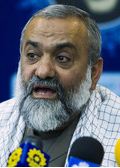
In a video broadcast to artist Basij members of Mashhad, Basij chief Mohammad-Reza Naghdi said, “Our full independence and unhindered advance towards progress and perfection is subject to removing the arrogant system (a reference to the US) and Zionism from our path.”

“When we want to advance in science and technology, we are confronted with repeated resolutions, the assassination of our prominent scientists, scientific sanctions and other obstacles. Our economic progress and the sale of our exports are threatened by the creation of parallel markets, and Zionist networks strengthen the destructive domestic movements,” Naghdi continued.

Coming to his point he declared, “Until the US exists, we shall not be quiet.” “We must raise public hate against the US for the complete destruction of the US. … We have no choice but to completely annihilate the US to attain our ideal society.”

In a related development, Iran’s ambassador to Lebanon Ghazanfar Roknabadi announced during a press conference, “We are in a defensive posture and if we are attacked we shall respond with a hard and painful response.” And referencing some of the comments by Israeli officials about a possible attack on Iran’s nuclear installations, while dismissing the seriousness of these threats said, “We have prepared ourselves and right now have 11,000 missiles ready to be fired at the US, Israel and their global interests.”

Prior to this on November 19 of last year ayatollah Khamenei had said, “Anyone who thinks about attacking the Islamic republic of Iran should prepare himself to receive hard slaps and steel punches.”

Following these remarks, senior military authorities of Iran announced a change in the defense strategy of the country and said that the “strategy of threat” was on the agenda and began threatening Western countries.

On the other side too, US and Israeli officials in recent weeks renewed their talk of a possible military attack on Iran and reiterated that “all options were on the table.”

Speaking at an AIPAC gathering last week, US president Barack Obama warned “I will not hesitate to use force when it is necessary to defend the United States and its interests.” The Israeli prime minister Netanyahu also told Jerusalem Post that an attack on Iran would not take place in “… a matter of days or weeks, but also not of years.”

The US Air Force chief General Norton Schwartz also said earlier this month that plans to attack Iran’s nuclear sites are in place, adding that various options had been presented to the US president. US defense secretary had also announced that the Pentagon was preparing for various military options to attack Iran’s nuclear installations should current diplomatic efforts and sanctions fail.

Source: roozonline

Human rights activist sentenced to five years and exile


Kuohyar Goudarzi, an Iranian journalist and human rights activist, has been sentenced to five years in jail and exile to Zabol.

The Human Rights Reporters Committee reports that the sentence was issued on March 7 at the Revolutionary court.

Goudarzi was arrested last July in Tehran and held in solitary confinement for more than two months. After three months, he was finally allowed to to contact his family by phone.

Goudarzi had also been arrested after the controversial presidential elections of 2009 that led to widespread street demonstrations. He was charged with propaganda activities against the regime for his collaboration with the Human Rights Reporters Committee and the collecting and publishing of anti-regime news and relaying the news to terrorist elements based outside of Iran. He was also charged for “giving interviews to foreign media and publishing his articles on the internet.”

Goudarzi is the winner of the 2010 John Aubuchon Press Freedom award.

His mother, Parvin Mokhtare, who championed his cause and spoke to the media about her son’s arrest, was arrested one day after her son’s arrest and is now being held in Kerman Prison.

Mokhtare was sentenced to 23 months in jail, which was turned into a suspended sentence in the appellate court.

She stood trial once more in Kerman last week, and her release was made conditional on the payment of a 5.4-million-toumans fine.

Source: radiozamaneh

Iranian hand seen in Gaza escalation

0


By Victor Kotsev

The Gaza Strip is a world full of violent paradoxes. The latest is the situation in which the Palestinian militant movement Hamas, which nominally controls the strip, found itself over the weekend sitting in the corner with its eyes down and praying for the lives of Israelis; all this when its former Iranian sugar daddy turned into a whip-cracking Dom whose surrogate, Islamic Jihad, battled it out with Israel.

Granted, there is creative emphasis added in the above interpretation, but the gist is on target. In fact, Islamic Jihad hasn’t been very successful so far in the confrontation; over the last couple of days, as mediation efforts progressed, it scrambled to avoid leaving the impression of utter defeat (which is tantamount to utter defeat these days). It fired so many Grad missiles at

Israel that had it not been for the Iron Dome missile defense, which shot down about 85% of the ones it targeted, Israeli tanks would probably be in the outskirts of Gaza City now.

As it is, on Monday evening the Egyptian go-betweens announced a ceasefire to take effect at 1am Tuesday. There is no certainty how long it will last, but most analysts expect a calm to set in by Wednesday or so. There are reportedly two main scenarios that could derail this and trigger off a wider Israeli operation: if Islamic Jihad or one of the other groups, in an act of desperation, fires a missile that can hit Tel Aviv, or if the Iron Domes fails to stop a barrage that kills Israeli civilians.

Barring these kinds of developments, US President Barack Obama can congratulate himself on an investment that proved its money’s worth (his administration gave Israel over US$200 million to procure the short-range missile defense system), and the Israeli military can congratulate itself on one of the most successful “surgical” operations it has ever conducted, with one of the lowest ratios of civilians to enemy combatants killed.

Based on what is known, 21 of the 25 Palestinians killed in the violence were combatants, some ranking members of Islamic Jihad and the Popular Resistance Committees, the two Palestinian militant organizations most heavily involved. Four civilians also died, including a 65-year old man, a 30-year old woman, and two teenage boys aged 12 and 15.

Over 80 Palestinians were reportedly wounded in the strikes, including dozens of civilians; the Israeli army claims that the militants’ use of human shields is to blame for non-combatant casualties. [1]

The low casualty rate among Israelis – no deaths so far – is even more striking, given that over 200 rockets were fired at Israeli population centers in four days, a quarter of them Grad Katyshas with extended ranges of about 40 kilometers. At least 56 rockets were intercepted by the Iron Dome system, whose radar can map where a rocket will fall and whose operators can selectively shoot down only those headed for densely populated areas. (The accuracy rate of the rockets is far from perfect.)

Three or four Israeli civilians were wounded (accounts vary), including one who is in a serious condition. A number of others suffered from shock and minor related injuries.

In a sense, the Iron Dome is proving to be a game changer. Here is how the Jerusalem Post’s defense analyst Yaakov Katz put it:

“Diplomatic maneuverability” are the two words that could be heard over and over again on Sunday within the IDF [Israel Defence Forces] in reference to the performance of the Iron Dome rocket defense system.

It is easy to understand why. Imagine if the 43 rockets that the Iron Dome intercepted on their way to Beersheba, Ashdod and Ashkelon had succeeded in hitting their targets.

Had this happened, the government would be facing unbelievable pressure from the public to order the IDF [Israeli Defense Force] to launch a ground offensive into Gaza to stop the rocket fire, as it was on the eve of Operation Cast Lead in late 2008. The Iron Dome is helping to prevent that from happening.

That did not happen – at least not so far in a bout of violence that looks like it is nearing its end – much to the relief of almost everybody involved, reportedly ranging from Israel to Hamas to the Egyptians and Americans. Hamas did not take any significant part in this violence, and even as it condemned “Israeli aggression” it did its best to calm things down. [3]

It is true that Israel started the violence with a targeted assassination, but it is hard to ignore several important circumstances: firstly, the top militant who was assassinated on Friday, Zuhir al-Qaisi, was so deeply involved in terrorism that the Egyptian intelligence had recently warned him to keep it down or else Israel would kill him. [4]

Whether or not he was the mastermind of the specific terror attack that Israel accuses him of planning – a cross-border raid from Egypt in August of last year which killed eight Israelis – it seems quite plausible that he was intimately involved in the destabilization of Sinai in the last year. (See Sinai clashes send loud message, Asia Times Online, Aug 24, 2011)

Given that the Egyptian-controlled peninsula became the last stretch of a long arms-smuggling route that started in Libya and ended in Gaza, numerous Israeli officials have warned over the past month that more violence was to be expected in and near the strip.

Secondly, al-Qaisi was not a member of Islamic Jihad, the organization that launched the majority of the rockets at Israel and that suffered most of the losses (the majority of those rocket crews on combat missions). He was the leader of the Popular Resistance Committees, another militant organization.

There is every indication that Hamas was the one being punished, as much as Israel was being provoked with the missile salvos. In the last couple of weeks, though really ever since the Syrian uprising against the regime of President Bashar al-Assad took off, Hamas’s relationship with its former patrons Iran and Syria have gone from bad to worse.

In late February, the organization moved its headquarters out of the Syrian capital Damascus, motivated by the fact that as an ideological offshoot of the Muslim Brotherhood movement, its primary allegiance rested with the Syrian opposition. Then over the last week, Hamas became embroiled in a controversy over whether it would strike back at Israel in the event of an Israeli attack on Iran’s nuclear program. [5]

The punishment, it seems, came swiftly: at a period when Hamas is in flux, changing bases and supply lines and still responsible for the wellbeing of Gaza’s 1.5 million inhabitants, Iran and Syria apparently unleashed the other proxies they had cultivated in the strip. In so doing, they capitalized on Hamas’s lack of interest and readiness to fight, and sought to either draw the movement into a war that was bound to damage it badly or to weaken it domestically by portraying it as a collaborator with the Israelis.

It must be noted that in parallel with the turmoil in Egypt and Libya in the last year, Islamic Jihad has grown to be quite a formidable organization. The Arab-Israeli journalist Khaled Abu Toameh reported on this in an article published by the Jerusalem Post last October:

With the help of Iran and Syria, Islamic Jihad has become a major player in the Palestinian arena. The organization’s leaders now visit Cairo and other Arab capitals, where they are received as VIPs. …

The organization is beginning to emerge as a major challenge to the Hamas regime, especially given the fact that dozens of disgruntled Hamas members are reported to have defected to Islamic Jihad. Former Fatah security officers, some of whom were trained by the US and EU, are also believed to have joined Islamic Jihad in the past few years. [6]

Israel itself seems quite weary of an escalation, to the point where the measured response to the “unprecedented” rocket salvos has raised a lot of eyebrows among the right-wing allies of Israeli Prime Minister Benjamin Netanyahu. So far, however, the lack of Israeli casualties and the surprising success rate of the surgical strikes have deprived the hawks of important ammunition.

As of early Tuesday morning, reports by the Israeli press suggest that the ceasefire was breached by new rocket strikes, but no casualties are being reported. Given Islamic Jihad’s humiliation, a few isolated rockets, perhaps aimed loosely or at military facilities, are to be expected in the hours after the ceasefire comes into effect; a symbolic Israeli strike, perhaps of an empty militant base, can be expected in return.

What we need to look out for is anything that is more serious than that. We can only hope that the luck which has prevented greater civilian casualties on either side does not run out, and that Israel and Hamas do not end up drawn into a bloody war that neither seems to want. In an ironic twist, the two finally seem to find themselves sharing a similar agenda.


Source: atimes

End of Election: Beginning of Revolutionary Guard’s Repression


Hossein Alizadeh


Iran Briefing : The result of the 9th parliamentary election, which was held on March 2, 2012, has once again become problematic.  Taking into account the country’s dire economic situation and increasing pressure resulting from the sanctions, high turnout in the parliamentary election, 64% as claimed by the regime, can neither be perceived by common sense nor is it compatible with statistics.

Foreign reporters had been complaining about the restrictions imposed by the regime on them to cover the election, as they could have only access to a few selected polling stations. If the election was as free as the regime claims, and if the turnout is the same as the regime has announced, why were the foreign media banned to freely cover the election as they could do during the 2009 presidential election.

Interestingly, Eight Sources of Emulation refrained from taking part in the election, and so did their followers naturally. The present article does not concern itself with the election and its result, although it is of the opinion that the parliamentary election was replete with massive irregularities. What concerns us here is that overwhelming majority of dissenters in the Iranian society are firm in their opposition to the Islamic Republic establishment, even if the election was free and fair as claimed by the regime.

At a time when the regime appears to be willing to impose a sort of forceful peace on the society, how are the oppositions going to confront the regime? One has to keep in mind the fact that by announcing the number of participants in the parliamentary election at 64%, the regime wanted to show that it is not going to make any compromise with the opposition.

Bloody Year, Iron Fist

To understand the extent of the Revolutionary Guard’s fear about the result of the election, one can refer to the comment made a year before the election by one of commanders of the Revolutionary Guard.

Brigadier-General Abnoush, the Commander of the Qazvin-based division of the Revolutionary Guard, said on March 4, 2011, that, “Should the result of the election not be in line with our values, 2012 is going to be a very dangerous and even bloody year… because we are going to be left with no option but to fight with each other.”

Although his remark was later denied by the Revolutionary Guard, fear about the result of the election could not be concealed. On August 31, 2011, Iran’s Supreme Leader, Ayatollah Ali Khamenei, described the election as a challenging issue and said that, “By its nature, an election creates a sort of challenge for the country. However, we have to be vigilant that the election is not going to turn into a challenge for the country’s security and stability.”

What adds to the fear of the Islamic Republic’s ruling class is that they are aware of the fact that the US president, Barak Obama, will not be hesitant to ramp up pressure on the Islamic Republic in order to show to his Republican contenders that he has led a very successful foreign policy.

By imposing sanctions on Iran’s Central Bank and oil sector, Obama has in fact targeted vital sources of Iran’s economy.

In such circumstances, any sort of street demonstration, like the one which followed the 2009 disputed presidential election, will not be tolerated by the system and will be highly likely faced with the Revolutionary Guard’s iron fist.

To understand the Revolutionary Guard’s strategy, i.e., iron fist, one has to look at the situation in Syria where the ruling class led by Bashar Al-Assad has been unable to curb snowballing popular uprising which has been going on for last 12 months. Taking into consideration the deep-seated disenchantment among the Iranians, the Islamic Republic’s ruling class is worried about any sign of public protest. The Revolutionary Guard is likely to use its iron fist strategy to curb public protests at their early stage. That is what Brigadier General Abnoush has warned of, and that is what the Supreme Leader has called a challenge to the country’s security.


Cutting off the Dragon’s Head

Since the Iranian society is highly volatile for outbursts of public anger, the Revolutionary Guard is prepared to crush the opposition leaders who are deemed to have the ability to provoke the people. In other words, it is prepared to separate the head, opposition leaders, from the body, society.

The Revolutionary Guard is likely to impose more restrictions on Rafsanjani, Khatami and some of the Sources of Emulation like Ayatollah Dastgheib who are feared to be capable of provoking the people against the system. That is why rumor over Rafsanjani’s assassination was spread in the society.  On the election day when Rafsanjani made an oblique remark about the election, the state TV showed some people chanting death slogan against Rafsanjani.  Khatami and Dastgheib are very likely to have similar fate, so that the head is separated from body.


Possibility of Overseas Assassinations

It must not come as a surprise if the Revolutionary Guard uses its repressive apparatus abroad, should it be convinced that the root of provocation of the people lies somewhere outside the country.

Recent remarks made by the intelligence minister, in which he had bragged about the regime’s ability to maneuver outside the country, coupled with the recent wave of assassinations in Georgia, India and Thailand, and assassination plots against Saudi Arabia’s ambassador to Washington, which have been attributed to the Revolutionary Guard, show that the Revolutionary Guard will not shy away from carrying out assassinations outside the country.

Repressing Civilians

In the case of popular uprisings, like the ones that happened in Tunisia, Yemen, Syria and Egypt, the Iranian regime would likely to imitate the Bahraini model of repression where the regime has been successfully able to quell and curb the popular uprising in very short span of time.

A show of force by the regime on February 14, 2012, the anniversary of the house arrest of Messrs. Mousavi and Karoubi, demonstrates the fact that the regime has achieved the ability to stifle any sort of opposition.

There are difficult days ahead. In his letter to Khamenei on February 14, 2102, Mohammad Nourizad, opposition activist and film maker, called on Iran’s ayatollahs to set themselves on fire. He said, “I strongly believe that self-immolation of Iran’s ayatollahs is the only way to prevent these bandits, Revolutionary Guard’s members, from training their guns on their own people. If only eight ayatollahs, not even eighty of them, set themselves on fire, they will surely help prevent eighty thousand people from setting themselves on fire.”


The Guards Entry into Political Affairs

0


Bahram Rafiei

Just a few days after the spokesperson of Iran’s Revolutionary Guards (IRGC) announced that the force was “not defined by the narrow and limited political circles,” ayatollah Khamenei’s deputy representative in the force gave a different picture by saying, “The Guards support the principlists,” die hard hardliner ideologues who claim to support the ideals of the 1979 revolution.

Speaking during the fourth seasonal seminar of the representatives of Iran’s supreme leader in the ground forces of the IRGC, cleric Abdollah Haji Sadeghi stressed the force’s participation in political affairs and said, “The IRGC will definitely take a position in the political posturing against the revolution and this is one of its inherent characteristics.”

Sadeghi further claimed that the force was created to “deepen and export the values of the revolution,” and added that “in the confrontation between the principlists (hardline ideologues) and liberal reformists we support the principlists and there is nobody more principlist than the IRGC.”

He described principlism to be a belief in “religious content and in velayate faghih in all spheres,” and concluded that the Guards were the leaders in these.

These remarks come despite earlier statements by the spokesperson of the IRGC who had rejected the notion that the force had to support a political faction after cleric Ali Saeedi had said before the March 2 elections that “the Majlis had to be in the hands of the principlists.”

On March 1Guards brigadier general Ramezan Sharif had stressed that “the IRGC had never defined itself in the narrow and limited circle of factional politics and had always viewed itself as the defender and guard of the Islamic revolution ideals and values.” He further clarified this statement by saying that it would be diminishing to limit the Guards strictly to factional politics.

To make matters worse, the public relations office of the IRGC issued a statement saying that the views of both of these individuals constituted the official position of the force. Prior to this statement, the very same public relations office had said that the official positions of the force would be announced only by the supreme commander, the representatives of ayatollah Khamenei and the IRGC public relations office.

In recent years criticism over the interference of military forces in the political affairs and political parties of the country have been on the rise even though officials of the armed forces have been denying it. Still, these officials have also supported the principlists and have even intervened to defend them.

In another related event, on September 11, 2011, the then head of the IRGC political office Yadollah Javani wrote an article in Sobh Azadegan, the official magazine of the force which operates under the supervision of ayatollah Khamenei’s representative there as the campaign for the March 2 Majlis elections had begun, in which he stressed on supporting the principlists.

Javani claimed in the article that the IRGC did not belong to any political group and had no sympathy for any group either, but also added, “The IRGC supports the discourse on principlist ideology. The principlist views or the very discourse of the Islamic revolution are clear and known to the IRGC.”

Soon after assuming the post of IRGC commander issued by ayatollah Khamenei in 2007 Mohammad Ali Jaafari expressly announced his support and that of the forces under command for the principlists.

Later that year, Jaafari also told a group of Basij students that it was necessary to defend the principlist movement for the continuation of the revolution, adding that it was a divine duty and inevitable for revolutionary forces (such as the IRGC) to do so.”

He openly expressed joy that the principlist movement or force had returned to the revolution after a 25 year lapse and dominated the two of the three government branches (executive and judiciary).

These remarks brought forth some criticism and Jaafari subsequently toned down his position and even claimed that his remarks were not to support any political or faction and added that the IRGC only supported the values and thoughts of the principlists.

A large group of current regime critics who at one time played key roles in the birth of the Islamic republic have in recent years criticized the IRGC for ignoring the directives of the founder of the regime ayatollah Khamenei and accused the armed forces of interfering in political affairs of the country and supporting a specific faction, thus deviating from the ideals of the revolution and the Islamic regime.

Ayatollah Khomeini had expressly banned the armed forces from engaging in political affairs. His political will also clearly and expressly states this. The constitution of the Islamic republic also has clauses that ban the members of the armed forces, the police, the Guards and the Basij from entering any political or other groups and states that they must stay away from “political games.”

But the current leader ayatollah Khamenei has in various remarks assigned political tasks and missions to the armed forces, in addition to those in the security and economic realms.

In fact, Jaafari’s earlier comments that stressed the political involvement of the Guards in addition to their other activities specifically quotes ayatollah Khamenei. “Just as the supreme leader does not accept any restrictions for the IRGC in carrying out its mission in various realms to defend the Islamic revolution, the force must be prepared to defend the Islamic revolution and its accomplishments in all spheres,” he said. He said that the IRGC was the “powerful arm of the leader,” and added that the force was also a non-armed arm of the leader.

Source: roozonline

UN Rights Expert Finds Pattern Of Iran Abuses


AUN human rights expert tasked with investigating the situation in Iran says he has collected “allegations that produce a striking pattern” of human rights abuses.

Ahmed Shaheed told the UN Human Rights Council in Geneva that his repeated requests to visit Iran have so far been denied.

Among the violations he cited were the arbitrary arrest of journalists, harsh sentences for human rights lawyers, and cruel forms of punishment.

He said there were 200 executions in Iraq during the first 9 months of 2011, but 670 by the end of the year.

The 47-nation council appointed Shaheed last year against strong objections from nonmember Iran and its allies on the council.

Several European members of the council and the United States welcomed Shaheed’s report on March 12.

But Cuba and observer countries such as Sri Lanka, Syria, and Belarus criticized the report and called for Shaheed’s post to be abolished.


Source: rferl

Reporters Without Borders names Iran as ‘2012 enemy of Internet’


Media watchdog Reporters Without Borders has once again named Iran in its “2012 list of the Enemies of the Internet.” The list contains states with the most restrictive approaches towards Internet freedom.

The report’s publication coincides with World Day Against Cyber-Censorship.

“Iran and China, in particular, reinforced their technical capacity in 2011 and China stepped up pressure on privately-owned Internet companies in order to secure their collaboration,” the Paris-based organisation noted.

“Iran has announced the launch of a national Internet. Iran and Vietnam have both launched a new wave of arrests, while the bloody crackdown on protests in Syria is hitting netizens hard and is enabling the regime to perfect its mastery of online surveillance with Iran’s help,” RWB said.

According to RWB, Iran has the largest number of netizens in prison after China and Vietnam. “Iranian authorities … favour extracting confessions from dissidents then broadcasting them on television.”

The group said that regimes such as Iran had also invested a great deal in attempts to neutralise various means of evading censorship such as encryption, anonymisation and circumvention. “Attempts to ‘phish’ for social network usernames and passwords have been reported in Syria and Iran, as well as the use of false security certificates … Iran is now capable of blocking https and the ports used by Virtual Private Networks,” the report argued.

The RWB document says that the Iranian Cyber Army has played a “major role” in the regime’s efforts to control cyber space. It goes on to add that the Iranian authorities “censor Internet access so effectively that they restrict their populations to local intranets that bear no resemblance to the World Wide Web.”

Burma, China, Cuba, North Korea, Saudi Arabia, Syria, Turkmenistan, Uzbekistan and Vietnam, were also named as countries with restrictive attitudes towards Internet freedom.

While Internet freedom showed little sign of improvement in countries such as Iran, RWB argued that there was “one light of hope” when considering the situation in Burma, where “the military have permitted the release of journalists and bloggers and the unblocking of news websites.”

In December 2011, a report by the Committee to Protect Journalists, a New York based organisation that promotes press freedom and journalist rights, named Iran as the world’s worst jailer of journalists. Eritrea, China, Burma, Vietnam, Syria, and Turkey trailed behind as the world’s worst imprisoners of journalists.

Mousavi daughter involved in car collision ‘staged’ by security services


The campaign of harassments meted out to the family of imprisoned opposition leader Mir Hossein Mousavi entered a new stage on Sunday, after one of his daughters found herself in a dangerous car crash, reportedly caused by Iran’s security forces.

According to Kaleme, a website affiliated with Mousavi, the Green Movement leader’s youngest daughter was recently involved in a “serious” car crash, reportedly staged by the country’s security apparatus with the intent to intimidate the opposition figure’s family.

Mousavi, his wife Zahra Rahnavard and fellow Green Movement leader Mahdi Karroubi were placed under house arrest in February 2011 after calling for protests in solidarity with the Arab Spring. Human rights groups say that their ongoing house arrest is against international conventions as well as Iran’s own constitution.

Since their house arrest, Mousavi’s three daughters—Zahra, Kokab and Narges—and son-in-laws have been subject to threats and harassment from the Iranian regime. The country’s security forces recentlythreatened the daughters with imprisonment and, one of them, who had been studying art at Azzahra University, has already been barred from attending school without receiving any form of written explanation. Azzahra is Iran’s sole women-only university.  Zahra Rahnavard was a professor and chancellor there for a number of years.

Kaleme reports that on Sunday, Mousavi’s youngest daughter was driving on a motorway when a car with three occupants began to tailgate her car “persistently” until the chase came to an abrupt end with a “very severe” rear-end collision. While the young Mousavi survived the crash uninjured, her vehicle was “severely damaged.”

The website went on to add, “Two of the men quickly fled the scene … The driver of the [Kia] Pride insisted that he would directly pay compensation for the damages inflicted to the car … He declined to show any identification or insurance documents and provided two telephone numbers, both of which were out of service.”

Kaleme says that the man then presented himself as an employee of Iran’s notorious Evin prison and stressed that “at Evin, everyone knows me,” without providing any further information as to what his precise role at the facility is. The opposition site hinted that the country’s security services had been behind the collision. It promised its readers it would provide them with images showing the impact of the crash and the substantial damage.

Two years ago, Mousavi and Rahnavard were injured in another car crash. Rahnavard was subsequently hospitalised. That incident was also staged by Iran’s security agencies, Kaleme reports.

Since the start of Mousavi’s captivity in February 2011, his daughters have effectively been his only channel of communication with the outside world, sometimes through visitations and other times via the even shorter phone calls he is occasionally allowed.

During their most recent and second-ever meeting with their daughters, Mousavi and Rahnavard are said to have been in high spirits. The former Prime Minister reportedly told his daughters that he and his wife had not voted in the 2 March parliamentary elections, which were boycotted by the country’s major opposition groups.

Iran slams UN human rights report

0


Iranian authorities have denounced the recent report of the United Nation’s special human rights rapporteur for Iran.

Justice Minister Morteza Bakhtiyari described Ahmad Shaheed’s report as an “unforgivable injustice” and, in an interview with the Fars News Agency, accused the UN rapporteur on human rights of being dishonest.

Ahmad Shaheed released his latest report on the situation of human rights in Iran on March 6, in time for the 19th session of the UN Human Rights Council in Geneva,

Shaheed claimed his report has “catalogued allegations that produce a striking pattern of violations of fundamental human rights.” In the report, he calls for further investigation into the testimony he has collected.

The 36-page report documents the cases of numerous victims of human rights violation, as well as accounts of violations of the rights of women, labour unions, human rights defenders and prisoners of conscience, journalists, students, religious and ethnic minorities, and the lesbian, gay, bisexual and transgender community.

Allaeddin Boroujerdi, the head of Iran’s National Security Commission and Foreign Policy in the Islamic Republic Parliament, accused Shaheed of being a U.S. agent, saying that: “instead of contacting Iranian officials, he just contacts anti-Revolutionary elements.” Boroujerdi said the report is prepared in coordination with U.S. policies against Iran.

In order to prepare his report, Shaheed met with various NGOs and interviewed several Iranians living outside Iran. His methodology also included visits with various diplomats and inter-governmental organizations. Iranian authorities denied Shaheed’s request to travel to Iran for further research.

Source: radiozamaneh

Iran’s satellite photos indicate ‘cleanup’ of suspect site

0


Claims by International Atomic Energy Agency experts could add to international pressure on Tehran over its nuclear programme

Satellite images of Iran appear to indicate attempts to clean up radioactive traces possibly left by tests of a nuclear-weapon trigger, diplomats said on Wednesday.

The claims by International Atomic Energy Agency experts could add to international pressure on Iran over its nuclear programme, which Tehran insists is for peaceful purposes.

While the US and the EU are backing sanctions, Israel has warned that it may resort to a pre-emptive strike against Iran’s nuclear facilities to prevent it from obtaining atomic weapons.

Two of the diplomats said the images suggested that crews at the Parchin military site may be trying to erase evidence of tests of a small experimental neutron device used to set off a nuclear explosion.

A third diplomat could not confirm that but said any attempt to trigger a so-called neutron initiator could only be in the context of trying to develop nuclear arms.

The diplomats said they suspect attempts at sanitisation because some of the vehicles at the scene appeared to be haulage trucks and other equipment suited to carting off potentially contaminated soil from the site.

The images, provided by member countries to the IAEA, the UN’s nuclear watchdog, are recent and constantly updated, one of the diplomats said. The diplomats all requested anonymity because they were not authorized to discuss the information on the record.

The IAEA has already identified Parchin as the location of suspectednuclear weapons-related testing. In a November report, it said it appeared to be the site of experiments with conventional high explosives meant to initiate a nuclear chain reaction.

It did not mention a neutron initiator as part of those tests, but in a separate section cited an unnamed member nation as saying Iran may have experimented with a neutron initiator, without going into detail or naming a location for such work.

If Iran did try to trigger a neutron initiator, it would harden international suspicions by adding a nuclear component to a suspected string of experiments linked to weapons development that generally have not included radioactive material.

Iran has previously attempted to clean up sites considered suspicious. It razed the Lavizan Shian complex in the north, before allowing IAEA inspectors to visit the sitethat Tehran said had been demolished to make way for a park. Inspectors who subsequently came to the site five years ago found traces of uranium enriched to or near the level used in making the core of nuclear warheads.

Samples taken from Kalay-e also showed traces of enriched uranium, though at levels substantially below warhead grade.

Iran vehemently denies allegations that it conducted any research and development into atomic weapons and says the totality of its nuclear activities are meant purely to generate power or for research.

Ali Asghar Soltanieh, Iran’s chief delegate to the IAEA, said he would not discuss any nuclear issues until after he delivered his statement to the agency’s 35-nation board meeting on Thursday. IAEA officials also said they could not comment.

Attention most recently focused on Parchin, when senior IAEA officials first spoke of unexplained activities at the site without saying what they could be.

Diplomats who who had seen spy satellite imagery said the trucks and other equipment at the site almost certainly showed attempts to clean it of radioactive contamination.

They said radioactive traces could also be left by material other than a neutron initiator, such as uranium metal which can be used as a substitute for testing purposes.

IAEA teams twice in recent weeks were denied permission to visit Parchin. Tehran said on Monday that such a visit would be granted, but that a comprehensive agreement outlining conditions of such an inspection must first be agreed.

The UN security council wants Iran to end uranium enrichment – which can make both nuclear fuel and fissile warhead material..

Source: guardian