Home Blog Page 491

Regime Exposes its Fear of People Again

0


Arash Bahmani & Keyvan Bozorgmehr

In response to calls by political groups to gather in streets of Iranian cities and towns on February 14 and hold silent marches, and amid the intense presence of security forces to confront opposition demonstrations, Iranian expatriates also participated in gatherings in solidarity with the Green Movement and issued statements calling for the release of Mehdi Karoubi, Mir-Hossein Mousavi and Zahra Rahnavard.

Tehran Occupied by Government Agents

The major streets of Tehran were heavily populated with the police and security agents because of the calls by green movement activists to hold protest demonstrations. Security forces began to position themselves on Azadi and Engelab avenues – the main thoroughfares in the capital that are traditionally used by protestors and government marchers – around noon but were soon joined by plain-clothes agents, until about 9pm after which they began to thin out.

Other spots in the capital that witnessed heavy police presence were Azadi Circle – usually the end point of all major demonstrations in Iran – Enghelab Square, Vali Asr Intersection, Kalej Intersection and Ferdowsi Circle. There were about 400 to 500 government forces in each of these spots while Azadi Circle clearly had the largest security presence greater than these estimates.

In some spots such as Ferdowsi Circle Metro station, Vai Asr Intersection Metro station, Tohid Metro Station and Azadi Street Metro station agents had positioned cameras enabling them to video record people as they walked in and out of the station. At about 5PM, cars began to honk, and as their numbers grew government agents moved to the streets to video passing by cars.

Police presence was not confined to the main streets of Tehran as smaller streets that led to the main arteries were also populated with police and security forces. Most of these forces remained in parked buses and mini-buses which were parked on side streets, enabling them to rapidly congregate in specific areas where protestors may have gathered. At the Enghelab Street Bus Terminal too there were several parked buses loaded with security forces. The courtyards of most government agencies on the main Ferdowsi Circle to Azadi Circle stretch were also filled with security agents.

In addition to the police and other security forces, plain-clothes agents were also present at the same scenes and were easily identifiable because of their proximity and behavior even though they did not wear any uniform.

Two groups of 50 motorcycles each and driven by security agents also plied the main Ferdowsi to Azadi stretch in a routine and highly visible manner. These red bikes were driven by identically dressed and helmeted riders. In addition to these riders, there were also plain-clothes riders who roamed the main Ferdowsi-Azadi street in groups of 10 to 15. There was also a third group of security motorbike rider groups who continuously dodged between cars and the traffic in a highly visible and noisy fashion and swayed in and out of bus-designated street lanes.

But perhaps the most visible security agents were those plain-clothes agents who mingled on the sidewalks. Their behavior and even appearance clearly identified them and people who recognized these agents openly passed that information to others walking around them. There were also instances when agents were in hot pursuit of somebody in the streets as the public witnessed a cat and mouse run which also identified the plain-clothes agents. Many agents wore masks to hide their identity, revealing their affiliations and status.

Until 4PM, the flow of people on the main streets appeared normal. After that however, crowds grew larger. For example, the crowds of people on the stretch between Kalej Intersection and Engelab Circle were estimated to be about three to four times larger than normal. One could even recognize some people who had been seen minutes earlier in other parts of the city. The stretch between Engelab Circle and Daneshjoo Park became so crowded and security-controlled after 4PM that it was almost impossible to remain there as agents ordered people to move on and not remain stationary in one spot. People did not remain on the sidewalks and many ventured into the bus lanes from where they could watch events easier and also maneuver if necessary.

Vehicle traffic became denser gradually so that by about 5PM it was moving very slowly and buses would drop off their passengers wherever they could, between bus stops.

Sometime after 5PM news came that clashes had taken place in some spots of the city such as Fatemi Circle and Vanak Circle, and security agents used tear gas to disperse protestors. And as the size of crowds grew, it was almost impossible to walk through some stretches such as street between Enghelab Circle and Vali Asr Circle. At this point, security agents were reported to have formed two lanes on either side of the sidewalk, terrorizing people who walked on the pedestrian sidewalk along the street. In some spots this led to clashes and fights between the agents and the public.

Throughout the march, people remained silent and no chants or slogans were heard. Even their normal communication was limited as they tried to avoid the attention of the security forces around them.

Agents detained many people as darkness approached and took the detainees to spots designated for temporary detention until the end of the protest. One highly visible temporary detention spot was the Jamalzadeh Street Intersection where about 500 detainees could be seen at one time. When anyone was detained by security agents, they would be walked to parked police vans and then transferred to the pre-designated temporary detention spots.

The only time the public demonstrated any loud verbal protest was when someone was taken to a parked police vans and the public would respond with a loud “boo.” In one instance when some people were brought to the Azadi Street Parking, people booed the agents and nearby cars began honking their cars.

As the evening progressed, vehicular traffic became so dense that even security driven motorcycles could not move around on the streets. This led them to park their bikes at some lesser crowded spots and remain stationary but ready to be summoned to a particular trouble spot.

The protestors had come to the streets on calls by green movement activists and political groups such as the Mojahedin Enghelab Eslami (The Mojahedin of the Islamic Revolution) and the Shoraye Hamahangi Rahe Sabz (The Coordinating Council for the Green Path). Amnesty International had earlier called on the Iranian authorities to allow people to hold demonstration on this day. Government officials however did not issue a permit for this demonstration, which was not to the surprise of anyone. Also, text messaging services were temporarily unavailable for a few hours during the evening.

Government officials had made varying remarks about the day earlier. Attorney general Gholam-Hossein Ejei for example said a day earlier that public gatherings were related to their seasonal shopping rush. Last year, as similar demonstrators poured into the streets of cities, government and regime officials declared them to be related to the annual shopping rush that is normal during the Persian new year which falls on March 21.

Form Revolutionary Guards commander and current secretary of the State Expediency Council also remarked that people were smarter than to respond to calls by a bunch of “hypocrites” to demonstrate against the regime on the streets. Hypocrites is a term Iranian officials normally use for the Mojahedin Khalq Organization whose leaders remain outside the country.

Bulletin News website affiliated to security forces editorialized on the peaceful marches by saying that its purposes were to “re-establish the leadership position of Mousavi and Karoubi, expand the domestic protest front, boycott upcoming elections, neutralize the February 11 official celebrations marking the anniversary of the 1979 revolution, and prompting a security situation for the country.”

Principlist media mostly kept silent on the demonstrations and the calls of protest activists and leaders. The only exception till the writing of this report was the Bashgahe Khabarnegaran Javan website (Club of Young Journalists) which commented on a BBC report about the demonstrations in the country but denounced it in harsh language.

Source: roozonline

Iranian Activists, Journalists Receive Threatening E-mails

0


A number of Iranian activists and journalists based inside and outside the country have told RFE/RL’s Radio Farda they have been threatened in anonymous e-mails.

The e-mails, which have been sent since February 13, warned activists of their “illegal activities” and said they will be dealt with according to Iranian Islamic laws. The e-mails claim that a list has been created including names and e-mail addresses of individualsaccused of working for the goals of “foreigners“ and “seditionists,” which are terms used by Iranian officials to refer to the members of the opposition Green Movement.

The e-mails were sent ahead of the planned February 14 “silent protest” by the opposition. Opposition sources claim that were some ” target=”_blank”>scattered protests in the Iranian capital on February 14. Some citizens who took to the streets of Tehran were reportedly arrested. The reports cannot be independently confirmed.  Several citizens in Tehran told Persian Letters that they witnessed a heavy presence of security forces in central Tehran.

Iran appears to have stepped up its use of the Internet to pressure activists and scrutinize the activities of its citizens. In recent months, several activists have been reportedly warned and sentenced to prison over their postings on Facebook. In the past, the Iranian authorities have used text messages to warn people not to take to the streets.

Iran’s cyber police unit said last month it had “destroyed” a Facebook page that organized an online beauty competition, and arrested its four administrators.

Earlier this month, a reporter from the BBC’s Persian Service was questioned via the Internet by intelligence officials who had arrested her sister in Tehran.

Last December, Iran’s Intelligence Minister Heydar Moslehi publicly admitted hacking into the e-mail of opposition members.

Moslehi was quoted by Iranian news agencies as saying that e-mails were the most important tool of communication between opposition members during the 2009 postelection protests and that the Intelligence Ministry could break into them and defeat “the enemy.”


Source: insideofiran

Syrian regime used poisonous gas under Iranian, Russian supervision: dissident officer

0


A Syrian dissident military officer, Capt. Abdul Salam Ahmed Abdul Razek, said the Syrian regime is using internationally prohibited poisonous gas against protestors under the supervision of both Iran and Russia.

“The Syrian army used nerve gas to facilitate the invasion of Homs and was planning to do the same in Jebel al-Zawia and al-Zabadani,” Abdul Razek told Al Arabiya.

According to Abdul Razek, who worked in the Syrian army’s Chemical Warfare Division, the army has in its possession large quantities of a poisonous asphyxiating substance that is banned internationally.

Mass extermination

“A little amount of this is enough to carry out a mass extermination,” he said.

The gases, Abdul Razek added, are used under the supervision of both Russia and Iran.

“Russia is the source of those gases and Iran provides advice on how, when, and where they are to be used,” he said.

Abdul Razek explained that prohibited gases were made available only for the Fourth Battalion of the Syrian army and the Presidential Guard.

The use of those gases and other brutal measures taken against civilians, Abdul Razek said, demonstrate that the Syrian army has one purpose in mind: killing the Syrian people.

“For example, what happened in Rif Dimashq was genocide.”

This, he added, is what drives many officers to defect.

“Now security forces are very alert and they watch closely anyone suspected of not being loyal to the regime,” Abdul Razek said. “Some officers have not been given one day off for the past few months for fear they would defect.”

Other officers, he said, were interrogated just for watching satellite channels that cover the ongoing protests in Syria, such as Al Arabiya.

Abdul Razek said that his plight has been made easier because of the help offered to him by the Free Syrian Army.

“They transferred me safely from Damascus to the Syrian borders.”


Source: insideofiran

Genocide Against Kurdish Population in Kurdistan


Iran Briefing Exclusive: The Convention on the Prevention and Punishment of the Crime of Genocide was adopted by the United Nations General Assembly on December 9, 1948, in the wake of the massacres that took place during the first and second World Wars. 140 countries are currently signatory to the convention and are legally obliged to meet its terms.

In spite of this convention, the Kurdish people have been regularly subject to massacre by the governments ruling the Kurdish dominated areas (Iran, Iraq, Turkey and Syria).

Kurdistan (Iran)

Following unsuccessful rounds of negotiation between the Islamic Republic officials and Kurdish oppositions over the indispensable rights of the Kurdish people, a new wave of massacres against the Kurdish people was launched by the Islamic Republic after the victory of the Islamic Republic in 1979. Innocent civilians were the main victims of raids carried out by the Basij militia and the Quds branch of the Revolutionary Guard. The genocidal policy taken by the Islamic Republic against the Kurdish people goes against all the conventions on the political and civil rights which have been signed and ratified by the Islamic Republic.

The following are such conventions to which Iran is a signatory:

– The Convention on the Civil and Political Rights signed in 1975

– The Convention on Economic, Social and Cultural Rights

– The Treaty of Prevention of Brain Drain[AD1]  signed in August 1968

– The Convention on the Rights of the Child signed in July 1994

Massacre in East Kurdistan

On September 2, 1979, the Islamic Republic’s army brought heavy artilleries and tanks into Qarna village and massacred as many as 68 people, including women and children, according to the Kurdish sources.

On November 4, 1980, the Revolutionary Guard, under the commandership of Maboudi raided the villages of Inderqash and Yousfekenad, near the city of Mahabad, and killed as many as 35 civilians.

On August 28, 1980, Qelatan village, located on the outskirt of the city of Naghadeh,  came under attack by the Revolutionary Guard and as many as 13 people were killed.

On November 8, 1980, four days after the massacre in Inderqash and Yousfekenad, the Revolutionary Guard’s troops, led by Maboudi and Molla Hasan,  attacked Sofian village, near the city of Ashnavieh, and killed as many as 12 people and wounded 20 others. Seven of the victims were over fifty years old.

Nine people were killed in Baizava village, near the city of Naghadeh, on November 9, 1981.

18 employees of Sar-o-Qamish, a brick-making plant, were killed on September 14, 1981.

18 people were killed in Gharagol village, near the city of Mahabad, on September 2, 1982. Some of the victims were over 70 years old.

Nine people were killed in a massacre carried out in Suzi village, near the city of Mahabad.

Over 40 people were slayed in Dilanche-Rokh, Helabi, Koikan, Rize-Shakakan and Younselia, near the city of Naghadeh.

An unknown number of people was killed in Dimeh-Sour, Jafar-Ava, and Merejan-Ava, near the city of Mahabad, on March 16, 1983. Only nine victims have been identified so far.

13 people were killed in Hala-Ghush and Gijeh, near the city of Oroumieh, on March 23, 1983.

21 people were killed In Cheghol-Mostafa, Khalifeh-Lina and Gourkhaneh, on March 25, 1983.

Six people were killed in Jabril-Ava, Goundeh-Vileh and Dou-Ava, near the city of Oshnavieh, on September 14, 1983.

It is necessary to mention that the names and personal information of all the victims of the mentioned examples are recorded. The aforementioned incidents show only a tiny part of the Islamic Republic’s crimes against the Kurdish people. There are also other examples of massacres launched by the Islamic Republic against the Kurdish people.

Politically Motivated Execution of  Kurdish People

According to Kurdocide-Chak, a center dealing with the Kurdish affairs, more than 832 people were  executed by the Islamic Republic regime between 1979 to 1991 in areas dominated by people of Kurdish background. Of the victims, 399 were members of the Democratic Party of Iranian Kurdistan, 209 were reported to be member of Komole Party, and the rest had no political activity.

Mass Executions of Political Prisoner

11 people were executed by firing squad in Dizel-Ava prison in the city of Kermanshah on August 19, 1979.

Seven people were killed by a second firing squad on August 20, 1979.

59 people from the city of Mahabad were killed by firing squad  in the city of Tabriz on June 2, 1984.

20 people were killed in the city of Saghghez  by firing squad on August 27, 1979.

22 people were killed on April 22, 1979.

11 people were killed in the city of Saneh on August 26, 1979.

52 people were executed in 1980.

163 people were executed in Mahabad, Saneh, Kamyaran, Baneh, Divandareh and other cities on 1981.

160 people were executed in 1982.

44 people were executed in 1983.

37 people were executed in 1984.

20 people were executed between 1985 to 1986.

59 people were executed between 1988 to 1989.

Eight people were executed in 1990.

25 people were executed in 1991.

Four people were executed between 1994 to 1995.

Two people were executed between 2002 to 2003.

Six people were executed in the city of Saghghez in 2004.

Hasan Hekmat Dami, member of PJAK, Free Life Party of Kurdistan, was executed in the city of Khoi on  December 20, 2007.

Farhad  Tarem was executed in Oroumieh Prison on January 26, 2009.

Ehsan Fatahian was executed in the central prison of the city of Saneh on November 11, 2009.

Fasih Yasmini was executed in the city of Khoi on January 6, 2010.

Ali Heidarian , Farzad Kamangir, a teacher, Farhad Vakili and Shirin Alam Holi were executed in Tehran on May 9, 2010.

Hossein Khazari was executed in the central prison of the city of Oroumieh on January 15, 2011.

Below are the names of  13 political prisoners with Kurdish background who are sentenced to death:

Zeinab Jalalian, Shirko Moarefi, Anvar Rostami, Habibollah Latifi, Habibollah Golpari-Pour, Rashid Akhkandi, Mostafa Salimi, Sayyed Jamal Hosseini, Aziz Mohammd Zadeh, Ablaleh Sarvarian, Zaniar Moradi and Loghman Moradi.

The Islamic Republic has been, on various occasions, condemned by the international bodies for gross violations of human rights.

According the Amnesty International’s 2010 report , with a population of over 70 million,  Iran maintains one of the highest rates of execution following China. The report says that 252 people were executed in 2010. According to unofficial sources, the number of those who were executed in 2010 exceeds 300.

In its 2011 report on Iran , Amnesty International severely condemns the Islamic Republic for human rights violations.

According a 70-page report prepared by the US Department of State, 312 people were executed in 2010. The report adds that other sources put the number over 500. On the other hand, the prisoners are forced by the Islamic Republic’s security forces to make confessions that they have been in contact with groups which are accused by the Islamic Republic of terrorism.

In 2011, The EU imposed sanction on 32 officials of the Islamic Republic for violation of human rights.  In its annual report, the UK Foreign Ministry criticizes human rights situation in Iran. According to this report, the rate of reported executions rose sharply from 388 in 2009 to 650 in 2010. Similarly, the Islamic Republic has been severely criticized  for human rights violation by other international bodies and institutions.


 [AD1]Nuclear Non-Proliferation Treaty


Iran behind Thailand blasts, claims Israel’s Ehud Barak

0


Three blasts in Bangkok wound bomber and five others
Two men in custody with a third on the run
Israeli defence chief blames Iran ‘terror cell’

Israel has accused Iran of being behind three blasts in Bangkok that injured five people and blew off the legs of the alleged bomber – an Iranian national who was fleeing police when the grenade slipped through his hands and detonated next to him.

The blasts came just a day after bombs targeted Israeli diplomats inIndia and Georgia, and has again escalated tensions between the two countries.

Thai police have not yet divulged motives for the blasts, but the Israeli defence minister, Ehud Barak, directly accused Iran of exporting terror around the world. “The attempted terror attack in Thailand proves once again that Iran and its proxies continue to operate in the ways of terror and the latest attacks are an example of that,” said Barak.

He said Iran and its Lebanese ally Hezbollah were “unrelenting terror elements endangering the stability of the region and endangering the stability of the world”.

A second suspect was arrested at Bangkok’s Suvarnabhumi international airport after authorities found explosive materials in a house apparently rented by the bomber and two others. A third suspect is still at large, according to Thai police.

The two men in custody are likely to be closely interrogated by Thai police about their intended target and who they were working for. Israeli officials said they expected the Thai authorities would share information obtained in the course of their investigation, but declined to say whether Israel would seek an active role in the interrogation of the men.

Saeid Moradi, who was seriously injured in the blast, is an Iranian national who is thought to have entered Thailand from South Korea on 8 February at the southern resort town of Phuket. The second suspect has been named as the Iranian national Mohammed Hazaei, 42, who was detained after trying to board a flight to Malaysia, according to local media.

The blasts started at about 2pm local time on Tuesday, when a bomb accidentally detonated inside the assailant’s house in Ekkamai, a bustling residential district in east Bangkok. The blast blew off part of the roof, causing two occupants to flee, police said, followed by a wounded and bloodied Moradi.

“He tried to wave down a taxi, but he was covered in blood, and the driver refused to take him,” police general Pansiri Prapawat told Associated Press.

Moradi then threw a grenade at the taxi, injuring the driver and four others.

When police tried to stop the man, he threw another grenade at them, which local media reported as bouncing off a tree and detonating in front of him. One of his legs was blown off and landed in the playground of a nearby school.

Doctors at Chulalongkorn hospital, where the bomber is being treated, said the second leg had to be amputated above the knee.

A satchel found near the blast contained Iranian currency, US dollars and Thai bahts, and was inspected by a bomb disposal unit.

The Bangkok Post released a photo of the assailant after the blast, his face lacerated and bloodied from the attack. Another photo posted on Twitter just after the explosion showed a man, allegedly Moradi, lying in front of a school amid shards of glass, his body slumped on the pavement. No children were injured in the incident.

A police raid on the assailant’s house found a cache of C4 explosives and remote-control detonators. These are now being investigated, the government spokeswoman Thitima Chaisaeng told the Bangkok Post.

Thai authorities said they were already alert to a potential bomb attack. “There was some warning of a possible attack and police were monitoring, but we did not know where it would happen,” the Thai national police chief Phrewphan Damapong told AFP.

The city has been on edge since Thai police charged a Lebanese man suspected of planning an attack in Bangkok following a US warning of a threat of a terrorist strike on tourist areas last month, although Thai police said they had found no direct link.

Observers fear the bomb attacks in Thailand, India and Georgia are the latest acts in a covert war between Israel and Iran over the Islamic republic’s nuclear ambitions. Iran has accused Israel of assassinating several of its nuclear scientists in magnet bomb attacks – the same weapon that was used to target an Israeli diplomat in Delhi on Monday, injuring four people.

In Jerusalem, the Israeli foreign ministry spokesman, Yigal Palmor, said there was not yet any sign that the targets in Bangkok were Israeli or Jewish. “Security co-operation [between Israel and Thailand] is very tight,” he said.

Israel has raised the state of alert within the country, with the emphasis on public places, foreign embassies and offices, as well as Ben-Gurion international airport.

The US embassy in Bangkok released an emergency message to all US citizens in the capital, stressing the need for “heightened awareness” of any suspicious behaviour, while the Thai prime minister, Yingluck Shinawatra, urged the public not to panic, saying it was still too early to assume terrorists were responsible for the blast.

The explosions come just a month after the US embassy warned that “foreign terrorists” were poised to attack Bangkok and a Lebanese-Swedish man with alleged links to pro-Iranian Hezbollah was detained by police at Bangkok’s Suvarnabhumi airport. Authorities later discovered a warehouse filled with nearly four tonnes of urea fertiliser and several gallons of liquid ammonium nitrate.

Thai authorities said then that Thailand appeared to be a staging ground but not the target of an attack.

The police general Pansiri said that so far, there were no links between last month’s case and Tuesday’s blasts.

Will Hartley, editor of IHS Jane’s Terrorism & Insurgency Centre, said: “While Israel’s claims that Iran and Hezbollah are behind the attacks in India and Georgia cannot be discounted, at this stage it’s impossible to substantiate such allegations, and it is unclear why Iran would risk an attack on Israeli interests in India, when India has been broadly supportive of Iran during the recent nuclear sanctions debate, and is one of Iran’s most important trade partners.

“The alleged perpetrator of today’s attempted attack in Thailand reportedly possessed an Iranian passport, possibly lending credence to Israel’s allegation that Iran is waging some kind of international campaign. However, the attacks in India, Georgia and now Thailand have all been highly amateurish, and lack the sophistication that would normally be expected from an operation executed by either Hezbollah or Iran’s own external operations wing, the Quds Force.”

Source: guardian

Ali Reza Firouzi and Sourna Hashemi summoned to the Revolutionary Court

0


Journalist and blogger Ali Reza Firouzi was summoned to serve his prison sentence; Sourna Hashemi was summoned for questioning regarding his court dossier.

Ali Reza Firouzi, journalist and blogger whose 4.5-year prison sentence was upheld by the appellate court and begins on February 21, 2012, was summoned to appear in court to begin serving his sentencing.

According to Human Rights House of Iran, student activist Sourna Hashemi was also recently summoned to the Revolutionary Court to discuss his court dossier, which is now under review.

Judge Pir-Abassi presiding over Branch 26 of the Revolutionary Court has sentenced Ali Reza Firouzi and Sourna Hashemi each to 2.5 years behind bars, stemming from their arrests in 2010.

These 2 activists were detained on January 2, 2010 in Orumiyeh (Urmia) and spent 2 months incommunicado behind bars with no information regarding their condition or whereabouts. After 70 days they were finally allowed to contact their families from Evin prison. Sourna Hashemi and Ali Reza Firouzi were released with bail on April 2, 2010 and May 12, 2010 respectively.

Ali Reza Firouzi was summoned to serve his new sentence despite the fact that the court of appeals recently upheld his prison sentence without any notification.

Previously both these students faced another trial regarding events that took place at Zanjan University, because they had objected to unethical conduct by the Vice-Chancellor of the school. They were each handed down a sentence of 6 months behind bars, which they served, along with an additional 2-year suspended sentence. Per a new ruling the suspended sentence for Ali Reza Firouzi must now be carried out.

Therefore Ali Reza Firouzi has now been summoned to serve 4.5 years behind bars.

The appellate court is still reviewing Sourna Hashemi’s court dossier and he has been summoned to appear for the review.

These 2 student activists from Zanjan University were arrested and transferred behind bars to serve their 6-month sentences on June 12, 2010, and were both recently released after serving their time.

Ali Reza Firouzi and Sourna Hashemi were deprived of their university education when they were put behind bars stemming from their disclosure of un-ethical conduct by a high-level university official.

In the past years, Intelligence officials have consistently harassed and threatened Hashemi via phone calls. This student has been arrested numerous times, and has another open case in the Revolutionary Court stemming from another arrest on November 19, 2009.

Source: rahana

Widespread arrests reported on day of protest

0


Tehran saw some sparks of protest on February 14, and accounts of scattered demonstrations in other large cities, like Shiraz and Esfahan, were relayed through eyewitness reports, since all independent and international coverage of the protests was prohibited by the authorities.

The Coordination Council for the Green Path of Hope, an Iranian opposition group, had issued a call to rally Green Movement supporters to mark the anniversary of last year’s February 14 protest with a march of silence in the streets of Tehran and major cities.

State measures against the rally appear to have begun days earlier, as internet speeds slowed to a crawl and some personal email accounts were reportedly inaccessible over the past week.

On February 14, several parts of Tehran experienced a serious disruption in mobile services.

The day began with the heavy deployment of security forces, police and plainclothes forces all across Tehran.

The sidewalks of major city thoroughfares were reported to be unusually crowded, but security forces continuously stopped people from coalescing into a group. Clashes with security forces were reported in some areas, as was the use of teargas bombs.

Businesses were forced to close down at Haft Tir Square and all around Tehran University.

After nightfall, the Melli Mazhabi website reported “extensive” arrests in Tehran and passed along eyewitness accounts of buses full of detainees.

Other reports indicate that security forces were stopping people where crowds had gathered and checking their mobile phones to see if they were sending protest-related pictures or messages.

The state media has basically blacked out any report on the events of the day. However, Iranian Prosecutor General Gholamhossein Mohseni Ejei once again used last year’s explanation for the crowds, saying they were shopping for the Iranian New Year, even though it is still more than a month away.

One year ago, after Iranians responded to the rally call by opposition leaders MirHosein Mousavi and Mehdi Karroubi, the authorities put the leaders and their wives under house arrest, cutting them off from the outside world. Activists inside Iran and internationally have denounced their house arrest, maintaining that such treatment breaks both Islamic Republic and international laws.

Source: radiozamaneh

Security forces round up protesters, text messaging blocked in Tehran

0


Reports from the Iranian capital indicate a tight security in anticipation of opposition protests marking the first anniversary of the house arrest of Green Movement leaders Mir Hossein Mousavi and Mahdi Karroubi.

Eyewitnesses say police helicopters have been hovering “abnormally” over the area where the protests that were scheduled to start at 4pm.

Security forces have been deployed along the protest route watching over pedestrians on pavements. Bookstores and shops on Engelab and Azadi Boulevards were shut down before demonstrations got underway and plain-clothed forces on motorcycles have been seen patrolling the path in the past few hours.

A heavy traffic congestion has also been reported in a number of areas of Tehran including the Vali-Asr intersection, the city’s Mellat Park, and Vali-Asr boulevard. The constant honking of car horns is also quite noticeable in the aforementioned areas.

Meanwhile, at around 6:30pm in Hafte-Tir Square, plain-clothed forces began to randomly confiscate mobile phones from pedestrians after which they inspected them with the owners’ consent. This happened as three individuals in the back of a van filmed passers by. Agents were also seen filming individuals passing by the Vali-Asr and Enghelab metro stops.

We’ve also learned that in a new tactic, plan-clothed security agents posing as disgruntled civilians infiltrated the crowds and attempted to identify key elements in the demonstrations.

Sources told the Green Voice of Freedom that a large number of protesters have been arrested on Enghelab Boulevard. There are also unconfirmed reports about the arrest of dissenters in the proximity of the main protest path in the capital. Some have been released shortly after being detained.

The SMS text messaging services has also been disrupted in the country. GVF sources confirmed that the entire SMS network has been blocked in Tehran.

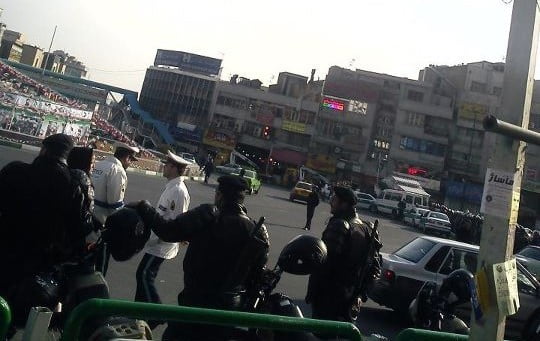
The following image shows the heavy security deployment at Tehran’s Enghelab (Revolution) Square at around 3pm local time. Tight security has also been reported at other points on the routes designated for today’s opposition protests.

3 Tabriz men receive 17-year jail sentence

0


Three activists from the city of Tabriz have received a combined seventeen-year prison sentence, human rights sources reported today.

According to the Human Rights Activists news agency, Branch 26 of the Revolutionary Court has handed down the jail-terms to Esmail Barzegari (dentist), Rasoul Heidarzadeh (musician) and Javad Zadkam (owner of a sports club) on espionage charges. The website said the three were arrested in the northwestern city of Tabriz close to ten months ago and were then transferred to Tehran’s notorious Evin Prison. After enduring seven months of solitary confinement in ward 209, they were taken to the ward 350 of the prison.

The men reportedly had no legal representation at their trial, which was presided over by Judge Pirabbasi. In the end, Barzegari and Heidarzadeh were sentenced to seven years in prison each, while Zadkam received a three-year jail term.

Pressures on Kurdish students and teachers in Marivan continue


Over the past few weeks, the Iran Human Rights Documentation Center has received several reports about continuing pressure from Iranian authorities on university students and teachers in Iran’s Kurdish region. Amidst reports of pressures on Azerbaijani student activists in other parts of Iran, the latest reports are indicative of an enduring and troubling pattern of intimidation of students and teachers by Iranian authorities.

Yesterday, on Sunday, February 12, Suran Daneshvar, a Kurdish university student from Mariwan and member of the central council of the Democratic Union of Kurdish Students, was sentenced to a year in prison, suspended for two years, by the first branch of the revolutionary court of Sanandaj for “propaganda against the regime”. Daneshvar, along with other members of the Democratic Union of Kurdish Students—a student organization—were detained for their activities last summer and later released on bail. Since the summer, many members of the organization have been arrested and jailed.

On the same day Daneshvar was sentenced, three other Kurdish university students were summoned by the intelligence office in Marivan and interrogated, threatened and later released. These three students—Jiar Salamatian, a law student; Esma’il Ravangard, a geography student; and Aziz Tajik, a social sciences student—attend Payam Noor University in Mariwan. Salamatian, Ravangard, and Tajik were summoned and threatened in connection with their role in a gathering to condemn the actions of the Turkish army in killing 34 Kurdish citizens in Uldere, Turkey this past December. Previously, on January 13, 2012, Salamatian and Dana Lanjabadi, a Kurdish student of agricultural economics, also from Payam Noor, were summoned around noontime by the intelligence office of Marivan and interrogated, threatened, and beaten for hours until 2 AM the next day.

Additionally, on Wednesday, January 25, intelligence agents from Marivan arrested two Kurdish teachers, named Rezgar Sharifi and Mozaffar Sharifi, from the “Lenjabad” village of Marivan, as well as a student named Aram Faraji from Payam Noor University in Mariwan. No further information has been obtained about the condition or whereabouts of these three individuals.

Also, a month following his initial detention, Mardin (Khaled) Eyvazeh, a law student from Payam Noor University in Marivan is still being held in the detention center of the information campaign of Mariwan’s intelligence office. Earlier, authorities promised that Eyvazeh would be released, but as of yet, that promise has not come to fruition.

Kurdish student publications and Kurdish student gatherings are closely monitored by government officials in Iran. According to witness testimonies taken by the Iran Human Rights Documentation Center in recent years, the herasat—or what is known as the intelligence gathering apparatus on a university campus—collects intelligence files on Kurdish student activists. Sometimes theherasat reports students to the intelligence authorities in that city or town.

Students suspected of “subversive” activities are then singled out for disciplinary action ranging from forced transfer to other universities (sometimes in non-Kurdish majority regions) or outright expulsion. Expulsions have a deterrent or chilling effect on the larger student body – and tend to discourage others from participating in Kurdish student organizations.

Along with expulsion, government agents pressure universities to shut down student publications and student organizations. In extreme cases, some students are arrested and taken to prison for their student activism.

Source: iranhrdc