Home Blog Page 492

Three Months into Detention, No Formal Charges

0


Three months after the arrest of Massoud Sepehr, his wife told the International Campaign for Human Rights in Iran that it is still not clear why he was arrested. Sepehr is a Political Science lecturer at Shiraz Azad University who was arrested on 17 November 2011.

“On the morning of 17 November 2011, plainclothes security forces came to our home and after a complete search of the premises, he was arrested and transferred to the Shiraz Intelligence Office Detention Center, also known as Number 100,” Mahshid Tadayon told the Campaign about her husband’s arrest.

Tadayon said that during the first few days after Sepehr’s arrest, security forces told his family not to interview with the media so that his situation would be clarified quickly and he would be released. After three months, despite the family’s silence, there has been no change in the prisoner of conscience’s case.

“My husband was arrested about three months ago, but his case file has not yet been forwarded to the courts. His charges are not clear, nor is there any news about his release. His lawyer has not been able to access his case file or even meet with him. He has been denied all his legal rights,” Tadayon told the Campaign.

“His general health is not good. He suffers from high blood pressure. He has kidney problems, too, and must always be monitored by a physician. I am seriously concerned about his physical condition,” Tadayon added.

In a 31 December 2011 statement, the Iran Islamic Revolution Mujahedin Organization objected to the wave of arrests of critics and political and civil society activists. “Dr. Sepehr is a prominent figure and a highly educated academician, respected by the people of Shiraz. More than anything else, the arrest of this distinguished individual who has always maintained his balance and supported logical criticism while maintaining his independence, shows the increasing constriction of legal liberties and the daily increase of repression and dictatorship,” the statement said.


Source: iranhumanrights

Concern grows for health of Iranian opposition leader


Fatemeh Karroubi told the Jaras opposition website that she is greatly concerned about her husband’s health under house arrest, given that opposition leader Mehdi Karroubi is being treated by “physicians trusted by the state security services.”

She said the state is responsible for her husband’s well-being, and any possible outcomes “cannot be attributed to arbitrary forces.”

Last year, Mehdi Karroubi and the other opposition leader, MirHosein Mousavi, rallied supporters to march on February 14 in solidarity with the Arab uprisings. The two opposition leaders were put under house arrest along with their wives, but a few months ago, Mehdi Karroubi was transferred to a small apartment, and his wife has not been allowed to join him at his side.

Fatemeh Karroubi maintained that her husband is, in effect, under solitary confinement.

The opposition leaders have not been officially charged by the state, and human rights groups both within and outside the country have protested their arrest as an illegal act by any measure.

Faremeh Karroubi added that her husband is “more determined than ever and still stands by the people demanding reform of the current deviation,” adding that he is very optimistic about the future of the protest movement. She quoted her husband saying that though the “path is strenuous, people’s legitimate demands have deep roots, and as the society reaches political maturity, its future is bright.”

Source: radiozamaneh

Iranian MP denounces internet service disruptions

0


Iranian MP Ahmad Tavakoli says the recent blocking of internet and satellite services, causing sudden and unexplained disruptions, is creating widespread discontent that could be “very costly” for the regime.

Tavakoli, who is also the head of Parliament’s Centre for Research, told the Mehr News Agency: “This method of filtering, on the one hand, draws people toward breaking the law and using proxies, and on the other hand, makes the blocking of sites and signals ineffective, because the use of proxies becomes widespread.”

In the past few days, Iranian internet users have not been able to access foreign websites, and even sites like Yahoo Mail, Gmail, Yahoo Messenger and other email services have been sporadically unavailable.

Tavakoli called on officials to clearly explain the current disruptions and to stop “creating a nuisance” in people’s lives.

He added that many websites that contain “useful and specialized information” have also been blocked and need to be reopened to public access.

MP Ali Motahari, a critic of the government, announced that he will follow up on the difficulties in accessing personal email with the Ministry of Communications and Technology.

Yesterday, the ministry announced it was unaware of the disruptions in internet service, claiming the cause of the problem lay elsewhere.

Opposition groups, however, maintain that the disruptions are being caused by government precautions being taken in advance of February 14. That day will mark the anniversary of mass demonstrations called by opposition leaders MirHosein Mousavi and Mehdi Karroubi, who have both been held under house arrest for the past year.

This Coalition for the Green Path of Hope has called on people to join a march of silence on February 14 to mark the anniversary of last year’s protest and to demand the release of the opposition leaders.

Some analysts have declared that the service disruptions are also related to government efforts to launch a “national internet,” also referred to as a clean or decent internet.

Source: radiozamaneh

Imprisoned Blogger on Hunger Strike in Critical Condition

0


Imprisoned blogger Mehdi Khazali is in critical condition due to his hunger strike, his son Mohammad Saleh Khazali told the International Campaign for Human Rights in Iran in a February 10 interview.

“Today is the 33rd day my father has been on a hunger strike. After he suffered stomach bleeding last week, they transferred him from Evin Prison’s Ward 209 to the General Ward (350), and he was taken to the infirmary,” Mohammad Khazali told the Campaign. “After two weeks of refusing to let him have visitors, we were finally able to visit with him with a letter from the prosecutor. He had lost a lot of weight. He was in very poor condition, and unfortunately, since that day we don’t know about his condition.”

Security forces arrested Mehdi Khazali, a critical blogger and head of Hayyan Publishing House, on 9 January. Khazali’s arrest was accompanied by physical abuse, leading to a broken arm, according to Kaleme website. Security forces had previously arrested him on similar charges and had released him on bail.

“My father was arrested this time on charges such as ‘propagating against the regime,’ ‘insulting [the Supreme Leader],’ etc., for which he was previously arrested and for which there exist case files. My father told the investigative judge who issued his temporary detention orders that these same charges existed in his previous cases, and he had posted bail, guarantees, or custodianship for them, never having been detained.”

In February, presiding Judge Pirabbasi of Branch 26 of Tehran Revolutionary Court sentenced Mehdi Khazali to 14 years in prison, 10 years in exile, and 90 lashes for interviewing with the BBC and writing a letter to the the Supreme Leader of Iran.

Mehdi Khazali is one of a few Iranian political activists who has spoken of boycotting the upcoming parliamentary elections. According to Mohammad Khazali, his father’s hunger strike is in protest to his so-called temporary detention.

“In our visit with my father, we asked him to break his hunger strike and we also conveyed his friends’ request that he break his hunger strike, but he would not accept it.… He objects to his temporary detention. According to law, he must be released on bail until his sentence ruling is announced, but we don’t know why they don’t issue bail orders for him. Maybe they are afraid my father would write something if released,” he said.

Mohammad Khazali also told the Campaign that when his father’s arm was broken in his 9 January arrest, prison authorities refused to send him to the Medical Examiner’s Office, despite the family’s request. “Officials inside Ward 209 refused to take him to the Medical Examiner’s Office and told his case judge that my father himself had refused to go to the Medical Examiner,” said Mohammad Khazali. Mehdi Khazali is the son of Abolghassem Khazali, a high ranking cleric and a member of the Council of Experts.

Akbar Amini known as ‘The Crane’ arrested again

0


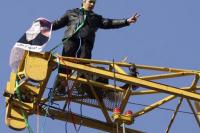
Akbar Amini, the protester who climbed atop a crane during opposition demonstrations a year ago, was detained after being interviewed by opposition media in recent days.

According to the Human Rights House of Iran, security forces raided the home of the activist, inspected it and then took him to an unknown location. The agents carried an arrest warrant issued by Judge Reshteh Ahmadi and explained his recent interview with pro-opposition media was the reason for his arrest.

Early in the morning of 14 February 2011, hours before Green Movement demonstrations in support of the uprisings in Tunisia and Egypt, Amini hit the headlines by climbing a crane, while wearing a green head band.

Shortly afterwards he was apprehended by law enforcement officers and taken to Evin Prison where he spent his sixteen first days of imprisonment in solitary confinement. The authorities alleged that Amini had been suffering from a mental illness as well as a drug addiction, which had led him to climb the crane. Amin has dismissed the claims saying the Iranian people will be the ones to judge the story.

According to opposition website Kaleme, while still in prison, Akbar was known as the “crane” amongst fellow inmates, in reference to the symbolic move that had gotten him arrested in the first place. In addition, during football or volleyball matches, Amini’s side would also take the name “crane.”

In an interview with Iranian journalist Masih Alinejad just days prior to his arrest, Akbar Amini vowed to continue the struggle for freedom in Iran. “Even when I was under torture and interrogation, I told my interrogators … that injustice would not disappear by means of pressuring, beating, cracking down, imprisoning, suppressing and killing the people,” he said. “Even if I am imprisoned a thousand times again, I will persist on this path which I have chosen knowingly, and will do this over and over again for my country’s freedom,” he added.


Source: freedomessenger

Binyamin Netanyahu accuses Iran over bombs targeting Israeli diplomats

0


Tehran’s ambassador to India denounces Israeli claim as ‘sheer lies’ after blast in New Delhi and discovery of device in Tbilisi

Israeli prime minister Binyamin Netanyahu has accused Iran of being behind twin attacks on Israeli targets in India and Georgia on Monday in a move likely to further escalate tensions between the two countries and increase international pressure on the Iranian regime.

The attacks, in which four people were injured, followed a warning from Iran’s supreme leader, Ayatollah Ali Khamenei, earlier this month that the Islamic Republic would retaliate against international sanctions and would back “any nation or group” that sought to “confront and fight”Israel.

In Delhi, witnesses said they saw assailants on motorcycles attaching a device to a car when it stopped at a traffic light. In the Georgian capital, Tbilisi, an Israeli embassy driver discovered a device planted on the undercarriage of his car. The modus operandi in both incidents mirrored the assassination of an Iranian nuclear scientist in Tehran last month, which Iran claimed was carried out by agents for Israeli intelligence.

The Iranian regime also blamed Israel for a string of earlier assassinations and covert operations. Many in the international community have voiced alarm at the prospect of a low-intensity war between the two states conducted by intelligence operatives and their proxies.

Within hours of Monday’s apparently co-ordinated attacks in the Indian and Georgian capitals, Netanyahu declared: “The elements behind these attacks were Iran and its protege, Hezbollah.”

Tehran, he added, was “the largest terror exporter in the world” and was also responsible for recent attempted assaults on Israeli targets in Azerbaijan and Thailand. Israel, he said, would “act with a strong hand”.

The Israeli foreign minister, Avigdor Lieberman, said Israel “know[s] how to identify exactly who is responsible for the attack and who carried it out”.

Iran described the accusations as “sheer lies”. Mehdi Nabizadeh, Iran’s ambassador to Delhi, was quoted as saying by IRNA: “Any terrorist attack is condemned [by Iran] and we strongly reject the untrue comments by an Israeli official. These accusations are untrue and sheer lies, like previous times.”

There has been no claim of responsibility for the attacks, which were initially linked to the anniversary of the assassination of a Hezbollah militant in Lebanon four years ago.

Four people, including the wife of an Israeli diplomat on her way to collect her children from the American Embassy School in Delhi, were reported injured when an explosive device wrecked a car with diplomatic plates.

According to Delhi Police Commissioner BK Gupta, the woman noticed a passing motorcyclist attach what appeared to be a magnetic device to the car when it slowed to approach a crossing.

The car drove a short distance, there was a loud sound and then an explosion and the car caught fire, he told a press conference.

Some witnesses told Indian television channels that they saw two riders on the bike.

The woman, Tali Yeshova, was taken to hospital for treatment and was expected to fly back to Israel later. Her driver and two other people in a nearby car sustained minor injuries, Gupta said.

In Tbilisi, police safely defused an explosive device found underneath a car of a local man employed as a driver at the Israeli embassy.

The Israeli foreign ministry declined to give details, only saying Israeli authorities were co-operating with local security forces.

Israeli missions around the world had been alerted to potential attacks around the anniversary of the death of Imad Mughniyah, a senior Hezbollah figure who was killed when his car exploded in 2008. Hezbollah, which has close ties to Iran, blamed Israel for the blast.

Israeli officials have also warned of the threat to embassies and other targets from Iran or its allies.

Last month, the Israel Defence Force chief of staff, Benny Gantz, warned: “We are witnessing efforts by Hezbollah and other hostile elements to perpetrate a brutal terror attack far from Israel.”

Yoram Cohen, the head of Israel’s internal security agency Shin Bet, said earlier this month that Iranian agents were attempting to attack Israeli targets around the world in retaliation for covert operations, including the assassination of Iranian nuclear scientists.

Source: guardian

Tehran governor warns protesters ahead of opposition rally

0


Users in Iran are finding it increasingly difficult to access the internet in the lead-up to pro-opposition demonstrations on 14 February called for by the Coordination Council of the Green Path of Hope, a leading decision-making body within the protest movement.

The protests will mark the first anniversary of opposition demonstrations held in solidarity with the Tunisian and Egyptian uprisings that toppled the Ben Ali and Mubarak regimes in early 2011. At least two protesters were shot dead and hundreds were reportedly detained by security forces.

Shortly after the street protests, Mir Hossein Mousavi and Mahdi Karroubi, who had been spearheading the opposition Green Movement since the rigged presidential elections of June 2009 and had called for the solidarity marches, were placed under house arrest along with their wives. Karroubi’s wife Fatemeh Karroubi was later released. Rights groups say their detention violates international human rights conventions as well as Iran’s own constitution.

In a recent statement, Amnesty International called on Iranian authorities to “respect freedom of assembly and allow peaceful demonstrations in Tehran and elsewhere in Iran on 14 February 2012.” The organisation called for the “immediate” release of Mousavi, Karroubi, Mousavi’s wife Zahra Rahnavard and “anyone held solely for the peaceful expression of their right to freedom of expression, association or assembly or in connection with their beliefs.” It said it was “deeply concerned” at the regime’s increasingly heavy-handed repression of dissent, especially ahead of scheduled parliamentary elections on 2 March.

On Friday, the Coordination Council of the Green Path of Hope, the Green Movement’s most prominent decision-making authority, urged Iranians to express their protest of the country’s autocratic rulers, but also any form of foreign intervention in Iran such as a international sanctions and war. The council’s statement argued that the regime was neither “Islamic” nor a “Republic,” while accusing the political elite of “sacrificing liberty for authoritarianism and the lust for power and wealth.” “They have sacrificed [our] independence for their own economic and security interests in joining hands with China and Russia. They have deepened poverty and class polarisation in society, while endangering national security with the threat of war through their adventurous policies.”

The Coordination Council’s calls for protests has been backed by other opposition groups, including the Mujahedin of the Islamic Revolution, a major reformist group, with many of its members either in Iranian prisons or awaiting jail time.

Tehran Province governor Morteza Tamaddon,  told the Young Journalists’ Club on Saturday that the security forces were prepared to quell dissenters on Tuesday. “We will confront them with readiness and by equipping Tehran with all the security systems,” he warned.

Tamaddon downplayed the significance of the upcoming street demonstrations, describing them as a “propaganda pose.” “Their public call [for protests] is an attempt to impact the people’s participation in rallies on 11 February [in commemoration of the anniversary of the 1979 Revolution] and the 2 March [parliamentary elections].”

Although the actual street protests are not scheduled before Tuesday afternoon, for many, the protests will begin on the night of 13 February and atop rooftops when they chant “Allah-O-Akbar,” meaning “God is Greatest.” In recent weeks, some Green Movement activists have advocated blowing whistles as a safer and more efficient alternative to shouting.

Meanwhile, since Thursday, many Iranian internet users have not being able to check their emails, leading many to accuse the regime of intentionally reducing internet access in preparation for the planned demonstrations on Tuesday. Iranian officials regularly tamper with internet access in order to control the free flow of information, especially ahead of and during opposition protests.

Iran’s semi-official Mehr news agency reported on Saturday that more than thirty million Iranians were unable to log onto their emails account. Most Iranians use foreign-based email service providers for communication. According to Mehr, the Telecommunication Company of Iran and the Telecommunication Infrastructure Company had failed to provide “clear” explanations for the disruptions.
Source: irangreenvoice

U.S. Navy claims Iran preparing ‘suicide boats’ in case of conflict

0


By WARDA AL-JAWAHIRY

Iran has built up its naval forces in the Gulf and prepared boats that could be used in suicide attacks, but the U.S. navy can prevent it from blocking the Strait of Hormuz, the commander of U.S. naval forces in the region said on Sunday.
Iran has made a series of threats in recent weeks to disrupt shipping in the Gulf or strike U.S. forces in retaliation if its oil trade is shut down by sanctions, or if its disputed nuclear program comes under attack.

“They have increased the number of submarines … they increased the number of fast attack craft,” Vice Admiral Mark Fox told reporters. “Some of the small boats have been outfitted with a large warhead that could be used as a suicide explosive device. The Iranians have a large mine inventory.”

“We have watched with interest their development of long range rockets and short, medium and long range ballistic missiles and of course … the development of their nuclear program,” Fox, who heads the U.S. Fifth Fleet, said at a briefing on the fleet’s base in the Gulf state of Bahrain.

Iran now has 10 small submarines, he said.

Military experts say the U.S. Navy’s Fifth Fleet patrolling the Gulf – which always has at least one giant supercarrier accompanied by scores of jets and a fleet of frigates and destroyers – is overwhelmingly more powerful than Iran’s navy.

But ever since al-Qaeda suicide bombers in a small boat killed 17 sailors on board the destroyer U.S.S. Cole in a port in Yemen in 1996, Washington has been wary of the vulnerability of its huge battleships to bomb attacks by small enemy craft.

Asked whether the U.S. Navy was prepared for an attack or other trouble in the Gulf, Fox said: “We are very vigilant, we have built a wide range of options to give the president and we are ready… What if it happened tonight? We are ready today.”

Iranian officials have threatened to block the Strait of Hormuz, the outlet to the Gulf through which nearly all of the Middle East’s oil sails.

Asked if he took Iran’s threats seriously, Fox Said: “Could they make like extremely difficult for us? Yes they could. If we did nothing and they were able to operate without being inhibited, yeah they could close it, but I can’t see that we would ever be in that position.”

He added that diplomacy should be given priority in resolving the tension.

“So when you hear discussion about all this overheated rhetoric from Iran we really believe that the best way to handle this is with diplomacy… I am absolutely convinced that is the way to go. It is our job to be prepared. We are vigilant.”

Contacts between the U.S. Navy and Iranian craft in the Gulf region were routine, Fox said, referring to cases where his sailors helped Iranian ships that were in distress or threatened by pirates.

In addition to commanding the Fifth Fleet, Fox is also the commander of a multinational naval task force charged with ensuring Gulf shipping routes stay open. Although most of its firepower is American, the task force also includes other Western countries and the Gulf Arab states.

The European Union slapped an embargo on Iranian oil last month, which is due to kick in completely by July 1. The United States and EU have both imposed new sanctions on Iran’s central bank which make it difficult for countries to pay Tehran for oil and for Iran to pay for the goods it imports.

Source: alarabiya

Reactivation of Iran’s Dissident Assassinations Program

0


Leila Tayyeri

News reports indicating that the assassination of Iranian political activists outside the country is once again on the agenda of the Islamic republic of Iran. Among personalities on the target list are Dr Abdol-Karim Soroosh and Nobel Peace Laureate Shirin Ebadi, while others too have received death threats through the phone or emails.

Based on reports received by Rooz, the assassination of a number of prominent Iranian opposition figures is on the agenda of the intelligence and security apparatus of the Islamic republic of Iran. In a related development, two foreign nationals in a foreign country have recently been reported to have been detained and interrogated by local police officials over their activities in gathering intelligence regarding an Iranian opposition personality in that country.

Rooz has received information that Shirin Ebadi, Abdol-Karim Soroosh and a defected former senior Iranian official are among those who have received death threats by individuals associated with the regime in Tehran.

In addition, a number of Iranian political activists and journalists residing outside the country have also received threatening emails. Some of these emails have originated from Iranian embassies in countries where the activists live. The emails threaten the activists to remain silent or face the consequences of their actions and statements.

Commentators have said that as relations between Tehran and the West have deteriorated, and the possibility of a military strike against Iran’s military installations is gaining media circulation, such threats against dissidents living abroad have multiplied and intensified. According to some analysts the morale of Iranian personnel at the country’s nuclear facilities have dropped because of the recent assassination of Iranian scientists and nuclear professionals, and as a consequence the regime may be embarking on a revengeful path as a way to improve the morale of the members of the nuclear community.

Following the stern response of European countries against the assassinations of Iranian political activists and Kurdish leaders by the Islamic republic of Iran at the Mikonos restaurant in Berlin and reformist president Khatami’s ascent to power, Iran suspended its assassination activities outside the country. These assassination missions by the country intelligence ministry were acknowledged during the trials of some intelligence officers (the trials are commonly known as the chain murders) that were held in Iran after a number of prominent Iranian dissidents and former political leaders were brutally assassinated around the country in the late 1980s.

An Iranian journalist living in France told Rooz that he has received death threats on the phone and through emails. “They sent a message saying that living abroad was not an issue for them and that they could easily bring us back into the country whenever they decided it was necessary,” he said. Even though he said that he had filed formal complaints to the police authorities in his country of residence he would not rule out the possibility of the regime carrying out its threats. These threats, he added, indicated that the Islamic republic has been seriously weakened and shaken and had chosen to threaten its opponents, indicating the failings of the regime.

Among Iranians who have filed reports with local police authorities because of the threats they have received are two defectors who had previously held senior positions in the Iranian regime.

Source: roozonline

Christian converts arrested in Shiraz

0


At least 10 Christian converts were arrested on Wednesday in Shiraz at a residential home that was used as a church.

The Human Rights Activists News Agency reports that plainclothes forces raided the home where, according to HRANA, Christians gathered to observe religious practices and ceremonies.

The families of the detainees have not been able to ascertain their location and, so far, have not been informed of the charges against them.

Last Friday, a number of followers of the Baha’i faith were arrested at their homes in Shiraz.

Last month, in a raid on a church in Ahvaz, authorities arrested the pastor, Farhad Sabokrouh, his wife and the entire congregation.

The Islamic Republic does not recognize the Baha’i faith, and its followers face constant persecution in Iran. While the Islamic Republic recognizes Christianity as an official religion, Christian converts are not accepted and can even face the death penalty.

There are no clear statistics on the number of Christian converts in Iran, but the Open Doors organization reports that almost half of the Christians inside Iran are converts.

Source: radiozamaneh