Home Blog Page 524

Mohammad Tavassoli Under Pressure for Forging Letter to Khatami

0


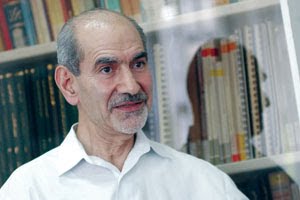
Since his 3 November arrest, 74-year-old Mohammad Tavassoli, Political Secretary of Iran’s Freedom Movement, has been in prison without any communication with his family.

Mehdi Nourbakhsh, a close relative of Tavassoli, told the International Campaign for Human Rights in Iran that Tavassoli’s family is under pressure for talking to the media about him.”Throughout the time Tavassoli has been in detention, his family has not been informed about his location, nor specifics about his charges. During his detention, he has not been allowed to contact his family at all,” said Nourbakhsh.

Security forces arrested Tavassoli at his home on 3 November in relation with a letter to Mohammad Khatami signed by 143 political and social activists. “There will not be the smallest glimmer of hope for protecting the people’s vote and for holding free, healthy, and fair elections,” said the letter.

“We heard from some Evin prisoners and their families that Mr. Tavassoli is inside Evin Prison and under immense pressure. Kayhan Newspaper wrote after his arrest that the reason for his arrest is forging 143 signatures on a [15 October] letter to Khatami. But during the weeks since he has been in prison, we heard that several of the people who signed the letter have been taken to the Intelligence Ministry, where they were interrogated. They all said ‘we signed the letter ourselves and it is not a forgery.’ Now we heard news from the prison that they want to charge Tavassoli with writing the text of the letter, whereas members of the Nationalist-Religious group wrote this letter. More importantly, it doesn’t matter who authored the letter signed by 143 people. It means that all of them assume responsibility for it, and not just one person,” Nourbakhsh told the Campaign.

Mohammad Tavassoli was Tehran’s first mayor after the 1979 Revolution. He has been arrested and tortured several times since then. His last detention before the recent one was during the days immediately following the 2009 presidential election, when he spent almost two months inside Evin Prison’s Ward 209.

Nourbakhsh, who is also Ebrahim Yazdi’s son-in-law, told the Campaign that the Tavassoli family are under pressure not to talk to the media. “From that first day intelligence forces arrested Mr. Tavassoli at his home, his family was told not to give interviews. The Tehran Prosecutor told them the same thing later. His family has been going to courts and other places, but has not been able to receive any answers about his whereabouts and his charges,” he said.


Source

Three Possibilities of Foreign Military Attack

0


Hossein Mohammadi

After a period of public verbal confrontations between Iranian and Western officials, the website of Iran’s supreme leader ayatollah Khamenei has taken the possibility of military action against Iran seriously and now posts an analysis on three possible military scenarios Iran could be subjected to. In a related development, a Revolutionary Guard commander has threatened that Iran would fire missiles at Israel if the country was attacked by that country.

The importance of the story on ayatollah Khamenei’s website, Khamenei.ir, lies in that the contents of the site reflect the views of the supreme leader. Just last week in a message to the families of those killed in the Bidgeneh military base explosion, ayatollah Khamenei called the victims “martyrs” whose work was available to those engaged in jihad (self sacrifice), and called on the armed forces to increase their efforts “so that others were aware, more than before, that martyrdom is a divine privilege for us and a source of rewards.”

The story describing the three war scenarios against Iran is written by Amir Mohebbian, a veteran Iranian theoretician belonging to the conservative Principlists camp. The first possibility he writes is an “exhaustive all out war” which would involve an “invasion by ground forces after a destructive air campaign” whose purpose would be nothing other than inflicting heavy damage” on the country.  The second possibility is “a war as a preparatory action for a political goal.”  This phase would aim at hitting Iran’s control centers for the purpose of disrupting the stability of the Islamic regime aimed at creating domestic chaos or forcing Iran to the surrender table.” The last possibility is a war on “specific centers and locations.” The purpose of this would be to destroy such centers as “nuclear, political, economic and military facilities” with the aim of destroying the aggressive machinery of the state particularly those aimed at Israel.” In short, it’s retaliatory and strike capabilities.

Describing the limitations of each scenario, Mohebian argues that the first option could result in difficulty in justifying the war to US allies, a change in the balance of power of the region, absence of knowledge of Iran’s possible response, etc.

The problem with the second type of action, according to Mohebian, is that there is no certainty that Iran’s defensive potential would be destroyed, the possibility of Iran becoming more radical, the expansion of the war to other regional countries, etc.

The issues with the third option are the public in Iran may not necessarily stay aloof and the inability to strike at all the sensitive and critical military centers.

He views the materialization of the first possibility to be zero. US domestic issues prevent it from making life in the US even more difficult. He rules out the second scenario also by arguing that even if Iran was defeated and forced to give up its nuclear centers, what would the US do if the Iranian people rejected this surrender? Would it bomb the Iranian people? Striking at the control centers would not produce a clear outcome because the “enemy does not have an active alternative inside Iran.” The goal of creating “chaos for chaos’s” sake is not something that the US would pursue with its responsibilities. Mohebian writes that the third option, which has the most likelihood among the three, has serious flaws. Which are these centers: political, economic, military, etc? If economic centers are targeted, he argues, then this translates into hitting at public institutions which would not produce the desired goal of encouraging the public to rise against the regime. Striking at military centers, even if undertaken for days, would not guarantee their total destruction because of their dispersion around the country. At the same time Iran would not be passive and would attack regional centers thus extending the war into a fully regional, if not beyond, conflict. If nuclear centers are the target of such attacks, then would the Bushehr nuclear power plant which is currently operational be attacked even though there are international standards against it. If Bushehr were attacked, would the fallout from the attack not create a situation worse than the explosion at Chernobyl? If such an attack took place, “Would Iran not retaliate by attacking the Persian Gulf countries?” he asks.

Mohebian concludes that since war is not a realistic possibility, then the reason why threats are made is simply to test the will and determination of the other side. Other reasons are to keep Russia and China on board with the sanctions regime as the alternative to war, test Iranian public opinion and support for the regime, terrorize the regional Arab countries for the purpose of selling them arms, turn Iran into a defensive as opposed to an offensive mode and test the regime’s capacity to absorb crisis.

Mohebbian’s article is published on the supreme leader’s site after the massive deadly explosion at an IRGC missile depot at a time when speculation about Israeli involvement in the blast has been raised by publications such as Time magazine.

Although contrary to other sabotage activities in Iran, the Islamic Republic has tried extensively in this case to negate the possibility of Israel having a hand in this explosion, Western media does not see this possibility farfetched because of Israel’s earlier destruction of the nuclear plants in Iraq and Syria.

This narrative as a response to what the Iranian regime feels are Western threatening activities against it comes at a time when other Iranian leaders have been vocal in their responses. Rahim Safavi, the former Revolutionary Guards (IRGC) commander and advisor to ayatollah Khamenei for example recently said that “If any military or security action is taken against Iran, the geography of the battlefield and the management of the battle ground shall be with the Islamic Republic under the supervision of the supreme leader ayatollah Khamenei.” He also added that the Middle East region was in an insecure and unstable and lacking lasting strategic political and security stability.”

Regarding Israel’s possible involvement in the missile depot explosion, Gholam Ali Rashid, the deputy head of Iran’s supreme armed command said, “Mossad, the CIA or any intelligence service no longer have the ability for such an act.” “They have claimed to have had a hand in every natural event during the last thirty years, ranging from the death of a few military men to any natural event.” Regarding militarily threatening the Islamic republic however, he said, “They do not have the ability to do this and this is merely a psychological war and is normally exerted against the Europeans and other countries who they think may not support the US and Israel. Of course we are always prepared and based on the missile power that this great martyr Hassan Tehrani Moghadam has created, we shall destroy all Israeli centers.”

Prior to this, Hassan Firuzabadi and Ali Larijani also had rejected the possibility of Israel having a hand in the explosions at the missile depot.

In his article Mohebian argues that military threats are not new to Obama’s administration and existed earlier as well. He says Iran carried out a missile firing exercise in late 2009 as a way to sour the Israelis from rejoicing the Yum Kippur holiday and celebrations.

He says the West views Iran to be a multi-ethnic society which it tries to use against Iran. Elsewhere in the article he says that “Western media strengthened the 2009 protests in Iran,” notably not attributing the protests to be Western launched or inspired, something that Iranian propaganda routinely claims.

Iran targeted with more Western pressure

0


The U.S. and its Western allies have made a joint effort to increase economic pressure on Iran in an attempt to resolve their nuclear disputes.

For the first time, Iran’s petrochemical industry has been put under sanction by the U.S., and the American Foreign Secretary called Iran and its Central Bank a “primary money-laundering concern.”

Meanwhile, George Osborne, the head of the British treasury, announced that Britain is completely boycotting the Iranian Central Bank, an unprecedented move. The aim, he said, was stop Iran’s alleged ambition to develop nuclear weapons.

France has also imposed new sanctions on Iran and called on other EU countries, as well as the U.S., Japan and Canada, to freeze assets of the Islamic Republic’s Central Bank.

Canada announced on Monday that it is imposing sanctions on Iran’s petrochemical products as well as its oil and gas industry.

The new sanctions come on the heels of a resolution by the International Atomic Energy Agency, passed on November 18, which indicates grave concern about Iran’s nuclear program. The resolution calls for Iran to end uranium enrichment, but Iran says its has a right to continue its enrichment in order to provide fuel for nuclear energy production.

On November 19, the UN Security Council also approved a resolution, introduced by Saudi Arabia, which condemns the “assassination plot” against the Saudi ambassador to the U.S. The resolution calls on Iran to hand over suspects whom the United States has accused of being involved in the alleged plot.

Mohammad Khazai, Iran’s representative at the UN, reacted by saying: “This resolution is based on unsubstantiated claims by a country that has a long history of enmity with my country, and we completely reject it.”

The U.S. has accused Iran of involvement in an assassination plot against the Saudi ambassador in Washington. Iran denies the allegations, and many analysts have stated that the accusations lack credibility.


Source

Security Forces Raid Iran Newspaper, Beat, Pepper Spray, and Arrest Journalists


Shortly after an armed raid by security and police forces on Iran Newspaper’s editorial offices today, a journalist present at the scene provided an eyewitness account for the International Campaign for Human Rights in Iran. “Everyone is still covered in white fire extinguisher powder. All of us still have a headache. At around noon, we heard screams and shouts from the fourth floor. We work inside the editorial offices of Iran Newspaper on the third floor. Javanfekr’s office is on the fourth floor. Several IRNA Political Desk reporters work inside a room adjacent to his office. Apparently, reporters from the Political Desk saw several plainclothes forces inside Javanfekr’s office, holding him by his feet and hands, forcing him to lie on the floor. The guys started yelling “Allah-o-Akbar” and “Heydar, Heydar. We were in the editorial rooms downstairs. We entered the hallways and stairways [to fourth floor] to see what was happening,” the IRNA reporter said, on condition of anonymity.

Security forces attacked Iran Newspaper, one of IRNA’s major publications, to arrest Ali Akbar Javanfekr, the President’s press adviser and Managing Director of IRNA News Agency. Javanfekr was sentenced to one year in prison for publishing articles and photographs considered “against public morality” in “Khatoon,” a special insert in Iran Newspaper. He held a press conference about his sentence this morning. At the end of his press conference, he was approached by representatives from the Tehran Prosecutor’s Office who had come to arrest him, leading to the confrontation with the entire editorial staff. In a November 19 interview with Etemad Newspaper, Javanfekr sharply criticized Iran’s Prosecutor General, Gholamhossein Mohseni Ejehi, and former Iranian Foreign Minister, Manouchehr Mottaki.

The source expanded on the raid, saying, “The Political Desk reporters cut off the elevators [to the fourth floor], so that they couldn’t take Javanfekr with them. They locked Javanfekr’s office door and called the police. But the forces broke the door with their sticks and came out and all of a sudden every floor was filled with plainclothes and police forces. It was as if they were all waiting upfront to come in. They entered every floor, threw the computers to the ground and cursed. They beat everyone with sticks. Several of the guys directed the fire extinguishers at the plainclothes men so they could run away. They sprayed us with pepper spray. We were suffocating. Our guys set the newspapers on the desks on fire in order to neutralize the spray effects. Right now, we are all covered in a white powder from the fire extinguishers. Our eyes are red because of the pepper spray. They were beating guys with sticks and taking them away. I had never seen anything like this before.”

An hour after the incident Javanfekr told the Reuters that he had not been arrested. According to the source, however, at least 30 reporters and personnel from IRNA News Agency, Iran Newspaper, Iran Online, and Iran Economic were arrested and several were also injured. Mossayeb Naimi, Iran Newspaper’s Editor-in-Chief, was also arrested.

When asked whether any of the employees were seriously injured, the source said, “One of the reporters with the Community Desk, Maryam Samani, has a leg handicap. Security forces kept screaming at her to walk as they drove everyone downstairs using their sticks. Ms. Samani was standing on the side of a hallway, saying: ‘I can’t go down without an elevator.’ They then pushed her and pepper sprayed her face. She passed out. Then they picked her up and took her.”

The source added that the Iran Newspaper staff have returned to work, and that the Tehran Governor is now inside the newspaper offices to maintain order.


Source

Protester wounded in 2009 demonstrations dies from wounds

0


GVF — Another Green Movement protester wounded during the protests that erupted following the country’s 2009 presidential election has passed away in Boston, Massachusetts following a stroke.

Alireza Miandehi Sabouri, along with millions of other Iranians also outraged by what they saw as widespread rigging in the elections, had taken to the streets of the capital on 15 June 2009 to ask peacefully, “Where is my vote?” However, like many others on that unforgettable day, Alireza’s peaceful show of protest was answered with the barrel of a gun.

In the afternoon of 15 June, when he was just nineteen years of age, Alireza was trying to help rescue fellow protesters wounded in front of the Basij militia’s Ashura base, Battalion 117, when he was struck by a bullet and fell unconscious. He was then taken to Ibn Sina hospital in west Tehran for treatment.

Although he gained consciousness at the hospital, doctors were unable to fully remove the bullet from inside his skull. “The bullet exploded inside his head, a fragment left through an eyebrow, [but] the projectile stayed inside his skull while four shrapnel fragments were stuck. The projectile was extracted during a complicated and intense operation, but the fragments remained inside,” a family member told the Green Voice of Freedom on condition of anonymity.

Months after his operations, Alireza continued to suffer from numerous physical and psychological complications. He would experience recurring seizures either at home or on the street.

“We still have all of the evidence and Ali’s documents which show how they shot him in the forehead. The side-effects were due to the fragments in his brain. The two complicated brain operations led to his premature death,” the close relative explained.

Eleven months after he was first wounded, Alireza, accompanied by the family member, left Iran for Turkey to seek medical treatment through the UN office there. However, despite family pleas to relocate him to Germany where some of his relatives reside, the UN officials in Turkey rejected the family’s calls and instead decided to send Alireza to the United States. “We told them [the UN] time after time that he should be in Germany, close his relatives who could take care of him. But as usual, the UN completely ignored our calls and sent him to the US,” the family argued.

Nearly 900 days after being shot, Alireza Miandehi Sabouri died at the tender age of 22, 6,000 miles away from home in Boston, Massachusetts, where he was buried. “He passed away in a foreign land in silence and loneliness,” the family member continued. “He was treated unjustly both in Iran and abroad. We couldn’t take our complaint to any organisation.”

“You don’t know the fire that burns me from within, maybe you’re able to understand me. But at the very least you can write the truth [about Alireza] so that the world can know what they’ve done to us and how they’ve treated us. Everyone knows that Alireza was innocent, just like the many thousands of youth who were on the streets on 15 June. He was very innocent and did not deserve this.”

Alireza had five older sisters while his only brother had died during Iran’s eight-year war with Iraq. It is also said that his father was reportedly close to the Iranian regime and did little to improve his son’s poor health.

“The death of Ali is not the death of a single person. For me it has a universal meaning. I hope that I can one day say what I have not yet said … I am filled with pain,” the relative told us.

While the exact casualty figures from the 2009 anti-government protests are still unknown, the tragic death of Alireza Miandehi Sabouri 2 ½ years later is yet another reminder of the brutality and heartlessness exercised by the Iranian regime in quelling dissent.


Source

Appeals Court Upheld Heavy Prison Terms for Labor Activists in Tabriz

0


HRANA News Agency – The Appeals Court has upheld heavy prison sentences issued for four leftist labor activists from Tabriz, East Azerbaijan Province.

According to a report by Human Rights Activists News Agency (HRANA), the sixth branch of the Appeals Court in East Azerbaijan Province upheld the verdicts against Shahrokh Zamani, Nima Pouryaghob, Mohammad Jarahi and Sasan Vahebivash.

On August 18, 2011, the first branch of the Revolutionary Court in Tabriz sentenced Shahrokh Zamani to 11 years, Nima Pouryaghob to 6 years, Mohammad Jarahi to 5 years and Sasan Vahebivash to 6 months in prison. A fifth defender, Buick Sydler, was found not guilty. Charges against these labor activists included organizing opposition groups, acting against national security and propaganda against the regime.

Nima Pouryaghob is studying mechanical engineering and Sasan Vahebivash is majoring in biomedical engineering at Tabriz Azad University. Shahrokh Zamani is a member of the Representatives’ Council in the Coordinating Committee to Create Labor Organizations and also a member of the Painters Union.Mohammad Jarahi is a labor activist. Although Shahrokh Zamani was unable to post his heavy bail for a while, all four labor activists are currently free on bail.

The verdicts issued against these political activists are unprecedented in Tabriz in the recent few years.
Source

Rajayi Shahr Prison guards violently attack and beat Kurd political prisoners

0


On Monday November 14 a number of Kurd religious and political prisoners who are detained in Hall 10, Cellblock 4 in Gohardasht Prison [Rajayi Shahr] were attacked and beaten by the prison gang instigated by prison officials.

Subsequently, the head of the Prison Intelligence Department, Faraji Nejad along with the head of Cellblock 4, Talivardi, Mirza Aqayi and a number of other prison guards created a ‘human tunnel’ and forced Kurd political and religious prisoners to go through while beating them. The prison guards stood on either side of the ‘tunnel’ and used electric batons to beat the prisoners in the face and body.

Three Kurd prisoners identified as Ayoub Karimi, Layeq Kordpour and Mohamamd-Amin Barqi passed out from the beatings while Mohammad Barqi’s nose broke from the baton strikes. The bodies of political prisoners Abdolhadi Hemat Zadeh, Abdolvahed Soleimani, Fakhroddin Azizi, Rahim Zehi, Eunice Qaderi and Osman Ahsani have become black and bruised from the violent beatings.

These prisoners were transferred to solitary cells in the notorious cellblock 1 while injured and bruised without receiving minimum medical treatment.

Currently, 42 Kurd political and religious prisoners are detained in cellblock 1 in Gohardasht Prison in Karaj. (Human Rights and Democracy Activists in Iran, Committee for Human Rights in Iran [RAHANA] – Nov. 15, 2000)

Source

Britain imposes new financial sanctions on Iran

0


Reuters – The government imposed new financial sanctions on Iran on Monday, ordering all UK financial institutions to stop doing business with their Iranian counterparts, as well as with the central bank of Iran, the Treasury said.

It said the sanctions were in response to the International Atomic Energy Agency’s (IAEA) latest report on Iran, which highlighted fresh concerns about the possible military dimensions of Iran’s nuclear programme.

Chancellor George Osborne said Iran’s actions posed a serious threat to national security and that the action was being taken in coordination with other countries.

“This follows the International Atomic Energy Agency’s report uncovering evidence of Iran’s development of nuclear weapons technology. It is also a response to calls from theFinancial Action Task Force for countries to strengthen safeguards to protect their financial sectors from money laundering and financing of terrorism risks emanating from Iran.”

“We believe that the Iranian regime’s actions pose a significant threat to the UK’s national security and the international community. Today’s announcement is a further step to preventing the Iranian regime from acquiring nuclear weapons.”


Source

Iran may have supplied Qaddafi’s regime with chemical weapons: report

0


The Obama administration is probing whether Iran supplied the Libyan government of slain leader Muammar Qaddafi with hundreds of special artillery shells for chemical weapons that Libya kept secret for decades, the Washington Post reported on Monday citing U.S. officials.

Revolutionary fighters have uncovered the shells, which were filled with highly toxic mustard agent, at two sites in central Libya in recent weeks. Both sites are currently placed under heavy guard and round-the-clock surveillance by drones, U.S. and Libyan officials told the Post.

The main aim of the U.S. probe is to figure out how the Libyans obtained the shells. “We are pretty sure we know the shells were custom-designed and produced in Iran especially for Libya,” a senior U.S. official was quoted as saying.

The Post quoted another U.S. official with access to classified information as confirming that there were “serious concerns” that Iran had provided the shells, albeit some years ago.

The United Nations’ International Atomic Energy Agency last week passed a resolution condemning Iran’s nuclear activities following a recent IAEA report strongly suggesting they involved research for atomic weapons.

The resolution – worded to pass muster with Iran’s allies Russia and China – notably stopped short of sending the matter to the U.N. Security Council.

Tehran, which rejected the recent IAEA report as “baseless,” denies all Western allegations it is seeking a nuclear arsenal.

The Washington Post cited an e-mail by Mohammed Javad Larijani, an adviser to Iran’s supreme leader and the brother of Iran’s former negotiator on nuclear issues, in which he denied the U.S. allegation. “I believe such comments are being fabricated by the U.S. to complete their project of Iranophobia in the region and all through the world. Surely this is another baseless story for demonizing [the] Islamic Republic of Iran.”

In 2004, then Libyan leader Muammar Qaddafi promised the U.S., Britain and the U.N. to declare and begin destruction of all of his country’s chemical arms. The stockpile’s existence now raises new questions about the ability of the world’s most powerful nations to police such pledges in tightly closed societies.

According to the report carried by the Post, this newly discovered stockpile will need to be protected from theft by militia groups or others in the politically unsettled nation. “Disposal of the munitions poses an additional challenge for Libya’s new government and allied Western powers, because the chemical-filled shells cannot be readily relocated and, according to some estimates, may take as long as a year to destroy in place,” said the report.


Source

U.S. to impose more sanctions on Iran

0


The United States is looking at imposing fresh sanctions against Iran’s petrochemical industry, according to diplomatic sources quoted by CNN.

The new measures will bar foreign companies from dealing with Iran’s petrochemical industry under threat of being banned from U.S. markets. U.S. companies are already barred from dealing with Iran.

The new sanctions are reportedly meant to “build on existing sanctions on Iran’s oil and gas industry.”

The report follows the International Atomic Energy Agency’s announcement of its concern over possible military dimensions to Iran’s nuclear activities. Iran denies all allegations.

The European Union has also said it is looking at increasing pressure on Iran.

Russian Foreign Minister Sergey Lavrov has said, however, that imposing sanctions on Iran is not an effective approach, stressing that diplomatic talks and negotiations provide the only path toward an adequate solution.

On Friday, the IAEA Board of Governors issued a resolution on Iran, expressing growing concern over Iran’s nuclear activities and urging Iran to submit to previous UN resolutions.

Those resolutions have called on Iran to end its uranium enrichment activities, but Iran refuses to do so, insisting that the enriched uranium is only used as fuel for its nuclear reactors.


Source