Home Blog Page 540

Saudi Arabia Takes Iran To UN Over Alleged Plot

0


Saudi Arabia has reportedly moved to have Iran reported to the UN Security Council over an alleged plot to assassinate the Saudi ambassador in Washington.

The Saudi-owned “Asharq al-Awsat” newspaper reported today that Saudi Arabia’s permanent mission formally requested the UN secretary-general notify the Security Council of the alleged murder plot.

The United States said it had uncovered a plot by two men with links to Iran’s security forces to assassinate Adel al-Jubeir by planting a bomb in a Washington restaurant.

Iran has denied the charges, and Supreme Leader Ayatollah Ali Khamenei said today that Tehran would respond harshly to any “inappropriate measures” by Western powers in connection to the alleged plot.

The Saudi step at the United Nations could lead to new sanctions being placed against the Islamic republic.

U.S. President Barack Obama has said he will press for “the toughest possible sanctions” over the alleged plot.


Source

Mohammad Maleki and Fereshteh Shirazi Receive Prison Sentences

0


Mohammad Maleki has been sentenced to one year in prison for anti-regime propaganda. Maleki was arrested in 2009 and released after 191 days due to medical necessity. He has been acquitted of Moharebeh and insulting the Supreme Leader and Ayatollah Khomeini.

Furthermore, women’s rights activist Fereshteh Shirazi has been sentenced to 2 years in prison for disturbing public opinion by libel, insulting the authorities on her weblog and one year in prison for anti-regime propaganda. She has also been banned from exiting the country for 7 years.

She is held in poor conditions since she has to sleep on the floor even though she has undergone neck and back surgery. She is deprived of contacting and visiting her family and has not been allowed to  receive information on her mother’s condition.


Source

UN Human Rights Committee Sharply Criticized Increasing Flogging Sentences in Iran


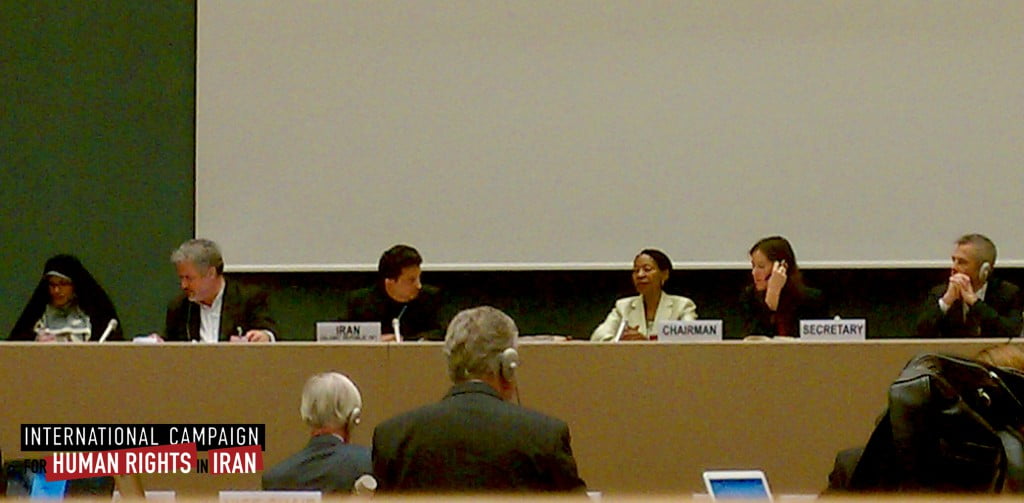
As flogging sentences issued and carried out by Iranian judges and judicial authorities are on the rise, during a meeting of the UN Human Rights Committee today in which the Iranian government’s compliance with the International Covenant on Civil and Political Rights (ICCPR) is under review, members of the Committee sharply criticized Iranian authorities at the meeting for Iran’s use of inhumane punishments such as flogging. According to the representative of the International Campaign for Human Rights in Iran who is currently at the meeting in Geneva, UN officials criticized Iran’s refusal to provide statistics about flogging sentences to the Human Rights Council while continuing to routinely dole out flogging sentences.

Last week, a source close to the case of actress Marzieh Vafamehr told the International Campaign for Human Rights in Iran that she was sentenced to one year in prison and 90 lashes. Also last week, student activist Payman Aref was lashed at Evin Prison as a part of his sentence, before he was allowed to leave upon completion of his prison term. Last month, the flogging sentence ofSomayeh Tohidloo, a women’s rights activist, was also carried out at Evin Prison.

“It appears there are continuing reports of flogging for minor offenses, including most recently reports that the actress Marzieh Vafamehr has been sentenced to 90 lashes merely for appearing in a film,” said Mr. Neuman, a member of the UN Human Rights Committee, during the Monday meeting. He added that members of the Council have asked the Iranian authorities to present numbers of flogging sentences and limb amputation sentences to the United Nations, but that Iranian authorities have refrained from providing this information, failing to include any statistics in their report.

According to Article 7 of the ICCPR, of which Iran is a signatory, no one shall be subjected to torture or to cruel, inhumane or degrading treatment or punishment.

Iran’s Islamic Penal Code allows for the punishment of flogging in a wide range of crimes. The Periodic Report of the UN Secretary General, published in March 2011, states that Iranian authorities claim that such punishments in the Islamic Penal Code are not considered torture or inhumane or degrading. “They claim that such sentences serve to prevent crime and replace imprisonment of individuals,” it said.

Kaleme website wrote on Monday, 7 October that Amin Niaifar, an accomplished Mechanical Engineering student at Tehran University’s College of Engineering, has also received 30 lashes for “insulting Mahmoud Ahmadinejad.” According to Kaleme, Niaifar, who is currently inside Ward 350 of Evin Prison, was returned to the ward after the flogging was carried out. “He was returned to the Ward without any medical or drug treatment though he was in severe pain as a result of the flogging,” wrote Kaleme. Niaifar, who is scheduled to be released next week when his prison sentence is complete, was taken to Evin Prison Court this morning, on the weekly visitation day.

Niaifar, 22, is only one of several pro-Green Movement prisoners who are currently serving time inside Ward 350 of Evin. He was arrested during the Ashura Day protests in Tehran (27 December 2009). and Judge Pirabassi, Head of Branch 26 of Tehran Revolutionary Court sentenced him to six months in prison, 1.5 years’ suspended imprisonment, and 30 lashes.

According to Kaleme, Niaifar was one of the highest-ranking participants in Iran’s Nationwide University Entrance Examination and an outstanding student of Tehran University’s College of Engineering.  He served some time inside solitary cells in Ward 209 of Evin Prison after Ashura Day 2009, and was later released on bail. After an appeals court upheld his sentence this summer, he was returned to Evin Prison. He was unable to enroll at his university during the new academic year as a result.

Source

Jafar Panahi loses appeal against six year prison sentence


Iranian film-maker Jafar Panahi is to approachIran‘s supreme court after his latest appeal against a six-year prison sentence was turned down by the country’s authorities.

A Tehran appeal court confirmed the sentence,which was handed down in December 2010 and included a 20-year ban on making films, travelling abroad or speaking to the press, during a hearing last week. Government-backed newspaper Iran said the neo-realist film-maker was being punished for acting against national security and creating anti-regime propaganda. While not yet imprisoned, Panahi is banned from speaking to the media or travelling outside of Iran.

Panahi, 51, managed to take part in a film documenting a day in his life, This Is Not a Film, which was smuggled out of Iran on a USB stick hidden in a cake and premiered at the Cannes film festival in May.

Panahi’s co-director Mojtaba Mirtahmasb was arrested and charged with espionage for working for the BBC shortly before the film’s premiere at the Toronto film festival last month. His fate is unclear, as is that of three other film-makers arrested on the same charges: Katayoun Shahabi, Hadi Afarideh and Shahnam Bazdar. Two further directors, Naser Safarian and Mohsen Shahrnazdar, were recently released by authorities.

Panahi, an outspoken supporter of Iran’s opposition Green movement and critic of president Mahmoud Ahmadinejad, was initially arrested in July 2009 after he made clear his support for protesters killed following Iran’s disputed presidential election. He was soon released but denied permission to leave the country. In February 2010, he was arrested with his family and colleagues and taken to Tehran’s Evin prison. Panahi’s colleague, Mohammad Rasoulof, who was arrested at the same time and initially jailed for six years, had his sentence reduced to one year at the hearing last week.

Panahi’s lawyer, Farideh Gheyrat, said she had only learned about the court’s ruling through the media on Sunday. She told the student news agency ISNA that she would lodge an appeal at Iran’s supreme court.

Panahi won the Camera d’Or at the Cannes film festival in 1995 for his debut feature, The White Balloon, and the Golden Lion at Venice for his 2000 drama, The Circle. His other films include Crimson Gold and Offside. He is highly regarded around the world but his films are banned at home. Film-makers and actors such as Ken Loach, Martin Scorsese and Juliette Binoche have been active in their support for the campaign to secure his release.


Source

Total of 30 Years in Prison for Baha’i University Officials

0


HRANA News Agency – Seven professors and officials involved in Baha’i Institute for Higher Education (BIHE) have been sentenced to a total of 30 years in prison. BIHE is a provisional online university established for Baha’i citizens who have been denied the opportunity to study at Iran’s higher education institutes.

According to the Committee of Human Rights Reporters, during the last couple of days, Judge Moqayaseh presiding over the 28th branch of the Revolutionary Court has sentenced seven Baha’i citizens to a total of 30 years in prison. The defendants were present in the courtroom when the verdicts were read. Defense attorneys objected to the rulings and filed appeals on behalf of their clients. The verdicts are as follows:

  • Kamran Mortezahi – 5 years imprisonment
  • Vahid Mahmodi – 5 years imprisonment
  • Riaz Sobhani – 4 years imprisonment
  • Mahmoud Badavam – 4 years imprisonment
  • Ramin Zibaie – 4 years imprisonment
  • Farhad Sedghi – 4 years imprisonment
  • Noshin Khadam – 4 years imprisonment

Citing Article 499 of the Islamic Penal Code, Judge Moqayaseh sentenced seven Baha’i professors and university officials for being involved in an illegal group with the intention to commit crimes against Iran’s national security. These seven individuals together with nearly 300,000 other citizens throughout the country are members of Iran’s Baha’i Community outlawed by the Islamic Republic of Iran.

On May 22, 2011, Iranian security forces raided the houses of more than 40 Baha’i professors, students and university officials and arrested six of the aforementioned individuals. Riaz Sobhani was arrested separately on June 13, 2011. During the last few months, more than 20 Baha’i citizens connected to the online university have been detained, and nearly 50 individuals have been summoned to the Intelligence Agency. Furthermore, several buildings including a laboratory have been sealed, and the university’s website has been filtered and blocked multiple times.

Last week, all of the defendants with the exception of Noshin Khadam were transferred to Rajai-Shahr Prison. On October 15, 2011, Noshin Khadam was transferred to the women’s ward in Evin Prison.


Source

Assets frozen over alleged Iran plot to assassinate Saudi envoy

0


The UK Treasury has ordered the assets of five men frozen in connection with the alleged Iranian plot to assassinate Saudi Arabia‘s ambassador to the US.

The finance ministry confirmed it had acted under the Terrorist Asset Freezing Act, after ministers pledged action over the purported plan to kill the Saudi envoy, Adel al-Jubeir, in a bomb attack. The decision does not necessarily mean that the five men hold assets in Britain.

Two men have been charged by US authorities, accused of attempting to hire an alleged Mexican drug cartel member to carry out the killing.

US officials have described the plot as a clumsy but serious operation byIran‘s elite foreign action unit, the Quds Force.

The Treasury confirmed the ministry had imposed asset freezes against five men. They include both men charged in the case – Manssor Arbabsiar, a 56-year-old US citizen who also holds an Iranian passport, and Gholam Shakuri, an alleged member of Iran’s Quds Force, who remains at large in Iran.

Britain also froze the assets of three other men – Hamed Abdollahi, a senior Quds officer alleged to have helped co-ordinate the plot, Abdul Reza Shahlai and Qasem Soleimani, the commander of the Quds force who allegedly oversaw the plot. The US last week acted against the same five men.

The foreign secretary, William Hague, told MPs last week the alleged plan “would appear to constitute a major escalation in Iran’s sponsorship of terrorism outside its borders”.

He said talks were ongoing between the US, Britain, Saudi Arabia and the EU over whether to impose additional sanctions, which could include measures against Iran’s regime, or specific entities.

“We are in close touch with the US authorities and will work to agree an international response,” Hague said.

The US president, Barack Obama, said last week officials at the “highest levels” of the Iranian government must be held accountable.

Iran has strongly denied any involvement in the alleged plot.


We Can Assassinate Even King Abdullah

0


Since the revelations of the involvement of the supreme leader of the Islamic republic of Iran and that of the Ghods force in a plot to assassinate the Saudi ambassador in the US which brought about a response from the president and other senior officials of the US, harsh accusations and counter-accusations have followed between both sides including senior Iranian diplomats. Among them is radical cleric Mehdi Taeb, closely tied to the Revolutionary Guards (IRGC and the commander of the Ammar garrison, who said that Iran had the ability to assassinate Saudi Arabia’s king Abdullah.

These remarks were published by Fars news agency which quoted the cleric to have said, “If we have a need to assassinate anyone, we have the power to assassinate king Abdullah himself.”

In the mean time, Abbas Abdi – former hostage taker and now democratic reformer – called on officials to particularly refrain from making rash televised statements and allow the situation to mellow out through diplomacy and reason.

Saudi Arabia at this time formally complained to the UN Security Council about Iran and requested the international community to confront the Iranian regime. King Abdullah also spoke on the phone with US president Barack Obama and declared his approval for a confrontation with Iran.

Prior to this, US vice-president Joe Biden had spoken of “all options being on the table regarding Iran.”

In that charged atmosphere, Iran’s diplomatic officials initially rejected US assertions and called them “a joke.” But as soon as Saudi Arabia took a harsh tone regarding diplomatic actions against the Iranian regime, they turned up the heat and issued a “warning” to Saudi Arabia over its actions and remarks.

The hardline media of Iran also took a tough posture against the US and Saudi Arabia and called on the Iranian officials to take a tougher stance over the uproar over the assassination of Saudi ambassador Adel al Jaber so that Mehdi Taeb, the head of the Ammar garrison spoke of Iran’s capabilities to assassination Saudi Arabia’s king Abdullah. A member of Majlis too made similar remarks when he spoke of Iran’s military capabilities and the prosecution of Saudi leaders, remarks that received wide coverage in Arab and regional media.

From then on, the verbal war between Iran and Saudi Arabia elevated to the current level and the Saudi UN representative in New York submitted a letter to the Security Council and asked that the issue of the assassination plot of its ambassador in Washington by Iran be discussed. At the same time, US ambassador to the UN Susan Rise launched talks and consultations with other members of the Security Council on the subject.

According to Aljazeera, senior officials in Saudi and the United States have reached an agreement on how to confront this issue. Two days ago, Saud al Faisal who was attending the opening of a religious center in Austria spoke of “reprisals” against Iran and according to Iran’s Aftab site has said, “Anything action that Iran takes against Saudi Arabia will be calculatedly reciprocated.”

It should be noted that according to AFP, the Gulf Cooperation Council also condemned Iran, as announced by the secretary general of the group Abdol-Latif al Ziani. “Attempts to assassinate ambassador Adel al Jaber a flagrant violation of all laws, rules and international norms, which will dramatically hurt relations between the GCC members and Iran,” he has said.

Iran however which through the foreign ministry spokesperson had initially called the issue a joke, issued a warning to Saudi Arabia after wide international reactions to the plot news as remarked by foreign minister Salehi.

According to Fars news agency, Salehi calmly had said, “We have no problems with Saudi Arabia and the only differences are in our interpretations of regional developments. We hope that the Saudi will deal with this issue by considering all aspects because the enemy continues to desire to create division among regional countries. The Saudi’s are wiser than be taken by this political game.”

He continued that some legal consequences could follow this “invalid accusation”. “Politics has a software nature and we are not the military to act militarily. We shall deal with other countries through respect, wisdom and pragmatism. We shall soon put to shame the accusations that are made against Iran. They want Iran to be in their political orbit, but we have already paid for our independence during the last 32 years,” he said.

But in contrast to Salehi’s conciliatory tone, Fars news agency carried the full text of Mehdi Taeb who spoke of Iran’s capability to assassinate king Abdullah.

“By claiming that we want to assassinate the Saudi ambassador, the US wants to return the attention to Iran. We do not have a need to assassinate the Saudi ambassador. If we have a need to assassinate anyone, we have the power to assassinate the person of king Abdullah,” he said.

In addition to these remarks, a member of Iran’s Majlis, Mohammad-Reza Abedi, who also happens to a member of the national security committee of the parliament, spoke with Jahan News and also talked about Iran’s capability for an Iranian military attack on Saudi Arabia. He said that, “Iranian armed forces could easily enter Saudi Arabia and then arrest and try the rulers of Saudi Arabia. Al Saud dynasty will be toppled at Iran’s determination. Al Saud must be prosecuted for engaging in character assassination of distinguished Islamic personalities.” He also made a reference to this year’s protests by Iranian pilgrims to Mecca and said, “We must prepare ourselves world Muslims to denounce the US and al Saud at the pilgrimage this year.”

Observers have said that this year’s Mecca pilgrimage event, which brings Muslims from all across the world to Saudi Arabia, could turn into a confrontational event between Iran and Saudi Arabia.


Source

Honors Student Amin Niaeifar Lashed

0


Niaeifar who was confined in Ward 350 of Evin Prison, was returned to his ward after the sentence was carried out. He was in excruciating pain and was not given any medical attention.

He is to be released next week and was summoned to carry out the lashing sentence during the prison visits.

Nieaifar,22,had been arrested during the Ashura protests. He was sentenced to 6 months in prison, 1.5 years of suspended imprisonmnet and 30 lashes.

Niaeifar has a very high GPA as a mechanical engineering student at Tehran University. He spent time in solitary confinement after his arrest during the Ashura protests. He has been unable to continue his studies after being summoned to serve his sentence.


Source

Rights rapporteur issues report on Iran


Ahmad Shaheed, the special UN rapporteur, has published his first report on the state of human rights in Iran.

The International Campaign on Human Rights says Shaheed’s report is divided into six categories of “persecution and prosecution of civil society activists…, the routine denial of freedom of assembly, women’s rights, the rights of religious and ethnic minorities, and the skyrocketing rates of executions.”

In describing oppression of civil society activists, the report highlights the house arrest of Iranian opposition leaders MirHosein Mousavi, Zahara Rahanvard and Mehdi Karroubi, and notes they have been subjected to “harassment and threats.”

The situation of other political prisoners including jailed journalists, students, artists and lawyers is also documented in the report.

The report cites the death of Hoda Saber, who was a political prisoner at Evin Prison, when describing the “rising concern” over the conditions for Iranian prisoners.

Hoda Saber died from heart complications 10 days into a hunger strike, and many prisoners have testified that he was beaten in prison seven days into his strike.

Sentences given to filmmakers Jafar Panahi and Mohammad Rasoulof as well as the prison sentence issued in absentia for singer Mohsen Namjoo have been documented as examples of the persecution of artists.

In the section of the report dealing with human rights violations against detained lawyers, the names Nasrin Sotoudeh and Mohammad Seifzadeh are mentioned.

The report indicates that environmental activists and protesters demanding government action to stop the drying of Lake Oroumiyeh have been arrested and subjected to “torture as well as inhumane and contemptuous treatment.”

The report criticizes the lack of freedom of assembly and also cites the oppression of women’s rights activists.

The report also voices concern for the situation of religious and ethnic minorities in Iran, referring to “Arabs, Azerbaijanis, Baluchis, Kurds, Nematollahi Dervishes, Sunnis, Baha’is and Christian communities.”

The rising number of executions is also mentioned as cause for concern. In Iran, crimes such as murder, drug dealing, rape, kidnapping and armed robbery carry the death sentence, and in recent months many prisoners have been sentenced to death for drug-related charges.

Shaheed has expressed hope that Iranian authorities will allow him into the country to corroborate the cases included in his first report.

Iran has denied all allegations of human rights violations and refuses to let Shaheed enter the country.

Iran’s terrorism exposed!

0


Asharq Alawsat – What if Iranian officer Gholam Shakuri had succeeded – via his agents – in assassinating the Saudi Ambassador in Washington, perhaps even blowing up the Saudi Arabian embassy there?

When it came time to point the finger, would the Quds Force – who Shakuri works for – have been in the picture, or would a statement on behalf of a Jihadist group – perhaps an Al Qaeda franchise – been issued claiming responsibility for this attack and speaking about a double revenge against the US and Saudi Arabia for the assassination of two jihadist icons, namely Osama Bin Laden and Anwar al-Awlaki?

I admit I wouldn’t have been surprised if Al Qaeda had carried out an operation such as this, not because I am prejudiced, but because the general context of such an attack, as well as the prevailing logic and the organization’s history, all support it carrying out such operations.

The Quds Force, commanded by General Qassem Suleimani, has had a hand in a series of operations and actions across the region, and has been dubbed the “Iranian bat”, as it is Tehran’s between the world of light and the world of darkness, or between the realm of countries and states, and that of groups. It is the illegitimate face of the Iranian regime, the gateway to terrorism and off-the-book “black” operations. The Quds Force is nothing more or less than the dark side of the Islamic Republic of Iran.

As for General Suleimani, he is none other than the custodian of Iraqi politics and security, and he governs the country from somewhere on the Iranian – Iraqi border. The Quds Force has an unmistakable presence in Baghdad’s impenetrable Green Zone, via Iranian agents stationed there.

We can clearly see General Qassem Suleimani’s fingerprints in our region, from Hezbollah in Lebanon to the Shiite militias in Iraq to the sleeper cells in the Gulf, the Huthi rebels in Yemen, and the loyalist groups in Pakistan and Afghanistan.

The danger of the foiled terrorist operation in Washington, which targeted the Saudi ambassador and embassy, is that Iran could easily have gotten away with this. Even more dangerous than this, is that this foiled terrorist operation raises a question that is nearly impossible to answer, namely: what other operations have the Quds Force – or other Iranian intelligence apparatus – carried out in the region which others have been blamed for? What about the assassination of a Saudi diplomat in Karachi last May?

The mistake of Iran’s agents in Washington was akin to a slipup made by a master thief who has grown complacent after the fourth or fifth successful burglary. For during the initial operations, the thief would be very careful and alert, but if he continued not to get caught, he might grow complacent or start to take greater risks, until he is caught.

Iran is not so dumb that it would seek to carry out an operation of this kind for the first time. There are two major issues that clearly explain why Iran would try this. Firstly, it is clear that the Iranian [intelligence] apparatus previously successfully carried out operations such as this – worldwide – that have not been traced back to it. Therefore, they laboured under the delusion that this operation would be like its predecessors. Secondly, and more importantly in my view, the Iranians have found themselves facing intense regional pressure, with their Syrian ally facing internal problems, the [Arab] Gulf victory in Bahrain, not to mention the Huthi setback in Yemen. Therefore, this assassination attempt was a desperate bid to turn the tables and preoccupy Saudi Arabia and the US with something new, by framing Al Qaeda for this operation.

In short, this failed operation uncovered what was hidden, exposed the language of lies and hypocrisy and revealed the truth of this confrontation.

Yes, a state of covert war exists between Saudi Arabia and Iran on the one hand and between Iran and the international community on the other, and I do not believe that the international community will allow Iran to capitalize on the regional vacuum and overrun the Middle East.

We have moved from one condition to another and so our policies, rhetoric and positions must reflect this. It is absolutely imperative that this happens, there is no other option.

One last word to those who promote the Iranian claim – being repeated by the Muslim Brotherhood – that this whole story is nothing more than a fabrication and a lie. Is the US – which uncovered this plot via Justice Department – a banana republic, like Syria, not possessing any oversight bodies able to uncover the most basic of lies?


Source