Home Blog Page 546

Four journalists arrested by Iranian authorities

0


In a new wave of arrests, the Islamic Republic has detained four journalists, the opposition website Kaleme reports.

Ali Akarami and Mehdi Afsharnik were arrested at their homes, and Mohmmad Heydari, another journalist, and Mohsen Hakimi, an internet expert and media activist, were arrested a few hours later.

Ali Akarami had an earlier arrest six years ago, when he was detained as part of a crackdown on members of the Freedom Movement of Iran political party.

Mehdi Afsharnik, a reporter for Etelmad daily, took part in the presidential campaign of opposition leader Mehdi Karroubi.

Mohammad Heydari is a prominent nationalist-religious activist and has collaborated with several reformist newspapers.

Mohsen Hakimi is also a Freedom Movement activist and was also arrested in 2009 in the post-election protests that sprang up over allegations of fraud in Mahmoud Ahmadinejad’s victory.

Reporters Without Borders reported recently that, in 2009, more than 200 Iranian journalists and bloggers were arrested and incarcerated in Iran. The group has referred to Iran as the biggest jail for journalists in the Middle East. Iran’s Supreme Leader Ayatollah Khamenei and Mahmoud Ahmadinejad have been referred to as the greatest enemies of a free press.


Source

Iranian intelligence ministry steps up pressure on Ashraf city


Iranian regime’s Ministry of Intelligence and Security (MOIS) is planning to dispatch a number of its agents from city of Urumieh  in western Iran  and its vicinity to further intensify the psychological torture of Ashraf residents.  The agents will  leave Urumieh for Iraq on buses on October 12, 2011.
The psychological torture of Ashraf residents has continued since early 2010 with some 300 loudspeakers placed in and around the camp by MOIS agents with full political and logistical support of the Iraqi Government and forces.  They are used for blaring profanities and threatening the residents around the clock.

According to the reports from inside the Iranian regime, the Iraqi committee tasked with suppression of Ashraf, has already prepared the necessary facilities for the stay of Iranian regime’s agents.  Iraqi border guards have received  the names of  the agents so they would not face any difficulty entering Iraq.

Furthermore, in coming weeks a number of other agents will be dispatched from Fars province in southern Iran to Ashraf to replace returning agents.

While stipulating that the silence and inaction by the international community in this regard has persuaded the Iranian regime and the Iraqi forces to continue and intensify the blatant and systematic violations of international laws and conventions, the Iranian Resistance calls on United Nations, the U.S. and the EU for urgent action to end the psychological torture of Ashraf residents and calls for the permanent stationing of  UN monitors in the camp to protect the residents and prevent the Iranian regime from carrying out its plans to annihilate them.


Source

New EU sanctions to hit Syria commercial bank and 29 Iranians

0


The European Union is preparing to target a Syrian commercial bank and 29 Iranians accused of human rights violations in fresh sanctions to be announced in the coming days, EU diplomats said Thursday.

A decision to blacklist a commercial bank is expected to be formally adopted in the coming days and come into force at the end of next week, several diplomatic sources told AFP.

The 27-nation bloc last month banned the delivery to Syria’s central bank of bank-notes and coins produced in the EU in a seventh round of sanctions designed to step up economic pressure on President Bashar al-Assad’s regime.

The last round also included a ban on European firms making new investments in Syria’s oil industry, biting further at Assad’s regime after an earlier ban on imports of Syrian crude to Europe.

Europe buys 95 percent of Syria’s oil exports, providing the regime with one third of its hard currency earnings.

New restrictive measures against Iran meanwhile will target 29 Iranians with an assets freeze and travel ban “to state our concern on the situation of human rights,” as one senior EU diplomat put it.

The EU enforced the same measures in March against 32 Iranians.


Source

Iran’s biggest financial scam weakens Ahmadinejad; economic hardship may revive unrest in Iran

0


Iranian President Mahmoud Ahmadinejad, whose campaign pledge was to combat corruption, is facing a fresh political blow over the biggest financial scandal in Iran’s history.

The $2.6 billion scam has taken on political dimensions as some politicians have linked the main suspect in the fraud to a so-called “deviant current,”, allegedly led by Ahmadinejad’s chief of staff and closest ally.

Esfandiar Rahim Mashaie is accused by many Shiite clerics and politicians of trying to undermine the central role of the clergy in politics by emphasizing the nationalist strain of Iranian history and culture.

“Now Ahmadinejad’s hands are filled with the scam … Weakened in the eye of the nation, Ahmadinejad has been rendered impotent to initiate any political action ahead of the (March 2012) parliament vote,” said a former senior official, who asked not to be named.

The judiciary has said corruption at this level could not have happened “without the involvement and backing of different individuals,” a reference to high-ranking government officials.

The fraud was made public with Supreme Leader Ayatollah Ali Khamenei’s approval, said some hardline politicians.

“Ahmadinejad’s allies are determined to win the next elections and Khamenei’s allies want to block their way … That is the main reason behind the revelation of this scam,” said an economist, who identified himself as Saber Lavasani.

“People will not vote for those linked to the scam.”

Some analysts speculated that Ahmadinejad was grooming Mashaei to succeed him in 2013 presidential elections.

“The state of economy is the underlying cause of the nation’s discontent and is considered a crucial factor for political factions’ electoral win,” said an analyst, who asked not to be named. “Who will vote for those involved in a $2.6 billion scam that is equal to one percent of Iran’s Gross Domestic Product?”

Khamenei’s unprecedented public intervention in April to reinstate the intelligence minister sacked by the president displayed “his disapproval of Ahmadinejad’s policies.”

Analysts say by sacking the minister, Ahmadinejad’s allies wanted to secure a majority in the parliamentary elections, since the ministry is in charge of checking the backgrounds of potential candidates. The intelligence minister is appointed by Khamenei.

“It is like a domino … A parliamentary election win will pave the way for winning the next presidential vote,” said analyst Mohsen Sadeghi.

The fraud has become a national obsession, increasing pressure on the clerical establishment to take action at a time when Iran’s economy is badly flagging.

The scam, which involved illegal bank withdrawals, will further put economic pressure on the nation by increasing inflation. It officially hovers around 16 percent. Critics say the figure is really over 30 percent.

Iranian newspapers and websites have given wide coverage to the scandal, criticizing Ahmadinejad and his inner circle of allies. The president has rejected the allegations, calling his government “the cleanest in Iran’s history.”

Khamenei criticized the government for failing to prevent the embezzlement but warned the media not to cover the scam in a way to make ordinary Iranians “lose hope and become disappointed” in the Islamic state.

“Khamenei’s red-line is the economy … more economic pressure on ordinary Iranians means less support for the establishment. His aim is to preserve the establishment,” said analyst Hamid Farahvashi.

Frustration is simmering among lower and middle-class Iranians. Prices of most consumer goods have risen and many Iranians struggle to make ends meet.

“I am struggling to meet my children’s school fees … I am unable to even grasp the number of zeros in this corruption,” said taxi driver Reza Bakhshi, 45, a father of three.

Some MPs say the government was linked to the scam in order to fund monthly compensation of $40 per person introduced since eliminating fuel and energy subsidies in 2010.

Despite having been criticized for squandering petrodollars and fuelling inflation, Ahmadinejad has shown no hint of revising his unorthodox economic policies.

Oil earnings still account for up to 60 percent of state income and a surge in consumer imports under Ahmadinejad and subsidy cuts have hit local industries and forced some plants to close.

International sanctions imposed on Iran over its disputed nuclear program, coupled with high inflation have led to a general fear that life will get worse before getting any better.

Iranian leaders, concerned revolts in the Arab world will spread to Iran, have made it clear that they will not tolerate any fresh anti-government protests which died down a few months after the 2009 presidential election.

Opposition leaders, who say the vote was rigged, have been put under house arrest since February. Other pro-reform politicians have adopted a “wait and see” policy, analysts say.

Iran’s elite Revolutionary Guards, who quelled post-election protests, also have distanced themselves from Ahmadinejad and remain fiercely loyal to Khamenei.

However, analysts say Ahmadinejad will most likely stay in the office until the end of his term as “an early election might revive anti-government protests in Iran.”


Source

‘IRGC and intelligence involved in every aspect of life’; Cleric slams Assembly of Experts’ inaction over Khamenei conduct


GVF — In two highly critical letters to the current Chairman of the Assembly of Experts, senior dissident cleric and vocal member of the Assembly, Ayatollah Seyed Ali Mohammad Dastgheib, has once more highlighted the Iranian authorities’ illegal conduct following the 2009 presidential as well as the ongoing interference of security and military bodies in civil society and the people’s livelihood.

Ayatollah Dastgheib, a prominent religious scholar and supporter of the opposition Green Movement, is also a member of the Assembley of Experts, the only constitutional body with the authority to appoint and dismiss the leader. Since the rigged 2009 presidential race and its subsequent crackdowns, the Ayatollah has proven to be a thorn in the side of Iran’s ruling elite. His forthrightness and vocal opposition to the violence has made him his home, students, mosque, and seminary the target of regular attacks by pro-government vigilantes who are usually backed up by the security forces.

The two letters, recently made public by opposition website Kaleme, are dated 27 August and 7 September 2011. In both letters, sent before and after the Assembly’s last summit, the senior cleric launches a series of criticisms against Mahdavi Kani, the Assembley’s Chairman, the supreme leader Ali Khamenei and the bodies and organisations that operate under the leader’s direct and indirect control.

The senior cleric’s letter calls for the setting up of a “fact-finding committee” trusted by all sides and charged with “examining the violations of religious law, the constitution and the reasons behind the interference of the Revolutionary Guards and security forces in various social institution and people’s livelihoods.”

The member of the Assembly of Experts representing the people of Fars Province, warned that “if this path continues, if no change occurs in the country’s situation, if prisoners are not released, if the press are not freed and if the constitution is not implemented, the only [rational] conclusion about this [Assembly of] Experts will be that its members lack any will or judgement and that they are forced to approve all these anti-religious [and illegal] acts.”

Ayatollah Dastgheib also indicated that his concern for his safety was the reason why he had chosen not to take part in the Assembly’s meetings.

In his letter, he also reiterated his support the leaders of the Green Movement Mir Hossein Mousavi and Mahdi Karroubi who have been under an illegal house arrest since mid-February when they called on their supporters to hold demonstrations in support of the Arab Spring. He also criticised their ongoing house arrest saying it was based on “unsubstantiated accusations” and lacked any formal legal proceedings.

Dastgheib slammed the non-stop smear campaign directed against the two men as well as fellow reformist and former president Mohammad Khatami. He also accused the Revolutionary Guard and the intelligence bodies of playing an important role in vilifying former president and former Chairman of the Assembly of Experts Hashemi Rafsanjani.

The letter, which refers to the supreme leader as “article 110,”—a reference to article 110 of the constitution which outlines the duties and powers of the leader—makes note the role of IRGC and Basij, two bodies operating under the leader’s orders, in attacking critical figures such as himself.

“Must I, who have only spoken the truth, in meetings, gatherings, and in statements, be verbally assaulted and [physically] attacked? Is the response to [speaking] the truth attacks on my home in which my wife and children live, and attacks on my seminary, the Ghoba mosque [in Shiraz, managed by Dastgheib’s supporters], and my seminary students, particularly [attacks by] the commanders of Revolutionary Guard and representatives of Article 110? Most strangely, when officials are called upon, and the judiciary is told that the mosque and my home have been attacked, instead of investigating them, the pious people are accused and asked, ‘Why did you defend? Why did you resist?’ [They imply] none of the bodies are able to investigate the incidents, as they were carried out by IRGC and the Basij.”

“Do you consider what’s been imposed on the people in the past two years as being in compliance with the Quran and prophet [Mohammad’s] teachings?” he asked Mahdavi Kani. “History attests to the fact that in the life of the [Assembly of] Experts, very many anti-religious acts have occurred, but the [Assembly of] Experts has not only shown no reaction, but has in fact given its seal of approval instead. And if anyone [dares] express a just, rational and logical argument, all accusations are directed at him.”

In his second letter, Ayatollah Dastgheib made scathing remarks about the exaggerated stance of the country’s leadership Ali Khamenei. “It is astonishing. It is as though preserving Islam has become synonymous with one person, if he is not protected, Islam is seen as being lost; if he exists, Islam exists, even if nothing remains of Islamic doctrines, [even if] the people’s beliefs are weakened, [even if] every person turns indifferent and regresses.”

Responding to recent calls by Mahdavi Kani for the people to rise in defence of the Islamic Republic, the cleric stated, “What establishment are you defending? Which regime must the people defend? You speak of an Islamic state, now look and see if with all these deviations from the Quran and the teachings [of the Prophet], this regime is still ‘Islamic’.”

The Shiite cleric went on to add that “only a shadow” remains of the people’s demands for “Independence, Liberty, Islamic Republic,” during the 1979 Revolution.

“Unfortunately, as a result of what has happened, the people only see a shadow of what they yearned for, what they chanted for, and whose sweet fruits they discovered for a short while. And now, they do not see themselves as a part of that.”

The letter also proposes the “formation of a committee comprised of individuals trusted and chosen by both sides [of the political divide] so as to examine the breaches of law and religious law that has taken place.”

According to this member of the Assembly, the committee would be charged with investigating laws and norms based on which the IRGC and the country’s intelligence apparatus “entered all aspects of the people’s lives, and with what justification the offices, homes, and seminaries [of the dissident clerics] are being watched all the time, and why in addition to the government and the universities, they [the security forces] control mosques and places of religious gatherings?”

“You a person with influence and effect, you cannot claim there’s nothing you can do,” Dastgheib reminded the Chairman of the Assembly of Experts.

He called the 2009 presidential election a “continuation” of the “engineered” 2005 election that saw Ahmadinejad win the office of president. “Do you approve of what’s been taking place following the events of 2009? … Was the 2009 presidential election in accordance with reason and law? Did the people’s will prevail? … Why did they [the authorities] not convince the people and why were they suppressed by the IRGC and other military bodies and why is no one held accountable?”

Dastgheib also touched on the growing discontent among Iran’s leading clergy over the country’s present state of affairs. He mockingly asked, “Do they [senior religious clerics] approve of the current situation? Are they foreigners too? Do they rely on foreign [powers] too? Is Grand Ayatollah Vahid Khorasani [dissident cleric] dependant on foreigners? Are all the other dissident Marjas [senior religious authorities] also reliant on outsiders?”

In the end, the letter states: “I hope that you receive this letter and do your legal and religious duty.”


Source

Political Prisoner Aziz Khakzad Hanged Secretly in Kerman


HRANA News Agency – On Tuesday morning, October 4, 2011, political prisoner Aziz Khakzad was secretly hanged in Kerman Central Prison on charges of Waging War Against God (Moharebeh). He was a resident of Salmas County in Kurdistan Province and was exiled to Kerman to serve his prison term.

According to a report by Human Rights Activists News Agency (HRANA), Aziz Khakzad was a 29 year old political activist arrested in 2007. The Revolutionary Court in Khoy County sentenced him to death on charges of Waging War Against God and helping opposition groups. As a result of efforts made by his family and friends, the Appeals Court had reduced the death sentence to 5 years in prison and exiled him to Kerman.

Last night, Aziz Khakzad was unexpectedly transferred from the general prison population to solitary confinement and was hanged in Kerman Prison this morning. Aziz Khakzad’s family received the news of his execution this morning but Iranian government officials have yet to confirm the report.

Source

Revolutionary Guards’ power grows in Iran

0


UPI – The recent appointment of a top commander of Iran’s Revolutionary Guards as oil minister underlines the growing political and economic power of that elite force at a time when U.S. influence in the region is waning and U.S. forces are quitting Iraq.

“The Revolutionary Guards Corps is seizing control of all branches of government,” declared Ali Alfoneh of the American Enterprise Institute in Washington and a leading expert on the organization known in Farsi as the Pasdaran.

And there’s no sign of this ongoing accumulation of power slowing down.

One of the possible candidates to succeed President Mahmoud Ahmadinejad, a former IRGC officer himself, in the 2013 elections is Brig. Gen. Qassem Suleimani, shadowy commander of the al-Quds Force, the covert action arm of the Islamic Revolutionary Guards Corps.

Suleimani’s clandestine force formed “Special Groups” of Shiite militiamen who fought the Americans in Iraq and it effectively runs Hezbollah, Iran’s most prized proxy in the Arab world, in its conflict with Israel.

Two other potential candidates in the presidential elections, Parliament Speaker Ali Larijani and Tehran Mayor Mohammad-Baqer Qalibaf, are former Revolutionary Guards officers.

The IRGC’s tentacles are spreading amid political upheaval that has been roiling Iran since Ahmadinejad’s widely disputed election for a second four-year term in June 2009.

The organization, formed by the late Ayatollah Ruhollah Khomeini as the ideological guardians on the Islamic revolution that toppled Shah Mohammad Reza Pahlavi in January 1979, has become the most powerful force in Iran.

It has accelerated its rise during Ahmadinejad’s tenure as president that began in 2005.

The appointment of Rostam Qassemi as oil minister in August, giving the Pasdaran control of the government’s key economic position, underlined just how powerful the 120,000-strong IRGC has become.

Before his appointment, Qassemi was head of the IRGC’s economic arm, the Khatam ol-Anbia, which has become the leading engineering and construction group in Iran and has been accumulating an ever-greater share of oil and gas revenues.

Securing the Oil Ministry consolidated the Pasdaran’s hold on Iran’s economic lifeline and with it immense political influence.

This is causing growing unease in many quarters, leading critics to talk darkly of a “state within a state” and the possibility of a military takeover by the Pasdaran, who constitutionally are answerable only to Khomeini’s successor as supreme leader, Ayatollah Ali Khamenei.

The IRGC’s growing involvement in politics, not to mention the economy, has thrust it into the vortex of the current political turmoil in which Ahmadinejad is locked in a power struggle with the deeply entrenched conservatives of the clerical leadership led by Khamenei.

In recent months, the Pasdaran has come down firmly on the side of the supreme leader, who is seeking to clip the presidential powers that Ahmadinejad appears bent on expanding.

Ahmadinejad’s appointment of Qassemi as oil minister is widely seen as a stratagem to woo the IRGC on his side in what could be a looming showdown between the two main political power centers.

Iran’s constitution limits any president to two consecutive terms so the fiery Ahmadinejad cannot run again in 2013.

But if he can secure the presidency for one of his allies, such as a key figure in the Pasdaran, the IRGC could become even more powerful.

Parliamentary elections next March could indicate how the presidential poll will play out.

In recent weeks, Khamenei has warned that next spring’s legislative ballot could pose serious security risks and has called for national unity.

The last thing the leadership wants is a rerun of the 2009 unrest, when huge protests by an electorate increasingly disenchanted with clerical rule, injustice and corruption erupted across the country.

The protests were ruthlessly crushed by the IRGC and other security forces.

But the biggest test will be who will succeed Khamenei, who is 72 and not in the best of health.

The Middle East Economic Digest observed that Iran “is facing the most turbulent time in its history since the 1979 Islamic revolution, as the authorities struggle to contain protests and political divisions.”

If Khamenei dies in office, it said, “there is a real chance previously suppressed protesters will use the resulting vacuum to rise up against the regime.”

There seems little doubt that if that happens, the Pasdaran will be the deciding factor.


Source

Iranian cleric sentenced to 4 years in jail

0


Iranian cleric Hojjatoleslam MirSadegh Honarvar Shojai has been sentenced to four years in prison, 500 lashes and an $8,000 fine.

Radio Zamaneh reports that Honarvar Shojai, a senior member of the clergy and a teacher at the Qom seminary, is a critic of the concept of velayat faqih, which means leadership under one chief cleric, the position currently held by Ayatollah Khamenei.

Honarvar Shojai reportedly supports a civil role for the clergy as opposed to a political one. The court has ordered him defrocked for his beliefs.

However, Honarvar Shojai has challenged the ruling, saying the government cannot defrock him because it is not involved in the process of frocking the clergy, which is done with the approval of senior clergy members once a subject has achieved a degree of judgement.

Honarvar Shojai was arrested in November 2010, accused of “espionage and collaboration with the German embassy in Tehran through projects aimed a europeanizing Islam and opposition to the theological bases of Islam and propaganda activities and activities against national security as well as defaming the regime and the clergy.”

He has been held in Evin Prison and put under heavy pressure to submit to a so-called televised confession. He has also been denied special medication for his epilepsy.

He reportedly holds various classes in section 350 of Evin Prison, the section where political prisoners are held.


Source

A Full Month After Arrest, Still No News on Freelance Photojournalist

0


A full month after the arrest of freelance photojournalist Reza Entesari, there is still no news available about him.  A source told the International Campaign for Human Rights in Iran that the photojournalist was arrested along with a large group of Dervishes in late August 2011 when he was photographing a gathering of Gonabadi Dervishes, and was transferred to Evin Prison’s Ward 209.

According to the source, the former photography student has not had any contact with his family and has been not been allowed to see a lawyer.  Several other individuals arrested with Entesari, including Alireza Roshan, Ali Karami, Mehdi Osanlou, Farzaneh Nouri, Farzad Darvish, Behzad Nouri, and Ali Astaraki, were released 3 October 2011.


Source

Imprisoned Lawyer Tried and Sentenced Again on Same Charges

0


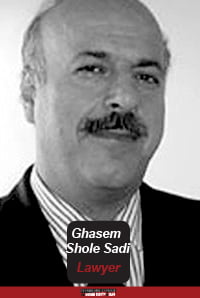
Ghassem Sholeh Sadi, lawyer, university professor, and former member of the Iranian Parliament, who is now serving time inside Evin Prison, was again tried by Branch 28 of the Revolutionary Court on the charge of “insulting Supreme Leader Ayatollah Khamenei” and was sentenced to two years in prison.

In an interview with the International Campaign for Human Rights in Iran, his wife, Sahandej Sholeh Sadi, said: “He has been sentenced to two years in prison by Judge Moghisseh on the charge of ‘insulting the Supreme Leader,’ while Branch 15 of the Revolutionary Court had previously tried this case. He objected to this decision in court, and the Investigative Judge promised that if after review they conclude the content of this file is the same as the one at Branch 15, the Judge will issue a cease order. After reviewing the case, he reached the conclusion that the charges in both cases were the same, and that a sentence was previously issued for this charge. Unfortunately, however, before he issued the order to cease proceedings, the Prosecutor sent the case out for prosecution to the Revolutionary Court, and he was sentenced to two years in prison again.”

“We are going to object to this new ruling and we are really hopeful that it would be changed,” Sahandej Sadi told the Campaign, emphasizing that her husband was charged with insulting the Supreme Leader because of interviews he had given.

Sahandej Sadi expressed concern about her husband’s physical condition and his spinal injury. “On Monday we had a booth visit; he said that he is still suffering from his spinal cord problem. Despite a letter written by the medical examiner to Tehran Prosecutor that he is not capable of tolerating his punishment, so far there has not been any action taken to remedy the situation. My attempts have all been futile. He can’t even move his left fingers anymore,” she told the Campaign.

Ghassem Sholeh Sadi was previously sentenced to 1.5 years in prison for writing a critical open letter to Ayatollah Khamenei, and was also sentenced to one year in prison and a ban on legal practice and teaching because of his media interviews and analysis. He was arrested on 3 April 2011 at Tehran’s Mehrabad Airport while returning from the city of Shiraz. He has been at Evin Prison for the past six months.


Source