Home Blog Page 550

Bodily Search of Female Students at University of Science & Culture

0


HRANA News Agency – Following the implementation of gender segregation at universities throughout Iran, the entrances for male and female students at the University of Science & Culture in Tehran (USC) have been segregated, and female students have been subject to bodily searches.

According to a report by Human Rights Activists News Agency (HRANA), as the new school year began in Iran, USC female students were directed towards a canvas tarp hung at the entrance designated for them. Iran’s semi-secret police tasked to monitor all educational institutes, Herasat, was established behind this curtain to inspect female students’ clothing and makeup.

In an unprecedented act, USC Herasat subjected several female students to bodily searches and asked to see their student ID cards. University students who didn’t have their ID cards with them were denied attending classes at USC and sent home. Additionally, a number of other students were asked to present birth certificates or driving licenses. Faced with students objecting to being searched, USC Herasat cited a notice issued by the university officials authorizing the bodily search.

To increase pressure on university students, the number of female agents at USC has increased significantly. Although USC Herasat had in the past confronted students aggressively and insulted them for their attire, as a result of gender segregation, USC semi-secret police has begun a new phase of its operations.


Source

Azerbaijani citizens arrested at funeral

0


Iranian security forces have arrested a number of Khoy citizens in northwestern Iran at the funeral for two prominent community activists in Azerbaijan.

The Association Defence of Azerbaijani Political Prisoners (ADAPP) reports that 60 people were arrested at the funeral of Ebrahim Jafarzadeh, his wife Mona Kahrobayi and their daughter Ayla.

The report indicated that the prominent activists and their daughter were killed in a “suspicious accident.”

The detainees reportedly include a number of Azerbaijani civil activists who have records of arrest and imprisonment for their social activities.

In recent months, several civil activists in Azerbaijan have been arrested by the authorities in connection with protests over the drying of Lake Oroumiyeh.


Source

MORE ARRESTS, THREATS AND SENTENCES FOR IRAN’S JOURNALISTS

0


Reporters Without Borders firmly condemns a new wave of arrests of Iranian journalists in recent weeks. The following journalists were arrested between 1 August and 27 September without any official reason being given:

  • Hamid Moazeni, a blogger and journalist who works for several local newspapers in the south-coast city of Bushehr;
  • Ali Dini Torkamani, a writer and economist who contributes to the online magazine Alborznet;
  • Hadi Ahmadi, a journalist who works for the news agency ISNA in Karaj, a city 20 km northwest of Tehran;
  • Mehrdad Sarjoui, a Tehran-based journalist who writes for several English-language newspapers;
  • Amir Mehdi Alamehzadeh, a journalist who works for the news agency ILNA in Tehran;
  • Ebrahim Rashidi, a journalist with the weekly Bayram in the northwestern city of Ardabil;
  • Faranak Farid, a writer and translator who contributes to the Feminist School website. She was arrested on 3 September in the northwestern city of Tabriz.

As already reported, members of the staff of Majzooban Nor, a website that supports Iran’s Sufis, were arrested during raids by intelligence ministry officials on 7 and 8 September, again without any official reason being given.

The following are still held: Alireza Roshan, a book reviewer for the newspaper Shargh, Ali Akrami, editor of the Sheydagooyi blog (http://sheydagooyi.blogfa.com/), Ali Straki, Mehdi Hossini, Mehdi Osanlo, Hamid Moradi, Mehran Rahbari, Mostafa Abdi, Nosrat Tabassi, Ali Moazemi and Reza Entesari.

These detained journalists are being denied their rights. They do not have access to their own lawyer. Some of them, such as Mehrdad Sarjoui, have been in solitary confinement for weeks. Others, such as Faranak Farid, have been mistreated. Their families are threatened with reprisals if they talk to the media.

Reporters Without Borders is also outraged by the way the various intelligence services are harassing journalists and intellectuals in an attempt to force them to collaborate with the regime and betray colleagues. Several detained journalists are suffering from depression after being pressured in this way. Others who are not in prison have fled the country to escape this form of harassment.

The journalist Narges Mohammadi has meanwhile just been sentenced to 11 years in prison on charges of collaborating with the Human Rights Defenders Centre, “meeting and conspiring against the Islamic Republic” and anti-government propaganda. Until her arrest, she was the centre’s a spokesperson and a close colleague of Nobel peace laureate Shirin Ebadi.

Ahmad Reza Ahmadpour, a theologian and editor of the “Silent Echo” website (http://www.pejvak-kh.com) who has been held since 18 July, was sentenced on 26 September to three years in prison and 10 years of internal exile on a charge of disseminating false information attacking the government.

A cleric and blogger based in the religious city of Qom, Ahmadpour was previously arrested in December 2009 and was given a one-year sentence on a similar charge. While held, he sent an open letter to UN secretary-general Ban Ki-moon to draw attention to his arrest.

According to the pro-reformist website Kalameh, Chari Mohammad Moradof, a citizen of Turkmenistan held for the past 26 months in Tehran’s Evin prison, has been sentenced to 21 years in prison on charges of spying and anti-government propaganda. A student and translator, he was arrested while filming a street protest shortly after President Mahmoud Ahmadinedjad’s disputed reelection in June 2009.


Source

Christian Pastor Yousef Nadarkhani faces potential execution

0


The Washington Post – Just days after Iran released two Americans accused of spying, an Iranian court has upheld the apostasy conviction and execution sentence of Christian Pastor Youcef Nadarkhani.

The 11th branch of Iran’s Gilan Provincial Court has determined that Nadarkhani has Islamic ancestry and therefore must recant his faith in Jesus Christ. Iran’s supreme court had previously ruled that the trial court must determine if Youcef had been a Muslim before converting to Christianity.

However, the judges, acting like terrorists with a hostage, demanded that he recant his faith in Christ before even taking evidence. The judges stated that even though the judgment they have made is against the current Iranian and international laws, they have to uphold the previous decision of the 27th Branch of the Supreme Court in Qom.

When asked to “repent” by the judges, Youcef stated, “Repent means to return. What should I return to? To the blasphemy that I had before my faith in Christ?” The judges replied , “To the religion of your ancestors, Islam.” To which he replied, “I cannot.”

It is reported that Youcef was able to see his children for the first time since March and was in good spirits speaking of how he longed to serve the church upon his release.

Pastor Youcef will be brought to the court for two additional “hearings” on September 27th and 28th for the sole purpose of being called upon to recant his Christian faith. TheACLJ’s sources report that although Pastor Youcef’s attorneys will attempt to appeal the case, there is no guarantee that the provincial court will not act on its own interpretation of Sharia law and execute pastor Youcef as early as Wednesday.

Technically, there is no right of appeal, and under Iran’s interpretation of Hadith and Sharia law, Pastor Youcef is to be given three chances to recant. He has already been asked to recant twice, and will be asked to do so again Tuesday. If he does not recant his Christian faith, he could be executed at any time.

We are continuing to press for the international community to take note of Youcef’s situation and call for his unconditional release. We are also continuing to work with members of Congress and are urging the State Department to get involved to save the life of this Christian pastor.

There is still time to save this pastor’s life.

Please share Youcef’s situation with anyone you know and pray for his release and the safety of his attorney, a brave Muslim who has been sentenced to nine years in prison and banned from practicing law by the Iranian government.

UPDATE: Today, Firouz Sadegh-Khandjani, a Member of the Council of Elders for the Church of Iran and a close personal friend of Youcef, called into my radio show from Iran to provide an update on Pastor Youcef. You can listen to the interview here.


Source


Iran: Executions point to ‘killing spree’

0


UPI – A sharp rise in the number of executions reported in Iran is raising suspicions that the Tehran regime has, in the words of a British newspaper, engaged in “a judicial killing spree” to intimidate its opponents.

Human rights organizations say this underlines the alarm within the regime that Iran could be infected by the wave of pro-democracy uprisings that have swept the Arab world since January and toppled three dictators.

The Tehran regime has cracked down hard on political dissidents since a major confrontation with protesters during the hotly disputed 2009 presidential election when Mahmoud Ahmadinejad won a second four-year term.

Thousands of dissidents were arrested and reportedly continue to be harassed and persecuted.

Amnesty International said there were 253 reported executions in the first six months of 2011, with another 300 people believed to have been killed. These included the first executions of juvenile offenders in the world this year.

In February, Shirin Ebadi, an Iranian human rights activist and former judge awarded the Nobel Peace Prize in 2003, accused Tehran of using criminal charges, narcotics in particular, to mask executions for political purposes.

“A second-term presidency launched amid bloodily suppressed riots in 2009 now appears to be assuming an even more vicious character as reports accumulate of ongoing secret mass executions and new waves of political repression,” foreign affairs columnist Simon Tisdall wrote in The Guardian of London recently.

These events “suggest the regime is embarked on what is in effect a judicial killing spree,” he wrote.

There was a sharp rise in the number of executions last December and January. The United Nations reported that 66 people were executed in Iran in January.

Most were reportedly related to narcotics crimes but three political activists arrested in 2009 were among those hanged, the office of the U.N. Commissioner for Human Rights reported.

“It’s no coincidence that Iran’s increased staging of public executions came at the same time protest movements were gaining steam throughout the Middle East,” Mark Wallace, a former U.S. ambassador wrote in the Los Angeles Times recently.

“What better way to keep Iranians from having ‘dangerous ideas’ like those of their neighbors?”

The United Nations says executions in Iran in the early part of the year were running at three times the rate of 2010 when about 18-25 people were executed monthly. The United Nations estimated that about 300 executions, most of them undeclared, took place in 2010.

Iran Human Rights, an independent monitoring organization, reported that 25 people were executed in Ghezel Hesar Prison in Karaj, 25 miles west Tehran, July 3, with another seven in Tehran’s notorious Evin Prison. All were allegedly drug-related.

Another frenzy of executions was reported two months later in the same two prisons. The state-owned newspaper IRAN said 22 men convicted of drug trafficking were hanged Sept. 19 in Evin and Ghezel Hesar.

Iran Human Rights said it had uncorroborated evidence that mass executions took place during 2010 in prisons in Khorasan province in northeastern Iran.

The International Campaign for Human Rights in Iran, a non-governmental group, reported in 2010 that undeclared mass executions had taken place in Vakilabad Prison in Mashhad, one of the holiest cities in Shiite Islam.

Ten prisoners were reported to have been hanged there Oct. 12, 2010. ICHRI quoted a former inmate as saying he’d witnessed 49 executions in one day in October 2009.

Mashhad, 530 miles east of Tehran, is the capital of Razavi Khorasan province. It’s a smuggling center for opium and heroin from neighboring Afghanistan.

Iran is a key conduit for large volumes of narcotics from Afghanistan and Pakistan headed westward through Turkey to Europe.

Narcotics use is alarmingly high in Iran and eradicating it has become a national priority. Some 3,500 security officers have been killed fighting smuggling gangs over the last two decades.

In 2010, amid growing criticism of Iran in the West for the growing number of executions in prison, the spokesman of Iran’s Foreign Ministry, Ramin Mehmanparast denounced the West for its condemnation.

He claimed 80 percent of those hanged were drug smugglers and declared, “If Iran does not combat drugs, Europe and the West will be hurt.”


Source

Cruise missiles delivered to Iranian Navy, IRGC

0


Domestically-manufactured Qader cruise missiles were delivered to the Navy and the IRGC Navy Division on Wednesday.

The event was attended by Defense Minister Ahmad Vahidi, Navy Commander Habibollah Sayyari, and IRGC Navy Division Commander Ali Fadavi.

Vahidi said that Qader missile, which had been unveiled by President Mahmoud Ahmadinejad, is now being mass-manufactured in the country.

The 200-kilomter missile has a high destruction power and can target destroyers and battleships, he stated.

The small-size missile moves at low altitude, he said, noting the missile with high precision and low weight has a high deterrence capability.

Vahidi also rejected claims made by cretin Western media outlets that the missile is not manufactured in Iran.

Iran has made great progress in designing and manufacturing various missile systems as well as anti-aircraft systems.

For instance, the commander of Khatam-ol-Anbiya military base announced last week that ‘Bavar-373″ missile system, which is being designed by Iranian engineers, is much more advanced than the Russian S-300.

The Islamic Republic is also designing a new radar system which is able to counter cruise missiles.

In addition, Iran is designing an anti-missile system that is able to change the direction of an incoming enemy’s missile.

The system is also capable of guiding the enemy missile and making it hit a different target.


Source

Hikers’ Lawyer Arrested, Interrogated, and Released in Tehran


On Tuesday morning, security forces entered the home of Massoud Shafiee, the lawyer representing the recently released Americans, and after several hours of searching his home and offices, transferred him to Evin Prison.

“Yesterday at 7:00 a.m., five security forces entered my home with my arrest warrant. It was strange to see an arrest warrant issued for me, as arrest warrants are usually issued for murderers or fugitives,” Shafiee told the International Campaign for Human Rights in Iran a few hours after his release.

“Going to prison is not a problem, it’s the best time to get some rest, something I need. I asked the gentlemen yesterday, ‘why don’t you consider the dignity of the Judiciary? Why would you want to arrest me?,” Shafiee added.

“They entered my home and searched the entire house, including the safe, the closets, everything for one or two hours. Even though they were respectful, this act was wrong in essence. They came right after my wife left the house. I guess they didn’t want to upset my wife. Then they asked me to wake up the rest of the sleeping family members.  After searching the home, they took my passport and several other things and brought me to my office. There they confiscated the computer and hard drive, documents, the case files of the two Americans, and several other documents and took me to Evin,” he told the Campaign.

Regarding his interrogation at Evin that lasted for several hours, Shafiee said, “most of the talk was about the two Americans’ case. But thank God everything ended well and they returned my documents, including my passport, to me, and I returned home. Whatever the young Americans do, and whatever they say, how is that related to me? I believed that they were innocent, and I did my job. But if, upon going home, they say some things, how is that related to me? My arrest did not have any legal justification. I am an Iranian and the entire time I defended the two Americans, I naturally thought about my country’s interest to protect the dignity of the [Iranian] Judiciary, and this is how I am treated in return for my honest work. I am so disappointed.”

“I just hope that I have not been barred from leaving the country. I am leaving next Sunday to visit my daughter, and I wish to visit the grave site of my sister who died a while back. The process of representing the Americans was prolonged and I was unable to go and see my sister in her last moments,” said Shafiee, adding that, “Now I am concerned that perhaps I have been barred from leaving the country, and it appears that I have. This morning I went to Evin to inquire about whether or not I have been barred from leaving the country. If this is the case, I should at least get a refund on my plane ticket. But they didn’t let me in and said that they would get in touch with me.”


Source

Al Qaeda chides Iran over 9/11 ‘conspiracy theories’

0


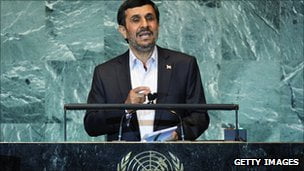
Al-Qaeda has accused Iranian President Mahmoud Ahmadinejad of spreading “conspiracy theories” about the 9/11 attacks in 2001.

Inspire, an al-Qaeda-linked online magazine, described Mr Ahmadinejad’s controversial speech to the United Nations last week as “ridiculous”.

The Iranian leader said he believed the World Trade Center towers could not have been brought down by aircraft.

The article said such a belief “stands in the face of all logic and evidence”.

Entitled “Iran and the Conspiracy Theories”, the Inspire article said Iran used the theory “as a rallying call for the millions of Muslims around the world who despise America”.

Iran “is a collaborator with the US when it suits it” nonetheless, the Yemen-based author said.

There have been sharp sectarian tensions between mainly Shia Iran and Sunni Muslim al-Qaeda – although are both fiercely opposed to US influence.

Mr Ahmadinejad’s speech last Thursday triggered a walkout from the General Assembly by diplomats from more than 30 countries.


Source

Dismissed Saderat CEO questions absence of Melli Bank chief

0


Mohammad Jahromi has slammed the decision to relieve him of his duties as the head of the Bank of Saderat and claims the man who just quit as head of Iran Melli Bank, Mahmoudreza Khavari, has fled to Canada due to the “widespread corruption in the Melli Bank system.”

Jahromi released an announcement stating that the main culprits in Iran’s huge banking fraud are in “the Central Bank, the cabinet and the banking system” and they are making every effort to falsely present him and the Bank of Saderat as the real perpetrators of this fraud.

He continues: “With the escape of Mr. Khavari [the former head of Melli Bank] to Canada, some of them are lost and caught off guard.”

Khavari offered his letter of resignation yesterday with an apology to Iran’s Supreme Leader and the Iranian people.

According to Jahromi, Khavari and his family were Canadian residents prior to his becoming the head of Iran Melli Bank.

Jahromi maintains that Khavari has fled to Canada, and his accomplices in the Central Bank and the government are trying to justify his absence. A Melli Bank spokesman told ISNA today that Khavari is currently on “an authorized mission” abroad and will return to Iran tomorrow.

Jahromi insisted that his dismissal is another way of pointing the finger in the wrong direction. He adds that the financial fraud was well underway before he was appointed to run the Bank of Saderat, and it was his attempts to investigate irregularities that led to his dismissal from the Council of Credit and Currency.

Reports of an immense financial fraud in Iran’s banking system hit the media in recent weeks. According to these reports, the owner of several companies has managed to acquire billions of dollars by colluding with the manager of a Bank of Saderat branch in Ahvaz in the sale of fraudulent letters of credit to public and private banks.

The judiciary has so far arrested 22 people in connection with this case, including the head of Ahvaz branch of the Bank of Saderat branch and a number of other mangers, as well as the head of the Kish branch of Iran Melli Bank and the owner those related investment companies.


Source

France: Iran faces high risk of military strike. Russia practices Iranian reprisal

0


France’s UN Ambassador Gerard Araud warned Wednesday, Sept. 28 that Iran runs a high risk of a military strike if it continues on the path to nuclear proliferation. “Some countries won’t accept the prospect of Tehran reaching the threshold of nuclear armament,” he said. “Personally I am convinced that it would be a very complicated operation …with disastrous consequences in the region.”
Ambassador Araud’s comment confirmed reports from DEBKAfile’s military sources in recent months that US and European sanctions against Iran had been ineffectual and the ayatollahs had no intention of slowing down on their drive for a nuclear weapon.
The French diplomat was not the only one to raise the alarm this week about regional war clouds circling over Iran.
Sept. 9-26, the Russian army, joined by Kazakhstan, Tajikistan and Kyrgyzstan, deployed 12,000 troops in a huge combined military exercise code-named Center-2011 which simulated an Iranian attack on Caspian oil fields operated by American firms in reprisal for a US strike against Iranian nuclear sites.

Russian intelligence postulated an instantaneous Iranian reprisal for this strike and based the war game staged by Russian-led Collective Rapid Force and the Collective Rapid Deployment Forces of the Central Asian Region –CSTO – on this assumption.
Our military sources disclose that the forces taking part in the exercise were briefed for a two-stage scenario:
Stage One: An naval attack on the Caspian Sea coast coming from the south (Iran).
Stage Two: A large-scale air and ground attack from the south by 70 F-4 and F-5 fighter-bombers, namely, the bulk of Iran’s air force, along with armored divisions, marine battalions and infantry brigades landing on the northern and eastern shores of the Caspian Sea.
The Russian briefing conjectured that the Iranian offensive would single out the Kazakh oil field at Mangustan on the Caspian coast, a field which DEBKAfile reports Exxon Mobile is operating.

Moscow clearly attached the highest importance to the exercise and extreme credibility to the hypothetical scenario. Russian chief of staff Gen. Nikolai Makarov personally commanded the drills and on Monday, Sept. 26, President Dmitry Medvedev toured the field commands and units.

Tehran was not idle: Tuesday, the day before the war game ended, Adm. Habibollah Sayyari, commander of the Iranian Navy, stated that  Iranian warships would be deployed “close to US territorial waters,” since the Islamic Republic of Iran considers the US presence in the Persian Gulf “illegitimate and makes no sense.”

After Tehran rejected a recent US request to establish a “red phone” link between the countries to avoid unwanted confrontation between their armed forces in the Gulf region, Ali Fadavi, Revolutionary Guards (IRGC) Navy chief, commented enigmatically: “When we are in the Gulf of Mexico, we will establish direct contact with the United States.”

A significant remark on the intentions of another nuclear rogue government came from Peter Hughes, the British Ambassador to North Korea, when he stopped over in Seoul on his way home from a three-year tenure in Pyongyang.
“I have had discussions with high-level officials, who have made clear to me their view that if Colonel Qaddafi had not given up his nuclear weapons, then NATO would not have attacked his country,” he said.

The ambassador therefore held out little hope of the long-stalled US-South Korea talks with the North resumed lately getting anywhere on Pyongyang’s denuclearization.

All these ominous events – pointed comments by French and British diplomats and the large-scale Russian-Central Asian war game – add up to widespread skepticism about any chance of halting Iran’s race for a nuclear weapon or disarming North Korea.


Source