Home Blog Page 614

Syrian refugees say Iranian forces involved in crackdown

Fri, 06/10/2011

AFP reports that Iranian troops are in Syria supporting the regime of Beshar Assad, according to injured Syrian refugees in Turkey.

The refugees say they were victims of “Iranian military forces,” but Iran has dismissed the allegations as “baseless.”

Mostafa, an injured Syrian refugee, said: “There were both plainclothes and uniformed Iranian soldiers. I saw them with my own eyes. We asked them not to attack us, but they didn’t speak Arabic.”

The 23-year-old man added that his attackers wore black shirts, which is uncommon in Syria, and wore beards. He added that the Syrian military is forbidden to wear beards.

A 17-year-old Syrian student named Akram reported: “Most of these people are snipers. They do not speak Arabic and, most significantly, they carry weapons that are unfamiliar to us.”

In May, the Washington Post cited U.S. officials saying Iran is supporting Beshar Assad’s regime during the recent uprisings. They claimed Iran is sending advisors and training personnel to suppress Syrian protests.

On Tuesday, British Foreign Minister William Hague accused the Islamic Republic of cooperating with the Syrian government to extinguish the protests, saying: “Iran is combining brutal suppression of opposition leaders at home with the provision of equipment and technical advice to help the Syrian regime crush protests in Syria.”

He added: “This is unacceptable, and compounds our concern about Iran’s behaviour and its intentions over its nuclear program.”

Yesterday Iran summoned the British charge d’affaires to explain Hague’s statements. Press TV reported that the head of the West Europe division of Iran’s Foreign Ministry told the top British diplomat: “The remarks [by the British Foreign Secretary] are completely unfounded and part of a series of false claims.”

He added: “The British government is not qualified to make such comments about other countries due to its negative influence and meddling in the region, especially by helping to train some countries’ military forces so they can crack down on the people.”


Source

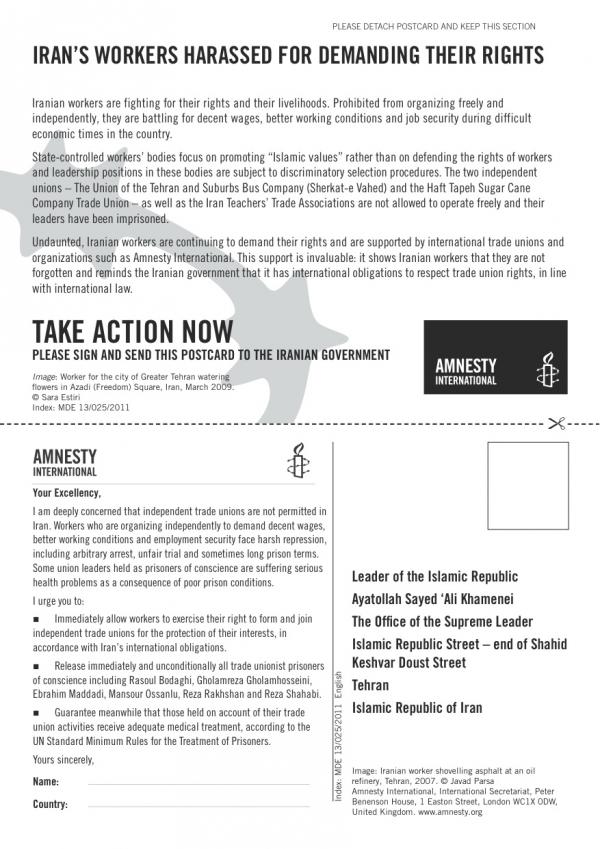
End the banning and harassment of independent trade unions

06/10/2011

An Amnesty International report released today, Determined to Live in Dignity: Iranian Trade Unionists Struggle for Rights, reveals the harsh treatment meted out to independent trade union activists who speak up for workers’ rights under Iran’s pervasive climate of repression.

“Independent trade unionists have been made to pay a heavy price by a government that has shown itself increasingly intolerant of dissent,” said Malcolm Smart, Amnesty International’s director for the Middle East and North Africa. “The harassment and persecution they face smacks of a desperate government attempt to stave off social unrest that could arise from new hikes in the costs of fuel and power to which Iranians are now being exposed.”

“The government seems determined to break existing unions while continuing to ban new, independent workers’ bodies that have begun to emerge, in gross contempt for its international obligations as an ILO member, and for the labour rights of its own people,” said Shane Enright, Amnesty’s global trade union adviser.

Leading activists in the banned Tehran bus drivers’ union were arrested in the crackdown following the 2009 presidential election, and up to 1,000 union members and their families were subjected to a brutal attack by security forces during a strike in 2006.

Mansour Ossanlu, president of the banned Tehran bus drivers’ union, has been repeatedly arrested and by the time of his conditional release last week had been in prison for almost four years.  Since organizing strikes in support of pay rises for bus drivers, he has been subjected to enforced disappearance, unfair trials and beatings, and frequently denied medical treatment. On the few occasions when he was allowed medical treatment, he was generally kept shackled to his bed.

“We greatly welcome Mansour Ossanlu’s release but he should never have been jailed in the first place,” said Shane Enright. “His release must be made unconditional and other trade unionists who are prisoners of conscience must be freed immediately. The Iranian authorities must end, once and for all, their persecution, harassment and imprisonment of trade unionists simply because of their efforts to uphold workers’ rights enshrined in International Labour Organisation conventions.”

Mansour Ossanlu’s union is affiliated to the International Transport Workers’ Federation (ITF), one of the global unions campaigning with Amnesty International for Iranian workers’ rights.

“The incredible mistreatment meted out to Mansour Ossanlu and his fellow members of the Tehran bus drivers union is a sign of how much some elements in the Iranian authorities fear them as a force for genuine change and reform,” said David Cockroft, the ITF’s general secretary. “His release is a positive sign but he and his colleagues must now be allowed to freely represent the interests of their members without fear of arrest or persecution.”

Independent unions, like other independent organizations and activists, have come under increasingly fierce attack since the mass protests that followed Iran’s 2009 presidential election.

The state-owned Haft Tapeh sugar cane processing company in Iran’s south-western Khuzestan province was forced to address working conditions after a mass strike led its workers to set up an independent union in 2008.  The new union’s president Reza Rakshshan has been detained twice in the last two years, and five other leaders were tried and sentenced in 2009.

“The IUF draws continued inspiration from the bravery of Iranian union activists who are risking their lives and their freedom for the rights of all,” said Peter Rossman of the International Union of Foodworkers, to which the Haft Tapeh union is affiliated.

Iran’s teachers’ association was formally banned in 2007 after strikes against low pay, but has continued its work in the face of hundreds of detentions, beatings and other ill-treatment of its members in detention, and even the execution of one member in 2010.

“The Iran Teachers’ Trade Associations’ members have told us that they will not be defeated by this extreme government intimidation, but that they need solidarity from ordinary teachers like them across the world in their struggle for rights,” said Dominique Marlet from Educational International, the global education union federation.

Amnesty International, in partnership with the global unions and the International Trade Union Confederation, is launching a campaign to support Iranian trade unions in their struggle for basic human and labour rights, ahead of the second anniversary of the 2009 Iran presidential elections.


Source

Iran begins to target women in new crackdown

0

June 10, 2011

Religious fascist dictators in Iran are creating a new suppressive force and establishing new suppressive plans,According to HRANA news agency.

Ahmadreza Radan, deputy commander of regime’s infamous police force and one of the major figures involved in heinous crimes in the horrible Kahrizak Prison, declared June 15 as the beginning of harsh plans in dealing with what he called mal-veiling and said:

“In our new plan, a dossier will be created for women who are mal-dressed and we will confront producers of unsightly clothing for women; we will also deal with those who create auditory pollution [referring to Iranian youth listening to ‘unapproved’ music in their cars].”


“Beginning of summer worries the officials, the people, and the religious leaders about mal-dressing and they expect the police force to carry out its responsibility,” Radan said.

He added: “In the highways and boulevards, special teams of motorcycle forces, driving control forces, and police will confront vehicles whose drivers or occupants are mal-dressed.”

Radan also spoke of intensifying suppressive measures in the northern provinces of Iran by using additional forces other than regime’s regular police force and said: “The police force will form the ‘clean police’ starting June 15 and will pay attention to mal-dressing even in the  interstate roads.”


Source

Two years after Iran polls, President Ahmadinejad under new pressure

0

Friday, 10 June 2011

Two years ago, Iran’s reformists were stunned to see him re-elected president and said the election must have been fixed.

Now, half way through his second and final term, Mahmoud Ahmadinejad has silenced the opposition—their rallies crushed and leaders under house arrest—but his presidency is still threatened, this time from rival fellow hardliners.

Critics in parliament, the judiciary and the clergy accuse the 54-year-old president of misdeeds ranging from a swaggering disrespect for other branches of government, through financial mismanagement, to being influenced by a “deviant” clique of aides some say are involved in sorcery.

Analysts say the fact that he can no longer rely on the complete support of Supreme Leader Ayatollah Ali Khamenei—who forced him to reverse his decision to sack his intelligence minister in April—means Mr. Ahmadinejad risks becoming a lame duck or even being forced out.

Some parliamentarians are threatening to impeach him.

But at a news conference earlier this week, a bespectacled Ahmadinejad looked in no mood to either quit or curb his populist, West-baiting agenda, promising to make good on a promise to create 2.5 million jobs this year and predicting once again that the “cancerous” Israel would be eradicated.

When asked about infighting, he answered: “Our position at the moment is to stay silent. An inspiring unity silence.”

And asked about reports of arrests of figures close to his entourage, he said: “They arrested those people. Good for them.”

“Now they should let us continue our job.”

A key part of the president’s job is steering the economy and Mr. Ahmadinejad says he has made progress where his predecessors were too timid and slashed the $100 billion in annual subsidies that the government used to pay to hold down prices.

Bread prices doubled and gasoline now costs up to seven times what it did six months ago, but forecasts of riots did not come true, allowing Mr. Ahmadinejad to declare victory for what he called “the biggest economic plan in the past 50 years.”

“He has certainly pulled off a policy his predecessors couldn’t politically,” Farideh Farhi, an Iran expert at the University of Hawaii, said of the subsidy reform long advocated by Western economists at the IMF and World Bank.

“But the inflation risk remains high,” she said.

Central Bank figures show the official rate of inflation has been rising steadily over the last year to 14.2 percent last month. Food inflation is around 25 percent. But many Iranians doubt the statistics and say real inflation is much higher.

Farhi said inflation was not just a concern for consumers, but also for industry whose input prices could soar.

“The real worry is a combination of increased inflation and increased unemployment as the factory owners’ inability to adjust to higher prices lead to shutdowns and layoffs.”

Inflation also contributes to pressure on the rial which the government has struggled to keep close to a peg with the dollar.

The Central Bank reduced the official dollar exchange rate by more than 10 percent this week, bringing it closer to the real price Iranians pay to buy dollars that many see as a safe haven in times of economic uncertainty.

Ever tighter international sanctions, aimed at forcing Iran to curb its nuclear program, have added strain to the economy.

But Ahmadinejad is benefitting from a spike in global oil prices that should insulate Iran from too much pain.

“It’s difficult to determine the effects of major economic surgery when oil is over $100 a barrel,” said Karim Sadjadpour, an associate at the Carnegie Endowment in Washington.

“We won’t know if the Iranians are swimming naked until the oil tide goes out.”

During his six years in office, Mr. Ahmadinejad has seen presidents and prime ministers come and go in Washington, London, Israel and Russia and has earned a reputation on the world stage for provocative hostility to the West.

The decision earlier this week to shift sensitive uranium enrichment to a mountain bunker and triple the output capacity of the nuclear fuel showed he is in no mood to compromise with countries that are piling on sanctions.

The United States maintains a veiled threat of military action to stop Iran getting the bomb.

Mr. Ahmadinejad said at his news conference there is no incentive major powers could offer to persuade Iran to stop enriching uranium—the process which makes nuclear fuel, or, if done to a higher level, weapons material.

The defense of Iran’s right to all types of peaceful nuclear technology plays well to a nationalist electorate and is in line with the view of Mr. Khamenei, who has final say on the country’s biggest issues.

Analysts say Mr. Ahmadinejad is more likely to harden his stance in what remains of his presidency.

“One way for Mr. Ahmadinejad to try to get back in the good graces of Iran’s hardline clerics will be to be even more vitriolic toward the United States and Israel. I don’t doubt that he will rise to the occasion,” said Mr. Sadjadpour.

“I expect that in the coming year Iran’s rhetoric toward Israel will be even more hostile than usual, and it’s plausible that they might use Hezbollah to provoke a conflict with Israel.”

Yet with criticism mounting from hardline rivals who are jostling for position ahead of parliamentary elections early next year and the presidential race in 2012, some question whether Mr. Ahmadinejad will make it to the end of his term.

“(Mr.) Khamenei’s ideal scenario is to have a weakened president who can absorb responsibility for Iran’s economic and political malaise,” said Mr. Sadjadpour, predicting President Ahmadinejad would stay.

Mr. Farhi was less certain when asked if he expected the president to serve out his term.

“He may or may not. His fate as president will depend on him and whether he will continue to challenge other institutions.”

“He will probably be able to survive as a lame duck president. But being a lame duck is not what he has shown to be in his character.”

 

Source

US sanctions Iranian police and two other security forces for rights abuses

0

06/09/2011

The United States on Thursday hit Iran’s police, Revolutionary Guard and the Basij militia with sanctions for “serious” rights abuses, ratcheting up pressure on the regime amid upheaval in the Islamic world.

Slapping sanctions on three key pillars of the Islamic Republic’s security apparatus, as well as the head of the nation’s police force, Secretary of State Hillary Clinton lashed out at the “hypocrisy” of Iran’s human rights rhetoric.

“While Iran’s leaders hypocritically applaud protesters abroad calling for self-determination, many of Iran’s own citizens… are being held as political prisoners merely for holding views contrary to Iran’s leaders,” Clinton said.

As popular uprisings continue to rock the Middle East and North Africa, Clinton also gave a message of support to Iranians longing for democracy.

“The United States stands with all Iranians who wish for a government that respects their human rights, their dignity and their freedom, and we call on the Iranian government to end its systematic human rights abuses and political hypocrisy,” said Clinton.

It is the latest in a series of measures against Tehran, following a crackdown in the wake of disputed 2009 presidential elections.

The sanctions freeze the assets of the three organizations in the United States and subjects them to a visa ban.

Iran’s elite Revolutionary Guards are the spearhead of the Islamic republic’s armed forces, while the Basij (Mobilization) is a militia made up of volunteers fiercely loyal to supreme leader Ayatollah Ali Khamenei.

The US had previously placed sanctions on Mohammad Reza Naghdi, the head of the powerful Basij militia.

The human rights-based sanctions are separate from a long series of Treasury sanctions on Iran linked to its suspected nuclear weapons program.

The United States and Iran have been fierce adversaries since the 1979 Islamic revolution.


Source

Azerbaijan poet Saeed Moghanli arrested

9 , June , 2011

Early Wednesday morning intelligence agents raided the home of Saeed Moghanli’s father. Security agents arrested the journalist from Azerbaijan in a village in Ardebil and transferred him to an undisclosed location.

Human Rights House of Iran reported that Mr. Moghanli’s personal belongings were confiscated during the time of arrest. This social activist from the province of Azerbaijan has been arrested on numerous occasions in the past years and has been subjected to many interrogations.

To date there is no information about his condition and no disclosure of his location.


Source

Arrest of Baha’i citizen, Anisa Dehghani

9 , June , 2011

Human Rights House of Iran reported that this Baha’i citizen had traveled from Isfahan to Mashhad for a visit with her friends. Security forces in Mashhad arrested her and transferred her to the intelligence holding jail in this city.

To date she has been able to contact her family twice. Despite her family’s efforts, officials have given no explanation for Anisa’s arrest.

During the past few weeks many Baha’i citizens in Iran have been arrested and taken to prison. Instructors of the Baha’i Institute for Higher Education, which is an online Baha’i university, are among those recently incarcerated.


Source

Iranian ‘blogfather’ loses appeal against 19-year jail term

06/09/2011

A renowned blogger with Iranian and Canadian citizenship has lost an appeal against a 19-year jail term imposed after he visited Israel, a French magazine said Wednesday, citing his family.

Hossein Derakhshan, a 35-year-old known as the father of the Iranian blogging movement, has been imprisoned in Iran since 2008 and was convicted last year of “aiding enemy states and propaganda against the Islamic system.”

He was best known for travelling to Israel in 2006, using his Canadian passport to get round Iran’s ban on such visits, hoping to help change the views that Israelis and Iranians have of each other’s countries.

“I’ve just had his family on the phone from Tehran,” his partner Sandrine Murcia told philosopher activist Bernard-Henri Levy’s revue La Regle du Jeu.

“They’re shattered. It’s the Biggest ever sentence imposed on an Iranian journalist. There’s no reason for Hossein to be in prison. This sentence is simply unacceptable,” the French woman said.

Murcia said she thought the lengthy sentence was intended as a message from Iran’s Islamic regime to the young cyber-activists battling to keep the spirit of the “green revolution” against the regime alive online.


Source

Human Rights Activist Abdolreza Ahmadi Sentenced to 3 Years in Prison

June 9, 2011

RAHANA: Blogger and human rights activist Abdolreza Ahmadi was detained in February of 2009 and spent 4 months in the solitary confinement units of the IRGC-run Ward 2A of Evin Prison.

According to the Human Rights House of Iran, he has been sentenced to 3 years in prison for acting against national security and disturbing public opinion.


Source


Concern Voiced For Children Of Iranian Political Prisoners

Thursday 09 June 2011

Radio Free Europe / Radio Liberty: Some 350 Iranian civil activists have written an open letter expressing concern about the plight of the children of political prisoners, RFE/RL’s Radio Farda reports.

The letter — addressed this week to Iran’s Judiciary Chief, the offices of the United Nations Children’s Fund (UNICEF) in Tehran and Jordan, the UN High Commissioner for Human Rights, Amnesty International, and Human Rights Watch — describes prisoners’ children as “forgotten victims” and says jailing a parent does not justify punishing his/her child as well.

One of the signatories to the letter, journalist and civil activist Fereshteh Ghazi, told Radio Farda June 8 that the Iranian authorities violate the rights of children whose parents are in prison.

Ghazi added that she has been in contact with a number of political prisoners’ families in the past two years.

She said Parsa Zeidabadi, whose father, prominent journalist Ahmad Zeidabadi, was arrested in front of his eyes and is now in jail, cannot sleep at night because of anxiety and has developed a stutter.

Ahmad Zeidabadi was arrested during the unrest in the wake of the June 2009 presidential election. He is currently serving a six-year prison sentence and has not been granted furlough since his arrest.

These children are deprived of regular visits with their jailed parents, and even when they visit them, it is not in proper conditions, Ghazi said.

She noted the negative psychological impact on children of so-called “cabin visits” in which the two parties are separated by a glass partition. “They pound on the glass, trying to get to the other side to hug their parents,” Ghazi said.


Source