Home Blog Page 622

Iranian women political prisoners speak out against sexual threats

SUNDAY, 29 MAY 2011

Radiozamaneh – Female political prisoners in the quarantine section of Iran’s Evin Prison have issued a letter for Iranian Women’s Day, saying they have suffered repeated sexual threats by their interrogators.

The letter, which was published on the opposition website Kaleme, indicates that male interrogators have often forced these female activists “to make false self-incriminating confessions” by threatening them with sexual assault.

The letter indicates that sexual threats are commonly used to “break the resistance” of female detainees.

In addition to sexual threats, they describe being subjected to “beatings and other forms of torture”, and add “In the detention centres of the Ministry of Intelligence and the Revolutionary Guards, subjecting prisoners to various forms of torture including slapping, throwing objects and even the chair at the prisoner, and severe beatings … are common practices.”

Many of the female political prisoners who had been sent to the general section of Evin Prison have now been moved to the quarantine section of the prison, which is referred to as the “methadone ward.” This section, which was used for detainees suffering from withdrawal symptoms of drug use, lacks all the facilities provided for prisoners in other sections.

The signatories of the letter say they are denied regular access to fresh air or any form of recreational activity. Even phone calls to their families are forbidden.

Currently, 32 female political prisoners are being held in the cramped quarantine hall (methadone ward) of Evin Prison and they have been told they will soon be transferred to Varamin Prison.

Last month, another 11 women political activists were arrested or recalled to prison to serve out their sentences.


Source

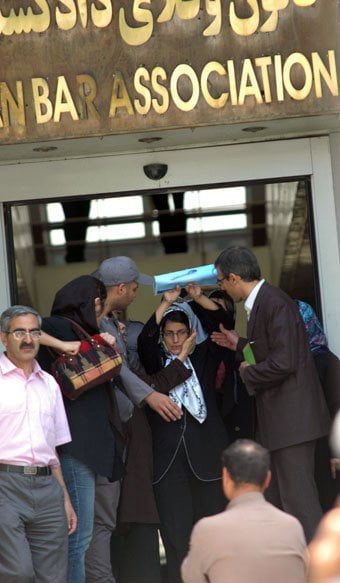
Human rights lawyer Nasrin Sotoudeh appears in court, in cuffs

05/29/2011

GVF — The first court hearing to examine whether to revoke veteran human rights lawyer Nasrin Sotoudeh’s license to practice law, was held today.

According to the women’s rights website Feminist School, on Sunday morning, Nasrin Sotoudeh was taken from Evin prison to the Iranian Bar Association where a group of lawyers including Ms. Keyhani, a member of the association’s board of directors, examined her case.

The school’s website has also reported that the jailed women’s rights activist was seen handcuffed and accompanied by a female police officer as well as two soldiers. “She appeared in the court with a smiling face while looking very confident, something that reassured those present [including] the women’s rights activists who had come to see Nasrin Sotoudeh at the Iranian Bar Association.”

In a recent letter to her husband Reza Khandan, who was also present at the court today, Sotoudeh had vowed to continue her battle to seek justice regardless of the court’s decision. “As long as these unjust sentences continue to persist, and as long as the Revolutionary Court continues to hand down shocking sentences, I shall object to these rulings with or without my license to practice law. Protesting unfair sentences does not require license. Tell them [they can] take away my license from me, but not justice!”

Sotoudeh is also known for her vocal advocacy in defence of her clients detained in the aftermath of the rigged June 2009 presidential elections in addition to interviews she gave to human rights organisations and media regarding their cases.

The writer, lawyer, and activist Nasrin Sotoudeh, is also the recipient of the 2011 PEN/Barbara Goldsmith Freedom to Write Award.

Nasrin Sotoudeh was summoned to Evin Prison Court on 4 September 2010 and was arrested and imprisoned there. In January 2010, she was sentenced to 11 years in prison, with a twenty-year ban on being professionally active and a twenty-year travel ban on charges of “acting against national security,” “colluding and propagating against the Islamic Republic of Iran,” and “membership in the Defenders of Human Rights Centre.”

In addition to being denied the right to see her two young children. Sotoudeh’s husband has also been harassed by the authorities and briefly imprisoned for supporting her.


Source


Iran: Ahmadinejad Administration in Tensions With Revolutionary Guards — 600 Million Dollars in Embezzlement

05/29/11


Ertebatat Zirsakht telecommunications company – a government entity operating under the Ministry of Telecommunications – issued a warning to Iran’s main telecommunications agency, TCI that unless it paid up its debt, the country’s telecommunications with the outside world and even between the country’s provinces, would be cut off “in the near future.”

Ertebatat is the company that handles international Internet communications, inter-provincial and international telephone communications for Iran’s Telecommunication Company (also known as TCI or the Sherkate Mokhaberate Iran), the government agency that regulates all telecommunications.

Ertebatat split from TCI in 2008 and has been operating as an independent government agency since then. It has about 25 million land telephone subscribers, 41 million cell phone (mobile) subscribers and about a million data subscribers who receive services from TCI. According to the manager of TCI, Ertebatat made a net profit of 2.5 million Dollars.

Prior to that, TCI was a fully government entity. It was bought by a consortium of three companies owned by the Revolutionary Guards, the IRGC, and the Setade Ejraie Farmane Imam (translated as the Operational Group for the Imam’s Decree) in September of 2009. The consortium, called the Tose-e Etemad Mobin, bought the shares of TCI and is made up of three companies: Tose Etemad investment company and the Shahriyar Mahestan investment company – both of which belong to the Bonyad Taavone company (a cooperative foundation) belonging to the IRGC – and Gostareshe Electronik Mobin Iran company which belongs to the Setade Ejraie Farman Imam group.

The 600 Million Dollar Debt

State-run IRNA news agency, which published the news of Ertebatat’s debt to TCI, adds that after Ertebatat broke away from TCI, the latter never signed any contracts with Ertebatat, while it still owes it about 700 million Dollars. In response to the claims and threats of Ertebatat, the managing director of TCI, Dawood Zarian announced that his company had no outstanding debt to Ertebatat adding that it had paid up its dues. He also said that Ertebatat pursued “anti privatization” actions.

Zarian has said that because his company has had good profits for its shareholders, “some were trying to create flux in the value of the company’s shares by making such debt announcements.”

An uproar and controversy erupted in 2009 when the TCI handed over 8 billion Dollars of its shares to the Tose Etemad Consortium that year. Just hours prior to the transaction, a competitor to Consortium, namely Pishgaman Kavir Yazd, was announced disqualified to bid as a way to ensuring that the IRGC owned Consortium would win the bid for the company. This event has been labeled as the “largest stock exchange transaction in Iran’s stock exchange.” Even the Majlis which conducted an investigation into the allegations of fraud a year later announced that the transfer of TCI shares as part of the privatization policy of the government was “superficial” (i.e. lacking essence and authenticity) adding that “the transaction took place completely in an uncompetitive manner with the purpose of passing shares to a government entity.”

The IRGC and Business

Tensions between Ahmadinejad’s administration and the IRGC Revolutionary Guards, involving such large sums of money, come despite the fact that Ahmadinejad’s administration has engaged in the largest business transactions since 2005 in which it has handed over the country’s largest projects in all economy and business sectors ranging from road building, industrial projects, gas and oil development projects, etc to the IRGC bypassing even existing regulations for such transfers that are designed to ensure fair competition among bidders. IRGC consortiums and firms that have received the bulk of government privatization shares include the Khatam ol- Anbia engineering firm and the Taavon (Cooperative) Foundation.

In addition, the IRGC has received full support in entering the financial and economic sectors of Iran’s economy which includes its banking and stock exchange activities. While there are no official estimates of the value of such transactions that have gone to the IRGC, numbers that are often mentioned by those in the business world are around billions of Dollars. What is known and clear is the heavy take over and involvement of the IRGC in the country economic life. One example of such intrusion are the activities of Mehr Eghtesad Iran Investment Company which till now has investments in a range of companies and fields such as telecommunications, Mobarake Steel Mill, Iralco, Tabriz Tracktor Manufacturing, Sadra, Technotaj, Tose Sanati Investment Company, and Jaberin Hayan Pharmaceutical Company.

According to Tehran Emruz newspaper, Bonyad Taavon Sepah (an IRGC cooperative company) currently owns 45 percents of Bahman Group, 4 percent of Saipa automobile manufacturing, and 25 percent of Kermanshah Petrochemical Plant. This entity is also aggressively active in Iran’s stock market and has purchased large shares in companies such as Bama. Among better known companies that are fully owned by the IRGC’s Bonyad Taavon are Kesht va Sanaat Shadab Khorasan company, Khadamat Havai Pars aviation company and Maede food industries.

In addition to such aggressive and uncompetitive market interventions and take-overs, the IRGC in August of 2006 militarily took over an oil production rig, Orizant, in the Persian Gulf operated by the Romanian “Grup Servicci Petroliere” company and a year later took over Kish Oriental company.

It is widely accepted that IRGC’s Khatam ol-Anbia is the largest economic and industrial cartel in Iran which owns and controls the largest oil and other economic projects in the country.

These tensions between the IRGC and Ahmadinejad’s administration come at a time when Ahmadinejad’s relations with the supreme leader have also been shaken particularly since last month when ayatollah Khamenei blocked Ahmadinejad’s dismissal of the intelligence minister. The IRGC and its commanders are directly appointed by the supreme leader and in recent weeks some commanders have publicly spoken against senior administration officials, particularly Esfandiar Rahim Mashai, the head of the president’s office, Hamid Baghai who is Mashai’s deputy, and Mohammad-Reza Rahim, the first vice-president.


Source

Regime’s official: Iran’s prisons so congested one cannot “drop a needle to the floor without being obstructed”

May 29, 2011

Speaker of regime parliament’s legal and judicial commission said: “The number of prisoners has so sharply risen that it has created many difficulties for the Organization of Prisons and the Judiciary. In fact, keeping so many prisoners has become a hard task.

In regards to the increase in number of prisoners, I must say that during the last 30 years, population of the country has doubled, but the prisons have remained the same as 30 or 40 years ago…

In reality, we transferred the prisoners to other prisons which resulted in doubling those prisons’ occupants, and currently, there is not enough space in those prisons to drop a needle to the floor without being obstructed,” government-run Khabar-Online reported on Thursday.

Meanwhile, mullah Ejeyee, regime’s chief prosecutor, admitted congestion in the prisons and said: “I say with frankness that we have congestion in some prisons. Of course, prison is different than one’s own house,” state-run Mehr News Agency said on May 25.


Source

Mullahs’ agents expelled 12 students from Tehran University; more were forced out of the dorms

May 29, 2011

To further suppress and harass freedom seeking students, the operatives of the mullahs’ regime at Tehran University, expelled 12 students.

Following the order of Kamran Daneshju, regime’s minister of higher education, 12 students of Tehran University were expelled. The students were from Tehran University’s School of Law and School of Literature.

Students who resisted against regime’s agents when student dormitories were attacked, were forced out of the dorm, and were replaced by Basiji and paid mercenary students.

Additionally, in order to create an atmosphere of fear at the universities, the security and control measures have been increased and intelligence and security agents are far more present at the universities than before.


Source

Iranian advisors helping Assad to crush Syrian protests: Report

Saturday, 28 May 2011

Iran is sending trainers and advisers to Syria to help crush anti-government demonstrations threatening to topple Iran’s most important ally in the region, The Washington Post reported late Friday.

The influx of Iranian manpower was adding to a steady stream of aid from Tehran, the newspaper said, citing unnamed US officials.

That aid includes not only weapons and riot gear but also sophisticated surveillance equipment that is helping Syrian authorities track down opponents through their Facebook and Twitter accounts, the sources said.

Iranian-assisted computer surveillance is believed to have led to the arrests of hundreds of Syrians seized from their homes in recent weeks, the paper said.

According to one diplomat and US officials, the Iranian military trainers are being brought to Damascus to instruct Syrians in techniques Iran used against the nation’s “Green Movement”’ in 2009, the Post reported.

Officers from Iran’s notorious Quds Force have played a key role in Syria’s crackdown since at least mid-April, it said.

US sanctions imposed against the Quds Force in April had been intended as a warning to Iran to halt the practice, said the Post.

Since the revolt in Syria erupted in mid-March, Friday protests have become a weekly ritual and are widely seen as a barometer of whether activists are able to maintain momentum despite the repression.

At least eight people were reported killed by security forces Friday as pro-democracy protesters took to the streets in cities and towns across the country after Muslim Friday prayers in defiance of a government crackdown.

The death toll by early evening was far lower than last week when at least 44 people were killed by security forces during similar protests.

State television said nine “martyrs”, including police and civilians, were killed by armed groups on Friday. Authorities say at least 120 soldiers and police have been killed since the protests erupted in March.

However, rights groups estimate at least 1,000 people have been killed over 10 weeks. Leaders at a Group of Eight meeting in France said they were “appalled” at the killing of peaceful protesters, demanding an immediate end to the use of force.

Damascus has ignored growing Western condemnation and sanctions and looks determined to crush the pro-democracy revolt by sending out security forces and tanks to
subdue unrest it blames on armed groups backed by foreign powers.


Source


Deteriorating Health of Political Prisoners on Hunger Strike

SATURDAY, 28 MAY 2011

HRANA News Agency – Reports from Rajai-Shahr prison indicate that the physical condition of political prisoners who are currently on hunger strike has worsened while their health is deteriorating fast.

According to a report by Human Rights Activists News Agency (HRANA), a number of political prisoners in Section 12 of Ward 4 in Karaj’s Rajai-Shahr prison began their hunger strike on May 22, 2011.  On the seventh day of this hunger strike, prisoners’ physical condition is reported to be critical.

The web site of Human Rights and Democracy Activists in Iran has reported that the political prisoners have become physically weak and suffer from headaches, fatigue and a number of other symptoms.  Keyvan Samimi, Mehdi Mahmoudian and Essa Sahar are amongst the prisoners whose condition is critical.

Meanwhile, the authorities continue to refuse addressing the prisoners’ rightful demands.  Additionally, there has been no news of Rasoul Badaghi’s condition since he was transferred to solitary confinement in Ward 1 of Rajai-Shahr prison on the fifth day of the hunger strike.


Source

Ofer fights sanctions

0

Saturday May 28, 2011

Ofer Brothers Group of Israel has joined Singaporean spinoff Tanker Pacific in challenging sanctions imposed by the US State Department, TradeWinds has learned.


Sources in Washington, DC say “top executives” at affiliate Ofer Shipping are locked in talks with advisors to Secretary of State Hillary Clinton, who has the power to remove the companies from the Obama Administration’s blacklist following accusations the companies sold a products tanker to Islamic Republic of Iran Shipping Lines (IRISL) last September.


An official said: “Both firms [Ofer and Tanker Pacific] have cooperated with the [State Department‘s] investigation and are interested, of course, in having the sanctions lifted but I cannot elaborate further.

“But I can say the sanctions will remain in place for at least two years unless the Secretary [Clinton] makes determinations and certifications that would have them lifted earlier.”

A spokesman at Ofer Shipping declined to comment when contacted by TradeWinds and refused to speak about an Israel Radio interview with Ofer Brothers Group spokesman Motti Scherf, who said his company “did business unwittingly with an Iranian shell company”.

During a Wednesday broadcast the AP says Scherf told commentators that Ofer Brothers and Tanker Pacific checked the US government’s list of companies affiliated with the sanctioned country before sealing the $8.7m sale of the 41,300-dwt products tanker Raffles Park (built 1992).

He reportedly identified the buyer as UAE-based Crystal Shipping, which did not appear on the blacklist.

When the transaction was first unveiled, sources in Dubai told TradeWinds the client was affiliated with IRISL.

Today, Equasis lists the owner as Coral Light Asset Corp of Iran which shares an address with shipmanager Qeshm Ramouz Gostar Shipping.

Scherf said in February the company “received an indication that this sale was more complex and problematic than what we thought at first” and said “the sale has been under US investigation for the past few weeks”.

Scherf and several other Ofer Brothers Group employees say they are “optimistic” the US sanctions will be lifted.

The Israeli owner and its Singapore subsidiary, which has publicly rejected the claims, are accused of failing to exercise due diligence in tanker transaction and violting anti-Iranian initiatives outlined in the Iran Sanctions Act (ISA) of 1996 and the Comprehensive Iran Sanctions, Accountability, and Divestment Act (CISADA) of 2010.

Both firms were barred from getting loans in excess of $10m from US financial institutions, financing from the Export-Import Bank of the US and and from obtaining US export licenses.

It is not known if Associated Shipbroking, which was accused of brokering the sale-and-purchase deal with the IRISL shell company, is fighting to have sanctions lifted as the company has not returned repeated calls requesting comment.


Source


The response of “International Organization to Preserve Human Rights in Iran ” to Khatami

SATURDAY, 28 MAY 2011

Insideofiran – The response of “International Organization to Preserve Human Rights in Iran (IOPHRI)” to the statements of Ahmad Khatami during Tehran’s Political Friday Prayers – on 27th May 2011. In which he said ” If the women assume scarf as hijab … ” by issuing this press release IOPHRI asks Khatami, for the sake of his tyranny should not interpret Quran according his own point of view and as stated in the Quran: ” You in the name of religion, justify your tyranny and use of the Book of God as a tool to interpret the Quran from your own point of view ” فسّر القرآن برأيه فليتبوأ مقعده من النار من ‏”.

The full text of press release, ” International Organization to Preserve Human Rights in Iran” is as follows:

In Tehran’s so called “Friday Prayer” Market Show the Temporary (Khatib) speaker Ahmad Khatami once again allowed himself to interpret Quran verse according his own personal ideology and defined Jalbab “جلباب” as a Veil ” چادر ” and gave ultimatum to his listeners!

The following points must noted in response to Khatami’s personal interpretation of Quran.

First – Jalbab (Surat Ahzab – verse 54) in Arabic language at the beginning of Islamic period at the time that the Quran was revealed to Prophet Mohammed referred to a one piece cloth which covered from neck downwards and did not convey a veil which covers one from head to toe, this was due to the fact that pre-Islam it was common for women to dress in such a way that their chest was visible and for this reason covering their chest and other parts of body via Jalbab was advised.

Second – In this verse there is no reference to head and hair and therefore covering of hair or head cannot be concluded from this verse.

Third – From this verse there is no trace of imposing a particular type dress code for women’s hair.

Fourth – In this verse the new Muslim women, who were used to ignorant traditions of the era, there is a recommendation on how to dress and makeup according to their own will and to cover their neck, chest and body as they are responsible for their actions to the God.

Fifth – This verse does not allow Geomancers and exorcists to use the Friday prayer for spreading superstitions and their own interpretations of Quran.

Sixth – This verse does not allow those who spread superstitions to interfere in women’s affairs under the pretext of starting a “Hejab Police”, or to spread gender discrimination within society by the use of heavy fines, floggings, dismissal from work, and other forms of inhuman persecutions in order to force them to accept the imposed and obligatory Hejab.

Dressing code of people is subject to customs and culture of a society in which they live in and falls within the area of personal responsibility.

The previous monarchist Iranian regime which was overthrown tried to impose “Non-Hejab Principle” as form of a social convention on Iranians, and now you are trying to impose “Forced Hijab” as the common norm on the society.

But there is a difference between what the current regime is trying to do and what Mohammad Reza Pahlavi and his father did. The Pahlavi’s did not impose “mandatory coverage” under the name of religion.

You, in the name of religion, are trying to justify your tyranny and using the Book of God as a tool and are interpreting it according to your own point of view and do not observe the following verse of Quran that explicitly prohibits interpretation of Quran based on personal opinions.

“من فسّر القرآن برأيه فليتبوأ مقعده من النار ”

Muslims advise to you that it is because of the severity of your ambition and lust for power that you can no longer deter yourself from such actions and return to the right path. You are too busy with the business of Geomancy and interpretation of Quran according to your own ideology to realise that you are raising the anger of the Muslims of the world as well as the displeasure of God.

28th May 2011

International Organization to Preserve Human Rights in Iran

Berlin – Toronto – Washington

Nordic Branch – Oslo


Source

Iran’s victims

SATURDAY, 28 MAY 2011

LA Times – Scores of political dissidents are languishing in jail or have been executed.


On May 28, 1961, British lawyer Peter Benenson penned a passionate article in the London Observer, drawing attention to the plight of two Portuguese students who had delivered a toast calling for democratic reform in their country and were promptly carted off to prison for defying dictator Antonio de Oliveira Salazar. Benenson wrote in that article: “Open your newspaper any day of the week, and you will find a report from somewhere in the world of someone being imprisoned, tortured or executed because his opinions or religion are unacceptable to his government…. The newspaper reader feels a sickening sense of impotence. Yet if these feelings of disgust all over the world could be united into common action, something effective could be done.” That summer, Benenson went on to co-found Amnesty International.


Today, across the Muslim world, the annual “prisoners of conscience” day — from a phrase in Benenson’s article — finds scores of political dissidents languishing in jail, their only crimes being peaceful expressions of opposition to the undemocratic regimes under which they live.


Their situation is particularly dire in Iran, where on May 17 in the city of Isfahan — home also to one of the country’s nuclear installations — jailers executed brothers Abdollah and Mohammad Fathi Shoorbariki, after subjecting Abdollah to beatings and threats of rape. Their parents were never shown the charges against their sons. According to the International Campaign for Human Rights in Iran, Bijan Fathi said, “I still don’t know whether my sons’ charge was moharebeh (enmity against God) or robbery. I don’t believe they were at war with the regime or with God.”


Last weekend Iran’s semiofficial Fars News Agency reported that Iran had arrested 30 people whom the country accuses of spying for the United States. It’s not yet clear whether the charges hold water, but even if they don’t, like so many other Iranians who stand accused of crimes against the regime, the detained face the death penalty.


In Iran, 29-year-old Iranian Kurdish university student Habibollah Latifi also faces extrajudicial execution on charges of “enmity against God” — a claim Tehran frequently invokes to silence political dissent. Latifi awaits his fate on Iran’s death row with at least 16 other known Iranian Kurds, as part of a massive wave of internal repression amid the demonstrations across the Middle East. The victims of Iran’s judicial system have no recognized rights to defend, and their trials, when they exist, are show trials at best.


According to an Amnesty International investigation last month, there has been “a sharp rise in the rate of executions in public in Iran — which have included the first executions of juvenile offenders in the world this year. Since the start of 2011, up to 13 men have been hanged in public, compared to 14 such executions recorded by Amnesty International from official Iranian sources in the whole of 2010.” Eight of those executions have taken place in the last month alone.


The plight of homosexuals, who face widespread state-sanctioned murder and violent repression, was the subject of last year’s Human Rights Watch report, “We Are a Buried Generation: Discrimination and Violence Against Sexual Minorities in Iran.” The investigatory report noted that trials based on moral charges in Iran are usually held in private. As a result, it is a herculean task to assess whether the defendants were killed for their sexual orientation.


As Iran continues its brutal crackdown on prisoners who seek the freedom to elect a government of their choosing, Western governments have swept its human rights violations under the rug, in hopes that dialogue and negotiations will somehow force its rulers to stop repressing their people.


President Obama, to his credit, has come to the realization that words alone will not change the Iranian leaders’ behavior, and he has enacted a range of sanctions against the regime as recently as this week. “Hundreds of prisoners of conscience are in jail” in Iran, Obama said in his annual address to the Iranian population on the country’s Nowruz holiday in March.


In a sharp break from his administration’s previous posture, Obama attached names to the nebulous statistics of brave Iranians promoting democracy at the risk of their livelihoods.


“We have seen Nasrin Sotoudeh jailed for defending human rights; Jafar Panahi imprisoned and unable to make his films; Abdolreza Tajik thrown in jail for being a journalist. The Bahai community and Sufi Muslims punished for their faith; Mohammad Valian, a young student, sentenced to death for throwing three stones,” Obama said.


Although the United States and the European have enacted human rights sanctions against Iran’s leaders, they have done little to prevent the ongoing persecution of Iran’s pro-democracy activists.


To inform the 50th anniversary of prisoners of conscience day with something more potent than symbolic speeches and commemoration events, the Obama administration must match words with actions. For starters, the president could help fast-track the one-two punch of human rights and economic sanctions legislation working its way through the House and Senate.


The new congressional measures contain a range of innovative penalties to crack down on Iranian officials responsible for human rights abuses, including targeting their assets and rejecting visas for their travel to the United States. The measures also punish foreign companies for their lucrative business deals with Iran’s Revolutionary Guard, including the sale of products used to repress Iran’s people, and the purchase of crude oil from Revolutionary Guard-controlled companies, which are the dominant force in Iran’s petroleum trade.


In southern Europe, prisoners of conscience made enormous sacrifices to bring freedom and representative government to their countries. Portugal’s fascist regime, for example, finally met its demise in 1974, as democracy began to take root. The Iranian people, who have suffered under their nation’s theocratic dictatorship for far too long, deserve no less.


Benjamin Weinthal is a fellow at the Foundation for Defense of Democracies, where Mark Dubowitz is executive director and head of the Iran Human Rights Project.


Source