Home Blog Page 623

Ahmadinejad loses ground with Revolutionary Guards

0

Sat, 05/28/2011

President Mahmoud Ahmadinejad came under more fire today from Iran’s Revolutionary Guards Corps (IRGC) and the Supreme Leader’s representative at the Corps.

IRGC head Mohammad Ali Jafari today told a meeting of Basij university organizers: “The presence of certain political views and opinions among the people surrounding the presidency is becoming worrisome for those who care for the Revolution.”

Jafari added that one of the chief “blights of the Revolution” are those people who were once on the path of the Revolution and have now turned against it.

Meanwhile, Ayatollah Khamenei’s representative at IRGC, Ali Saidi, said today that the government has been afflicted with a “major disaster being infiltrated by corrupt elements.”

In an interview with Mehr News Agency, Saidi warned Ahmadinejad and his supporters in president’s office that they can count on the support of “the nation of Hezbollah and the clergy” on the condition that they remain committed to the supreme leadership.”

He rebuked Ahmadinejad for failing to immediately act on Ayatollah Khamenei’s stated wishes. He seems to be referring to Ahmadinejad’s refusal to sever relations with Esfandiar Rahim Mashai, even after repeated implicit indications from Ayatollah Khamenei.

Ahmadinejad was forced to remove Mashai as his vice-president but then went on to appoint him his chief of staff.

Saidi went on to criticize the apparent “aristocratic current” and “elements of sorcery” attributed to Ahmadinejad’s circle of intimates. He said: “These people in the government have been engaging in sinful acts and those who are involved in such activities are completely corrupt.”

Ahmadinejad has been losing more and more ground in the Islamic Republic’s political landscape ever since his showdown with Ayatollah Khamenei over the president’s Minister of Intelligence, Heydar Moslehi.

After Ahmadinejad accepted Moslehi’s letter of resignation, Ayatollah Khamenei reinstated him as minister. Ahmadinejad showed his disgruntlement by avoiding cabinet meeting for over a week but he finally had too acquiesce to the Supreme Leader’s decision.

From that point onward, Ahmadinejad and his chief of staff have been repeatedly attacked by the conservative elite and accused of trying to create a “deviant current” in the Islamic Republic establishment.


Source


Rasoul Badaghi Transferred to Solitary Confinement

FRIDAY, 27 MAY 2011

HRANA News Agency – The imprisoned teacher, Rasoul Badaghi, has been transferred to one of the solitary confinements in Ward 1 of Gohardasht prison on the fifth day of his hunger strike.


According to a report released on the web site of Human Rights and Democracy Activists in Iran, on Sunday, May 22, 2011, Rasoul Badaghi together with a number of other prisoners announced the beginning of his hunger strike in a letter outlining prisoners’ demands.  In this letter, prisoners state that until their requests are not met, they will continue their hunger strike.  Rasoul Badaghi in protest to the ongoing oppression in Iran, the lack of freedom of speech, the absence of independent organizations, the continuing trend of show trials, the infliction of inhuman restrictions on political prisoners and the increasing pressures on their families has been on hunger strike for five days.


On May 26, 2011, instead of investigating Rasoul Badaghi’s legitimate demands, interrogators of Iran’s Ministry of Intelligence ordered his transfer to solitary confinement.  However, Rasoul Badaghi has announced that until his demands are not met, he will not end his hunger strike.


Rasoul Badaghi has outlined his requests clearly as follows:

  • Full implementation of prisons’ statute including visits, access to phone and the right to furlough
  • Ending any and all forms of pressures on the families of political prisoners
  • Immediate improvement of prisoners’ welfare and conditions


It must be noted that Rasoul Badaghi’s health and physical condition is by no means well, and other political prisoners are extremely concerned about his well-being.  Currently, in addition to Rasoul Badaghi, a number of other political prisoners including Keyvan Samimi and Mehdi Mahmoodian are on hunger strike.


Source


Detained Iranian reformist finally gets hospital check-up

0

Fri, 05/27/2011

Iranian political prisoner Mostafa Tajzadeh has finally been allowed to be taken to hospital after repeated demands by his family.

Tahavol-e Sabz website reports that Tajzadeh was examined by a neurologist and, after an MRI and CT scan, was diagnosed with severe spinal arthritis.

The report adds that Tajzadeh has been told to wear a medical neck support at all times and to use an orthopedic mattresses and pillows. The doctor has also recommended daily swims, exposure to sunlight and physiotherapy sessions.

Tahavol-e Sabz also indicates that Tajzadeh also suffered from a severe toothache, which he had reportedly endured for a long time. However since the judiciary had not specified a visit to the dentist, he was prevented from seeing one.

Tajzadeh is a senior member of the reformist party known as the Islamic Iran Participation Front. He was the minister of the interior during the presidency of reformist Mohammad Khatami. Tajzadeh was arrested following the disputed victory of Mahmoud Ahmadinejad in the 2009 presidential election, charged with “assembly and collusion against national security and propaganda against the regime.” He has been sentenced to six years in prison and a 10-year ban from political and media activities.

Many who supported the reformist candidates MirHosein Mousavi and Mehdi Karroubi in the 2009 presidential elections have been arrested and sentenced to long prison terms on similar charges.


Source


Advocacy group expresses solidarity and support for Abdollah Momeni, Nasrin Sotoudeh

05/27/2011

GVF — An independent watchdog that advocates freedom and democracy around the globe, has expressed solidarity and support for Iranian political prisoners Nasrin Sotoudeh and Abdollah Momeni, who will be celebrating their birthdays on Monday and Tuesday respectively, in Iran’s notorious Evin prison.

“Abdollah Momeni and Nasrin Sotoudeh, who should be spending their birthdays at home with their families, are instead held in terrible conditions, denied family visits, and undergoing abuse in Iran’s Evin prison. Their imprisonment and mistreatment by the Iranian authorities are gross violations of international human rights standards,” said Paula Schriefer, director of advocacy at Freedom House. “Freedom House calls for their immediate release as well as the release of other political prisoners suffering in Iranian prisons.”


Abdollah Momeni, a leading student activist and head of the Alumni Association of Iran (Tahkime Vahdat), was arrested days at presidential candidate Mahdi Karroubi’s campaign headquarters just days after the rigged presidential election on 12 June 2009.

While in prison, he was held incommunicado by the Iranian authorities for 35 days, his whereabouts unknown. In September 2010, Momeni wrote a letter to Supreme Leader Ayatollah Khamenei detailing the tortures he had faced during his imprisonment.

Human rights lawyer Nasrin Sotoudeh will also have to celebrate her birthday in Evin prison next week. After her arrest in September 2010 and a show trial in January, Nasrin received an 11-year jail-term and a twenty-year ban on practicing law and travelling abroad.


In addition to being denied the right to see her two young children. Sotoudeh’s husband has also been harassed by the authorities and briefly imprisoned for supporting her.

“Both Abdollah Momeni and Nasrin Sotoudeh have undergone severe abuse by the Iranian authorities, including interrogation under duress, attempts to force confessions, solitary confinement, and the denial of family visitation rights and legal representation,” Freedom house said on Friday. “Their imprisonment is part of a broader campaign by the Iranian regime to silence peaceful human rights activists and deny Iranians basic human rights.”

Iran is ranked Not Free in Freedom in the World 2011, Freedom House’s survey of political rights and civil liberties, and Not Free in Freedom of the Press 2011.


Source

Siemens denies supplying compressors for damaged Iran refinery

0

May 27, 2011

Siemens AG, Germany’s largest engineering company, denied that it supplied compressors for the Phase III unit of Iran’s Abadan refinery where a blast two days ago killed as many as four people and wounded some 25.

“Siemens has not sold any compressor to Abadan refinery Phase III,” Alexander Becker, a spokesman with the Munich-based company, said in an e-mailed statement today.

The May 24 blast and subsequent fire hit one of the two main compressors of the refinery, the Tehran-based Arman newspaper said today. The system, used to liquefy gas, wasn’t ready to be operated, it said, citing unidentified officials.


The newspaper said the compressors for this unit were purchased from Siemens, which declined to send experts to Iran to operate the machine for the start-up, citing restrictions related to international sanctions. The report cited an unidentified National Iranian Oil Refining & Distribution Co. official. Iranian personnel in charge of operating the compressors were under pressure to proceed with the project despite concerns about an accident, the newspaper said.

The explosion took place during the inauguration ceremony of the new wing at the refinery in southern Iran, an event intended to underscore the nation’s self-sufficiency in producing gasoline. Iranian President Mahmoud Ahmadinejad was present for the occasion.

‘Unreasonable Request’

The accident was the result of an “unreasonable request” to open the refinery on May 24, the state-run Mehr news agency said, citing remarks by Parliamentary Speaker Ali Larijani in parliament yesterday.

The government wanted to open the unit at Abadan in the southwestern Khuzestan province to coincide with the anniversary of Iran’s liberation of Khorramshahr, a city in the province that was captured by Iraqi forces during the 1980s war between the two countries, Mehr said in a report yesterday. The news agency cited Ali Mousavi, a parliamentary deputy representing the city of Abadan, as saying experts had conducted tests and warned about the possibility of an accident.

Officials in the Iranian president’s office for media affairs and the public relations department of the National Iranian Oil Refining and Distribution Co. couldn’t immediately be reached by phone. Thursday is the start of Iran’s weekend.

Iran, which is constrained by sanctions imposed by the United Nations, U.S. and European Union over its efforts to develop its nuclear program, is seeking to become self- sufficient in gasoline production by expanding its refineries and cutting domestic fuel use. The U.S. and EU say Iran’s nuclear program masks an effort to develop nuclear weapons, an allegation it denies.

U.S. sanctions have cut the flow of fuel into Iran, formerly the largest market for gasoline imports in the Gulf, and forced the country to boost its motor fuel production.


Source

Young boy becomes executioner in Iran

May 27, 2011

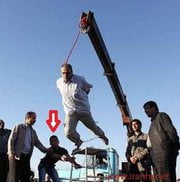
Over the course of the past two days a wave of executions in Iran has taken place with at least eight and up to 11 people hanged in public executions. One of the executions was conducted by a young boy.
Mehdi Faraji, 37, was hanged in public in Qazvin on Thursday. He was convicted of murdering five women who had boarded his mini bus. According to Iran Human Rights a young boy was used to remove the chair that Mehdi was standing on carrying out the execution. Mahmood Amiry-Moghaddam, the spokesperson of Iran Human Rights strongly condemned today’s execution and said : “These barbaric executions and using ordinary citizens, especially the minors to carry out these executions must be condemned by the world community”.


He added : “Iranian leaders must be held accountable for promoting a culture of murder and brutality in Iran”. According to the Herald Sun five people were hanged in public yesterday and two more were executed behind the public’s eyes. In Shiraz two men convicted of armed robbery and two convicted of rape were executed. In Sari two convicted of drug trafficking were also hanged. In Yasouj four convicted drug smugglers were hanged in prison.
The execution total for Iran in 2011 according to media reports stands at 143. Iran claims that the death penalty is needed to maintain law and order. In April Amnesty International reports that Iran executed two juvenile offenders convicted of rape and murder when they were 17. “Yet again, Iran has distinguished itself by being the only country this year to execute juvenile offenders. No more juvenile offenders must die at the hands of the state,” said Hassiba Hadj Sahraoui, Deputy Director of Amnesty International’s Middle East and North Africa Programme “Not only were these young men executed for crimes committed when aged under 18, but their executions were carried out in public. Public executions are not only a violation of the right to life, but are a gross affront to human dignity which cannot be tolerated.”
In 2010 at lest 252 people were executed in Iran according government reports to Amnesty International. The actual number is estimated to be over 550. Many of those executed have been convicted of drug trafficking. Those on trial in Iran often do not have long to wait to hear their fate. Trials can take place in just a few minutes. Mass trials are also said to take place in the nation. Those convicted of drug trafficking are denied the right to appeal in a court system that has sped the judicial processing of those cases.
Late in 2010 a new Anti-Narcotics Law came into being making it easier to give a death sentence to those convicted of drug trafficking. The families of executed persons are not always given their loved ones bodies. In some cases it has been reported that relatives have been ordered to pay for the rope used to kill their family members prior to receiving the body.


Source

Lawyer’s ‘nationalism’ on par with apostasy says deputy prosecutor

05/27/2011

Lawyer and human rights activist Mohammad Ali Dadkhah faced new charges in a trial court hearing held on Saturday, 21 May, including a charge on the same level as apostasy, according to the Deputy Prosecutor. Dadkhah’s charges ranged from membership in the Defenders of Human Rights Center, to representing a case against Isfahan’s Metro for endangering national heritage monuments.

“The most important charge in my case is my membership in the founding committee of the Defenders of Human Rights Center, which according to the court, was operating illegally and against national interests. I said in court that according to articles 26 and 27 of the Iranian Constitution, associations do not need permits. They recognize the Defenders Center as illegal. But the question remains as to whether an individual who wishes to run an illegal operation would go to the Interior Ministry, and adopt its articles of incorporation and credo? The reasoning of the court suffers from a paradox and no wise and rational individual would accept it,” Dadkhah told the International Campaign for Human Rights in Iran about the charges raised against him in court.

“They told me that my actions smell of nationalism. It was the Prosecutor’s deduction that nationalistic activities amount to apostasy. I told him that I am no expert in this area, but of course I have always defended our cultural heritage, such as Nowruz, to the best of my ability. The prophet of Islam said: ‘Love for the land comes from the belief in God.’ Which one should I accept now and what should I do?” said Dadkhah about his charge of “nationalism.”

Dadkhah told the Campaign that during his trial session, Shirin Ebadi’s activities were also mentioned. “They told me that they believe Ms. Ebadi to have issues, for example that her actions are [towards] overthrowing the regime. I told them that she has a separate and independent case, and [her doings] are not related to my case,” said Dadkhah.

Dadkhah, who was previously arrested and tried on charges of possessing drugs and guns, told the Campaign that his criticism of Saeed Mortazavi, the former Prosecutor of Tehran, was one of the issues raised in his trial. “In court, they asked why I said that Saeed Mortazavi had no right to mention my name in the newspapers as a suspect in a case of possession of guns and drugs. I said that if Mr. Mortazavi is responsible for implementing the law as the Prosecutor, he should know that according to the Code of Criminal Procedure, mentioning a suspect’s name is against the law, whether or not Mr. Mortazavi knew this. If he didn’t know it, he acted against the law and was not qualified to be the Prosecutor.  But if he knew it and acted on it, then he had mal-intention in my case and has treated me on other motivations.”

Mohammad Ali Dadkhah is a lawyer and founding member and spokesperson for the Defenders of Human Rights Center. He currently represents university students and many political activists who were arrested in the aftermath of the 2009 election. He also represented the plaintiffs in the case of the demolished Gonabadi Dervishes’ mosque. After pressure on lawyers began to mount, he was arrested in his office on charges of possession of drugs and guns. He spent more than 60 days in detention. New charges have been raised against Dadkhah, while the earlier case remains open.

International Campaign for Human Rights in Iran


No change in situation of opposition leader under house arrest

Thu, 05/26/2011

The son of Iranian opposition leader Mehdi Karroubi reports that his father has not been allowed to leave his home once during his 100-day house arrest.

In a report posted on Mehdi Karroubi’s personal website, his son writes: “In response to the false news that Mr. Karroubi has been released from house arrest, which has prompted repeated telephone inquiries from friends and supporters, I wanted to inform everyone that his situation has not changed and he is still under strict house arrest.”

“As of today, his one hundredth day of house arrest, Mr. Karroubi has not left the house even once, and during that time he has not even been allowed telephone contact with his children or grandchildren.”

Iranian opposition leader Mehdi Karroubi was put under house arrest together with his wife, Fatemeh Karroubi, after he and the other opposition leader, MirHosein Mousavi, rallied people to demonstrate last February in support of the recent Arab uprisings.

The two opposition leaders and their wives have been held captive in their homes despite the judiciary’s refusal to officially press charges against them.

“We hope that the government ends this illegal treatment as soon as possible,” the younger Karroubi writes.

Last week, the pro-government website Neday-e Enghelab published a report on the Karroubis entitled “the latest situation of the leaders of sedition and their wives.” They wrote that Fatemeh Karroubi was regularly allowed to leave her home and attend to her errands, and Mehdi Karroubi goes to the pool three times a week and orders food from the best restaurants in Tehran.

However, Fatemeh Karroubi, who was once allowed out for medical reasons, said in a short interview before her return that their entire apartment is under the control of security forces. She said she and her husband are denied the basic rights of prisoners such as making a phone call or getting daily fresh air.


Source


Ahmadinejad administration to be probed for suspect fund distribution

0

Thu, 05/26/2011

The Iranian parliament has approved a plan to investigate why the government distributed funds to people prior to the 2009 presidential election, under the pretext of paying interest on Edalat (fairness) shares.

“In reviewing the documents we have noticed that at the start of the presidential election, and without any apparent benefit, the government paid out 80,000 toumans to nine million people,” said MP Ali Akbar Oliya, according to Mehr News Agency.

“The source of these payments is not clear, and it is said that some companies were even forced to pay them out of their budgets, and that in fact it was not interest paid for shares,” the MP added.

Oliya insists that distributing the money appears to have been an attempt to influence voting in the election.

Previously, MP Norollah Heydari had accused Mahmoud Ahmadinejad’s administration of illegally distributing money to people.

This allegation has been loudly raised in recent weeks by several conservative MPs.

Assadollah Badamchian said recently: “As someone who cares for the president and the government and has had extensive experience in parliaments and elections, I warn Mr. President that the government should not interfere in election issues.”

Last week, however, Mahmoud Ahmadinejad gave a live TV interview in which he denied any government involvement in elections matters.

Iran’s conservative elite is intent on excluding Ahmadinejad’s circle of supporters from the next parliamentary election in March 2012.


Source


Baluchi Teenager Taken Hostage by Intelligence Agency for 20 months

THURSDAY, 26 MAY 2011

HRANA News Agency – Mohammad Saber Malek Raisi, a Baluchi teenager who was kidnapped by the Iranian Intelligence Agency 20 months ago, still remains locked up in solitary confinement.

According to a report by Human Rights Activists News Agency (HRANA), this Baluchi teenager was arrested in late 2009 in Chahbahar County because his brother refused to cooperate with the Ministry of Intelligence and National Security of the Islamic Republic of Iran. Mohammad Saber Malek Raisi has been locked up since then in solitary confinement in a detention center in the city of Zahedan, [Sistan and Baluchestan Province].

In the last twenty months, Mohammad Saber Malek Raisi has been denied access to phone or visits with his family. During this time, he has also been unable to attend school and has fallen behind his education.

Since Zahedan Intelligence Agency has neither offered any explanation regarding this teenager’s continued detention nor Mohammad Saber Malek Raisi has been tried for any crimes, it is safe to conclude that the arrest has been done illegally.

In an earlier interview with HRANA, Mohammad’s brother expressed his concern and said that he was worried about his brother’s continued detention since the Intelligence Agency could be holding Mohammad hostage until he would be at a legal age to be executed.

Despite the fact that one year ago the news of this arrest was published, and Mohammad Saber Malek Raisi was introduced to the world as Iran’s youngest political prisoner, human rights organizations inside or outside Iran have made no effort to look into this prisoner’s condition.

In short, Mohammad Saber Malek Raisi has been denied the right to attend school or pursuit a normal life for twenty months, and his family has not been allowed to see their child for the same period of time.


Source