Home Blog Page 652

Imprisoned and Exiled Student Activist Transferred Back to Prison

29th March 2011

In an interview with the International Campaign for Human Rights in Iran, “starred student” Zia Nabavi’s, told the Campaign that his son has been transferred back to Karoon Prison in Ahvaz. “My son has been returned to Karoon Prizon. I talked to him on the phone today. He was well,” Seyed Ali Akbar Nabavi told the Campaign.

Asked whether Zia Nabavi was allowed furlough for the Iranian New Year, his father said, “they won’t give him leave.” In order to start his exile sentence, Nabavi was transferred from Evin Prison to Karoon Prison on 22 November 2010. In February of this year, Nabavi was abruptly moved from Karoon Prison to an unknown location. His family found out a month later that he had been transferred to the Intelligence Office of Ahvaz.

Zia Nabavi is a Chemical Engineering graduate of Noshirvani Industrial University in the city of Babol, who earned a top ranking in the Graduate Entrance Examination in sociology in 2008, but was banned from continuing his education. Nabavi is the spokesperson for the Right to Education Council and was arrested on 15 June 2009. A Tehran Revolutionary Court, presided by Judge Pirabbasi, sentenced Nabavi to ten years in prison in exile at Karoon Prison.

Source

Political prisoner Mohsen Dokmechi passes away from cancer

March 29, 2011

Political prisoner Mohsen Dokmechi died last night due to lack of medical care and support. Mohsen Dokmechi was arrested for his support and contacts with the family of political prisoners and his daughter’s presence in Camp Ashraf, Iraq .

Despite the fact that he was suffering from cancer the inhumane government of Iran refused to give him proper care, even after they had to move him to the hospital. They denied any family visits during his hospital stay,  and he was under total control by his guards. Unfortunately, after many months of suffering with severe pain, he died last on Monday March 28th.

Source

No Furlough Allowed for Journalist Ahmad Zeidabadi

28th March 2011

Mohammad Sharif, a lawyer who represents many political prisoners and is one of the founders of the Defenders of Human Rights Center, spoke with the International Campaign for Human Rights in Iran about his client Ahmad Zeidabadi’s case. “Since his sentence was upheld [by the appeals court] there have been no new developments in his case.  The latest development was that I tried to get approval for his furlough leave [for the Iranian New Year, Nowruz], which, unfortunately, was not granted. So, he is now in Rajaee Shahr Prison and is serving his sentence term along with other political prisoners,” Sharif told the Campaign.

“Basically, they did not agree with the leave, and so bail was not discussed, either.   During the time between the lower court sentencing and the appeals court ruling, a series of actions were taken to set bail for him.  They changed bail courts three times and each time the family of Mr. Zeidabadi would provide the bail, and each time they had to pay a large amount of money for the fees of expert property evaluations for the several bails.  Even so, they did not agree to release him on bail until the final verdict was issued.  He has been in prison since he was first arrested, and he has remained in prison throughout his lower court and appeals court ruling.  Once the sentence was final, they said that he was now serving his term.  The other attempt I made was for his leave, and as I mentioned, basically, this year I was unsuccessful [to get prison furlough for Nowruz] for Hoda Saber, several of my clients from other provinces, and for Mr. Zeidabadi,” said Sharif.

“The last time I asked for leave for him was at Nowruz [Iranian New Year, March 21].  I had asked previously, too.  During several meetings with the Judge, I asked him whether these clients of mine could have furlough leave or not, and each time I faced a negative reply.  I knew what it meant.  For the New Year’s holidays, he acted himself.  I had the meetings, too, hoping that I could get him furlough leave, but unfortunately, they did not agree,” he added.

Journalist Ahmad Zeidabadi was arrested on 14 June 2009 in front of his home and has not been allowed prison leave so far. On 2 January 2010, Judge Pirabbasi sentenced Zeidabadi to six years in prison, five years’ exile in Gonabad, and a lifetime ban on social and political activities. An appeals court upheld Zeidabadi’s sentence in full. Zeidabadi’s bail was increased from $250,000 to $500,000; even so, the Tehran Prosecutor prevented his release on bail.

Source

Majid Tavakoli denied family visits, telephone privlidges

March 28, 2011

Iran News Agency: Majid Tavakoli the imprison student activist was not able to visit his family and was not allowed to have telephone contact.
Majid Tavakoli the student activist who was expelled from Amir Kabir University,  has been in jail since November 2009, continues to have his visitation rights revoked. In the New Year he was not allowed to have any telephone contact with his family.

Based reports from RAHANA, the authorities of Rajaee Shahr gave permission to some of the political prisoners who had no contact with their family for a long time to contact their family for the new year, However Majid Tavakoli was not permitted to do contact his family.
Tavakoli was prohibited from contacting his family since January of this year, and this ban has continued without any explanation.   In the recent visit from members of  RAHANA to his home town Shiraz; Majid’s mother said: “ I will not give up until my son is released and I will try to be his voice.”
She included:” all the greeting cards for Persian New year that were sent to our family have been banned by the officials in intelligent service.” She thanked everyone who supported Majid and her family and said:” Although my son is in jail, the support of other young activists who are following Majid’s dream keeps my hopes up.”
Majid Tavakoli who was arrested in November 2009 was sentenced to 8 years in prison. He was charged with insulting the leadership, acting against the system and will not be allowed to leave the country for five years after he served his term. He is currently in Rajaee Shahr prison.

Source

Iranian regime hangs five people in Evin prison

March 28, 2011

The Iranian regime secretly hanged five people in the notorious Evin prison on Monday, March 14, according to Hrana news agency.

One woman, two men and a couple identified as Adiva Mirza Soleiman and Varjoun Petrosian, followers of the Jewish and Christian faiths respectively, were hanged in the prison in Tehran.

The regime has prevented the families from organizing memorial ceremonies for their loved ones.

Source

40th day ceremony held for Mohammad Mokhtari, father wants son’s murderer revealed

March 27, 2011

Mohammad Mokhtari’s family and friends gather at his grave site on March 25th for the 40th day of death ceremony. Regime suppressive forces were also present.

March 25, 2011, Persian2English –  Today afternoon, following 39 days since the death of 22 year old Iranian student Mohammad Mokhtari, his family held the ceremony for the 40th day of his death at Behesht Zahra cemetery, the place of his burial.

In an interview with Rooz on March 15th, Ismaeil Mokhtari, the father of Mohammad Mokhtari asked for the identity of his son’s murderer to be [revealed and] publicized. He says that his son was shot in the forehead.

Mohammad Mokhtari, a 22 year old mining engineer student at Shahrood Azad University, was killed by a bullet during the [Iranian] people’s uprising on February 14th. His last Facebook status was: “Oh God, please give me the honor to die on my feet, for I am tired of living seated and humiliated.”

His Facebook profile picture promoted the rally that took place on February 14th. His close relatives [describe him as an] opposition to the Iranian regime and [there are] photos of him wearing a green wristband. Despite this, at his funeral, his dead body was carried by security and plainclothes forces.

Initially, some websites, including Rooz, reported that Mohammad Mokhtari died as a result of the delay in delivering him to the hospital.  But, Ismaeil Mokhtari recently told Rooz that his son was shot in the forehead with a bullet and died in the Imam Khomeini hospital.

(join the Mohammad Mokhtari Facebook page)

Below is the translation of the interview with Mohammad Mokhtari’s father:

The Rooz report above and the interview below are by Fereshteh Ghazi, Rooz Translation by Taghi Abdolhosseini, Persian2English

Fereshteh Ghazi (FG): Mr. Mokhtari, was your son a protester? Ismaeil Mokhtari: Mohammad, like the other youth, was open minded. He was in his last year in university for mining engineering. In the polarized disputes of our society, he was supporting the Greens. He supported the Greens and wore the green wristband that he never took off for over a year and a half. But, on February 14th, he took the wristband off and tied it to the house doorknob and left. Today, the wristband remains tied [in the same spot].

[Mohammad] was raised in a religious household. He prayed and fasted, and on holy nights, he travelled to Tehran to be with us. Sometimes, I would ask him to break his fast since he did not eat the meal at dawn, but he would say no.

I have to make it clear that there are two types of religious people, one who became religious after the Revolution and the other before the Revolution. Our family was religious before the Revolution. I have four sons and a daughter. I did the best I could for them so they could receive [post-secondary/post-graduate] education. I told them that I will take care of the costs, even if I was forced to sell the house.

Mohammad had written in his last Facebook status: “Oh God, please give me the honor to die on my feet, for I am tired of living seated and humiliated.”

During [the last lunch before his death], he told his sister that it would be his last lunch. He never took his wristband off during the year and a half [after the 2009 Iranian Presidential election]. I told him to be careful and to not let [political beliefs] make trouble for him. He replied that he would roll up his sleeve to show his green wristband [to anyone who confronted him]. But on February 14th he took his wristband off and tied it to the doorknob and left. When I put all the pieces together, I think that perhaps he was inspired. When I arrived home that day and realized that Mohammad had gone to the protest, I was very worried. But, I never thought that [he would be killed].

22 year old student Mohammad Mokhtari was killed when he was shot with a bullet in his forehead on February 14th, the day of the Iranian people’s uprising against dictatorship.

FG: How did you find out about your son’s martyrdom? IM: Someone called and informed me [that my son] was in the Mostafa Khomeini hospital and his head was bandaged as a result of being hit by a stone. We managed to get to the hospital and learned that the truth was a different story. They told us that he should undergo surgery to prevent the bleeding to see how much damage [was caused]. They told us that [the surgery]  would take up to five hours, but, less than an hour later, they transferred him to the ICU. I touched his legs, they were cold. He was not breathing. The oxygen tube was disconnected from his mouth. Still, Mohammad’s body was held in the ICU over night. In the morning, they [informed] us that he died at 6:30am.

FG: What part of his body did the bullet hit? IM: The bullet was lodged in the center of his forehead. During the funeral, after washing his body, I kissed that part of his forehead.

FG: How did you receive his dead body? IM: They did not give his body to us in the hospital. They said that legal work first needed to be completed and a file must be established. We went to the police station, and, the next day, we did the funeral.

FG: Did you attend the funeral? The reports and photos show that the funeral was performed by Basij forces. IM: They came to us in the morning and arranged for the funeral to be at 10:30am. My son went to get the body, but he [didn’t return until] 2:30pm. We [were] told to carry the body from home to the mosque and then place the body in an ambulance there. [But,] [the family was] still at home when they took the body out and began the funeral. I saw the photos later and noticed that none of my friends and relatives were carrying the coffin. We came, but trailed the funeral. I was at the gates of my house when they had reached the front of the mosque. They stood there and chanted slogans, beat their chests, and filmed the event. This made me very angry. At 5:30pm, they told us to go to the Behest Zahra cemetery. I told them that Behesht Zahra closes at 3 o’clock, but they said it would be open.

On March 21st, the first day of the Persian New Year, Mohammad Mokhtari’s family set up the traditional haft-sin on his tombstone.

FG: In what section is Mohammad buried in? Was the place of burial chosen by you [and your family]? IM: He is buried in section 249, number 6, in a two-story tomb.  His friend is buried below him. [The story of how this happened] is strange. Mohammad had a friend names Rouzbeh. They would always hang out and study together in Shahrood. Then they decided to go to Tehran together. Rouzbeh’s parents had gone to Cyprus. A day after they [arrived in Tehran], Mohammad decided to [return]. Rouzbeh [decided to stay in his house] in Tehran. Later, after not hearing from Rouzbeh, Mohammad went to see him, but Rouzbeh had killed himself. He lay on his bed, his mouth surrounded with foam. There was a broken gas valve in the room. Mohammad suffered a lot. He could not believe it. Rouzbeh’s father…purchased a two-story tomb, and suggested that, one day, Mohammad should be buried there too. We made these arrangements. When Rouzbeh’s body was buried, and after they covered the top, Mohammad…asked to also be covered in soil. We explained to him that this was Rouzbeh’s fate. [Now,] Rouzbeh is at the bottom and Mohammad is on the top. We never thought that the tombstone that he once photographed and wanted to lie in would be his home.

FG: What was written in the death testimonial certificate for the cause of death? IM: Bullet to the head.

FG: You have not held any ceremony for the seventh night of his death. Was there any specific reason for this? IM: We had announced that we would hold a ceremony for his third night of death at the Nabi Mosque, and for the seventh night of his death, the ceremony would be at home. They said that the Nabi mosque did not have any open slots. We said that we would hold it at our home instead. But, then the ceremony would have coincided with the February 20th protests, so we decided to not hold the ceremony. On the seventh night of his death, we along with our friends and relatives went to the Behesht Zahra cemetery. The ceremony for the fortieth night of his death is March 26 and we plan to go to his grave and hold the ceremony there.

FG: Have you made any complaint in regards to identifying the person who killed Mohammad? IM: The first day, they asked if we had any complaints. I asked who we should file the complaint against. But, now, I have written a complaint letter and I will pursue it. They should identify the killer so [Mohammad’s] mom may settle in peace, so [we may all] settle in peace. They say that the *Monafeghin (the hypocrites) had killed him, [so then they should] publicize the identity of the killer. My son was almost two meters tall. They had hit him from the front, directly in his forehead. Let us know who killed him…

FG: May I ask how Mohammad’s mother and the other family members are dealing with this right now? Had you ever thought that Mohammad’s participation in the demonstration might… IM: No body believes it, neither do I. I [still] think that Mohammad is in Shahrood studying in his last semester. He commuted there for four years…He was a young, healthy, and athletic…I always worried that [since he was in another province], he may befriend crooked people, but never could I have imagined something like this. Now, his photo is on the computer monitor, in front of me with open arms, like he wants to hug someone. The green wristband is tied to his wrist. His mom looks at his photos and watches his videos every day. None of our family members can [still] believe [this happened]. We are all waiting for him to come [back]… But Mohammad left us with a belief. He had [published] everything on Facebook and took the password with him…

Source

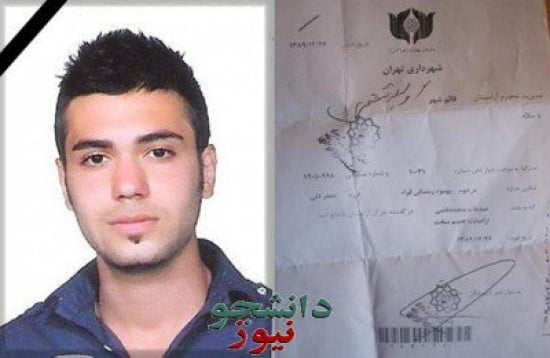
Behnoud Ramezani’s Close Friend Reveals Brutal Beatings by Regime Forces Resulted in Death

March 27, 2011

23rd, 2011, Daneshjoo NewsBehnoud Ramezani, a second term student at Nooshiravani University of Technology in Babol, was killed on the night of the Iranian Fire Festival at the hands of basij forces in Tehran. The body of this martyred student was eventually delivered to his family two days after his death, under the condition that he be buried outside of Tehran. The two initial forensic reports described the cause of death as “multiple blows to the head by a hard object”. The “final” cause of death, however, was announced as a result of “explosion of a hand grenade”. Security forces banned any burial ceremonies for Behnoud Ramezani in Tehran, so this martyred student born in 1992, was finally buried on Friday, March 18th, in his native village of Gharakhil in the province of Ghaem Shahr. The following interview was given to Daneshjoo News by one of Ramezani’s close friends who was with him at the time of his death:

Can you please provide us with background information on Behnoud?

Behnoud was born in the village of Gharakhil in the province of Ghaem Shahr. Due to an employment opportunity for his mother, she and Behnoud moved to Dubai when he was in forth grade. He lived in Dubai until his second year in high school and became fluent both in Arabic and English. His family then moved back to Tehran and Behnoud enrolled at Dr. Shariyati High School in Tehran, Pars, the neighborhood where he also lived. After high school, Behnoud enrolled at non-profit community college named “Salam”. At that time, Behnoud studied from morning til night and kept saying, “I’ll study for an entire year. I’ll bear the hardship now and all will be well when I [get accepted to] the university.” However, something strange happened when he took his university entrance exams. I would have sworn that he could have ranked amongst the top 1000 or less in the entry exams, but his watch wasn’t working; it was apparently slow on the day of the entrance exams, and as a result, he was forced to skip the physics tests although he was strong at physics. In the end, he ranked 3300th and was accepted at the Mechanics Faculty at Nooshiravan University of Technology in Babol. He chose this university because most of his relatives went there. Behnoud’s family is very religious. I know his father, and although he is religious, he by no means supports this government.

Please explain Behnoud’s beliefs if you will.

We both believed that everything should be based on humanity. Neither of us were particularly religious. In our discussions, we came to the conclusion that we want behave like decent human beings without harming anyone [in our actions]. Whenever we had discussions, we came to the conclusion that in this country we will never be able to do the things we like. There will always be obstacles and problems. There are always people who won’t allow us to live how we like to live. All in all, it is impossible to do anything here. Our thought was to study for four years and then leave the country. Behnoud and I had differing political views. Behnoud was completely against the current ruling government.  He always watched the programs on satellite, even though I personally disliked some of these programs. There were times when we had lots of discussions. For example, we would argue every day for two weeks in a row.  We would discuss how we should change this corrupt regime. We would talk about how lives would have to be sacrificed. My friend and I would explain that we were not willing to die for this cause. We wondered whether people would stand by us and follow in our path if we paid such a price. What if we paved the way and the people did not follow? Behnoud did not agree with our analysis and would say: “You may be right, but in the end lives have to be sacrificed, there has to be bloodshed…”.

What were Behnoud’s thoughts on the Green Movement and the events that occurred after the elections? Did he participate in the post-election demonstrations?

We argued a lot regarding this issue. We weren’t really preoccupied with Mir Hossein Mousavi and the others. We were completely against the ruling government. Our hearts were 100% with the people of Iran. Behnoud wanted to attend all the demonstrations, but my friend and I wouldn’t allow him to attend. He wanted for all of us to participate in the demonstrations together, because we were all supportive of the people’s movement. Until Qods Day and Ashura, Behnood kept insisting that we attend the demonstrations. I kept saying, “Let it go my brother. They are going to kill everyone.” At first, they [authorities] were not as brutal, but later anyone who showed up [in demonstrations] was named a “Mohareb” (enemy of God), arrested without a trial, and killed.

Can you explain what happened to Behnoud during the Iranian Fire Festival?

A few days before the Iranian Fire Festival, we organized material and built a few hand grenades. After the Fire Festival, we went to the 22nd Square in Narmak where a number of our friends live. We had put the hand grenades in our car. We were going to wait and see — if the time was right, and others were using hand grenades, we had planned to use ours too.

What was the security atmosphere like at that square? Did you witness any demonstrations or people chanting slogans?

The security atmosphere in Tehran was undoubtedly tense. At around 4:00pm, when we left Iran Pars Square, you could see security agents every step of the way. We later went to Narmak, because that neighborhood has approximately 150 to 200 squares and even if they placed 10 agents at every square they would need to deploy tons of agents. In any event, there were lots of motorcycle-riding security agents watching the neighborhood. We didn’t witness any particular political protests in the square. We had no intention of holding political rallies, not because we were against the idea of protesting, but rather because we saw our Iranian Fire Festival as a night for happiness, celebrations, and festivities.

At around 6:00pm, a number of motorcycle-riding agents filled the square. Those in front were fully equipped Basij’s, followed by special security forces who were covered in gear and also well equipped. We all ran away and about fifteen minutes later, we returned to the square.  At around 8:00pm, the security agents once again attacked the square. The 22nd Square was very busy. There were approximately 40-50 of us young men in the square. Later on in the night, when the crowd dispersed and Behnoud and I were standing with a few others in the middle of the square, we noticed that a group of motorcycle-riding agents had entered the main street. They revved their motorcycles and drove towards us causing us to flee. After a few seconds, I turned around and saw a boy with a short beard running away. At first I didn’t think he was a Basij, but then I heard a women at the end of the street shouting: “They have killed someone! The Basij’s have attacked and killed someone!” Initially, I had no idea that it was Behnoud she was talking about. I saw two of the neighborhood boys running after the Basij who had jumped into a White Samand with the license plate “44-Iran-246S61″ and had fled the scene.

Was the boy you saw a Basij? What was he wearing?

Yes, I’m sure he was a Basij. I don’t recall exactly what he was wearing, but I think he was in plain clothes. When someone has been killed, no one runs away. If anything, people come to see what has happened so that they can help. Unless you have killed someone, you don’t run away. Behnoud had not moved even 10 steps from his location. A few of our friends who had witnessed what happened, explained that they first hit Behnoud from afar with an electric shocker (I must say that I am sure of this fact) and later Behnoud slipped. When I went to stand above him, I saw that Behnoud’s body and face were black and bruised. He had not even shed a drop of blood. Reports by certain sites saying that his body was cut up in pieces are completely false! His pants were burning and looked like coal, so we took his pants off. His jacket was completely ripped. We then called an ambulance.

Why were his pants burning? Did he have a hand grenade in a pant pocket?

I don’t know why his pants were burning, but I am sure of one thing, there was no hand grenade in his pant pocket. Maybe I might have done something like that, because I’m stubborn, but Behnoud was smarter than that. He would never do something like that. These small hand grenades generally don’t cause much harm, let alone kill anyone. Once in the past, one exploded in front of Behnoud, resulting in his face being covered with smoke.

What happened to the special security forces?

I first ran after the Basij. When I returned, I no longer saw any other security forces. Those who were present, said that they had all ran away. In general, the basij and the special security forces are together.

What did they do with Behnoud’s body?

I saw Behnoud’s body. Later the forensic experts confirmed the details in their report. The bone in his right thigh was crushed. One of his testes had exploded. His right or left hand was broken. His neck was broken, but an injury to the spinal cord does not lead to death. The cause of his death was the heavy blows to his head. It is unclear what caused the head trauma that led to the rupturing of an artery in his brain and cerebral hemorrhaging. He was taken to the Alghadir hospital by ambulance where he was declared dead.

What is your last word? What are your expectations of the authorities in Iran and the international community?

Let me clearly state that those responsible in Iran will do nothing.  They are happy with things as they stand; both those in high positions of power and those who are in the lower ranks who know they could do something but don’t want to create headaches for themselves. The citizens are left holding the short end of the stick with no one to turn too. What can you expect of the likes of Hashemi Rafsanjani who first stepped forward, but then retreated and instead engaged in flattery? I have absolutely no expectations of the authorities. When it comes to the international community, I really don’t know what to say. They just talk, but we see no action. They keep publishing resolutions that only lead to someone like Ahmadinejad to laugh at us. These resolutions only increase the pressure on us and not on the likes of Ahmadinejad. Let them understand that by publishing resolutions, the price of gas only goes up for us. Our life becomes more difficult. They, on the other hand, are unscathed. I had better not embark on discussing this issue, as it will take me until tomorrow. I feel sorry for the international community because all they seem to do is talk.

Thank you for providing us with your time.

Source

Female political prisoner in Iran in coma after denial of medical treatment

March 27, 2011

A female political prisoner has gone into coma and transferred to a hospital on Saturday after she was refused medical treatment by the regime’s agents in prison for her critical heart condition.

Zahra Jabbari, who was also imprisoned in the 1980s, was arrested last year and placed under inhumane torture.

She was last arrested for having family ties with members of the main opposition People’s Mojahedin Organization of Iran (PMOI/MEK) in Camp Ashraf, Iraq.

She is diagnosed with a serious heart condition and acute rheumatism, but has been refused medical treatment on the orders of Abbas Jafari Dolatabadi, the regime’s prosecutor in Tehran, and interrogators in prison. Her condition deteriorated rapidly as a result.

The Iranian regime routinely exploits political prisoners’ illnesses as leverage to pressure them and torture them.

Source

Urgent news: Iranian-Kurd prisoner in imminent danger of execution

March 26, 2011

According to various reports Shirkou Moarefi, an Iranian-Kurd political prisoner, will be executed on May 1.

The Human Rights Activists News Agency reports that a local Kurdish newspaper in Iraq is citing reliable sources as it reports that Shirkou Moarefi is set to be executed on May 1, International Workers Day.

At the same time, the Campaign for the Defence of Political Prisoners reports that the Islamic Court of the city of Saghez has approved the execution for May 1.

The Campaign has also published a letter written by Shirkou Moarefi’s family, which urges human rights organizations and international bodies to negotiate with the Islamic Republic government to save the condemned man’s life.

“Shirkou was charged with Moharebeh (enmity with God) by the Islamic Republic for his support of an organization that for years had put aside armed resistance and was only active in cultural activities, and his death sentence was issued after a few minutes in court,” the Moarefi family writes.

Aged 31, Moarefi was sentenced to death for “activities against national security” and “enmity with God.”

He was arrested in November of 2008 in Saghez for cooperating with the Komeleh Party, a dissident Kurdish organization.

Last year, Khalil Bahramian told Rooz-on-line that his client’s file was being reviewed by a branch of the Qom Supreme Court and also by the Amnesty and Impunity Commission.

Shirkou Moarefi was not a member of the dissident group Komeleh but rather just a sympathizer.

In November 2009, Ehsan Fatahian a 28-year-old Iranian Kurd was executed in Sanandaj for cooperating with the Komeleh organization. In May 2010, five other political prisoners, four of them Kurdish, were hanged in Evin Prison in Tehran.

Source

Iranian-Backed Thugs Reportedly Captured in Syria

03/26/2011

Assad’s Iranian Friends Come to the Rescue?

There was an isolated report earlier this week that the Iranian military had moved armed units into Syria to help the Assad regime. Now there are reports that several “Farsi-speaking” commandos were captured in Dara’a, Syria. Farsi is the language spoken in Iran. Michael Ledeen reported this at The Tatler:

Dara’a. An eyewitness on BBC Arabic said that armed units speaking only Farsi descended upon Dara’a. They have smothered the walls of the al-Omari Mosque with their graffiti but several of them were captured. Another witness, Omar al-Masri, said that snipers took positions on rooftops and started shooting. He said Syrians converged in large numbers upon the rooftops and five snipers were captured. Al-Masri, confirmed the other eyewitness, and said that non-Syrians wearing all black were captured in al-Omari Mosque. They spoke only Farsi. The same eyewitness said that 25 Syrians are known to have died today in Dara’a and that many security people have resigned their positions in As-Sanamyn and Inkhil.

The protesters also claimed that pro-Iranian Hezbollah thugs were attacking the activsits in Syria.  Zawya reported:

More than 100 people were killed on Wednesday alone, according to rights activists and witnesses. Even Syria’s arch-foe, Israel, “didn’t do this to us,” one protester said. “No to Iran, no to Hezbollah,” they chanted, accusing the Syrian regime of using members of Lebanon’s Iran-backed Shiite militant group Hezbollah for the killings in Daraa, a mainly Sunni tribal city near the border with Jordan.

Source