Home Blog Page 654

Iran’s IRGC attacks anti-Assad protesters in Syria

Monday, March 21, 2011

LONDON — Iran’s elite military units have been deployed to attack protesters of the regime of Syrian President Bashar Assad.

Opposition sources said Iran has sent units of the Islamic Revolutionary Guard Corps to attack thousands of anti-Assad protesters in the city of Dera.

They said IRGC transported hundreds of commandos via helicopter in what could mark the prelude to massive bloodshed.

“The IRGC landed before the killings, which means this is an intentional operation to massacre wholesale the people of Dera,” the Reform Party of Syria said. “If true, the Syrian security in Dera has been penetrated.”

Five protesters were killed by Syrian troops in Dera on March 18. The protesters flooded the streets of the southern city after Friday mosque prayers and were met by anti-riot and security forces armed with firearms and water cannons and supported by helicopters.

Tribal leaders in Dera have warned that they intend to destroy all military and security facilities unless the Assad regime withdraws its troops. In their statement, the leaders were not identified.

“If our demands are not met, all security centers in the region, including Military Security, Political Security, National Security, and Air Force Security may be burned to the ground,” a tribal statement said.

The sources said the Assad regime has been bolstered by both IRGC and the Iranian-sponsored Hizbullah. They said both foreign forces were providing anti-riot, armored and air support for Assad’s military and security agencies.

Dera marked the bloodiest response by the government to the growing protest movement in Syria. Other anti-regime demonstrations were reported in Banias, Damascus and Homs.

The Assad regime has acknowledged the killing of protesters in Dera. The Interior Ministry has pledged to investigate.

Source

EU vows to sanction Iran human rights violators

March 22, 2011

BRUSSELS, March 21, 2011 (AFP) – The European Union on Monday agreed to rapidly slap sanctions against Iranians responsible for human rights violations, a declaration adopted by foreign ministers showed.

The EU “will continue to address human rights abuses in Iran, including by swiftly introducing restrictive measures targeted against those responsible for grave human rights violations,” the declaration said.

Expressing fears over a “deteriorating” rights landscape, the 27 EU states said they were “alarmed by the dramatic increase in executions in recent months and the systematic repression of Iranian citizens.”

It cited “human rights defenders, lawyers, journalists, women’s activists, bloggers, persons belonging to ethnic and religious minorities and members of the opposition,” saying they “face harassment and arrests for exercising their legitimate rights to freedom of expression and peaceful assembly.”

Ministers again called on the Iranian authorities “to live up to the international human rights obligations that Iran has entered into,” calling in particular on Tehran “to release immediately all political prisoners and to halt executions.”

Source

EU vows to sanction Iran human rights violators

March 22, 2011

BRUSSELS, March 21, 2011 (AFP) – The European Union on Monday agreed to rapidly slap sanctions against Iranians responsible for human rights violations, a declaration adopted by foreign ministers showed.

The EU “will continue to address human rights abuses in Iran, including by swiftly introducing restrictive measures targeted against those responsible for grave human rights violations,” the declaration said.

Expressing fears over a “deteriorating” rights landscape, the 27 EU states said they were “alarmed by the dramatic increase in executions in recent months and the systematic repression of Iranian citizens.”

It cited “human rights defenders, lawyers, journalists, women’s activists, bloggers, persons belonging to ethnic and religious minorities and members of the opposition,” saying they “face harassment and arrests for exercising their legitimate rights to freedom of expression and peaceful assembly.”

Ministers again called on the Iranian authorities “to live up to the international human rights obligations that Iran has entered into,” calling in particular on Tehran “to release immediately all political prisoners and to halt executions.”

Source

‘My Client’s Year Long ‘Temporary Detention’ is Considered Pre-Trial Punishment,’ Says Lawyer

22nd March 2011

The International Campaign for Human Rights in Iran recently interviewed Mahmoud Taravatrouy, lawyer for Mohammad Saber Abbasian, a prisoner of conscience and student activist, who said that Abbasian’s case is one of the most critical cases of a student in the past two years. “He has remained in ‘temporary detention’ since 26 February 2010, which is more than a year, and so far there have been about 10 court sessions at Branch 2 of Shiraz’s Revolutionary Court to review his charges. He has a thick case file which is comprised of several volumes and about 1,050 pages. The eleventh session of his trial court has been postponed until 4 April. Unfortunately, about a week ago, his ‘temporary detention’ orders were extended,” Taravatrouy told the Campaign.

Abbasian’s temporary detention was extended after a year of imprisonment, even though his family and lawyer have repeatedly asked the judge to issue a bail order for him. The Revolutionary Court has declined every time.

Abbasian was a graduate student of political science at Sheikh Mofid University in Qom and a political activist. He was in charge of Mir Hossein Mousavi’s 2009 presidential campaign in the province of Fars. Abbasian was also a member of the Islamic Participation Front Party in Fars. He has been charged with “propagating against the regime,” “acting against national security,” “insulting the Supreme Leader,” “insulting regime authorities such as the president and the Guardian Council,” “insulting sanctities,” and “propagating falsehoods.”

“Our biggest objection to this case’s legality is the extended ‘temporary detention” of Abbasian. A ‘temporary detention’ is an exceptional criminal ruling and when the ‘temporary detention’ is extended this long, in fact it is considered pre-trial punishment.  It is possible that he would be exonerated from all the impending charges against him. In that case, who would be accountable for this long ‘temporary detention?’ We do not know,” said Taravatrouy, objecting to the latest extension of his client’s temporary detention orders.

“Abbasian does not accept any of the charges leveled against him. Appointing so many criminal actions to individuals, especially when the charges are so heavy, is like walking on a razor’s edge. We cannot accuse him solely on the basis of his writing in personal blogs and to regard his actions as criminal. I did not see anything against Abbasian in his case file. I hope that the Judiciary would show good faith in this case and to release him. The extension of his temporary detention, unfortunately, would keep him in jail and away from his family for the second Nowruz in a row,” said Mahmoud Taravatrouy.

Source

Four Year Prison Sentence Upheld for Human Rights Activist Kaveh Kermanshahi

March 20, 2011

Rahana-
Kaveh Ghassemi Kermanshahi, an Iranian journalist and human rights activist, has been given a confirmed sentence of four years in prison by the Iranian judiciary.

The decision by a Kermanshah appeals court reduces the original five-year sentence that had been handed down by the preliminary court, according to opposition websites.

Ghassemi Kermanshahi was charged with “activities against national security through membership in the Kurdistan Human Rights Organization, and propaganda against the regime by publishing news and reports and giving interviews to the media as well as communicating with the families of political prisoners and casualties.

He was arrested in February 2010 in Kermanshah but was released after four months on $100,000 bail.

Kaveh Ghassemi was very active in the human rights campaign to prevent the execution of Ehsan Fatahian, an Iranian-Kurdish political prisoner who, after being sentenced to 10 years in prison, was then sentenced to death by the appeals court.

Fatahian, who was 28, was executed on November 11, 2009 in Sanandaj.

Source

Son sees Iran opposition’s Karroubi after 38 days

March 20, 2011

TEHRAN, March 18, 2011 (AFP) – A son of top opposition figure Mehdi Karroubi said he met up with his father at the family home after a separation of more than five weeks, denying he was in jail, an Iranian opposition website reported late on Friday.

“After 38 days of having been deprived of meeting my father and my mother, I was able to see them at their apartment,” Mohammad Taghi Karroubi wrote on his personal blog, the website Kaleme.com said.

Mehdi Karroubi and his wife Fatemeh were put under “complete” house arrest in early February after calling for an anti-regime protest to take place in the middle of that month.

But opposition websites reported at the end of February that Karroubi and Mir Hossein Mousavi, another top figure in the opposition movement, had been jailed.

The authorities have branded the two men, who have never accepted President Mahmoud Ahmadinejad’s disputed June 2009 re-election, as “counter-revolutionary” traitors and threatened them with legal action.

In a separate report on Friday, Karroubi’s website Sahamnews said that another son of the opposition leader, Ali Karroubi, had been released from jail on bail.

Ali Karroubi, who was arrested about a month ago, paid bail of one billion rials ($90,000, or 63,000 euros), according to Sahamnews.

Source

Survivors from recent prison massacare at Ghezel Hessar transfered to Solitary confinement in Rajai Prison

March 19, 2011

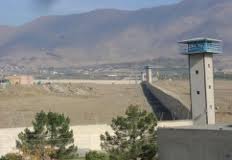
Transferring mass number of remained survived prisoner from the recent massacre in Ghezel Hessar prison to solitary confinement cell in Gohar Dasht prison in Karaj.

In recent reports received by “Human Rights and Democracy Activist in Iran”, there has been indication of many prisoners who were remained alive from recent attack in Ghezel Hessar, have been transferred to solitary confinement of Sepah and Gohar Dasht prison and are under going torture and investigation.
Since Wednesday March 16th more than 100 prisoners have been moved to Gohar Dasht Prison Confinement cells, which is under control of Intelligent Service Agents. From the moment of their transfer they have been under physical and emotional turture. Also on Wednesday march 16th, Twenty prisoners and on Thursday March 17th, Ninteen prisoners have been transferred to solitary confinement in Branch 5. Since these transfers took place, the Intelligent service agent took complete control over Prison.
One of the prisoners who were moved from section 2 of Ghezel Hessar to Branch 5 of Gohardasht is Mousa Malek.
It is important to note that on evening of Tuesday March 15th prisoners of section 2 and 3 in Ghezel Hessar have been brutally attacked by the guard and security of the prison, after they request a review on their inhuman situation in prison. Most of these prisoners were awaiting their death sentence. They have been attacked by fire arm. More than a dozen have been killed and over 100 have been injured.
Instead of investigating this brutal attac, Jafari Dolat Abadi, the D.A in Tehran, threat the prisoners to execution. (Check this part)
Human Rights and Democracy Activist in Iran condemn attacks, killing, and transferring of the defenseless captives by security and guards who took the order from Judges of Supreme Leader Ali Khamenehee. They also request an investigation by the United Nations and other Human Rights Organizations to be sent to Ghezal Hessar Prison.
Human Rights and Democracy Activist in Iran
March 18, 2011
This report has been sent to:
United Nations Secretary General
Amnesty International
European Human Rights of European Union

Source

Another Martyr from 14 Feb uprising: 22 years old Amir Tehranchi killed by regime forces

March 19, 2011

A month after Amir Hossein Tehranchi got killed on February 15th 2011, his picture is been published for the first time

Amir Hossein Tehranchi got killed on February 15th after he got shot by a bullet in Tehran. The Intelegent service agents stole his body and about nine days later he was buried in section 312 in Behesht Zahra cemetery. The news of his assassination at age 22 was announced by his friends, and they reported that: “that the intelligent service authorities have arrested his brother and threaten the family not to contact any media or news agency about his death. Even when they wanted to burry his body they were not allowed to see his face. The agents and security have buried his body in section 312. They informed the family if they talk about his death to any one, then their other son will have the same story and will be buried just like him.

Source

Father of Jaild student activist: Non of the woman prisoners at Rajaii shahr prison has a good health

March 19, 2011

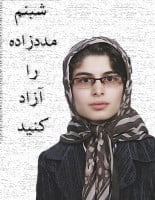
Father of Shabnam Madad zaadeh: No matter how much I screamed and tried to get help, there was no effect. None of the political prisoners in Rajaee Shahr women prison is feeling well.
Iran News Agency: Shabnam Madad zaadeh, who was vice president of the student union called Tahkim Vahdat and the head of political brunch of student community in Tarbiat University, got arrested on February 19th 2009. After a16 months of her arrest and jail time in Evin prison, she was convicted to five years imprisonment in Rajaee Shahr Prison by judge Moghiseh in Revolution Court branch 28.She  was accused for having contact with P.M.O.I (People`s Mojahedin of Iran Organization)  and her support for them.
Shabnam Madad Zaadeh’s father said:” Shabnam and all other political prisoners are not feeling well; they are all in bad condition physically and emotionally. Usually there is no water available to them or if there is water,it is too cold, and there is only one shower for everyone. There are all types of prisoners in jail, killers, addicts, and thieves. This is my daughter’s and other political prisoners’ situation in Jail”.
Abdolali Madad Zaadeh pointing on being hopeless and don’t know what to do added:” If Shabnam get bothered she will not tell us and I am sure she is under pressure, because there are all types of people in there. It is impossible to be safe in the environment she is in, with all other criminal next to her.” About his last visit with his daughter he said: “ My last news from her is from about one month ago. I have no other news, because their phone is disconnected. I used to go visit her more often but I got sick and am not able to go the long way from Tabriz to Karaj. My age doesn’t allow me to do that. What should I do?”
Shabnam Madad Zaadeh’s father was concerned about her daughter well being and said:” When there is no water or when the water is cold, when there is only one bath for that many prisoners, how can they take care of their needs. They have no clean environment.”
Abdolali Madad Zaadeh was concern about his daughter health and talked about her situation and said:” Shabnam became ill; she got heart problem and other diseases. Almost all the women who are in jail have some medical issue and the doctor in jail doesn’t care about them. When they question them why they can’t get treatment, they response we didn’t bring u to jail to take care of you, we have to torture you.”
Abdolali Zaadeh has witnessed the harsh reaction of regular prisoners during his visit with his daughter. In that regard he said:” They separate the political prisoners from other prisoners. They gather all of them in on room and there are two guards in the room at all the time controlling everyone in the room and no one can talk comfortably. During our visit we are not allowed to see other cellmates.”
Mr. Zaadeh tried to contact authorities to get some help for her daughter situation. In this regard he said:” When I went to the office of D.A in Karaj they told me it is not our concern and we only have to keep them in there. Tehran D.A didn’t have a better response for us. When I asked if she get some break from jail or telephone contact they didn’t respond either. Now everything is in God’s hand. There is no other hope.”
Mohammad Oliaee Far who was Shabnam’s and her brother Farzad’s lawyer, have been arrested and being sentenced after he got involved with their case. Shabnam a university student is in Rajaee prison is in danger among many other political prisoners. Their safety and security is in risk. Few days ago some family members of the women in Rajaee Shahr prison wrote a letter to Tehran D.A to inform him about their unlivable situation.

Source

Amnesty International: Deaths in Iranian prison must be investigated

March 18, 2011

Amnesty International has called for an investigation into reports that up to 14 people were killed in a disturbance in a jail near Tehran this week.

The incident at the overcrowded Qezel Hesar prison in Karaj occurred on Tuesday night when clashes broke out involving prisoners and prison guards. The Prisons Chief said that a judicial investigation has been launched.

“Such a high death toll is extremely worrying. Prison officials have a responsibility to maintain order and to protect the lives of prisoners, but must exercise restraint,” said Hassiba Hadj Sahraoui, Deputy Director of Amnesty International’s Middle East and North Africa Programme.

“A prompt inquiry into these deaths is essential but it must be independent and transparent, as international human rights standards require, such as those set out in the Standard Minimum Rules for the Treatment of Prisoners and the Body of Principles for the protection of All Persons under Any Form of Detention or Imprisonment.

“Unfortunately the Iranian Judiciary  has routinely failed to carry out such investigations, so we are once again calling on the international community to use the current session of the UN Human Rights Council to create a Special Rapporteur to monitor and report on human rights in the Iran.”

Prison authorities said the riot was sparked by death row prisoners and drug-trafficking and possession offenders committing arson and other destructive acts in an attempt to escape, as well as attacking prison guards.

However, human rights activist groups told Amnesty International the prisoners were protesting at poor conditions and attempts to transfer some of the inmates for execution.

One activist based abroad said he had been in contact with a prisoner from inside Section 2 of prison until the early hours of Wednesday, when the phone lines were cut.

“The prisoners took over Sections 2 and 3 of the prison,” the activist told Amnesty International.

“I was told that armed guards had stationed themselves on the roof of the prison and outside the doors to the section and the prisoners set fire to bedding to try to stop the guards from entering.  The prisoner told me that the guards were shooting at everyone.”

There are reports that at least six people died from gunshot wounds and over 100 may have been injured, with some dying in – or on the way to – medical centres.

Iranian State Television reportedly said on Wednesday that 14 people had died, including at least nine prisoners, and 33 had been injured.  Prison guards may have also been among the fatalities.

“We know that the Iranian authorities are on a killing spree at the moment, having executed well over 100 people – mainly alleged drugs offenders – since the start of the year. This is yet one more reason why they should immediately order a moratorium on all executions,” added Hassiba Hadj Sahraoui.

Source