
Home Blog Page 662

Conflicting reports on fate of Iranian opposition leaders

March 1, 2011

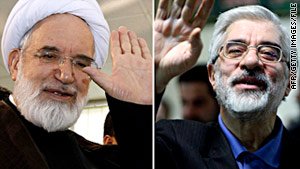
Tehran, Iran (CNN) — Reports conflicted Monday over the fate of Iranian opposition leaders Mir Hossein Moussavi and Mehdi Karrubi, with an opposition website reporting that they were in custody of the government but a semi-official news agency denying it.

The website, Kaleme, citing “trusted sources,” reported Monday that the men and their wives had been arrested and taken to Tehran’s Heshmatieh prison.

But the Fars News Agency, citing a source within Iran’s judiciary, denied the report. The source, who was not identified, said that both men were inside their homes “and the only restrictions placed on them are contacts with suspicious elements.”

Another Iranian source gave a similar account, saying the report of the men’s imprisonment was false.

Meanwhile, a Tehran resident said people in his neighborhood were chanting from inside their homes “God is great,” a phrase used by the opposition movement after the disputed presidential elections in 2009.

The conflicting reports came shortly after the semiofficial news Fars News Agency reported that the government had restricted the movements and communication of both opposition leaders.

Referring to the opposition movement, Iranian Prosecutor General Gholam-Hossein Mohseni-Ejei said, “The movements and telephone communication of the head of rioters have been restricted and, if circumstances demand it, the next steps for arresting them and putting them on trial will be arranged,” Fars reported.

“Today, these men no longer have a place amid the people,” Mohseni-Ejei said, according to Fars News.

In their stories, neither the official Islamic Republic News Agency nor Fars named the two opposition leaders.

The opposition has called for a demonstration to be held Tuesday to protest the imprisonment of Karrubi and Moussavi.

Over the weekend, before the fate of the couples was known, the International Campaign for Human Rights in Iran expressed concern for their safety.

“Moussavi and Karrubi and their wives have been disappeared; they are being held incommunicado in an unknown location, a severe breach of Iranian and international law,” Aaron Rhodes, a spokesman for the human rights group, said in a statement.

“Given the lynch mob-like calls for their execution by numerous Iranian politicians and clerics, there is reason to be deeply concerned for their safety and well-being,” Rhodes said.

State-run Press TV aired video of Iranian lawmakers earlier this month chanting, “Moussavi, Karrubi … execute them.”

This month, Iranian authorities began rounding up a number of government opponents amid calls for protests like those that have swept across North Africa and the Middle East.

Iranian government leaders have praised the revolution that overthrew Egyptian President Hosni Mubarak, but when protesters took to the streets of Tehran on February 14, the government cracked down hard. The Iranian government rounded up activists ahead of the protests after Karrubi and Moussavi called for supporters to gather at Azadi Square, the site of mass protests by Iran’s opposition movement after the disputed 2009 presidential elections.

Despite the security crackdown, tens of thousands of demonstrators marched in Tehran. Dozens of demonstrators were detained during those protests, while videos posted on YouTube showed others had been chased and beaten.

Two people were killed during the protests, according to Fars. Several others were seriously wounded as a result of the gunfire, which the Iranian government blamed on “agitators and seditionists.”

An Iranian government source said Saturday that Iranians were disturbed by the opposition’s demonstrations.

“The people are not happy with these protests and (Moussavi and Karrubi) making announcements for more protests. The people believe their peace is being disrupted, and they want these protests to stop,” the source said.

U.S. Secretary of State Hillary Clinton on Wednesday accused Iran of recently cracking down on protesters and political opponents, and security forces of killing peaceful demonstrators.

International journalists have been limited in their ability to gather news in Iran, where the government has squelched the media and maintains tight control over state-linked news organizations. During the protests this month, foreign journalists were denied visas, accredited journalists living in the country were restricted from covering the demonstrations, and internet speeds were slowed to a crawl in an apparent attempt to restrict information being transmitted abroad.

Intelligence Minister Accuses Greens of Ties with MKO

0

Monday, 28 February 2011

InsideIran/2011-02-28 – Iran’s Minister of Intelligence Heydar Moslehi appeared in a live television broadcast Feb. 24 and accused the opposition Green Movement of having ties to the Mojahedin Khalgh Organization, a terrorist group based in Iraq. Leaders of the Green Movement have vehemently denied these charges and have always insisted that there are no ties whatsoever between their activities and those of the MKO.

Moslehi, who was on a live broadcast on national television, claimed that senior advisers to Mir Hossein Moussavi and Mehdi Karroubi, the de-facto leaders of the opposition in Iran, have extensive ties to MKO. According to Iran’s Channel Three, Moslehi named Ardeshir Amir-Arjmand, a senior Moussavi adviser currently in France, and Mojtaba Vahedi, a senior Karroubi aid now in the United States, as the link between the MKO and the opposition Green Movement. Both Amir-Arjmand and Vahedi denied these allegations in the strongest terms.

Amir-Arjmand, speaking to Radio Farda, said that Moslehi’s lies are so outrageous that they make Joseph Goebbels look good. Amir-Arjmand then said, “And even if Mr. Moslehi’s accusations are based on the truth, this shows the weakness of people like Moslehi [who is in charge of Iran’s intelligence service].”

Vahedi also denied Moslehi’s claims and said, “The Minister of Intelligence is just repeating the words of the coup government,” referring to the government of President Mahmoud Ahmadinejad that enjoys the backing of the Islamic Revolutionary Guards Corps.

During his televised interview, Moslehi said that leaders of the opposition were no longer seditionists; rather they were now “counterrevolutionaries.” This elevation of the opposition’s leaders by the Minister of Intelligence could be a sign that the government is preparing to treat the opposition in Iran in the same manner it eradicated armed groups opposed to the regime in the 1980s.

There are no ties between the opposition Green Movement and the MKO, which has been described by many as a personality cult revolving around its leader Masoud Rajavi. In the 1980s, when the MKO and the regime were engaged in a civil war, Moussavi and Karroubi were considered prime targets for MKO’s assassination plots. The MKO lost much of its popular support when it sided with Saddam Hussein during the Iran-Iraq war and carried out attacks against Iranian cities in the late 1980s.

The regime’s efforts today to link the opposition to the MKO are designed to discredit the Green Movement. On the other hand, the MKO, or the PMOI as it calls itself these days, has tried to portray itself in the West as part of the opposition in Iran. There have been several unsuccessful attempts to remove the MKO from the US State Department’s terrorist list. But the MKO and its lobbying wing in the US are increasing their efforts to remove the name of the organization from the State Department’s list.

Source

Hashemi Rafsanjani Retreating?

0

February 28, 2011

s government supporters mount their criticism of veteran politician Hashemi Rafsanjani, particularly since the street protests of earlier this month when calls have been made for his dismissal as the head of the Experts Assembly on Leadership, an 86-man cleric association entrusted with the duty of overseeing the work of the country’s supreme leader, Rafsanjani changed his tune two days ago and spoke against the February 14 demonstrations that had been called by Green Movement leaders and took place in support of the uprisings in the Middle East, despite the government ban, while reiterating that he was a candidate in the upcoming Experts of Assembly. Speaking at the opening session of the Assembly of Experts, he said that the supreme leader ayatollah Khamenei had told him that it was his “duty” to participate in the elections of the Assembly.

In his opening remarks, Rafsanjani said that the February 14 demonstrations were “a clear example” of those who were against the essence of the revolution, the Islamic republic, the constitution and the principle of Velayat-e Faghih” (i.e., rule of clerics). In his talk, Rafsanjani emphatically said, “Under the current conditions in the country there can be no other center for replacing Islam the constitution and Velayat Faghih.”

In another part of his talk he said, “Without the participation and support of the public, something that has been expressly outlined in Islamic writings and in the constitution, actions will not work.”

“This revolution does not belong to its first or second generation but must continue with future generations to accomplish its ultimate goals and remain the light for the future. We must keep people involved and not allow the rise of hardline or extremist views and groups,” he added.

It should be noted that the statement that was issued at the end of last plenary meeting of the Assembly in the presence of clerics Mahmoud Hashemi Shahrudi, Sadegh Larijani, Ibrahim Reisi and Ahmad Khatami which was chaired by Rafsanjani, condemned the February 14th demonstrated that had been planned by the Green Movement, calling it “counter-revolutionary sabotage.” After the demonstrations, Rafsanjani had said that “all sections of society must respect the law and anything that is contrary to the law is detrimental to the country and in the words of ayatollah Khomeni is haram” (i.e., religiously banned, sacrilegious).

In talking about the upcoming Assembly elections for its leadership, Rafsanjani said, “Unfortunately some sick individuals and circles raise issues about the Experts that convey the message that I am thirsty to remain the head of the body. History and current personalities of the regime attest that I have never been after such positions.” Then listing the positions that he has held in the Islamic republic till today, Rafsanjani said that these had either been requested of him by ayatollah Khomeini or by people and the leaders, which would remain so and that he would be a mere revolutionary soldier.

On the question of the next Assembly leader, Rafsanjani said that during the last plenary meeting he had personally suggested Mohammad Reza Mahdavi Kani to become the next chairman and preferred not to run himself. He added, “The leader has tasked me to run in the Assembly elections, as some ignorant or perhaps knowledgeable individuals create scandals as if I have an attraction to such posts.”

Rafsanjani reiterated that he would run in the upcoming elections for the leadership of the Assembly because, this would be responding to “calls for duty to commitment, religious duty, duty to the revolution, to the people and the regime.”

Responses to Rafsanjani

Immediately after Rafsanjani’s remarks at the Assembly session, Fars news agency – affiliated to the security-military apparatus of the Islamic republic – published interviews it had with Rafsanjani’s known opponents in the Assembly. Talking about the future Assembly elections, one such opponent Abdolnabi Namazi said, “The idea that the leader has tasked Mr. Rafsanjani to run for the chairmanship of the Assembly is a media ploy because the leaders does not approve or reject any person in this regard.” “Ayatollahs Mahdavi Kani, Mesbah Yazdi, Mohammad Yazdi and Janati are the four possible candidates for the leadership of the Assembly,” he predicted.

Mohammad-Hassan Mamdoohi, another Assembly member also rejected Rafsanjani’s remarks and said that while Rafsanjani may be a candidate to the chairmanship of the Assembly but the leader normally did not take such positions.  He too made remarks to support the candidacy of Kani adding that he enjoyed a good standing among the members.

Another Assembly member Ali-Akbar Garebaghi who is a known adversary of Rafsanjani called the incumbent’s remarks “lies.” He is also known to be close to another conservative cleric Mesbah Yazdi and added that Rafsanjani would have strong competitors if he ran, concluding, “representatives of people will choose the future chairman of the Assembly of Experts.”

Verbal attacks on Rafsanjani have been mounting and in a more recent case ayatollah Khamenei’s representative in the Revolutionary Guards (IRGC) called him the “axis of the seditionists”, a term Iranian officials use for the protests against the announced results of the disputed 2009 presidential elections that have kept the incumbent in office.  Also, an advisor to the IRGC, Saffar Herandi (a former minister of culture) also spoke publicly of “gradually removing Rafsanjani from his positions.” “Mr. Rafsanjani will be relieved of his two duties and in the upcoming elections for the leadership of the Assembly of Experts we shall witness his dismissal, which is what his aides fear and want to prevent.”

Mohammad-Reza Bahonar, a hardline pro-administration Majlis deputy also had some harsh words and threats on this issue. “Mr. Rafsanjani was not with the people on the issue of the sedition and has less than a week to declare his position regarding the sedition,” he retorted.

Source

Billions of dollars of oil money diverted into regime coffers

0

February 28, 2011

Close to 12 billion dollars has disappeared in Iran after the government of the Iranian regime’s President Mahmoud Ahmadinejad failed to deposit oil revenues in foreign reserves, according to the state-run Jahan News on Tuesday.

The news agency cited the regime’s Supreme Audit Court as saying that about $11.7 billion have gone missing since 2009.

The chairman of the budget committee at the regime’s Majlis (Parliament), Jafar Qaderi, was quoted by Jahan News as saying, “The Supreme Audit Court has claimed that $11.7 billion in oil revenues from 2009 and 80 percent of added revenues in 2010 – average price of $65 dollars a barrel – have not been deposited into the foreign reserve account and the National Development Fund.”

Two years ago, it was reported that one billion dollars in oil revenues, which should have been deposited into the foreign reserves account, disappeared into the coffers of various factions within the clerical regime.

Source

Security forces shoot three people, killing two

February 28, 2011

The Iranian regime’s suppressive State Security Forces (SSF) have shot three Kurdish citizens, leaving two dead and one critically injured, according to Hrana news agency.

The report said on Monday SSF forces attacked two brothers as they were driving in a car on the Maragheh-Hashtrood highway, killing one and seriously wounding another.

Yaqoub Ahmadi died while his brother, Amir, is suffering from critical wounds. Both were residents of the Kurdish city of Mahabad.

SSF agents tried to justify the shootings by claiming that the brothers were involved in drug smuggling.

On Tuesday, the regime also shot some people on the western border region citing the same reasons, killing a man identified as Ezzat Qaderi.

Source

Family of killed protestor threatened by regime

0

February 28, 2011

The clerical dictatorship in Iran has threatened the family of a young man killed during Sunday’s anti-regime uprising, pressing them to deny his murder by the regime.

A number of regime officials, including the commander of the State Security Forces (SSF) in Shiraz, where Hamed Nour Mohammadi was killed by regime forces, and the president of the city’s university, have claimed that Mr. Nour Mohammadi was killed in a car accident.

The Iranian regime is pressuring the family to parrot the mullahs’ account of the incident by sending its agents to the family residence, according to news reports.

Source

Regime’s fear from protest movements on Feast of Fire Day

0

February 28, 2011

In fear of popular uprising on Feast of Fire Day, the clerical dictatorship announced in its TV: “for increasing the security and as the feasts of the end of the year are coming especially Feast of Fire, SSF in provinces of Kermanshah and Kurdistan have been able to discover more than 180,370 types of igniting items”.

Source

Rafsanjani knelt about the attacks from Khamenei against his family

February 28, 2011

According to Iran News agency, Rafsanjani knelt about the attacks which was done against his family. He also said: ” In these circumstances, unity and sympathy and confidence is one of the most essential things in this country”. According to regime’s media ”Jomhori” Rafsanjani said: ” People or groups that are against the Islamic republic of Iran or breaking the laws, should know that actions will be pointed at them. Nobody can replace this regime, and it’s a shame that some people/groups have this thought”.

Source

Mousavi and Karroubi have bee arrested were transferred to Heshmatie prison in tehran

February 28, 2011

A French news-agency wrote: Mir Hossein Mousavi and Karroubi were arrested and transferred to a prison in Tehran with their wives.

Kalame website: Mir Hossein Mousavi and Mehdi Karroubi were arrested with their wives and transferred to the Heshmatie prison. According to the Kalame website, the arrest and transfer of Mousavi and Karroubi to prison is confirmed but the exact time is not clear.

Source

Student Activists Milad Taheri and Danial Zargarian Arrested

0

Monday, 28 February 2011

Rahana/2011-02-28 – Following the February 14th and February 20th events, the security forces have arrested several student activists in Babol.

Student activists Milad Taheri and Danial Zargarian, were arrested by the security forces on February 20th and February 14th respectively and transferred to an undisclosed location.

Mohsen Barzegar, Iman Sadighi, Sarah Bagheri, Ali Yazdanpanah, Hossein Zamen-Zarabi, Ramtin Meghdadi and several other students have also been arrested in the recent days.

Source