Home Blog Page 663

Hundreds of Iranian students honor memory of fallen classmate

0

February 28, 2011

Hundreds of students at the University of Shiraz on Wednesday commemorated the memory of one of their classmates, Hamed Nour Mohammadi, who was killed by Iranian regime agents during an anti-regime demonstration on Sunday.

According to Hrana news agency and Iran Khabar, Wednesday’s protest at the university campus took place with chants of “my martyred brother, I will honor your blood,” “Don’t be afraid, we are all together,” and “Even if bullets and plots were to rain down, the movement will continue.”

There were clashes reported between protestors and the regime’s intelligence and paramilitary Bassij agents.

The president of the university, who had repeated the regime’s claims that Mr. Nour Mohammadi was not murdered but killed in a car accident, was roughed up by the students during Wednesday’s clashes.

The regime has deployed a large number of intelligence agents to the campus to prevent the expansion of protests.

A number of students were violently beaten and arrested.

Regime agents could be seen standing on guard around the campus to control passersby and to prevent entry into the university, reports said.

Source

Zia Nabavi transferred from Ahvaz prison to undisclosed location

Sunday, 27 February 2011

Persian2/2011-02-27 – On February 24th, a few security officials transferred starred student Zia Nabavi from Ahvaz prison to an undisclosed location.

According to Daneshjoo news, there is still no information regarding the reason for transfer. Zia Nabavi is the spokesperson for the Council to Defend the Right to Education. An informed source told Daneshjoo News that on February 24th, security agents accompanied by Ahvaz prison officials first asked Zia Nabavi to gather his belongings then took him to an undisclosed location, without providing an explanation. So far, no explanation has been given by either the security authorities or Ahvaz prison officials.

In recent months, the judicial and security officials in Ahwaz have increased the pressure on Zia Nabavi so much that in the last family prison visit, based on an order from judicial authorities, prison officials only allowed Zia Nabavi to meet with his family for a few seconds. They were separated by a glass window and were able to meet for a few minutes. During the visit, Zia Nabavi was mistreated by prison officials and was subjected to two extreme bodily searches.

Seyed Zia Nabavi has been sentenced to ten years in prison to be served in exile in Karoun ‘Ahvaz’ prison. He has been detained since June 15, 2009 and has not had one day of leave or furlough. Atefeh Nabavi, Zia Nabavi’s cousin is in a similar condition while serving a three years sentence in Evin prison. She has also been imprisoned since June 15, 2009, without a day of furlough.

In continuation with the pressures exerted on the Nabavi family, recently, Alireza Nabavi, Atefeh Nabavi’s husband was also arrested by security forces. He was subsequently sentenced to two years in prison and one year exile outside of [his home province of] Semnan.

Source

Prominent reformist Abdollah Ramezanzadeh arrested

0

Sunday, 27 February 2011

The Green Voice of Freedom/2011-02-27 – Abdollah Ramezanzadeh, a prominent member of the Islamic Iran Participation Front, has once again been arrested by Iranian security forces.

According to GVF correspondents, the former spokesman and secretary of the government during Mohammad Khatami’s presidency was arrested by security forces on Saturday afternoon. Reportedly, there was also a scuffle between security forces and Ramezanzadeh’s brother who were only attempting to take pictures with their sibling before he was taken away.

The security forces’ use of violence was then followed by the arrest of Ramezanzadeh’s brothers who were released on bail after a few hours. It should be noted that the physical confrontation caused serious damages to the eardrum of one of the Ramezanzadeh brothers, Nasrollah.

Ramezanzadeh who had endured six months of imprisonment following the fraudulent 2009 presidential election, had been in a state of legal uncertainty since his release in December 2009. Shortly after the election, he was paraded along with other reformists in televised show trials organised by the Iranian judiciary, yet judicial authorities have until now kept him in a state of limbo as no decision has been made regarding his case.

Ramezanzadeh was initially arrested on 13 June 2009, but was released more than six months later on 23 December on a staggering bail of 8 billion Rials ($778,740). During his time in prison, the veteran reformer endured 116 days of solitary confinement.

An Iranian Kurd, Ramezanzadeh is also considered to have been among the most successful governors of Kurdistan Province.

In August 2010, Ramezanzadeh and six other leading Reformist political figures filed a lawsuit against several commanders of the Islamic Revolutionary Guard Corps for their intervention in Iran’s rigged presidential election and its aftermath.

The seven plaintiffs included four members of the Organisation of Islamic Revolution Mojahedin (OIRM) — Behzad Nabavi, Mostafa Tajzadeh, Mohsen Aminzadeh, and Faizollah Arabsorkhi—and three members of the Islamic Iran Participation Front (IIPF)—Mohsen Mirdamadi, Abdollah Ramezanzadeh, and Mohsen Safaei-Farahani. They described in their lawsuit how the Guard commanders planned the election “victory” of Mahmoud Ahmadinejad long in advance and what they did in order to realise their goal.

Ramezanzadeh is an assistant professor at the faculty of Law and Political Science of Tehran University. He received his PhD from the Catholic University of Leuven in Belgium in 1996. The title of his thesis was “Iran; Ethnic relations; Minorities; Culture conflict; Conflict management; Political activity.”

Source

Iran’s Khatami calls for release of opposition chiefs

0

Sunday, 27 February 2011

AFP/2011-02-27 – Iran’s former reformist president Mohammad Khatami has urged the authorities to release opposition leaders Hossein Mousavi and Mehdi Karroubi from house arrest, his website said on Saturday.

“Why should people like Mr Mousavi and Mr Karroubi, and their wives, who have had a glorious past in the revolution and the Islamic republic, and who are loyal to the revolution and the Islamic republic, be placed under house arrest?” Khatami said according to his Khatami.ir website.

“Such action pushes people who are against the regime and who don’t care for Iran… to manipulate the feelings of our youths.

“I hope that with the start of the Iranian New Year (March 20) we will see the end of the house arrest, the end of restrictions, the release of the prisoners and the creation of a safe and free climate… in which the people’s vote will be decisive,” he told clerics and university professors.

It was the first time Khatami has called for the release of pro-reform opposition leaders Mousavi and Karroubi.

His comments came after the websites of Mousavi and Karroubi, who are steadfastly opposed to President Mahmoud Ahmadinejad, had posted calls for new protests on Tuesday to demand their release.

Karroubi, Mousavi and their wives are under house arrest and living in complete isolation, their homes under surveillance and cut off from the outside world, according to their websites.

The call to demonstrate was posted on Kaleme.com and Sahamnews.org and issued by the Coordination Council of the Green Path of Hope, an umbrella group backing the two leaders.

“We invite everyone to protest on Tuesday… against the continued restrictions and house arrest imposed on the movement’s leaders,” the group said in a statement posted online.

It said the protests would be held in key squares and streets of Tehran and provincial cities.

The group, which called previous protests on February 14 and February 20, said more demonstrations would be held on March 15 if Mousavi and Karroubi remained under house arrest beyond March 1.

Clashes between demonstrators and security forces killed two people in the February 14 protests. But the February 20 protests in Tehran were quelled by a massive deployment of police.

Former president Ali Akbar Hashemi Rafsanjani, who had indirectly backed Mousavi’s in the 2009 elections, condemned the February 14 protests, ILNA news agency reported on Saturday.

“The duty of the regime is clear: we must act against individuals and enemy groups who are seeking to weaken the regime,” ILNA quoted Rafsanjani as saying.

The protests, the first to be held since February last year, infuriated the authorities who accused Mousavi and Karroubi of treason, according to opposition websites.

Officials have also branded anyone who supports the two men as “anti-revolutionary.”

Mousavi and Karroubi led a string of protests in Iran after Ahmadinejad’s controversial re-election in June 2009, which they claim was rigged.

Their opposition to Ahmadinejad has shaken the Islamic regime and divided the nation’s elite Shiite clergy.

Khatami, once a pillar of Iran’s clerical regime who served two terms in office between 1997 and 2005, has turned into a vocal critic after the Ahmadinejad’s re-election.

Source

Regime general Firoz Abadi afraid of clash up’s, and requiring armed Basiji’s

February 27, 2011

The leader general Firoz Abadi, required armed basiji’s for defending this regime. He also expressed his fear against the demonstrations. Firoz Abadi was holding a speech in friday, and said: ” There are a few important things for us; the first thing is that the leader (Khamenei) is respected and defended by armed basiji’s. ”

Source

The harassment of Rafsanjani’s nephew

February 27, 2011

Only three days after the harassment of Rafsanjani’s daughter, the nephew of Rafsanjani were attacked and harassed while he was commemorating his mother. He was beaten up and sent to the hospital.

Rafsanjani’s daughter were also harassed when the wife of Rafsanjani’s brother (Ghasem Hashemi) was buried by the regime’s agents.

Source

In setback, Iran to unload fuel from nuclear plant

0

February 27, 2011

By ALI AKBAR DAREINI, Associated Press Ali Akbar Dareini, Associated Press

TEHRAN, Iran – In a major setback to Iran’s nuclear program, technicians will have to unload fuel from the country’s first atomic power plant because of an unspecified safety concern, a senior government official said.

The vague explanation raised questions about whether the mysterious computer worm known as Stuxnet might have caused more damage at the Bushehr plant than previously acknowledged. Other explanations are possible for unloading the fuel rods from the reactor core of the newly completed plant, including routine technical difficulties.

While the exact reason behind the fuel’s removal is unclear, the admission is seen as a major embarrassment for Tehran because it has touted Bushehr — Iran’s first atomic power plant — as its showcase nuclear facility and sees it as a source of national pride. When the Islamic Republic began loading the fuel just four months ago, Iranian officials celebrated the achievement.

Iran’s envoy to the U.N. nuclear monitoring agency in Vienna said that Russia, which provided the fuel and helped construct the Bushehr plant, had demanded the fuel be taken out.

“Upon a demand from Russia, which is responsible for completing the Bushehr nuclear power plant, fuel assemblies from the core of the reactor will be unloaded for a period of time to carry out tests and take technical measurements,” the semiofficial ISNA news agency quoted Ali Asghar Soltanieh as saying. “After the tests are conducted, (the fuel) will be placed in the core of the reactor once again.”

“Iran always gives priority to the safety of the plant based on highest global standards,” Soltanieh added.

Calls to the Russian nuclear agency Rosatom for comment were not answered Saturday afternoon.

The spokesman of the Atomic Energy Organization of Iran said the fuel unloading was nothing unusual.

“It’s a kind of technical inspection and to obtain confidence about the safety of the reactor,” Hamid Khadem Qaemi told the official IRNA news agency. He accused foreign media of blowing the issue out of proportion.

The Bushehr plant is not among the aspects of Iran’s nuclear program that are of top concern to the international community and is not directly subject to sanctions. It has international approval and is supervised by the U.N.’s nuclear monitoring agency, the International Atomic Energy Agency.

In a report released Friday about Iran’s nuclear program, the IAEA said that Tehran informed the agency on Wednesday that it would have to unload the fuel rods. The agency said it and Tehran have agreed on the “necessary safeguards measures.”

A senior international official familiar with Iran’s nuclear program said the IAEA had no further details. He said unloading and reloading fuel assemblies is not unusual before any reactor startup. The official asked for anonymity because his information was confidential.

Soltanieh and other officials have not specified why the fuel had to be unloaded, but Iranian officials denied any link to the Stuxnet computer virus.

“Stuxnet has had no effect on the control systems at the Bushehr nuclear power plant,” Nasser Rastkhah, a senior official in charge of nuclear security, told the official IRNA news agency.

Foreign intelligence reports have said the control systems at Bushehr were penetrated by the malware — malicious software designed to infiltrate computer systems — but Iran has all along maintained that Stuxnet was only found on several laptops belonging to plant employees and didn’t affect the facility’s control systems.

Some computer experts believe Stuxnet was the work of Israel or the United States, two nations convinced that Iran wants to turn nuclear fuel into weapons-grade uranium.

The Islamic Republic is reluctant to acknowledge setbacks to its nuclear activities, which it says are aimed at generating energy but are under U.N. sanctions because of concerns they could be channeled toward making weapons. Only after outside revelations that its enrichment program was temporarily disrupted late last year by Stuxnet did Iranian officials acknowledge the incident.

The startup of the Bushehr power plant, a project completed with Russian help but beset by years of delays, would deliver Iran the central stated goal of its atomic work — the generation of nuclear power.

But the inauguration of the facility has been delayed for years. Iran said when it began inserting the fuel rods in October that the 1,000-megawatt light-water reactor would begin pumping electricity to Iranian cities by December. But it pushed back the timing to February, citing a “small leak” and other unspecified reasons.

The Bushehr plant itself is not among the West’s main worries because safeguards are in place to ensure that the spent fuel will be returned to Russia and cannot be diverted to weapons making.

The United States and some of its allies believe the Bushehr plant is part of a civil energy program that Iran is using as cover for a covert program to develop a nuclear weapons capability. Iran denies the accusation.

The Bushehr project dates back to 1974, when Iran’s U.S.-backed Shah Mohammed Reza Pahlavi contracted with the German company Siemens to build the reactor. The company withdrew from the project after the 1979 Islamic Revolution toppled the shah and brought hard-line clerics to power.

In 1992, Iran signed a $1 billion deal with Russia to complete the project and work began in 1995.

Under the contract, Bushehr was originally scheduled to come on stream in July 1999 but the startup has been delayed repeatedly by construction and supply glitches.

Source

Conservative MP says Mousavi and Karroubi must speak on state TV

0

Saturday, 26 February 2011

The Green Voice of Freedom/2011-02-26 – Ali Motahari, a conservative member of the Iranian parliament has said that opposition leaders Mir Hossein Mousavi and Mahdi Karroubi must be allowed to speak their mind on national television.

Motahari told the Salam website, “the voice of the opposition and [regime] critics must be heard and they must have the right to peacefully protest.”

“I believe that this way, the issue is better resolved, but we tend to create idols and portray the problems as being enormous.”

Motahari is also the son of assassinated Islamic scholar Morteza Motahari, a disciple of Ayatollah Khomeini who later formed the Council of Revolution of Iran following the Islamic Revolution in 1979. He was assassinated while he was the chairman of the mentioned council in May 1979.

Ahmadinejad’s Interior Ministry has until now refused to grant any permit for the Green Movement to hold demonstrations. Nevertheless, article 27 of the Iranian constitution stipulates that public gatherings and marches may be held freely, provided arms are not carried and that they are not detrimental to the Islamic values. The opposition took to the street on the 14th and 20th February, but protests were turned violent after security forces opened fire on protesters killing at least three. According to eyewitnesses, Tehran was effectively turned into a military camp on 20 February due the massive security presence in preperation for the pro-opposition marches.

“There’s no doubt that the events on 14 February were illegal and deplorable, but we must take a look at our own actions, much of our media, such as the IRIB and certain newspapers began to provoke and belittle the protesters between 30 December [2009] and 11 February [2011] while continuously challenging them to a fight by using such phrases as ‘you are all finished, you’re nothing, you were executed, you have no supporters’.”

“When they address a certain group of people telling them they have no support base and that they’re out of the political scene and that they’re dead, they are effectively provoking them into making their presence felt.”

Following the 14 February protests, the Iranian authorities have increased the pressures on Mousavi and Karroubi, blocking all channels of communications between the men and the outside world. Since 15 February, there’s been no news about the two reformists’ state of well-being, raising concerns about their condition under house arrest. Mousavi’s top advisor Ardeshir Amir-Arjomand who is currently based outside the country has expressed concerns about the fact that at the moment, it is the Iranian regime that is responsible for providing food for the men under house arrest.

In response to the Green Movement leaders’ house arrest, the Coordination Council of the Green Path of Hope has already called for nationwide protests across the country on 1 March, a day before Mousavi’s birthday.

Source

Obama, Iran and a push for policy change

0

Saturday, 26 February 2011

Reuters/2011-02-26 – Could the administration of President Barack Obama hasten the downfall of Iran’s government by taking an opposition group off the U.S. list of terrorist organizations? To hear a growing roster of influential former government officials tell it, the answer is yes.

The opposition group in question is the Mujadeen-e-Khalq (MEK) and the growing list of Washington insiders coming out in its support include two former Central Intelligence Agency chiefs (James Woolsey and Michael Hayden), two chairmen of the Joint Chiefs of Staff (Peter Pace and Hugh Shelton), former Attorney General Michael Mukasey, former Homeland Security chief Tom Ridge and former FBI head Louis Freeh.

The MEK was placed on the terrorist list in 1997, a move the Clinton administration hoped would help open a dialogue with Iran, and since then has been waging a protracted legal battle to have the designation removed. Britain and the European Union took the group off their terrorist lists in 2008 and 2009 respectively after court rulings that found no evidence of terrorist actions after the MEK renounced violence in 2001.

In Washington, initial support for “de-listing” came largely from the ranks of conservatives and neo-conservatives but it has been spreading across the aisle and the addition of a newcomer of impeccable standing with the Obama administration could herald a policy change not only on the MEK but also on dealing with Tehran.

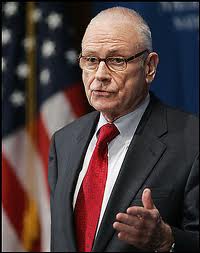
The newcomer is Lee Hamilton, an informal senior advisor to President Obama, who served as a Democratic congressman for 34 years and was co-chairman of the commission that investigated the events leading to the September 11, 2001 attacks on Washington and New York.

“This is a big deal,” Flynt Leverett and Hillary Mann Leverett, two prominent experts on Iran, wrote on their blog. “We believe that Hamilton’s involvement increases the chances that the Obama administration will eventually start supporting the MEK as the cutting edge for a new U.S. regime change strategy towards Iran.” The Leveretts think such a strategy would be counter-productive.

But speakers at the February 19 conference in Washington where Hamilton made his debut as an MEK supporter thought otherwise. Addressing some 400 Iranian-Americans in a Washington hotel, retired General Peter Pace said: “Some folks said to me … if the United States government took the MEK off the terrorist list it would be a signal to the Iranian regime that we changed from a desire to see changes in regime behavior to a desire to see changes in regime. Sounds good to me.”

The Obama administration’s policy is not regime change but the use of sanctions and multi-national negotiations to persuade the government in Tehran to drop its nuclear ambitions. So far, that has been unsuccessful. Two rounds of talks between Iran, the U.S., China, Russia, France, Britain and Germany in January ended without progress and did not even yield agreement on a date for more talks.

NO POLICY CHANGE BUT SHARPER RHETORIC

That did not change Washington’s “no regime change” stand. What has changed is the tone of public American statements on Iran since a wave of mass protests swept away the authoritarian rulers of Tunisia and Egypt and forced the governments of Jordan, Bahrain, Yemen, Algeria and Saudi Arabia to announce reforms. In contrast, Iran responded to mass demonstrations with violent crackdowns.

Secretary of State Hillary Clinton declared that the U.S.  “very clearly and directly support the aspirations of the people who are in the streets” of Iranian cities agitating for a democratic opening as they did in 2009, when Washington stayed silent.

Like the U.S., Iran labels the MEK a terrorist organization and has dealt particularly harshly with Iranians suspected of membership or sympathies. In the view of many of its American supporters, the U.S. terrorist label has weakened internal support for the MEK. How much support there is for the organization is a matter of dispute among Iran watchers, many of whom consider it insignificant.

At last week’s Washington conference, however, speaker after speaker described it as a major force, feared and hated by the Iranian government. General Shelton called it “the best organized resistance group.” Dell Daley, the State Department’s counter-terrorism chief until he retired in 2009, said the MEK was “the best instrument of power to get inside the Iran mullahs and unseat them.”

The decision to give legitimacy, or not, to the group is up to Hillary Clinton. Last July, a federal appeals court in Washington instructed the Department of State to review the terrorist designation, in language that suggested that it should be revoked. Court procedures gave her until June to decide.

Source

European list IDs 80+ Iran militia, police for possible EU human rights sanctions

0
February 26, 2011

European diplomats have prepared a list of over 80 Iranian militia and police unit commanders, prison guards, prosecutors, judges and ministry bureaucrats that will be taken up for discussion for possible European Union sanctions for alleged torture, murder and other human rights violations against Iranian citizens.

POLITICO was provided a list of the Iranian individuals that the EU will discuss possibly targeting for sanctions to include asset freezes and travel bans. EU foreign ministers will discuss the list at a “brainstorming session” in March, a European diplomat said Friday.

Notable is that the list includes not only such senior Iranian security and ministry officials as the interior and intelligence ministers and the Iranian Revolutionary Guards Corps general commander, but that it names quite specific prison guards, militia members, police unit figures, revolutionary court judges,  prosecutors and ministry bureaucrats identified by governments and NGOs as responsible for torture, murder, and gross human rights abuses against Iranian civilians and political dissidents in the brutal crackdown unleashed in the wake of Iran’s disputed June 2009 presidential elections.

Among the over 80 Iranian individuals on the list are: Ansar-e Hezbollah chief Hossein Allahkaram, and several Basij militia commanders including:  Mohammad Reza Naqdi, the commander of the Basij and Hossein Taeb the former commander of the Basij; Ali Fazli, the deputy commander of the Basij and former head of the Seyyed al-Shodada Corps of Tehran Province, Abbas Kargar Javid, a Basij militiaman and the alleged murderer of Neda Agha-Soltan on June 20, 2009.

IRGC figures on the list include: the head of the IRGC’s Seyyed al-Shodada Corps of Tehran Province Hossein Motlagh; the head of the IRGC’s Rassoulollah Corps in charge of Greater Tehran Hossein Hamedani, the head of the IRGC’s Sarollah Corps in Tehran Mohammad Hejazi; and IRGC General and deputy head of the Medical Unit of Sarollah base Ali Khalili.

Several prison officials from the Rajai Shahr prison in Karaj are named including: Hassan Akharian, the head of Ward 1, as well as several men identified as “keepers” of Ward 1 of the same prison including Mr. Mirzaghayi, Mr. Zeynali, Mr. Youssefi, and Mr. Morradi.

Information and Communications ministry officials on the list include: Reza Taghipour, the Minister of Information and Communications, Abdolmajid Riyazi, the deputy minister. Also on the list: Mehrdad Omidi, the head of the Computer Crimes Unit of the Iranian Police, as well as Behrouz Kamalian, the head of the IRGC-related “Ashiyaneh” cyber-group.

Names on the list from the Iran interior, intelligence and justice ministries and Iran and Tehran Judiciary: Iranian Minister of Justice Morteza Bakhtiari, the Iranian Interior Minister Mostafa Mohammad Najjar, deputy Interior minister for political affairs Seyyed Solat Mortazavi, the Interior Ministry’s political director Mahmoud Abbaszadeh Meshkini, and the Minister of Welfare and Social Security Sadeq Mahsouli,  the Minister of Science, Research and Technology and former head of Election headquarters during the disputed June 2009 Iran presidential elections Kamran Daneshjou, Sadeq Larijani, the head of the Iranian Judiciary, and his first deputy Ebrahim Raissi, Saeed Mortazavi, the former prosecutor-general of Tehran and current head of Iran’s anti-smuggling task force, two former prosecutor-generals of Iran and former Intelligence ministers: Gholam-Hossein Mohseni-Ejei and Ghorbanali Dorri-Nafajabadi, current prosecutor general of Tehran Abbas Jafari-Dolatabadi, and former deputy prosecutor general of Tehran for prison affairs Mahmoud Salarkia. Several Tehran Revolutionary Court judges are also identified on the list.

The full list is here:

http://www.politico.com/static/PPM176_1110226_iran_officials.html

Source