Home Blog Page 678

Three Attorneys Sentenced to Prison Following the Complaint by Intelligence Ministry

23 , January , 2011
Following the complaint filed by the Intelligence Ministry, attorneys Farshid Yadollahi, Amir Eslami, and Mostafa Daneshjou, have been sentenced to prison for disturbing public opinion and libel.
Farshid Yadollahi and Amir Eslami who were lawyers for many of the cases related to the dervishes in Kish Island have been sentenced to 6 months in prison for disturbing public opinion and libel while their clients have been acquitted of their charges. Mostafa Daneshjou had also been sentenced to 7 months in prison which has been upheld by the Mazandaran appeals court.The 3 lawyers had filed a complaint against the unlawful behavior of the Intelligence Ministry authorities. However, not only their lawful complaint was ignored but they were eventually convicted themselves.Farshid Yadollahi and Amir Eslami are members of the Human Rights Commission of the Iranian Bar Association and Mostafa Daneshjou was disbarred along with Omid Behrouzi while defending the rights of dervishes.Source

Esmaeil Sahabeh Began Serving 4 Year Prison Sentence in Evin Prison

23 , January , 2011

Esmaeil Sahabeh-Tabrizi, member of the youth branch of the Islamic National Front, who had been arrested in September and released 2 months later, was summoned to Evin Prison on January 22nd to begin serving his 4 year sentence.

Esmaeil Sahabeh was arrested during the Komeil Prayers ceremony at the house of Shahab Tabatabaei’s wife.

Esmaeil Sahabeh was sentenced to 4.5 years in prison by Judge Salavati in August for being one of the organizers of the Komeil Prayers ceremony.

Surprisngly Judge Salavati had been absent during the hearing and had issued the verdict without listening to Sahabeh’s defense.

The appeals court reduced his sentence to 4 years in prison.

Saeid Nourmohammadi, another member of the Islamic National Front, was convicted for his participation in the ceremony and began serving his one year prison term in Evin Prison September.

Source

Vaez Tabasi Against the Green Movement

0
January 23, 2011

The custodian of Iran’s saint Imam Reza’s shrine (Astan Ghods Razavi) in the city of Mashhad ayatollah Vaez Tabasi verbally attacked the leaders of the country’s Green Movement, calling them “leaders of the sedition” (a term the Iranian regime uses for the national uprising and massive protests over the official announcement of the 2009 presidential election) who he said were fighting Islam, strived to spread ignorance and who opposed the supreme leader.”

Speaking at the gathering of the board that organized the celebrations to commemorate the anniversary of the founding of the Astan Ghods Razavi foundation which manages imam Reza’s shrine and its finances, Tabasi said, “The rejected event that we call fetne (generally translated as sedition) and its leaders have strived for three important goals: fighting Islam, return to ignorant (pagan) values, and combating the supreme religious leader and imam of the nation.”

“If religious leadership is weakened it will be very easy to destroy Islam, spread ignorant values and alter the youth,” he proclaimed and then called for greater efforts on “Islamic ideas, the introduction of the role and position of leadership, its impact on human society, and a deep discussion on culture.”

Presented as one of the most powerful figures in the Islamic republic, ayatollah Tabasi did not publicly support any of the presidential candidates in 2009 but indicated his implicit choice when he provided a warm welcome to Mir-Hossein Mousavi during the ex-Prime Minister’s trip to the city of Mashhad where Tabasi resides.

When massive protests against the 2009 presidential elections erupted around the country, Tabasi chose to remain silent, neither expressing support for the protestors nor sending a congratulatory message to Mahmoud Ahmadinejad on his “election victory.” Because of his reticence in condemning the popular protests, he too was characterized to “lack insight” by supporters of the leader of the Islamic republic ayatollah Khamenei.

On January 20, 2010 the conservative pro-government Hemat weekly published by a group of individuals close to Gholam-Hossein Elham (former government spokesman during Ahmadinejad’s administration) and his journalist Fateme Rahimi published a photograph of Tabasi along with Hashemi Rafsanjani, Mir-Hossein Mousavi, Mehdi Karoubi, Nategh Nouri, Mohammad Khatami Ali Larijani, Mohammad-Bagher Qalibaf and other political and religious leaders in the Islamic republic of Iran presenting him as a supporter of the protest movement.

It is noteworthy that just 10 days earlier, Tabasi had labeled the organizers of the protests on Ashura last year to be enemies of God, whose fate he said was clear in the Islamic republic.

In a talk that he delivered then, this member of the powerful Assembly of Experts on Leadership added, “This is a small group of people who are under the gun. If they do not repent their actions, if they do not ask for forgiveness from people, if they do not ask for amnesty from the leader of the revolution, it will be too late.”

Amin Bozorgnia, an Iranian social analyst residing in France, wrote that Tabasi has been under pressure to denounce the demonstrations. He said conditions in Iran were black and white where one had to either speak against the protest movement which would put him inside the “inner circle” of the regime, or remain silent, which would then make him to be with “them,” i.e., the protestors or enemies. According to Bozorgnia, Tabasi say these things to preserve their positions within the power structure of the regime. “Under the present conditions, there is no difference between Tabasi and Ahmad Tavokoli (a conservative member of the Majlis) in their opposition to the Green Movement,” he said.

In their protests and statements, Mir-Hossein Mousavi, Mehdi Karoubi, Mohammad Khatami, Hashemi Rafsanjani and many other protestors have repeatedly stressed that senior clerics in Iran are “unhappy” with the current state of affairs, and observers believe that the leaders of the protest movement rely on these individuals to support them.

Tabasi is one of those clerics who has on many occasions publicly criticized Ahmadinejad administration’s performance during the last 6 years. So the big question is whether his recent remarks against the green movement and protestors demonstrate the failure of the protestors in gaining the support of the senior and powerful clerics?

Bozorgnia says that traditional conservative clerics cannot be significantly helpful to the Iranian democracy movement. He believes that it is an illusion to believe that these clerics will support the reformists. The world in which conservative clerics live and the one in which a pro-democracy activist plays are two different realms. He adds that these clerics are not concerned with democracy and whether it is beneficial or whether dictatorship is harmful. Bozorgnia points out that these very clerics, who today have been criticizing Ahmadinejad’s administration, were also against the democratic reforms that Mohammad Khatami’s reform administration was promoting. The criticism that conservative clerics have regarding Ahmadinejad’s administration stems not from democratic perspective but from fundamentalist beliefs.

Bozorgnia concludes that someone like Mousavi can take advantage of ayatollah Safi Golpaygani’s criticism of Ahmadinejad but this should not create the illusion that a shift has taken place in favor of democracy and human rights among conservative clerics.

Source

Human Rights Activist Abolfazl Abedini Banned from Face-to-Face Prison Visits

0

22 , January , 2011

Journalist and human rights activist Abolfazl Abedni who has been sentenced to 11 years in prison, has been banned from face-to-face prison visits with his family

Abolfazl Abedini, a journalist and a human rights activist, who has been sentenced to 11 years in prison for membership in the Pan-Iranist Party, anti-regime propaganda, collaborating with hostile regimes and human rights activities, is currently held in Ward 350 of Evin Prison.

According to RAHANA, he has been deprived of face-to-face prison visits since September when he was transferred to the Evin Prison. Their requests for furlough and face- to-face prison visits have been denied.

Abedini was arrested in February for the second time and was transferred to Ward 2A of Evin Prison. After the issuance of the court verdict, he was transferred to Karoun Prison in Ahvaz and endured the harsh prison conditions until September.  He was banned from prison visits and using the phone and was also beaten in Ahvaz Prison.

Abedini, 29, who has a heart condition, was arrested on March 3rd. He was sentenced to 11 years in prison which has been upheld by the appeals court.

Source

IRGC Making Big Investments In Macau Brothels

0

January 22, 2011

IRAN BRIEFING EXCLUSIVE: Following the economic downturn in the United Arab Emirates and Dubai, and from where the IRGC made huge investments in Dubai’s economic, real estate, and financial sectors, this organization has now shifted its assets and economic activity from Dubai to Southeast Asia.

Malaysia and Macau are the two places where the IRGC now concentrates its economic activities, investing in banks and trade towers in Malaysia, especially Kuala Lumpur. The IRGC invests in the casino, Red Light and brothel business in Macau, an island in the middle of the Indian Ocean.

This industry is very new in Southeast Asia. After successful growth in China, it has taken hold in this region. Since Macau is very close to China, it is a paradise for investment in this sort of trade.

Why the casino?

China has about one billion people in the workforce and a growing middle class. Thus, as logic goes, if the middle class has a little capital, then there must be a vacation spot to spend its money (Until a few years ago, people in general considered vacation exclusive, work their only obligation and wealth unimportant). Yet Macau now has become a place for getting their money, and this mandate has in Southeast Asia made it bigger than Las Vegas. Macau is deemed a threat to Las Vegas, and in this respect our brothers in the IRGC have a lucrative opportunity.

An Iranian is in charge of directing the cash flow from Dubai and Turkey to Macau. This individual known as Haj Safdar Minamand (whose real name is Seyyed Javad Zavarei) is the IRGC’s second general and is a first degree relation to Seyyed Reza Zavarei. Reza Zavarei was one of the kingpins of the Islamic Republic: he was the first Tehran Revolutionary Court public prosecutor, advisor to the Interior Minister (Hashemi Rafsanjani), Head of the National Security Council, the Tehran representative in the Majlis (1981-1987), a legal expert and deputy to the head of the Guardian Council (until 2005), Head of the National Registry and Assets Organization (1989-1997), Presidential candidate in 1989 in the third, fourth, and seventh rounds.

But General Javad Zavarei, in addition to building casinos and hotels, as well as some tourist, leisure, and cultural centers, also works to project an image.

One of the local experts in the real estate affairs believes that Iran has invested up to one billion dollars in Macau but adds that some of these investments were under and sometimes one place could be bought and sold 3.2-10 times in one month—even if there is no record available about the exact amount of inflow investment. All these activities are conducted in the name of business, done under unknown circumstances.

According to some unconfirmed statistics, the IRGC until now has invested up to 20 billion dollars in this region.


Some Worrying News About the Appalling Winter Conditions of Female Prisoners and the Possibility of Three Executions To Be Undertaken Soon

0

20 , January , 2011

There are some startling news about the appalling situation of female prisoners in winter time and the possibility of three executions to be undertaken soon.

The women in Evin  prison are in poor conditions. Some of them in kept in the notorious Block 209, others are being held  in general block, Methadone ward whilst three more are kept in the same room which the prominent Shahla Jahed was kept before execution.

Nazanin Khosravani is being held in Block 209 of Evin Prison. Her family have been quoted saying:” Nazanin has told us that the cell is so cold that it is comparable to sleeping on a sheet of ice”. They added:” We have sent some  warm cloths to Nazanin  but we don’t know why prison staff haven’t delivered them ”.
It is unknown how many prisoners are kept in 209 of Evin prison but according to the news received by “Change for Equality“, three prisoners, Hengameh Shahidi, Faremeh Khoramjou and Zahra Bahrami, are being kept in the former cell of  Shahla Jahed and with the remainder held in the Methadone ward. The prisoners in latter section are taken outside at different times from the other prisoners and are not allowed to make telephone calls. Also, in the general Block, there is no hot water and food is poor. In ward 2 of general Block,  there is a ratio of  4 telephones to 300 prisoners. Prisoners are allowed to talk on phone between 8 AM and 10 PM, giving each prisoner only about 3 minutes to talk.
In the corridors of general  Methadone ward  Block tension is high with rumor of the early execution of Kobra Rahmanpour, Lida Tavakoli and Sowgand Jahani.Jahani is less than 20 years old and is accused of the murder of her husband.
At the same time, according to some sources,  in one of  Evin prison’s solitary cells, Ladan Mostowfi, 45 , daughter of Manoochehr, has been kept  for a substantial term. She has been accused of the crime of  ”Moharebeh” which crimes against Islam and the Islamic Regime.

Basij Force Infiltrated by Anti-Revolutionaries

January 19, 2011

Ever since protesters were brutally suppressed in Iran because of the demonstrations against the results of the 2009 presidential elections, discontent among the various layers of the military and police personnel regarding the deployment of the forces against protesting civilians has been on the rise. High-ranking commanders of these forces have become highly suspicious of the spread of such negative sentiments even among the voluntary paramilitary Basij force. Recently this sense of suspicion has been expressed by various news sites affiliated with the IRGC and Basij. Internal bulletin boards for political officers of the Pasdaran Revolutionary Guards (IRGC) have warned of “the infiltration of Basij centers by anti-revolutionaries” and have stated that “just recently anti-revolutionary groups had ordered their followers to enroll at and infiltrate Basij compounds, and receive Basij active force ID cards.”

Officials in charge of the “Analysis and Justification Office of IRGC” have linked this announcement to the activities of “a terrorist group in the west of the country” and have explained the reason behind this alleged infiltration as a way “not to be identified when going about their missions of causing terror and destruction”. But such warnings have been reiterated time and time again by high commanders of IRGC and Basij, several extremist clerics and even the supreme leader ayatollah Khamenei.

On November 25th last year ayatollah Khamenei dedicated a main part of a speech he delivered to the IRGC and Basij personnel to the provision of political advice and guidance. Referring to the protests of 2009 regarding the presidential elections, he called the events “a complex sedition” and added, “During those events, the agitators ignored the interests of the country in order to rise to power and they turned their back to the clear path of truth in such a way that the number one enemies of the nation rejoiced at their deeds and supported them. Some just didn’t and still don’t see the clear path of truth, however some others do recognize the truth but due to their indulgence in egoistic desires don’t want to heed to their reckoning.” During the same speech ayatollah Khamenei praised the Basij force but emphasized, “To remain a Basiji persevere in this path is even more important, and this requires constant meditation and self-discipline”. Those messages of the ayatollah also implicitly conveyed his sense of discontent at some of the Basij and IRGC personnel, a sense that had been expressed more clearly by the IRGC commander Hossein Hamedani earlier.

Earlier, during an interview with Khabar Online on October 2nd 2010, the commander of Mohammad Rasool-allah IRGC force was asked if in facing last year’s protests “those forces responsible to maintain security responded inadequately or acted in a way that the image of Basij was tarnished or misrepresented?” The commander replied in words that clarify its role in the eyes of its commanders: “What do we need the Basij for? Do we need the Basij for its own sake or for the sake of the revolution? We don’t need Basij if it is to remain inactive when the regime is under attack”.

Source

Hossein Gohari Detained

0

Wednesday, 19 January 2011 21:32

RAHANA – Gohari is a political activist and a central member of the Third Wave Campaign and was arrested on January 18th.

He was arrested by the plainclothes agents and transferred to an undisclosed location.

There has been no information as to his whereabouts or how he was arrested.

The Third Wave campaign is the biggest election Campaign

Source

Ahmadinejad Ransoming Khamenei?

0
January 18, 2011

Through their separate remarks two days ago, Jaafar Shajooni, a cleric supporting Ahmadinejad’s administration, and Ali Motahari, a principlist member of the Majlis critical of the administration, revealed the existence of differences between Iran’s leader ayatollah Khamenei and the head of the tenth administration Mahmoud Ahmadinejad on current issues facing the country.

Speaking to KhabarOnline website close to Majlis Speaker Ali Larijani, Ali Motahari implicitly disclosed ayatollah Khamenei’s displeasure with the recent policy of lifting government subsidies was implemented. This Majlis representative pointed out to what he called “insistence” of Ahmadinejad and Mashai on their views and said, “The leader knows that the president does not retreat from his positions and so he normally does not intervene” in the latter’s work.

The example Motahari gave for his observation was the implementation of the recent law that rearranged the government subsidies on some basic goods to the public.  “What is taking place right now, regardless of whether it is good or bad, is not according to the law that Majlis passed. It is something that Mr. Ahmadinejad has been pressing for from the beginning, and now is not the time to explain in this in more details,” the conservative lawmaker said.

Jaafar Shajooni, a cleric who is a member of the ruling body of the Majmae Rohaniyoon Mobarez (The Association of Combatant Clerics, a reformist clerical group) and the Motalefe party is also a principlist member (a Majlis faction that has expressed criticism over some of the administration’s policies) also spoke of differences between Khamenei and Ahmadinejad. In his interview with Hamshahri Mah newspaper, he spoke of Ahmadinejad’s disregard for the views of the clerics and the senior ayatollahs and the supreme leader’s weak posture towards the administration.

According to Shajooni, the principlists are (i.e., advocates and followers of ideological principles) are tolerating the government. In response to a question by the reporter about Ahmadinejad’s errors, he responded by asking, “How long is the life of this administration?” implying that it will not last forever.

The member of the Combatant Clerics also spoke of the senior clerics’ dissatisfaction with the administration. “This is a weakness of the government. The government of course contends that they are not ashamed of this. But this is undesirable and nothing can be done about it. We shall wait.”

The Only Capital Left for Khamenei

Analysts and observers of the Iranian scene have talked about differences between ayatollah Khamenei and Ahmadinejad in recent months. They point to the appointment of Esfandiar Rahim Mashai as the first vice-president and the changes at the top administration levels to be contention points between the two, appointments which the leader has disapproved.

One commentator in Paris Mohammad-Ali Tofighi believes the differences are serious and real. Speaking with Rooz, he compared Ahmadinejad to a child who has found a flaw in his dad and therefore regularly asks for a ransom. “Nobody knows better than Ahmadinejad how he was made president and he knows how much support he has from Khamenei, which is why his administration has more authority than any other administration since the 1979 revolution,” he said.

“On the other hand, Khamenei has vested all his credibility in Ahmadinejad, which is why he not only eliminated the reformists but even his long-time friends. Ahmadinejad is now the only capital Khamenei is left with,” Tofighi believes.

Differences Exist but the Administration is Obedient

Principlists and members of the ruling circles in Iran admit to differences between Khamenei and Ahmadinejad even though observers point out that the verbal support that Mr. Khamenei has given to Ahmadinejad is more than such support to any other chief executive. Khamenei has said that the reason for his strong support of the president is because Ahmadinejad is under the greatest criticism and attack than previous administrations.

In his most recent trip to Qom where ayatollah Khamenei met with the Shiite’s senior ayatollahs, he again defended and supported Ahmadinejad’s administration. As reported by Fars news agency and other media outlets close to ayatollah Khamenei, the leader told the clerics, “When the president or other senior administration members go on foreign trips, I have no concerns. Whereas before, I was concerned about what the officials would say.”

According to Ali-Reza Islamian a member of the experts Assembly of Experts on Leadership – Mr. Khamenei also said, “Differences exist under the current conditions and I too do not support some of them; but if the leader says something today the president accepts it and implements it.” In another part of his talk, Khamenei is reported to have said, “Government authorities today present the views of the regime and the revolution.” He then raised the issue of the Iranian interpretation of Islam that Mashai had publicly raised and said, “I am against this issue and have pointed this out to the gentlemen. Still, I do not believe that they are pinning Islam against Iran.”

In speaking about the meeting that Khamenei had with the senior clerics in Qom, Hassan Mamdoohi, a member of the powerful teachers association of the Qom Theological Association said, “In the various meetings that the leader had in Qom, he said that the level of criticism of the administration was meaningless.”

Tofighi points out that the real differences between Iranian leaders do not make to the media as they try to portray an image of unity in public. Still, he says, there are many subtle and coded messages that point out to the differences between Khamenei and Ahmadinejad. He cites another such example to be Ahmadinejad’s negative remarks about the 20-year vision plan for the Islamic republic. He had said that the document was prepared by someone who had no knowledge about the potentials of the country. This document had been approved by ayatollah Khamenei as a 30-year plan for the Islamic republic.

Support Because of Lack of Alternative

Tofighi also points out that the differences between the two have been managed and have become rationalized. But he also says that Ahmadinejad also enjoys support in the Pasdaran Revolutionary Guards. Tofighi, who used to be a member of the Mojahedin Enghelab Eslami reformist group, believes that the president is the person on whom the security and Guards have agreed on to lead the country, and he in turn has given them plenty of the state booty through economic deals, government positions and other privileges. He believes that Khamenei supports Ahmadinejad because he has no other choice right now, pointing out that as the next round of Majlis elections approach, Ahmadinejad’s differences will become more public and apparent as he and his team have set their eyes on those elections and even on the future of the supreme leader.

Source

Majid Jamali-Fash; An Spy for Israel or Another Forced Confession Under Torture by Iran’s Military Government?

0

Investigated and Compiled by: Amir Farshad Ebrahimi and Meraj Rasoolof
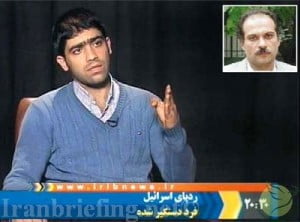


On January 10, 2011 Iran’s Ministry of Intelligence circulated an announcement in the newspapers claiming to have identified the real causes for the attack against Dr. Masoud Ali Mohammadi (the Iranian nuclear expert assassinated last year) and thus having made arrests. After this announcement, the Iranian state television news aired statements made by an individual identified as Majid Jamali Fashi. During the initial broadcasts which had a picture of him and the bomb scene, he stated that:

“It was about three years ago when I travelled to Istanbul for the second time, and there I came to know a person by the name of Radpour who suggested me to go to the consulate. Since I was enthusiastic, we both went to the consulate. We did some official paperwork and entered a room, but then we were separated. They asked me a number of questions and then gave me some identification papers and [papers] on how to cooperate with them.”

And this was his first communication with the Mossad.  In Iran’s latest propaganda move, a forty minute documentary called “Red Windows” was aired again in the news channel. The title refers to a laptop with a secure “Red Windows” installed which Jamali claims that the Mossad provided him:

“This laptop from the outside looked like an ordinary laptop which everyone carried, and if anyone saw they would not have realized that it actually had two Windows XP programs; one of them had a secure sign-in in which you had to pass through a series of steps in order to reach the real Windows called the ‘Red Windows’.”

The “Red Windows” documentary was based upon previous statements, but then important facts were gradually deleted. In this documentary, many of the countries and cities which Jamali mentioned as places where he met with the Mossad were erased, so that he only mentions Israel. Furthermore, the producers of this documentary explicitly list the four main goals they have in mind. The documentary begins by linking one reason for [Mohammadi’s] assassination to the post-election events:

“The post-election strife formed this vacuum and made the job easier for the Mossad and the CIA.”

Likewise, Iran’s security and intelligence power was apotheosized many times throughout the documentary in that it has been able to “deeply infiltrate the Mossad Intelligence Agency” and acquire valuable information—that all such moves were constructed and executed with “domestic and national” technology.  In this respect, Jamali mentions many times that the Mossad were really scared of Iran’s intelligence:

It was obvious that they feared Iran’s security apparatus. For them, everything must definitely go well as they were examining every little detail. They heavily emphasized that because they were very scared of Iran, whatever they said must be done. Their fear was apparent.”

Who is Majid Jamali Fashi?

But who is this suspect who today simply sits in front of the camera, talking about the many accusations against himself which will punish and eventually put him to death? Majid Jamali Fashi (who for unclear reasons referred to in Iran’s newspapers as “Jamali Fash”) was born on 8/3/1982 in Urumiyeh and is a resident of Tehran. He only has a secondary school education and after failing twice the pre-college examinations, he left school altogether in order to play his favorite sport.  From 2002 to 2008, Jamali worked at a Tehran Pars sports club called “Shayestegan” as a kickboxing coach. Jamali was one of the national and international kickboxing champions participating in many national and international competitions, most recently at the June 2009 Azerbaijan International Games.

Jamali won third place at the Baku Games and returned to Iran. In July 2009, the Iran Boxing Federation asked him to help the IRGC Basij which wanted to set up a martial arts gym. For personal and financial reasons, Jamali did not reach an agreement and backed away from consenting to this collaboration with the IRGC. His refusal opened a Pandora’s Box of problems, to the point where the Federation barred him from working and forbade him to continue his job at the Shayestegan sports club.

During his last trip to Baku, Jamali apparently received a number of job proposals. When he saw that it wasn’t just possible to continue his life and job [in Iran], in August 2009 Jamali went to Azerbaijan where he became a coach at a Baku sports club. It was that time when his wife (still in Iran) told him about the summons issued by the judiciary. Since the reason for the summons and the charges were not clear, Jamali did not return to Iran. Following such hassle (the last one being Revolutionary Prosecution agents showing up at his residence), Jamali abandoned the idea of returning to Iran altogether. He applied for a visa at the American embassy in Baku but did not succeed.

After his visa application got rejected, Jamali went to the American embassy again. Taking into account all his problems, he applied for asylum. The American Embassy’s report #BAKU68709 to the State Department (which Wikileaks has published) deals with one of these visits as follows:

A martial arts coach (apparently an Azerbaijani) said at the American Embassy in Baku that the Iranian sports clubs and their directors placed him under heavy pressure on behalf of the Ministry of Intelligence and the IRGC—that in addition to training the IRGC forces in the martial arts, he must also directly participate in the crackdown on the people’s protests and in political assassinations at the government’s orders.”


Since Jamali felt hopeless in getting the visa in Azerbaijan and could not find a proper home, he was forced to go to Turkey. It was very difficult for us to find Jamali in Turkey, and when finally we found a man named “B. Kamali” (an Iranian merchant from Urumiyeh) he became very frightened and apprehensive about revealing his name. Jamali stated that in January 2010 he got to know Kamali in Istanbul and stayed at his home for one month.

During Dr. Alimohammadi’s Assasination, Majid Jamali Fashi was in Turkey!


What is clear from “B. Kamali’s” statements is that little before the end of February 2010 Majid Jamali had been in Istanbul, exactly when Dr. Masoud Alimohammadi was assassinated! Of course, he revealed to us that he had a friend named “Mohsen Radpour” and he came to their residence twice.

Jamali in his confessions presented Radpour as follows:

“There (in Istanbul) I came to know a person named Radpour who had suggested going to the consulate and since I was enthusiastic we went to the consulate together.”

Setting aside all the made-up stories, “Kamali” points out that after the second meeting with Radpour at his home, Jamali left some days later and chose to stay at an Istanbul hotel called “Hotel Armanda” and did not see him again.  In our investigation at Hotel Armanda, it was shown that an Iranian named “Majid Fesh” stayed there from 19-27 February 2010.

In order to find a trace of Jamali, we even went to the UN High Commission for Refugees in Ankara and strangely they did not answer us—meaning neither did they confirm nor deny that that this individual visited them! But an Iranian lawyer who has lived Ankara for several years and works in immigration affairs (and he too wanted to remain anonymous) confirmed that:

“Jamali asked him to become his lawyer for getting a U.S. visa or a European visa. The aforementioned lawyer tells Jamali that since he recently was rejected by the American embassy he must wait and apply again.” (He said that this visit happened around mid-March.)


We couldn’t find any more trace or news of him in Turkey. Since Majid Jamali Fashi became discouraged after trying every way to move to another country, and given that any Iranian can stay up to three months in Turkey, he probably returned to Iran after his legal residency permit expired.

Contradictions in Jamali’s Confession

In a part of his confession, he said that he went to Israel:

“We flew from Istanbul to Tel Aviv, and when we arrived it was indicated on my passport that I was an Israeli national.”


Shajar Katzman is an advisor at the Israeli Foreign Ministry, and told us that:

“I’m not going to deny Israel’s power and influence, but based upon my 25-year experience at the Foreign Ministry I never saw the Mossad issuing an Israeli passport to a spy or any foreigner even for a one-day trip. Definitely doing that is considered a big crime and offensive in Israel.”

In another part of his confession, Jamali claims that he entered a training camp:

“The next day they said that the training session will begin, and the next morning Bahram came and the rental car was from Tel Aviv. We went to a shop to buy some stuff like water….then we left Tel Aviv and in half an hour reached a camp.


We left Tel Aviv, and it took half an hour driving on the Tel Aviv-Evr Shelim highway in order to reach the camp. I think it was next to the Tel Aviv-Evr Shelim highway. After crossing a bridge we entered the camp itself. We walked along the fence for three or four kilometers, they had put up fences as far as you could see.”


Setting aside the fact that it doesn’t take half an hour to buy stuff like water, and that basically the Mossad agents would not use a “rental car/taxi” to go to a secret training camp, the details of the route which Jamali describes (from Hertzliya to the Mossad training camp) is contradictory. Israeli newspapers, as they are familiar with the area, deny the existence of such an area and camp.

Ilya Chen, a public relations director at the Israeli Defense Ministry told us that:


“Not only we don’t have such a camp according to what this individual said, but also throughout that route there is only one suspended bridge where there is an orange grove and a parking lot for old cars close to it. In addition, there are also other inconsistencies in his claims. For example, he says that he received open-air training in archery but from 2005 until now no armed force can use its weapons in such a manner. All archery training fields have been closed down. The use of weapons for training the military, police, and even Mossad is only permitted in secure and closed-roof compounds reserved for archery, not as stated by this individual in a field at the end of this camp.”

We also see other contradictions in Jamali’s statements:

In a penholder contained a passport, an identification card, a card indicating the end of service, and a driver’s license with the name Mehdi Vali and my picture, and pictures that they had taken of me before.”

Instead if the Mossad was able to provide him armed vehicles, bombs, a house, and an armory in Tehran, undoubtedly it was also able to give him these documents in Tehran and not in Israel. It would have been certainly dangerous for him to carry these false documents when entering Iran as he would have been questioned by airport authorities!

The most appalling contradiction in his statement is where he talks about the assassination:

“It was 4am when I woke up I checked my laptop again as they advised me to check for messages. They said that if there were no messages, I must put on warm and comfortable clothes as planned in order to drive smoothly. According to security conditions, I left the phones at home and used a taxi.”


The question is that if he “following orders” on the day of the assassination left his phones at home as a precaution, and started to carry out his mission, then how did he talk with his superiors on the day of assassination? For when first describing the mission for that day, he said that he left his phones at home:

“While going to Shariati Avenue, and the end of Saba Avenue in front of the electricity company at the point where there was the phone number of the coffee shop, I made the first call and said that I was ready and had arrived at the place. Since satellite phones were not secure and could not talk easily, they had provided codes for the satellite phone.”


In order to make Jamali a lesson for others about collaborating with the Mossad and how it does not keep its promise, Jamali states that:

“They only gave half of the $50,000 reward which they had set aside for me….I really don’t know why they took half of it for themselves?”


Now Majid Jamali Fashi’s confessions have been aired, and we cannot find anyone who believes what he says—because whatever he says [in the video] looks more like something from a James Bond or some other Hollywood movie about how Iranian intelligence infiltrated the Mossad, with all the intensive training and the so-called laptop with the “Red Windows”! Currently he is in prison and all we can do is to simply wait for the news which undoubtedly would be of his execution. The more we investigate the more we find inconsistencies. Whether the Mossad, the Islamic Republic, individual, organization or group caused this assassination is not clear, but certainly Majid Jamali Fashi didn’t do it.