
Iran warning puts thousands of European troops in spotlight
Iran warning puts thousands of European troops in spotlight

Iran warning puts thousands of European troops in spotlight

Iran arrested the UK ambassador for attending a vigil for crash victims
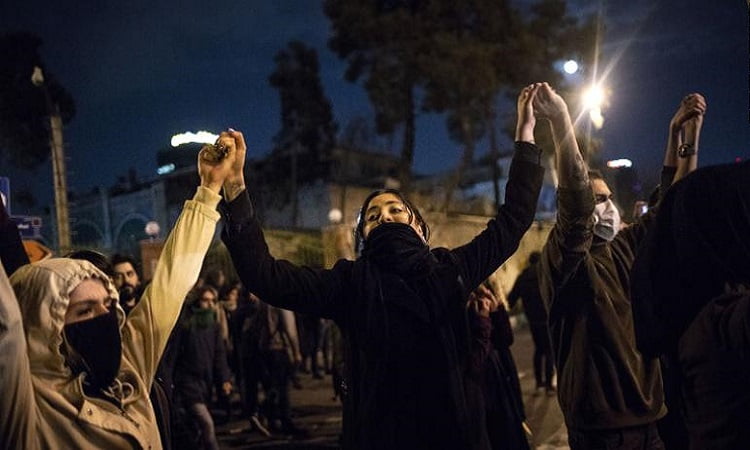
Iran’s admission that it mistakenly shot down a passenger plane sent protesters pouring into the streets over the weekend.
Though demonstrations were smaller on Monday and nearly outnumbered by riot police, some observers have already begun to wonder if this could be the beginning of the end for the current regime.
Iran Briefing | News Press Focus on Human Rights Violation by IRGC, Iran Human Rights

Local circumstances limit the extent to which Iran and its proxies can retaliate against the US in Lebanon and Syria.
On January 3, a US drone strike killed Iranian General Qassim Soleimani, head of the Quds Force of the Islamic Revolutionary Guard Corps (IRGC), shortly after he landed in Baghdad followinga visit to Lebanon and Syria. On January 8, the Iranian regime retaliated by firing ballistic missiles at military bases in Iraq housing American and Iraqi forces.
While direct confrontation between Washington and Tehran remains improbable in the foreseeable future, there are questions about what implications the current escalation might have for Lebanon and Syria, especially since Soleimani was the main architect of Iranian expansion in the Levant. However, Iran might face limitations for any retaliatory actions in Lebanon and Syria it may consider.
Hezbollah Secretary General Hassan Nasrallah, who had a close relationship with Soleimani, was the first proxy leader within the Iranian orbit to speak publicly after the assassination. When officials came to offer condolences, an image of Nasrallah was seen on display at Soleimani’s home, which speaks of the status he enjoys within the Iranian regime compared to leaders of other Iranian proxies.
In his January 5 speech, Hezbollah’s leader said it is time for US forces to leave the region and the way to accelerate that is to attack its military positions (rather than civilians). He also made it clear that members of the Iran-led “axis of resistance”, which includes Hezbollah, will decide themselves how to respond to the US, regardless of what Tehran does. In his second speech, on January 12, Nasrallah took this matter further by urging that “it is time for the axis of resistance to start working” on driving out US forces.
Since 2006, Hezbollah has acquired some form of autonomy from the Iranian regime in handling issues related to Lebanon even though the Lebanese armed group became more dependent on the Iranian regime for funding as a result of US sanctions against Lebanese banks and businesses that deal with Hezbollah. It remains to be seen if that autonomy will remain in place after the killing of Soleimani as Iran would expect more from its allies.
In a January 9 speech, IRGC Air Force commander Amir Ali Hajizadeh made it clear that Iran expects its proxies to take action. Speaking in front of the flags of Iranian backed-armed movements, including Hezbollah, he said that the next phase of retaliation will be undertaken by what he called “the resistance front”.
Although Hezbollah has the capabilities, experience and internal structures – led by Samer Abdallah, son-in-law of former Hezbollah leader Imad Mughniyeh, assassinated in a 2008 CIA-Mossad operation in Syria – to carry out clandestine activities abroad, it stands to lose more than gain from any operation that is seen as a retaliation for Soleimani’s killing. Taking military action against the US or Israel in Lebanon or on its border also seems far-fetched at this point, given the dire economic crisis in the country and the growing frustration among the Shia community which was on display during the ongoing protests.
Iran Briefing | News Press Focus on Human Rights Violation by IRGC, Iran Human Rights

US troops in Iraq knew of Iranian attack 2.5 hours ahead of time – report

For 40 years, Iran’s military has used unconventional warfare to destabilize the Middle East and make up for what it lacks in traditional military capabilities.war
Its unconventional operations, which include the use of terrorist and guerrilla groups, are run via the Quds Force, a branch of Iran’s Revolutionary Guard Corps. The guard was led by Qassem Soleimani, who was killed in a Jan. 2 U.S. airstrike.
At 15,000 strong, the Quds Force’s influence far outweighs its numbers. What it lacks in forces, it makes up through proxy groups. These include Hezbollah in Lebanon, the Iraqi Popular Mobilization Forces, the Houthi rebellion in Yemen, and various Palestinian groups such as Hamas. Most recently, an Iranian-backed group in Iraq killed a U.S. contractor, sparking military action.
Both Hezbollah and Hamas have been designated as terrorist groups by the U.S. State Department.
“Clearly, the use of proxies to execute Iranian political objectives is part of their modus operandi,” retired Air Force Lt. Gen. David Deptula told the Washington Examiner. “It is a method by which they can instill terror and conduct aggressive actions without being associated with the actual conduct of the act.”
In 1983, the group that evolved into Hezbollah was believed to have killed 241 U.S. personnel when it bombed a barracks in Beirut. Today, Hezbollah is one of the largest Iranian proxy groups and fields a massive missile arsenal thanks to Iranian support.
After the United States invaded Iraq in 2003, Iran supported Iraqi Shiite Muslim groups via the IRGC and the Quds Force. The IRGC was accused of supplying these groups with explosively formed penetrators, a type of improvised device designed to tear through American armor.
“These guys are very good at their methods, which is unconventional, asymmetric warfare, but they don’t have the power to put in place an alternative to the American traditional order,” said the Hudson Institute’s Peter Rough. “Instead, they have the power to sow this discord and to destroy.”
Iran Briefing | News Press Focus on Human Rights Violation by IRGC, Iran Human Rights

Hundreds of people protested in several cities around Iran on Saturday after the military admitted to mistakenly shooting down a civilian Ukrainian plane, killing all 176 on board.Iranian Protests
In Tehran, protesters gathered near universities and called for the resignation of Supreme Leader Ali Khamenei and chanted, “Down with liars!” and “Death to dictator!”
Saturday’s demonstrations came two months after Iran cracked down on massive anti-government protests, brought about by an increase in the price of subsidized gasoline in November. Iran declined to release a death toll at the time, but Amnesty International said more than 300 people had been killed.
Earlier Saturday, Iran’s Islamic Revolutionary Guard Corps admitted it mistakenly shot down a Ukrainian International Airline flight earlier this week.
IRGC aerospace commander Amir Ali Hajizadeh said on state television, “I take full responsibility and I will obey whatever decision is taken.” He said he “wished” he “were dead” when he learned about the fate of the aircraft.
“That night we had the readiness for all-out war,” Hajizadeh said. He added that the Revolutionary Guard had asked that commercial fights be canceled but that the request was not granted.
The downing of the Ukraine International Airlines jetliner, a Boeing 737, happened just hours after Iran launched a ballistic missile attack on Iraqi bases housing U.S. soldiers in response to last week’s U.S. drone attack that killed Iranian Quds Force commander General Qassem Soleimani.
In Tehran, demonstrators gathered at Amirkabir and Sharif universities, where some called for the resignation of their country’s leaders, according to the semiofficial Fars news agency, which is affiliated with the IRGC.
‘Down, down, Khamenei’
At a vigil Saturday, crowds gathered at Sharif University of Technology in Tehran chanted, “Down, down, Khamenei,” according to The Washington Post.
Some videos shared on social media showed protesters shouting, “Death to liars!” and “Death to the dictator!,” according to The New York Times.
VOA’s Persian news service reported protests also spread to other areas of Iran, including the country’s third-largest city of Isfahan. Protests were also reported by Reuters and the BBC.
In Isfahan, protesters chanted, “Khamenei is a murderer and his rule is not legit.”
Iran Briefing | News Press Focus on Human Rights Violation by IRGC, Iran Human Rights

Airstrikes Hit Iranian Targets in Syria

Iranian General Qassem Soleimani arrived at the Damascus airport in a vehicle with dark-tinted glass. Four soldiers from Iran’s Revolutionary Guards rode with him. They parked near a staircase leading to a Cham Wings Airbus A320, destined for Baghdad.
Neither Soleimani nor the soldiers were registered on the passenger manifesto, according to a Cham Wings airline employee who described the scene of their departure from the Syrian capital to Reuters. Soleimani avoided using his private plane because of rising concerns about his own security, said an Iraqi security source with knowledge of Soleimani’s security arrangements.
The passenger flight would be Soleimani’s last. Rockets fired from a U.S. drone killed him as he left the Baghdad airport in a convoy of two armored vehicles. Also killed was the man who met him at the airport: Abu Mahdi Muhandis, deputy head of Iraq’s Popular Mobilization Forces (PMF), the Iraqi government’s umbrella group for the country’s militias.
The Iraqi investigation into the strikes that killed the two men on Jan. 3 started minutes after the U.S. strike, two Iraqi security officials told Reuters. National Security agents sealed off the airport and prevented dozens of security staff from leaving, including police, passport officers and intelligence agents.
Investigators have focused on how suspected informants inside the Damascus and Baghdad airports collaborated with the U.S. military to help track and pinpoint Soleimani’s position, according to Reuters interviews with two security officials with direct knowledge of Iraq’s investigation, two Baghdad airport employees, two police officials and two employees of Syria’s Cham Wings Airlines, a private commercial airline headquartered in Damascus.
The probe is being led by Falih al-Fayadh, who serves as Iraq’s National Security Adviser and the head of the PMF, the body that coordinates with Iraq’s mostly Shi’ite militias, many of which are backed by Iran and had close ties to Soleimani.
The National Security agency’s investigators have “strong indications that a network of spies inside Baghdad Airport were involved in leaking sensitive security details” on Soleimani’s arrival to the United States, one of the Iraqi security officials told Reuters.
Iran Briefing | News Press Focus on Human Rights Violation by IRGC, Iran Human Rights

President Trump said that Iran appears “to be standing down” after Tuesday night’s missile attack in Iraq and that “the American people should be extremely grateful and happy no Americans were harmed.”
Trump, in a nationally televised address from the White House, also announced a new round of what he termed “punishing economic sanctions” against the Iranian government. And he called on NATO to become “much more involved in the Middle East process.”
Later in the day, Trump spoke by phone with NATO Secretary General Jens Stoltenberg. According to a White House statement, “The President emphasized the value of NATO increasing its role in preventing conflict and preserving peace in the Middle East.”
The missile strikes against U.S. military and coalition forces in Iraq were in apparent retaliation for the killing of Qassem Soleimani, an Iranian military commander.
Soleimani “should have been terminated long ago,” Trump said, calling him “the world’s top terrorist.”
House Speaker Nancy Pelosi, D-Calif., announced that the House will vote Thursday on a measure that would limit Trump’s abilities to order a possible military strike against Iran. Democrats have argued that Congress should have been notified ahead of the U.S. strike that killed Soleimani in Iraq.
Trump shifts blame to Obama
Trump essentially blamed the Obama administration, which reached an agreement limiting Iran’s ability to pursue nuclear weapons in return for — among other things — billions of dollars of Iranian assets that had been held by the U.S., for the Tuesday night missile strike.
“The missiles fired last night at us and our allies were paid for with the funds made available by the last administration,” he charged.
Trump withdrew from that 2015 agreement in 2018, and on Wednesday, he called on the nation’s European allies along with Russia and China to do so as well.
Iran Briefing | News Press Focus on Human Rights Violation by IRGC, Iran Human Rights