
Iran’s new Quds leader vows ‘manly’ revenge for Soleimani killing
Iran’s new Quds leader vows ‘manly’ revenge for Soleimani killing
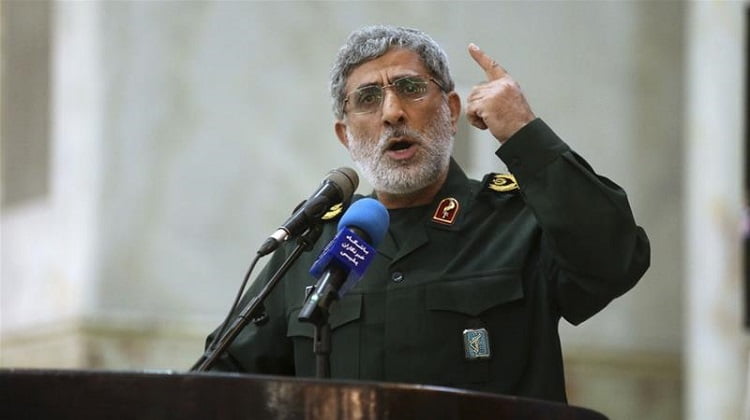
Iran’s new Quds leader vows ‘manly’ revenge for Soleimani killing

In the past weeks, much attention has gone toward the possibility of tensions with Iran spilling over into cyberspace. But the reality is that cyber warfare with Iran is already more than a decade old. The question is not, “Could it happen?” but instead, “What will the next chapter bring?”
The origin of a cyberwar with Iran can be traced back to the 2009 Stuxnet attack on Iran’s Natanz uranium enrichment plant which disrupted its development of nuclear weapons. The attack has largely been attributed to Israel and the United States. Since that time, Iran, which presently does not have the sophisticated cyberwarfare capabilities of the United States, Russia and China, has nonetheless vastly expanded its cyberwarfare program.
In 2012 and 2013, Iranian hackers attacked large American banks such as Bank of America, JP Morgan Chase, Wells Fargo and Citigroup through a denial-of-service attack that temporarily took their computers offline. A denial-of-service attack renders a website inoperable by flooding it with excessive traffic. Seven Iranians were indicted by a New York grand jury for these attacks.
Also in 2013, Iranians hacked into the control system of a New York dam. In 2014, Iranian hackers attacked the computers of the Las Vegas Sands Corp. whose CEO, Sheldon Adelson is a vocal supporter of Israel who has advocated for a hard line against Iran.
In 2018 nine Iranians were indicted on charges related to the hacking of hundreds of universities and companies in an effort to steal data. And in 2019 Iranian hackers attacked 30,000 computers at Saudi Aramco, the world’s largest oil company, destroying data and temporarily halting half of Saudi Arabia’s oil production. According to the Defense Department’s Cyber Command, Iran has surreptitiously been probing a wide swath of American infrastructure such as the electric grid as well as government and corporate computer networks.
Iran Briefing | News Press Focus on Human Rights Violation by IRGC, Iran Human Rights

IDC’s International Institute for Counter-Terrorism (ICT) has identified a bitcoin front for Hamas which has links to Iran in a report exclusively obtained by The Jerusalem Post.
According to the IDC-ICT Cyber desk report, the al-Nasr Brigades – Lawa al-Tawahid – serve as the military arm of the Popular Resistance Committees, was formed in 2001 by Jamal Abu Samhadna Abu Atayya and operates under the auspices of Hamas.
The report also says that the brigades have been funded by Iran in the past, but appear to be low on Iranian funds in the present, leading to the new bitcoin fund-raising initiative.
In addition, the organization is known for its kidnapping operation of Gilad Schalit.
In the ICT report, the Hamas and Iran-linked group’s network of online media platforms is deciphered as well as how they all interact to raise funds for the group.
A website called “cash4ps” enables Hamas to send and receive money out of Gaza for operational terror purposes while simultaneously providing a measure of anonymity to either donors or beneficiaries of the funds, said the report.
While monitoring Bitcoin address 1LaNXgq2ctDEa4fTha6PTo8sucqzieQctq, ICT’s cyber desk noted “an irregular increase in the scope of activity,” and a “deeper review showed that the same address served a seemingly legitimate financial website by the name of cash4ps.”
It added that the company connected to the bitcoin address in question “has been identified as operating an account in a banned bank.”
A check with BitcoinWho’sWho.com did not reveal any fraud alert associated with the wallet, yet the report said that the Bitcoin Abuse Database website flagged the wallet as a fund-raising wallet for Hamas, the report stated.
Iran Briefing | News Press Focus on Human Rights Violation by IRGC, Iran Human Rights

Tehran has the initiative to attack from the direction of its choosing—or several directions simultaneously—while confronting defenders with the Sisyphean task of providing 360-degree protection.
Major conflict looms in the Middle East, and Iran is already on track to win. Its September surprise attack on the Saudi oil facility at Abqaiq and the glaring lack of response is a microcosm of how Tehran is busy gaining the strategic upper hand over the United States and its allies.
Using swarms of new long-range precision munitions, Iran and its proxies can now credibly threaten to conduct disabling, and potentially catastrophic strikes against vital strategic targets across the region. This is a function of three factors: Iran’s upgraded weapons, regional expansion to encircle its enemies, and the lack of strategic depth possessed by these enemies.
Amazingly, Iran is building this leverage despite sanctions, antiquated conventional military forces, a small defense budget and no nuclear weapons. Instead, it is creating clear offensive advantages by increasing the precision and range of its ballistic and cruise missiles and drones.
Though they receive less attention than nuclear delivery vehicles, advancements in the range, lethality and accuracy of Iran’s conventional short-range ballistic missiles (SRBM) are at least as worrisome. It is also producing anti-ship ballistic missiles with enhanced terminal guidance and maneuverability.
Cruise missiles are also overlooked even though they are arguably more important. Iran has increasingly precise land-attack cruise missiles like those that were used to damage Abqaiq and some can range the entire Middle East. And it is producing longer-range anti-ship cruise missiles (ASCM) launchable from mobile land batteries or swarms of missile boats, which a recent Pentagon report called the “capital ships” of Iran’s Persian Gulf fleet. Iran is also developing submarine-launched ASCMs.
Drones—specifically unmanned aerial and naval surface vehicles—form the third leg of Tehran’s triad. Often called “the poor man’s precision munition,” Iran and its proxies use these in kamikaze-style attacks, with the vehicle often doubling as the warhead. Recently, Iran has improved these weapons’ accuracy, partly by reverse-engineering captured Western models.
Iran Briefing | News Press Focus on Human Rights Violation by IRGC, Iran Human Rights

It was in the late 1980s when Ismail Qaani — then a local commander in Iran’s Islamic Revolutionary Guards Corps (IRGC) — first became active in Afghanistan.
It was to be the start of Qaani’s decades-long involvement in Iran’s eastern neighbor, where Tehran has carved up influence by arming and offering political and economic backing mostly to the Shi’ite and Persian-speaking communities.
Qaani on January 3 became the chief of Iran’s elite Quds Force, the overseas operations arm of the IRGC, established following the 1979 Islamic Revolution to defend the country’s theocratic system.
The 63-year-old general succeeded Major General Qasem Soleimani, who was killed in a U.S. drone strike in the Iraqi capital, Baghdad, early on January 3. He had long served as Soleimani’s deputy.
Mysterious Visit
Soon after Qaani’s appointment, photos of the media-shy general appeared in the Afghan media from a mysterious trip he took to Afghanistan in 2018.
Qaani was in several photos alongside Mohammad Tahir Zuhair, the governor of Bamiyan Province, a predominately Hazara area in central Afghanistan.
Zuhair told RFE/RL’s Radio Free Afghanistan on January 9 that Qaani introduced himself as Iran’s deputy ambassador to the country and said his name was “Ismaili.” He says he didn’t know that Qaani was the deputy chief of the Quds Force.
“We were informed by Kabul that an Iranian delegation was coming to Bamiyan to visit a hospital that was being built with Iranian funds,” said Zubair. “They went straight from the airport to the hospital. They were at the hospital for around 45 minutes. Then they came to my office. I held talks with them for around 10 minutes. They assured us that the construction of the hospital would be completed.”
Afghanistan’s acting foreign minister, Idrees Zaman, said on January 7 that Kabul was investigating the “exact nature” of Qaani’s visit.

Person who filmed Ukrainian passenger plane being shot down by missile arrested, Iran says
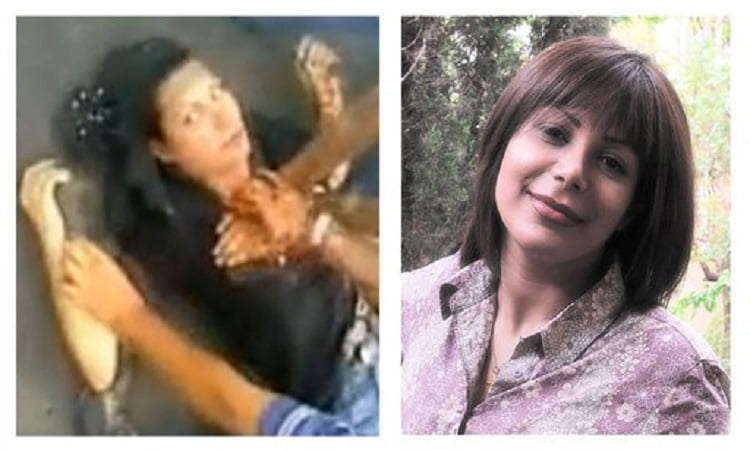
When politicians and pundits speak of “Iran” and “the Iranians,” they often mean just the Islamist thugs who rule that nation by institutionalized terror.Neda
But Iran and the Iranians also include the protesters who brave batons and bullets in the streets of Tehran, proving themselves as desirous of freedom as any Americans in America.
The most recent protests began on Sunday at a vigil for the 176 innocents who perished when a Ukraine International Airlines passenger jet was downed by an Iranian missile. The regime had initially denied any responsibility for the tragedy, but finally admitted the truth.
The people at the vigil—as much or more representative of Iran as any mullah—are so decent as to be outraged that such a lie had been told by their government. The regime responded, as often before, by battering and tear-gassing and, by several accounts, firing live ammunition at the demonstrators.
One noticeable difference from the demonstrations of a decade past was that women were reported to be at the forefront, some of them holding up flowers in the face of assault rifles. A video that made it through the regime’s social media filters shows a wounded woman being assisted by fellow protesters.
“They shot her with a bullet,” someone can be heard saying in Farsi.
Other images that made it online are of blood-stained concrete said to be in the vicinity of Azadi Square.
“The blood of our people!” someone was recorded exclaiming.
The saving of that blood at the edge of a square whose name means “freedom” brought to mind a decade-old video taken a short distance away showing the final moments of 26-year-old Neda Agha-Soltan. She was an aspiring musician and photographer standing at the fringe of the demonstration with her piano teacher on June 20, 2009, when a militia sniper on a nearby roof shot her in the chest. An onlooker’s cellphone footage recorded her final words.
Iran Briefing | News Press Focus on Human Rights Violation by IRGC, Iran Human Rights
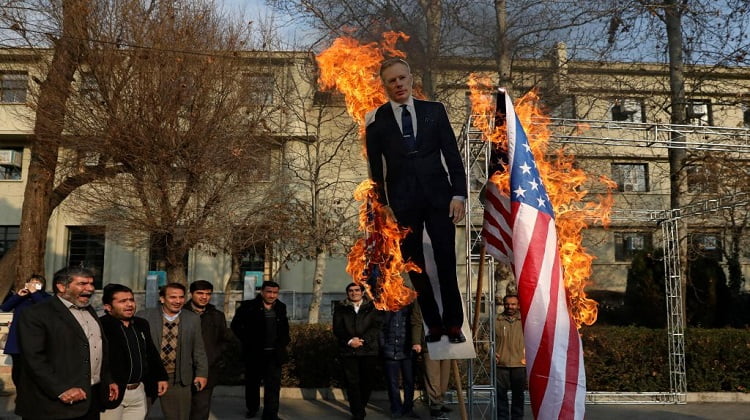
Iran warns Europe on nuclear deal: ‘Tomorrow the European soldier could be in danger’
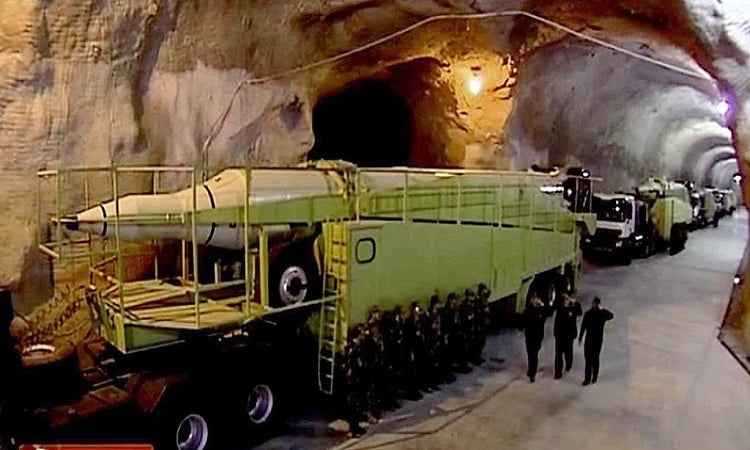
The Iranian Tansim news agency released images of the Islamic Republic’s underground “missile cities,” which hold hundreds of missiles and solid-fuel rockets ready-to-fire under five levels of concrete, Radio Farda reported on Tuesday.
Iran Briefing | News Press Focus on Human Rights Violation by IRGC, Iran Human Rights

Not long ago, Iranian terror mastermind Qassem Soleimani was traveling around the Middle East with a sense of invincibility. And for good reason.
The years preceding his death gave Soleimani nearly full impunity to kill Americans. Over-confidence in U.S. inaction cost Iran its top general.
In a career full of death and destruction, Soleimani never will know that his last, fatal mistake was taking a single American life — that of Nawres Hamid, an American patriot who paid the ultimate sacrifice for our nation on Dec. 27. Hamid, an American-Muslim of Iraqi descent, was based at K1 air base near Kirkuk, Iraq. Kata’ib Hezbollah, the Iranian militia whose leader was killed alongside Soleimani, launched a rocket attack on Hamid’s base. At 33, Hamid left behind his wife and sons, ages 2 and 8, in California.
Until the U.S. drone strike on Soleimani, Iran believed America was a paper tiger. Despite complaints and warnings from the U.S. and our allies for years, Iran’s military and proxy forces acted with increasing hostility and lethality. Under Soleimani’s direction and influence, the Islamic Revolutionary Guard Corps (IRGC) and its proxies slaughtered thousands of civilians from Iraq to Afghanistan, Lebanon, Israel, Yemen and even inside Iran. All faiths and ethnicities were subject to the IRGC’s brutality, though Muslims were a frequent target.
At home, Iran recently killed approximately 1,500 civilians who took to the streets dreaming of a better future. Soleimani’s IRGC played a role in the crackdown. In Bandar Mahshahr, a city in Iran’s southwest, witness accounts describe the IRGC surrounding and killing 40 to 100 unarmed demonstrators in just one episode. These protestors received no three-day mourning period, as Soleimani did, no procession, no glorification. Nothing like the parade and theatrics following Soleimani’s death.
Iran Briefing | News Press Focus on Human Rights Violation by IRGC, Iran Human Rights