
Iran’s U.N. Ambassador: Strike On U.S. Bases Was ‘Measured, Proportionate
Iran’s U.N. Ambassador: Strike On U.S. Bases Was ‘Measured, Proportionate
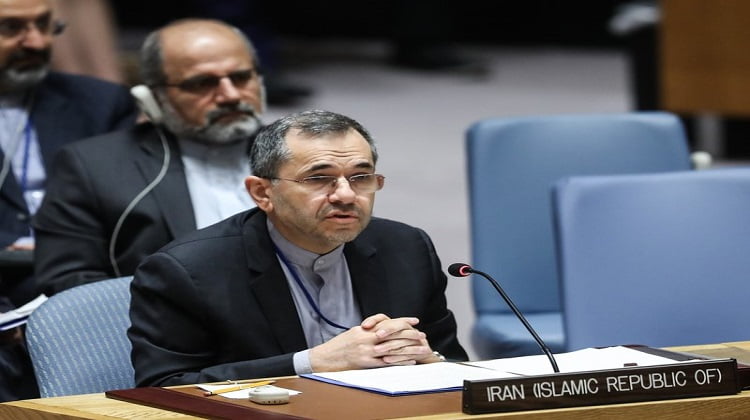
Iran’s U.N. Ambassador: Strike On U.S. Bases Was ‘Measured, Proportionate
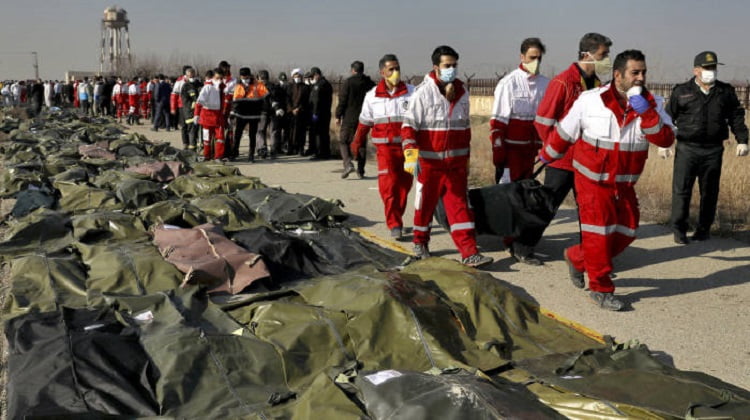
Iran says it will not give black box of Ukrainian plane to Boeing
Iran’s civil aviation organization has said that it will not hand over to Boeing the black box of the Ukrainian airlines flight that crashed shortly after taking off from Tehran’s Imam Khomeni Airport on Wednesday morning.
Both black boxes were found Wednesday, Iranian state television has reported. An Iranian official was quoted as saying both boxes were damaged but that it was believed their data could still be retrieved.
On Wednesday morning, engine failure was named as the cause of the crash. However, the Ukrainian embassy to Iran later issued a new statement on the crash which omitted engine failure as a cause, and saying that any previous statements on the cause of the crash had not been official.
—
Source: JPost
Iran Briefing | News Press Focus on Human Rights Violation by IRGC, Iran Human Rights
Iran’s civil aviation organization has said that it will not hand over to Boeing the black box of the Ukrainian airlines flight that crashed shortly after taking off from Tehran’s Imam Khomeni Airport on Wednesday morning.
Both black boxes were found Wednesday, Iranian state television has reported. An Iranian official was quoted as saying both boxes were damaged but that it was believed their data could still be retrieved.
On Wednesday morning, engine failure was named as the cause of the crash. However, the Ukrainian embassy to Iran later issued a new statement on the crash which omitted engine failure as a cause, and saying that any previous statements on the cause of the crash had not been official.
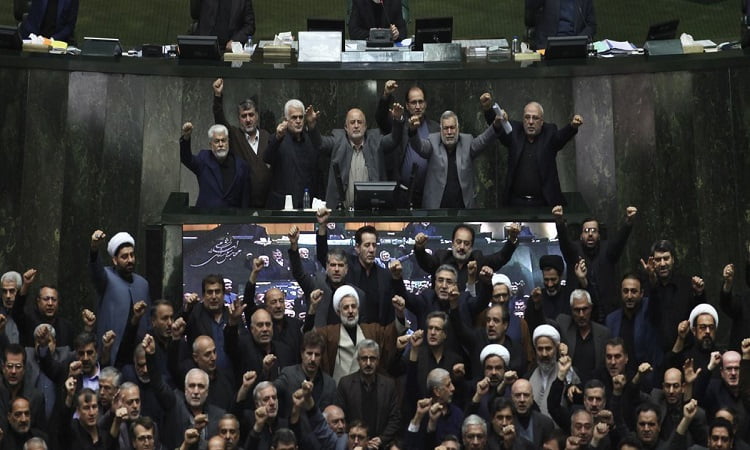
The Iranian parliament approved a bill on Tuesday that designates United States military forces as terrorists, days after American airstrikes killed top Iranian military leader General Qassem Soleimani in Iraq. The bill is similar to the action the U.S. took last year when the Trump administration designated Iran’s Islamic Revolutionary Guard Corps (IRGC) as a foreign terrorist organization.
Members of parliament passed the bill declaring the U.S. military and the Pentagon terrorist entities, according to Iranian state media. Under the bill, the Iranian government will also provide $220 million to the IRGC to “reinforce its defense power in vengeance for General Soleimani’s assassination,” the news agency reported, as tensions between the U.S. and Iran rise.
A senior U.S. official told CBS News national security correspondent David Martin that Iran’s Supreme Leader Ayatollah Ali Khamenei has ordered a direct attack on American interests in retaliation for the airstrike that killed Soleimani, his top military commander and friend. The official said the U.S. military was “extremely concerned” that the retaliation could come quickly.
When asked by CBS News correspondent Elizabeth Palmer on Tuesday when the Iranian response would come, Iran’s Foreign Minister Mohammad Javad Zarif would only say that his country would retaliate at the time of its choosing. While a senior Iranian commander threatened at Soleimani’s funeral to “set ablaze” America’s supporters in the region, Zarif told CBS News the response would be “proportionate” and “against legitimate targets.”
Secretary of State Mike Pompeo continued leading the Trump administration’s defense of the targeted missile strike that killed Soleimani. He insisted that President Trump was right to order the killing and dismissed Iran’s claim that Soleimani was in Iraq for diplomatic purposes.
In April, the U.S. declared the Revolutionary Guard Corps as a foreign terrorist organization, which makes it illegal for anyone to provide material support to the group. The U.S. Defense Department used the Guard’s designation to support the strike last week that killed Soleimani, the head of Iran’s elite Quds military force and one of the most powerful figures in the Islamic Republic.
Iran Briefing | News Press Focus on Human Rights Violation by IRGC, Iran Human Rights

President Donald Trump’s confrontation with Iran is posing a gut check for Congress, brazenly testing whether the House and Senate will exert their own authority over U.S. military strategy or cede more war powers to the White House.
As tensions rise at home and abroad, Speaker Nancy Pelosi will hold House votes this week to limit Trump’s ability to engage Iran militarily after the surprise U.S. airstrike that killed Gen. Qassem Soleimani. A Senate vote is expected to soon follow.
Yet Congress has shown time and again it is unable to exert its ability to authorize — or halt — the use of military force. With their inaction, lawmakers have begrudgingly allowed the commander in chief to all but disregard Congress.
“I think this president has pushed this to the limit with action that has a huge, escalating effect,” said Scott Anderson, a former attorney in the State Department’s legal office and former legal adviser for the U.S. Embassy in Baghdad. “Maybe this will push Congress to make it a priority. … Anything short of legislative action doesn’t mean anything.”
The showdown between the White House and Capitol Hill provides the latest example of how Trump’s willingness to break the norms in Washington is setting new standards in governance.
Ahead of the attack that killed the Iranian general, the president did not consult with congressional leaders. In the aftermath, he refused to make public his justification for the airstrikes.
Facing an outcry, Trump scoffed that his tweets should provide adequate updates to Congress, regardless of what is required by law.
Republicans have largely supported Trump’s actions, saying the president was well within his power to take out Iran’s architect of proxy operations against Americans in the Middle East. The U.S. considered Soleimani a terrorist.
Senate Majority Leader Mitch McConnell said Monday there’s plenty of time for lawmakers to learn more about the president’s reasoning for the attack. He complained that Democrats “rushed to blame our own government before even knowing the facts, … rushed to downplay Soleimani’s evil while presenting our own president as the villain.″
Iran Briefing | News Press Focus on Human Rights Violation by IRGC, Iran Human Rights

Citing a report from Iran’s Fars News Agency, Reuters reported that Ali Shamkhani, the secretary of Iran’s Supreme National Security Council, said that “even if there is consensus on the weakest scenario, carrying it out can be a historic nightmare for the American.”Meanwhile, Iran’s Parliament on Tuesday unanimously voted to classify the entire US military and the Department of Defense as terrorist organizations.Both Iran and Trump have a history of making intense threats without following through, and it’s unclear what comes next.
Iran Briefing | News Press Focus on Human Rights Violation by IRGC, Iran Human Rights

The tension between Iran and the United States is increasing after the murder of Qassam Solomoni, the commander of the Jerusalem Revolutionary Guards in Iran, while the countries of the world do not remain silent and express their reactions.
Iran plans to get revenge on the US, while US president Donald Trump continues to make statements. Iranian religious leader Ayatollah Khamenei’s representative Sayyid Hasan Amuli’de CNN on the latest developments in the Turkish television evaluations. Amuli said in a statement that we will respond very violently to the United States and added:
“Kasim Solomon stood in the face of terror and fought against ISIS.
We’il pull molars of the US
If we don’t give the US the necessary answer, the US will be more audacious. Their next target may be our higher commanders. So we have to punish the United States. We will respond very strongly to the USA, we will pull molars of the USA.
We will fight open and take revenge
The United States killed our commander in a cowardly manner, and hit him with a hit. We don’t do that, we fight open. We will take a clear revenge and this will be an open act for the media. “The United States killed our commander in a cowardly manner, and hit him with a hit. We don’t do that, we fight open. We will take a clear revenge and this will be an open act for the media. “
The United States killed our commander in a cowardly manner, and hit him with a hit. We don’t do that, we fight open. We will take a clear revenge and this will be an open act for the media. “
Iran Briefing | News Press Focus on Human Rights Violation by IRGC, Iran Human Rights

How Bernie Sanders and Ro Khanna want to block Trump from attacking Iran

The U.S. Department of Homeland Security (DHS) has issued a National Terrorism Advisory bulletin warning of a potential cyberattack by Iran in the wake of a U.S. drone attack that killed a senior Iranian military commander.
“Iran maintains a robust cyberprogram and can execute cyberattacks against the United States,” reads the bulletin, dated January 4.
The United States is bracing for possible retaliatory measures from Tehran following the January 3 attack on an Iran-backed militia convoy in Iraq that killed Qasem Soleimani, who was commander of Iran’s Quds Force, the foreign arm of the Islamic Revolutionary Guards Corps (IRGC).
The Quds Force has been designated a foreign terrorist organization by the United States.
The DHS bulletin noted that U.S. forces had “carried out a lethal strike in Iraq killing Iranian IRGC-Quds Force commander Qasem Soleimani while Soleimani was in Iraq.”
“Iranian leadership and several affiliated violent extremist organizations publicly stated they intend to retaliate against the United States,” it added, saying that it had no information indicating a “specific, credible threat.”
But it said that “previous homeland-based plots have included, among other things, scouting and planning against infrastructure targets and cyberenabled attacks against a range of U.S.- based targets.”
It added that Tehran maintains a “robust cyberprogram and can execute cyberattacks against the United States.”
“Iran is capable, at a minimum, of carrying out attacks with temporary disruptive effects against critical infrastructure in the United States.
“Iran likely views terrorist activities as an option to deter or retaliate against its perceived adversaries,” the bulletin said.
Hours later, a group claiming to be hackers from Iran breached the website of a U.S. government agency and posted messages vowing revenge for the killing of Soleimani.
The website of the Federal Depository Library Program was replaced with a page headlined with “Iranian Hackers!” displaying images of Iran’s supreme leader, Ayatollah Ali Khamenei, along with the Iranian flag.
The U.S. government did not immediately comment on the apparent hack.
Separately, a leading cybersecurity expert said his firm is warning businesses and government agencies to intensify protection measures following the threats by Iran to seek revenge for the U.S. attack.
Iran Briefing | News Press Focus on Human Rights Violation by IRGC, Iran Human Rights

Donald Trump threatens 52 targets if Iran takes revenge
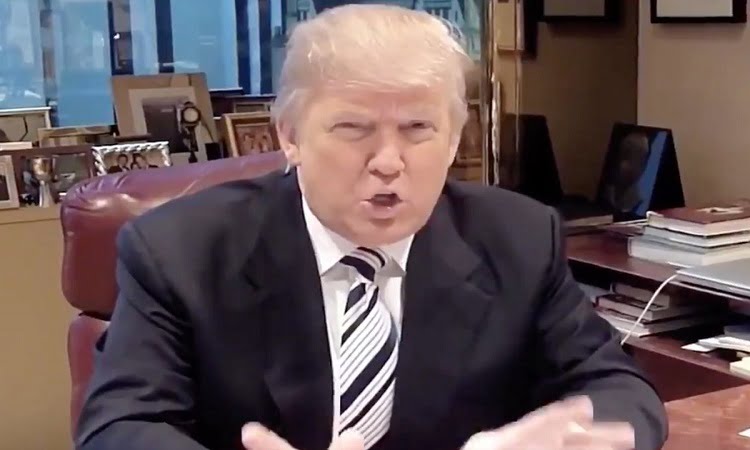
Supreme Leader Ayatollah Ali Khamenei has vowed “harsh retaliation” after the Trump-ordered assassination of military commander Qasem Soleimani Iran
Early Friday morning in Iraq, the United States assassinated high-ranking Iranian military and intelligence official Qasem Soleimani. He was killed in a drone strike at Baghdad International Airport, along with several officials from Iran-backed militias operating in Iraq. The attack represents the most aggressive action yet in an increasingly tense standoff between the U.S. and Iran, and one that many believe could lead to war between the two nations.
The Pentagon confirmed the news of Soleimani’s assassination late Thursday night in the U.S., noting that the action was carried out “at the direction” of President Trump, while misidentifying the organization Soleimani led. The Pentagon did not detail the intelligence that led to Soleimani’s death, and justifications from the administration have been inconsistent.
It’s hard to overstate the magnitude of Soleimani’s assassination. The commander of Iran’s elite Quds Force, he was the longtime architect of the nation’s military and intelligence operations. As such, he was one of Iran’s most powerful men, and a close confidant of Supreme Leader Ayatollah Ali Khamenei, who has made his disdain for Trump’s strong-arm tactics clear. Soleimani was a terrorist, murderer, and one of the world’s most dangerous men, aiding Syrian President Bashar al-Assad in the Syrian civil war and causing the deaths of hundreds of Americans during the Iraq War, according to U.S. officials. But his assassination is tantamount to an act of war against Iran, and it’s unclear — if not unlikely — that the Trump administration, which acted without the input of Congress, has any real plan to deal with the fallout.
Though the Pentagon claimed in its statement that Soleimani was assassinated “to protect U.S. personnel abroad,” the move will almost certainly have the opposite effect. Iran has already said it will respond aggressively — with Supreme Leader Khamenei promising a “harsh retaliation” — and the U.S. State Department has urged citizens in Iraq to leave “immediately.”
Iran Briefing | News Press Focus on Human Rights Violation by IRGC, Iran Human Rights